

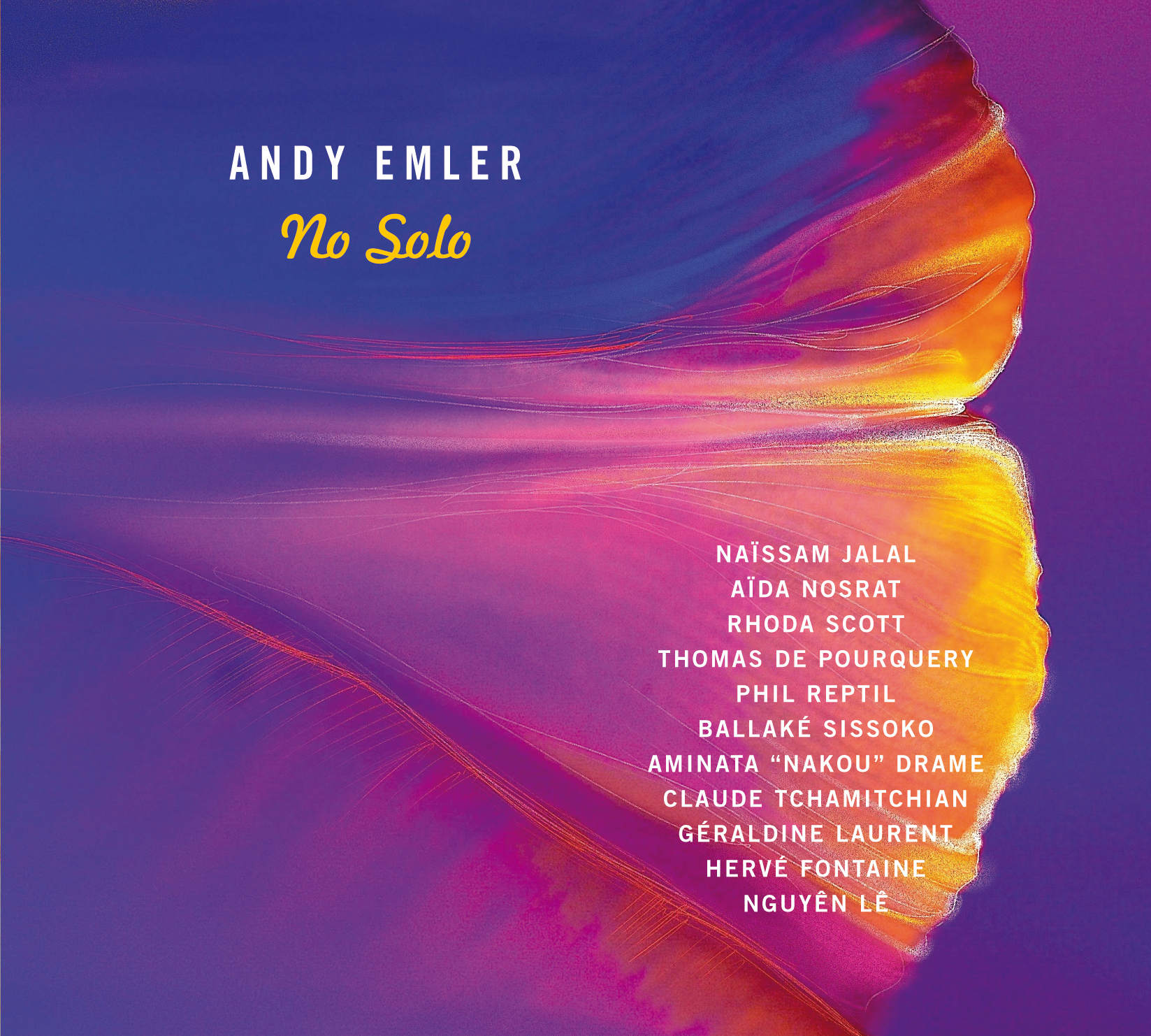
Naïssam Jalal flute, voice
Aïda Nosrat voice
Rhoda Scott voice
Thomas de Pourquery voice
Phil Reptil sound design
Ballaké Sissoko kora
Aminata “Nakou” Drame voice
Claude Tchamitchian double bass
Géraldine Laurent alto saxophone
Hervé Fontaine beat box
Ngûyen Lê electric guitar
Andy Emler piano
Recorded live and mixed at Studio La Buissonne on February 7/8, 2019, by Gérard de Haro
Steinway D piano preparation and tuning by Alain Massonneau
All guests were recorded at Studios Sextan – La Fonderie Malakoff by Vincent Mahey and Arthur Gouret
except Nguyên Lê, Thomas de Pourquery, and Phil Reptil, who overdubbed from home
Mixed by Gérard de Haro and Andy Emler
Mastered by Nicolas Baillard at La Buissonne Mastering Studio
Produced by Gérard de Haro and RJAL for La Buissonne Label and Andy Emler
Release date: August 28, 2020
After a sequence of musical journeys ranging from the boldly orchestral to the hushed and introspective, Andy Emler arrives at a revealing new vantage point with No Solo. The title gestures toward a meditation on relation in which individuality becomes clearer precisely by being placed in conversation with others. Surrounded by collaborators who span generations, geographies, and aesthetic traditions, Emler constructs an expansive portrait of an artist continually navigating the blur between solitude and collectivity. From the very first notes, the music suggests that borders are never fixed lines but shifting membranes through which feeling, history, and sound continually pass.
Such tensions are announced with gentle irony in the opening moments. “Jingle tails” and “The warm up” begin as solo piano excursions, yet their isolation never feels enclosed. The playing seems already attuned to voices yet to arrive in anticipation of dialogue. The pieces balance a soft, melancholic edge with a dense sense of nostalgia, revealing Emler’s gift for emotional acuity and storytelling without artifice. As they unfold, the textures grow more panoramic and suggestive, evoking the quiet brilliance of winter light alongside the promise hidden within its stillness. Instead of lingering in recollection, the pianist moves through memory with the velocity of rewound time, allowing fragments to flicker past while granting each moment enough space to resonate. From this inward world, the music gradually opens outward, preparing the listener for a widening field of encounter.
That expansion becomes tangible in “For nobody,” where Naïssam Jalal appears first as breath rather than melody. Her flute and voice hover in sibilant, almost vaporous gestures before coalescing into drifting lines that feel both fragile and insistent. What begins as liminality slowly gathers gravity, and her presence reads less as accompaniment than as an elemental force shaping the atmosphere itself. Her timbres stand vividly in the foreground, sculpting a climate of unresolved yearning, a feeling that carries directly into “Gold timer,” where vocalists Aïda Nosrat and Rhoda Scott usher the listener into more populous territory. Spoken reflections on togetherness surface amid the harmonies, imagining a world beyond division while quietly questioning whether such separation was ever absolute. Here, Emler’s writing probes the idea that music might precede political or cultural borders, operating as a language that connects before it categorizes.
That inquiry deepens further in “Light please,” which inhabits a distinctly mystical register. Phil Reptil’s ethereal sound design and Thomas de Pourquery’s falsetto suspend time in a luminous haze, allowing the music to drift through slow currents of call and response. Voices feel scattered across invisible distances, suggesting that connection is less an achievement than a condition already written into the air. This sense of movement finds a different, more earthly expression in “12 Oysters in the lake,” an enchanting meeting of Ballaké Sissoko’s kora and Aminata “Nakou” Drame’s voice. The narrative takes shape organically, intertwining images of shared labor, mutual care, and the rhythms of the land. The kora glimmers with radiant delicacy while Drame sings with an urgency that feels both grounded and transcendent, as if addressing not only listeners but the very environment that sustains them in an act of sonic reciprocity.
“Près de son nom” shifts the perspective toward darker, more resonant depths. Claude Tchamitchian’s arco bass sketches a sequence of sonorous shapes that accumulate weight and gravity, as though the ground beneath the music were slowly giving way to ocean. The sound swells, thickens, and finally seems absorbed by an imagined vastness, suggesting how personal expression can dissolve into something larger without losing its essence. From this submerged state emerges “The rise of the sad groove,” a piece that feels as if dawn were breaking after a long night. Géraldine Laurent’s alto saxophone breathes with quiet optimism, offering tender phrases that transmit feeling without explanation. Just as the mood appears ready to drift, beat boxer Hervé Fontaine introduces a grounded rhythmic pulse, his deep bass anchoring the flight and demonstrating that momentum and vulnerability can coexist.
In closing, “You’re so special” arrives as a generous ballad illuminated by Ngûyen Lê’s singing electric guitar. Its lyricism soars yet remains warm, drawing together the strands of connection that have threaded through the entire work. Taken as a whole, No Solo reveals how distinctions can coexist within a shared space, allowing identities to overlap without dissolving into sameness. The music does not simply end but recedes toward a quiet horizon, where breaths, strings, and distant echoes continue to shimmer just beyond hearing, as if the lines between here and elsewhere were slowly loosening in a gentle, unbounded glow.
 Between Sound and Space: ECM Records and Beyond