And there was there an herd of many swine feeding on the mountain: and they besought him that he would suffer them to enter into them. And he suffered them.
Then went the devils out of the man, and entered into the swine: and the herd ran violently down a steep place into the lake, and were choked.
When they that fed them saw what was done, they fled, and went and told it in the city and in the country.
Then they went out to see what was done; and came to Jesus, and found the man, out of whom the devils were departed, sitting at the feet of Jesus, clothed, and in his right mind: and they were afraid.
They also which saw it told them by what means he that was possessed of the devils was healed.
Luke 8:32–36
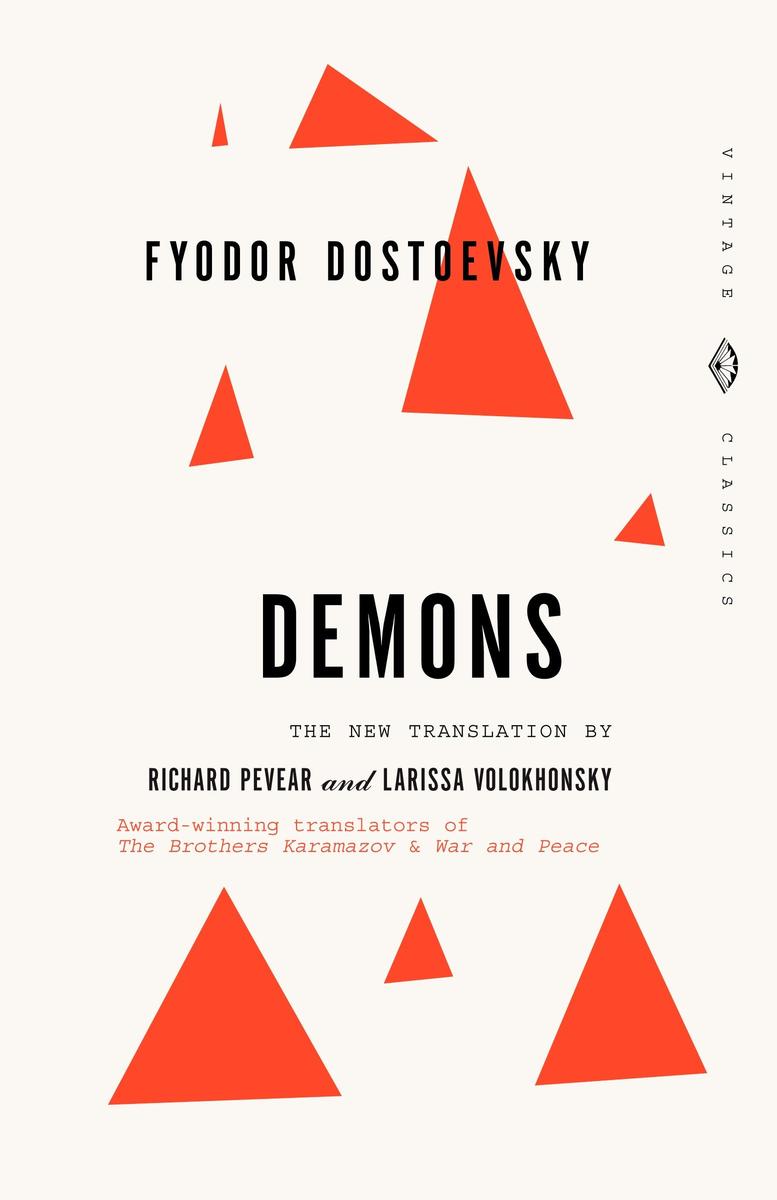
In Demons, Fyodor Dostoevsky draws us into an unnamed Russian provincial town where the wounded pride of an older generation meets the revolutionary impatience of its children. What begins amid the familiar absurdities of social life gradually exposes a more troubling intimacy between belief adend the desire to possess another person. We come close enough to these people to laugh at their vanities before hearing, beneath promises of liberation, the demand that someone else surrender the right to exist on his own terms. That demand gives the novel’s title its spiritual weight and draws us toward the above passage from Luke that Dostoevsky places before the narrative. Beside the lake into which the herd has rushed, a man sits at the Savior’s feet, released from the voices that had occupied him. His quiet presence offers a first glimpse of freedom whose meaning the novel’s contending voices will struggle to comprehend.
Luke places the encounter under Christ’s authority before the herd even begins its descent. The devils ask permission, and Jesus suffers them, allowing what they cannot authorize for themselves. Their multitude has occupied a man without becoming his rightful owner. Although the preceding verses name that multitude “Legion,” Christ addresses a life whose identity survives its captivity, and the healing restores the person whom the voices have crowded out. The distinction pulses throughout Demons, where the appearance of limitless power repeatedly conceals dependence upon something borrowed. It also governs the violence of the epigraph. The swine are choked, but Luke does not say that the devils have been annihilated in the lake, nor does their departure commission human beings to purify a community through catastrophe. Our attention belongs finally to the man who has been healed. To make the precipice the passage’s center would already concede too much to those who confuse deliverance with the grandeur of destruction.
Clothing gives this restoration a bodily tenderness, while “in his right mind” describes a freedom intellectual brilliance alone cannot furnish. The man can remain in the presence of another without being consumed by it. So opens a horizon beyond the novel’s occupied selves, whose thoughts so often demand the surrender of whatever they claim to liberate. Yet the analogy requires discrimination. Luke supplies no history of wrongdoing that would justify blaming the afflicted man, whereas Dostoevsky’s characters make storied choices for which they must answer. Neither illness nor disability proves evil’s presence, and biblical devils possess a reality that ideology cannot exhaust. The novel brings spiritual captivity into view through human relations, asking what happens when a conviction receives the allegiance owed to God. Even the witnesses are implicated. Their fear before the healed man suggests how readily a community may prefer a familiar misery to a restoration that unsettles its understanding of itself.
Such understanding remains precarious in the hands of Dostoevsky’s chronicler, Anton, a local observer whose affection for his acquaintances survives his exposure of their absurdities. News travels through the province more quickly than anyone can comprehend it, gathering motives as it passes from mouth to mouth. An intimate disclosure seemingly becomes public property before its speaker has finished speaking. Anton notices these appropriations with a sharpness that never quite excuses him from them, especially when another person’s distress inconveniences his own desires. His eagerness to meet Lizaveta Nikolaevna, the wealthy young woman more affectionately known as Liza, quietly enters his account of other people’s concerns. Liza’s proposed compilation of Russian life makes this difficulty explicit when Ivan Shatov, a former student searching for a faith he can call his own, observes that the selection of facts will indicate their meaning. Demons proceeds under the same difficulty, arranging lives whose unfinished claims keep exceeding the arrangement. We must listen through a teller whose limitations belong to the world he describes, without imagining that our awareness of them places us beyond it. A convincing account may leave its subject unheard, just as an unreliable speaker may suddenly recognize something his listener has refused to see. Reading becomes an exercise in the attention the town so often withholds from its inhabitants, and our impatience to arrive at a verdict begins to resemble theirs.
Nikolai Stavrogin, the enigmatic son of a wealthy local widow, becomes the disturbing center of a book initially conceived as a political polemic. The introduction traces its emergence from Dostoevsky’s engagement with the revolutionary organizer Sergei Nechaev, yet the novelist’s admission that he might once have become a Nechaevist gives the inquiry an inward exposure, which helps explain why the finished work rubs up against so much beyond its originating argument. As Mikhail Bakhtin’s account of embodied ideas suggests, a conviction changes when someone must speak it to a person whose recognition he needs. Translators Richard Pevear and Larissa Volokhonsky thus preserve the resulting interference between thought and its speaker. A qualification betrays the appetite it was meant to conceal, while a French phrase protects cultivated feeling from the indignity of sounding ordinary.
Stepan Trofimovich Verkhovensky, a liberal intellectual and Stavrogin’s former tutor, has cultivated that demand into a way of life. His scholarship matters chiefly as an occupation he has magnificently postponed, while the possibility that nobody has been persecuting him threatens an essential distinction. His belief in God follows a related arrangement. “I believe as in a being who is conscious of himself in me,” he declares, giving the divine somewhere suitably cultivated to become interesting. Such inwardness reaches painfully outward when he wakes the young Stavrogin to pour out his grievances, burdening his pupil with a care he owes the child. Meanwhile his actual son, Pyotr, grows up elsewhere. One boy receives his helplessness and another his absence, leaving both to reckon with what the father has mistaken for sensibility. Dostoevsky allows this inheritance its weight without making it a destiny. Pyotr will answer for his own conduct, even as his father remains answerable for a neglect that eloquence has made easier to endure. Their connection unsettles the comfortable division between a cultivated generation and the barbarism of its successors. The younger man discovers what can be done with the evasions the elder has taught himself to admire.
Varvara Petrovna, Stavrogin’s mother and Stepan’s patron, finances this helplessness with a devotion whose generosity grows inseparable from its demands. “She invented him, and she was the first to believe in her invention,” narrator Anton observes, locating within affection an ambition to create its object. Stepan’s independent life consequently offends Varvara whenever it departs from the person she has cherished into existence. Yet her concern for his humiliation prevents an easy verdict, and Dostoevsky makes us feel the tenderness through which domination finds its most persuasive language. The difficulty expands around her young ward Darya Pavlovna, a.k.a. Dasha, when she proposes the young woman’s marriage to the fifty-three-year-old Stepan. “So, you consent! Wait, don’t speak,” Varvara announces, allowing consent precisely the silence her design requires. Stepan contributes his fear of marrying “someone else’s sins,” and Dasha disappears beneath the uses others have prepared for her. A room furnished with such exquisite intentions has somehow acquired its lock on the outside.
Stepan’s defense of beauty carries more conviction than this conduct might suggest, which makes its inadequacy harder to dismiss. His insistence that Pushkin stands above boots preserves something a crude worship of utility would destroy. Still, aesthetic discrimination cannot settle the accusation concerning Fedka, his former serf and now an escaped convict, whose life has entered the accounting of a gambling debt. The discussion brings an actual person into a sensibility accustomed to admiring humanity from a comfortable distance. When Stepan invokes the shaking of dust from his feet and adds a curse, sacred language becomes a stage direction for wounded importance. The Gospel gesture concerns the rejection of Christ’s messengers, a commission his injured vanity has quietly awarded itself. The comedy begins to hurt because the distinction he defends deserves a fidelity his own life has withheld from it.
The established authorities offer little protection against this discrepancy between profession and conduct. Von Lembke, the provincial governor, treats official restraint and revolutionary agitation as mutually necessary activities, provided decent appearances can be maintained. Karmazinov, a celebrated writer, lends cultural prestige to an expectation of collapse whose consequences he can contemplate from a safe distance. Their apparent opposition conceals a shared confidence that other lives may be managed without bringing their own standing into question. Pyotr Stepanovich Verkhovensky, now a revolutionary organizer, understands this confidence well enough to make himself appear beneath it. His performed ineptitude invites listeners to enjoy their superior understanding, and that pleasure soon becomes his protection. “Those who know how to speak well, speak briefly,” he quips, explaining how verbosity can hide an intention within the audience’s exhaustion. The harmless fool they congratulate themselves on recognizing has already begun delineating the parameters of their regard.
Pyotr’s ingenuity gives dramatic force to the introduction’s observation that demons are unoriginal. Evil must borrow the goodness it cannot originate, making fellowship serve control and the desire for justice furnish excuses for cruelty. Even its promise of emancipation depends upon capacities it intends to enslave. Stepan’s suggestion that truth requires an admixture of falsehood supplies his son with an inheritance more useful than paternal care. The lie may now announce itself as truth’s necessary preparation, postponing indefinitely the moment when its own authority must end. Dostoevsky lets this corruption enter speech so intimately that accuracy itself offers no guarantee of innocence. A fact can be perfectly correct while serving an intention that deforms the person hearing it. Our laughter becomes precarious here. Having enjoyed Pyotr’s absurdity, we may find ourselves defending the impression he has encouraged us to take for knowledge.
Shigalyov, a revolutionary theorist in Pyotr’s circle, bolsters the same ambition. His reorganization of humanity removes the will from nine tenths of its members, whose equality will consist in an administered helplessness. Luke’s herd has entered a political program. The minority charged with securing liberation receives the privilege of deciding how little freedom everyone else can bear, while the grotesque proposals of Lyamshin, a postal clerk in the same circle, reduce troublesome human beings to quantities that may be subtracted. Their reasoning regards the creature’s resistance as a flaw in the design, then discovers in that resistance a justification for further force. Its paradise has a tree whose roots have been cut to prevent disobedience. Against this completed world, the man seated at Jesus’s feet retains the disturbing particularity of someone who has received his life back without becoming an instrument of mundane supremacy.
Stavrogin lends these competing salvations a magnetism that belief alone cannot explain. His elegance unsettles the expectation that depravity will announce itself through a repellent surface, and the province’s fascination enlarges him beyond the measure of a person. Shatov, once his ideological disciple, still inhabits a conviction its former teacher can regard with a disconcerting distance. A disciple may spend years struggling within words their speaker has already abandoned, until the unequal investment becomes a wound argument cannot close. Stavrogin’s self-control intensifies this authority because even restraint seems to place him beyond ordinary dependence. Yet a will can govern its impulses while remaining captive to the privilege it claims over others. His apparent abundance of possibility keeps an accountable life at a distance. To become one person would mean relinquishing the intoxication of forever being otherwise. The soul becomes an observatory whose telescopes point inward, mistaking another conscience’s plea for a newly discovered star. The chapter title “The Wise Serpent” gives this inward sovereignty a scriptural edge. Christ joins “wise as serpents” to “harmless as doves” in Matthew 10:16, keeping discernment answerable to the life it encounters. The province admires a cunning released from that obligation, until intelligence itself appears to confer the right to decide whose suffering matters. Stavrogin’s brilliance can illuminate an argument without ever consenting to live within its light.
Nietzsche gives such solitude an unexpected interruption when Zarathustra, tracing his shadow with a stick, is startled because “beside his own shadow he saw another shadow.” The visitor is the soothsayer of weariness, and his arrival makes thinking alone suddenly questionable: a borrowed conviction may have been holding the stick all along. Dostoevsky follows this disturbance into the obligations influence has concealed, where a supposedly original will discovers itself repeating somebody else’s sentence. Shatov seeks release through an object too immense to abandon him. “God is the synthetic person of the whole nation,” he declares, making national belonging answer a religious hunger that humiliation has left exposed. When Stavrogin detects God’s reduction to an attribute of nationality, Shatov insists that he is raising the nation to God. The change of direction leaves the divine answerable to a people’s need for an absolute image of itself.
Shatov’s suffering makes his certainty understandable without securing its truth. His account of America reveals how ingeniously experience can be rearranged to protect an ideal, while the nation promises a belonging his borrowed convictions have denied him. His appropriation of “rivers of living water” brings the theological danger into focus. The Gospel identifies that water with the Spirit received by believers in Jesus, whereas Shatov transfers its source to national vitality. Scriptural radiance survives a change of allegiance that Luke’s narrative quietly resists. The restored man desires the presence of the Savior his frightened community asks to leave, and healing reaches an inhabitant without becoming the possession of his country. Shatov’s recollection of Stavrogin’s anti-Catholic teaching similarly condemns the surrender of Christ to earthly dominion, although his own national divinity threatens to reproduce that surrender. The charge belongs to a character’s polemic, whose force cannot excuse it from the scrutiny it directs elsewhere.
The remembered claim that Stavrogin would choose Christ even if mathematical proof placed truth outside him exposes a more intimate danger. Its devotion is moving because attachment appears willing to bear the cost of certainty, yet the separation it imagines cannot finally govern faith. Christ’s identification with truth gives us reason to question a proof that would divide them. The hypothetical discloses the speaker’s need while leaving open whether his love will accept an obligation beyond the beauty of its own declaration. Kirillov, an engineer preoccupied with human divinity, carries this struggle into the will itself. “He who overcomes pain and fear will himself become God,” he says, assigning the creature the impossible task of proving its independence from the conditions of its existence. His distinction between the “man-god” and the “God-man” reverses salvation’s direction. In the incarnation, God gives himself to humanity, while Kirillov’s apotheosis must be mass-produced by those who need it to be true. This burdens freedom with a demonstration no ordinary life can complete. Whatever depends upon another has become suspect before it can be loved, and fear must be treated as an accusation against existence itself. The man who would release humanity consequently struggles to accept the vulnerability through which anyone might reach him. His abstraction grows merciless at precisely the point where his conduct can be so tender.
Yet Kirillov’s delight in a leaf keeps his argument from enclosing him. A yellow leaf edged with decay remains good, and his childhood memory of imagining a green one preserves a tenderness no assertion of sovereignty can explain. Asked whether he speaks allegorically, he insists upon the leaf itself. For an instant the created thing is relieved of having to justify a system, its thin surface bearing a reality the surrounding metaphysics can scarcely touch. His affirmation falters when actual suffering enters the discussion, since the world’s beauty cannot absolve cruelty committed within it. Otherwise the injured person would have to accept the injury as a necessary embellishment of someone else’s vision. Still, Kirillov lights an icon lamp because an old woman wants it lit, responding to a need his doctrine has given him little reason to honor. Such attentiveness opens a narrow passage through the machinery of his thought, where an uncommanded goodness waits for the will to recognize what it has received.
Marya Timofeevna, an impoverished woman with a physical disability, brings a less orderly perception into the province’s cultivated arrangements. Her identification of God with nature gathers Russian earth into imagery associated with the Mother of God, allowing the ground itself to receive a mourner’s grief. Its beauty makes the confusion easier to welcome. Creation can bear divine meaning without becoming its Creator, and Mary’s place in the incarnation does not make the earth identical with her. Yet to dismiss Marya along with her errors would repeat the respectable world’s refusal to hear anyone it has already classified. Her vulnerability leaves her exposed to people whose distortions possess the advantage of impeccable manners, even as her troubled perception detects something their polished appearances conceal. Dostoevsky asks us to remain with this uncomfortable difference between theological discernment and the wish to be rid of a difficult person. Patient attention can acknowledge her confusion without treating her existence as an inconvenience to the truth.
Such attention acquires a searching severity in “At Tikhon’s,” the suppressed chapter in which Stavrogin encounters the eponymous retired bishop. Tikhon hears how a disclosure may continue concealment through the very form that promises revelation. Whoever arranges his own disgrace can retain a terrible authority over its reception, preferring condemnation when it confirms an identity he has already prepared. Mercy threatens that certainty because a changed life would require actions whose meaning he cannot determine in advance. Tikhon’s attention to the writing’s aesthetic character consequently reaches beyond literary judgment into what its author expects another person to become while reading it. Even remorse may keep the guilty self enthroned, making those it has harmed supply the material for its spiritual distinction. Their suffering retains claims no exquisite account of guilt can satisfy. Repentance begins to loosen this possession when the offender consents to a reality his interpretation cannot consume, accepting the possibility that love might require an ordinary duty rather than a magnificent verdict upon himself. Tikhon leaves open the possibility of a future no longer organized around the spectacle of guilt. To accept it would mean surrendering the distinction misery has conferred, along with the imagined right to decide that forgiveness can have nothing further to say. The smallest act of amendment may ask more of pride than the most eloquent confession, because it must be performed among people who remain free to answer.
Sofya Matveyevna, an itinerant seller of religious books, brings that ordinariness into Stepan’s reach. A Gospel costs thirty-five kopecks, and after so much expenditure of cultural importance its modest price feels almost indecent. Stepan has not read the book for at least three decades, allowing his acquaintance with other people’s interpretations to spare him the disturbance of its words. Sofya’s care makes their encounter exceed a transaction, although his concern with her delivery and his own preparedness allows the performer to interfere with the emerging listener. The movement toward attention remains halting enough to be credible. “I want to recall it literally. I need it literally,” he insists when requesting Luke’s passage, and the insistence carries a hunger that cultural familiarity has ceased to feed. He needs words capable of arriving from beyond the elaborate persona he has persuaded others to maintain. For once, another voice may enter without being assigned a part in his performance. She gives Stepan room to be embarrassed without making that embarrassment the price of her kindness. The man Varvara has sustained through an elaborate image of him encounters someone willing to attend to what he needs. Her unassuming company permits a gratitude that has no audience to impress and no invention to defend.
Revelation’s address to Laodicea carries this newly urgent reading into a painful recognition of need. A prosperous church claims to “have need of nothing,” while Christ reveals its nakedness and counsels it to receive “white raiment, that thou mayest be clothed” (Revelation 3:17–18). Luke’s recovered man begins to emerge through the language of a rebuke addressed to people convinced that they already possess what they need. Stepan remains tempted to make the words illuminate somebody else’s failure, although their demand for repentance reaches the listener first. Religious confidence offers no exemption from that address. Sofya’s practical concern gives its clothing a material weight the surrounding rhetoric cannot dissolve. The person who needs care has a body, and love must remain where the inconvenience begins, without requiring that its presence become memorable. The Gospel finds its way into this small commerce of attention through a woman whose importance depends so little upon being noticed.
“I never spoke for the truth, but only for myself,” Stepan admits, acknowledging a corruption that accurate words have been powerless to prevent. His recognition unsettles our pleasure in recognizing him, since sound judgment can serve our wish to appear sound. The interpretation of Luke acquires a corresponding force when accusation finally includes its speaker. Where Dostoevsky’s polemical account identifies the herd with the Nechaevs, Stepan places himself at its head, allowing a changed pronoun to breach the architecture of exemption. His hope for a healed Russia becomes credible insofar as he ceases locating its sickness exclusively elsewhere. The national analogy must nevertheless remain answerable to the Gospel, which authorizes no country to secure its deliverance through the destruction of selected inhabitants. The lake cannot be allowed to eclipse the Savior. Stepan’s words move us toward the seated man only while they acknowledge the need of the man who speaks them.
Pevear and Volokhonsky let us hear these changes of scale without smoothing away the voices through which they occur. A salon’s humiliation exposes an appetite a political program enlarges, while a single leaf arrests a metaphysics intent upon refashioning humanity. The comedy never becomes safely separable from dread because the person we have laughed at can return with a need our laughter cannot answer. I come back to Luke’s lake carrying that unfinished claim. The novel’s most imposing wills would purchase freedom by determining what a life must surrender, but the man at Jesus’s feet has received his life back from a power he did not invent. His stillness has room for a future the witnesses’ fear cannot cancel. Beyond the herd’s terrible momentum, he remains clothed in a mercy that leaves him human, his face at last available to another’s sight. Freedom begins to breathe where the soul no longer has to become its own creator in order to consent to being alive.