Stenson/Andersen/Christensen: Underwear (ECM 1012)

1012

Underwear

Bobo Stenson piano
Arild Andersen bass
Jon Christensen percussion
Recorded May 18/19, 1971 at the Bendiksen Studio, Oslo
Engineer: Jan Erik Kongshaug
Produced by Manfred Eicher
Release date: September 15, 1971

With such a solid trio of musicians and a name like Underwear, you just know this one’s going to be good. And sure enough, Stenson kicks things off just right with the spirited title track, throughout which every instrument bubbles in a witches brew of fine flavors. Exuberant drumming, flurried bass lines, and a tightly knit sense of composition make this one of the great openers of ECM’s extensive jazz lineup. Hot on its heels is “Luberon,” the album’s requisite ballad, the placement of which both emphasizes the liveliness of the opener while also bolstering its own lyrical sensibilities. “Test” lays on a more organic sound of percussion and scraped piano strings. This delicate backdrop continues as Stenson breaks into a clearly defined melodic improvisation, prompting cries of ecstatic joy before succumbing to a forced fadeout. “Tant W.” brings us into more laid-back territory with its alluring conversation between piano and drums. Once the bass joins in, the groove becomes certifiably infectious. After this block of Stenson originals, we are treated to a pair of fine closers. Ornette Coleman’s “Untitled” runs with reckless abandon through frenzied pyrotechnics, priming us for the comforting “Rudolf” (Andersen). The latter’s fluid piano intro becomes the heart of the piece, echoing in an otherwise bass-dominant space.

Stenson is entirely on point, as if he were inborn with a finely attuned sense of melody and articulation. His playing is democratic and guides with a gentle hand, always managing to cover so much of the keyboard in a single cut. Andersen’s busy fingers provide the album’s backbone, while his gorgeous vibrato and twang-ridden charm work wonders in the softer moments. And Christensen’s drumming never fails to excite. Triply inspired soloing and a synergistic core make Underwear a prime choice for the ECM newbie and veteran alike. A simply fantastic album, this is one for the ages.

<< Dave Holland/Barre Phillips: Music From Two Basses (ECM 1011)
>> Dave Holland/Derek Bailey: Improvisations for Cello and Guitar (ECM 1013)
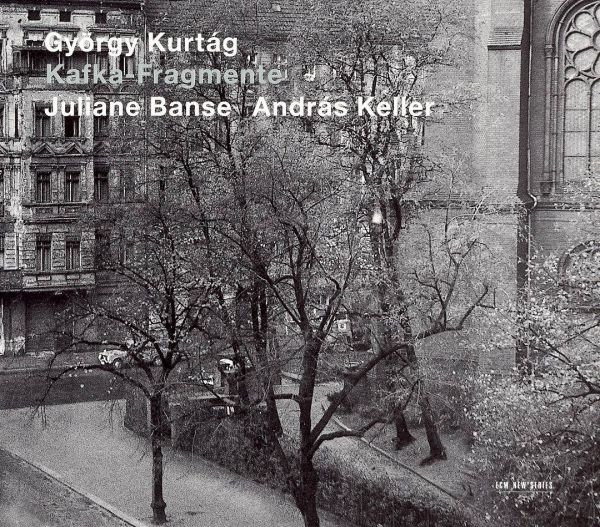
György Kurtág: Kafka-Fragmente (ECM New Series 1965)


György Kurtág
Kafka-Fragmente

Juliane Banse soprano
András Keller violin
Recorded September 2005, Reitstadl, Neumarkt
Engineer: Peter Laenger
Produced by Manfred Eicher

The true path goes by way of a rope that is suspended not high up, but rather just above the ground. Its purpose seems to be more to make one stumble than to be walked on.
–Franz Kafka

The Kafka-Fragmente (1985-87) of György Kurtág make up the composer’s longest song cycle to date. Written for soprano and violin, its forty short pieces fall just shy of an hour. While Kurtág frames the text, consisting of fragments from Franz Kafka’s diaries and letters, and its ordering as being secondary to the music, I believe a closer look at the words can only enrich one’s experience of these finely composed vignettes. In the same way that Kurtág has pulled Kafka out of context and reworked him, so too has he pulled melodic material from the words themselves and fashioned it into a demanding exercise in instrumental and vocal economy. The scoring may be sparse; the results are anything but. Kurtág’s miniaturist approach ensures that every word gets its unadulterated moment, while the intimate arrangements pay due attention to the space into which those words are deployed.

Some of these pieces are relentlessly dramatic—“Ruhelos” (Restless), “Stolz” (Pride), “Nichts dergleichen” (Nothing of the kind) come to mind—and others meditative—“Berceuse I,” “Träumend hing die Blume” (The flower hung dreamily), “Ziel, Weg, Zögern” (Destination, path, hesitation)—but all are linked by dialogue. Still others are playfully programmatic and concise, such as “Es zupfte mich jemand am Kleid” (Someone tugged at my clothes) and “Eine lange Geschichte” (A long story). The one fragment that is Part II, which I have quoted above, is a haunting piece and seems to act as the center toward which the others gravitate.

As part of a lifetime’s worth of personal musings and correspondences, Kafka’s jottings are, of course, rather candid, and indeed give us a “fragmentary” vision of the great writer. None is perhaps so self-deprecating as his letter to Milena Jesenká. “I am dirty,” he writes, “endlessly dirty, that is why I make such a fuss about cleanliness. None sing as purely as those in deepest hell; it is their singing that we take for the singing of angels.” Whatever darkness this piece may imply on the printed page is immediately transformed into a serenade, evoking the final image with voracious dedication. We find another lyrical moment in the mysterious “Verstecke” (Hiding-places), in which Kafka muses: “There are countless hiding-places, but only one salvation; but then again, there are as many paths to salvation as there are hiding-places,” and for which the accompaniment is suitably cryptic, scampering toward any available cranny in which it might conceal itself. Another highlight is “Szene in der Elektrischen” (Scene on a tram), a whimsical anecdote about street musicians and the delicate line they walk between musical appreciation and intrusion into personal space. Because the story tells of two violinists, the violinist must switch between two differently tuned instruments on either side of the soprano, who strings the narrative along with her own bowed articulations. The final fragment, “Es blendete uns die Mondnacht…” (The moonlit night dazzled us…), is a brooding and mystical evocation of animal spirits and the limits of human understanding.

Soprano Juliane Banse displays a superb command of voice as she squeals, chirps, and whispers her way through Kurtág’s personal selections, and violinist András Keller negotiates the minutiae therein with finesse and panache, while also managing to maintain the touch-and-go relationship with the texts at hand. In spite of the bright performances and ingenuity throughout, this isn’t necessarily music to have on the in the background while surfing the internet or throwing a dinner party (and to anyone using Kurtág to enhance a soiree, I humbly request that you invite me), but rather demands our attention as “readers.” Kurtág was in the studio throughout the entire recording process, and his presence is palpable. It is only appropriate, then, that we be just as present in the listening.

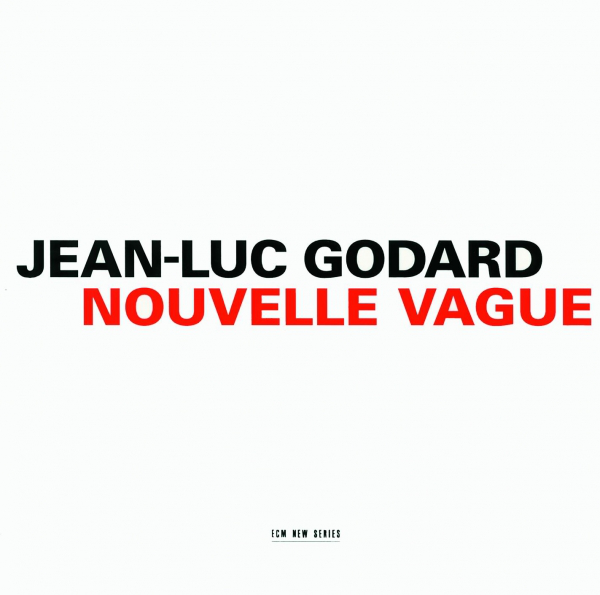
Jean-Luc Godard: Nouvelle Vague (ECM New Series 1600/01)

Jean-Luc Godard
Nouvelle Vague

Featuring the music and voices of:
Dino Saluzzi
David Darling
Patti Smith
Jean Schwartz
Werner Pirchner
Paul Hindemith
Heinz Holliger
Paul Giger
Arnold Schoenberg
Gabriella Ferri
Alain Delon
Domiziana Giordano
Roland Amstutz
Laurence Cote
Jacques Dacqmine
Christophe Odent
Laurence Guerre
Joseph Lisbona

But I wanted this to be a narrative. I still do. Nothing from outside to distract memory. I barely hear, from time to time, the earth softly creaking, one ripple beneath the surface. I am content with the shade of a single poplar, tall behind me in its mourning.

In every Godard film, there are moments in which chaos reigns. Ambient sounds replace human voices. Animals, especially dogs and crows, always seem to have something to add. The mechanical world becomes part of the conversation. These intersections of sound and darkness, of silence and light, underscore our social inequities and nothing more. They pass without judgment, suddenly swallowed whole by accidents and unarticulated pain. Yet it is in precisely these gnarled irregularities that the larger construction of life, and this film depicting it, is betrayed. There is no order beyond choice, no means for permanence in a world so finitely recreated. The film gives illusory clout to its own staying power and falls flat against the screen long before its depth can be realized.

As a soundtrack, Nouvelle Vague is a rich experience, made all the more so if one has seen the film and has its images in mind. An earlier companion piece to the vastly significant Histoire(s) du cinema, this is the complete aural map of Godard’s multi-sensory essay. Like the soundtrack to Histoire(s), it brings to light not only the film’s interior but also its exterior nuances, probing its topography, if you will, with a practiced hand. This is strictly a descriptive engagement. As spoken voices fade in and out of a painterly mélange of musical selections, ECM and otherwise, our ears (and our eyes) spin the one continual thread holding it all together. The musics of Dino Saluzzi and David Darling figure most heavily in Nouvelle Vague and inform much of its dialectic edge. They are placed among, and in place of, dialogue, adding to a mounting intellectual cacophony. Darling’s cello merges with a beeping car horn and screeching tires, Hindemith graces the inside of every mask donned by the film’s characters, and voices cry out like solo instruments against a larger orchestral palette. Godard’s familiar splashing water also makes its requisite cameo. Yet it is Saluzzi’s bandoneón that provides some of the more understatedly dramatic moments. Its tearful, bellowed cry is as recognizable as the rhythms of the filmmaker using it, and ends the text on a stark note as a car speeds away in a swirl of filmic dust.

With this release, ECM redefined what a soundtrack can be: something that literally “tracks sound,” marking every stage of a narrative with its most fleeting aspects. Diegetic distinctions are arbitrary in Godard’s world. Sound is image is sound. Our own mental pictures are no less substantial than those captured on film, for captured is precisely what they are. Nouvelle Vague invites us to let the visual world unfurl—not through the sound, but as the sound itself.

<< Eduard Brunner: Dal niente (ECM 1599 NS)
>> Ralph Towner/Gary Peacock: A Closer View (ECM 1602)

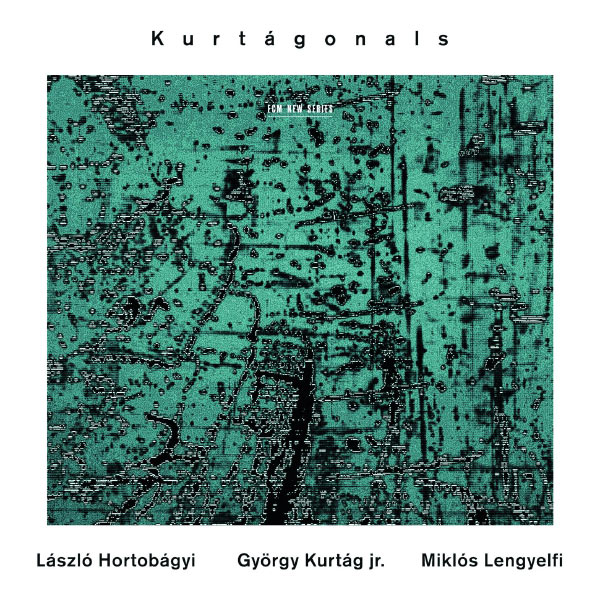
Kurtágonals (ECM New Series 2097)


Kurtágonals

László Hortobágyi synthesizers, computers
György Kurtág Jr. synthesizers
Miklós Lengyelfi bass, effects
Recorded August 2008 at the Guo Manor, Budapest
Produced by Hortogonals

In the landscape of electronic music among European art circles, the name of Pierre Schaeffer (1910-1995) is a monumental landmark. A pioneer in musique concrète and its ancillary technologies, Schaeffer introduced a remarkable line-up of composers to new and exciting possibilities in audible media, not least among them Luc Ferarri, Iannis Xenakis, Jean Barraqué, Karlheinz Stockhausen, and Pierre Boulez. Boulez is particularly important in the context of this album, for he would go on to found the Institut de Recherche et Coordination Acoustique/Musique, or IRCAM, where György Kurtág Jr. later studied. Boulez’s rocky association with Henry led to a schism between the former’s insistence on the integrity of electro-acoustic configurations over the latter’s “computer music.” I find this conflict to be a moot one, however, when considering that instrumental music immediately becomes “electronic” the moment it is recorded, and that electronic music becomes “acoustic” when played through speakers in any given environment. Also, much of Schaeffer’s pioneering work, such as his entrancing Symphonie pour un homme seul (1951), was fundamentally rooted in the acoustical properties of live instruments and the human voice. Whatever the argument may boil down to, this fiercely original album happily marries the two camps into a bustling commune of shared ideas. Kurtág is joined here by two fellow Hungarians: composer László Hortobágyi, who works much of his compatriot’s thematic material into the album’s infrastructure, and Miklós Lengyelfi, a musician of many stripes whose rock roots bring an edgier sensibility to the underlying aesthetic. The three are known collectively as Hortogonals, and through their triangular approach they create music that is undeniably spherical.

Intraga sets the tone for the album as a whole, its varied sounds barely discernible from the surrounding haze: a bass sings at our feet, a toy piano croaks into our ears, and a wordless voice flickers at the threshold of audibility. Kurtagamelan is appropriately riddled with its titular chimes. Their echoes are electronically transformed, seeming to inject a visible murmur into every struck note. A passing swarm of insects retreats into the background. And beneath it all, a muffled drum. The bass continues its subterranean journey, marking its passage through the earth with pitfalls and sinkholes. A brief chorus of voices swells, the wind blows. Interrogation is overlaid with a cicada-like drone and a distant wash of strings, contrasting effectively with the lovely rhythmic threads of Lux-abbysum, which put me in mind of Tomas Jirku’s early click-hop experiments on the Substractif label, though the “live” touches of triangle and other percussive samples add more variation to the music’s topography. Dronezone showcases some of Hortobágyi’s interest in North Indian music, and Kurtaganja a bit of Lengyelfi’s in the electric guitar. This and Twin PeaX form a whimsical pair, respectively characterized by less veiled beats and freer sampling. Necroga closes where the album began, its steady bass strummed like a large cosmic string boring into the center of our spines.

Although the music of Hortogonals is rich in implied silence, here it moves in a continuous stream of sound. The lack of gaps between tracks renders the titles almost arbitrary, even if they do provide the occasional clue into the goings on. The music is dark, but far from ominous, and when it is ominous it is never dark. The experienced electronic listener may not encounter much in the way of innovation in the album’s sound or construction, but will nevertheless find it bears a unique compositional stamp and that sort of haggard beauty only the collaborative object possesses.

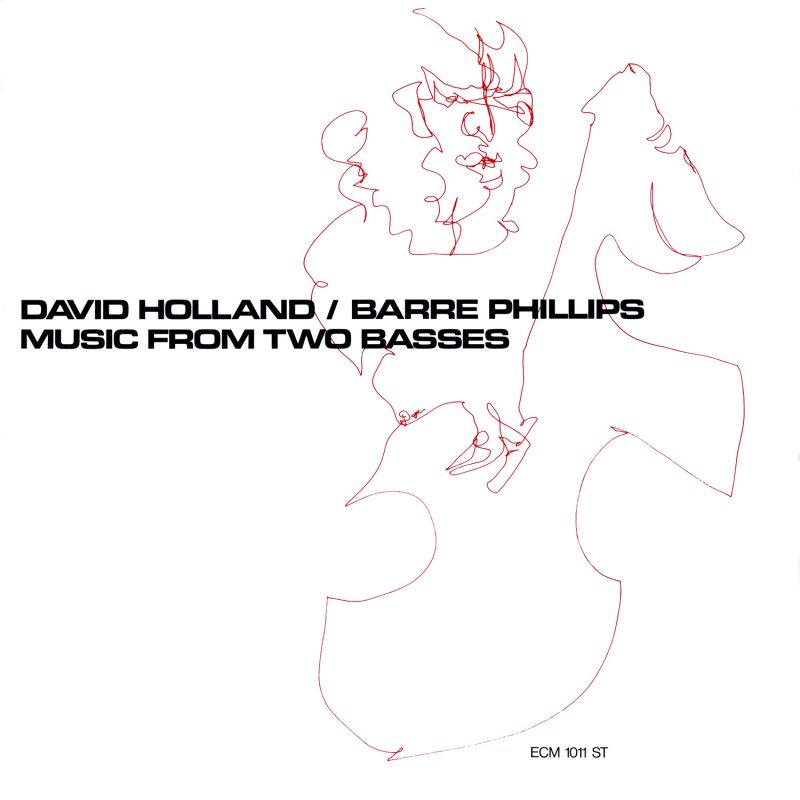
Dave Holland/Barre Phillips: Music From Two Basses (ECM 1011)

1011

Music From Two Basses

Dave Holland double-bass, violoncello
Barre Phillips double-bass
Recorded February 15, 1971 at Tonstudio Bauer, Ludwigsburg
Engineers: Kurt Rapp and Martin Wieland
Produced by Manfred Eicher
Release date: May 1, 1971

If you know the work of Barre Phillips, Music From Two Basses will be familiar, if not tame, territory. The more recent Dave Holland fan, however, may be in for an intriguing surprise. Through a mounting cluster of clicks, flutters, scrapes, and plucks, two bassists who now seem to inhabit rather different ends of the improvisatory spectrum find common ground here, and the results are extraordinary.

“Improvised Piece I” is dry and cracked around the edges, while “Improvised Piece II” is more like the genesis of a dream. The technique in both is phenomenal, covering a wide range of extended gestures, but always with an emphasis on the miniscule. “Beans” (Phillips) introduces us to the album’s first composed material, and is an exquisite journey laced with drones and bowed harmonics. The heavily applied reverb adds a cool distance. It is a celestial moment in an otherwise terrestrial program, and gone too soon. “Raindrops” (Holland) brings us in the opposite direction, plummeting toward earth in a gentle precipitation. “May Be I Can Sing It For You” (Phillips) is the most straight-laced piece on the album, and therefore the shortest, while the vague “Just A Whisper” (Holland) brings us back into a more delightfully abstract interaction. “Song For Clare,” another Holland piece, closes the set on an affectionate note and leaves us hungry for more.

This is free jazz of the most intimate persuasion. These two bassists may be household names, but here we really get a profound early glimpse into the microcosmic hearts of their instruments. This is an engaging album from start to finish, and one that could easily fail in so many other hands as it skips, sings, and chortles its way through a surprisingly vast program. There are no grand sweeping gestures, no complete sentences, nothing lost or gained. A taxing listen for some, but sure to delight the rest with its whimsical, focused atmospheres.

<< Paul Bley: Ballads (ECM 1010)
>> Stenson/Anderson/Christensen: Underwear (ECM 1012)

Bach: Das Wohltemperierte Klavier, Buch I – Fellner (ECM New Series 1853/54)

Johann Sebastian Bach
Das Wohltemperierte Klavier, Buch I

Till Fellner piano
Recorded September 2002, Jugendstiltheater, Vienna
Engineer: Markus Heiland
Produced by Manfred Eicher

One need only hear Till Fellner’s opening bars of the C major Prelude to know we’ve been taken in by a most heartfelt performance of The Well-Tempered Clavier. The Viennese pianist’s unparalleled grace and fluidity, aided by a rather “submerged” recording, serve to enlarge the visual field of the music at hand. And by the time we get to the C minor Prelude, we know there is no escape from this miraculous cage. Fellner always manages to keep himself at a distance, as if the music were coming from a dream he never wishes to abandon.

These pieces are like bits of life in concentrated form, each prelude a genetic signature and every fugue the trait it enables in the growing organism. Fellner bows to every movement and allows the dynamics to unfold from within. The faster sections in particular show a marked infusion of drama, each building through a slow fade-in to a more pronounced finish. Prime examples of this include the C-sharp major, G major, and B major Preludes, and the E minor Fugue. Fellner also makes the most of striking juxtapositions. The sprightly D major Prelude, for example, is all the more enlivening for being paired with the C-sharp minor Fugue’s beautiful lag. Yet never has a Bach interpreter so evocatively captured my interest in the slower movements, and no more so than in Prelude and Fugue in B minor. The A major Fugue and F minor Prelude go straight to the gut, and the F-sharp major Prelude practically weeps from the keyboard. Some of the album’s most emotional moments are to be found in the celestial G minor Prelude, with an opening trill that practically sings. And so, it is rather fitting that Book I should end on the somber B minor Fugue, seeming to regret its impending end while also fully resigning itself to the sentiment it has left behind.

Fellner has achieved something truly magical in this recording. Not only has be managed to “reopen” The Well-Tempered Clavier with his warmth, but he has done so by stretching it into a vaster tapestry, thereby allowing us to visualize every shadowy figure that passes through it. We distinguish mere snatches of form—an eye, a pair of parted lips, perhaps an extending hand—so that every nuance brings us closer to understanding the corporeal totality of the music. Fellner’s superb handling turns even the most staid movements into fresh listening experiences, while his airy separation and delicately applied arpeggios turn every polyphonic moment into its own soundscape. The album’s softness is, I think, as much a part of Fellner’s aesthetic as it is of ECM’s. Yet for all that Fellner brings to this project, the music comes through with renewed vigor, and that is the sign of a singular musician indeed.