Jan Garbarek/The Hilliard Ensemble: Mnemosyne (ECM New Series 1700/01)

Mnemosyne

Jan Garbarek tenor or soprano saxophones
David James countertenor
Rogers Covey-Crump tenor
John Potter tenor
Gordon Jones baritone
Recorded April 1998, Propstei St. Gerold
Engineer: Peter Laenger
Produced by Manfred Eicher

“And the strict lord Death bids them to dance.”
–Jof, The Seventh Seal

To anyone who ever wondered why the Officium project needed a successor, this album provides a formidable answer. Whereas in its first effort this fearless fivesome built a program around relatively structured material, hundreds of concert performances and subsequent additions to their repertoire led the Hilliard Ensemble and saxophonist Jan Garbarek to the veritable medicine bag of expansive ideas that is Mnemosyne. Their deeper surrender to the art of improvisation makes for an even more self-aware effort this time around, and the resulting double album is nothing short of remarkable.

Spanning over three millennia, the uncannily cohesive program takes the project to unexpected heights. Its opening Quechua Song epitomizes the inner harmony of this inimitable partnership; a union that, not unlike the music it produces, is fleshed out through countless fragments drawn from worldly sources. While familiar territories abound—among them pieces by Tallis, Dufay, and Tormis—the addition of tenor and soprano saxophones renders them beautifully arcane. Even during those pieces in which the Hilliards sing alone, Garbarek’s presence is ever felt, hovering like a shadow in the corner of our vision. A particularly impassioned rendition of an Antoine Brumel Agnus Dei provides one of the strongest cases for this vocal/instrumental combination, as Garbarek expels an intensely visceral song that both scales the highest reaches and plumbs the shallowest coves of his surroundings. Though the album may have its weak moments (the medieval Novus novus, for example, is a little too compact to allow much room for a “fifth voice”), these are few and far between. In any case, the commitment that binds them never wavers, so that by the end of the first disc, which is capped by Hildegard von Bingen’s stunning O ignis spiritus, we realize this project has attained an entirely new level of melodic unity and ethereality. As the pièce de résistance of this collection, O ignis rises in a class of its own, made all the more unrepeatable by Rogers Covey-Crump’s inscriptions of untold mythologies. The haunting Hymn to the Sun by Mesomedes of Crete (2nd century) is another radiant success that writhes in captivating pangs of resolution. I must also commend Garbarek for his own two compositional entries: Strophe and Counter-Strophe, which makes attentive usage of the Hilliards’ variegated range, and Loiterando, with its likeminded choral astuteness and finely attuned brassy ornaments, both widen the scope of possibilities to be discovered.

In his monograph The Passion of Ingmar Bergman, Frank Gado argues that The Seventh Seal “is not radically about death at all; rather, it focuses on the terror of emptiness in life.” Similarly, the music of Mnemosyne preaches transcendence even as it gazes quietly upon the earth at its feet. That the album artwork is plastered with images from the selfsame film is no mere coincidence. The synthesis of sound and silence is like that of life and death: the two can never be entirely separated. What we have here is neither fusion nor a hybrid musical form. It is a perfectly symbiotic meeting of minds that banishes the darkness of criticism with its vigorous light. David James shows particular strength with every step he takes down these newly indeterminate paths, Covey-Crump and John Potter form a beautifully harmonized center, and Gordon Jones is the ever-present anchor of this darkly striated vessel. As for Garbarek, one can only listen and be enlightened.

<< András Schiff: Schubert C-major Fantasies (ECM 1699 NS)
>> John Surman: Coruscating (ECM 1702
)

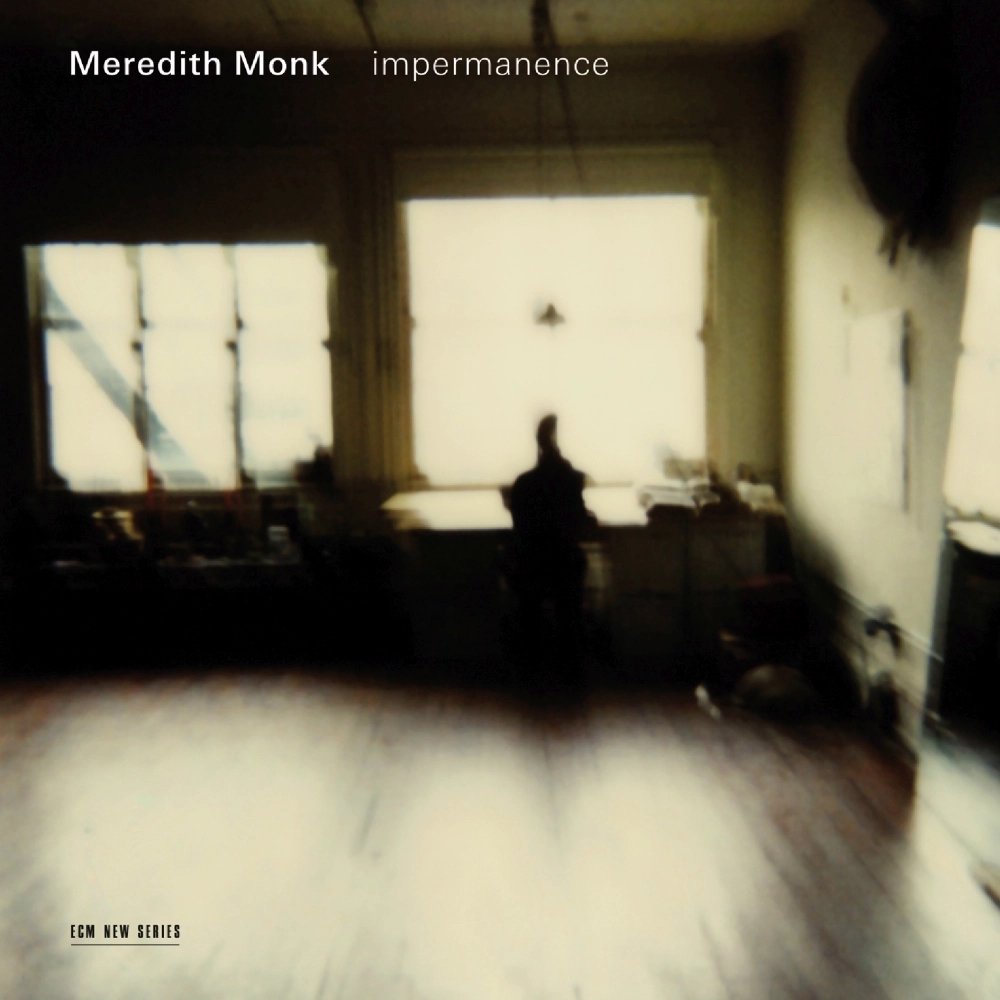
Meredith Monk: impermanence (ECM New Series 2026)


Meredith Monk
impermanence

Meredith Monk and Vocal Ensemble
Theo Bleckmann voice
Ellen Fisher voice
Katie Geissinger voice
Ching Gonzalez voice
Meredith Monk voice
Allison Sniffin voice
Sasha Bogdanowitsch voice
Silvie Jensen voice
Allison Sniffin piano, violin
John Hollenbeck percussion
Bohdan Hilash woodwinds
Recorded January 2007, Avatar Studios, New York
Engineer: James Farber
Produced by Manfred Eicher

“War belongs to our souls as an archetypal truth of the cosmos…. To this terrible truth we may awaken, and in awakening give all our passionate intensity to subverting war’s enactment, encouraged by the courage of culture, even in dark ages, to withstand war and yet sing.”
–James Hillman, A Terrible Love of War

I start with this provocative comment from author James Hillman for two reasons. First, for the way it fogs its breath over an unsettling facet of creative expression: namely, that the shape of our singing is often determined by violence. Second, because Meredith Monk’s impermanence opens with “last song,” a piece inspired by Chapter 2 of The Force of Character: And the Lasting Life, also by Hillman, in which the author writes: “By putting closure to a series of events that otherwise could run on and on, the last time is outside serial time, transcendent.” Perhaps no other statement could describe Monk’s latest ECM project more astutely. To be impermanent is indeed to transcend time, shrugging off rules like so much weight from the proverbial shoulders. The core message of Character stresses the primacy of the body in the acquisition of wisdom. In saying as much, Hillman also recognizes the value of life in precisely the moment at which it fades. Hence his take on war, which dives into the rubble of our denial and emerges with a body that is nothing if not the human experience personified.

For those of us who place ourselves outside its shadow, war would seem an impossible ideal, a reality in which utter ruin can be the only outcome. What we are so often led to forget—and on that note, I can only speak for myself—is that war is a multivalent term. The crossing of arms over contested borders may be no more fraught with tragedy than, say, the equally unstable terrain of our emotional battlegrounds. That such language has crept into the vocabularies of our internal lives is proof positive of the power of language to mold human relationships. In light of this, the act of memorializing trauma may seem a primal and universal phenomenon to those who have no investment in its implications. And yet, the process of forging an immediate conveyance of meaningful representation in the wake of death is one filled with choices, and it is these choices that keep it from merely being filed in the annals of psychoanalysis as a narcissistic reflex against loss. For although this album grew out of perhaps the most profound of losses (that of Monk’s partner Mieke van Hoek), there is much to be cultivated from the wisdom of its traumatic seeds. The music throughout this emotional document, drawn from the voice of a life unhinged, marks an auroral trajectory with its own lungs. Although a six-year gap separates impermanence from Monk’s previous ECM effort, mercy, it is filmed with lifetimes’ worth of residue.

Condensed from the larger synesthetic composition of the same name, as we encounter it here impermanence is far from incidental to its source. Here, Monk branches out from her usual diatonic trunk into more chromatic foliage. The staples of her craft are dutifully maintained: cyclical patterns and semantic dissolutions, keyboard parts that lumber like human figures, and a suitable array of extended techniques. The ordering of pieces suggests a structure that may crumble at any time yet which is all the more resilient for its empty spaces. From the clattering metal of “disequilibrium” to the ethereal rounds of “passage,” there is a clear lingual flow to be distinguished. Some of the sounds, such as can be found in “sweep 1,” are organic and vulnerable, while others, such as the clattering of “particular dance,” are picked apart like ancient automatons. Ultimately, the reverberations of the digital recording process lend such music a parable quality. Rather than being didactic, the lessons to be learned have more to do with silence than with moral truths. Our habit of reading prescriptive meanings into the human archive is an endless circle, an offering of shadow in a realm without light. Here, at least, we can cast aside such shackles and take comfort in the liminal.

Monk humbles me with her consistency in engendering new experiences. This album is a fine example of her indomitable generative spirit. This may very well be her textually richest album thus far, though it has its fair share of gracious confusion and impossible-to-complete sentiments. Her aphasia is distinctly her own, and I believe its frequency serves to interpolate speech into the human body. As such, it is anything but narrative. As with so much of Monk’s (sub)textual work, every semantic concept is consistently wound and unwound, so that by the end the word’s immediate power is at once erased and underlined. Much like the disc upon which they have been digitally imprinted, these songs epitomize the album’s title. As concepts, they are dead the moment they are uttered. As utterances, they are reborn as concepts the moment they are silenced.

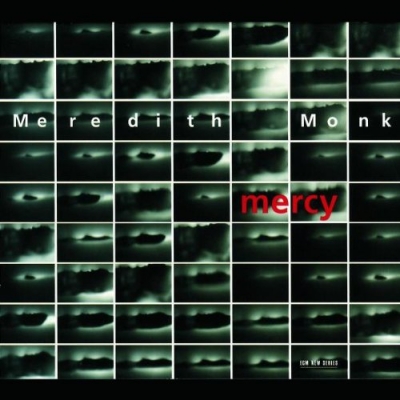
Meredith Monk: mercy (ECM New Series 1829)

Meredith Monk
mercy

Meredith Monk voice
Theo Bleckmann voice
Allison Easter voice
Katie Geissinger voice
Ching Gonzalez voice
Allison Sniffin voice, piano, synthesizer, viola, violin
John Hollenbeck voice, percussion, melodica, piano
Bohdan Hilash clarinets
Recorded March 19/20, 2002

I regularly have dreams about flying. Said ability never comes, however, without focused and sustained effort on my part. In order to achieve flight, I must push against the air with my arms, gaining height ever so incrementally—sometimes losing altitude on the downswing—until I am in a position to navigate obstacles such as buildings, trees, and power lines. If these dreams had a soundtrack, it might sound something like mercy, for here is a space in which the human voice soars, to be sure, but not without the utmost discipline on the part of its performers. The “rudimentary” nature of this album serves to accommodate its broader wingspan, thereby widening our view to that much greater distance. As the booklet contains no liner notes, we become integral to the narrative evolution of what passes through our ears.

Created in collaboration with artist Ann Hamilton (whose work I’ve always felt begins and ends with the body, in both its implicit and fully realized forms), mercy is as much a visual composition as it is an aural one. Its scoring is modest: anywhere from one to six voices are accompanied throughout by varied clusters of percussion, piano, and clarinet. In spite of the somewhat scattered programming, most of the pieces have a partner or can be grouped with others. The two “braids” and “leaping song” that open the album, for instance, form a tight weave of likeminded vocal information. Monk runs down their helical spirals with such organic potency that when a piano suddenly makes its presence known, its jazzy syncopation in the left hand almost comes as a shock. Throaty squeals meanwhile ascend toward an aphasic finish, leaving instruments to dance around a private ceremonial fire.

From gong-like meditation to whispered desperation, the psychokinetic interludes that are the three “lines” use more diffuse gestures to express miniscule things. These are not the artist’s marks seeking to define space against non-space. They are the projections of thoughts as vibrations. To “line 3” Monk adds a “prisoner,” whose voice is echoed from a variety of distances as the clink of knuckles on jail cell bars is heard, thus providing the album’s eeriest moments. “doctor-patient” is driven by piano and mallet percussion. Through a haze of illness and infirmity, the body’s internal condition resolves into focus. As the doctor-patient relationship stems from language, the former translates the latter’s internal melodies through external conjugations. In essence, the doctor mimics the ailment in question, hence his echoing of the patient’s literal cry for help. “woman at the door” transcends communicative barriers with the possibility of silence. Slight dissonances operate rather like a hearing test, eventually unwinding into an alluring cascade of voices, leaving us with a solitary invitation: “Come in, come in.”

As I listen to the final track, “core chant,” I am wont to ask myself: What chant? The core of what? Perhaps our first clue into either query is the seemingly abrupt ending, the incompleteness of which is rendered inconsequential, for without even the most basic morpheme at one’s disposal the pantheon of meaning begins to crumble in the face of more immediate auditory signatures. In the end, the performers’ humility is the most vital dynamic of the music in question, personal and steadfast in light of its possible resolution.

Monk’s is not a world in which the voice is primary but rather a voice in which the world is primary. Her centrality ensures that she is not alone, spared the burden of carrying the others, while also making her utterances the most visible. The variety of instrumental arrangements represented on mercy shows us some of the more tangible aspects of her compositional process, balancing beautifully with the voices’ less mechanical nature. “urban march (shadow),” for one, features an almost harp-like synthesizer, while its exuberant cousin, “urban march (light),” boasts enthralling percussion and ecstatic chanting. Just as the body remains unseen in the recorded voice, so too does the instrument betray its own biology through the unleashing of its sound. Of course, the voice is also an instrument, and nowhere more so than in the rhythmic mosaic of “masks,” where breath alone imparts the voice its defining shape.

My flying dreams typically end the same way. The fatigue becomes overpowering and I must seek solid ground. Yet I always seem to land in a high place. Rather than empowering me, this humbles me to the landscape I have just traversed, reminding me of its insurmountable vastness, which is always greater than the sum of my actions. So, too, do we end mercy on a higher place from where we began. And is that not one possible outcome of mercy? Does compassion always leave one elevated? Fortunately, we are given the freedom to answer such questions differently every time we listen.

Meredith Monk: Volcano Songs (ECM New Series 1589)

Meredith Monk
Volcano Songs

Meredith Monk voice
Katie Geissinger voice
Allison Easter voice
Dina Emerson voice
Harry Huff piano
Nurit Tilles piano
Recorded July 1995, Clinton Studios, NYC
Engineer: James Farber
Produced by Tina Pelikan

The Random House Dictionary defines volcano as “a vent in the earth’s crust through which lava, steam, ashes, etc., are expelled, either continuously or at irregular intervals.” In spite of human fears, the volcano is vital to the earth’s formation, sculpting the very landscapes we inhabit. For Meredith Monk, it would seem more importantly a source of fertility, and it is from this fertility that she opens herself to the generative spirit that infuses the world as a living organism. In this sense, she vocalizes a point of continuity between herself and listener, between the illusions of recorded sound and the illusions of physical bodies.

Like their referent, Monk’s Volcano Songs (1993-94) reveal the earth’s hidden forces, at once violent and graceful, as they are embodied in the human form. Fissures in the great cosmic wheel release their breath in chant, foregoing the detriment of words in search of untinctured expression. Therein lies the great irony of this music, and of the earthly condition that engenders its existence: namely, that in order to express detachment one must hold steadfastly to the ephemeral utterance as a point of departure. Hence the uncanny splitting of the self we find between Monk and Katie Geissinger in the duet portions of the Volcano cycle (for indeed, were I unaware of the album’s personnel, I might have thought that Monk was overdubbing herself). Undulating breaths open into distant cries, like shepherdesses reaching deep into their lungs to lure their spiritual flocks out into the open. For all their microtonal friction, grunting expulsions, and sustained laments, these songs cut through the darkness like lightning bolts in slow motion. Of note are the guttural “Boat Man” and the playful “Skip Song.” In these, Monk’s mimicry is at its most humble, fleshing out evocative characters and histories with the most minimal of palettes. And how can one resist the siren-like ascents and delicately applied throat singing techniques of “Old Lava,” with its appropriately languid crawl, dripping like molten rock?

Although New York Requiem (1993), for piano and voice, profoundly intersects with the AIDS epidemic and is, says Monk, “really about all kinds of loss,” for me it is also about gain: of awareness, of situatedness in one’s sociopolitical surroundings, and perhaps even of silence. By the latter, I mean to imply that, through the art of wordless singing (for what requiem is without a text?), Monk has caressed the contours of mourning with a uniquely feathery touch so as not to disturb the memories being circumscribed. It is a slogging, diaphragmed journey in which narration must be forged rather than found. A truly heartfelt composition matched by an equally committed performance.

St. Petersburg Waltz (1993) is a solo piano piece that peers back into Monk’s genealogical roots. Falling with the solemnity of snow on wide streets and narrow alleys, its columnar gestures and understated motives were “inspired by the idea of a place rather than the place itself.” Thus is the complex web of genetics and circumstance delineated only vaguely, a ragged film reel on its last revolution, its swan song fading like a credit roll in the throes of this digital age. We find in its preservation an archival quality that speaks of a history beyond the confines of personal reflection.

Three Heavens and Hells (1992) sets a poem of the same name by an 11-year-old Tennessee Reed. In a humble quartet of voices, Monk and her sistren unravel a rather brief splash of words into a vaster ocean of implications. They open with an invocation:

There are three heavens and hells

Every breath seems to revel in the words, underscoring the unity of the flesh that binds them in worldly care. Over a precise macramé of chants and variations, the voices continue:

People, heaven, and hell
Animal, heaven, and hell
Things, heaven, and hell

Reed tellingly uses the word “animal” in the singular, thereby planting the text into a more unified field of impression and evocation. A deeper exploration of each word ensues, where “People” are mournful, pitying; “Animal” abounds with calls of the wild; and “Things” become externally convoluted yet internally ordered. Latched as we are onto the lure of meaning, a single question hangs over us:

What do the three heavens and hells look like?

This unreachable dilemma constricts our understanding of the piece’s thematic core, and renders any possible answer a barrier to enlightened solutions. In the end, we are left with:

Heaven, heaven, heaven
Hell, hell, hell

And as we flounder in the wake of our own attentions throughout this 21-minute piece, we come to realize that the act of listening doesn’t always mean being a receiver, that it can just as easily suspend the mask of the questioner from our attentive ears. On a side note, the strong rhythmic breathing throughout this piece plays a role not unlike beatboxing in modern hip-hop, and puts me in mind of Björk’s Medulla-era vocal menageries—which makes me curious as to the contemporary shadows that might be hovering at the edges of either artist’s ever-evolving craft.

The album ends intimately with two of Monk’s Click Songs (1988). These self-styled “duets for solo voice” further expand upon the refracted aesthetics through which the album’s opening seeps, thereby calling our attention to the finality of subjecthood and the selfish desires that are its attendants.

Compared to Monk’s six previous ECM New Series efforts, Volcano Songs is perhaps the most intimately recorded. Microphones seem fully embedded in these voices, subtly processed for reverberant effect. Ultimately, I feel that one gets out of this music only what one is willing to lay at its feet. It is both the beauty and the tragedy of the human voice: in pulling at the threads of our emotions, we must undo one thing to communicate another, so that by the end we have forgotten where we started, inhaling an idea that may very well outlive us. And just as a volcano spews forth its scalding breath into the atmosphere, so too must we eventually exhale, licking the fragile layer that separates our survival ever so delicately from the blank space beyond. The magic of Monk’s music is that it offers a glimpse of that other side, in terms that we can relate to.

<< Louis Sclavis Sextet: Les Violences de Rameau (ECM 1588)
>> Erkki-Sven Tüür: Crystallisatio (ECM 1590 NS)

Zelenka: Trio Sonatas (ECM New Series 1671/72)

Jan Dismas Zelenka
Trio Sonatas

Heinz Holliger oboe
Maurice Bourgue oboe
Thomas Zehetmair violin
Klaus Thunemann bassoon
Klaus Stoll double-bass
Jonathan Rubin lute
Christiane Jaccottet harpsichord
Recorded June 1997, La Chaux-de-Fonds
Engineer: Stephen Schellmann
Produced by Manfred Eicher

From the first measure to the last, the trio sonatas of Czech composer Jan Dismas Zelenka (1679-1745) cast an enchanting spell. The combination of instruments—two oboes, bassoon, and basso continuo, with a violin replacing an oboe in the third sonata—is unique and colorful. Zelenka’s writing embodies the epitome of Baroque ensemble stylistics, drawing from such diverse influences as Bach and the folk music of his own homeland.

The first two sonatas I see as a linked pair. Sonata No. 1 is an awakening into sunrise, birds weaving and darting in a complex interplay of lilting motifs. Sonata No. 2 is the dusk to the first’s dawn. Its gorgeous introductory movement builds to Albinoni-like proportions. Meticulous development and smooth bassoon writing in the final Allegro make this one of the most consistent sonatas in the collection. Thomas Zehetmair takes charge in the sinuous opening Adagio of Sonata No. 3. A virtuosic second movement and ornamental minor shifts in the fourth lend this sonata an overall anticipatory character. The oboes return to the “fore” in Sonata No. 4, which features a heartrending bassoon line in the Adagio. And on that note, the trio sonatas are a goldmine for the bassoon. Though touted by Heinz Holliger as a highpoint of oboe literature that evolves with the performer through time, this collection brings out so much detail from the oboe’s throatier cousin that one cannot help but give it equal attention. Klaus Thunemann’s dramatic sense of diction is almost never supplementary, but rather flickers with its own inner fire. The bassoon is perhaps nowhere so present as in Sonata No. 5. After a thematic statement in tutti, Thunemann takes the reigns, leading us through an interludinal Adagio before enthralling yet again in the Allegro. The bassoon remains an integral presence in Sonata No. 6, threading the Andante that opens, bolstering the snake-like oboe solo of the Allegro, and carrying the full weight of another gorgeous Adagio. The concluding movement starts off daintily enough, but soon works its way into wild flights on oboe (the effect of which is not unlike the bursts of violin in the Adagio of Bach’s fourth Brandenburg Concerto), thus adding that much more emphatic punctuation to this ever-unfurling manuscript.

These pieces are like concerti grossi in miniature form, each its own massive universe compacted into a rather demanding form of chamber music. Holliger initiated a “Zelenka renaissance” when he first recorded these works for Archiv in 1972, and manages to outdo even himself here in ECM’s praiseworthy production. The acoustics manage to bring out the earthiness of the bassoon, the glitter of the continuo, and the complexity of the oboe with nuanced attention. The click of oboe keys is pleasantly audible and only serves to underline the rhythmic backbone of the music.

Not since Bach had a composer taken the raw material of counterpoint and fashioned it into something beyond its own means. We know very little of Zelenka. Not even a portrait remains to show us his face. And yet, when we don our musical lenses and peer into the gems he left behind, we know that in his creations we have something far greater than a few strokes of cracked paint on a time-worn canvas could ever convey. One can only hope that this revival of a revival, combined with the tireless efforts of such Zelenka proponents as Wolfgang Reich and Holliger himself, will continue to polish away the centuries of neglect from this nearly forgotten Baroque treasure.

<< Bley/Peacock/Motian: Not Two, Not One (ECM 1670)
>> Erkki-Sven Tüür: Flux (ECM 1673 NS
)

Brahms: Sonatas for Viola and Piano (ECM New Series 1630)

Johannes Brahms
Sonatas for Viola and Piano

Kim Kashkashian viola
Robert Levin piano
Recorded November 1996, Mozart-Saal/Liederhalle, Stuttgart
Engineer: Peter Laenger
Produced by Manfred Eicher

These two sonatas, originally written for clarinet, marked the end of an intense period of depression for Brahms, during which his creative energies had all but faded. Kim Kashkashian, whose command of the viola unearths an even deeper realm of possibility in this already engaging diptych, faithfully captures the somber circumstances of its creation. In doing so, she shows that the viola is no less an instrument of breath, drawing from deep within her lungs the sheer vocal power required to carry across such arresting music.

The disc opens with the Sonata No. 2, evoking the spirit of its underlying “tragic motive” as if it were the weight of an all-consuming desire. The entire sonata, but especially the first movement, flows with what I can only call an urgent delicacy. The looser third movement makes for a more abstract statement, never seeming to settle until it is dashed off with a declamatory flourish in its concluding Allegro. As arousing as the second sonata is, the Sonata No. 1 is perhaps the more fully fleshed of the pair. The second movement is for me the most effective portion of the album. It unfurls the viola’s heart like no other recordings (excepting Kashkashian’s, of course) can. Its yearning melody moves like grass bending in the wind, expressing in its pliancy a total acceptance of emotional upheaval and the growth that upheaval fosters. Just as the Andante casts its lyrical spell, so does the final Vivace enchant with gorgeous pockets of emptiness, drawing in thick lines the journey of its own resolution.

As one would expect of Brahms, the piano writing is superb at every turn, providing Robert Levin the perfect foil by which to extol the wonders of this richly blessed composer. Once again, he and Kashkashian prove themselves to be a finely matched pair. They maintain respectable dynamic distance throughout, balancing the latter’s robust vibrato with the former’s assertive yet nuanced touch. In spite of the darkness that binds these sonatas, their rewards are nothing if not radiant.

<< Rosamunde Quartett: Webern/Shostakovich/Burian (ECM 1629 NS)
>> Arild Andersen: Hyperborean (ECM 1631
)

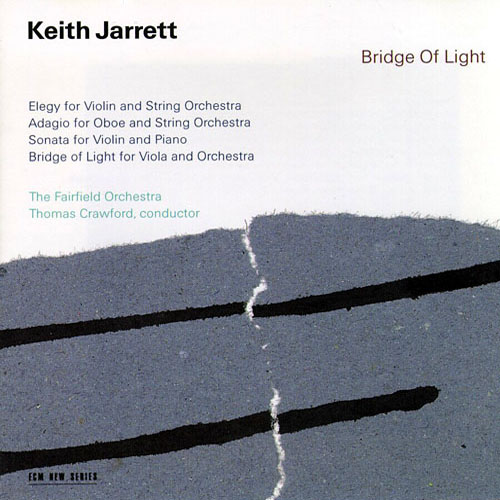
Keith Jarrett: Bridge Of Light (ECM New Series 1450)

Keith Jarrett
Bridge Of Light

The Fairfield Orchestra
Thomas Crawford conductor
Keith Jarrett piano
Michelle Makarski violin
Marcia Butler oboe
Patricia McCarty viola
Recorded March 1993, State University of New York, Purchase
Engineer: Peter Laenger
Produced by Keith Jarrett and Manfred Eicher

Keith Jarrett’s classical compositions tend to feel, not surprisingly, like an expanded piano in which the left and right hands come to be demarcated by greater instrumental forces. I also tend to hear the improvisational origins from which I imagine his music sprouts, as if the orchestra were simply channeling the pianist’s gift for spontaneous creation with due simultaneity. This is by no means a detriment to his efforts in this field, for it cleverly reconfigures the orchestra’s traditional physiognomy. Yet what I hear in the Elegy for Violin and String Orchestra that opens this striking disc is something altogether different from his previous efforts and, dare I say, more fully realized. Here, Jarrett approaches the orchestra on its own terms—cutting a path that is somewhere between the density of a symphony and the detail of a string quartet—in a deft exchange of pensive asides and grander responses. It is a piece about perseverance, reveling in its own structural integrity, and is one of Jarrett’s most painterly compositions.

The Adagio for Oboe and String Orchestra that follows pulls at the same threads, loosening knots that were once ironclad. The structure is therefore freer, amorphously shifting itself into a variety of shapes, while always maintaining the same spirit.

If I were to make any general statement about Jarrett’s classical music, it would be that his lead melodies possess a profound melodic drive. One can hear this most vividly in the beautiful Sonata for Violin and Piano that follows, and particularly in the second movement, “Song.” The Sonata features the composer at the keyboard and glows with a Mozartean charm. The music rolls off the fingers of both musicians with consummate ease and never lets up for a moment, always searching for a new field of expression in which to make itself known. The fourth movement, “Birth,” is, like its name implies, a liminal realm of uncertainty in which dissonance is creation. The third and fifth movements, both titled “Dance,” play with the shadows at the periphery, breathing with a whimsical, almost Bartókian flavor that soothes even as it invigorates.

The title work for viola and orchestra opens with a lush inhalation before the viola expels its rather mournful proclamation. Yet within that yearning a glimmer of hope slowly unfolds. The viola charts a consolatory path, feeling as if it were remembering a journey long past while also sharing those experiences as they happen. Two solo passages act like messengers as the music builds to a glorious ascent, then subsides into its gentle coda, where resolution seems but a natural extension of what came before.

The performers on Bridge Of Light make delicate work of Jarrett’s soundscapes, balancing reservation and overstatement with reverence. Moments of unity abound in which soloists and orchestra share the same breath. It is in these moments that we find glimpses of what makes us human, shaping our internal lives like the ceaseless flow of time.

<< Trevor Watts/Moiré Music Drum Orchestra: A Wider Embrace (ECM 1449)
>> Barre Phillips: Aquarian Rain (ECM 1451)

Gavin Bryars: Vita Nova (ECM New Series 1533)

Gavin Bryars
Vita Nova

David James countertenor
Annemarie Dreyer
violin
Ulrike Lachner viola
Rebecca Firth cello
The Hilliard Ensemble
Gavin Bryars Ensemble
Recorded September 1993 at Propstei St. Gerold and CTS Studios (London)
Engineers: Peter Laenger and Chris Ekers
Produced by Manfred Eicher

Nomina sunt consequentia rerum.
(Names are the consequences of things.)
–Dante

The music of Gavin Bryars has always been a revelation in my life, and it all began with this 1994 album. In my opinion still one of ECM’s finest New Series releases, Vita Nova is the perfect introduction to the composer’s heartfelt musical cosmos.

Incipit Vita Nova (1989), for male alto and string trio, sets the short Latin phrases that appear in Dante’s otherwise Italian La Vita Nuova. The title means “A new life is beginning” and the piece was written to celebrate the birth of a child, aptly named Vita, to his close friends. That this “new life” was the inspiration for a piece on that very subject imbues the music with the mystery of creation. Its etherealness cannot be overstated, and anyone who adores the voice of David James may find no better showcase for it. The piece swells into audible existence, bobbing like a petal on water that stays in place as waves roll beneath it. From these languid beginnings James ravels into his own life as the strings apply a more pronounced rhythm, each weaving through the others with the deftness of divine messengers. James negotiates the text with a practiced throat, though every instrument has its moment, the cello navigating the words “Omnis vita est immortalis” (All life is immortal) like a thread through a needle. There is an airy pause before the opening motif returns, this time in descending half steps, forging microtonal harmonies between voice and violin.

Glorious Hill (1988) was the result of a Hilliard Ensemble commission. The text is from Pico della Mirandola’s Oration on the Dignity of Man and imagines a dialogue between God and Adam. Here, Adam is graced rather than cursed with self-awareness—the sacred gift of personal re-creation given to no other creatures in God’s domain, where free will becomes the determinant of human nature. It is a breathtaking piece, and one in which James also figures vividly at the center of a veritable tapestry of choral sounds. But where in Incipit the strings supplemented James with “vocal” gestures, here those gestures are explicitly taken up by the human body, which renders notes with even more fragility. James spreads the text over this choral backdrop in a veneer of supplication as the tenors weave a central drone. Voice-pairs and solos emerge in turns, shifting weight with richly varied effects. Consequently, each section of text seems to be treated as its own full composition. Some are antiphonal, while others are densely polyphonic. The beautiful call of “O Adam” goes straight to the heart, upon which the tenors launch into sustained undulations, even as James charts the most inspiring regions of his unparalleled craft. Gordon Jones provides a few glorious moments of his own. This masterful piece is by far one of Bryars’s finest and ends in shining resolution, folding ever inward into solemnity.

Four Elements (1990) redirects our attention with a larger instrumental ensemble. Scored as incidental music for a ballet by Lucinda Childs, the piece characterizes Water, Earth, Air, and Fire through a variety of tonal and rhythmic combinations (one has to take such pieces with a grain of salt, for the ways in which one views primary elements differs with subjective experience). “Water” opens with an ominous thud and is dominated by bass clarinet and bells, making for a nocturnal, oceanic sound that betrays only the slightest indications of coastline through the fog. Swells of marimba and piano plow the darkness of “Earth.” The pace accelerates in “Air” with a healthy dose of brass, of which alto sax provides much of the melodic thrust before fading into the fluegelhorn-led “Fire,” ending with a slow reverberant finish as James intones a delicate flame.

Sub Rosa (1986) is another ensemble piece, if of a far more intimate persuasion. Dedicated to Bill Frisell, whose track “Throughout” from the ECM album In Line Bryars has re-imagined here, the piece is otherworldly. The central presence of a recorder lends it an antiquated flair and further enhances its enigmatic title. This is perhaps the most pensive piece on the album and speaks of a mind that is spiritually in tune with its own goals and means of achieving them. Beautifully ascendant passages from the violin are overlaid with alluring swaths of recorder, at times struggling against the most delicate of dissonances. The piano marks its path steadily and slowly with triadic arpeggios. Intriguing doublings and an ascendant chord progression make Sub Rosa all the more transitory in its beauty. It skirts the line between waking and dreaming, placing careful steps in a realm where the spirit speaks more fluently than the lips.

Anyone who finds fulfillment in the music of such ECM-represented composers as Arvo Pärt, Giya Kancheli, and Alexander Knaifel should feel rather comfortable being surrounded by this most august music. Bryars is a discovery to be cherished. Listen and be moved.

<< Peter Erskine Trio: Time Being (ECM 1532)
>> John Surman Quartet: Stranger Than Fiction (ECM 1534)

Bach: The French Suites – Jarrett (ECM New Series 1513/14)

J. S. Bach
The French Suites

Keith Jarrett harpsichord
Recorded September 1991, Cavelight Studio, New Jersey
Engineer: Peter Laenger
Produced by Manfred Eicher

Johann Sebastian Bach composed his so-called French Suites between 1722 and 1725 while still Kappelmeister to Prince Leopold. Although the title was a later addition and has nothing to do with its content (it is, if anything, Italian in form and convention), it does lend the collection a certain categorical charm. The first three suites are in minor keys, while the latter three are in major, leaving an invisible division to be drawn at their center. This does, in effect, create an open circle toward which one may bend an attentive ear at any point and still feel immersed in the suites’ totality.

As with his other Bach recordings for ECM, Keith Jarrett shows himself to be more than comfortable at the harpsichord, threading as he does a distinctive legato pacing into that instrument’s penchant for separation. In Jarrett’s hands, the music generally hovers in mid-tempo. He arpeggiates chords beautifully (note, for example, the Courante of Suite No. 1), approaches the more courtly dances (Allemande of Suite No. 2) with explicit grace, and puts plenty of meat on the bones of his trills (Gigue of Suite No. 1, Menuet of Suite No. 3). He also elicits a strikingly rich tone from the instrument’s middle range (Allemandes of Suite Nos. 2 and 3; Polonaise of Suite No. 6), and in others cultivates a gorgeously voluminous sound (Courante of Suite No. 2). Not surprisingly, Jarrett excels in the faster movements, and nowhere more so than in the Gigues (especially those of Suites Nos. 2, 3, and 4), yet the slower movements also convey a great humility. This isn’t merely because of his astounding virtuosity, but also because of his ability to expand the space in which he operates and because ECM highlights this expansion accordingly through attentive recording. Suite No. 4, with its touching Sarabande and luscious Air, provides some of the most varied atmospheres within any one suite. Suite No. 5 is another rich bouquet, its Allemande perhaps the most exquisite moment of the entire set. The Courante is wonderfully syncopated, while the Gavotte delights with its circuitous melody. The Gigue here is one of the album’s brightest highlights, combining a range of techniques in a spirited display of Shepard scale-like denouement. The Courante of Suite No. 6 flies off Jarrett’s fingers with ease, and the stately Gigue of the same brings everything to a masterfully contrapuntal conclusion.

On the whole, Jarrett performs splendidly. His technique is consistent, impassioned, and stripped to its essentials. These works may abound with courtly flair, but they also break from any of the restrictions that the circumstances of their composition might imply into moments of sheer enchantment. These suites are emotional endeavors through and through, and though they may not always be as consistently enthralling as some of Bach’s “heavier” works for keyboard, they duly remind us that it is never simply the artist’s responsibility to render such music captivating, but also ours as listeners to realize that not all music has to be in order to work its way into our hearts.

<< William Byrd: Motets and Mass for four voices (ECM 1512 NS)
>> Garbarek/Brahem/Hussain: Madar (ECM 1515)