Lester Bowie: The Great Pretender (ECM 1209)

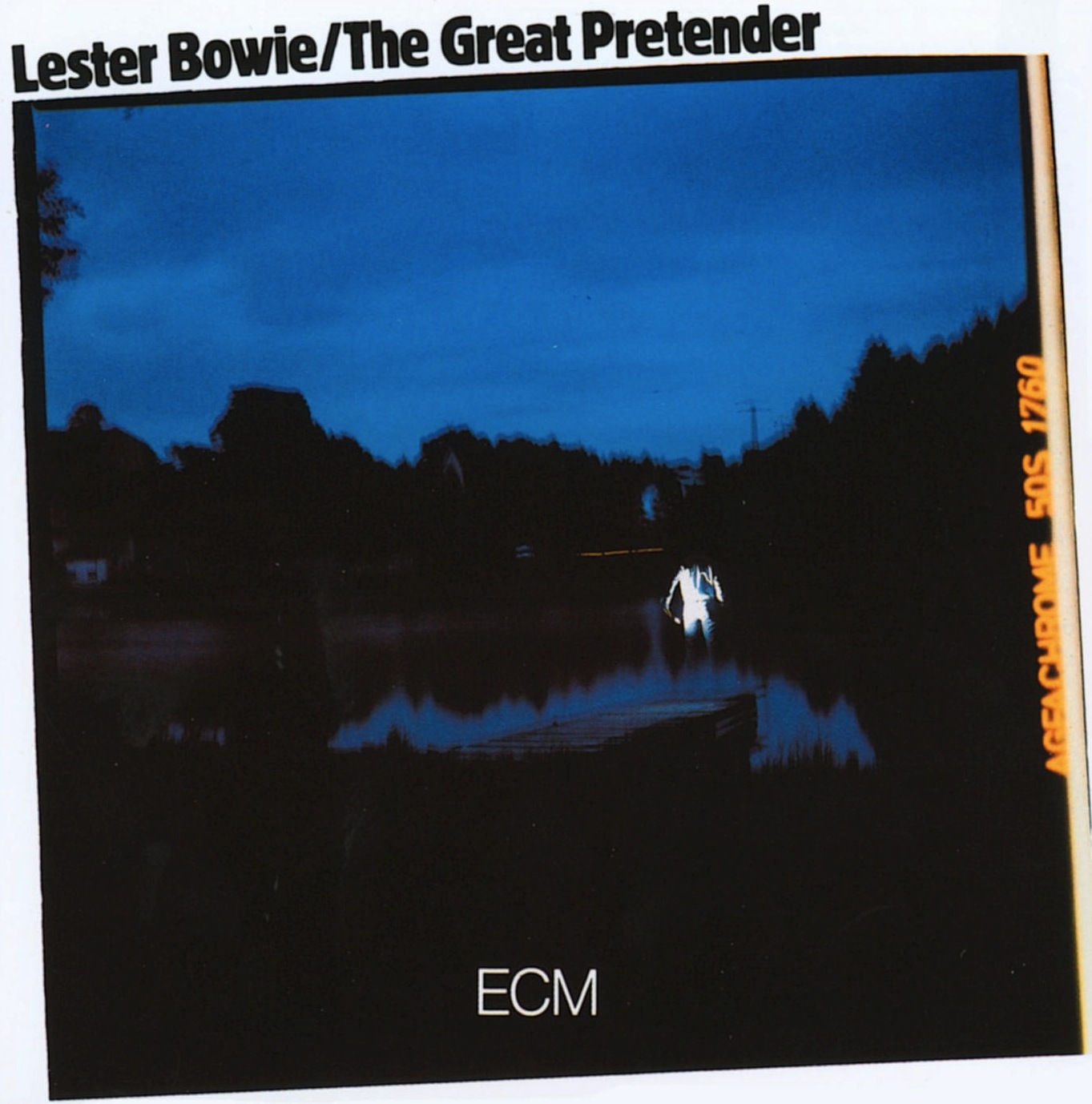
Lester Bowie
The Great Pretender

Lester Bowie trumpet
Hamiet Bluiett baritone saxophone
Donald Smith piano, organ
Fred Williams basses
Phillip Wilson drums
Fontella Bass vocal
David Peaston vocal
Recorded June 1981 at Tonstudio Bauer, Ludwigsburg
Engineer: Martin Wieland
Produced by Manfred Eicher

The title cut on Lester Bowie’s The Great Pretender comes of course from The Platters, the influential vocal group whose other hits, “Only You” and “The Magic Touch,” catapulted the group’s success through the rock n’ roll charts of the 1950s. Bowie’s investment in popular music’s connections to jazz set him a world apart. Second perhaps only to 1978’s The 5th Power, his debut for ECM as leader works wonders with its namesake. Where the original opens with quiet fortitude, this massive 17-minute rendition does so even more, the pianism of Donald Smith breathing a soulful mist upon a landscape that sometimes swirls with unanticipated gales. Fontella Bass and David Peaston are our doo-wop backups, their presence making the music that much more phenomenal. From Hamiet Bluiette’s heady baritone solo to the swampy rhythm section, Bowie has plenty of gum to chew in his horn.

No Bowie experience is complete without an inoculation of whimsy, and this we get in his rendition of “It’s Howdy Doody Time.” Phillip Wilson’s bright snare and Bowie’s fluttering elaborations share the air with Smith’s long slides. These morph into an evocative Fender Rhodes in “When The Doom (Moon) Comes Over The Mountain,” a wild chase backed by Fred Williams’s popping electric bass and the late-night sprawl of Bowie’s blatting. What begins as an overused Latin riff in “Rio Negroes” quickly transforms into a foray of architectural proportions secured by solid improvisational beams. Rich bass lines and rim-work carry us out in style. “Rose Drop” again looks through a glass playfully, only this time with a deeper drop. The tinkling of toy piano sparkles in Bowie’s waning sunlight, overflowing with half-remembered sentiments, each a photograph pasted in a scrapbook like no other.

Lester Bowie is like the moon. His is a field that waxes and wanes, haunting us with intimations of a distinct face, even as it harbors a dark side that we never get to see, except through the grace of studio technology, which allows us a glimpse the deeper intimations of his craft. We get this most readily in “Oh, How The Ghost Sings,” which from the evocative title to its flawless execution rings with the after-effects of a temple bell, the actual striking of which we never hear, and ends on a protracted, distant wail.

The material on The Great Pretender is all great and lacks a single pretender, and has been deservedly consecrated among ECM’s Touchtones.

<< Lande/Samuels/McCandless: Skylight (ECM 1208)
>> Gary Peacock: Voice from the Past – PARADIGM (ECM 1210)
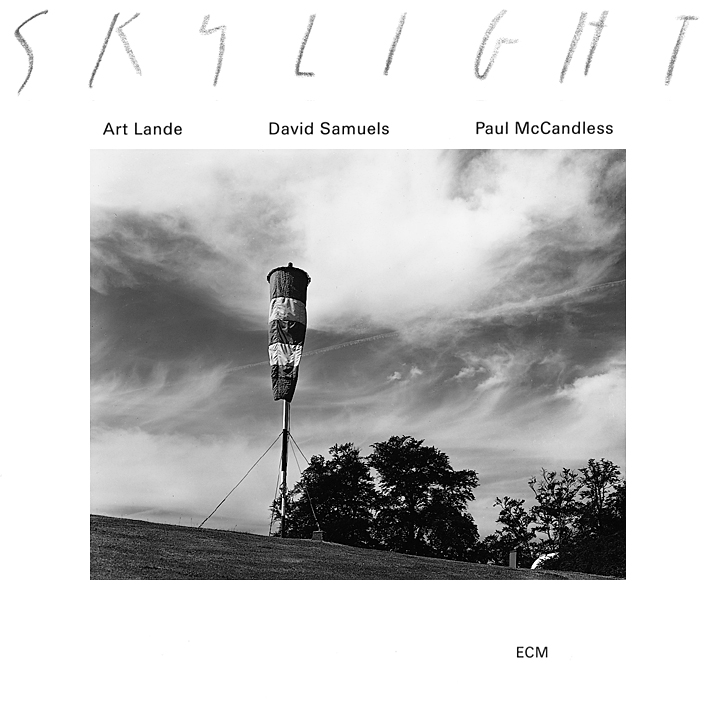
Lande/Samuels/McCandless: Skylight (ECM 1208)

ECM 1208

Skylight

Paul McCandless soprano saxophone, English horn, oboe, bass clarinet, wood flute
Art Lande piano, percussion
David Samuels vibraharp, marimba, percussion
Recorded May, 1981 at Tonstudio Bauer, Ludwigsburg
Engineer: Martin Wieland
Produced by Manfred Eicher

As one of the finest mallet players of his generation, Dave Samuels has treaded a wide and multifarious path. From Double Image (his gorgeous project with David Friedman) to the exciting territories of his work with the Caribbean Jazz Project (some of the best Latin jazz around), not to mention his fruitful years with Spyro Gyra, Samuels brings a signature delicacy to his playing that is comforting and domestic. His first two intersections with ECM, Dawn and Gallery, are both sadly out of print but make a flowing trilogy of sorts with 1981’s Skylight, which thankfully is still available and marks his last appearance on the label. Joined by one-and-onlys Art Lande and Paul McCandless, Samuels shows us his compositional brilliance in the airy title cut. Not to be outdone, Lande and McCandless offer two tunes apiece. Lande’s territories are more contradictory in their energies, at once twilit and dripping with morning dew, and undeniably engaging. The reed work of McCandless is awesome in its quiet power, particularly in his “Willow,” which closes the album in unified pleasure. Two improvisations round out this overlooked effort. The loamy tales of a bass clarinet thread every monochromatic turn of “Duck In A Colourful Blanket (For Here),” while the interludinal “Ente (To Go)” stands as one of the most effective pieces to employ a thumb piano I’ve heard in a long time.

While the album’s title may refer to an architectural feature, here one encounters its meteorological meaning (“the diffuse light from the sky, scattered by air molecules, as distinguished from the direct radiation from the sun”) in full. With a blend of joy and sorrow that is imaginative but never gaudy, this singular trio session shows us that, even in a darkening day there is music to be discovered.

<< Ralph Towner/John Abercrombie: Five Years Later (ECM 1207)
>> Lester Bowie: The Great Pretender (ECM 1209)

Ralph Towner/John Abercrombie: Five Years Later (ECM 1207)

1207 X

Ralph Towner
John Abercrombie
Five Years Later

Ralph Towner classical and 12-string guitars
John Abercrombie acoustic guitar, 12-string electric guitar, mandolin
Recorded March 1981 at Talent Studio, Oslo
Engineer: Jan Erik Kongshaug
Produced by Manfred Eicher

John Abercrombie is unique among guitarists in that whenever he becomes enraptured his sound becomes neither louder nor more pronounced but becomes somehow mysterious, liberated. Ralph Towner, on the other hand, revels in the crackling ruptures that so characterize his playing. Yet these roles seem reversed in this follow-up to the duo’s Sargasso Sea. A far more fragile carnation than its predecessor, it seems to forego the usual bag of tricks in favor of something more, as the album’s title would imply, reflective. This is especially apparent in the three improvisations with which the set list is dotted, and nowhere more so than in “Late Night Passenger,” where Abercrombie’s laddered filaments provide stunning berth for the other’s muted, jangling starlight.

As for composed pieces, Towner offers three, Abercrombie two. Among the former’s, the all-acoustic “Half Past Two” is a vibrating rib cage of biographical energies, and the most comely track on the album. The attraction continues with “Caminata” and on through the whimsy of “The Juggler’s Etude.” Abercrombie’s “Child’s Play” pairs electric and classical for a complementary sound, Towner’s shallower accents the caps on Abercrombie’s resonant stalks. Child’s play it may be in name, but in execution it is anything but. Yet it is in “Isla” that the reverie reaches new depths, the musicians’ negotiation of lead and backing effortlessly egalitarian. Such reciprocity is the keystone that keeps this arch from crumbling.

<< Gallery: s/t (ECM 1206)
>> Lande/Samuels/McCandless: Skylight (ECM 1208)

Gallery: s/t (ECM 1206)

ECM 1206

Gallery

David Samuels vibraharp, percussion
Michael DiPasqua drums, percussion
Paul McCandless soprano saxophone, oboe, english horn
David Darling cello
Ratzo Harris bass
Recorded May 1981 at Sound Ideas Studio, New York
Engineer: David Baker
Produced by Manfred Eicher

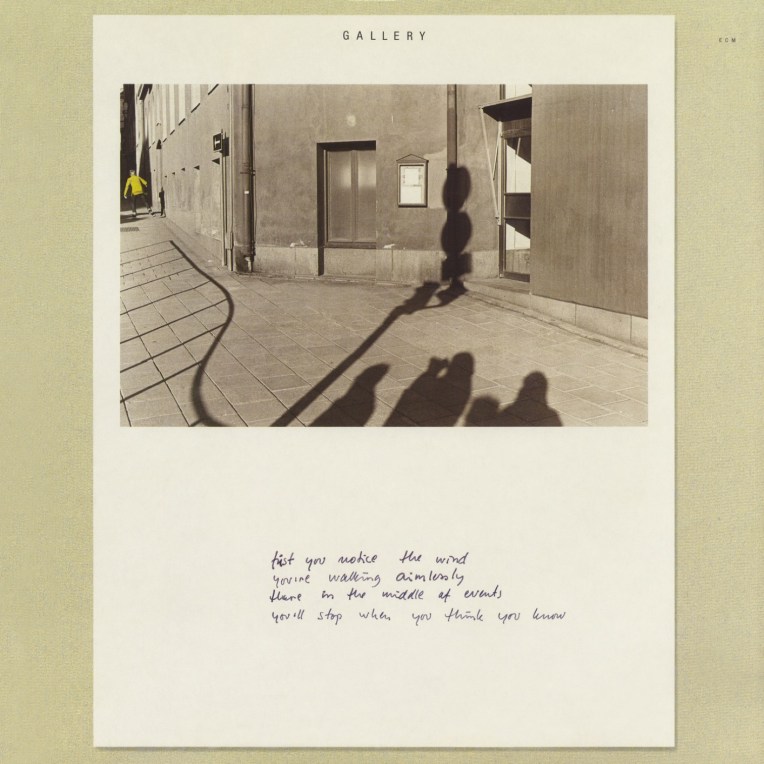
Another enigmatic outlier in the land of the as-yet-to-be-reissued, Gallery follows in the tender footsteps of First Avenue. Its talents are immediately sent skyward in “Soaring,” where the sprightly vibes of Dave Samuels find complement in bassist Ratzo Harris and cellist David Darling, both of whom roll off Michael DiPasqua’s delicate snare and cymbals like words from a poet’s tongue. Darling takes some of the album’s most gorgeous improvisatory turns here. His fluid lines continue in “Prelude,” a duet with Samuels that shares the same breath with “A Lost Game.” The latter is transitory, not unlike the album as a whole, playing out especially in the rhythmic crosspollination between vibes and drums, slung ever so delicately by the bass’s curves. Paul McCandless lays the gold foil of his own beauties with a soprano sax solo that takes this configuration to greater heights, surpassed only by the reflective cello that follows. “Painting” sounds like a Gavin Bryars ensemble piece, unfolding into the remnants of a Morton Feldman dream before awakening in the harmonic contract of a “Pale Sun.” On then does the “Egret” drop us in limpid vibrations, where only a hushed “Night Rain” shows us the final trail.

As the album’s title indicates, this music offers a row of artful images. Yet rather than guide us through a linear passage of creative relics, it brings that passage to us, so that we need only observe…and listen.

<< Old And New Dreams: Playing (ECM 1205)
>> Ralph Towner/John Abercrombie: Five Years Later (ECM 1207)

Old And New Dreams: Playing (ECM 1205)

ECM 1205

Old And New Dreams
Playing

Don Cherry trumpet, piano
Dewey Redman tenor saxophone, musette
Charlie Haden bass
Ed Blackwell drums
Recorded live, June 1980, Theater am Kornmarkt, Bregenz (Austria)
Engineer: Martin Wieland
Produced by Manfred Eicher

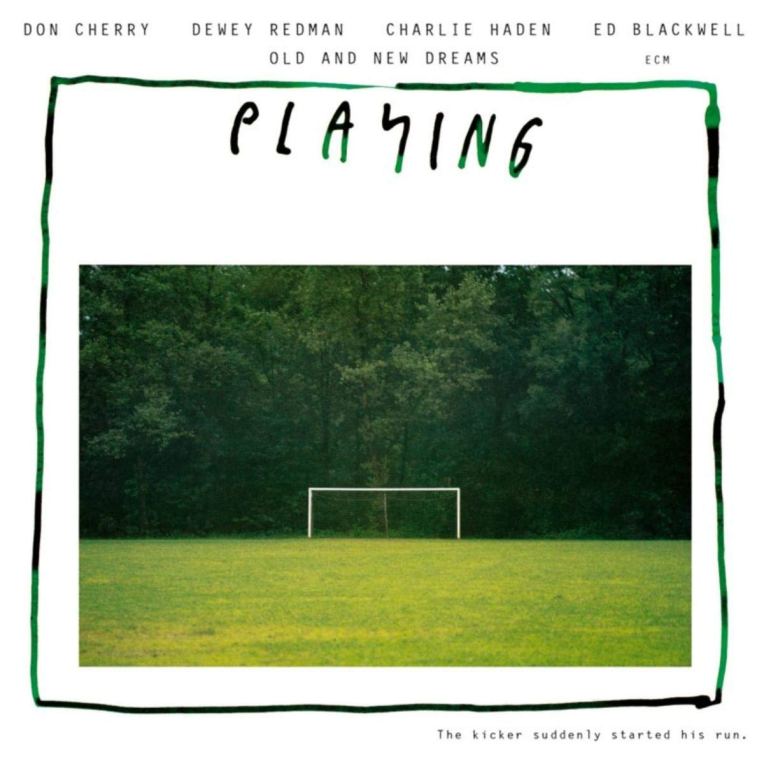
This fantastic set, recorded live in Austria, is the place to start for anyone wanting a glimpse into the attic of Old And New Dreams. The playing is on point, the crowd riled, and the stakes high. From that first lively jump into “Happy House,” one of three extended Ornette Coleman tunes, we are plunged into the group’s quintessential sonic parameters. Lithe syncopations from Dewey Redman relate to Ed Blackwell’s drumming like family, while the free-flowing trumpeting of Don Cherry loosens its grip on predictability for a style that is utterly devoid of pretense and ever eager to communicate. Charlie Haden’s melodious plasticity completes a formula that carries through to the last drop. Just listen to the gut-wrenching tenor solo in “New Dream,” the liquid horns and percolating toms of “Broken Shadows,” where Redman’s musette also unfurls for a fantastically CODONA-like sound, and tell me there isn’t something special going on here.

Cherry drops a groovy hit of his own with the pointillist “Mopti,” of which the infectious pianism from the composer and attuned percussion delight. Redman contributes “Rushour,” the album’s most incendiary flush. The incredible saxophonism and expansive lyric trumpeting spread their joys far and wide. The title track comes from the hand of Haden, around whose spine horns weave like a medical caduceus before being lobbed back into their familiar station like ping-pong balls at the ready.

Considering the heft of talents assembled here, the results are weightlessly executed. This shows not weakness or lack of fortitude, but the maturity everyone brings to the sonic table. This is a solid date from musicians who know the business inside and out, and then some. About as good as it gets. Reissue, anyone?

<< Egberto Gismonti: Sanfona (ECM 1203/04)
>> Gallery: s/t (ECM 1206)

Egberto Gismonti & Academia de Danças: Sanfona (ECM 1203/04)

ECM 1203_04

Egberto Gismonti
Academia De Danças
Sanfona

Egberto Gismonti piano, guitars, Indian organ, voice
Mauro Senise saxophones, flute
Zeca Assumpção bass
Nene drums, percussion
Recorded November 1980 at Talent Studio, Oslo, and April 1981 at the Amerika Haus, München
Engineer: Martin Wieland
Produced by Manfred Eicher

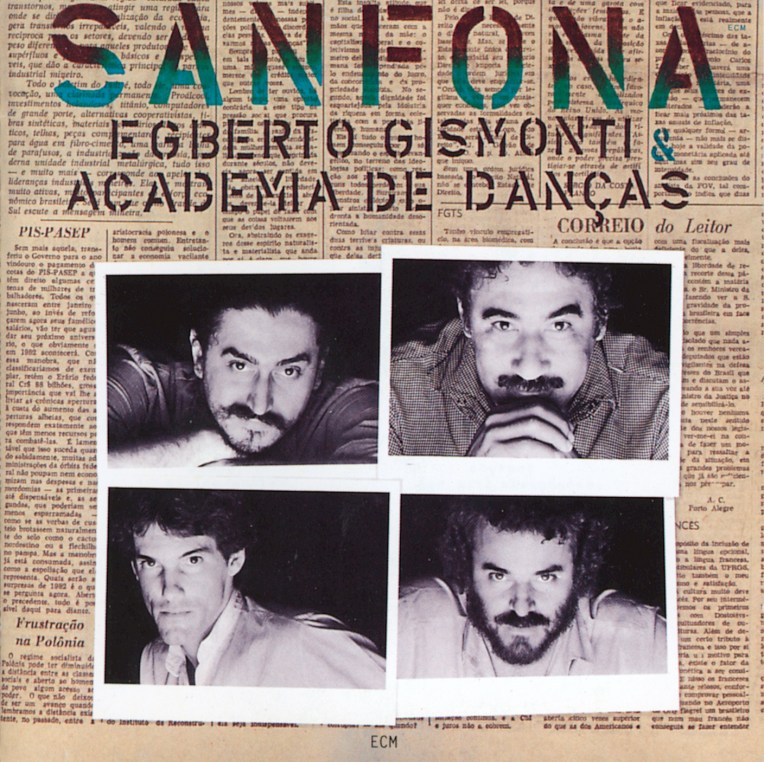
For his third ECM effort, renaissance man Egberto Gismonti offers a classic diptych. The first half is a heaping helping of originals played with his Academia de Danças quartet, the second a live solo set from Munich. One can hardly listen to Gismonti at his best without being there to catch every story as it falls through the cracks. Everyone’s story will be different. Here’s one:

The accentuating winds of “Marcatu” waft past our noses. The scent is moist, hinting at lichen. Our breathing quickens us as we climb into thinner air, compensated by a majestic and quiet beauty in all directions. Gismonti’s piano introduces itself as the traveler who will be our guide. As he works his magico on the keys, bass (Zeca Assumpção) and drums (Nene) assume his lead, leaving Gismonti running with a saxophone (Mauro Senise), and us, following close behind. Every gesture of “10 Anos” is another footstep tracing the outskirts of a place unknown. And without knowing it, we have become one person. We wish to introduce ourself to the new community in the vale, into which we have now crossed. Drums nip at our heels as we find ourselves propelled by the downward slope. We are welcomed with ceremony in “Frevo.” But then, a lone figure cuts through the celebration, bringing with him the possibility of destruction. Instead, he shows us the wisdom of local ways, observing proper form in the presence of new life, the possibilities of love, and the realities of an ever-changing kinship. As the forest yields ancestors’ whispers, that their progeny might better survive, so too are voices encamped here among their people, where fires burn low and judgments even lower. Yet somewhere in the shadows, the saxophone lies in wait, trickster in disguise. Whatever mischief lies in store, however, is dispelled by the crystalline joys of “Lôro.” Here we find rebirth, brought forward to a council of harmony.

A four-part tribute follows, an epic in true Gismontian fashion. This time around, his guitar returns cloaked in the shadows of pianism, carried by an airborne saxophone. Every fluted note is an ensnared animal, gift of the hunt and of the gather. Recounting those undeniable moments of community that embraced us, we hear the voices of our own past in the harmonium, bleeding into guitar and drums. From this tenderness emerges “De Repente,” an engaging 12-string interlude that could give Gustavo Santaolalla a run for his money any day. And run it most certainly does, as if after spending time in the village, we find our heart also ensnared, only now by the life we abandoned on our way to getting here. And so, we take these feet and put them to the ground as quickly as they will, running hand-in-hand with the person we once were. The Ralph Towner-like diction here makes for one of Gismonti’s most captivating solo pieces. In our wake we leave the lamenting “Vale Do Eco.” The newly escaped continues in our place, lost and alone. In “12 De Fevereiro” we become her lullaby as she lays herself among the ferns and slumbers. And there she stays until a new village grows in her place, her dream at last realized in “Carta De Amor” before making her final leap into a rare green flash that halos the setting sun.

This album is a perfect example of what “World Music” really should be: not music of this, or any, world, but music that is a world in itself. Arguably Gismonti’s best date on any label and an essential one for your collection.

<< Keith Jarrett: Invocations/The Moth And The Flame (ECM 1201/02)
>> Old And New Dreams: Playing (ECM 1205)

Keith Jarrett: Invocations/The Moth and the Flame (ECM 1201/02)

ECM 1201_02

Keith Jarrett
Invocations/The Moth and the Flame

Keith Jarrett pipe organ, soprano saxophone, piano
Recorded November 1979 at Tonstudio Bauer, Ludwigsburg (The Moth and the Flame) and October 1980 at Ottobeuren Abbey (Invocations)
Engineer: Martin Wieland
Produced by Manfred Eicher

Among ECM’s many mainstays, Keith Jarrett would seem to have been given the most freedom, and it is within that freedom that he excels. In this fascinating double album, a standout even in his extensive résumé, Jarrett fleshes a sparse skeleton with intimate venation. The first half consists of Invocations, a meditative dialogue between organ and soprano saxophone. The latter alone bookends this antiphonal “text” with self-effacing distance. Equal parts hope and doubt, every word both a star and the supernova that ends it, Invocations ranks among Jarrett’s most introspective works. Of the organ solos, “Mirages, Realities” is the profoundest example. Building over a steady pulse, it is more akin to Arvo Pärt’s Mein Weg hat Gipfel und Wellentäler than to anything in the Jarrett oeuvre. In its lilting phrases, one finds a backward fall into a void where only sound describes reality. On the other hand, the lofty chords and denser architectures of “Power, Resolve” and “Celebration” clearly recall Jarrett’s Spheres. The most affecting verses, however, are to be found when organ and saxophone unify, especially in “Recognition,” which stretches the listener in opposing directions, only to meet in self-realization.

After the suspensions of the program’s first half, the five-part The Moth and the Flame floats a thousand pianistic lotuses—and with no less grand a sweep. Between the heartland spirit that permeates Part II and the iron-and-air elegy that is Part V, Jarrett maps out a tessellation of emotion, not unlike the spirals of Staircase. He winds his way with mirth through every dip of flight, splitting prismatically at the center in Part III. Like a spinning top, its myriad emotions funnel into a single point, wobbling until equilibrium is achieved.

This album, as much as any other in the Jarrett landscape, shows a deep commitment to personal development. He plows these instruments like the fields of his very heart. He is that moth, drawn to a musical flame which, rather than burning him, fuels his humanity all the more.

<< Jan Garbarek: Eventyr (ECM 1200)
>> Egberto Gismonti: Sanfona (ECM 1203/04)

Jan Garbarek: Eventyr (ECM 1200)

ECM 1200

Jan Garbarek
Eventyr

Jan Garbarek tenor and soprano saxophones, flutes
John Abercrombie guitars
Nana Vasconcelos berimbau, percussion, voice
Recorded December 1980 at Talent Studio, Oslo
Engineer: Jan Erik Kongshaug
Produced by Manfred Eicher

A strange flute it was! It emitted a note as sustained as the whistle of a steam-engine, but much more powerful. It penetrated through the whole manor, over the gardens, the woods, for miles out into the countryside, and with the sound of it came a great gust of wind roaring.
–From “Everything In Its Right Place” by Hans Christian Andersen (trans. L. W. Kingsland)

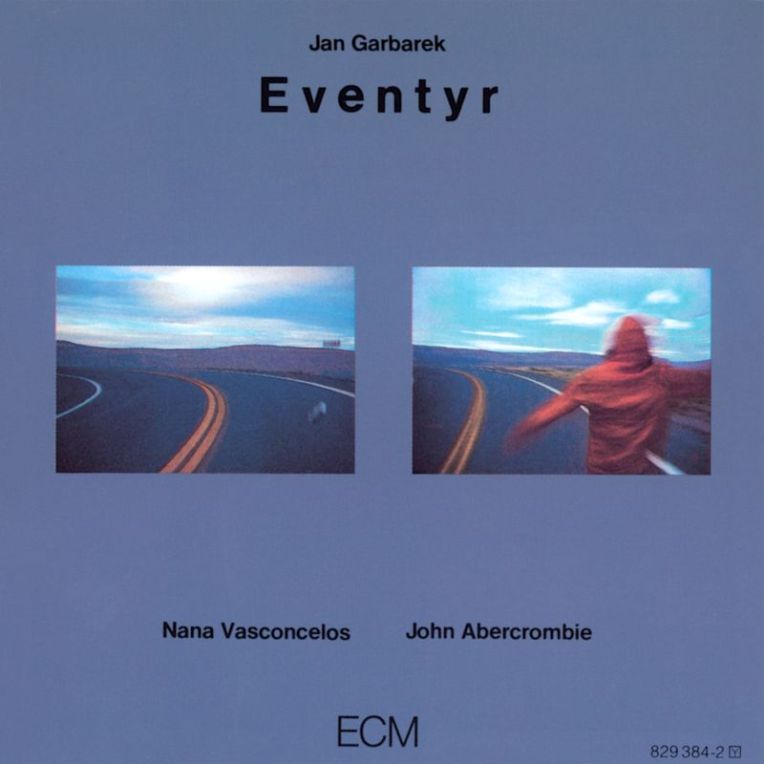
Eventyr means “adventure.” Classical listeners may also recognize it as the name of Frederick Delius’s lovely 1917 tone poem, which is often translated as “Once Upon A Time” to underscore its origins in the folk tale collections of Norwegian scholar Peter Christen Asbjørnsen. Here, the name adorns one of Jan Garbarek’s most recondite efforts to date and, like its own “Once Upon A Time,” houses a world of lessons and signs for those willing enough to interpret them. Joined by John Abercrombie and Nana Vasconcelos, he spins a string of seven improvisations, rounded out by a standard, “East Of The Sun And West Of The Moon” (Brooks Bowman), that doesn’t so much end the album as open us to its nebulous center. In that center we encounter swirls of majesty as only he can draw. With almost liquid fire and ever-insightful phrasing, Garbarek brings his deepest considerations to the nearly 12-minute “Sora Maria” that is its primordial soup. His interplay with Abercrombie resolves into a vague continent, where only the playful refractions of “Lillekort” resolve themselves into separate entities. Vasconcelos’s pliancy is the animating skeleton of the title track, in which his gravelly voice and ritualism exudes from every gamelan hit. In “Weaving A Garland,” tenor sax and guitar paint a rolling horizon of vegetation. Such shorter tracks as this and “The Companion” comprise the more potent incantations amid the long-form spells that otherwise dictate the album’s vocabulary. Transcendence comes in the form of “Snipp, Snapp, Snute,” a sparkling menagerie of triangles and wooden flute that works its light into a crepuscular sky. Through it we see in fine detail the inner life of three musicians whose nets run far into the cosmic ocean, where only transformation awaits in the catch.

<< Katrina Krimsky/Trevor Watts: Stella Malu (ECM 1199)
>> Keith Jarrett: Invocations/The Moth And The Flame (ECM 1201/02)

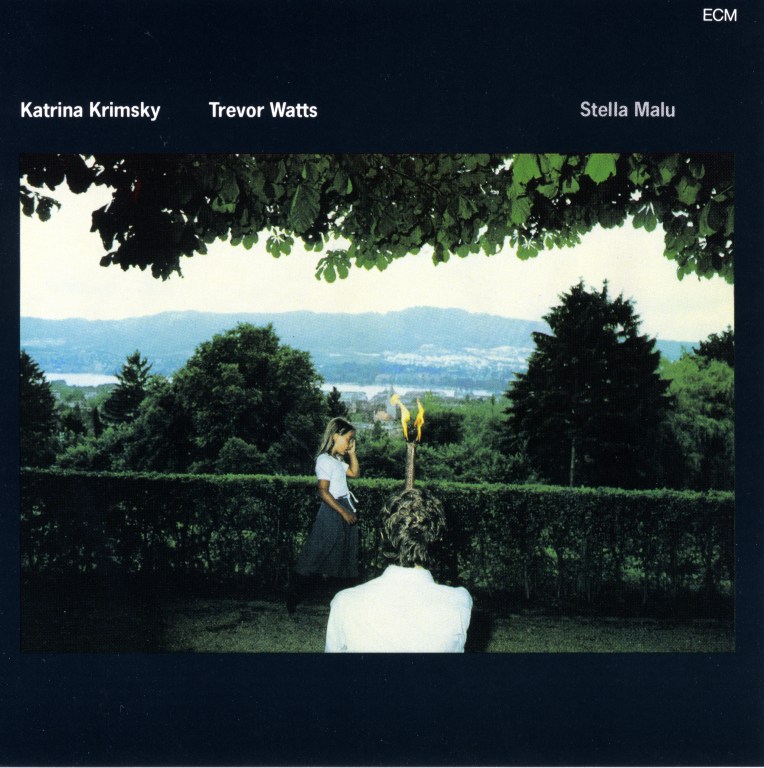
Katrina Krimsky/Trevor Watts: Stella Malu (ECM 1199)

ECM 1199

Katrina Krimsky
Trevor Watts
Stella Malu

Katrina Krimsky piano
Trevor Watts soprano and alto saxophones
Recorded March 1981 at Tonstudio Bauer, Ludwigsburg
Engineer: Martin Wieland
Produced by Manfred Eicher

Classically trained pianist and composer Katrina Krimsky began her distinctive musical career in 1968, when she joined Terry Riley and friends to record the world premiere of In C for Columbia Records. Since this momentous occasion, she has thrived as a commissioned performer, collaborator, and pedagogue. In this, her only album for ECM, she paired her venerable skills with those of English saxophonist Trevor Watts. These two voices, both pluralistic and utterly descriptive, coalesced into an unforgettable 38-minute contemplation of melody and space.

Having just recently seen Joshua Redman and Brad Mehldau in concert, the unique possibilities of saxophone and piano are fresh in my mind, and as I listen to this superb album anew I hope these possibilities continue to be explored (on that note, the more adventurous may want to check out Watts’s stimulating collaborations with Veryan Weston). Krimsky’s astrologically minded pianism is the heart of Stella Malu and so well engenders Watts’s free-flowing lines. Between the billowing vapors of “Mial” and the slice of exuberance that is “Villa In Brazil,” we find ourselves not so much caught as draped by the veils therein.

The reach of these two musicians stretches farthest in “Duogeny” and “Moonbeams.” The first is a stunner, rich in potent notecraft and development. It is also a fluid mixture of the mystic and the bluesy, pockmarked by a rain of reveries. The second breathes even more organically through the richly muted intonation of Watts’s alto. Beneath the latter’s solos, Krimsky leaves the sustain pedal down, allowing every breath to resonate in open strings.

Krimsky has two solo pieces, including the nostalgia-laden title track. But it is “Song For Hans” that captivates me most of all. It ripples with cinematic reality, sounding like an epilogue to a lost Theo Angelopoulos film. Watts enters the darkness alone in “Rhythm Circle.” This short but sweet soprano excursion swirls in its own afterimages. Along with the duet “Crystal Morning,” it steers into the album’s briskest territories, combing the fields like a persistent wind on its way to the sea.

For lack of a better comparison, Stella Malu falls somewhere between Keith Jarrett’s Gurdjieff tribute and John Surman’s Upon Reflection. The outdated, even if haunting, echo applied throughout in postproduction may irk some listeners, even as it coats the music with an historic charm. Regardless, it stands as one of ECM’s finest and an album that reveals more to be thankful for with every listen.

<< Steve Eliovson: Dawn Dance (ECM 1198)
>> Jan Garbarek: Eventyr (ECM 1200)