Pat Metheny: 80/81 (ECM 1180/81)

Pat Metheny
80/81

Pat Metheny guitar
Charlie Haden bass
Jack DeJohnette drums
Dewey Redman tenor saxophone
Michael Brecker tenor saxophone
Recorded May 26-29, 1980 at Talent Studio, Oslo
Engineer: Jan Erik Kongshaug
Produced by Manfred Eicher

With 80/81, Pat Metheny took one step closer to his dream of working with The Prophet of Freedom (a dream he finally achieved with 1985’s Song X), and what better company than Coleman alumni Charlie Haden and Dewey Redman, both fresh off the boat of Keith Jarrett’s newly defunct American Quartet and both welcome additions to the extended Metheny family. Along with the technical mastery of reedman Mike Brecker and drummer Jack DeJohnette, plus a dash of post-bop spice, the result was this still-fresh sonic concoction. The atmospheres of the opening “Two Folk Songs” invite us with that expansive pastoralism so characteristic of Metheny. This makes Brecker’s highly trained yet raw stylings all the more marked, bringing as they do a sense of presence that explodes into a million pieces. Metheny’s benign sound catches at the threshold of perfection with every turn of phrase, allowing Brecker fiery bursts of abandon. DeJohnette throws on a log or two with his rocketing solo, while Haden wipes the slate clean with shadings of his own. Metheny shows off his unparalleled command of two-string harmonies, fading on a lightly skipping snare. This feeling of perpetual motion lingers throughout the title track. Content in sharing the revelry, Metheny relays to Redman who, though he may not fly as high, emits no less intensity in his groove. “The Bat” gives us a minor-keyed shadow of “I’ll be Home for Christmas” before diving headfirst into Coleman’s “Turnaround.” This trio setting boasts inventive melodies and a plunking solo from Haden. “Open” is, suitably enough, the freest track on the album, emboldened by trade-offs between Redman and Brecker, while “Pretty Scattered” dances more lithely with John Abercrombie-like exuberance. A ringing high from Metheny laser-etches this track into our memory. Balladry abounds in “Every Day (I Thank You),” one of his most gorgeous ever committed to disc. This is music that grins even as we grin, and shines through the darkest cloud of a Midwestern storm. Metheny ends alone with “Goin’ Ahead.” This breath-catching piece works its farewell into our hearts with every suspended note, effortlessly walking the beaten path of all those souls who have traveled before, so that those yet to be born might know where they come from, and to where they might return.

Like much of what Metheny produces, 80/81 is wide open in two ways. First in its far-reaching vision, and second it its willingness to embrace the listener. Like a dolly zoom, he enacts an illusion of simultaneous recession and approach, lit like a fuse that leads not to an explosion, but to more fuse.

<< Bengt Berger: Bitter Funeral Beer (ECM 1179)
>> Corea/Burton: In Concert, Zürich, October 28, 1979 (ECM 1182/83)

Bengt Berger: Bitter Funeral Beer (ECM 1179)

ECM 1179

Bengt Berger
Bitter Funeral Beer

Bengt Berger ko-gyil (Lo Birifor funeral xylophone)
Don Cherry pocket trumpet
Jörgen Adolfsson violin, sopranino, soprano and alto saxophones
Tord Bengtsson violin, electric guitar
Anita Livstrand voice, bells, axatse (rattle)
Recorded January 1981 at Decibel Studios, Stockholm
Engineer: Thomas Gabrielsson
Produced by Manfred Eicher and Bengt Berger

Swedish percussionist Bengt Berger’s deep interest in Ghanaian folk music and Don Cherry’s wayfaring trumpet inform every moment of this stunning record, one of a handful in ECM’s back catalogue to be digitally unearthed, not unlike the site on the cover. In contrast to many likeminded projects since, which seek to augment the “indigenous” with the “ingenious,” in the dregs of Berger’s we encounter something all too rare in the world music market: unforced sincerity. Take, for instance, the song that forms the Kundalini spine of the title track. The eclectic listener will recognize it as the sampled hook in “Hypnoculture” by Tears for Fears frontman Roland Orzabal. While in the latter it adds a touch of the “exotic” where really it isn’t needed (to Orzabal’s credit, the song is, like all on the solo album on which it appears, a sketch of ideas and not meant to be taken as a definitive statement on anything), here it thrives in an utterly organic assemblage. The addition of thumb piano and rooted drumming heighten the sense of immediacy that pervades the album, and not even the reeds of Jörgen Adolfsson feel out of place. The ululations of vocalist Anita Livstrand hit the psyche like the paroxysms of Mary Margaret O’Hara in Morrissey’s “November Spawned a Monster.” The acutely percussive “Blekete” is a walkabout into a land that is as corporeal as it is immaterial. Cherry is the brightest ember in the hearth that is “Chetu,” which continues the trance. The Fela Kuti-like drive of “Tongsi” beckons us with open arms before leaving us in the care of “Darafo.” This funereal dance begins with more pronounced instrumentalism, presenting us not with a mystery to be untangled, but rather a clear set of variables to be re-tangled into the mystery from which they came. The infectious soloing tightens into a record scratch of ecstasy, leaving only the ever-present beat to navigate the inevitable fade.

As with the work of CODONA, Bitter Funeral Beer epitomizes ECM’s pioneering approach to the world music idiom. Integration is the keyword here, collectivity its modus operandi. Each voice is well-fermented, so that one always gets the feeling of listening to a field recording and not a piece of studio trickery. This is music that accepts us as we are and allows us the opposite of escapism: a pure awareness of the cavernous self that defines the open channels of our communities.

One of ECM’s absolute finest and a window into the label’s evolution toward a sound-world without borders. As bitter as this beer is, one sip is all you’ll need to convince yourself that the cup must be drained.

<< Barre Phillips: Music By… (ECM 1178)
>> Pat Metheny: 80/81 (ECM 1180/81)

Barre Phillips: Music By… (ECM 1178)

ECM 1178

Barre Phillips
Music By…

Barre Phillips bass
Aina Kemanis voice
John Surman soprano and baritone saxophones, bass clarinet
Herve Bourde alto and tenor saxophones, flutes
Claudia Phillips voice
Pierre Favre drums, percussion
Recorded May 1980 at Tonstudio Bauer, Ludwigsburg
Engineer: Martin Wieland
Produced by Manfred Eicher

Long before Twitter was a microblogging phenomenon, it was the name of the first cut on this out-of-print gem from Barre Phillips. Thankfully, there is nothing micro about it. Driven by train-like syncopation from drums and bass clarinet, this attention-grabbing burst of virtuosity introduces us to the bubbling acrobatics of daughter Claudia Phillips, a vocalist whose career as chanteuse found a niche in France in the 80s. Her sometimes-manic instincts are swept down the stream of Aina Kemanis, the voice of Journal Violone II. Together they form a magic triangle with John Surman’s own sinewy lines. With such exuberance and glottal depth as Claudia displays here, one can hardly keep one’s ears focused on anything but her brilliance. Her siren-like spindles prove to be a guiding force in the more freely improvised “Angleswaite” and, with Kemanis, trace fluid arcs in “Elvid Kursong” and drop like spores in “Pirthrite.” The latter is a bizarrely martial excursion that is at once march and requiem, made all the more so through the liquid alto of Herve Bourde. These facets contract into a single plane in “Longview.” Here, Claudia comes to life in a bubbling stutter, soon overtaken by Bourde’s tenor, left of center. “Entai” and “Double Treble” sound like an ice-skating bass and clarinet struggling for balance over a warping record, compressing the album into more rudimentary ciphers.

This is yet another fascinating cell in the stained glass window that is Barre Phillips, capturing both the thrill and pain of modernism and those quiet moments, few and far between, where the soul kisses the brow of alienation. The content is brought to fervent life by an impassioned participation that frolics at the intersection of speech and song. As a longtime fan of the Cocteau Twins and Elizabeth Fraser’s voice that drives it, I have sometimes wondered what she might have sounded like had she made an ECM album. With Music By… we begin to approach one possible answer.

<< Walcott/Cherry/Vasconcelos: CODONA 2 (ECM 1177)
>> Bengt Berger: Bitter Funeral Beer (ECM 1179)

John Clark: Faces (ECM 1176)

John Clark
Faces

John Clark french horn
David Friedman vibraharp, marimba
David Darling cello
Jon Christensen drums
Recorded April 1980 at Talent Studio, Oslo
Engineer: Jan Erik Kongshaug
Produced by Manfred Eicher

Faces documents the only appearance of versatile French hornist John Clark on ECM proper (he does, however, appear on a trio of WATT releases) and is one from a modest overall output as leader. Having performed with musicians as diverse as Paul Winter, LL Cool J, and Gil Evans, his tender considerations fit snugly with the Eicherian touch in this out-of-print session. Joined by David Friedman’s mallets, the particularly welcome presence of David Darling’s electric cello, and Jon Christensen on drums, Clark paints for us a rain-slicked character study of a life lived in slow motion.

Side A charts the album’s deepest waters in “The Abhà Kingdom.” Its understated flow of vibes, overdubbed horns, and cello courses in and out of sonar range, diving ever deeper with every muted clench, so that even Christensen’s accentuations seem to move at the speed of honey behind Friedman’s subdued yet strangely exuberant cartwheels. The afterimages of “Lament” would make the perfect backdrop for a Terje Rypdal excursion. Instead of that grinding song, we get the rounded icicles of Darling’s bow and the sustained arpeggio from vibes that leaves us hanging before dropping us onto Side B. Our guide on this descent is “Silver Rain.” The marimba vamp evokes an African thumb piano and affectionately embraces Clark’s processed horn. Friedman also shares a notable dialogue with Christensen here. Darling’s fluid threads are the binding force of “Faces In The Fire.” A comforting feeling of perpetuity abounds in that cello’s voice and brings out otherwise inaudible whispers. “Faces In The Sky” would feel right at home as the soundtrack for a road picture. Christensen beguiles with his delicacy, in which he cradles a delicate implication that never breaks, even under Darling’s far-reaching pizzicato. After all of this soul-searching, the carnivalesque “You Did It, You Did It!” ends the album in resolute jubilance.

Faces has a semi-porous quality and shimmers like the surface of an out-of-focus pool. It sits comfortably just below the rim of our consciousness, like a half-dream that one holds dear in the face of inevitable wakefulness.

<< Keith Jarrett: The Celestial Hawk (ECM 1175)
>> Walcott/Cherry/Vasconcelos: CODONA 2 (ECM 1177)

Keith Jarrett: The Celestial Hawk (ECM 1175)

Keith Jarrett
The Celestial Hawk

Keith Jarrett piano
Syracuse Symphony
Christopher Keene conductor
Recorded March 1980, Carnegie Hall, New York
Engineer: Stan Tonkel
Produced by Manfred Eicher and Keith Jarrett

Keith Jarrett’s classical modality often comes across to me as a dark pastoral, a variegated tapestry of intensity and withdrawal. And while The Celestial Hawk may be no different in this regard, it promises some brighter discoveries upon deeper listening. Against a gentle backdrop of percussion that includes timpani, snare, and triangle, Jarrett deploys his tiny fleets of high notes in the First Movement, out of which arises a delicate harp ostinato, doubled by piano and accentuated by woodwinds and strings, as a crystalline glockenspiel slowly clouds into less translucent ores. After a deep surge, Jarrett rows us into calmer waters alone at the piano, where dolphins in the forms of harp and mallet percussion soon join him. The Second Movement offers up the most cinematic passage of this piece. One can feel its images running, skipping, and emoting through lives unseen. We never stay in one thread for too long, for each is picked up by another into which the previous one has looped itself. The martial snare and cavalrous brass of the Third Movement glisten with the patriotism of an undiscovered country, bound to a manifest destiny in which walking is like flight. From behind the uplifted curtain, horns dance for us a message to prosperity. And yet even as the twilight descends, the oboe threads a ray of moonlight through the waters, bringing with it all sense of time for which beauty is but an afterthought to the truer beauties of slumber, where life ends in a crashing gong.

Despite being very programmatic, this music is far more than incidental to the narrative it describes. At times tumbling in billowy romance, at others even jarringly uncomfortable, Jarrett’s piano embraces itself, following the orchestral advice that surrounds it to the letter. It is an honest music, a painful truth, a call for peace in a violent world.

<< Keith Jarrett: Sacred Hymns of G. I. Gurdjieff (ECM 1174)
>> John Clark: Faces (ECM 1176)

Keith Jarrett: Sacred Hymns of G. I. Gurdjieff (ECM 1174)

ECM 1174

Keith Jarrett
Sacred Hymns of G. I. Gurdjieff

Keith Jarrett piano
Recorded March 1980, Tonstudio Bauer, Ludwigsburg
Engineer: Martin Wieland
Produced by Manfred Eicher

The exact date on which George Ivanovich Gurdjieff was born into this world is unknown. This is fitting, for to one who spent his life trying to unravel it, such mundane details would have been unnecessary in the grander scheme of things. Born in Armenia to a Greek father and Armenian mother, Gurdjieff traveled the world in search of fabled monasteries and the secrets they contained. Unlike many before and since, he succeeded. Yet more unlike many before and since, he packed that knowledge into his somatic consciousness until it burst like a supernova. Biographer John Shirley likens the Gurdjieff encounter to a cold shower, “a welcome shock of wakefulness” that leaves its deep, indelible traces in body and soul. Music was the dark matter of his cosmology and operated at the whim of an inarticulable law by which the listener felt compelled to turn oneself inside out, loosing previously bottled emotions into the open stars. Music was vibration, and vibration was life itself. In the hands of an artist like Keith Jarrett, I daresay it becomes something more.

Composed during Gurdjieff’s so-called “second period,” the music on this album arose from a fruitful block of the 1920s, which saw him and Russian composer Thomas de Hartmann together producing a treasure trove of melodies drawn from various folk music traditions and Russian Orthodoxy. The resulting selections are understatedly suited to Jarrett, spun as they seem to be from the kindred methodology behind his own solo improvisations, which construct from the ground down glorious caverns of sound, melody, and spirit. The strains of “Reading Of Sacred Books,” for example, unfold ever so gently, and yet rather than unveiling new territory simply open more and more doors within, each the mirror to a different face of our psyche. Ceremony and despair share the same sky; exaltations and poverty, the same ground. Each of these living moments winds itself like a string around the finger of spiritual forgetting. Jarrett negotiates these stark contrasts, and the connective tissue between them, with unwavering attention. Just listening to the brilliance with which he dialogues the punctuations of “Hymn To The Endless Creator” with the Debussean meditations of “Hymn From A Great Temple” and “The Story Of The Resurrection Of Christ” is wonder in and of itself. “Holy Affirming—Holy Denying—Holy Reconciling” perfectly describes the tripartite process of becoming that Jarrett enacts throughout, leaving us suspended in the final “Meditation.”

From the titles alone, one might think of these pieces as incidental music, when in fact the music is its own ritual, a collection of hymns to itself in a mise-en-abyme of faith. It is a multifaceted jewel of loosely bound energy that finds joy in emptiness. With due assurance and temerity, Jarrett proves it’s not music that is its own religion, but religion that is its own music.

<< Ralph Towner: Solo Concert (ECM 1173)
>> Keith Jarrett: The Celestial Hawk (ECM 1175)

Ralph Towner: Solo Concert (ECM 1173)

ECM 1173

Ralph Towner
Solo Concert

Ralph Towner 12-string and classical guitars
Recorded October 1979, Amerika Haus, München and Limmathaus, Zürich
Engineer: Martin Wieland
Produced by Manfred Eicher

Ralph Towner’s Solo Concert holds a special place in my ECM-adoring heart, for it was my introduction to a guitarist whose skills have since become staples of my listening life. Lovingly recorded in the open concert spaces of Munich and Zürich, Solo Concert is to the guitar what Keith Jarrett’s The Köln Concert is to the piano. It’s that good.

Towner’s own compositions make up the bulk of the album. The opening “Spirit Lake” is the most transcendent of these and exemplifies Towner’s craft as both technician and melodic wellspring. Notes drip from his 12-string with shimmering lucidity, dipping below every motif it can swing from as it blossoms into a brilliant flourish of an ending. What at first seems an abstract improvisational exercise in “Train Of Thought” reveals the instrument’s hidden voices, in which a pulsing bass lingers and harmonic clusters soar. The staggered melodies and banjo-like articulations of “Zoetrope” contrast superbly with “Chelsea Courtyard,” in which dissonant arpeggios lie in the grass, above which the clouds are so thin they’re barely visible, and motivations even more so. Still, the music offers more than enough provocation as nostalgias flit by the windows of our attention, the curtains of which Towner opens to let in the light of a half-remembered day.

Towner also lays his hands on a pocketful of sparkling covers. Of these, the two by John Abercrombie—“Ralph’s Piano Waltz” and “Timeless”—are notable for their use of thumbed anchors, which provide a ghostly counterpoint to wider runs in the upper registers. Lilting syncopations trade places with jazzier throwbacks, packing melodic energy into increasingly compact cells. Yet it is with “Nardis” (Davis/Evans) that Towner truly enthralls. Played on classical guitar, it is a vivid standout that jumps headfirst into its themes before unraveling them in a blissful wave. Towner’s deft harmonies and prowess at the fingerboard leap with the precision of synchronized swimmers about to clinch a gold.

This is an intelligently assembled program of complementary music that shows the depth and breadth of Towner’s abilities more than any single disc. My only complaint is the applause that breaks the spell of every piece when it ends. Then again, I’d have done the same had I been there.

If you’ve ever wondered just how high a guitar can fly, then here’s your plane ticket.

<< Keith Jarrett: Nude Ants (ECM 1171/72)
>> Keith Jarrett: Sacred Hymns of G. I. Gurdjieff (ECM 1174)

Keith Jarrett: Nude Ants (ECM 1171/72)

ECM 1171_72

Keith Jarrett
Nude Ants

Keith Jarrett piano, timbales, percussion
Jan Garbarek saxophones
Palle Danielsson bass
Jon Christensen drums, percussion
Recorded May 1979 at the Village Vanguard, New York
Engineer: Tom McKenney
Produced by Manfred Eicher

Something about Keith Jarrett’s very presence seems to draw out from even the most highly regarded musicians unexpected levels of performance, commitment, and above all faith in the musical moment. Nude Ants, easily one of his most uplifting live dates (this time at the Village Vanguard) on record and the pinnacle of his quartet activities, exemplifies this to the nth degree.

In its European incarnation, Jarrett’s menagerie of yesteryear opens its gates quietly and smoothly with “Chant Of The Soil.” Jarrett digs in alongside one of the most engaging rhythm sections one could ask for (Palle Danielsson and Jon Christensen). The liveness of the performance comes across early in “Innocence.” Amid clinking glasses and the even more cacophonous spirits of appreciation of those drinking from them, an enthralling intro from keys tosses Jan Garbarek’s exposition like a salad of bright energies. The moonlit “Processional” burrows beyond the trappings of a ballad and into a cavernous subconscious. Jarrett’s singing teases out a vivid pedal point as he punches chords like ecstasy’s time clock before floating off in reverie.

The second half of this heavy loaf slices much like the first: in slabs of wing-beats and half-words. Garbarek shines in “Oasis,” his reed shawm-like and opaque, as he wrenches out some of his most ecstatic high notes on record. Out of this measured catharsis Jarrett waters his colors in a solo tour de force. After the upbeat “New Dance,” the drawl that begins “Sunshine Song” is hardly enough to keep the band from pulling back a slingshot of dynamism and hurtling its contents skyward. Mounting intensities from Christensen underscore a fluttering resolution. And yet, as with everything in this set, it is tempered by an intense feeling of perpetuity that renders every potential end into a pathway of renewal.

In spite—if not because—of the idiosyncratic strengths of its performers, this is ensemble jazz at its freshest. Jarrett’s vocal leaps are nearly as adventurous as his fingers, proving once again that such passion cannot be contained in a vessel so modest as the human lung. Garbarek lets loose in ways seldom heard outside of Sart, while Danielsson and Christensen are so good together that I would be nearly as content listening to just the two of them for the entire set. Everyone here is aflame. Together, they light the world.

An indispensable classic.

<< Haden/Garbarek/Gismonti: Folk Songs (ECM 1170)
>> Ralph Towner: Solo Concert (ECM 1173)

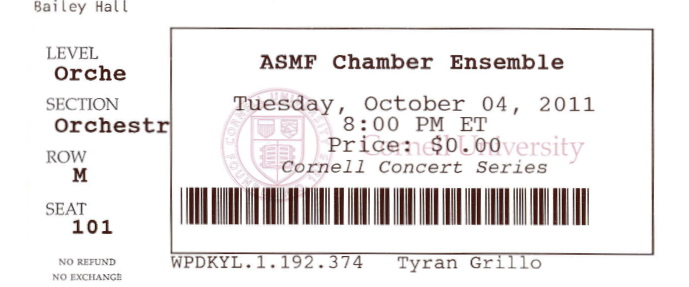
Lying in the Fields: An Evening with the ASMF Chamber Ensemble


Bailey Hall, Cornell University
October 4, 2011
8:00 pm

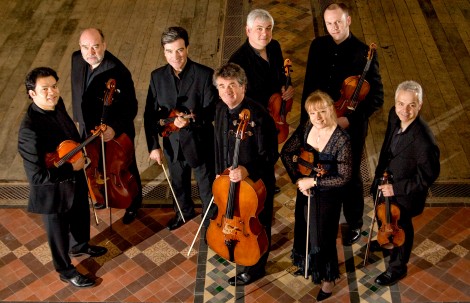
Since being founded in 1959 by Sir Neville Marriner, the Academy of St Martin in the Fields has flourished as one of the most renowned and most recognized orchestras in the world. The ASMF’s heritage traces back to its namesake church in London’s Trafalgar Square, where this conductorless collective was figuratively and literally instrumental in England’s renewed interest in Baroque music in the 1960s. Some 500 recordings later, the ASMF has now named violinist Joshua Bell as its new artistic director, thereby promising a fresh generation of adventurous programming and collaboration. On Tuesday night, Bailey Hall was presented with the ASMF in distilled form. Comprised of the orchestra’s principal players, the ASMF Chamber Ensemble continues to bring the legacy of its parent group to a broader international audience.

The results were a mixed bag of soaring catharses and unintended incidentals. These reputable musicians might have picked any number (or manner) of pieces for their performance. As it was, they played things relatively safely: two selections from the 19th century and one from the 20th made for an atmosphere that swung from quixotic to piquant at the draw of a bow. By fault of logistics, the program’s first half was flip-flopped at the last minute, thereby placing the Prelude and Scherzo of Shostakovich at the start, effectively bypassing the romanticism in which the rest of the concert would be steeped in favor of the neoclassical equivalent of a double espresso. While gorgeous in its own right—at the time of its composition (1925), Shostakovich declared the Scherzo the best thing he’d written—and filled with haunting moments, this diptych set an unsettling tone that I couldn’t quite shake.

Of the three composers represented, Brahms proved to be the most porous. His music breathes like a sponge. And yet, my heart still racing from the Shostakovich, I found difficulty in letting it soak up as much of my attention as I would have liked. Inked between 1864 and 1865, the String Sextet No. 2 is a farewell to a fiancée, Agathe von Siebold, from whom the composer had split. Traces from this emotional snap reverberate throughout the piece, which in its first movement obsessively spells Agathe’s name in hexachord. The addition of a second cello to the standard quintet seems to have opened Brahms’s sound to the symphonic possibilities of despondency, most especially in the Scherzo, which was the highlight of the performance. The Scherzo was so deeply realized, in fact, that I only found myself wondering why the rest of the piece seemed to waver on the surface of my interest. Thankfully, we had violist Robert Smissen, by far the brightest star of the evening, evoking a tremulous heartbeat, all the while underscoring the composer’s mid-range affinities and cutting some of the first violin’s incongruous glare.

Mendelssohn’s beloved Octet for Strings promised a costume change after the refreshing intermission. Composed in 1825 at the tender age of 16, it remains one of his most performed works and has been called “one of the miracles of nineteenth-century music.” That the ASMF has recorded this piece more than anyone showed in the delicacy with which the ensemble approached the dizzying Scherzo. And yet, like a Beethoven conductor who suspects that most in attendance are holding out for the Ode to Joy, the ensemble seemed to traverse the opening two movements as a courtesy toward getting there. The rousing finish did garner a standing ovation, however, so perhaps I was in the minority in feeling underwhelmed.

After thanking the audience and the many young faces populating it, Smissen lead the ensemble in a soulful rendition of Gershwin’s “Summertime,” which sounded like the Kronos Quartet, on a quiet day, in duplicate. I only wish such vibrancy had been on full display throughout.