Trio Mediaeval: Folk Songs (ECM New Series 2003)


Trio Mediaeval
Folk Songs

Anna Maria Friman
Linn Andrea Fuglseth
Torunn Østrem Ossum
Birger Mistereggen percussion and jew’s harp
Recorded February 2007 at Propstei St. Gerold
Engineer: Peter Laenger
Produced by Manfred Eicher

Since 1997, Trio Mediaeval has been unrolling a most distinct musical carpet. Yet nowhere has it made so consistent a statement as through the Norwegian folk songs that make up this, the group’s fourth album for ECM. With help from percussionist Birger Mistereggen, the Trio pulls the listener by the hand through a world of mythic scope. Mistereggen’s contributions are intuitive, drawing us into the spirit of things with a touch of the land for every ethereal weave loomed above him. His propulsive beat in “Villemann og Magnhild” (Villemann and Magnhild), for one, enhances the fablistic structure prevalent throughout so much of the program, and even in its absence renders such “Nu solen går ned” (The sun is setting) all the more dream-like for the precision of its harmonies. Styles range further from call and response [“Tjovane” (The thieves)] to lullaby [“So ro, godt barn” (Rest now, sweet child)], battle cry [“Rolandskvadet” (The song of Roland)] to supplication [“Folkefrelsar, til oss kom” (Saviour of the nations, come)], achieving emotive peaks in such forlorn sonic geodes as “I mine kåte ungdomsdagar” (In my reckless, youthful days) and in the solo “Nu vilar hela jorden” (All the earth now rests in peace).

Folk Songs cuts to the heart of its inspirations while also renewing those inspirations with clothing of the Trio’s design. The album also continues Manfred Eicher’s vision, which plunges its hands into the very earth and emerges with music that is uncannily familiar. The astute ECM fan will, for example, notice the wonderful “Bruremarsj frå Gudbrandsdalen” (Wedding march from Gudbrandsdalen) as a source on Jan Garbarek’s seminal Triptykon. These continuities are not without intuition, and speak to a deeper thread that links tradition to all eras with an unbroken line of affection.
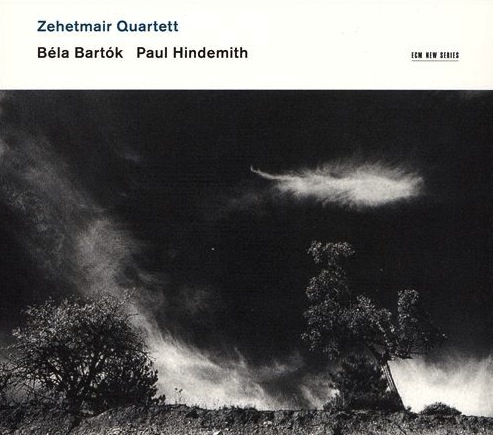
Zehetmair Quartett: Béla Bartók/Paul Hindemith (ECM New Series 1874)


Zehetmair Quartett
Béla Bartók/Paul Hindemith

Thomas Zehetmair violin
Kuba Jakowicz violin
Ruth Killius viola
Ursula Smith violoncello
Recorded June 2006, Kulturbühne AmBach, Götzis
Engineer: Stephan Schellmann
Produced by Manfred Eicher

The sound of the Zehetmair Quartet is hard to miss. Playing from memory, this intensely talented ensemble brings a fiery passion to everything that receives its bows. Following up their groundbreaking recordings of Schumann and Hartmann/Bartók, Zehetmair and company return in the latter vein, pairing the Hungarian’s Fifth (1934) with Paul Hindemith’s Fourth (1921).

Bartók’s writing is as colorful as it is a joy to play, and from the first Allegro even the new listener will note the freshness of the territory. So begins a flowing series of vignettes, of which the slinking Adagio is the most enigmatic departure from the density of its surroundings, as if the ghost of the first were whispering in our ears. The Scherzo proves fertile ground for the composer, a gesture par excellence that stakes a claim in the brain. Promises are fulfilled in chains, as Bartók seems to favor a tight and, in Zehetmair’s words, “functional” approach. The Finale sets us swooning, working in knit clusters made all the more intriguing by the flawless playing.

Hindemith’s quartet, also in five movements, stresses a complimentary ability at the slow and inward looking. The Fugato through which it breathes into life is a perfect example of his ability to do for introspection movements what Bartók does for the extro, forging an idiosyncratic lyricism that constantly reforms itself. The Debussy-like charm of the third movement touches the heart, lulling us via a cello-heavy passage into the fanciful Rondo that leaves us breathless.

Invigorating, committed, superb. No lesser adjectives will suffice.

Paul Giger/Marie-Louise Dähler: Towards Silence (ECM New Series 2014)


Paul Giger
Marie-Louise Dähler
Towards Silence

Paul Giger violin, violino d’amore
Marie-Louise Dähler harpsichord
Recorded October 2006 at Propstei St. Gerold
Engineer: Peter Laenger
Produced by Manfred Eicher

For his sixth album for ECM, violinist Paul Giger joins harpsichordist Marie-Louise Dähler for a centuries-spanning program of improvisations, complemented by arrangements of Bach and Giger’s own passionate music.

The title of the opening improvisation, From Silence to Silence, would seem to be a meta-statement for ECM, the ultimate asymptotic relationship between the musical utterance and its inevitable cessation. The opening bass note of the harpsichord speaks with the quiet force of the earth as Giger’s violin skips above it. Such growls from the harpsichord are typically relegated to continuo status, anchor rather than all-consuming statement. But here they emerge with a grand narrative all their own. The lovingly rendered Aria from Bach’s Goldberg Variations that follows is yet another grand narrative, the urtext over which all variations are laid. This flow by contrasts continues throughout the album, juxtaposing the extended techniques of Cemb a quattro (which sounds like the soundtrack to a Brothers Quay film) and the crystalline highs of Halfwhole with the Vivace from Bach’s Sonata V in F minor for violin and obligato harpsichord, BWV 1018.

The brilliance of this program is that its Baroque touches come across as the more esoteric against the status quo established by Giger and Dähler’s enticing musical language, such that the Allegro from the selfsame sonata seems almost avant-garde in the wake of Dorian Horizon. Giger’s solo pieces also nourish, as does the overtonal nectar of Gliss a uno, which is played in that mystic liminal range where the string gives up its inner secrets. Two further movements from the Bach sonata frame Bombay II, which expands beautifully on Giger’s original as it appeared on Schattenwelt. Spurred along by his footbells, it mourns with the cry of a bird in whose talons the final thread is taken, pulled from our hearts until it breaks into the silence toward which the album professes to travel.

This one-of-a-kind session is a most fortuitous meeting point, one sure to yield wonders with every listen. I’ve always felt that Giger is best heard alone, but of the collaborations on record this one ranks with Alpstein as being among the most intuitive.

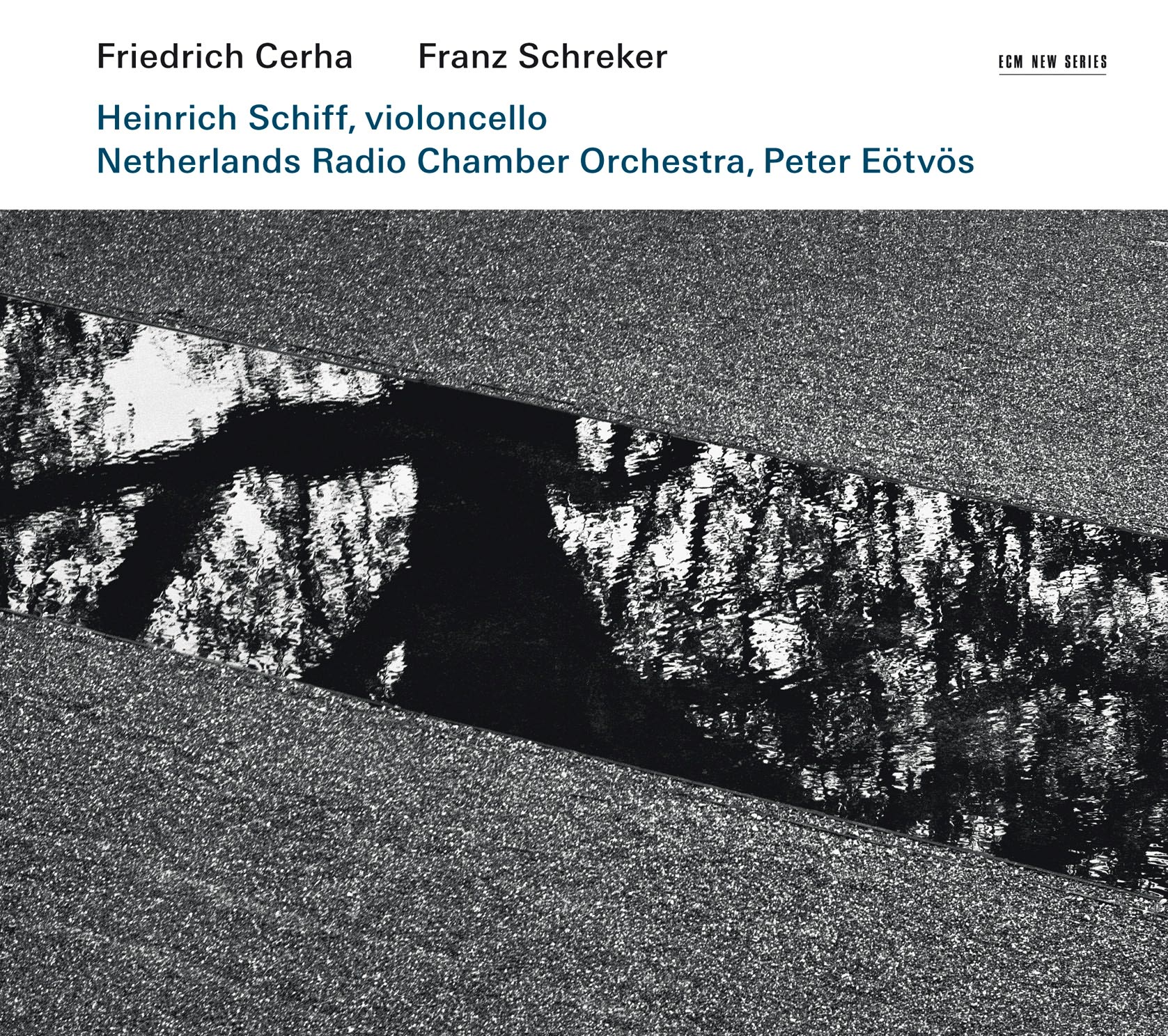
Music of Friedrich Cerha and Franz Schreker (ECM New Series 1887)


Cerha/Schreker

Netherlands Radio Chamber Orchestra
Peter Eötvös conductor
Recorded September 2003, MCO Studio 5, Hilversum
Engineers: Stephan Schellmann/Christian Starke (Cerha) and Ted A. Diehl/Laurent Watgen/George Luijten (Schreker)
Executive producer: Manfred Eicher

This unusual release from Austrian cellist Heinrich Schiff somehow slipped under my radar for years, coming rather late into my ECM New Series explorations. Neither composer represented here had been familiar to me, and I imagine these two works are as solid an introduction as any.

Friedrich Cerha (b. 1926) and Franz Schreker (1878-1934), both Viennese composers at the height of their creative powers here, seem to speak to one another beyond the force of their juxtaposition. Cerha’s Cello Concerto (1989/1996) bears dedication to Schiff, and the friendship between the two is evident in the familiarity of the playing. The opening proclamation brings with it an almost Dvořákian sense of communication between soloist and orchestra. The former skitters through the latter’s own lumbering (il)lustrations and races through the string-heavy surface with the ferocity of an impassioned editor: crossing out, underlining, circling, injecting its personal voice into the margins along the way. Yet the exact relationship between forces is always difficult to characterize. There is unity, to be sure, but it is not always so readily apparent, and this is perhaps the greatest challenge of this piece: namely, to supply that connective tissue with our undivided ears. The first movement excels in its quieter moments, for such are the moments when the cello meshes most harmoniously with its surroundings. The addition of percussion (steel drums, marimba, wood blocks) and pipe organ makes for some fascinating interplay, each ingredient flavoring the sonic recipe differently: the more you chew it, more delicious it becomes. The second movement, which is the core around which the entire concerto took shape, is gorgeous. The cello floats above wavering flutes and strings, hovering like a bird against an air current so as to render it stationary. The atmosphere is diffuse, comprising a fine mesh through which only light can travel. As strings slither in, they build of these sticks a more erratic cacophony. Woodblocks tick in every audible gap, seeming to punch out a hole with every contact, and as this climax dissipates, seemingly hundreds of individual paths open up before our eyes. Some forceful pizzicato signals the final movement, the cello’s rhythm dance-like yet somehow never exuberant. This tail is filled with verve, with all manner of snaps and other clicks to get us to our destination with plenty of souvenirs to spare.

Schreker’s one-movement Chamber Symphony comes directly out of World War I with hard-won tenderness. Almost rhapsodic, the violins trace a rippling orchestra, cutting through the darkness with the precision of a knife and the softness of a kiss. There is an ebb and flow to the piece that brings it full circle back to its own promises, turning darker as idealism crumbles in the shadow of reality. Thunder bursts with pastoral charm, frolicking among a meeting of winds. Each instrumental gesture translates into a visual stroke, rendering every detail of this broadening scene with the bleed of watercolor. Smaller offshoots of strings come together like orchestras in reduced form, drowning at last in their own murk and gloom.

Don’t worry if this album hasn’t won you over by the end of the first track, for it is a long and harrowing journey of triumphs and heavy losses, but through its continual tipping of scales one hears a vivid story. In the sparseness of Cerha, one finds the antidote to the density of Schreker and vice versa, and in that neutralization process there is a remarkable sense of belonging.

Luys de Narváez: Musica del Delphin (ECM New Series 1958)


Luys de Narváez
Musica del Delphin

Pablo Márquez guitar
Recorded April 2006, Kulturbühne AmBach, Götzis
Engineer: Markus Heiland
Produced by Manfred Eicher

That which is created
Is founded on music,
And the things that are created
Are all the more excellent
In that they are different
And that they are proportionate.

Luys de de Narváez’s seminal 16th-century Los seis libros del Delphin de música de cifra para tañer vihuela (Six books for the Dauphin, consisting of notated music for playing the vihuela) receives an introspective treatment via the fingers of Argentine guitarist Pablo Márquez. A student of bandoneón master Dino Saluzzi, Márquez indeed brings out a sustained quality to his notecraft, the subtlety of which will likely be lost in casual listening. While this disc will surely fulfill a certain function as the background to a dinner party, its greatest compliments are sure to reveal themselves only through personal attention. Though written for the 12-stringed vihuela, the music of Luys de Narváez translates beautifully to the guitar. Márquez’s fluid changes and attention to leading lines (something of a challenge in such repertoire) offer a wealth of listening pleasures for veterans and newcomers alike.

The six books—from which we get only a disc’s worth of selections—are significant for their arrangements of contemporaries Josquin and Gombert, as well as for containing what Narváez called Diferencias, regarded as the first sets of musical variations ever to be printed in Europe. Our biographical knowledge of their composer is as sketchy as their melodies are robust.

Anyone worth his or her arpeggios can muscle through the faster movements, but it is in the tenderest passages where Márquez displays his finest technique. The Diferencias sobre el himno O Gloriosa Domina (Libro IV, 1) is especially enchanting, drawing every line with vocal profundity, and is but one of many individual moments I might choose. Yet I believe these pieces are best taken as a whole. To be sure, they are substantial airs, but each fits into an architecture that is beyond its own time. Their atmosphere is antique yet vital in the hands of Márquez and ECM’s production team. There is a silent repose to be found in the heart that beats within them. It is the comfort of the predictable contrasted with those learning moments of unexpected departure.

In listening to this disc again as I write these words, I imagine not the solo player, but a modest gathering of friends and acquaintances sharing in an alluring complexity. The well-balanced recording merely underscores this mood, close enough as it is to hear the instrument’s finer nuances while distant enough to allow fuller grasp of its gestural parameters. This isn’t music with a moral or even aesthetic message. It breathes, like its performer, between notes, as preparation for the audible utterance that comes from the darkness of anticipation. The music drops with the regularity of water off the tip of a storm-drenched leaf. Like the leaf, it bobs with every release.

A delightful album conducive to relaxing on a quiet afternoon, all the while underscoring our privilege to do so.

Garth Knox/Agnès Vesterman: D’Amore (ECM New Series 1925)


Garth Knox
Agnès Vesterman
D’Amore

Garth Knox viola d’amore
Agnès Vesterman violoncello
Recorded September 2006 at Propstei St. Gerold
Engineer: Stephan Schellmann
Produced by Manfred Eicher

The name of Garth Knox’s solo ECM debut comes, of course, from the viola d’amore, a neglected instrument of which he is our greatest living proponent. Below its seven bowed strings lies a sympathetic loom, which absorbs what Knox calls “a kind of harmonically encoded souvenir.”

This luminescent album brings us straight into its unique body of twined metal, gut, and wood. And what better place to start than with Knox’s own 2004 composition, Malor me bat, of which the soulful playing and seamless execution are only part of the story. With a wide palette of sound colors at his disposal, Knox gives us a sometimes-unexpected journey, seeming to coax with harmonic arpeggios Agnès Vesterman’s cello from the depths of some enigmatic future. It is one of three modern works to appear on the program, the others being Roland Moser’s glyphic scratches in Manners of Speaking (2006) and Klaus Huber’s wonderful …Plainte… (1990), which ends the album with a meditation on (and in) negative space.

Along the way, we encounter a smattering from the early Baroque, including the somber, lilting A Pavin (1605) from Tobias Hume, Attilo Ariosti’s Prima Lezione (1720), which carves its rustic dances with a wide blade, and the immortal Les Folies d’Espagne (1685) of Marin Marais. Add to these a hefty sampling of traditional Celtic tunes, and the result is a vivacious cross-section of what the viola d’amore is capable.

On the whole, this is an adventurous disc and is sure to have something for everyone. Knox’s eclectic approach works wonders, prizing the instrument as the locus of musical activity before the bow even touches the strings. Such an approach allows us deeper insight into Knox’s own passions, that we might better attune ourselves to a wider musical world in the listening. That being said, the three modern pieces are what truly showcase the instrument’s breadth.

The favored acoustics of Propstei St. Gerold once again prove amenable to the music-making archived here, and lift every voice to sing with thrumming quality.

Vladimír Godár: Mater (ECM New Series 1985)


Vladimír Godár
Mater

Iva Bittová voice
Miloš Valent violin, viola
Chamber orchestra Solamente Naturali
Bratislava conservatory choir
Dušan Bill choirmaster
Marek Štryncl conductor
Recorded September 2005 at St. George Church in Svätý Jur, Slovakia
Recording director: Peter Zagar
Engineer: Otto Nopp
Produced by Pavian Records

Slovak composer Vladimír Godár’s Mater is really six pieces in one, each connecting into the larger whole of an hour-long cantata. The composer himself likens its introspections to travel: we arrive at a new place, only to scope out its most prominent features. Only with time can we find those niches, hidden alleys, and hideouts. The period instruments (played at period pitch) featured on this recording embody this philosophy to the letter, as do the voices, which switch comfortably between Yiddish, Slovak, Latin, and English throughout.

Godár’s experience as a film composer and interest in early music are both immediately evident in the opening Maykomashmalon (2005) for female voice, viola and violoncello. Singer Iva Bittová’s superb diction and commitment mix with her generous honesty to stunning effect in the present surroundings. This incantation is like that of a Latin mass, so that when the strings come in amid an earthen song, we have already felt that vocal urge in our hearts. Its song entwines the power of a lullaby and the catharsis of a lament. The 2003 Magnificat for female voice, choir, string orchestra and harp contrasts double bass drones and a choral middle ground with jagged consonants from strings. The entirety of this section arises as if its own nucleus, carrying the gravid harmonic changes of a Renaissance organum into the shadows of Luspávanky (Lullabies) (2001/03) for female voice, two violins, two violas and violoncello. The lead becomes more playful here, setting off a pentatonic intro through open strings, like a child playing on piano. As the piece winds down, Bittová brings an anthemic resurgence to bear on the encroaching silence. Ecce puer (1997) for female voice, two violins, viola, double-bass, harp, chitarrone and harpsichord takes James Joyce as its textual inspiration. The arrangement glows, Bittová unafraid to show the honesty of her vulnerability. The music cycles through its progressions, laying down lines with surety. With each repetition, it becomes more comforting. A glorious piece.

Yet it in the 2001 Stálá Matka (Stabat Mater) for alto, violin and chamber orchestra (and sung in Slovak) that we find the real heart of Mater. There is such ineffable purity here that one hardly notices the fleshiness of the playing. The power of monophony, caressed by every instrumental gesture, embraces the voice like a newborn in the amniotic flow of its revelation. One hears the ghost of Górecki here, hovering like a prophet as every stanza burrows deeper into itself. An orchestral swell at the center spreads like the bones of a gothic ceiling, from which censers spill out their smoky breath. So placated, we are lowered gently into the play of light in Regina coeli (2003) for female voice, violin, choir and chamber orchestra. With Renaissance colors, a single call is taken up by the chorus, thereby awakening the spirit of an age since buried in the battlefield of modernism, but now carefully unearthed, dusted off, and redressed. A reinstatement of Maykomashmalon ends and thereby fixes the piece in time, and in so doing sets it free to wander in ignorance of it.

Mater takes is melodic promises seriously. Fans of so-called “Holy Minimalism” are sure to feel right at home here, but also to become slowly aware that the term is redundant.

Erkki-Sven Tüür: Oxymoron (ECM New Series 1919)


Erkki-Sven Tüür
Oxymoron

Pedro Carneiro marimba
Leho Karin violoncello
Marrit Gerretz-Traksmann piano
Vox Clamantis
NYYD Ensemble
Estonian National Symphony Orchestra
Olari Elts conductor
Ardor recorded March 2003 at Estonia Concert Hall, Tallinn
Engineer and recording producer: Maido Maadik
Produced by Eesti Radio
Salve Regina, Dedication, Oxymoron recorded June 2006 at Estonia Concert Hall and Issanda Muutmise church, Tallinn
Engineer: Margo Kõlar
Recording supervision: Helena Tulve
Executive producer: Manfred Eicher

Oxymoron is ECM’s fourth album dedicated entirely to the exciting music of Estonian composer Erkki-Sven Tüür. Each of its four pieces is recorded here for the first time.

The album opens with his 2005 Salve Regina for male choir and ensemble. Beginning with a plainchant-like tenor line amid pattering hand drum and dissonant clusters, it blossoms into the creeping breath of organ, whose quivering configuration leaves us primed and centered for Ardor. This concerto for marimba and orchestra (composed 2001/02) is characterized by engaging, halting rhythms and quick clusters splayed against a terse backdrop. The marimba would be enough to carry itself on its own, and seems not to need the orchestral accompaniment, but the harmonics of the flute, signaling a sustained drone from orchestra in the second movement, prove that Tüür knows what he is doing. As he traces each finely shaped footstep of percussion in the softer sands of the ensemble at large, the sound becomes fuller, more urgent and demanding, reaching a drummed frenzy in the sustained tone that concludes, only to die in a wisp of tide.

Dedication (1990) for violoncello and piano is the earliest piece on the album and is an especially welcome addition to ECM’s ongoing Tüür survey, which now tunes our ears to his uniquely detailed approach to chamber idioms at last. Here are his melodic skills at their most potent, at once straightforward and crafty.

The 2003 title piece on which the album ends is exactly what it professes to be, fusing contradictory gestures of form and execution in a seamless whole. The overall effect is colorful, almost jazzy, and intensely involving.

Tüür’s typically unstable lines are so alive that they develop their own biological signature through a wealth of successive properties. Here is a voice never content in being still, one that is always challenging itself, growing toward something infinite and nourishingly whole.

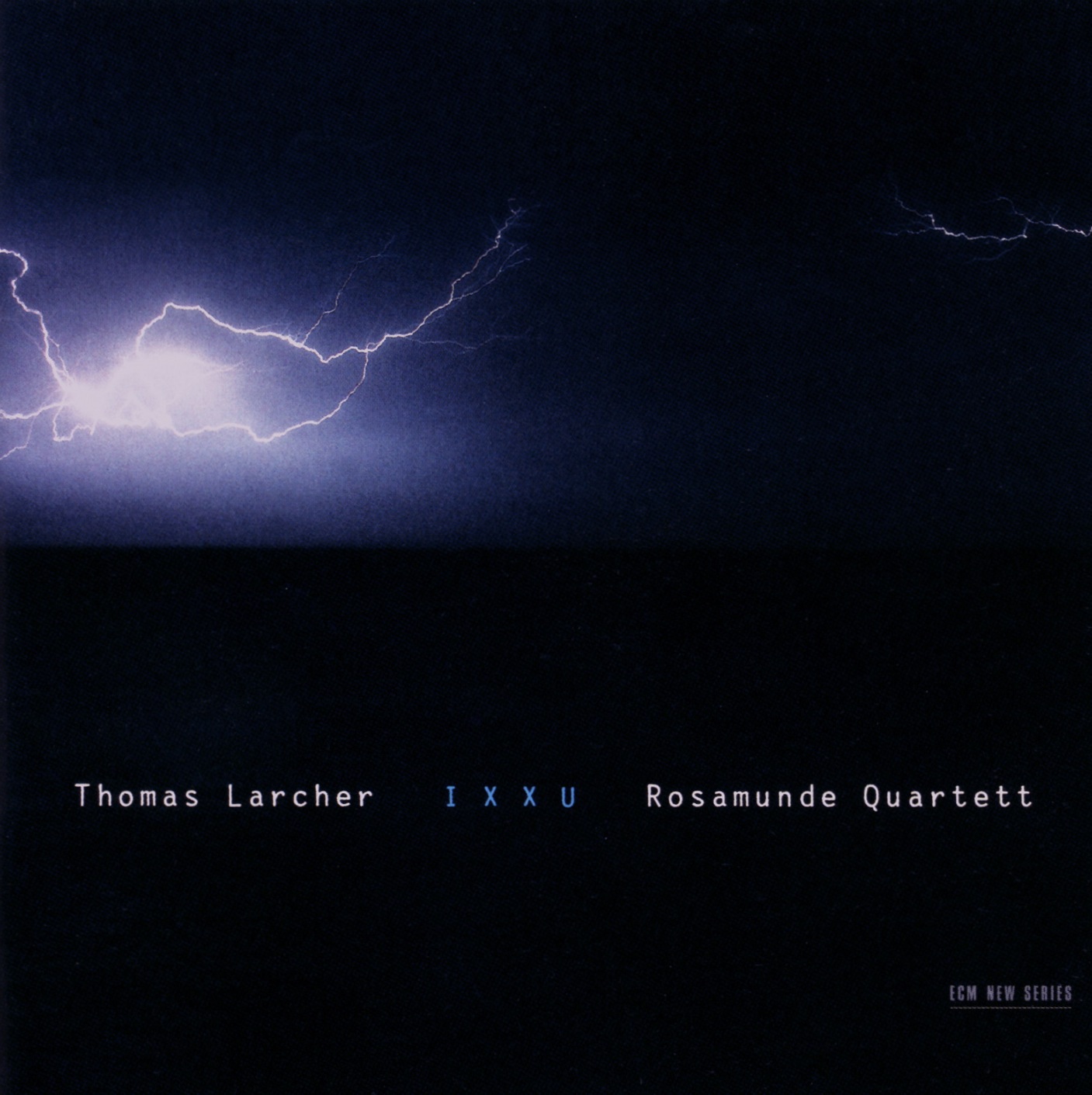
Thomas Larcher: Ixxu (ECM New Series 1967)

Thomas Larcher
Ixxu

Rosamunde Quartett
Andrea Lauren Brown soprano
Christoph Poppen violin
Thomas Demenga violoncello
Thomas Larcher piano
Recorded July 2005, August-Everding-Saal, Grünwald
Engineer: Markus Heiland
Produced by Manfred Eicher

Illness is many things. Indisposition, an amalgamation of cause and symptom, a clinical mystery and emotional nightmare. Thomas Larcher seems less interested in these polarities, however, and more in the sinews that connect them. For him, the notion of illness lives by a fragmented language. Ixxu, ECM’s second disc dedicated to the work of the Austrian composer, is thus a force to be reckoned with. It’s not that each of these world premiere recordings is particularly weighty, but more so that the sheer difficulty of their interpretation and execution is palpable. This is not for mere effect, but rather done in the interest of expanding musical languages to the point of distention. In the composer’s words: “I’m not interested in using shock techniques to flaunt the novelty of my architecture. I want to arrange and enhance the elements so as to produce new expressive values.”

The title string quartet (1998-2004), for one, proves that Larcher’s is a unique compositional voice when such distinction is sometimes hard to come by. He is rhythmically astute, melodically complex, and simply tantalizing to listen to. High-pitched whispers make for organic contrast to the music’s underbelly, culminating in the final movement with haunting charm. Another string quartet, Cold Farmer (1990), ends the album in Hartke territory, with just a touch of Schnittke and Riley to be found in due measure. Its equal dose of whimsy and magical realism make for a composition that would easily fit into the Kronos Quartet’s repertoire, and which completes the frame around the album’s masterful center. In the hands of the ever-capable Rosamunde Quartett, these pieces glitter.

My illness is the medicine I need (2002) for soprano, violin, violoncello and piano is indeed a most competent stroke in the realm of textual settings—these, medical patient statements found, of all places, in a Benetton Colors magazine. Soprano Andrea Lauren Brown embodies in its deft unraveling the very reenactment of a quantifiable cause, so that one’s illness indeed does becomes the only source for its cure. This is symptomatic music par excellence, and pairs well with Mumien (2001/02) for violoncello and piano. What begins as a staccato agitation ends up a handful of threads drawn into a single focused line. The rhythmic integrity of Larcher’s piano is a constant presence, while Thomas Demenga’s cello is the empathic observer, clarifying intentions with every turn of phrase.

The music of Ixxu has the quality of certain nursery rhymes: on the surface playful, perhaps full of holes, yet betraying an amazing wealth of morbid fascination just beneath the surface. Make these your bedtime stories, and you won’t be disappointed.