

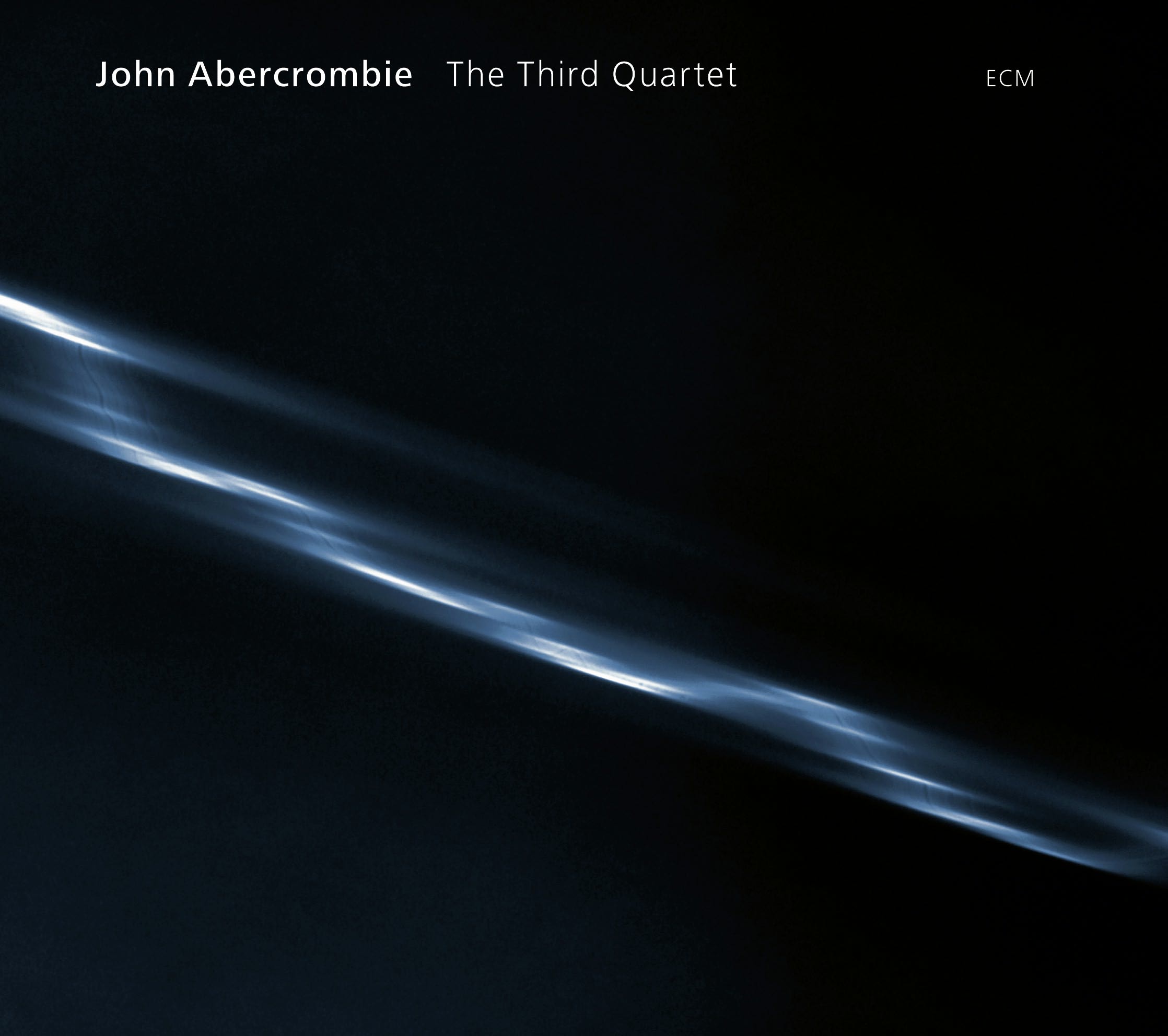
John Abercrombie: The Third Quartet (ECM 1993)

The Third Quartet

John Abercrombie
The Third Quartet

John Abercrombie guitar
Mark Feldman violin
Marc Johnson double-bass
Joey Baron drums
Recorded June 2006 at Avatar Studios, New York
Engineer: James A. Farber
Produced by Manfred Eicher

Congress of John Abercrombie, violinist Mark Feldman, bassist Marc Johnson, and drummer Joey Baron is back in session with The Third Quartet. Like its predecessors, this junior outing is a master class in atmosphere and navigation—only now, Abercrombie points his compass toward a decidedly nostalgic north. While much of that retrospective feeling is already encoded into the guitarist’s Jim Hall influences, his toolkit now rattles with screwdrivers marked Ornette and Evans. The former is a crosshead, fitting snugly into “Round Trip” by way of the rhythm section’s deft interplay. The latter is a flathead, and in the somber “Epilogue” finds its groove in a looser sort of lyricism. The rest of the set list comes from Abercrombie’s pen, which gives pliant skeletons for his band mates’ fleshings-out.

Opener “Banshee” combines the free and the composed. From nebulous beginnings, a quivering violin treads intermittent guitar buzz until the two unify in one thematic vessel, crossing currents onto the shore of “Number 9.” With the slack-jawed lyricism of a Bill Frisell tune, its love potion courses faithfully through the veins. And as Feldman gallivants through winter trees with the fire of moonlight, it’s clear that he is once again the celestial force of the band. His watery—though never watered down—tone conforms to every shape even as it defines new ones. Whether flowing through the duo intro of “Vingt Six,” in which he shares windswept dialogue with Abercrombie before the rhythm section appears, intimate and reassuring, or moving with feline flexion in “Wishing Bell,” he guides us downriver into another season with every sweep of his bow. He can be as loose (as in the intensifying “Bred”) as he can be frenetic (“Elvin,” which pays tribute to Coltrane drummer Jones), but is always attentive to the infrastructure through which he percolates.

Not to be out-nuanced, Johnson holds his own as a master of description. His solos tend toward the compact, although their implications are anything but, for even when they guide us back to the head, improvisational echoes remain. He matches Abercrombie’s rainbow arcs with trails of footprints below, and gilds the progressive swing of “Tres” with charm. Lest we forget the leader’s impact, however, Abercrombie ends with “Fine,” an overdubbed duet of steel-string acoustics that regresses to his duo albums with Ralph Towner. It is a backward glance turned inward, an elegy for someone not long passed.

The Third Quartet chambers a tender heart, delicate as a morning glory yet just as sure to bloom with the coming of dawn. Such certainty is hard to come by in a sound-world built on spontaneity, but here it is.

Tempesta di Mare: A Live Review

Tempesta

Tempesta di Mare
Barnes Hall, Cornell University
March 6, 2014
8:00 pm

In the 1991 French film Tout les Matins du Monde, Gérard Depardieu plays an aged Marin Marais—in-house composer at the court of Versailles around the turn of the 18th century. Gussied up in all the accoutrements of his station, a corpulent Depardieu stares off camera, filled with envy at the ambitious young man he once was. The real Marais studied under Jean-Baptiste Lully, who by the patronage of King Louis XIV singlehandedly defined the French baroque style. Listeners at Barnes were treated to his “March of the Turks” Thursday as part of a lively program by Tempesta di Mare. Much in contrast to the self-scorn of Depardieu’s Marais, who indifferently conducts the same march early on in the film, Tempesta brought flair and steady passion to its evening performance. Under the title “Apollo at Play,” Philadelphia’s premier baroque chamber orchestra culled a thoughtful program of incidental music by Lully, British emulator Matthew Locke and 20th century iconoclast Igor Stravinsky before coming full circle to Lully protégé Johann Sigismund Kusser, whose Apollon Enjoüé, composed in 1700, ended the concert.

Because the entire program consisted of music written for the stage, individual movements were as rich as they were compact. With its stately undercurrents and detailed orchestration, Lully’s descriptively astute Le Bourgeois gentilhomme (1670) set the bar high. Even without the titles provided for our edification, we could feel the sway of tailored cloth in the “Dance Teacher” scene and imagine the revelry of “The Uninvited Guests,” of which the Spaniards led the way with castanets and vihuelas blazing. On that note, Lully’s colorful palette represented a fascinating transition period in the evolution of Western European classical music, when the aristocratic impulses of court-appointed composers shared staves with motifs borrowed from earlier Sephardic traditions, as evidenced by the bevy of percussion at Tempesta’s employ.

Consequently, Lully’s sound world was equal parts pomp and folk. Enhancing its spread were recorders, bassoon, harpsichord and theorbo, a sort of lute on steroids sporting an elongated neck fitted with sympathetic bass strings. The latter provided a visual element that was the subject of much pre- and post-concert conversation. Yet the theorbo, played by the ensemble’s co-director Richard Stone, was a subtle anchor for the dramatic goings on. So too, in Locke’s instrumentals for The Tempest (1674) was the canvas replete with vivid splashes of baroque charm. Shuffling weighty pauses into upbeat turns of phrase, lovelorn abandon into systematic denouements, Locke’s writing emerged swift and sweet.

The next portion of the concert, however, brought to the fore what proved to be the evening’s only flaw: Tempesta’s battle with tuning. Although tuning issues first arose in the wind section of the Lully, the off-key slips of which were quickly smoothed over, in the all-string intimacy of Stravinsky’s 1928 Apollon musagète two mismatched cellos grated on the ears. Such inconsistencies, however, come with the territory, especially when performing on period instruments (although it seemed most were modern copies—the harpsichord, for example, having been built in 2012), and the fine musicians of Tempesta handled these hiccups with grace and fortitude. There were also the uneven temperatures of the venue itself, which required musicians to flit between a cold backstage room and a warmer auditorium: further proof, perhaps, that this year’s winter has overstayed its welcome. Nevertheless, they muscled through with a perseverance that certainly did not go unnoticed.

All said, Tempesta gave us a treat with Stravinsky’s gorgeous paean to the French style. By turns mournful and frolicking, each movement was like a shard of glass in a slowly turning kaleidoscope. But the best came last with Kusser’s fabulous orchestral suite, from which the program borrows its name. Not only did the ensemble smooth out its tuning snags; it also presented us with the loveliest and most adventurous music of the night. Full of surprising twists and virtuosic performances all around, it left us all with something to smile about. In that respect, the joys won over the nitpicks. Challenges make us human, and finishing strong in spite of them is no small feat. In this respect, Tempesta di Mare reminded us of why we go to hear live music in the first place: to remind us that we are all human.

(See this article as it originally appeared in the Cornell Daily Sun.)

Philip Glass and Tim Fain: A Live Review

Philip Glass & Tim Fain Promotional Images at Emory University.

Philip Glass: An Evening of Chamber Music
with Tim Fain
State Theatre, Ithaca, New York
March 1, 2014
7:00pm

If you have ever said a word over and over until it sheds all meaning and becomes its own sound, raw and devoid of attachment, then you know what the sound world of Philip Glass feels like. His melodies evolve in just such a way, nurturing new aspects with every iteration until they blossom of their own accord. His music has been called many things, from hypnotic to interminably monotonous. Its repetitive arpeggios and insistent themes have polarized listeners for decades. His admirers—myself among them—take comfort in his recognizability. His many critics, on the other hand, are often guilty of the very monotony of which the iconoclastic composer stands unfairly accused. Either way, resistance to his minimalist (im)pulses is futile: There’s nothing minimal about them.

But this is only half the story. Many will have heard Glass the composer, whose soundtracks for such films as Koyaanisqatsi and The Illusionist have long tickled the ears of even those unfamiliar with his name. Saturday night’s intimate chamber concert at the State Theatre was a choice opportunity to experience Glass the musician. Poised mountainously at a rococo baby grand piano yet with the touch of a willow’s tendril on water, he took concertgoers on a journey through his varied career by way of its most essential colors. To that end, he opened with a spirited performance of “Mad Rush.” The song was written—he explained to the audience—in response to a commission for a piece of “indefinite length.” This comment brought a collective chuckle and showed Glass as one at ease with his critics. It was obvious that the piece was originally written for organ as its waves crashed over one another in a gorgeous tumble. He also performed three selections from his Metamorphosis series. Like a jump between dream levels in the film Inception, each movement proceeded from a deeper place. The crosshatching of their dynamic pianism recalled the “stagger” technique of Baroque harpsichordists, and served to make an already resonant instrument brim with overtones.

Although Glass has ever been his own best interpreter, he has found in Tim Fain a viable partner in time. The American violinist, also no stranger to cinematic crossovers (he can be heard in Black Swan and, most recently, 12 Years a Slave), has emerged as one of the most exciting and innovative violinists of our generation. It was in the spirit of affinity that he joined Glass on stage for a smattering of scenes from The Screens. This incidental music, written for a stage production of the play by Jean Genet, was by turns sprightly and mournful. So, too, the concluding Pendulum, condensed here from a trio to a duo.

Yet it was Fain alone who secured the performance’s most stirring memories in the form of a two-part “Chaconne.” Excerpted from the seven-movement Partita for Solo Violin, it ranks among the solo violin works of Eugène Ysaÿe as a true inheritor of Bach’s hallowed craft. The purity and surety of Fain’s tone was alive with purpose as he leapt through a near constant chain of double stops. Concertedly, his strings sang the most recent music on the program, bringing everything back to Glass the composer and reminding us of just how he has evolved. Here was his art, soaring, full-throated, and open to whatever may come.

(See this article as it originally appeared in the Cornell Daily Sun.)