

Erkki-Sven Tüür: Strata (ECM New Series 2040)

Strata

Erkki-Sven Tüür
Strata

Jörg Widmann clarinet
Carolin Widmann violin
Nordic Symphony Orchestra
Anu Tali conductor
Recorded May 2007 and June 2009, Estonia Concert Hall
Engineer: Maido Maadik
Assistant engineer: Jaan Tsadurjan
Executive producer: Manfred Eicher

The music of Estonian composer Erkki-Sven Tüür is much like his name. Its frame contains doubled elements, a cosmic chemical signature that embraces a hyphenated signifier in the middle, connection to some gravid space from which one can observe the unfolding of his distinctly personal character. Of that character we get plenty on this album, his fifth for the New Series, for which the usual roster of ECM performers is swapped for the phenomenally talented Nordic Symphony Orchestra and its principal founder and conductor, Anu Tali. Together they bring luminescence to two recent works with mellifluous authority.

The Symphony No. 6, the subtitle of which gives this album its name, is in fact dedicated to Tali and the NSO, who commissioned it. From the first bars, the reasons behind this inception become clear, for the musicians play this music as if they have known it all their lives. Composed in 2007, Tüür’s massive symphony is a master class in affect. It heralds a new direction for the maverick composer, who abandons his “architectonic” method (although echoes of Crystallisatio remain) in favor of self-styled “vectorial writing.” Where the former embodied an interlocking or amalgamation, the latter is more of an expansive or, in the composer’s terms, “genetic” development. One might say that architectonics constructed the body in which the cellular divisions of his vectorial composing could divide. Evolution over invention.

The nature of this newer method is obvious in the symphony’s opening and closing bars, stretching as it does a sudden awakening into a dream of perpetual motion that, like all such experiments, inevitably journeys toward stasis. The result of all this is an orchestra that moves amorphously but singly, even if particular instruments do leave trails in the water. In the latter vein, for instance, piano and harp share a brief yet memorable dialogue. On the whole, strings lurk in recession for some time before revealing their palette of light—all the more effective in music that seeks through a glass darkly.

What makes this feel like a symphony at all is perhaps its grandness of scope, which nevertheless retains an internal spirit, as indicated by the subtle (and not-so-subtle) percussive touches throughout. Tüür’s feel for color and space in this regard is so acute that it opens doors in the mind one never knew were closed. The smoothness of his transitions likewise enhances another symphonic staple: a feeling of luxuriance and orientation of detail that are remarkable for a 33-minute duration. Tüür’s narrative language is thus overlapping yet practical, a form of meta-speech that stretches a whisper to a sigh and allows the listener to draw any number of conclusions.

Noēsis, composed in 2005, grew out of a very different commission (by the Detroit Symphony Orchestra and the Philharmonia Orchestra London, at the behest of Neeme Järvi). Although billed as a concerto for clarinet, violin and orchestra, the soloists are scurrying forces, less leading and more integrative. Each section of the orchestra becomes the panel of a fan, unfolding one rib at a time to reveal a connected focal point. Clarinetist Jörg Widmann joins his sister, violinist Carolin Widmann, in this wonderfully evocative piece, which is equally illustrative of Tüür’s new approach. Unlike the symphony, it begins in a hush of ambience that smoothes into the clarinet’s refracted introduction. The violin, on the other hand, is possessed of a free, if trembling, quality. The orchestra, meanwhile, pitches slowly, a boat on waves of molasses. The ending is one of Tüür’s finest, a braid of violin and clarinet carried into afterlife by a soft gong hit, resonant and touched by the sun.

Tüür’s craft has always been deeply physiological, but with Strata he shows it to be also physiologically deep. Whereas his previous work seemed forged from raw material (cf. Ardor), now it issues a line of spider’s thread, pulled by an unseen hand from galaxy to galaxy. It is an expansion rather than a compression of time, the audio equivalent of quantum physics, the equation of which again finds articulate form in the name.

Rim Banna review for RootsWorld

My latest review for RootsWorld online magazine is by Palestinian singer Rim Banna, who explores an all-inclusive message in delicate political times. This one boasts a couple of ECM connections. It is arranged and produced by Bugg e Wesseltoft, who has appeared on albums by Terje Rypdal, Jan Garbarek, Arild Andersen, and Sidsel Endresen. It also features guitarist Eivind Aarset in a characteristically atmospheric role. Click the cover to read my review and hear samples of the album.

Rim Banna

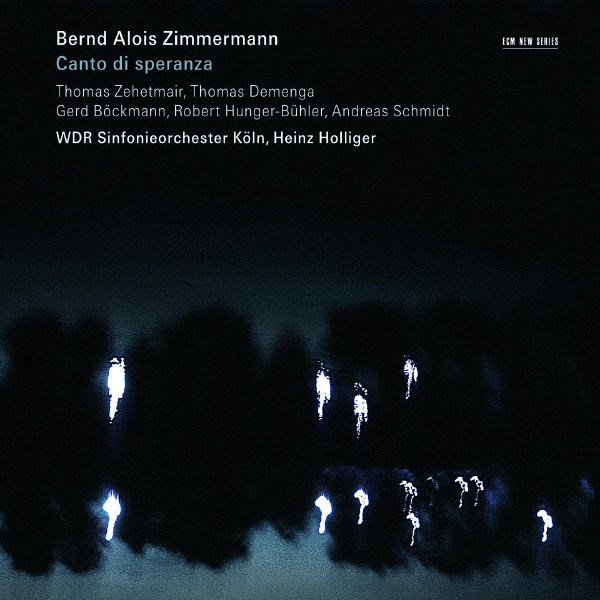
Bernd Alois Zimmermann: Canto di speranza (ECM New Series 2074)

Canto di speranza

Bernd Alois Zimmermann
Canto di speranza

Thomas Zehetmair violin
Thomas Demenga cello
Gerd Böckmann voice
Robert Hunger-Bühler voice
Andreas Schmidt bass
WDR Sinfonieorchester Köln
Heinz Holliger conductor
Recorded May 2005, Kölner Philharmonie
Engineers: Brigitte Angerhausen and Günther Wollersheim
Edited and mastered by Renate Reuter
Produced by Harry Vogt

In his 2003 monograph, Quotation and Cultural Meaning in Twentieth-Century Music, musicologist David Metzer describes West German composer Bernd Alois Zimmermann (1918-1970) as having “exposed the delusion behind the modernist renunciation of the past and offered a vision of time in which [past, present, and future] were interconnected.” Zimmermann, he goes on to say, “saw time as a broad sphere in which all periods were equally within reach.” Such philosophy was at the heart of a self-styled pluralistic approach to composition, taking comfort in a Joycean spirit of drift and adaptation.

One might say that ECM’s New Series imprint has followed suit, pulling lesser-heard composers like Zimmermann into an orbit equidistant from the massive planets he references. In line with this spirit, the label has brought together a meticulous team of interpreters—at the core of which Heinz Holliger conducts the WDR Sinfonieorchester Köln—to paint the portrait of a composer whose personal demons eventually won out: the final piece of this disc was, in fact, completed just five days before his suicide. Such biographical details, however, render the Violin Concerto that opens this disc all the more effective for its unabashedly serial touches. Completed in 1950 and cited as a model for the postwar concerto, it spans three richly contrasting movements, opening in a cacophony of details at once whimsical and shadowy.

The soloist’s relationship to the orchestra is very much in the Romantic mode, as emphasized by violinist Thomas Zehetmair’s gorgeous traversal of the second movement. As in the work of Erkki-Sven Tüür, the piano figures mysteriously, a distant echo of the violin’s central presence, a simulacrum of the internal. It finds entry points in the periphery and parasitizes the orchestral body therein. Despite some beauteous, even transcendent moments, this portion of the concerto is no fantasy, but rather an intense reality of its own making that transitions into the final movement, which dances circles around a joyful center: a rite of spring, if you will. Some magnificent brass writing spurs a solo violin passage into explosive yet contained finale.

Zimmermann’s sound walks the line between capriciousness and foreboding. Despite the composer’s fatalist (?) trajectory, the concerto exudes panache, presenting the soloist with no small technical task. His neoclassicism suggests Stravinsky and Bartók, but influences from Bach to jazz are equally discernible. His plurivocity is clearest in the cadenzas. The almost bacchanal exuberance and rhythmic color of the concerto is every bit as intense as the program’s relatively brooding title composition, which at the fingertips of cellist Thomas Demenga delineates an even thinner line between nostalgia and forgetting. Originally composed in 1952 and revised in 1957, the title of this “cantata” for cello and small orchestra means “Song of Hope,” although its distinctly internal dialogue would seem to shelter very little at first glance.

The sparse instrumentation yields a world of ideas, which Demenga handles with remarkable sensitivity. Tension is so smooth that it no longer feels like tension, but rather like the metaphorical harmony of lock and key: the yin of security and the yang of trespass. The chamber aesthetic, especially in Zimmermann’s pointillist writing for percussion, is solemn and melds beautifully with the cello’s forthright porosity. Demenga brings to these energies a feeling of such effortlessness that the music seems to unfold of its own need to be heard.

Yet, no solemnity can match that of the final piece on the program: Ich wandte mich und sah an alles Unrecht, das geschah unter der Sonne (“And turning then, I saw there great injustice is done under the heavens”). Designated as “an ecclesiastical action for two speakers, bass soloist, and orchestra,” this 1970 oratorio sets biblical verse and Dostoevsky’s “The Grand Inquisitor” parable from The Brothers Karamazov. Andreas Schmidt is the singer, a pathos-ridden reflection of actors Gerd Böckmann and Robert Hunger-Bühler, who provide the spoken voices.

Despite the large instrumental forces at his command, Zimmermann makes spare use of textural overlap, with brass and percussion adding particular and occasional resonance to the immediate voices. One can almost hear the theatrical gestures built into the score, the very comportment of which forms a language unto itself that is subtext to the piece’s articulated surface. Even with knowledge of German or a translation of the texts in hand, this is morose going. Sitting with it is a nevertheless dark fascination. Some moments recall the drama of Shostakovich’s The Execution of Stepan Razin, while others are their own brand of interlocking parable. It ends with a brass iteration of the Bach chorale “Est is genug” and an orchestral afterthought thereof, the latter an indication of a mind at play to the very end.

Concerning the level of musicianship required bringing this music to life, it is only appropriate that Holliger should hold the baton. This is clearly music after his own heart. Even the most dedicated listeners aren’t likely to pop Ich wandte mich… into their car stereo, but its rewards come earlier in the program, felt only as a retroactive lean toward infinity. In accordance to Zimmermann’s “sphericality of time,” the aftereffects are just as musical as the performances they follow, and sow their traces into our mental fields until, some time later, they sprout anew.

Norma Winstone Trio: Distances (ECM 2028)

Norma Winstone Trio
Distances

Norma Winstone voice
Glauco Venier piano
Klaus Gesing bass clarinet, soprano saxophone
Recorded April 2007 Artesuono Recording Studios, Udine
Engineer: Stefano Amerio
Supervision: Guido Gorna
Editing and mixing: Stefano Amerio and Manfred Eicher
Produced by Manfred Eicher

German reedist Klaus Gesing and Italian pianist Glauco Venier join the ECM roster for the first time in an astonishing trio album with veteran singer and lyricist Norma Winstone. Whereas in her past efforts for the label Winstone used her voice as much as a melodic tool as an agent of song, here she steeps the listener in a richly textured feeling not experienced since her 1987 masterpiece, Somewhere Called Home.

“Distance” sets the stage not only thematically, but also musically. The tune is by Venier, whose gentle ostinato exudes an atmosphere that is as weightless as Winstone’s lyrics are gravid. The whispers of Gesing’s bass clarinet complete this portrait of a subterranean world run dry. A prologue to an album of prologues.

Venier further pens “Gorizia” and “The Mermaid.” The former is a halting and wordless waltz that dissolves like ink in water, while the latter is another lyrical bird’s nest. Winstone and Gesing respectively provide words and music for “Drifter” and “Giant’s Gentle Stride,” both adaptive verses that sweep through the composer’s gorgeous reed work with ease. Winstone deepens the circle in “Remembering The Start Of A Never Ending Story,” set to the music of pianist Hubert Nuss. What begins as a play of light and glass finds solace through the soprano’s wide-flung window. In the haunting “Ciant,” Winstone sings words by Italian director Pier Paolo Pasolini to the tune of Erik Satie’s Petite Ouverture à danser, the peaks and valleys of which become interchangeable, each the yin to the other’s yang.

Winstone and her telepathic trio also reverse-engineer popular songs to an elemental sort of understanding. The Cole Porter chestnut “Every Time We Say Goodbye,” for one, pairs her and Gesing’s soprano to stunning effect. Moving like wings in concert, the duo reads the wind as Venier follows their birdlike shadow. Their version of Peter Gabriel’s “Here Comes The Flood” shines even brighter. Against a backdrop of palpable color, its celestial interpretations and earthly ruminations combine with the precision of a chamber music ensemble.

Finishing off the album’s eclectic stride is “A Song for England,” which finds the trio improvising on a Caribbean calypso, with words by Jamaican-born writer Andrew Salkey. The bass clarinet’s rhythmic support buoys a purely melodic Winstone before switching over to discernible lyric amid a shower of whimsy.

Distances is an album one wishes could go on and on. That said, its compactness offers plenty to rediscover on repeat listening. Combinations like this happen only rarely, and Winstone’s puzzle comes out of the box completed, glued together, and glowing with atmosphere. Hers is a voice that sings not because it must be heard by the world, but because it must itself hear the world. It speaks only of what it has known.