Lucian Ban / Alex Simu: Free Fall

Free Fall

In 2018, the Romanian duo of pianist Lucian Ban and clarinetist Alex Simu toured their homeland in a series of concerts inspired by the improvisational genius of Jimmy Giuffre. What transpired throughout this particular performance, captured at Bucharest’s French Institute, is a fitting embodiment inspired by one of jazz’ humblest stalwarts.

Ban’s “Quiet Storm” opens the concert by immersing listeners in the robust tenderness for which Giuffre will be forever known. Harnessing an illustrative power akin to incidental music of the theater, Simu comports himself like an actor on stage, deviating just enough from the script to wrap his performance in a cloak of individuality. Following this, two entirely improvised interludes (the jagged title track and more liquescent “Mysteries,” an album highlight) sandwich Carla Bley’s “Jesus Maria,” which in its present iteration feels as spontaneous as it does timeless. Moving with ghostly patience, it crowns the metaphysical heart stirring within each of these songs.

Simu offers two originals. “Near” finds him unaccompanied on a custom bass clarinet, expounding upon the influences of Giuffre’s playing, while “The Pilgrim” lures Ban into a gorgeously restrained exercise in itineracy. Two tunes by Giuffre close out the set. Where “Cry, Want” is a bluesy affair bathed in modal shadow, “Used To Be” bids farewell on an optimistic note, sending off the spirit of a fallen hero on a pyre of reed and ivory.

(This review originally appeared in the March 2019 issue of The New York City Jazz Record, a full PDF of which is available here.)

John Zorn: The Interpretation of Dreams

The Interpretation of Dreams

The Interpretation of Dreams ranks among John Zorn’s most mature amalgamations. Sporting three compositions from 2016, its program is a triangle within a triangle. Both “Naked Lunch” and “The Exterminating Angel” pair vibraphone virtuoso Sae Hashimoto’s navigations of a meticulously through-composed score with the ecstatic improvisations of bassist Shanir Ezra Blumenkranz and drummer Tyshawn Sorey. The first piece, in both concept and execution, pays obvious homage to William Burroughs, whose disillusionment with control pulses here in near-cultish abandon. With characteristic smoothness, Zorn’s writing spins the genre wheel from contemporary classical flourishes to noir-ish inflections of a jazzier persuasion. Hashimoto elicits surreal precision, if not also precise surrealism, in her malletry. “The Exterminating Angel” increases magnification on Spanish auteur Luis Buñuel. This time the effect is even more multilayered and of greater contrast between movements, the second of which breathes with plangent immediacy. Like the many secrets hidden beneath the dinner table of its eponymous film, “The Exterminating Angel” hides as much as it reveals. The result grabs the listener by the scruff with breakneck synchronicity and finds a suitable vehicle amid Zorn’s attentive search for order in chaos.

Between these sits “Obscure Objects of Desire,” an obituary piece for Buñuel. Subtitled “a study in frustration,” it draws a needle and thread through sexual tensions within the director’s oeuvre and which in this context bear out as gradations of virility and impotence. Pianist Stephen Gosling performs alongside the ever-adventurous JACK Quartet, by turns dominant over and submissive to a textural litany of desires. Tensions culminate in a breathtaking passage played sul ponticello on the strings while the piano reveals its fantasy life with psychoanalytical panache. That such images find points of commonality at any given moment is an achievement in and of itself and indicative of a composer whose finest works are coming to light in the hands of trustworthy interpreters.

(This review originally appeared in the March 2019 issue of The New York City Jazz Record, a full PDF of which is available here.)

Simone Dinnerstein and A Far Cry: Mirroring Bach’s Goldberg Variations

Simone

Simone Dinnerstein and A Far Cry
Goldberg Variations
Mechanics Hall
Worcester, Massachusetts
February 9, 2019

In her cycle of poems inspired by Johann Sebastian Bach’s Goldberg Variations, Alice B. Fogel describes the opening Aria: “All phases have beauty. Or in shaping time was Bach lost to all but the count, not consonance? One in the other, carriage and contained, body and spirit, hitched, indivisible.” Apt images to consider in relation to this masterwork for keyboard, wherein mathematical and unquantifiable principles intermingle until one cannot separate the two. Fogel’s words speak to the inherency of Bach’s art, and of the spark by which centuries of listeners have kindled its psychosomatic flames.

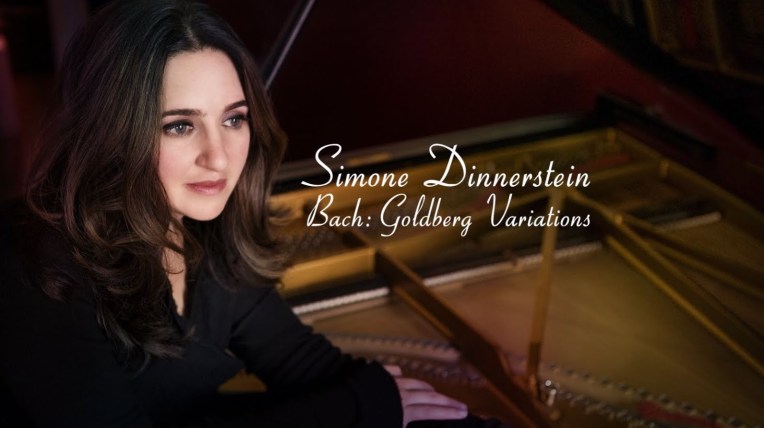
Pianist Simone Dinnerstein keeps her own fire for Bach close to heart yet guides its warmth in a manner anyone can understand. After being invited by the string orchestra A Far Cry to lead a new ensemble arrangement of the Goldberg, she became part of an experience which, though insurmountable in concept, unraveled so organically as to feel inevitable. Bathed in the Aria’s wordless songcraft, it was impossible to be unmoved. Dinnerstein’s touch, as delicate as it was forthright, was a precise sequence of suspensions and emulsions. Like a photograph developing in the ears, it revealed its totality one gradation at a time. My six-year-old son, taking notes beside me, wrote down: “I like the music. It’s very relaxing, soft and slow.” Dinnerstein’s simplicity—a difficult tone to strike when technical demands weigh heavily in the balance—thus spoke to a child’s unfettered worldview as much as to his father’s verbose classical allegiances.

Variations 1, 8, and 16 were variously buoyant, soaring and resplendent. In all of these the violins took on a leading quality that recalled Bach’s Brandenburg Concertos. Accents from every string were tastefully chosen and rendered. Whether delineated in the jazzy bass line of Variation 2 or the playful minutiae of Variation 5, there were more valleys than peaks to navigate from one end of this palindrome to the other. Rare passages in which either the piano or the orchestra played without the other therefore came across with that much more intimacy.

The hall’s collective breath had more avenues to travel in the slower Variations, of which the plucked conversation between cello and viola in 17 was a wonder. Even more so Variation 25, which Dinnerstein imagined as a chorale and therefore called upon the musicians to set aside their instruments and sing. Had it continued long enough, we might have started singing ourselves. Another highlight was Variation 28, for which Dinnerstein plucked the piano’s inner strings like a recumbent harp while the orchestra stretched this typically busy section into an open weave. The music ended as it began, with the piano alone, looking into the timeless mirror of which this performance was a heartfelt reflection.

As with the best tributes, A Far Cry didn’t so much add as draw out from within. All the more appropriate that Dinnerstein should be presented with a key to the city of Worcester by Mayor Joe Petty before the concert began, for indeed she gave us a key of her own design to the Goldberg unlike any fashioned before.

