

Dénes Várjon: De la nuit (ECM New Series 2521)

De la nuit.jpg

Dénes Várjon
De la nuit

Dénes Várjon piano
Recorded April 2016, Auditorio Stelio Molo RSI, Lugano
Engineer: Markus Heiland
Produced by Manfred Eicher
Release date: August 31, 2018

He searched under the bed, around the fireplace,
in the chest: but he found no one.
And he could not understand how the spirit had crept in—
and how he had escaped again.
–E.T.A. Hoffmann, Night Pieces

Hungarian pianist Dénes Várjon, who last regaled ECM listeners on 2012’s Precipitando, returns with another program of three culturally disparate composers united by the immaterial. Although the blood running through the veins of Robert Schumann (1810-1856), Maurice Ravel (1875-1937), and Béla Bartók (1881-1945) may be genetically dissimilar, in each we find arbitrations of music that, according to the booklet essay by Jürg Stenzl, “far transcended the confines of their time.” The untethered quality of these compositions, each chosen with utmost attention to detail, by virtue of their literary angles interlock in organic conversation. And in rendering them, ECM has found an unparalleled interpreter.

Schumann’s Fantasiestücke, op. 12 of 1837 are comprised of transfixing poetry. In these “character pieces,” linked explicitly to the writings of E.T.A. Hoffmann and Jean Paul, Schumann eschews sonata form in favor of an emotional mosaic that abides by its own logic. Its foundations support a lighthouse for listeners lost at sea. From the dramatic (Aufschwung and In der Nacht) and tenderly inquisitive (Warum?) to the mythic (Fabel) and dreamlike (Traumes Wirren), Schumann shines his light through one incredible prism after another until, coming to rest after the robust Ende vom Lied, Várjon, too, breathes the sigh of a journeyman closing his eyes with success.

Ravel’s Gaspard de la nuit (1908), inspired by a prose-poetry collection of the same name by Aloysius Bertrand, spins those latter impulses into a web of vivid imagery. The lambent Ondine evokes the water sprite of the same name, whose attempts at seduction follow fountain-like trajectories before rejection sends her reeling into the background. Le Gibet (Gallows) is meant to illustrate the body of a hanged man. Morbid yet beautiful, its suspensions take on new meaning. Scarbo returns to folklore in its depiction of the eponymous dwarf, said to haunt nightmares. The sensation of running desperately through a forest of which every tree is a hand tearing at our clothes makes this one of the most astonishing renditions I’ve ever heard of this piece.

The title of Bartók’sSzabadban(1926) means “Out of Doors,” and provides respite in the pastoral truths of its canvas. Some of its many influences include folk songs in the darkly percussive first movement and the harpsichord music of Couperin in the third. Throughout, a sense of comfort is always one step removed, locked in step with the march of a history that has all but left these jewels behind. Like the final movement, each scene is totally committed to its own unfolding, until we’re ready to work it back into shape as a promise to return.
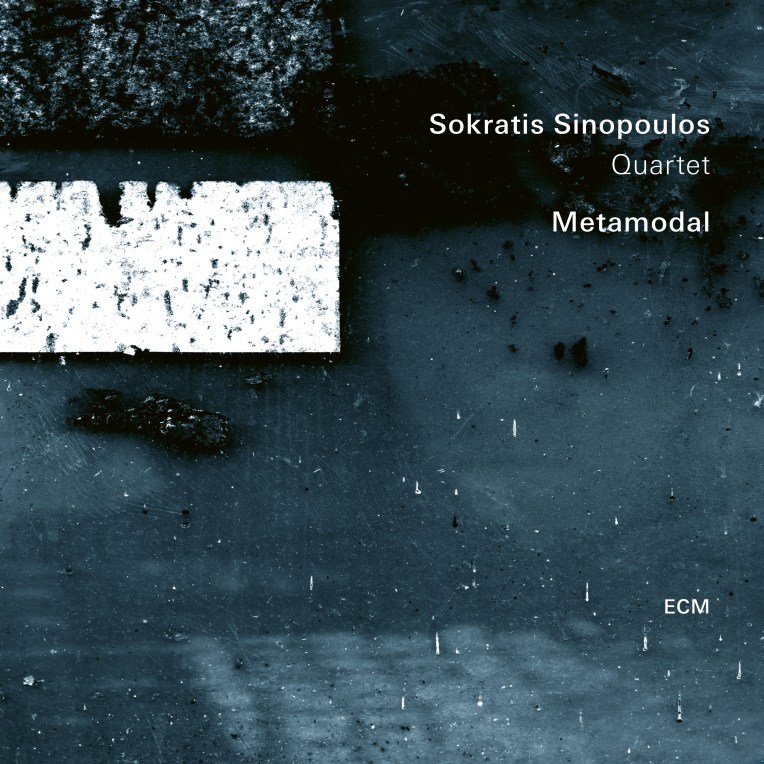
Sokratis Sinopoulos Quartet: Metamodal (ECM 2631)

2631 X

Sokratis Sinopoulos Quartet
Metamodal

Sokratis Sinopoulos lyra
Yann Keerim piano
Dimitris Tsekouras double bass
Dimitris Emmanouil drums
Recorded July 2018 at Sierra Studios, Athens
Engineer: Giorgos Karyotis
Produced by Manfred Eicher
Release date: March 15, 2019

Athens-based lyra virtuoso Sokratis Sinopoulos returns to the quartet that earned him deserved acclaim on 2015’s Eight Winds. With pianist Yann Keerim, bassist Dimitris Tsekouras, and drummer Dimitris Emmanouil, he once again brings the ancient and the unexpected into harmony. At the heart of Metamodal is its eponymous suite, divided into three parts: “Liquid,” “Illusions,” and “Dimensions.” From its quiet hole emerges a snake of melodic origin whose tongue flickers always in search of the next note. Behind the insistence of Sinopoulos’s playing, clay drums and bass erode a stony topography. As background and foreground intermingle, dances speak not of a celebratory present but of an unrecoverable past.

Before any of this takes shape, “Lament” opens the album proper with an arco bass drone, over which the lyra weeps, while a wave of piano caresses a distant shore, at once mournful of the footprints it destroys and hopeful of clearing the slate for new ones. Thus, Keerim lifts memories of those who once walked along those sands, their souls drifting to a land where the bodies they once inhabited were forbidden entry. Such transcendence is echoed in “Red Thread,” wherein the band paints a restrained yet dynamic canvas on which once-divisive politics now blend until their edges disappear.

If hope is to be found, it’s in “Walking” and “Dawn.” But the hope is fantasy. Still, the musicians hold fast to it like refugees their cultural identities, knowing as they do that illusions of safety are as real as one makes them out to be. And so, “Transition” is an appropriate title not only for the tune it names, but also for the aesthetic of Sinopoulos and his fellow travelers, who as a unit look two steps ahead with each remembered. As in the freely improvised “Mnemosyne,” they carry uncertainty like a treasure as they walk into the future, leaving footprints in the sand as an ephemeral record of their traversal.

(This review was first published in RootsWorld online magazine. The original link is here.)

Trio Mediaeval & Arve Henriksen: Rímur (ECM 2520)

Rímur

Trio Mediaeval & Arve Henriksen
Rímur

Anna Maria Friman voice, Hardanger fiddle
Linn Andrea Fuglseth voice, shruti box
Berit Opheim voice
Arve Henriksen trumpet
Recorded February 2016, Himmelfahrtskirche, München
Engineer: Peter Laenger
Produced by Manfred Eicher
Release date: March 3, 2017

If fate would send me around the world
far away from you,
I would yet, with tears, send you a sigh
that belongs to you.

The title of Rímur, Trio Mediaeval’s seventh album for ECM, takes its name from a longstanding tradition of Icelandic rhyming verses, passed down orally from generation to generation until reaching their present incarnations in a program that meshes three distinct voices with a fourth: that of trumpeter Arve Henriksen. In this artful sequence of chants, hymns, and folk songs drawn from Scandinavian sources, the quartet reimagines music as it might have swept across northern landscapes during bygone ages whose histories are renewed in these melodic survivors.

Because improvisation has always been a vital component of Nordic folk tunes, the leaps of intuition required of their interpretation are in-built into the music. And while saxophonist Jan Garbarek’s collaboration with the Hilliard Ensemble will draw obvious comparison—and, to be sure, fans of that project will want to own this one as well—it’s very much its own world, tracing a continental fringe that runs crosswise to that ECM classic.

The Icelandic material yields the most ghostly effects—not only because of a certain transparency, but more importantly because of Henriksen’s ability to see in it what few others might. Whether rising like the stream of a quiet fountain in “O Jesu dulcissime,” a highpoint of the disc for its vocal blending and Hardanger fiddle accents, or unraveling inner spirit in “Morgunstjarna,” a hymn to God’s only begotten Son in confirmation of grace, Henriksen reveals unforced harmonies, by turns balladic and martial. Other highlights include the original “Krummi,” the traditional Swedish shanty “Du är den första,” and the anonymous chant “Alma Redemptoris Mater.” In each of these, he extends the wingspan of expectation while yet cooling us in a familiar shade. In his absence, Friman, Fuglseth, and Opheim are spotlighted by a handful of vocal pieces, including some especially evocative material from Norway. Of these, the wedding tune “Brureslått” features some of the most stillness-inducing singing the trio has ever recorded.

At the heart of this recording are substantial hymns to Saints Birgitta (Sweden), Magnus (Orkney), and Sunniva (Norway). The first, by 14th-century Swedish composer Nils Hermansson, epitomizes the dynamics that make Trio Mediaeval such a unique ensemble. The way in which they spin from a single voice a sonority beyond triplicate measure is exquisite, even as Henriksen adds a voice of his own, at first in lockstep then in untethered flight. In the other hymns, they sail equally selfless waters. Would that we were able to turn their metaphorical vessel into a reality, docked far beyond the world’s storehouse of hatred by a braid of divine inspiration.