Jøkleba: Outland (ECM 2413)

Outland

Jøkleba
Outland

Per Jørgensen trumpet, vocals, kalimba, flute
Jon Balke electronics, piano
Audun Kleive electronics, drums, percussion
Recorded May 2014 at Madstun, Fall and Rainbow Studio, Oslo
Engineers: Audun Kleive and Jan Erik Kongshaug
Mixed by Audun Kleive
Mastered by Bob Katz
Produced by Jøkleba
Release date: October 24, 2014

Is it the sea you hear in me,
Its dissatisfactions?
Or the voice of nothing, that was your madness?
–Sylvia Plath, “Elm”

Although Per Jørgensen (trumpet, vocals, kalimba, flute), Jon Balke (electronics, piano), and Audun Kleive (electronics, drums, percussion) had already made four albums as Jøkleba before debuting on ECM under that same name, each musician had been involved in numerous other productions for the label. That said, this set of literarily themed improvisations leaves its own set of fingerprints, the whorls of which are spectral in range. By the second track, “Bell Jar,” itself a saline flush of digital impulses and organic trumpeting, the listener will know whether leaving or staying feels like the right thing to do.

To be sure, there’s much to admire here. From the visceral mountain calls in “Blind Owl” and “Horla” to the moonlit twinges of “The Nightwood” and “Below The Vulcano,” this trio knows how to craft a mood from scratch with cinematic lucidity. And while each musician contributes a personal energy throughout, for me it’s Jørgensen as vocalist who links the most creative chains. He plays the trumpet as if it were his own voice and sings as if his throat were honed in brass. The album’s most intriguing passages are his to carry. “Brighton,” for example, unfolds with the cadence of a Butoh dance, rich with meaning in the subtlest of movements.

Amid these abstractions, the appearance of piano and drums in “Rodion” feels like an oasis in the desert. “One Flew Over” gives further traction to the keyboard, and by that deference hints at something more pre than post. By the end, we’re left with a slipstream narrative that neither fulfills a promise nor answers a question. And perhaps that’s the way they prefer it.
Avishai Cohen: Big Vicious (ECM 2680)

2680 X

Avishai Cohen
Big Vicious

Avishai Cohen trumpet, effects, synthesizer
Uzi Ramirez guitar
Jonathan Albalak guitar, bass
Aviv Cohen drums
Ziv Ravitz drums, live sampling
Recorded August 2019, Studios La Buissonne, Pernes-les-Fontaines
Engineers: Gérard de Haro and Romain Castéra
Mastering: Nicolas Baillard
Produced by Manfred Eicher
Release date: March 27, 2020

Big Vicious marks the studio debut of trumpeter Avishai Cohen’s eponymous band. Already six years old, this assembly with Uzi Ramirez (guitar), Jonathan Albalak (guitar, bass), Aviv Cohen (drums), and Ziv Ravitz (drums, live sampling) embodies the canyon-wide leap of evolution Cohen has taken across ECM’s terrain since Into The Silence in 2016. This album is distinguished by its digital sheen, which through a web of guitars and live sampling shines the light of a distant future on the darker here and now. It’s a sensation amplified by the project’s silent partner, Tel Aviv musician-producer Yuvi Havkin (a.k.a. Rejoicer), who served as Cohen’s cowriter (another new direction for the frontman) on such tracks as “Honey Fountain” and “Teno Neno.” Where the former lifts the spirit by chains of echoing sentiment, even as it redraws boundaries of the flesh from which it stretches a hand toward hope, the latter tune speaks of moonlight in the language of a star.

From start to finish, Cohen fulfills the role of a storyteller gathering characters, dialogue, and settings, and in his combinations of those elements forges history. Throughout “Hidden Chamber,” his trumpet is a warrior of light, a reminder that politics forces us into places where tongues of strife lose their sense of taste. Cohen’s composing paves us a viable detour. From the propulsive bassing of “King Kutner” to the regressive groove of “This Time It’s Different,” every melody oils our skin through the thorny bramble of adversity.

The brightest heavenly bodies are the band’s arrangements. Beethoven’s “Moonlight Sonata,” for one, is reborn. Shedding every possible shade of cliché, it lives in a space only ECM can provide. Massive Attack’s “Teardrop” gets an equally postlapsarian treatment and harks to the earliest days of Big Vicious, when Cohen and friends mainly played 90s covers. The original lyrics of this song are appropriate in describing the present sound:

Water is my eye
Most faithful mirror
Fearless on my breath
Teardrop on the fire
Of a confession

Likewise, messages ooze from the ground as if during a spring thaw. Each is artfully crafted, traveling upward in a vortex of self-regard.

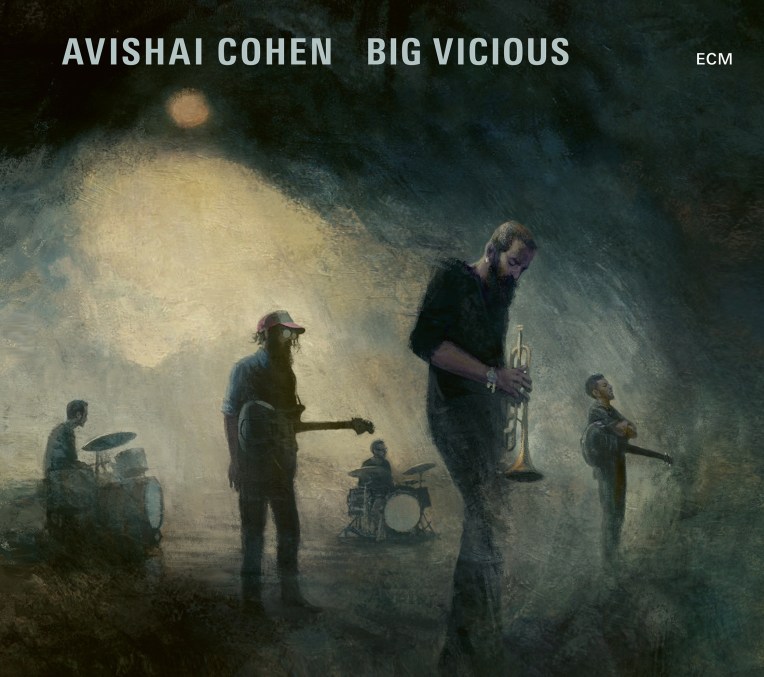
Of especial note is the album’s cover, a painting by David Polonsky, perhaps best known for Waltz with Bashir. Like the image itself, this is music that eschews photorealism in favor of something touched by hands, materials, and movement. It is also the visual equivalent of the album’s closer, “Intent,” which is so smooth that you might just find yourself blending in with your surroundings, wherever you happen to be.

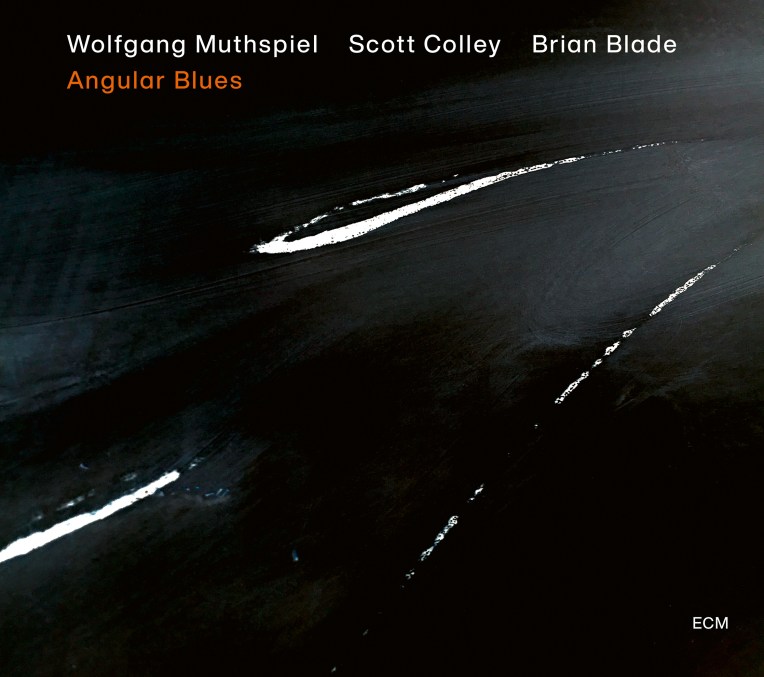
Wolfgang Muthspiel: Angular Blues (ECM 2655)

2655 X

Wolfgang Muthspiel
Angular Blues

Wolfgang Muthspiel guitar
Scott Colley double bass
Brian Blade drums
Recorded August 2018 at Studio Dede, Tokyo
Engineer: Shinya Matsushita
Assistants: Yuki Ito and Akihito Yoshikawa
Mixed at Studios La Buissonne by Manfred Eicher, Wolfgang Muthspiel, and Gérard de Haro (engineer)
Mastering: Nicolas Baillard
Album produced by Manfred Eicher
Release date: March 20, 2020

On Angular Blues, Wolfgang Muthspiel revives the format of his 2016 ECM leader debut. Rejoined by drummer Brian Blade yet inviting bassist Scott Colley in place of Larry Grenadier, the Austrian guitarist serves a full course of originals with a couple of surprises added to taste. The members of this trio share what Muthspiel calls a “love of song” and perhaps no more succinct a term could so accurately describe their rapport. Longtime listeners won’t be surprised that Muthspiel has brought together players who understand the value of space: how to shape it, to be sure, but more importantly how to let oneself be shaped by it in kind.

The narrative impulses of the opener, “Wondering,” harness the flexibility of Muthspiel’s acoustic playing, which in this context meshes with bass while kissed cymbals draw the z-axis of a three-dimensional sound. Moods cycle between gentility and insistence and shades between. The title track is aptly named for revealing a delicately virtuosic side to the energies at hand. “Hüttengriffe” follows with a soft-hewn anthem.

The remaining tunes find Muthspiel plugged-in, jumping into the amorphous body of his electric guitar. In “Camino” he is equally at home, his fingers free to engage in metaphysical play. As a thinly veiled tribute to the late John Abercrombie—not only in style but also in the way Muthspiel drafts his solo—it’s a highlight that deserves close listening. Others include “Kanon in 6/8,” which shows the trio at its deepest level of synergy (it’s also offset by the digitally enhanced “Solo Kanon in 5/4”), and bebop-influenced “Ride.” Two standards fill in the gaps. Where Cole Porter’s “Everything I Love” moves vertically, “I’ll Remember April” ends this worthy set on a horizontal plane.

(This review originally appeared in the April 2020 issue of The New York City Jazz Record, a full PDF of which is available here.)

James Ilgenfritz: You Scream A Rapid Language

YSARL

Bassist/composer James Ilgenfritz is rare for running lines of transfusion between jazz and classical bodies while keeping them equally alive. In that spirit, he presents this chamber program of formidable subtlety and feeling that travels comfortably between (and beyond) genres.

The combinations of instruments provide constant fascination, starting with the pairing of violin (Pauline Kim Harris) and double-pedal bass drum (Alex Cohen) in Terminal Affirmative. By turns primal and futuristic, this music frays the edges of such contradictions to the point of unity. It’s worth noting that this piece is based on observations of Ovid, who emphasized the power of water droplets to erode stone over time as an organic illustration of persistence. This philosophy seeps into everything that follows, but especially in Apophenia III: The Index. This trio for piano (Kathleen Supové), guitar (James Moore) and violin (Jennifer Choi), based on a short story by J. G. Ballard, asks the musicians to build a grander narrative out of through-composed fragments. Thus, what first seem to be aphorisms take on a coherence all their own.

Apophenia IV: A Bell In Every Finger sets poetry by the late Steve Dalachinsky (on Muhal Richard Abrams and Cecil Taylor, no less) for baritone (Thomas Buckner), piano (Joseph Kubera), percussion (William Winant) and Ilgenfritz himself. Buckner lends his falsetto to this garden of delights and darkness, contrasting hauntingly with the album’s masterstroke: How To Talk To Your Children About Not Looking At The Eclipse. Here flutist Margaret Lancaster breaks down breath to its most linguistically pure elements and makes them sing.

Tempting as it is to call this album intermittently assaultive, it is perhaps better described as possessed of a fierce intimacy. As in the concluding Fanfares For Modest Accomplishments for two violins (Pauline Kim Harris and Conrad Harris), it uses brevity to bring our attention to expanse. Such dichotomies are difficult to maintain, but these musicians do just that with unwavering strength.

(This review originally appeared in the April 2020 issue of The New York City Jazz Record, a full PDF of which is available here.)

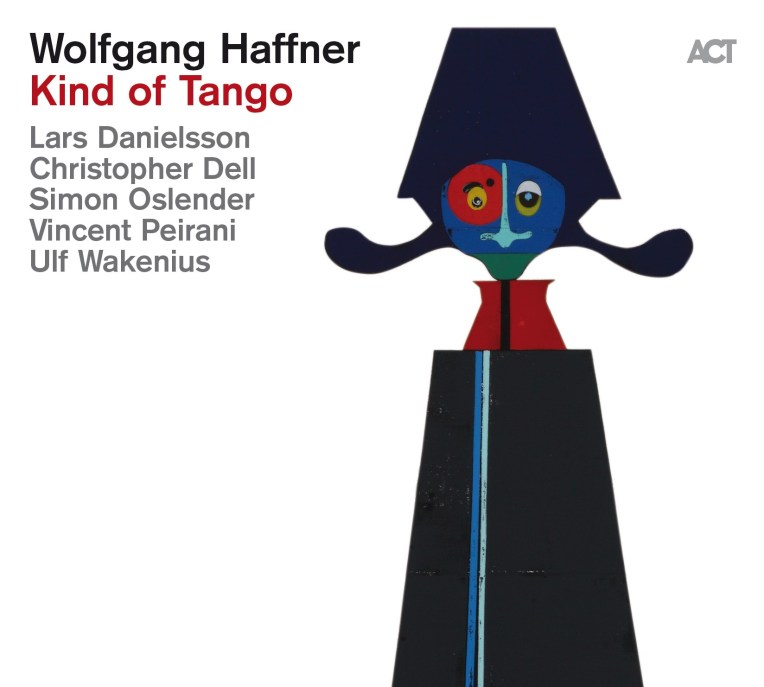
Wolfgang Haffner: Kind of Tango

Kind of Tango

This album expands composer and drummer Wolfgang Haffner’s Kind of… series with its best-integrated offering. Not only because the rapport he shares with bassist Lars Danielsson and pianist Simon Oslender is as involuntary as breathing, but also because the music spinning out from that core trio is reflective of a bandleader who understands that comfort is born of experience.

Whether in the understated groove of “La Cumparsita,” the inward glance of “Respiro” or the somber farewell of “Recuerdos,” Haffner figures that every dance doesn’t need to be a competition. And he’s not afraid to let melodies awaken slowly, as on “El Gato.” But the tango is best drawn between a leap and a crawl, and the brilliance of Haffner’s tempi lie in that balance. Quintessential in both concept and execution is his handling of Astor Piazzolla. By wrapping the familiar strains of “Libertango” in mystery and the lesser-known neorealism of “Chiquilín de Bachín” in the warmth of an open fire, he brings out a blush of sanctity from the secular. What we end up with, then, is a welcoming examination of tango: something personal, fresh and unforced.

(This review originally appeared in the May 2020 issue of DownBeat magazine.)

Tim Berne’s Snakeoil: The Fantastic Mrs. 10

Fantastic Snakeoil

There’s something undeniably adhesive about Snakeoil, alto saxophonist Tim Berne’s uncompromising outfit of exploding singularities. From the inaugural line, catalyzing an angular yet strangely joyful romp through head-nodding territory, we’d be hard-pressed to find ourselves unattached to at least one motif, line or beat along the way. Lending further veracity to his enterprise are Berne’s usual suspects of pianist Matt Mitchell, clarinetist Oscar Noriega and percussionist Ches Smith, adding to those guitarist Marc Ducret. One imagines the urban landscape moving in concert with these bodies ambulating through it, as if flesh, metal and concrete were all one assemblage to which this is the only logical soundtrack.

Despite the muscle behind much of the movement, passages of gargantuan sensitivity abound. Sometimes these are holistic, as in “Dear Friend,” which finds the band bowing its collective head for its composer Julius Hemphill. Other times, those moments are buried, as in “Surface Noise”—an accurate title, to be sure, but one that reclaims the term by severing its negatively connotative roots and replanting it in active soil.

The interplay between piano and alto saxophone is as oceanic as that between guitar and bass clarinet is amphibious, thus indicating a powerful array of duos throughout. Other notables include Mitchell and Ducret in the title track and “The Amazing Mr. 7,” Berne and Smith in “Rolo” and Berne and Noriega in “Third Option.”

All of this and more is summarized in “Rose Colored Assive.” At the touch of behind-the-scenes member David Torn, this concluding statement feels more like an opening one, its taste of fantasy whetting our palates for yet another new direction from one of the most exciting bands working in jazz today.

(This review originally appeared in the March 2020 issue of The New York City Jazz Record, a full PDF of which is available here.)

Sigurd Hole: Lys/Mørke

Lys:Mørke

Following 2018’s Elvesang (one of that year’s finest), Norwegian bassist Sigurd Hole returns with an even deeper solo session, recorded on a small island off the northern coast of Norway. Inspired by the surroundings, Hole often recorded with the studio door left open and sometimes even outside. As David Rothenberg observes in his liner notes, there’s something both primal and rare going on here—a willingness to speak with, rather than at, nature.

Although its 18 tracks are divided down the middle into suites of Light (Lys) and Darkness (Mørke), we could easily read one into the other. In Light, we encounter the inward arpeggios of “Skygge” (Shadow), just as in Darkness we stumble across the vast terrains of “Refleksjon” (Reflection). As dots in an aural yin yang, they are masterstrokes of one who intimately knows the inner life of his instrument. Aside from one traditional song, his subliminal folktales come from the heart.

Hole is a painterly musician in the truest sense—that is, one who isn’t afraid to call upon every brush and palette knife at his disposal. In most cases, he seems interested in examining the harmonic possibilities of the bass, drawing out hidden and elusive shades of color in the process. Prime examples include “Trestein” (Woodstone), “Årringer” (Growth rings) and “Bølge” (Wave), in which Hole opens his bow like a poet would a journal, setting pen to paper without filter.

Thus, Hole unravels until his emotions sing in a way that sidesteps the need for highlighted analysis. The more one listens, the more one feels each track as a vital organ of the whole. And while you may not walk away with discernible melodies on the brain, you will have in your possession something far more indelible: a feeling that you have known the texture of a soul.

(This review originally appeared in the February 2020 issue of The New York City Jazz Record, a full PDF of which is available here.)

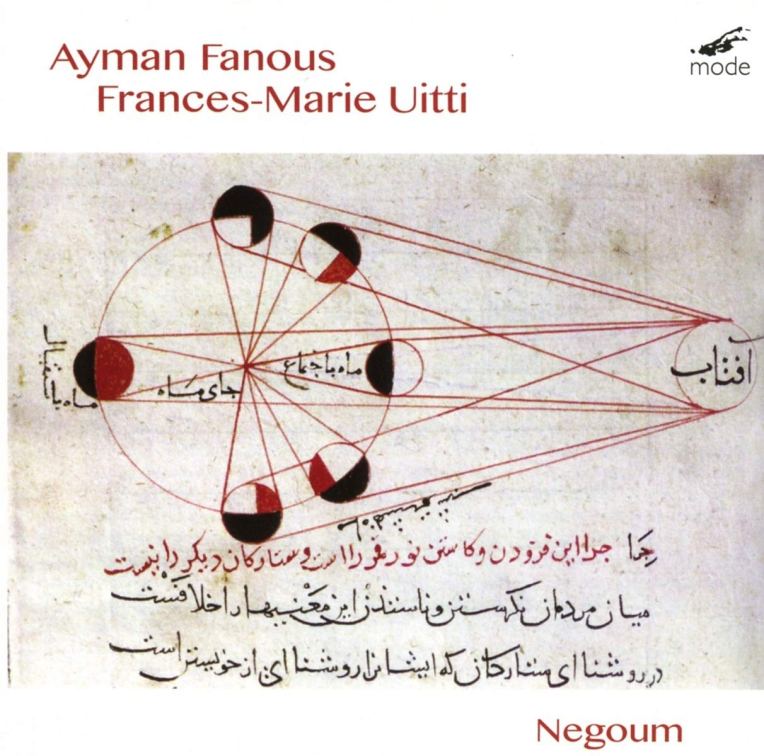
Ayman Fanous/Frances-Marie Uitti: Negoum

Negoum

This album is the first studio recording of two seemingly disparate virtuosi—Egyptian-born, New York-based bouzouki/classical guitar player Ayman Fanous and American, France-based cellist Frances-Marie Uitti—sharing a dialogue of traditions and their unraveling. In the former vein, Fanous brings his knowledge of taksim(a style of melodic improvisation prevalent in Middle Eastern music) and Uitti hers of classical precision while in the latter both seem to become increasingly connected as they drift further from canonical moorings. In Uitti’s duets with bouzouki, such as the opening 16 minutes that are “Adhara,” self-examination prevails. As for the tracks featuring guitar in place of bouzouki, one senses that something beyond magical is taking place. Rather, it’s a process of mental elimination, resulting in music of astonishing subtlety.

For half the program, Uitti employs a two-bow technique of her own innovation. But one might never know it because she plays with such an integrated mode of expression that her gestures are organic, soulful. Every line stands precisely where it should be standing and rests where it should be resting. Fanous approaches the primal pluck with two rural exhalations for every urban inhalation, blending Western and non- Western persuasions without fraying a stitch.

While highlights may be pointed out—among them the quasi-triptych of “Alnitac,” “Megrez” and “Alioth” at album center—what we have here is something greater than the sum of its parts. These are musicians far less interested in defining anything in particular than in cracking open the very concept of definition like an egg and frying it on the pans of their instruments until its savor curls up to the fortunate listener. Proof that dualism needn’t be a constant negotiation of dominance but rather a cyclical process of translation by which the original utterance and its re-rendering become indistinguishable to the point of nourishing a universal form of communication.

(This review originally appeared in the February 2020 issue of The New York City Jazz Record, a full PDF of which is available here.)