Between the covers of BIRD, Christina Rauh Fishburne offers a chapbook of moving images and emotional tableaux using words as her pigment and a keen sense of observation as her brush. Her prose poems are stories just beginning to petal open in the light of a reader’s eyes, each as fragrant with densely packed information as a human cell.
The scenes are as distinct as the verses describing them. While there are plenty of aerial views to take in, Fishburne dives ever inward as the pages flip by. From a scarecrow-stuck field and private garden to a dressing room and mollusk’s shell, she combines just enough ingredients to make a meal of the lesson at hand and consume it before moving on to the next.
Personalities plant their stakes along the way. Whether in the crow’s stark altruism, the albatross’s maritime legacy, or the barn owl’s untranslatable scream, the indifference of bare life to examined life renders our concerns at once universal and meaningless. This doesn’t mean we are always looking through nonhuman eyes; it does mean we are asked to consider how that gnaws at the ego.
Whereas impossibilities feel organic (“The sun was still and straight as a cowboy”), renderings of the quotidian and the agricultural (there is, for example, repeated mention of barley) feel starkly out of place, as if nature were only a construction of those who infringe upon it with the cutting of blades, the striking of matches, and the pulling of roots.
While the mood is generally retrospective, sometimes regretful, a certain resilience shines through with mounting clarity. Even darker passages like “Pheasant” embalm a youthful wonder that never seems to burnish. “Oyster Catcher” is a masterstroke of parental anxieties (“My child will be born quite soon. I receive her messages in sudden desperate grasping. She must be like me. She doesn’t like to be inside”) and confinement. In it, the pearl—for us, a sign of beauty and value—is a natural irritant, a bauble of sacrifice and forced honor that never quite reflects the visage of its wearer.
Signposting our journey are four “takes” on the gull. Their encounters with wounded yet resilient souls court the temptation to exaggerate or revise personal narratives. Fishburne continually seeks such hypocrisies, throwing intimate spotlights on them to ward us away. Elemental touchpoints also throw the occasional roof over our heads. Of these, “Water” gets at the heart of the collection’s worship of transfiguration. We take a lot of turns together yet come out the other end with scars to show for our survival.
The animal, insofar as it reflects the human, has more self-awareness and investment in the world than we might think. The human, insofar as it reflects the animal, loses itself in rote survival. “There’s nothing worse than a flightless bird,” Fishburne tells us, giving us hope to build wings of our own from the scraps of lived experience.
Bird is available directly from Kattywompus Press here.
In chapter 3 of Genesis, Satan makes his first cameo. By that point, God has commanded Adam to eat freely of every tree in the garden, with one proviso: “But of the tree of the knowledge of good and evil, thou shalt not eat of it: for in the day that thou eatest thereof thou shalt surely die.” Appearing as a serpent, Satan approaches Eve instead, echoing those fateful words on his forked tongue, “Yea, hath God said, ‘Ye shall not eat of every tree of the garden?’” So begins a chain of doubts and deceptions, tethering itself eventually to Father of Lies, the first novel by Brian Evenson.
Eldon Fochs is base but not basic. As a provost representing the local “Bloodite” Mormons, he commands respect, trust, and honor within his community. Yet the serpent’s voice rings in his ears like the vibrations of an empty skull. Empty is the operative word to describe Fochs, who serves as a willing vessel for that most ancient of mariners, steering the flesh into one fatal port of call before the winds of protection fluff his sails onward to the next.
Monitoring his disembodied crew of “loud thoughts”—not voices, he insists—is therapist Alexander Feshtig, at whose urging he unravels some of the fray of his childhood, passing off acts of violence as “dreams” and lightening his dark load in the face of uncertain accountability. Feshtig’s notes and battle of letters with his superiors (all of whom have a stake in keeping allegations of child abuse and murder under wraps), along with Fochs’s self-indulgent accounts in the first person, make for a morbid compass, the magnetic north of which points directly to the alter ego Fochs calls “Bloody-Head.” The latter’s interventions guide him into territories so wicked that he cannot help but come full circle into correction—or so he tells himself whenever the quotidian world seems poised to catch up with his perversions. Bloody-Head is neither a consequence of dissociative disturbances nor a projection of internal desires. He is, instead, the great tempter whose name and visage have been rendered for millennia on rock walls, stretched canvases, and human skin. And once he’s settled, no one dictates how long he can stay.
As a character study, Evenson’s narrative is a half-step removed from lived experience. His debut short story collection, Altmann’s Tongue (1994), prompted a critical response from his own Mormon leaders, who felt its frank sexual and thematic material went against the grain of doctrinal propriety. Refusing to succumb to their pressure to stop writing, he left a teaching job at Brigham Young University and the religious organization it represented. Although the seed of Father of Lies was already planted, this turn of events seems to have provided the increase. Here, he returns to those broken pieces, scrutinizing them in the light of retrospection and fashioning a catharsis of fiercely intimate proportion.
Seeing how far the church will gladly protect Fochs, lying to avoid soiling the undergarments of the Faith, hits close to home for me, too, as a survivor of spiritual abuse. When Fochs insists, “I know sin inside and out,” I believe him, if only because he is able to engage in that most horrific of illusions whereby he simultaneously swerves the wheels of innocent lives into oncoming traffic and sits behind the headlights that blind them moments before death.
Turning the secret into the sacred—or, if you prefer, treating the wrong as if it were right—is the only method of forgiveness by which Fochs can operate. Every killing is a “favor” to save a wandering sheep from reprobation, an act of such profound sacrifice that only a man of his supposed courage can bury the conscience so deep that its voice is muffled beyond recognition. And even when flowers of truth begin to bud from the rot, they are robbed of their fragrance before being given a chance to bloom. Thus, Fochs’s place on Earth is assured by the dint of a metaphysical contract. He knows his destination. Might as well destroy as many lives as possible on his way down. Feshtig puts it best: “Hell is crammed full of godly men.”
There’s no surprise in the ending, if only because we’ve seen it play out too many times in reality. The only spoiler here is Fochs, whose actions touch upon a sobering truth of the human experience: our addiction to crisis. Ignoring all the little (and not so little) signs that something is off gives us an excuse to swoop in as the savior when our complicity hits the proverbial fan. Therefore, what on the surface appears to be a slow burn of Mormonism soon forges a mirror in which we are asked to regard ourselves accordingly. Killing the body is one thing, killing the soul quite another—and how often we deny our readiness to flirt with that second sin!
The end effect of our time with Fochs is a scar. Whether in the anger one feels over the shuffling of apostolic cards or a child’s cry for salvation finding only the ears of her perpetrating father, the royal flush of revelation will abrade your heart as the conclusion lays its winning hand. After all, at the betting table of life, there’s nothing more frightening than a dealer who thinks himself righteous beyond reproach.
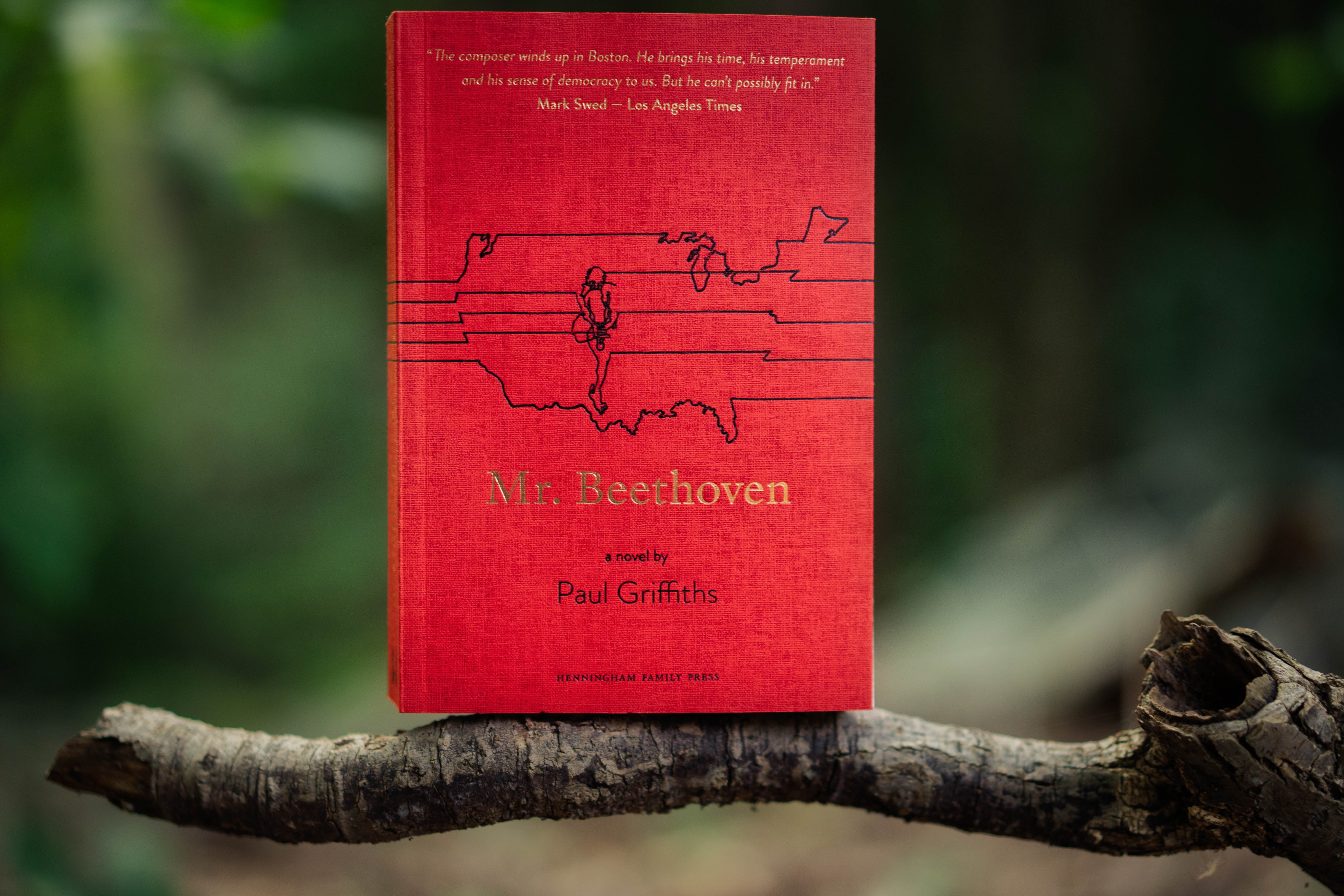
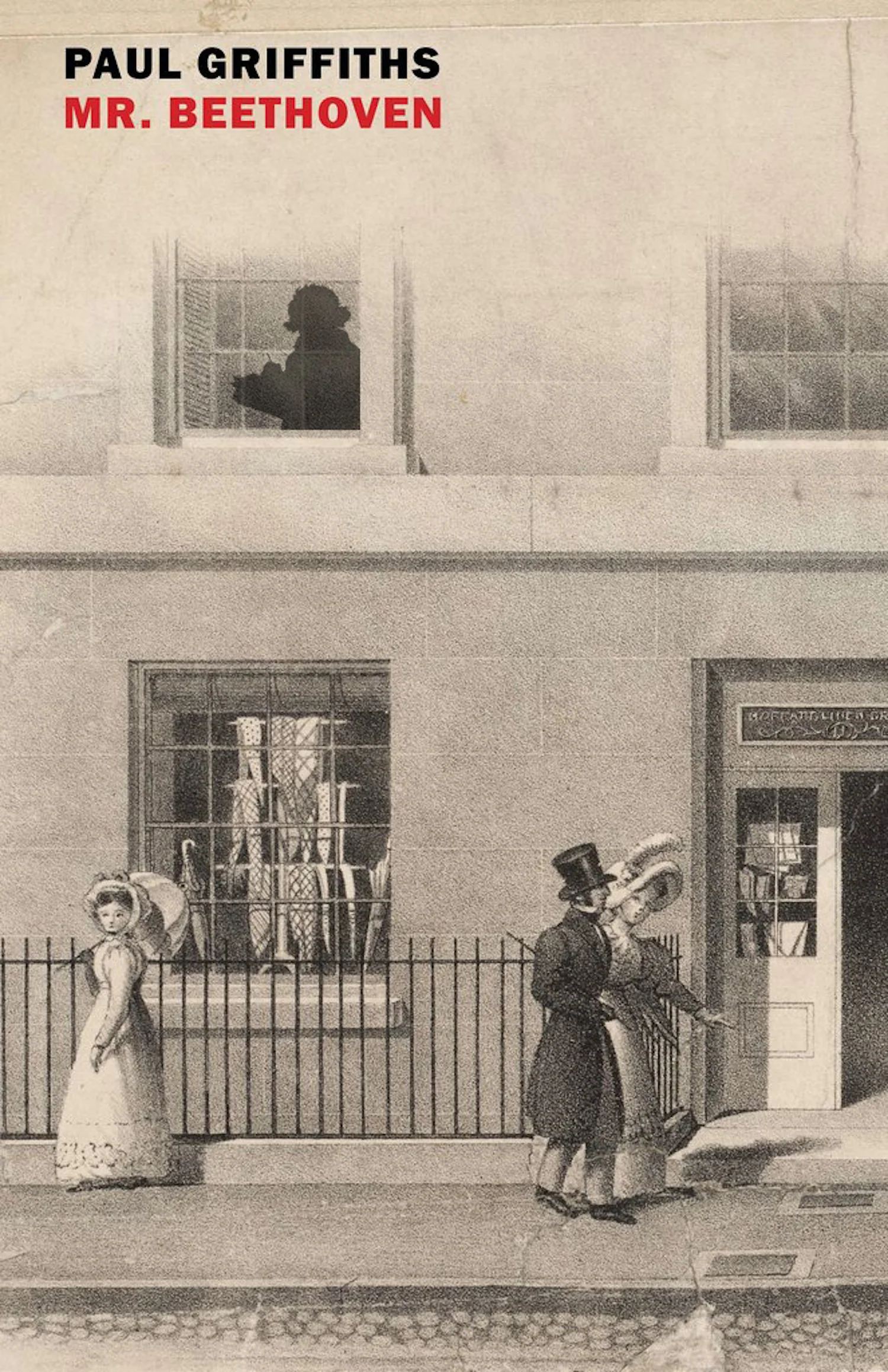
If fiction is the art of revivification, then let Mr. Beethoven be one of the most self-aware products of its wonders. The 2021 novel from Paul Griffiths grafts archival leaves to branches of nourishing speculation to imagine a journey the German composer might have taken in 1833 (six years after his death) to America to finish an oratorio on the Biblical figure of Job.
Although the Handel and Haydn Society of Boston indeed considered commissioning such a work, the only motif of it we will ever know may be articulated in the mind’s ear as we read of its stumbling fruition and premiere. Written in a narratively and stylistically episodic style and using only statements recorded as having been uttered by Der Spagnol, it unfolds not unlike his Ninth Symphony, building a dome’s worth of clouds one wisp at a time until the light of something divine pushes its way through to illuminate the ground at our feet anew.
If any of this sounds too good to be true, that’s because it’s too true to be good. Whereas the “real” Beethoven—as if the persona of that name weren’t already enigmatized by our constant recapitulations—reads to us today like the quintessential poète maudit, he marks the zoetrope of this book in moments of pandering frustration but also, more importantly, cadenzas of openheartedness, interpersonal profundity, and sheer delight.
Hints of a holistic portrait shade the opening act, wherein we encounter Beethoven as an enigma aboard a ship in the Atlantic bound for New England. He is a figure rendered by charcoal in intercontinental candlelight rather than oil in the Roman sun. “A stare, from a stranger,” we are told, “can be a flooding of humanity through whatever dams of difference.” Thus, we see and feel through the eyes of characters as fleeting as their target’s evergreen status. Such moments point to one of the novel’s most brilliant aggregations of historical impulse in Griffiths’s ability to articulate Beethoven before his place in the canon, itself in flux at this point, was assured by the validation of hindsight. By the same token, it emphasizes the unique disjointedness of place one experiences at sea before making landfall in realms of emotional economy. Says the muse of takeaways: Recognition is never universal.
By the time he gets to Boston, Beethoven’s dishevelment reads not like a caricature of the man but as the ravages of a harrowing journey. When encountering subsequent dramatis personae, we view them as he does: in his polite disinterest in Lowell Mason (responsible for the commission), in his enjoyment of Quincy under the auspices of hostess Mrs. Hannah Hill (a widow in whose company the bee legs of his heart collect no small amount of pollen), in his disappointment with the Reverend Ballou (a dismal librettist whose failures end up provoking a textual revival), and in his enchantment with Thankful (a sign language teacher and interpreter variously dubbed his “ear” and “amanuensis”). Every instance in which Herr Beethoven shakes a hand, exchanges words, or consumes a morsel of food reinforces the illusion that the music is imminent.
Each chapter is a composition unto itself. Whether in his iridescent vignette on the Fourth of July or in the careful construction of possible yet unprovable interactions, Griffiths sews his story with a leitmotif of concerns that make it clear he is wrestling as much as we are with the implications of his reality. While Chapter 32 is almost entirely footnotes, 33 only dialogue with dynamic markings, and 38 a single run-on sentence, these artifices never feel out of place or contrived. Each is a libretto unto itself for a musical work yet to be written.
From the selection of voices to travails with the local punditry, the story arc is pulled like a shuttle through looms marked by clefs instead of wooden frames, culminating in a virtuoso performance from musicians and Griffiths alike, as the author provides a full text for the oratorio, interleaved with reflections such as:
“To this Boston audience, the music is untoward, beyond familiar reference points, and yet at the same time wondrous, perhaps most of all in its successions of harmonies, how they float, swerve or dive while also proceeding forward inexorably, how they keep their sights on that one sure path while sometimes veering to the side or soaring high above, carrying their first listeners into new air.”
The book’s constant fourth-wall breaking may be its greatest pleasure. At one point, Griffiths even invites us to call him out on his conceit, only to retreat further into its fascinating depths. Hanging on what-might-have-beens (“it could all so easily have gone a different way,” “Scraps of paper might have survived,” etc.), he is content to vary his approach to the theme at hand as a seasoned improviser at the keyboard.
Among the many things to adore about Mr. Beethoven is that it sidesteps the trap of forcing a creative swoon. Unlike The Agony and the Ecstasy, whose Michelangelo rhapsodizes in the presence of unhewn marble, itself a cipher for escape, we get none of the romantic privilege of the artist at work. Hints of influences, witting or not, also make this a joyful effort. Top notes of James Cowan’s A Mapmaker’s Dream and Thomas Pynchon’s Mason & Dixon and a splash of Umberto Eco in the middle make way for a powerful dry down that leaves plenty of room for Griffiths’s base notes to settle in the nose for the long haul. In the latter vein, nods to his own work (“Let me tell you,” says Mrs. Hill at one point, naming his Ophelia novel) remind us of who is telling the story. Setting aside such comparisons leaves us with a three-dimensional object to regard in the light of our hopeful imaginations. The more we turn the key, the more it can sing when we let go.
Like the composer, we hear nothing yet feel every note.




 Between Sound and Space: ECM Records and Beyond