Tomasz Stanko Quartet: September Night (ECM 2650)

Tomasz Stanko Quartet
September Night

Tomasz Stanko trumpet
Marcin Wasilewski piano
Slawomir Kurkiewicz double bass
Michal Miskiewicz drums
Concert recording, September 9, 2004
at Muffathalle, Munich
Mixing: Manfred Eicher, Marcin Wasilewski, and Stefano Amerio (engineer)At Bavaria Musikstudios, Munich
Cover photo: Caterina Di Perri
Produced by Manfred Eicher
Release date: June 21, 2024

Recorded on September 9, 2004, at Munich’s Muffathalle, this surprise from the archives reveals as much about the late trumpeter Tomasz Stanko as it obscures. The live session finds him in the company of pianist Marcin Wasilewski, bassist Slawomir Kurkiewicz, and drummer Michal Miskiewicz, the trio with whom he shared stages from 1993 to 2017. “We were growing by his side, and he was watching us,” Wasilewski recalls about working with the man who was their mentor in every sense. “Every concert we played with him was important—the most important, almost as if it was the last one. That’s the approach he taught us: ‘When you play music, play it at a thousand percent!’” One hears that ethos revived throughout September Night, making it a vital document that deserves to wrap its arms around the shoulders of Suspended Night and Lontano, where it chronologically lands between.

I will never forget seeing Stanko with his New York Quartet in 2013. I still get whiffs of that octane now and then in the brain. But listening to “Hermento’s Mood,” which opens this all-original set, I am reminded of the ethereality he was uniquely capable of—a continuation of the song he held inside. Like “Elegant Piece” later in the show, it’s a flower that blooms only in moonlight.

Stanko’s ability to jump from exuberance to the depths of the soul never ceased to amaze. “Song For Sarah” is a prime example, just as comfortable grazing the bottom of the ocean in search of treasures long forgotten (of which this recording is one) as “Celina” is at home throwing its slow-motion strike across the proverbial plate. Even the freely improvised “Kaetano” cannot help but flirt with contradiction, shifting from urban meandering to a scenic train ride conducted by the rhythm section and exposited by Wasilewski.

Lest we forget the brilliance of Stanko’s backing band and the enmeshment of which they continue to be humble champions, we need only point to “Euforila” as a beacon of their craft. Opening with a lacy bass solo, it finds the band doing what it does best: knitting itself together while allowing plenty of open space between every instrument. As a determined body of water, they work around everything in their way without skipping a beat. Wasileswki is bright and joyful, while Stanko’s delicate punch of a solo is hot to the touch. Yet nothing can stop Miskiewicz from making the biggest waves below, crashing and roaring into the conclusion. Contrasting this is the closing “Theatrical,” which casts its ring into the fires of Mordor and walks away unscathed.

Incidentally, this concert was part of the “Unforeseen” symposium, co-curated by Munich’s Kulturreferat and the musicology department of the Ludwig Maximillian University, a week-long event that yielded two further ECM live albums: Evan Parker’s Boustrophedon and Roscoe Mitchell’s Composition/Improvisation Nos. 1, 2 & 3. If such companions feel radically different, it’s because freedom assumes a bespoke form here. Whereas Parker leaps skyward and Mitchell digs into the earth, Stanko is most comfortable riding that indefinable horizon between them.

Gianluigi Trovesi/Stefano Montanari: Stravaganze consonanti (ECM 2390)

Gianluigi Trovesi
Stefano Montanari
Stravaganze consonanti


Gianluigi Trovesi piccolo clarinet, alto clarinet, alto Saxophone
Stefano Montanari concertmaster
Stefano Rossi second violin
Claudio Andriani viola
Francesco Galligioni violoncello
Luca Bandini double bass
Emiliano Rodolfi oboe
Pryska Comploi second oboe
Alberto Guerra bassoon, dulciana
Riccardo Balbinutti percussion
Ivano Zanenghi archlute
Valeria Montanari harpsichord
Fulvio Maras percussion, electronics
Recorded January 2014 at Sala musicale giardino, Cremona
Engineer: Roberto Chinellato
Mixed September 2021 at Artesuono Studio, Udine
by Gianluigi Trovesi, Stefano Montanari, Guido Gorna, and Stefano Amerio (engineer)
Cover photo: Luciano Rossetti
An ECM Production
Release date: February 24, 2023

Italian reed virtuoso Gianluigi Trovesi and baroque violinist Stefano Montanari (doubling here as concertmaster) lead an ensemble of period instruments for a fresh take on the music of the 15th through 17th centuries. Meshing melodies from towering figures of the Renaissance and Baroque with equally visionary interpretations, the program manages to carve new initials into old pillars without marring their beauty. Some new compositions by Trovesi, plus a couple of improvisations with Fulvio Maras (percussion, electronics), complete the mix.

The album’s title, which translates as “consonant extravagances,” offers an accurate description of what is happening sonically, creatively, and even spiritually. “The Witches’ Dance” (from Henry Purcell’s opera Dido and Aeneas) leads off on a courtly foot. Purcell makes a handful of appearances throughout, most gorgeously as a motivic inspiration for Trovesi’s “For a While.” Like all of his pieces, it benefits from the robustness of Corrado Guarino’s arrangements, which take advantage of the period instrument ensemble under Montanari’s charge. The latter brings the crispness of strings to “Consonanze stravaganti” by Giovanni Maria Trabaci (an influence on Girolamo Frescobaldi), Guillaume Dufay’s Missa L’homme armé, and a sonata by Giovanni Battista Buonamente. Whether threading his alto through Andrea Falconieri’s “La suave melodia” or revealing his compositional wonders in “L’ometto disarmato” and the alto clarinet jaunt of “Bergheim,” Trovesi is a force of nature shapeshifting between song and cry on the turn of a dime. If the past is alive in his sound, then so is the future.

(This review originally appeared in the January 2024 edition of The New York City Jazz Record, a full PDF of which is available here.)

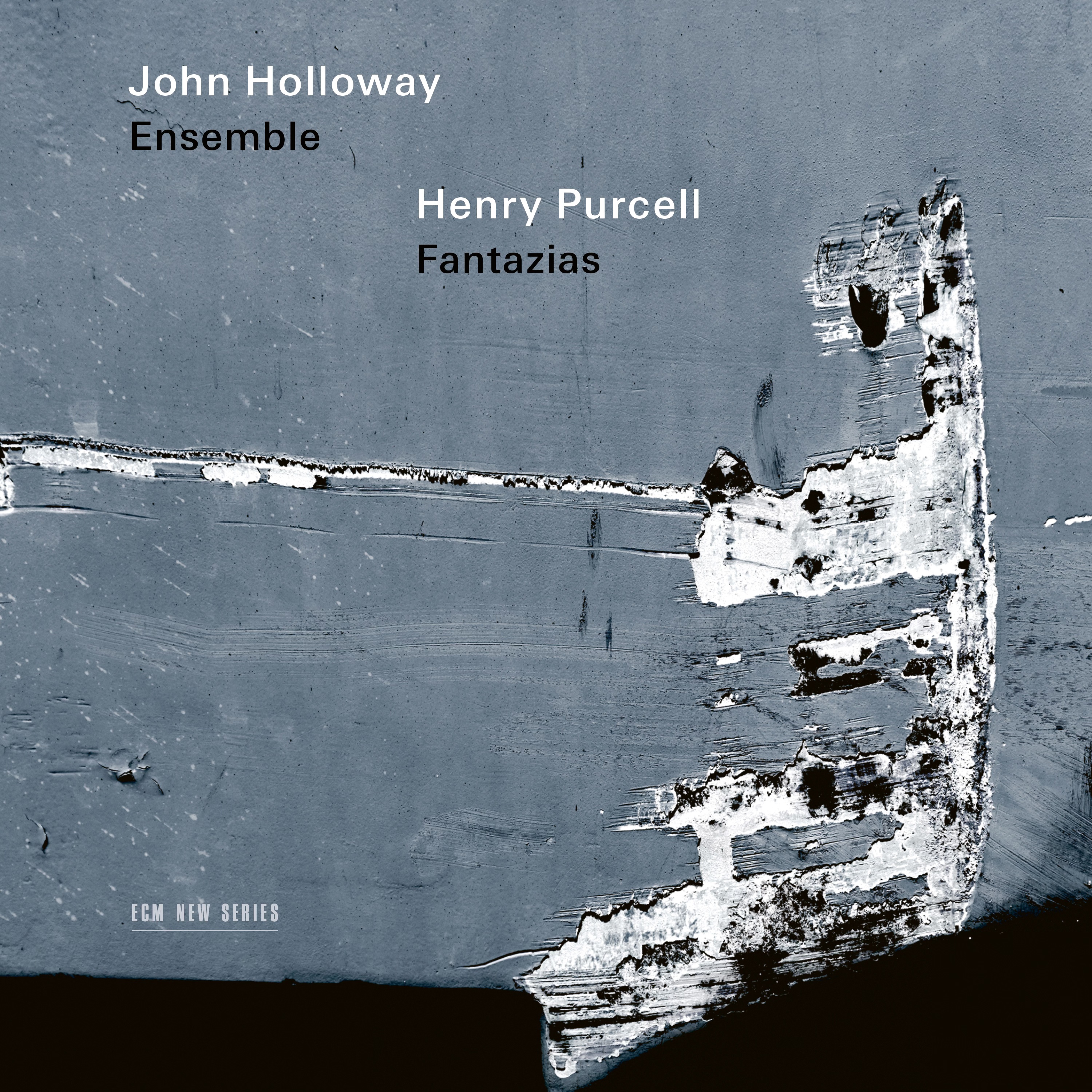
John Holloway Ensemble: Henry Purcell – Fantazias (ECM New Series 2249)

John Holloway Ensemble
Henry Purcell: Fantazias

John Holloway violin
Monika Beer viola
Renate Steinmann viola
Martin Zeller violoncello
Recorded March 2015 at Radiostudio DRS, Zürich
Engineer: Stephan Schellmann
Cover photo: Thomas Wunsch
Produced by Manfred Eicher
An ECM/SRF2 Kultur coproduction
Executive producer (SRF): Roland Wächter
Release date: September 22, 2023

Henry Purcell (1659-1695), best known for his operas, was no less a formidable composer of instrumental music. His Fantazias are the pinnacle of the form, rich in their intermingling of counterpoint and polyphony. By the time Purcell put these to paper in 1680, the fantasia was over a century old. Despite being honed into a science by such estimable predecessors as William Byrd, William Lawes, John Jenkins, and Matthew Locke (whom Purcell replaced as “composer in ordinary with fee for the violin to his Majesty,” Charles II), it had fallen out of favor. Violinist John Holloway calls the present collection “a personal farewell to a kind of music, which in Purcell’s own chamber music would soon be superseded by sonatas.”

Leading an ensemble that includes violists Monika Beer and Renate Steinmann and cellist Martin Zeller, Holloway regards these 12 gems through a jeweler’s glass, cherishing every occlusion as a testament to its crafting through time. We encounter them here out of sequence, beginning with the river’s flow of No. 10. The sound is both creamy and metallic, sometimes allowing dreams to peek above the surface while at others pushing them into the mysteries of the current. Like No. 4, it affords a special sort of grace, pivoting from a seamless introduction into an intricate unfolding without changing skins. The ensemble matches with a palette that is equal parts shimmer and shadow.

Indeed, while these strings owe much of their grace to the composing, one cannot discount the players’ lifeblood. Like actors in a stage play, they embody these “characters” from within. In No. 6, for instance, Holloway’s violin laments like an agent of mourning while the others cross-hatch that inward focus with extroverted streaks of illumination. This dynamic reverses as the urgency heightens, and Holloway grabs hold of the future while the lower strings keep vigil to avoid forgetting the past. No. 9 is its companion in spirit: Even when it dances, it casts hedonism into the fire. Nos. 7 and 8 are equally wondrous in their contrasts, and their slips into dissonance reveal an improvisatory heritage, making them feel spontaneous, raw, and passionate.

In his liner notes, Holloway says, regarding the English composer’s handling of the form, that Johann Sebastian Bach “would certainly have acknowledged it as equal to his finest achievements in this art.” This is perhaps nowhere more obvious than in No. 5, the knotwork of which immediately suggests The Art of Fugue. Sitting on its right hand and left are Nos. 11 and 12. As translucent as they are viscous, they constitute a trinity of resolution that begs for more yet offers salvation only through silence.

While the above pieces are in four parts, Nos. 1-3 are in three. More intimate in form but no less expansive in scope, each is a dip into the heart of a creator whose font ran dry too soon.

Robert Levin: Mozart – The PIano Sonatas (ECM New Series 2710-16)

Robert Levin
Wolfgang Amadeus Mozart: The Piano Sonatas

Robert Levin fortepiano
Recorded February 2017 and Feburary 2018
Großer Saal, Salzburg Mozarteum Foundation
Engineer: Markus Heiland
Cover: Fidel Sclavo
Produced by Manfred Eicher
Release date: September 16, 2022

Wolfgang Amadeus Mozart (1756-1791) is as much an enigma as an indelible emblem of what it means to be “classical.” In this seven-disc boxed set, a monumental achievement dedicated to one whose own achievements were nothing less than monumental, pianist Robert Levin offers a conspectus of the piano sonatas on the very fortepiano Mozart played from 1785 until his death and on which he composed The Magic Flute and his Requiem. Built by Anton Gabriel Walter in 1782, it speaks as one traveling out of time with a message of space.

Like much of Mozart’s writing, the music in these sonatas resulted from improvisations he later noted from memory—a spirit that Levin captures with charming honesty. The pianist’s historically informed approach heightens this effect, seeking to, in his own words, “revive a documented tradition” of embellishing repeats that goes back to C.P.E. Bach, whom Mozart greatly admired. Despite a fixed tripartite architecture across the board, there is great variation in mood, scope, and difficulty.

While Mozart is often cast as a poster child of vivaciousness, each sonata is best savored for its rich, sweet center. In these slower movements, genius bobs above and below the surface of a mind whose depths we can only begin to comprehend. We get a hint of this already in the Sonata No. 1 in C major, of which the Andante, nestled in neo-Baroque surroundings, is the music box of a childhood we’ve long forgotten.

Should that metaphor hint at immaturity, let such an illusion be shattered by a vision of the prodigy it manifests and which steps boldly into the foreground in the Sonata No. 2 in F major, cradling an Adagio that is the sonic equivalent of a precious stone. Even the Sonata No. 3 in B-flat major, with its lockstep opener and one-two punch of a conclusion, cannot steal the quiet thunder of the central movement between them. Such controlled ferocity must have been obvious to the composer himself when beginning his Piano Sonata No. 4 in E-flat major with an Adagio, pointing to the influence of Joseph Haydn, whose own sonatas he had then recently discovered.

Over the next four sonatas, expositions of stateliness and pastoralism bow to the dynamic brilliance of the Sonata No. 6. This D-major triptych is a stage drama in concentrated form, culminating in the final theme and variations. Spanning 15 minutes, they comprise the collection’s longest stretch, suggesting an orchestral sensibility.

This brings us to the pinnacle of Mozart’s engagement with the form: the Sonata No. 9 in A minor. Written in 1778, soon after the death of his mother, Anna Maria, its first movement sits on the throne of the collection. Morphing from extroversion to introversion and back again, its changes nourish Levin’s insights as a performer. The Andante here is the most holistic. Bursting into moments of passion but always returning to baseline, it sets up the concluding Presto and leaves us where we started: in wondrous anticipation. Along with its younger sibling, the Sonata No. 10 in C major, this is the form perfected.

Even “greatest hits,” including the Sonata No. 11 in A major, reemerge as hidden gems. The universally known Alla Turca lends itself to listening without prejudice, the familiar becoming new under Levin’s fingertips. Whether in the famous Allegretto grazioso of the Sonata No. 13 in B-flat major or the opening of the Sonata No. 16 in C major, Levin goes straight to the heart of these pieces so that we can feel them on their terms again.

The Adagio of the Sonata No. 12 in F major is a revelation, as is the Fantasia in C minor. Both soar in the present recording. The Sonata No. 18 in D major is among the shortest of the set, nevertheless a depth charge in its own right. The closing Allegretto is especially savory, and Levin handles it as an organic farmer would his finest crop.

Sprinkled throughout are unfinished sonata fragments newly completed by Levin and informed by his scholarly and creative approach to idiom. The sonata movement in C major is a pluralistic wonder. Another in B-flat major reveals a shimmering and ambitious architecture, while the last in G minor proceeds boldly from impressionism to realism. All three are a testament to what makes Mozart so comforting—namely, that he always has the destination in mind before his first step hits the ground.

What a gift for the seasoned and unseasoned alike, as fresh as the day it leaped forth from the soul of a life that, though cut short, was destined to resonate for all ages.