

Savina Yannatou: Watersong (ECM 2773)

Savina Yannatou
Watersong

Savina Yannatou voice
Lamia Bedioui voice
Primavera en Salonico
Kostas Vomvolos qanun, accordion
Harris Lambrakis nay
Kyriakos Gouventas violin
Yannis Alexandris oud
Michalis Siganidis double bass
Dine Doneff percussion, waterphone
Recorded March 2022 at Sierra Studios, Athens
Engineer: Yiorgos Kariotis
Mastering: Christoph Stickel
Cover photo: Woong Chul An
Album produced by Manfred Eicher
Release date: April 11, 2025

For her fifth ECM album, Greek singer Savina Yannatou returns with a collection of songs themed around water. Spanning the European continent and beyond, her sources draw from wells of uniquely situated cultures and traditions, where the elemental force that sustains us can be at once beatific and menacing. Along with her mainstay musicians, Primavera en Salonico, she is joined by Tunisian singer Lamia Bedioui, last heard alongside Yannatou on Terra Nostra, and whose Arabic inflections lend interlocking contrast to the Mediterranean flavors.

The soul of the set list is to be found in the Greek material, of which “The Song of Klidonas” brings that distinctive voice into frame, while violin and oud dot the sky with extra stars. Yannatou links these into a storyboard of constellations. Similar vibrations abound in “The Immortal Water,” which moves like a body in the throes of unrequited love, while “Kalanta of the Theophany” turns a solemn carol into a jazzy free-for-all. Yannatou and her band further skirt the edges of interpretation in “Perperouna,” which describes water as something prayed for to ensure a harvest for survival. A percussive backdrop lends uplift, violin and nay soaring as birds catching a tailwind.

While island hopping from Cyprus (“Ai Giorkis,” a hymn to Saint George) to Corsica (“O onda,” a paean to ocean waves and distant storms by G. P. Lanfranchi), we encounter a gallery of moods, times, and places, including “Sia maledetta l’acqua” (Cursed Be the Water), a playful 15th-century gem, plus two journeys farther north. In the Gaelic “An Ròn” (The Seal), the qanun plays the role of harp, filling the air with shades of green and blue. And in “Full Fathom Five,” Robert Johnson’s 17th-century setting of words from Shakespeare’s The Tempest, percussionist Dine Doneff plays the waterphone for a haunting evocation of entropy. But nowhere is the beauty so deep as in “A los baños del amor” (At the Baths of Love). This anonymous ballad from 16th-century Spain configures water as a sign of loneliness, a space to drown one’s sorrows. It is also something of a sister to “Con qué la lavaré?” (With What Shall I Wash It?) by El Cançoner del Duc de Calabria (1526-1554), another astonishingly lyrical melody, held in the most delicate of frames. It expresses that same sense of solitude, but with a hint of resignation to fate. 

Bedioui’s contributions are worlds unto themselves, especially because of the bridges they build. “Naanaa Algenina” (Garden Mint), an Egyptian traditional from Aswan, finds a suitable partner in “Ivana” from North Macedonia. Where one opens in duet as a moonflower, the other turns mystical in its freer geographies. “Mawal” (To the Mourning Dove, I Said) sets the poetry of Aby Firas al-Hamdani (10th century) to music by Iraqi singer-songwriter Nazem al-Ghazali, meshing Bedioui’s spoken word with Yannatou’s improvisational underlayment, hand drums marking the unprimed canvas with their ink. Finally, “Alla Musau” (God of Moses), a Nubian song about baptizing infants in the Nile, is interwoven with the African American spiritual “Wade in the Water.” The result is unexpected and wondrous.

As always, Primavera en Salonico’s chameleonic abilities are as free as they are precise. Playing both an anticipatory and reflective role, the band unpacks as many vocal implications as possible without the aid of words. Of the same mind, they walk in unison, even as their speech draws lines between increasingly disparate tongues.

Louis Sclavis/Benjamin Moussay: Unfolding (ECM 2831)

Louis Sclavis
Benjamin Moussay
Unfolding

Louis Sclavis clarinet, bass clarinet
Benjamin Moussay piano
Recorded March 2024 at Studios La Buissonne, Pernes-les-Fontaines
Engineer: Gérard de Haro
Mastering: Nicolas Baillard
Cover photo: Péter Nádas
Produced by Manfred Eicher
Release date: September 13, 2024

The pairing of clarinetist Louis Sclavis and pianist Benjamin Moussay, born of larger group collaborations on past work for ECM (including 2019’s Characters on a Wall), yields a program of fresh material penned by both musicians. Moussay’s writing, which comprises the lion’s share, comes into its own with smooth confidence from the start in the title track. Its invocational sound lends an air of providence to all that follows, which is indeed an unfolding of creative impulses into a grander narrative that takes shape one track at a time.

Extending the pianist’s signature is “Loma del Tanto.” A whispering keyboard introduces itself before the clarinet writes the names of faded others across a foggy window, breathing warm air to obscure them. This process repeats, each time a little bit differently, in a cycle of self-reflection. “None” has a more free-flowing quality. It seeks to spread anxieties until they are transparent enough to walk through. The slightly abstract and dissonant touches always return to harmonic resolutions, and the theme’s restatement assures us that all is well in the end. Other highlights from Moussay include the mysterious distortions of “L’heure du loup” and “Snow,” the latter an empathetic benediction that touches the past as if it were a physical substance.

If Sclavis’s voice, especially as spoken through the bass clarinet, is a multifaceted presence in these pieces, then so much more as a composer. Whether in the extradimensional fantasies of “L’étendue” or the phenomenally reactive improvising of “Somebody Leaves,” he is a master at delineating expressive space. In this and other respects, the album’s pinnacle is “A Garden in Ispahan.” Its piano arpeggios trace a wall of protection around the clarinet, whose lucid dreaming gives rise to an organic state flow. Like the set as a whole, it is a viewfinder into itself, ad infinitum.

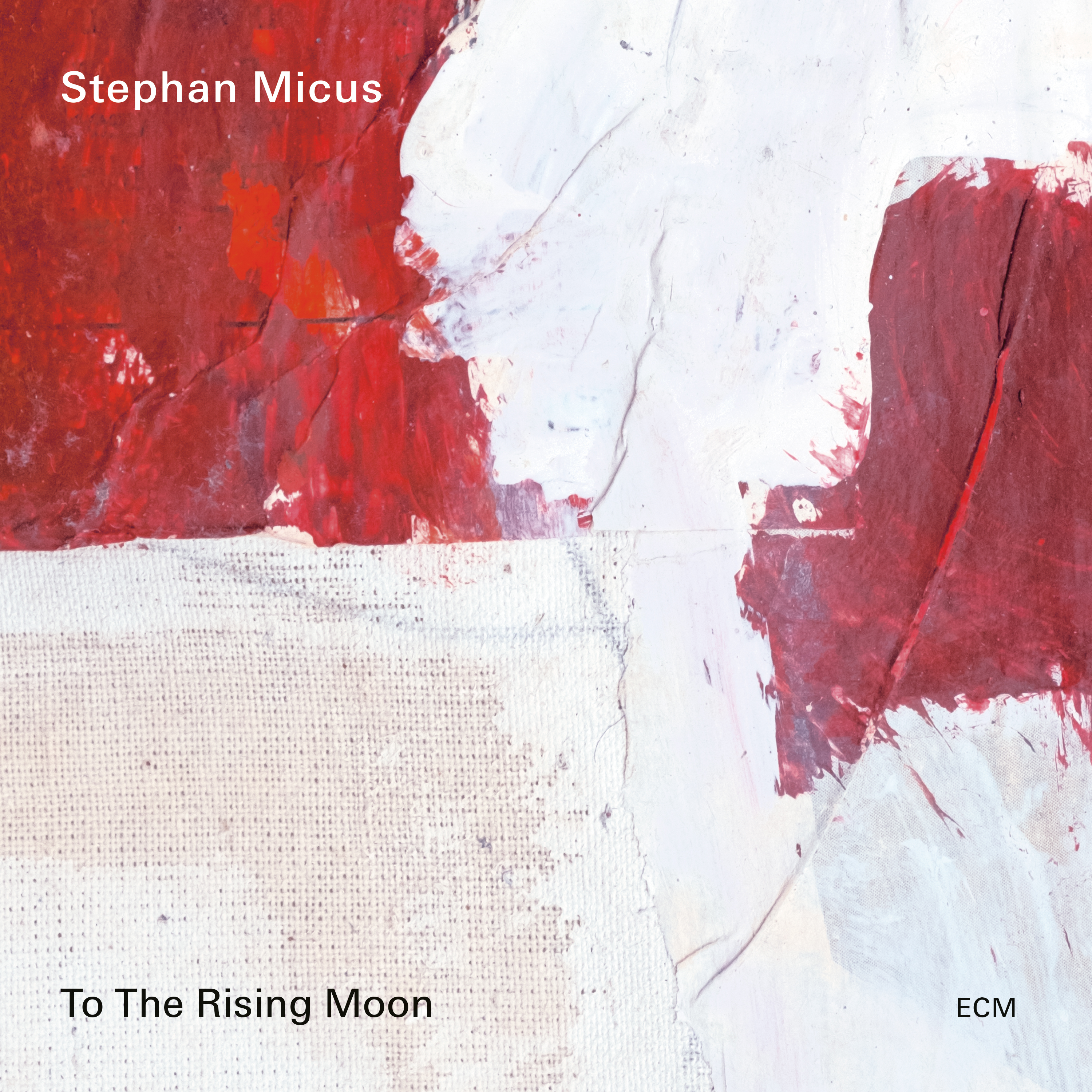
Stephan Micus: To The Rising Moon (ECM 2834)

Stephan Micus
To The Rising Moon

Stephan Micus tiple, dilruba, sattar, chord zither, tableharp, nay, sapeh
All music and voices composed and performed by Stephan Micus
Recorded 2021-2023 at MCM Studios
Cover art: Eduard Micus (1925-2000)
An ECM Production
Release date: November 15, 2024

my house burned down
now I have a better view
of the rising moon
–Masahide Mizuta (1657-1723)

To step into a new Stephan Micus recording is to approach a koan from the inside out. For while every world he creates feels immediately familiar, there’s also something about it that distances us from ourselves. In To The Rising Moon, his 26th solo album for ECM, he unravels an out-of-body experience through characteristically novel combinations, transcending cultural and historical borders in search of a collective humanity.

His narratives always seem to have a central protagonist; this time, it is the tiple. Sounding like a charango but with a looser feel, it is the national instrument of Colombia, but in the present context, it steps out of space and time into its own. “To The Rising Sun” features two of them: one to establish a percussive jangle, the other to sing through its contours. Building a monument one stone at a time, even as Micus scales it, he comes prepared with the finishing capstone, so that we can fully admire the valley of which it affords a sacred view. This format is later replicated in “Unexpected Joy,” which has all the internal tension of a young warrior walking through the forest on his first solo hunt, and in “To The Lilies In The Fields,” where gemstones rounded by the river’s current are ignored in favor of the greater value of leaving them as they are. “In Your Eyes” increases the count to three and adds a lone voice. Its juxtaposition of steel strings and Micus’s rounded singing gives us room to explore. At the heart of all this is “The Silver Fan,” a tiple solo through which light and shadow merge with a kiss.

On the topic of voices, another prominent one is the dilruba, an Indian bowed instrument with sympathetic strings. Six of these band together for “Dream Within Dream,” painting a realm where the physical world recedes into the farthest corners of consciousness. The sound is thin and incisive. Like wisdom offered by a sage on his deathbed, its truth can never be forgotten. The dilruba finds a long-lost brother in “Embracing Mysteries,” where the sapeh, a four-stringed lute from Borneo (normally plucked but modified to be played with a bow), evokes nature and nurture in equal measure. Meanwhile, Micus’s voice cuts the figure of a traveler with a rucksack filled with hymns, which he drops in place of crumbs.

Yet another member of this ad hoc family is the sattar, a long-necked bowed instrument of the Uigur people. In triplicate, it elicits one of Micus’s most spiritual creations: “The Veil.” He runs his hands gently across, feeling every pleat and fold as if it were an era of history to be navigated. In that sense, there is also mourning for the past and a hope that all the destruction we’ve brought has not ultimately been in vain. Despite taking part in the album’s largest ensemble in “Waiting For The Nightingale” (which brings together two dilruba with five sattar, five voices, three Cambodian flutes, and two chord zithers), the result feels open, a spider’s web touched with dew that has withstood an entire day’s worth of climatic change. Micus’s chorusing is a call to the wilderness within. The sattar also binds three tableharps (which combine elements of bowed psaltery, zither, and harp) in “The Flame,” leaving blurred traces of its past like paintings on stone. Finally, in the title track (alongside two tiples and two nay), it is a birthing ground of fluidity and purpose. Having nowhere else to go but inward, it bows its head in offering to silence, a prayer without words to get in the way of meaning.