

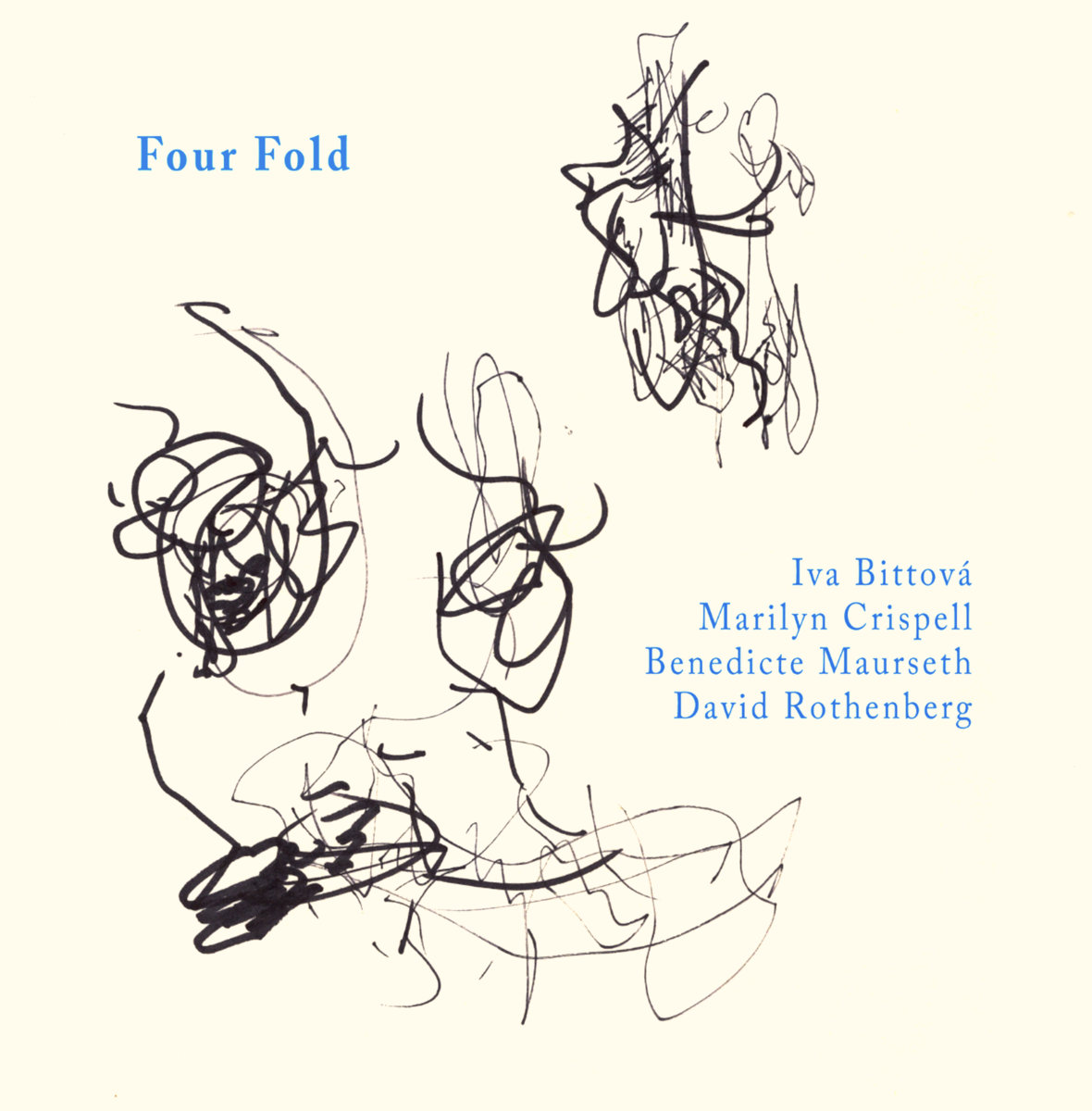
Bittová/Crispell/Maurseth/Rothenberg: Four Fold

An important aesthetic principle in ikebana, the Japanese art of flower arranging, is known as ma: the interval, the pause that holds all gestures in balance. This recording lives within that interval. Each sound is a petal in still air, its meaning found not in arrival but in suspension.

The album’s story begins at Banlieues Bleues in Paris, 2018. There, pianist Marilyn Crispell, Hardanger fiddle player Benedicte Maurseth, and reedist David Rothenberg gathered to explore the early birdsong transcriptions of Olivier Messiaen. In these notations, the wildness of the natural world first touched paper before it was tamed by harmony. A year later, Iva Bittová was added to the mix, her voice bridging word and weather.

Together, the quartet steps into the fragile terrain between music and its memory. What emerges, through years of subsequent reflection and patient shaping, feels less composed than revealed: a series of conversations with the unseen.

The first notes are a line drawn thin. Piano and clarinet trace its contour, a horizon trembling at the edge of being. From within that tremor, a voice unfurls, and the world begins its slow Folding. The fiddle answers from another time, its tone flecked with age and dust. The players seem to move by intuition, mapping silence the way birds adapt to wind: by feel, not by sight. What takes shape is not melody but the suggestion of one, a phrase on the verge of being spoken.

From the residue of that stillness, Ashlight begins to appear, pale and flickering, illumination born of what has burned away. Maurseth’s bow draws the dawn into being while Crispell drops her chords into water. Each tone contains its own echo. It neither advances nor repeats but hovers, luminous and uncertain, as if listening for its own reflection. Gradually, the instruments find each other in motion. Piano, fiddle, and bass clarinet circle in slow orbit, their lines folding inward and out again like geological strata. Hence Syncline, the meeting of two curves beneath the surface. Their rhythm is not one of time but of breath, a tide sensed more than counted. When Bittová enters, she brings something remembered rather than sung, a folk melody that the earth itself might hum when no one is listening.

In the wake of that convergence comes a retreat into intimacy. Fingers pluck at strings, keys whisper, tones barely formed—what the group calls Know No No, a study in almost-saying. Here, we behold a spiderweb of gestures catching the small debris of thought. A faint rustle passes through: the shimmer of Ruffle, where light and water trade reflections. The bow glides near silence, and the piano answers in small ripples, as if repeating the same idea in a different language. One senses communication without intention, like wind tracing reeds. And then, a sudden brightness opens the room, the solemn turning toward play.

The music leans into Anticline, the upward curve that follows a descent. Rothenberg’s clarinet teases, while Bittová answers in bursts of speech remembered from a dream. The ascetic finds her smile; the ritual learns to dance. It is here that the human reenters the sacred through joy. The air thickens again as if preparing for transformation. Out of the mix rise real-world signatures in Magpie, Moth. Rothenberg weaves them into the ensemble as if greeting long-lost kin. His bass clarinet decodes the nocturnal death’s head hawk moth, his seljefløyte joins the Australian magpie’s bright cry in an ecology of listening. The others respond in turn: piano breathing like wind through branches, Bittová’s voice flickering between the human and the elemental. For a moment, it is impossible to tell what is performed and what simply exists.

Out of this communion comes darkness. Crispell’s piano turns inward, each chord heavy and deliberate, the sound of thought imploding in sequence. Maurseth’s fiddle flashes briefly, a line of copper in shadow, and the piece known as Crinkle unfolds as an elegy for what has been touched and passed through. Here, absence finds its form, but the descent softens. From the quiet grows a song that seems to belong to no one, a Soft Fall through the air. Bittová sings as though speaking to the trees; the others move with her, their tones fragile as breath. There is no drama, only continuity, the sense that nature has momentarily found its human voice. The later pieces exist on the border of dissolution.

In Opposite of Time, the instruments scrape, sigh, and wander, seeking an equilibrium beyond rhythm, beyond structure. Here, the quartet listens not to one another but through one another. What follows is both release and return. The clarinet exhales, the piano sends a faint shimmer into the distance, and the fiddle carries us outward into Unfolding, a final gesture that feels less like an ending than an opening. A tune dissolves into the horizon, its players into the air.

When the last vibration fades, it becomes clear that this project was never about birds, nor about interpretation, but about presence: the act of being still enough to hear the world think. It is a study in attention, how breath becomes tone, how tone becomes silence, how silence, when held long enough, begins to sing.

Four Fold is currently available digitally on Bandcamp and will be on all streaming sites as of November 21, 2025.

EUROPE IN FLAMES: ONE

ONE is the debut of EUROPE IN FLAMES, the apocalyptic ambient project of Jason Wach and Hamish Low. In this intentional sonic sanctuary, the duo has crafted a refuge from the din of the current zeitgeist. In this space, the thunder of sociopolitical conflict becomes a distant shudder, melodic signals from afar. This is not an apocalypse of fire and smoke but the quieter aftermath that follows. It is the long exhalation after the collapse, the stillness that asks what it means to create once everything familiar has burned away.

The album opens with “for those who know the dawn,” a piece that serves as an invocation. Piano tones scatter their seeds on barren soil, mingling with the soft hiss of static and what might be the faint hum of machinery left running in an abandoned building. Each note gestures toward rebirth but is shadowed by the awareness that loss is first required. The track inhabits that moment when the first bird calls, not to announce light but to mourn the dark. This forlorn sentiment is only magnified in “forgetting how to breathe.” As low frequencies bloom in bruises, the listener feels themselves dissolving into vapor, suspended between panic and surrender. Dreams twist into strange geometries; trauma scratches the surface of consciousness like windblown branches on a windowpane. This is where the moral infrastructure of the self begins to crumble, leaving behind the rawness of skinned emotions.

The title of “seal the images in an envelope and say nothing” serves as a commandment as repression takes the place of grace. The atmosphere thickens until movement slows to molasses. Within this stagnation, a distant, rasping tone threads through the mix, binding us to our own restraint. The song becomes an act of preservation, suggesting that silence, too, can be a form of resistance. We then find ourselves “stumbling home through the rain.” After so much enclosure, it is a benediction. Its percussion on metal and stone creates a rhythm more human than a heartbeat. Digital glitches flicker through the soundscape, prayers half-remembered. The world, fractured as it is, feels newly sacred. A woman’s distorted voice emerges, a ghost in the circuitry. She becomes our lone witness, her syllables igniting the sky with fluorescent melancholy before “nocturne” lubricates the central axis with its ode to fragmentation. The piano and electronics drift apart, unable to find resolution, yet their disunity feels deliberate and compassionate. The music forgives itself for breaking, inviting us to do the same.

The closing track, “upon waking,” is a new beginning. Dawn finally breaks, revealing not salvation but continuity. The world is still in ruins, yet the rubble hums with faint electrical life. Smoke lingers, dust swirls, and through it all runs a current of hope: the fragile belief that creation can begin again, quietly, invisibly, from within. Every contact of the flesh, every fleeting gesture, sends out an unreturnable signal into the void that says, We are still here.

The album’s surreal brilliance lies in how it blurs the distinction between sound and memory, between the present and its ghosts. When archival voices or cinematic fragments surface, as in a clip from 12 Angry Men, they don’t feel sampled so much as resurrected. They reach us as if from another planet, their gravity warped, their meaning refracted. And yet, because of this distance, they cut deeper. Like nightowls who swear by the strange clarity that arrives when the sun has vanished and the world sleeps, they are most alive in that hour when thought loosens its grip. But ONE is not of the night. It lives in that trembling, liminal moment just before dawn, when the first blue light begins to touch the earth. This is music for that boundary state between remembering and forgetting.

ONE is currently available from bandcamp here.

Dominic Pettman: Ghosting (Book Review)

Ghosting: On Disappearance is a treatise of nonbeing—or, perhaps more precisely, of unbeing. It is not merely about disappearance but about the existential tremors that ripple outward when presence collapses into absence. Placing his authorial thumb and forefinger on the touchscreen of this modern inevitability, Dominic Pettman enlarges its finer gradations across emotional, social, and technological contexts. He pinches and stretches the phenomenon until its translucent membrane reveals something more fundamental: that to vanish is to be human and that to experience the vanishing of another is to feel the sting of impermanence.

While the titular concept has haunted language for centuries through folklore, spirit mediums, and psychological estrangement, it has, in our present age, acquired a peculiarly digital valence. Now, “ghosting” refers most commonly to the quiet, sudden severance of connection between friends, lovers, or kin. The gesture is at once devastatingly simple and infinitely complex: a single tap on a block button, a name fading from a chat log, a conversation frozen by the unrequited ellipses on the book’s cover. Technology makes the act almost frictionless. We already interact daily with people who are physically absent, replaced instead by avatars, text bubbles, and disembodied voices. To ghost someone is merely to withdraw the illusion that they were ever really there to begin with.

Pettman calls ghosting “a form of symbolic suicide,” if not also of violence, a dual wound inflicted upon self and other. It kills the relationship from both sides, leaving the ghosted “gasping at the silent vehemence of the act.” In centuries past, a ghost was thought to be an uncomfortable presence: the whisper in the night, the chill in a boudoir. Today’s specters, however, are defined by the unread message, the unanswered call, the untraceable unfriend. The modern ghost mocks us not with its return but with its refusal to reappear. What once demanded ritual now requires only signal and silence.

Ghosting has become, Pettman suggests, a modern luxury of the unencumbered self, one that allows us to discard what feels burdensome with the efficiency of deleting a file. Yet, what artifacts remain in the wake of such apparently clean erasures? The book’s modest yet densely packed 110 pages attempt to reckon with these residues, drawing out the historical and technical filaments that bind our vanishing acts to canonical anxieties.

Pettman walks us associatively through a gallery of geist-types, beginning with romantic ghosting. Once upon a time, the rules of engagement in love were dictated by proximity and propriety; now, they are replaced by rules of disengagement. The refusal to reply, the closing of a digital door, has become the reigning leitmotif of romantic punctuation. Where a lover might once have ignored a letter and let absence ferment over time into torment, today’s nonresponse hits instantaneous and permanent. Yet, as Pettman notes, the old dynamic persists despite our devices.

Romance has always been a theatre of projection, a negotiation between the seen and the unseen, the flesh and its fantasy. For all our bodies’ sweat and trembling, it is the embellishment that endures. Even in love’s most carnal moment, that fleeting dissolution of self into the other, there is already the seed of absence: the tiny death, the out-of-body vanishing we call climax. How curious, then, that the purest expression of intimacy is also an act of ghosting, the self evaporating in the ecstasy of its own undoing.

Ghosting also bears the battle scars of gendered terrain. Though often cast as an act of cruelty, Pettman reminds us that ghosting can just as easily be a form of survival, a necessary defense against the predations of aggression, stalking, or abuse. It can be liberation or surrender, sanctuary or exile. Either possibility, he writes, makes us acutely aware of our dependence on the other, the fragile scaffolding of recognition upon which our identities are built. In an age when partners must fulfill multiple roles once distributed across an entire community, the dissolution of a relationship casts us into a kind of social purgatory, suspended between connection and isolation.

Pettman insists, too, that ghosting is not an anomaly but a revelation of what we have always been: phantoms speaking to one another through the veil of mortality. Every “forever” whispered in the heat of the proverbial moment carries the irony of death; every “I love you” is also an elegy. Love itself unfolds under the shadow of the crypt. Perhaps this is why its rituals resemble religion, as both court devotion and doubt in equal measure, laying faith on the altar of inevitable loss.

I would add, by way of illustration, Robert Zemeckis’s Cast Away, a love story indelibly marked by absence. Chuck Noland (Tom Hanks), presumed dead after a plane crash, clings to a pocket watch containing his lover’s photograph, a relic of connection that fuels his will to live. When he returns after surviving for four years alone on a deserted island, he finds life has moved on without him; his beloved has remarried, rendering him the rarest kind of ghost, one who walks among the living, uninvited. His resurrection is itself a disappearance, a return that negates the meaning of home.

When lovers become projection screens for our own incomplete scripts, separation becomes not only likely but inevitable. The one left behind suffers not merely the withdrawal of a person but of the narrative that sustained them. In our culture of curated selves, ghosting has even acquired a perverse glamour as a badge of autonomy. One might recall Elaine Benes’s “spongeworthy” calculus from Seinfeld: who is worth the risk, the effort, the finite resource of bodily attention? Ghosting may be seen as a reversal of this privilege, a self-anointed freedom to choose extracourse over intercourse.

How, then, does one navigate the 50 shades of this phenomenon in an ecosystem already saturated with specters? As Pettman observes, “The paradox of the streaming age applies also to love: there are a million shows waiting to be watched, and yet none of them seem worth committing to.” In such a world, ghosting is less an exception than a rite of passage, a sacrament of connection where fulfillment is as fleeting as a notification bubble.

From romance, Pettman moves to the familial and the platonic. Here, the stakes deepen. To be ghosted by a coworker is unfortunate; to be ghosted by a child is practically biblical. In the age of ideological polarization, even the Thanksgiving table becomes a séance for the missing. The empty chair may symbolize courage to one and betrayal to another. Ghosting thus becomes political, echoing across generations and belief systems.

Professional and social ghosting occupy the book’s latter thrust, and here Pettman’s insights cut to the bone. Having once taught as a professor, I recognize the spectral economy of intellectual labor, the endless treadmill of unacknowledged effort and unreciprocated outreach. In graduate school, “imposter syndrome” was our ironic communion, a collective haunting where each scholar feared being the least real presence in the room. Every unanswered email, every “no reply” rejection, each job committee that never called back—all were tiny funerals for the self. Eventually, I chose to ghost the profession before it could continue to ghost me, if only to preserve a flicker of something to call my own.

Of course, ghosting is by no means confined to ivory towers. It infiltrates every professional exchange: clients disappearing mid-project, employers denying promotion for no apparent reason, friendships fading in inbox drafts. Even places ghost us: favorite restaurants that shutter without warning, neighborhoods transformed overnight, ecosystems collapsing out of sight. The world itself feels like it is ghosting us, withdrawing one news cycle at a time into abstraction. The more we exist, the more unreal reality seems.

I would add two more iterations to Pettman’s catalogue. First is the phenomenological ghosting of presence without feeling. We find this in M. Night Shyamalan’s After Earth, in which ghosting refers to the process of shutting down one’s emotions. This quality is a precious commodity in the film’s military-industrial complex, weaponized to render one invisible to alien predators who target their prey by detecting fear pheromones. To ghost, here, is to master disappearance from within. Second is Deanimated, an experimental film by avant-gardist Martin Arnold, who digitally erases actors one by one from the 1941 Bela Lugosi picture Invisible Ghost, until all that remains are empty rooms, doors that open by themselves, and dramatic music without diegesis. The world goes on performing, emptied of its inhabitants. The viewer, too, becomes ghosted, watching absence itself take center stage.

The loss of the one who ghosts us, Pettman ultimately suggests, is not merely a social wound but an ontological one. We lose not only another person but the mirror in which our own being once took shape. The terror of ghosting lies not in being forgotten but in discovering how easily we can forget ourselves when deprived of the other’s gaze. Technology did not create this fragility but has only revealed that relationships have always been provisional, sustained by faith, fantasy, and the flickering persistence of attention.

To be ghosted, then, is to confront the truth that love, friendship, and community are nothing more than brief illuminations against the endless dark of unbeing.