

Dine Doneff double bass, guitar, mandola, tambura, piano, organ, percussion, and tapes
Kyriakos Gouventas violin on “Flow”
Main corpus of recordings: MK Studio, Munich
Müncher Kammerspiele – December 29, 2018
Engineer: Johann Jürgen Koch
Additional recordings: Vertekop Studio – 2019
Engineer: Pande Noushin
Mixed and edited by Dine Doneff
Domagk Cell 27, Munich – May 2025
Mastering: Christoph Stickel
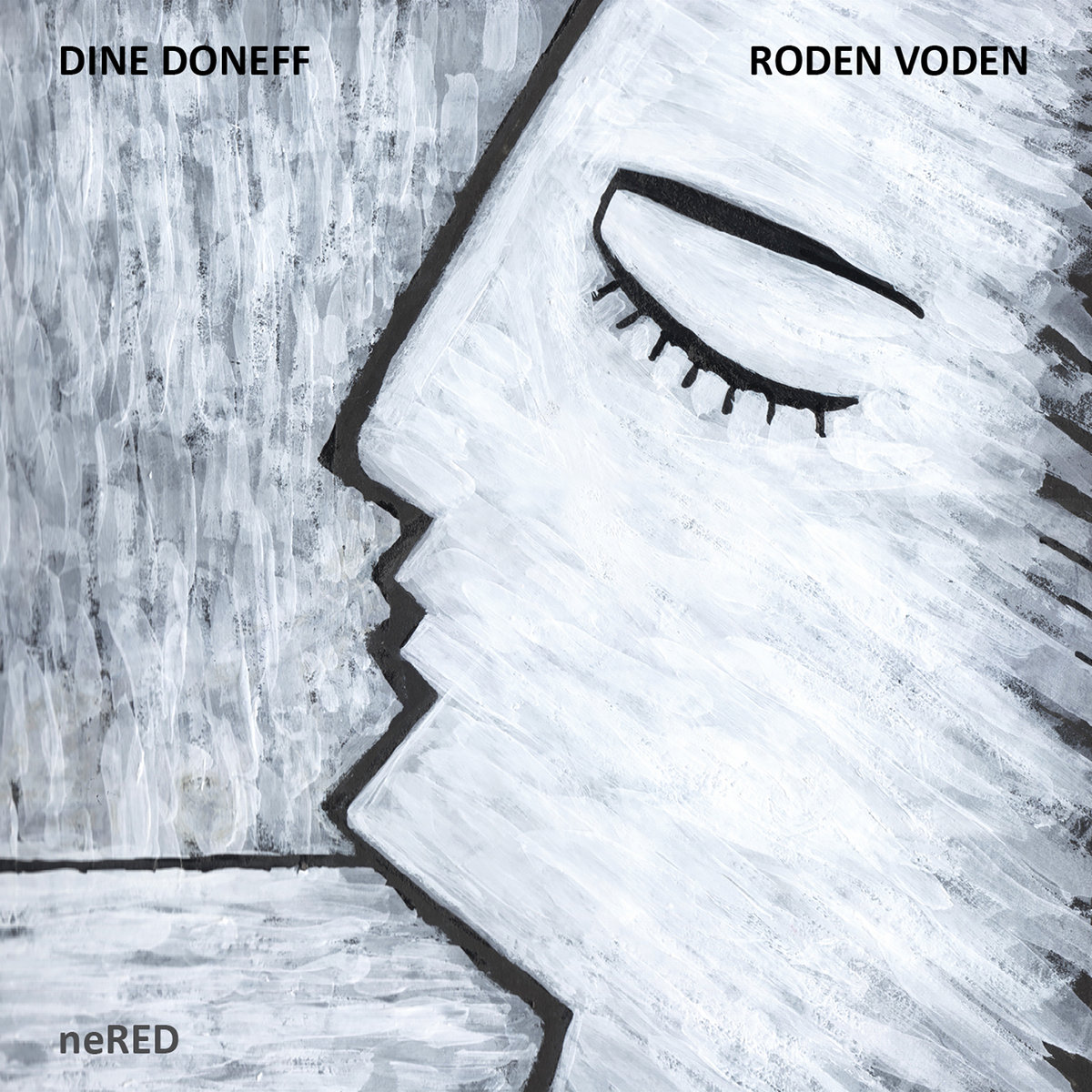
Cover artwork: Fotini Potamia
Produced by Dine Doneff
We Macedonians
will not live in fear
The time will come,
and we’ll sing
our old song, again.
Those lines run through Roden Voden like roots growing in the earth. They function neither as a slogan nor as a promise easily fulfilled, sounding instead as something learned under pressure, after history has already exacted its toll. In this sense, Dine Doneff’s concluding chapter in a trilogy that began with Nostos in 1995 and continued through Rousilvo in 2004 does not simply present music. It stages a reckoning. The album listens backward into time, gathering voices recorded between 1991 and 2009 in Rousilvo, Ostrovo, Ts’rnessovo, and Voden, Greece, and carries them forward into the present, where memory, erasure, and survival collide.
Macedonia’s modern history is marked by fragmentation, forced silences, renamings, and borders drawn without regard for the lives lived along them. Languages were pressured into retreat. Songs were sung quietly, or only at home, if at all. Roden Voden treats these conditions as active forces shaping every sound. Doneff’s original compositions do not dominate the archival material. They surround it, support it, and sometimes unsettle it, as though the music itself were asking how an inheritance scarred by violence can be carried without being embalmed.
The album opens its first vocal threshold with “Spell,” voiced and written by Vane Indiff (b. 1944). The poem abandons narrative in favor of invocation. Natural forces, measures of time, mythic presences, and ancestral peoples accumulate in a relentless cadence that feels closer to ritual than to verse. Language becomes a circle drawn to awaken a world that has been dispersed. The poem does not describe resurrection. It attempts it, using repetition and breath as tools of release.
Such ritual gravity strengthens with “Zhalaj me Majko,” sung by Slava Pop’va (b. 1927). This folk song unfolds as a quiet lament shaped by exile and unspoken longing. Its melody lilts and never fully settles, searching for reassurance of love in a land that does not recognize her. Addressed to a distant mother, the song carries the weight of a year spent loving in silence. Devotion here is intense but unseen, and by the final lines, it is no longer an emotion but a fatal condition. What remains is a spare, devastating cry that transforms private despair into communal mourning.
“Kirka,” another text by Indiff, fractures time and meaning even further. The poem constructs its logic from color, the everyday, and the body rather than from a story. An almost childlike order is established before being obliterated by the abrupt fact of death as the self is reduced to wood, fire, and branches. Innocence and physicality collide without romanticism. Loss is rendered through disjointed fragments that resist consolation, insisting instead on the rawness of what remains.
Collective tragedy takes center stage in “Dve Tri Poushki,” rendered by Neshka Ts’rnessova (b. 1925). The song distills catastrophe into stark repetition. Rifles are counted. Fallen youths are counted. Grieving mothers are counted. Loss is now the only measure, allowing the song to move from sudden violence toward an enduring lament that binds faith and pain.
The political heart of the album asserts itself most directly in “Censored Memory,” to which Doneff contributes percussion, strings, and a poem in Greek. At the center lies “Oj Lele Brate mi Tane,” a song about Tane Stojchev Kljandzev (1874-1907) from Gornitschevo, leader of the Internal Macedonian Revolutionary Organisation in Lerin (Florina). Memory here is not merely fragile. It is actively suppressed. By layering languages, voices, and historical reference, the track refuses singular authority and exposes history as something perpetually contested, shaped as much by silence as by speech.
“Nubeti” returns to the terrain of intimate loss. The folk song that follows unfolds as a dialogue between generations. A young widow carries her wedding crown as a relic of happiness interrupted. The mother speaks in the cadence of continuity and social expectation, while the daughter rejects comfort, insisting on the singularity of her grief. Survival and fidelity are placed in quiet opposition, and the song refuses to resolve the tension between them.
“Prikazni” unfolds as a dense, dreamlike collage where landscape, memory, and lament bleed into one another. Mountains, lakes, and weather respond like wounded witnesses to human violence and erasure. Personal cries of love and death interrupt the natural imagery, giving way again to familial grief and village memory. The verses move by emotional association rather than linear sense, capturing a world fractured by loss, where love, labor, war, and dispossession sound together for both the living and the dead.
“Narrative” gathers three texts into a single arc. “Stojna,” voiced by Stojan Gjorgiff (b. 1913), compresses catastrophe into a stark moral tableau where reproach and irreversible action collide in a single breath. Its restraint leaves the listener suspended in an unresolved aftermath. “Stara Panoukla,” sung by T’rpa Tanva Noushna (b. 1905), begins with pastoral tenderness before revealing a plague disguised as an old woman, death entering through the most ordinary gestures. “Dzemo,” sung by Tome Bojn (b. 1929), recounts the revenge killing of Dzhemail Aga, grounding historical violence in personal memory and inherited grievance. Together, these songs demonstrate how folk tradition carries ethics, fear, and justice as lived knowledge.
Threaded between these exhalations are extended wordless spaces where Doneff’s instrumental pieces function as corridors between testimonies. “Flow” opens this terrain with a radiant spread of piano, laying out a landscape where the living and the dead move together. Mandola and tombak provide traction, while a violin lifts memory skyward toward something unforgotten. “Prism” refracts emotion into color, turning sound into touch, a moment of fragile wonder. “Monologue,” an arco double bass solo, is a meditation on loss already named, allowing sorrow to resonate and slowly quiet. “Ghosts of Freedom” lingers with spectral patience, giving shape to implications too heavy for words. “Meglen” serves as connective tissue, bass and percussion sketching a passage rather than a destination. The title track itself emerges from ambient sounds recorded at the cemetery of Rousilvo, dissolving the boundary between presence and absence. “Ni Tvoj Ni Moj,” also rendered via the bow, strips a traditional ballad to its emotional bone. “Pepel” closes the album with classical guitar, light percussion, and the sound of locals speaking bilingually in Macedonian and Greek about atrocities suffered in Edessa Voden during the late 1940s. These unpolished voices do not seek resolution. They exist as ash does, settled, persistent, unavoidable.
Roden Voden matters because it refuses to let history become abstraction. These recordings are not artifacts sealed behind glass. They breathe, falter, contradict, and endure. By interweaving them with contemporary composition, Doneff does not attempt to heal the past. The album suggests that remembrance is not about closure or reclaiming a pure origin. It is about staying with what is difficult, listening without impatience, and recognizing that perseverance often sounds like an unfinished song. In the end, the album does not ask us to remember more clearly but more honestly and to accept that even in fear, even in silence, the old song awaits.
 Between Sound and Space: ECM Records and Beyond