

Artists often draw their deepest language from the places that first shaped their ears. For Lucian Ban, Mat Maneri, and John Surman, those places lie far apart geographically, culturally, and temperamentally. Yet, they converge in a shared devotion to improvisation and to the long memory carried by folk and classical traditions. Each musician arrives bearing an inheritance that feels less chosen than received. Ban carries the resonance of Transylvanian soil and song, absorbed long before jazz became his working language. Maneri brings an intuitive fluency, shaped by lineage and lived immersion rather than mere instruction. Surman arrives from open landscapes and weathered distances, his voice shaped by wind and horizon, ancient in contour and unsettled in spirit. Together they move as messengers through a forest of inherited material, carrying signals rather than declarations.
That shared path leads to Béla Bartók, whose early 20th-century field recordings in Transylvania revealed a music at once elemental and inexhaustible. Bartók sought preservation through rescue and documentation, gathering what might otherwise vanish. Ban, Maneri, and Surman approach these songs differently. For them, the material functions as a living threshold rather than a dying art, per se. Carols, laments, love songs, and dances do not arrive as artifacts to be handled, but as presences to be encountered, forms capable of friction and renewal.
Rather than fixing these melodies in place, the trio leaves them deliberately open-ended. Transcriptions act as waymarkers rather than maps. Fragments stretch and breathe until new centers of gravity appear. Silences are openings. Roles circulate, dissolve, re-form. What emerges absorbs history without sealing it off, allowing the past to remain porous to the present. Beneath everything runs a current older than borders or schools, a knowledge carried in breath and gesture. Thus, these tunes shelter a human grain, worn smooth by use, whether shaped by peasant hands or bent through jazz.
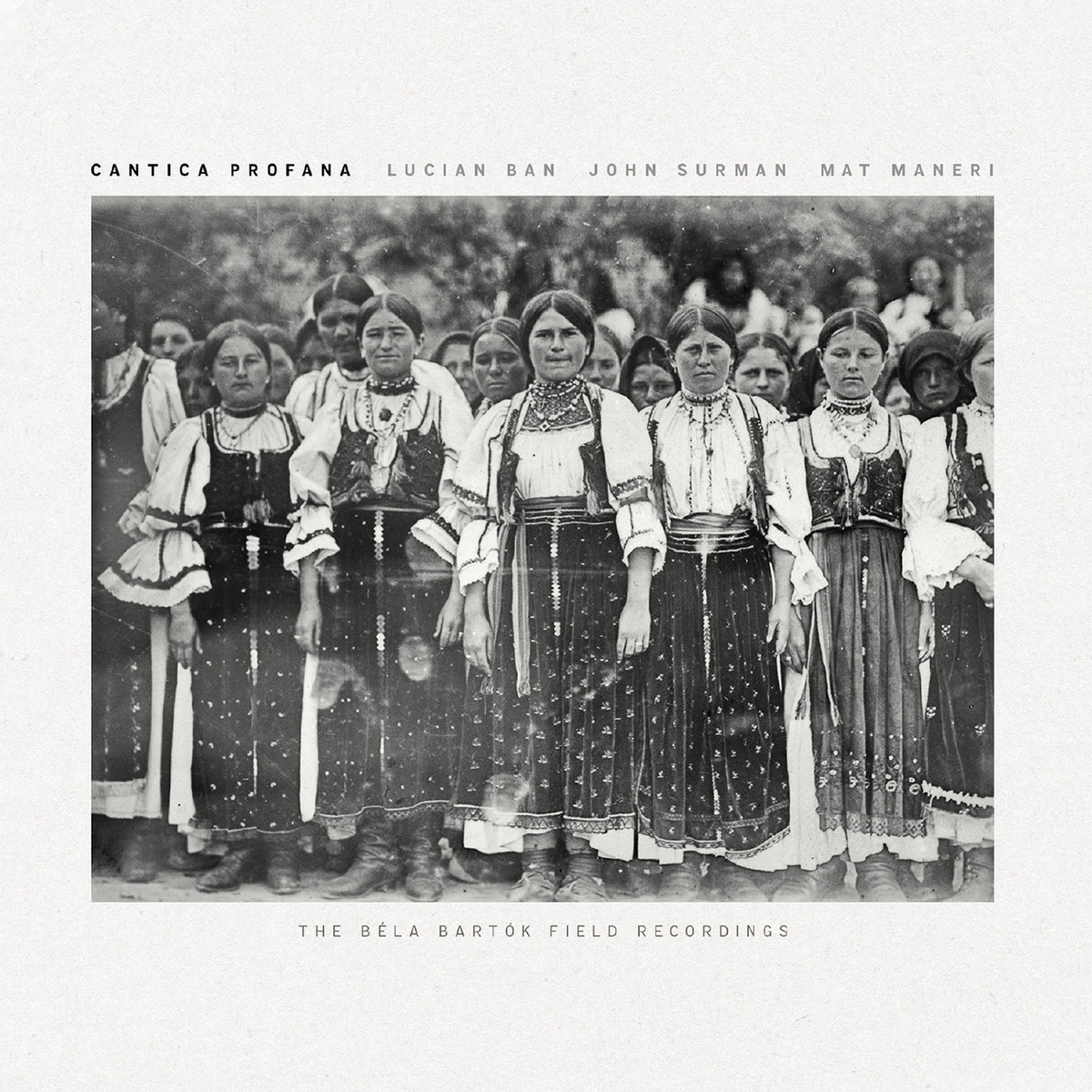
On Cantica Profana, recorded across three European concerts between November 2022 and November 2023, that grain is fully awakened. The album unfolds like a passage through shadowed terrain, where individual pieces as clearings briefly illuminated. The appearances of “Violin Song I” and “Violin Song II” establish a language of restless intimacy. Their skittering surfaces mask a deep inward focus, as muted piano strings and fragmentary viola lines open space for Surman’s soprano saxophone to move with playful acuity. His voice does not lead so much as observe, circling the material with curiosity. Novelty carries little weight here. These playgrounds are built from old principles and long-held feelings, animated by the freedom with which they are entered.
As the forest deepens, the melodies turn toward absence. “First Return” introduces a somber presence, Surman’s keening soprano a solitary call carried through the night air. That impulse surfaces again in “Last Return,” where wandering itself becomes a form of knowledge. Everything moves in widening circles around silence, the stillness that precedes life and waits beyond it, following not paths marked on maps but traces left by lived experience.
“Dowry Song I,” the first of two such communal clearings along the way, introduces the bass clarinet, its rough fibers weaving textures of interlaced light. Beneath it, Ban’s piano establishes a gentle cadence, enlivening Maneri’s viola until it takes on a copper patina. The trio finds a rocking motion that feels ritualistic, generous, drawing out the melody’s embedded joy before releasing it toward a distant horizon. “Dowry Song II” returns to this space with greater density and color, the voices braided into a resilient weave where each strand strengthens the others.
Other pieces arrive as messages carried from deeper within the trees. “Up There” repeatedly opens with extended bass clarinet meditations, Surman circling the melody until it settles into focus. Around this, Ban and Maneri widen the terrain, giving the line ground and horizon. What follows is often a dance of striking acuity, allowing Maneri room to roam while preserving collective balance. “A Messenger Was Born” distills this sensibility into a quiet prayer and inward dirge for those yet to be lost, for figures glimpsed briefly and never fully named.
“Dark Forest” stands as both setting and invocation. It unfolds as a lush, dreamlike traversal of nocturnal paths, where beauty emerges slowly. Improvisatory spirals coexist with melodic clarity in this, the trio’s deepest attunement. Meanwhile, the title track begins with struck resonance, muted piano notes falling like measured footsteps, before yielding to Maneri’s fluid inflections.
“Evening in the Village” captures darkness as a settling rather than a conclusion. Starlight defines the space as much as shadow. Thoughts, anxieties, romances, and plans continue their quiet circulation. By the time of “Transylvanian Dance,” the accumulated energy breaks open. An anticipatory rhythm gives way to exuberant confluence, Surman’s soprano emerging as a vividly human presence.
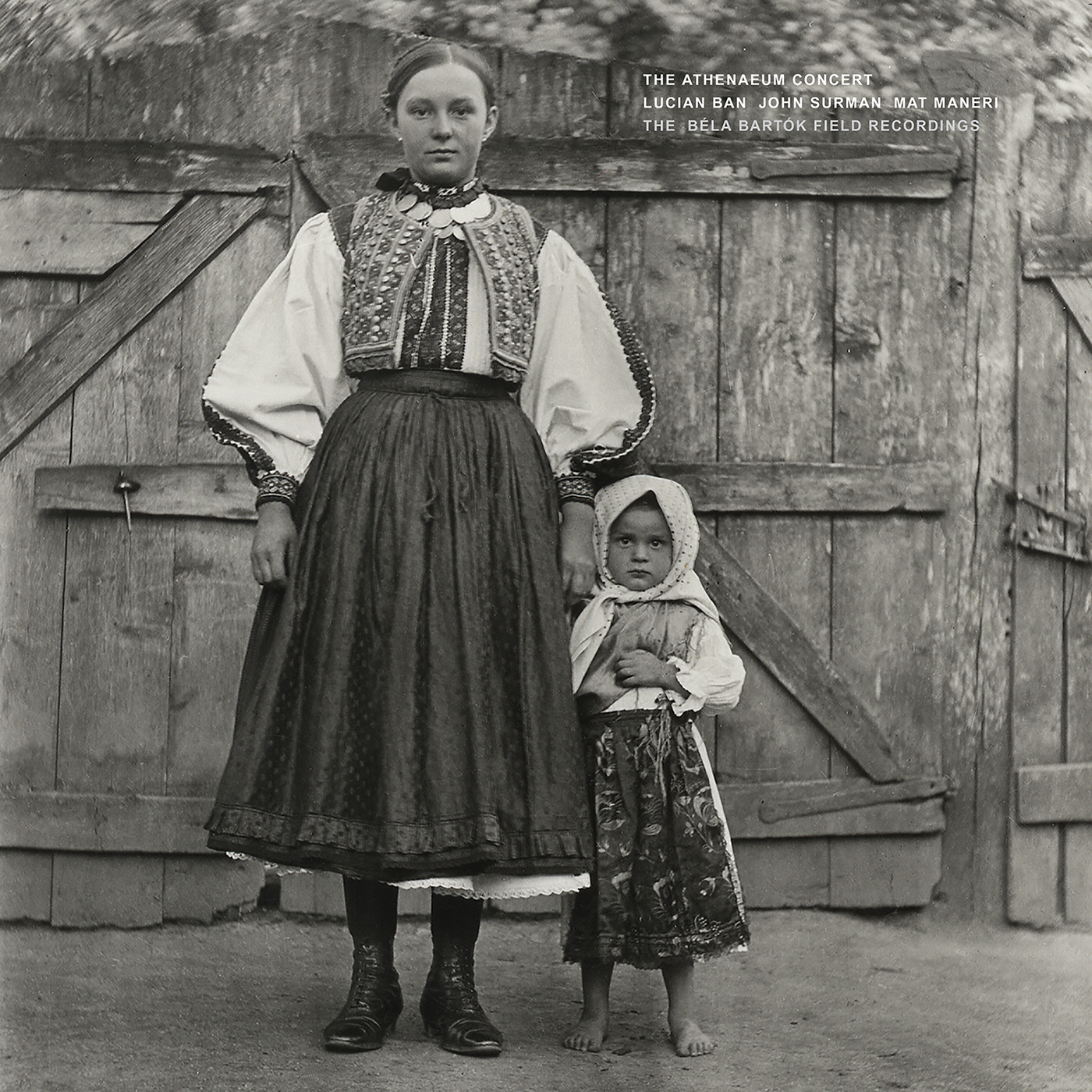
The standalone vinyl The Athenaeum Concert, recorded in June 2024 at the Romanian Athenaeum in Bucharest, extends this language with an even deeper patience. Where Cantica Profana often reads like a gathering of poems or stories, this companion album unfolds more like a life remembered in long form. “Evening in the Village (Bitter Love)” opens with a mournful viola that sounds like an extinct instrument briefly summoned back into breath. Wrinkled yet supple, it enters bearing generational weight. As dampened piano footsteps join and the bass clarinet emerges, the music takes on the temperament of weather itself, fog and time moving across the land, before slowly turning toward dance.
The present version of “Dowry Song” leaps immediately into motion, raining promises with the force of embodied love. The bass clarinet grounds itself, inviting participation, while the viola lifts free, buoyed by Ban’s steady, turning pianism. “Up There” again traces a river’s course, winding through brush under historical pressure, moving from insistence to reverie across its span. “Violin Song” builds gradually from quiet stirrings until Surman’s soprano takes flight, migrating toward warmth. Joy radiates through the exchange, though darkness lingers beneath, a reminder that wonder and struggle remain entwined.
Taken together, the two albums read as studies in ethical listening, in how sound is allowed to appear rather than be summoned by force. Their connection lies partly in shared source material, but more decisively in the trio’s instinct to remain inside unfolding time. Duration becomes a form of care. Attention turns toward relationship, toward the ways voices breathe around one another, and toward the responsibility carried by each choice. Folk material is treated as lived terrain, entered with awareness of what has already passed through it and what may yet arrive. From this stance emerges a vision of tradition shaped by patience and watchfulness, where meaning rises slowly from sustained uncertainty.
Maneri is often described as a microtonal improviser, yet the music pursued here feels macrotonal in spirit, resisting borders and divisions in favor of a broader resonance. Ban serves as both anchor and instigator, shaping time without enclosing it, anchoring the ensemble while inviting risk. Surman contributes a voice that feels elemental rather than ornamental, his reeds acting as carriers of weather and message, passing freely through the ensemble like breath through leaves. And so, the distance between Bartók’s Edison phonograph and now collapses into a single resonant gesture, fulfilling his quiet prophecy from 1921, that future musicians might uncover truths the original collectors could not yet hear.
Both albums are available from Sunnyside Records.
 Between Sound and Space: ECM Records and Beyond