

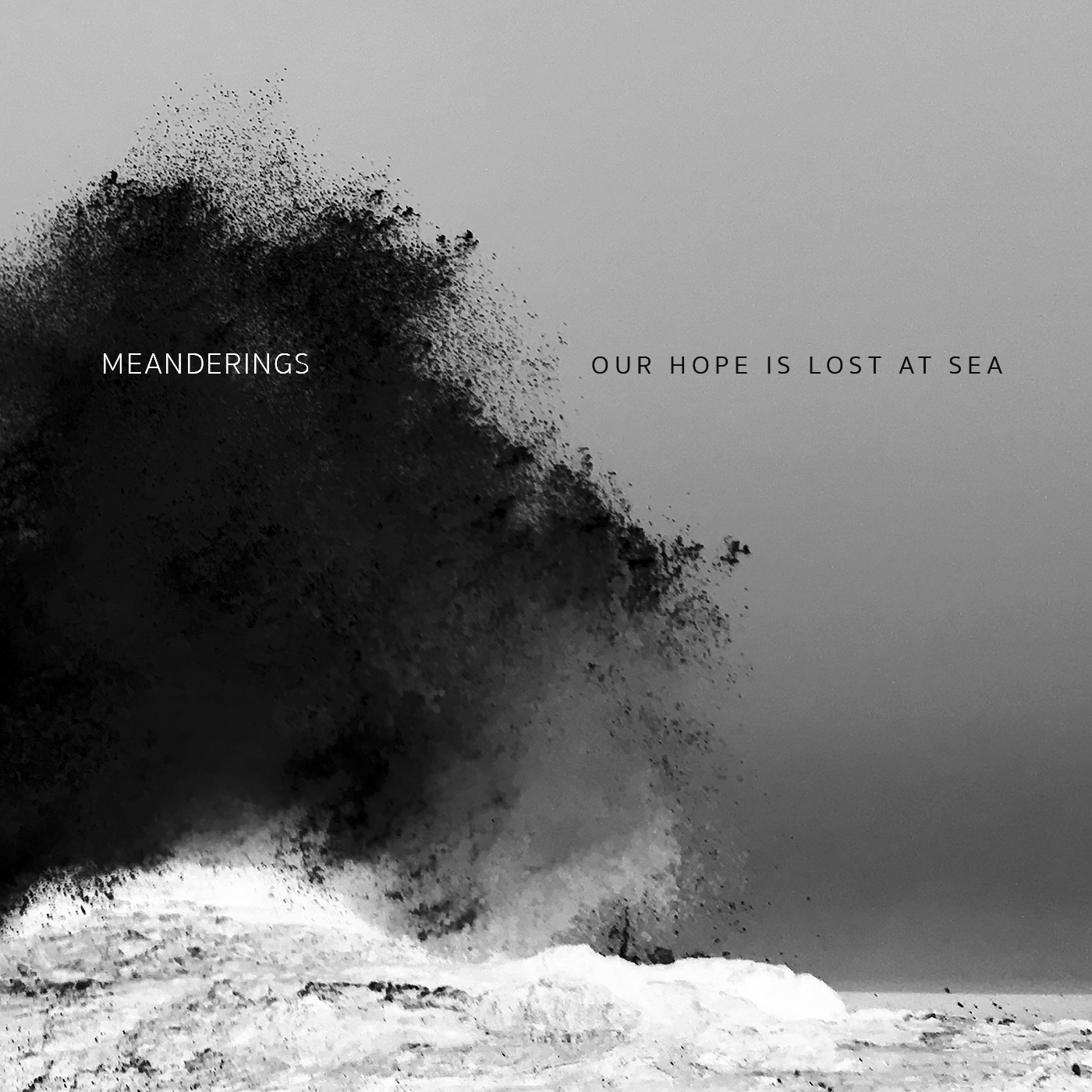
Hope drifts differently when it is set loose from the shore. Our Hope Is Lost At Sea arrives as a slow immersion rather than a statement, the eighth message in a bottle under Dann Michael Torres’ long-running Meanderings moniker and his first release for El Muelle Records. Across 11 pieces, it listens inwardly.
Torres works with sound the way a painter experiments with pigments. Guitars are multiplied, retuned, prepared, and worn thin by repetition, their voices folded into live electronics, tape fragments, and environmental residue. What emerges is not melody in the traditional sense, but colors shaped into mourning, solemn patterns and melancholic phrases, reverberations that feel less composed than uncovered.
“Empty Words” opens as a photograph undeveloping in real time. Your ears struggle to hold on to the image, but it fades of its own volition, seemingly caught in the net of amnesia in which all of us were ensnared when the album was recorded in 2020. It is a slow drift into places of the mind where you can experience good or evil. Here, you realize that the line between blissful dissociation and fearful isolation is too fine for the naked eye to register, yet unmistakable when felt. Its effects resemble a dying root system beneath an otherwise healthy-looking tree, remaining hidden until it is too late to save the specimen from certain death. The buzzing guitars and electronic washes recall Tim Hecker at his most subdued, as well as the early work of Jon DeRosa. In this case, however, the mind of genesis resides in the skull of an artist whose fires are lit only to watch them subside into embers. This is where grief begins.
What follows narrows the focus further, built from the fragment of a dying breath, left behind as a forensic trace and replicated until it yields a distinct emotional signature.
The cumulative effect of this restraint becomes apparent when an acoustic guitar finally enters the frame. Its appearance feels almost shocking, its clarity too real to accept, too contagious to approach, and too fragile to touch. Only as the piece unfolds do you realize you have been staring at your reflection the entire time. This makes the title of “Merely Shadows”feel less like poetic language and more like a diagnosis of the human condition. Even after the eclipse passes, fragments of that darkness cling to your skin, take shelter behind your eyelids, and graft themselves into your self-regard.
“Tethered Hand of a Savior” offers an all-too-brief gesture toward comfort amid quiet degeneration. Its rocking motion lulls you briefly into its embrace. Each chord reflects the last, drifting away as a plantlike photosynthesis bleeds into the foreground, leaving only a bass line behind as evidence that it was ever there. In its wake stands the title track, where shadows of heroes and heroines flit past with unrequited promises of healing.
Later passages introduce oceanic distortions and distant voices that brush the outer edges of the mind, summoning visions of a childhood that may or may not be your own. “Years Of Decline Yield No Wisdom” emerges as a mantra, repeated not in speech but through the laborious persistence of survival itself. Elsewhere, a tundra’s nightmare is turned inside out until it reveals a song. When the acoustic guitar reappears, its lucidity remains unsettling.
“You’ve Simply Had Enough of Drowning” closes with a thinning of presence. Thus, Our Hope Is Lost At Sea leaves you with the sense that something essential has been exposed and then gently withdrawn, as though the music has revealed a private interior space and asked you to sit alone with the knowledge of it. There is no catharsis here, no moment where grief lifts or resolves itself into sunlight.
In this way, Torres’ work feels less like a document of loss and more like an artifact shaped by endurance. The sounds linger because they refuse to be hurried past. Each piece carries the weight of its own patience. When the record finally releases you, it does so without reassurance. What you are left holding is not hope restored, but hope altered, stripped of illusion, reduced to something smaller and more durable. It is the kind of hope that no longer expects rescue, only the possibility of staying afloat. In that sense, Our Hope Is Lost At Sea does not mourn what has been lost so much as it honors what continues, fragile and uncelebrated, drifting onward in open water.
Our Hope Is Lost At Sea is available from Bandcamp here.
 Between Sound and Space: ECM Records and Beyond