

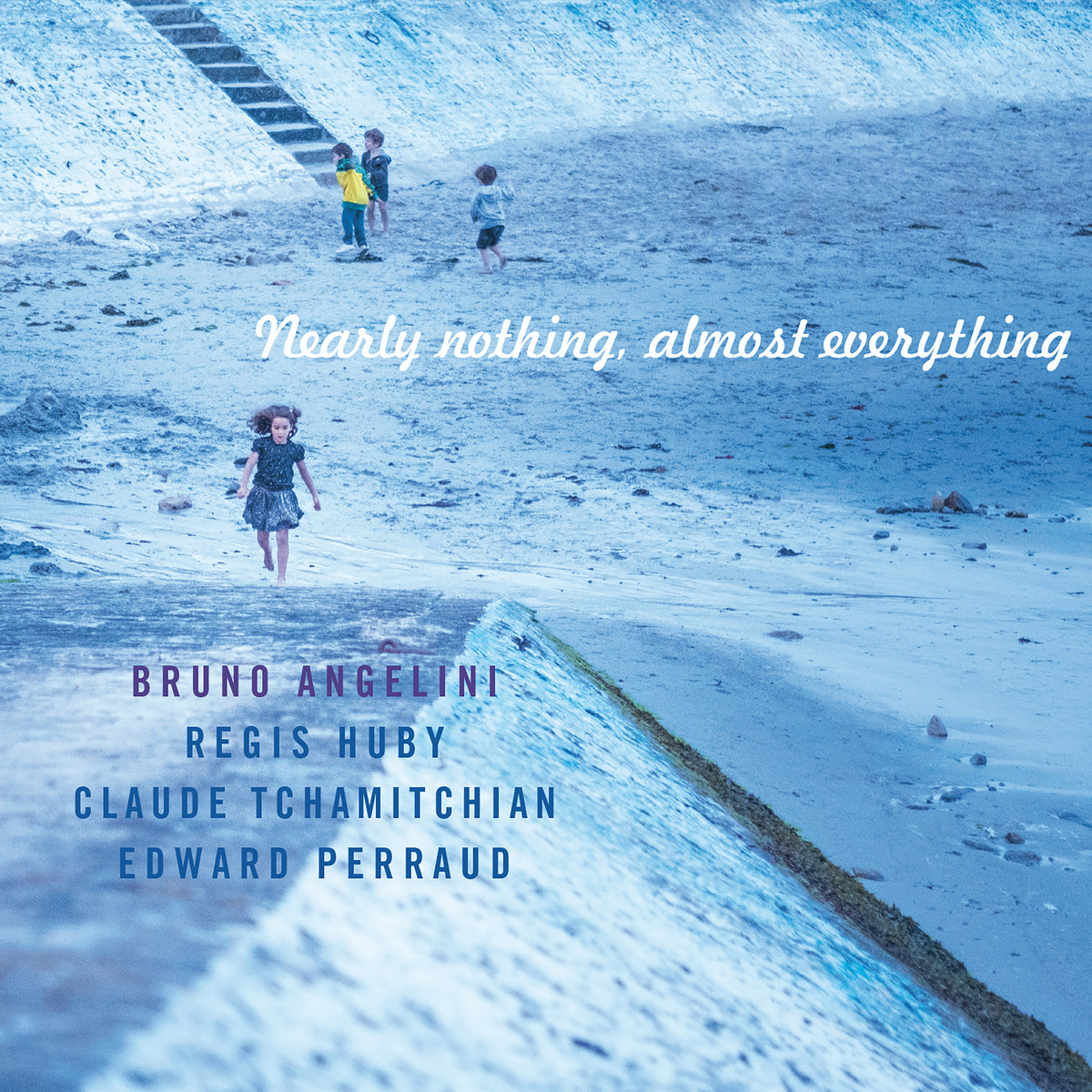
Bruno Angelini piano
Régis Huby violin, tenor violin, electronics
Claude Tchamitchian double bass
Edward Perraud drums, percussion
Recorded, mixed, and mastered at Studios La Buissonne, Pernes-les-Fontaines, France
Recorded June 7-9, 2021 and mixed May 2022 by Gérard de Haro, assisted by Matteo Fontaine
Mastered at La Buissonne Mastering Studio by Nicolas Baillard
Steinway grand piano prepared and tuned by Sylvain Charles
Produced by Gérard de Haro and RJAL for La Buissonne label & by Solange
Release date: October 28, 2022
Pianist Bruno Angelini’s Open Land Quartet is aptly named, though the phrase suggests not only geography but grammar. An open land is also an open page, a field upon which signs may be set down, erased, rewritten. The ensemble he shares with violinist Régis Huby, bassist Claude Tchamitchian, and drummer Edward Perraud does not simply spread outward into panoramic space. It inscribes that space with listening. One senses a text to be breathed in, line by line.
For this recording, the band turns toward minimalist poets such as Ada Mondès, William Carlos Williams, Chandak Chattarji, Lydia Vadkerti-Gavornikova, and Jacob Nibénegesabe. Their words become seeds rather than scripts. Angelini does not set poems to music so much as he releases music from them. Each track feels like a margin where ink has thinned and tone has taken over. The allusive and airy qualities of those writers are distilled here into a language that is both tactile and fugitive.
Immersed in the opening “Soul wanderings,” one encounters a poetry prior to utterance. The arco bass moves like a sentence being tested for truth. The piano ripples in aqueous figures that refract rather than declare. Cymbals swell with the patience of an ellipsis. Huby’s bow sings in a register that suggests both lament and invocation. Before a single quoted line can appear, the quartet has already composed an argument in timbre. The music refuses the label of minimalism, though it honors economy. Beneath its lucid surface lies a dense weave, enriched by rubato currents and rhythmic signatures that fold into one another. Different speeds coexist, braided into a living syntax. The result resembles a polyglot conversation in which no voice dominates, yet each retains its accent.
Angelini describes these pieces as rooted in a harmonic language shaped by contemporary practice, sometimes free in pulse, sometimes bound to intricate meters, favoring simultaneity of motion. The quartet merits the term “orchestra” by sheer sensibility of color and architectural ambition. As the third chapter in their journey for La Buissonne, this album deepens the soil of their earlier statements while extending new tendrils into the unknown.
“Peaceful warrior” traverses arid terrain, footsteps echoing through an interior canyon. Notes fall like sparse punctuation, each one weighted with intention. “At dawn” introduces a folk inflection that glows. Its lyricism carries the memory of communal song without succumbing to nostalgia. “Present time” and “Wild wanderings” pivot toward groove, yet their propulsion resists simple forward motion. The rhythm section interlocks with tensile grace, generating momentum that circles back upon itself. Every gesture is examined from multiple angles, as though the band were parsing a complex stanza. Huby’s violin in “Wild wanderings” weaves a dense canopy above the pulse, omnipresent and searching, while the ensemble moves through it like readers tracing a labyrinthine paragraph.
At the album’s core stands “Paterson,” a three-part suite whose title nods to Williams and his epic meditation on place and perception. Here, improvisation becomes a form of reading. The musicians approach the material as one might approach a palimpsest, attentive to what lies beneath the visible surface. Huby’s electronics extend the acoustic frame, introducing a digital aura that neither eclipses nor embellishes but refracts. Enthusiasm forms the suite’s spine, yet its musculature is supple, responsive to each fleeting impulse.
Throughout the album, Angelini operates at a porous border between jazz and contemporary music. He draws from the ethos of jazz, its risk and relational listening, while embracing the structural daring and harmonic ambiguity of modern composition. The quartet inhabits this intersection as if it were a natural habitat. Their music is neither hybrid nor compromise. It is a terrain where swing converses with spectral harmony, where counterpoint brushes against groove, where abstraction courts melody without irony. In this open land, genre becomes a provisional map that dissolves once the journey begins.
And so, when words inspire music that in turn transcends words, what remains of authorship? Perhaps art is less about translation than about transmutation. A poem enters the ear as language and exits as vibration. A melody enters as vibration and exits as memory. Between these states lies a space we cannot fully name. Angelini and his companions dwell there, inviting us to consider that meaning may not reside in what is said or played, but in the attentive signals that gather around it.
 Between Sound and Space: ECM Records and Beyond