

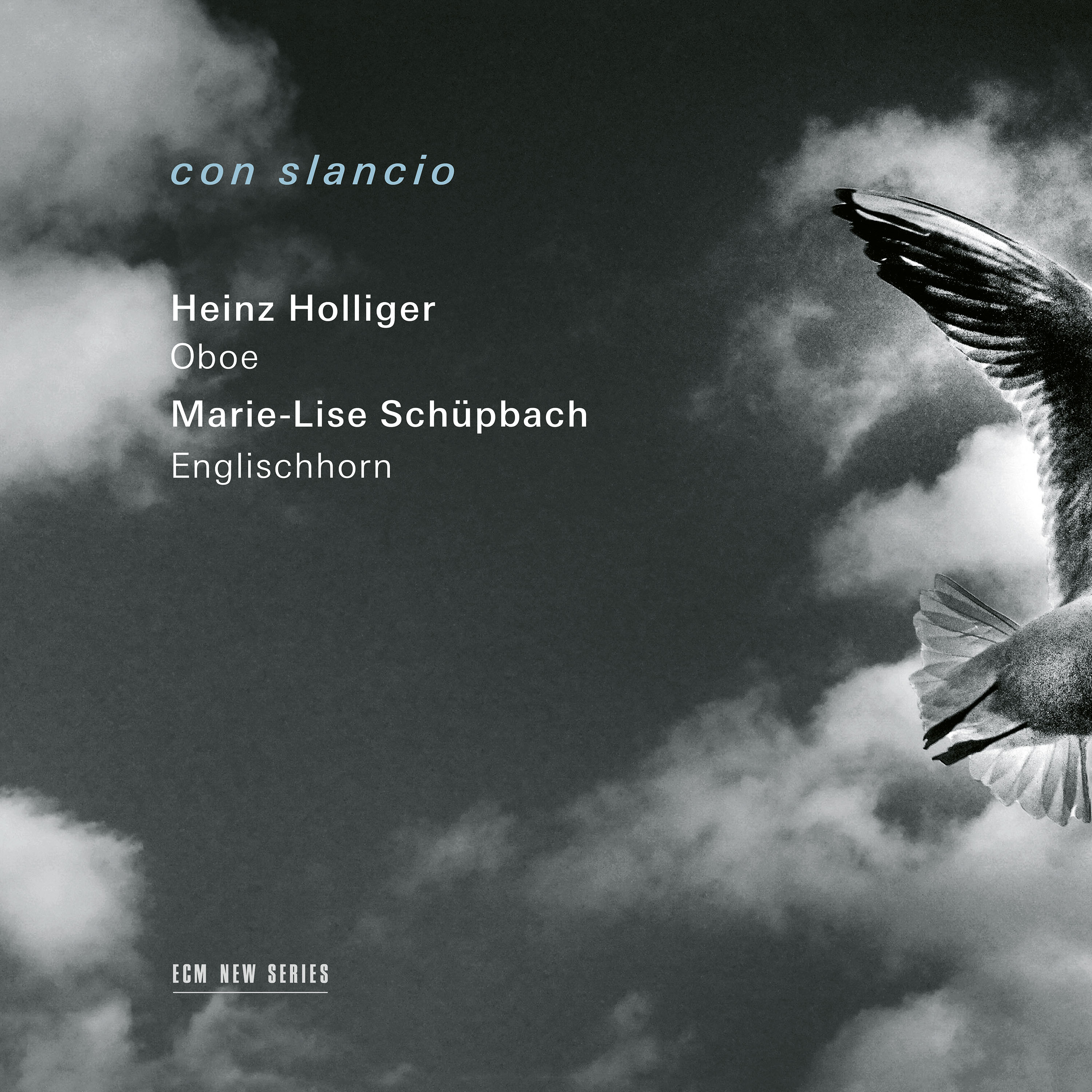
Heinz Holliger/Marie-Lise Schüpbach: con slancio (ECM New Series 2807)

Heinz Holliger
Marie-Lise Schüpbach
con slancio

Heinz Holliger oboe, English horn, Sprechstimme
Marie-Lise Schüpbach English horn, oboe
Recorded July/August 2020
Radiostudio DRS Zürich
Engineer: Andreas Werner
Cover photo: Jean-Marc Dellac
An ECM Production
Release date: February 6, 2026

“I don’t want to communicate something definite, something concrete. I find music entirely unsuited for that.”
–Heinz Holliger

This latest recording for ECM New Series by Heinz Holliger and Marie-Lise Schüpbach, who last appeared together on 2019’s Zwiegespräche, feels less like a recital than an extended meditation on the tremor that precedes orality. Across its span, the oboe becomes a site where language approaches, falters, and reconstitutes itself. Holliger’s return to composing for the instrument after decades of reticence gives the album its emotional and philosophical axis. In the booklet interview with Michael Kunkel, he speaks of Klangrede, a kind of sonic declamation in which music thinks aloud without becoming discourse. Rhythm for him is not a law but a mood. “Only in strict moments do I use a rigid framework,” he admits, “otherwise, I simply can’t bear it.” One hears in this a deeper suspicion of any language that hardens into doctrine. Music, he insists, is abused when reduced to a message. There is no lesson here, only a soul seeking its acoustical climate. With the oboe, that climate is paradoxical, what he calls “speaking with a closed mouth.” The entire program plays with this idea, as if testing how much meaning can survive in the face of a written score.

Holliger’s own con slancio from 2018 opens the project like a gasp before a sentence. Played by him alone, it begins with a leaping gesture that keeps missing its metrical footing. Fluttering figures scatter upward into brief star-flecks of multiphonics before dissolving into a luminous fade. Rather than announcing a theme, the piece performs hesitation itself. This sense of suspended utterance returns in his Ständchen für Rosemarie, where the English horn spars with its own desire to communicate, turning inward midway to reveal dreams that feel both candid and concealed. The two duo pieces from 2019, Spiegel – LIED and LIED mit Gegenüber (contr’air), place melody inside a hall of distorting mirrors. In the first, microtonal inflections make each phrase mishear itself, whereas the second builds nested dialogues in which the instruments appear to listen to their own thoughts while voicing them. The later works Fangis (fang mich) and à deux – Adieu, both from 2020, entwine play and specter, quick verbal-like exchanges interrupted by haunted multiphonics that sound like syllables losing their jobs.

Around these pieces gathers a constellation of works written for Holliger over decades, each treating the oboe as a dialect in danger of dissolving. Toshio Hosokawa’s Musubi from 2019, for oboe and English horn, knots the two players together only to let them unravel again. The instruments align in heart yet retain separate bodies, inventing a private grammar of crane-like calls that shed purpose precisely by insisting on it. As articulation softens, the music sinks into a subliminal murmuring. Jürg Wyttenbach’s Sonate für Oboe solo from 1961 is an entire idiom compressed into four movements. The opening juxtaposes public proclamation with whispered aside, while the second turns inward like a language translating itself into secrecy. The third becomes a virtuosic thicket in which Holliger’s upper register fractures into glittering particles before the epilogue lets the instrument split its tongue into a dance that evaporates into silence.

Jacques Wildberger’s Rondeau für Oboe solo from 1962 begins with disarming lightness, a kind of conversational sparkle that slowly acquires gravity. Higher registers awaken like excited vowels, yet beneath them lingers the anxiety that too much thought can make flight impossible. György Kurtág’s con slancio, largamente from 2019, played on English horn, answers this with austere brevity. An opening octave plunges downward into the instrument’s dark interior, brushing past a fleeting memory of Bach before collapsing into aphorism, and aphorism into an empty shell. Rudolf Kelterborn’s Duett für Oboe und Englischhorn from 2017 initially speaks in whispers but soon weaves an intricate web of gestures, a conversation that proves restraint can be the most baroque form of eloquence.

Finally, Robert Suter’s Oh Boe für Oboe solo from 1999 becomes the album’s most openly linguistic experiment. Holliger adds Sprechstimme for this recording, a personal gloss absent from the score. The spoken fragments stumble between playfulness and severity, nonsense and revelation, as if caught in a productive net of aphasia. Directions trip, recombine, and disintegrate, scattering meaning across the floor for the listener to collect, knowing that some syllables will forever be missing.

Taken together, these pieces create a cartography of inaudibility. Breath functions as syntax, timbre as grammar, silence as punctuation. The oboe emerges not merely as an instrument but as a fragile throat, perpetually on the brink of forgetting how to talk and therefore speaking all the more urgently. Music here does not replace language, nor does language dominate music. Instead, both hover in a trembling middle space where saying and sounding keep mistranslating each other.

By the album’s close, one senses that meaning survives only by remaining porous. Every phrase feels as though it might dissolve before finishing itself, and that very instability is what keeps it alive. Speech does not end in sound, sound does not end in speech. They circle one another like letters afraid of becoming words.
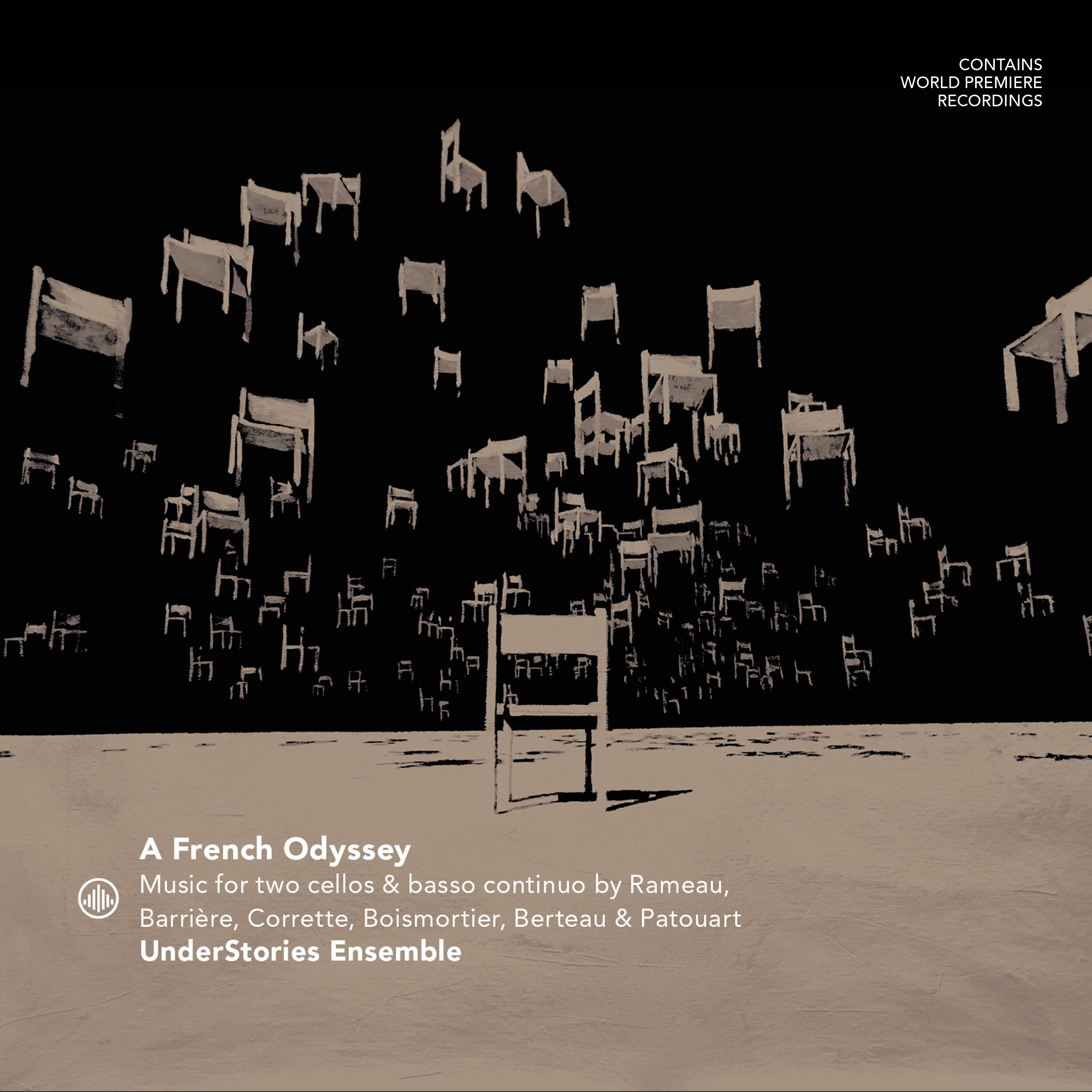
UnderStories Ensemble: A French Odyssey – Music for two cellos & basso continuo by Rameau, Barrière, Corrette, Boismortier, Berteau & Patouart

This recording unfolds as a meditation on movement: of peoples, of sounds, of power, and of bodies both musical and political. Forged in the turbulence of the Enlightenment and shadowed by the first tremors of revolution, the repertoire gathered here belongs to a France that was simultaneously consolidating itself at home and projecting itself outward through trade, conquest, and imagination. The 18th century witnessed an unprecedented circulation of goods, ideas, and bodies, and with it came an uneasy reckoning. Curiosity and domination advanced together, and music became one of the most refined sites where that contradiction could be staged, aestheticized, and occasionally questioned.

As Marco Crosetto observes in the album’s liner notes, ports, salons, and theaters absorbed the sonic residue of these encounters. Foreign rhythms, borrowed gestures, and invented “elsewheres” entered French musical language not as faithful transcriptions but as carefully framed reflections of desire and anxiety. The exotic was never neutral. It arrived filtered through fantasy, hierarchy, and control, transforming distant cultures into mirrors for Europe’s own doubts about virtuous progress. Rousseau’s warning that civilization estranges humanity from itself hovers over this repertoire, not as philosophy alone but as sound. What Europe called expansion often sounded like displacement, and what it called novelty frequently concealed erasure.

At the center of this program stands another transformation, quieter but no less symbolic: the ascent of the cello. By the mid-18th century, its depth and resonance began to eclipse the viola da gamba, an instrument long entwined with aristocratic inheritance and established authority. This was not a clean overthrow. Old techniques were adapted, absorbed, and revoiced within new forms. The cello did not abolish the past; it reincarnated it. In that sense, the instrument becomes a metaphor of its time, negotiating between continuity and rupture, inheritance and reinvention.

This philosophy animates the debut of UnderStories, a French-Italian Baroque ensemble that listens downward rather than upward. With Mario Filippini on viola da gamba, Loris Guastella on percussion, Marco Crosetto on harpsichord, Silvia De Rosso on violone, Margherita Burattini on harp, and Bartolomeo Dandolo Marchesi and Clara Pouvreau on violoncello, the group privileges the low register as a site of agency rather than accompaniment. Their approach embraces a Baroque freedom in which instrumentation remains fluid and arrangements remain provisional. The past here is not embalmed; it is negotiated.

Jean-Baptiste Barrière (1707–1747) offers one of the most eloquent articulations of this new cello identity in the Sonata a tre in D minor, No. 2, Book III (c. 1736). The opening Adagio unfolds with restrained longing, its melodic lines reaching outward as though aware of distance itself. The ensuing Allegro brightens the terrain without abandoning depth, allowing the ensemble’s tactile sonority to come fully into focus. Fingers, strings, and wood remain audible partners in the discourse, while the harpsichord gleams with controlled brilliance. The Aria sinks back into introspection, its melancholy exquisitely weighted, before the final Giga steps forward with buoyant resolve, dancing toward a horizon that remains deliberately unattainable.

Martin Berteau (1691–1771), trained on the viola da gamba and later a founding figure of the French cello school, embodies the transformation made audible. His Sonata a tre No. 6, Op. 1 (c. 1748) moves effortlessly between robustness and tenderness, never allowing one to eclipse the other. The harp’s presence lends an enchanted glow while also deepening the harmonic shadows beneath the surface. The central Siciliana stands as one of the album’s most persuasive moments, poised and inward, balancing restraint with warmth. Here, delicacy becomes discipline, and the ensemble articulates Berteau’s lines with refinement. This sonata emerges as a quiet manifesto for continuity through change.

Interwoven among these instrumental works are reflective pauses that clarify lineage. Marco Crosetto’s Prélude à l’imitation de Mr L. Couperin and Margherita Burattini’s Prélude à l’imitation de MM. Rameau et Naderman serve not as interruptions but as footnotes in sound. These solo interludes acknowledge ancestry while refusing nostalgia, reminding the listener that, in this century, imitation was a standard mode of dialogue.

Jean-Philippe Rameau (1683–1764) looms over the program not merely as a composer but as a cultural architect. His opera-ballet Les Indes Galantes appears throughout in carefully chosen arrangements that foreground both its brilliance and its complications. The Ritournelle pour “Le Turc généreux” and the Tambourins I–II, arranged respectively by Bartolomeo Dandolo Marchesi and the UnderStories Ensemble, pulse with rhythmic vitality and folk-tinged energy. Percussion and interwoven strings generate an intoxicating surface, yet beneath the dance lies a careful staging of difference. Rameau’s music constructs the foreign as spectacle, inviting admiration while maintaining control.

This tension becomes more explicit in the Air pour “Les Sauvages” and Air pour “Les Esclaves Africains”, both arranged by Clara Pouvreau, as well as the Air des Incas, arranged by Silvia De Rosso. These pieces dramatize otherness through bold rhythm, percussive force, and ceremonial pacing. They reveal how European music transformed colonized peoples into sonic symbols, vessels for projected fantasies of innocence, savagery, or nobility. The ensemble’s gravelly strings and emphatic rhythms refuse to smooth over this history. Instead, they allow the weight of representation to be felt, asking the listener not merely to enjoy the sound, but to interrogate its framing.

That interrogation deepens in Rameau’s “L’Égyptienne” from Nouvelles Suites de pièces de Clavecin RCT 5–6, arranged by Bartolomeo Dandolo Marchesi. The piece is a dramatic masterstroke, yet its allure destabilizes admiration itself. Exotic color here becomes a lens of appropriation, reminding us that fascination often coexists with domination. The music dazzles, then unsettles, forcing a reckoning with the cost of its own beauty.

Louis-François-Joseph Patouart (1719–1793) brings the program into remarkable focus with the Sonate en trio pour deux violoncelles et une contrebasse No. 6, Op. 2 (c. 1750), presented here in a world premiere recording. The opening Adagio unfolds with luxuriant depth, the instrumental blend feeling both inevitable and freshly imagined. Gavottes follow with confident verve, their brightness never shallow, while the Minuettos grow from gentle poise into declarative presence. The music seems to test its own balance between symmetry and surprise.

Joseph Bodin de Boismortier (1689–1755) contributes a different energy in the Sonate en trio No. 5, Op. 37 (1732). Its opening movement bursts forward with rhythmic assurance, pressing against borders rather than merely crossing them. The central Largo finds unexpected poignancy, pausing to reflect before the final movement reasserts momentum with dynamic wit. Boismortier’s voice here feels pragmatic yet searching, a composer aware of the pleasures of motion and its costs.

Michel Corrette (1707–1795) closes the journey with “Le Phénix,” concerto pour quatre violoncelles, violes ou bassons(c. 1735). The work’s lively opening ushers the listener into a richly variegated sound world, followed by a tender slow movement that invites collective listening rather than display. The final Allegro rises with confident vitality, its interplay among strings suggesting renewal without amnesia.

By the end of this album, motion itself emerges as the central theme. Instruments migrate, genres adapt, and cultures encounter one another in asymmetrical exchanges that leave lasting marks. UnderStories does not attempt to resolve the contradictions embedded in this repertoire. Instead, the ensemble listens into them, allowing beauty and unease to coexist. In doing so, the recording offers a philosophical proposition as much as a musical one: that history speaks most honestly when we allow its fractures to resonate, and that listening, when practiced with care, can become an ethical act. The past does not ask for absolution. It asks for attention.