2025: A Year in Review

First, allow me to thank you, dear readers, for your patience over the past few years as I navigated a series of life transitions and slowly found my way back into the rhythm of listening, reflecting, and writing. Returning to this practice has been quietly restorative, an act of reorientation as much as renewal, and it has been deeply gratifying to once again inhabit the role of reviewer. I hope that, in reading these pieces, you have found the same pleasure in weighing your own responses to the music against mine. After finally catching up with ECM’s recent output and dusting off a few long-neglected companions from my shelves, most notably Horizons Touched, I feel newly aligned with the label’s ongoing journey and eager to keep pace as it continues to unfold.

With that, I would like to humbly offer my ECM picks of the year for your consideration. On the jazz-oriented side of the spectrum, Thomas Strønen’s Off Stillness, the latest installment in his Time Is A Blind Guide project, stood clearly apart for me. Following Strønen’s artistic evolution across the ECM catalogue has been a rewarding through-line, and witnessing where he has arrived with this record fills me with a quiet, vicarious pride. The album’s balance between freedom and form, speaking and listening, forward motion and gentle retreat is a joy to experience. It is music that breathes and responds, and I hope it has spoken to you with the same quiet insistence with which it continues to speak to me.

Choosing a single favorite from the New Series proved more difficult, but in terms of depth and lasting resonance, Meredith Monk’s Cellular Songs ultimately rose to the surface. There is something profoundly pure and elemental in the collective intelligence of her ensemble and in the visceral immediacy of the music itself. Long after the final sounds fade, its presence lingers, asking to be felt rather than interpreted. In a world marked by upheaval, confusion, and uncertainty, its message arrives as a necessary balm.

I would love to hear your own reflections. Please feel free to share your top ECM albums of 2025 in the comments.

After bringing my ECM reviewing efforts for the year to a close, I turned my attention to several long-neglected projects. Chief among them was finally committing my thoughts on INDEX, an Austrian imprint I have long regarded as the counterpart to ECM within the realm of avant-garde film. Thank you for bearing with me as I documented these socioculturally prescient works here on the site, which I envision as a living archive for other important labels and creative endeavors beyond ECM alone. Given INDEX’s deep relationship to cinema, it felt natural to house these reflections here for those who share that interest. Along the way, I also caught up with releases from former ECM producer Sun Chung’s Red Hook label, as well as ECM artist Dine Doneff’s neRED imprint, both well worth exploring if they have escaped your notice.

Looking ahead, I have a handful of January releases already waiting in the wings, along with several additions to my ongoing “ECM Rarities” list that I trust will pique your curiosity.

Here’s to attentive listening, continued discovery, and an exciting new year ahead.

Dine Doneff: Nostos

Dine Doneff double bass, percussion, lute, classical guitar, tambura, voice
Takis Farazis piano, accordion, voice
Sokratis Sinopoulos lyra
Dimos Dimitriadis flute, saxophone
Dany Hayes trumpet
Melina Kana voice
Maria Thoidou voice
Takis Kanelos drums
Manos Achalinotopoulos clarinet
Dimitris Chalkias clarinet
Dimitris Christidis trumpet
Nikos Kollias Tantsis trombone
Pantelis Benetatos piano
Nikos Sidirokastritis drums
Michalis Siganidis double bass
Recording Engineer: Yannis Tsambazis
Polytropon Studio, Thessaloniki – November 1995
Dany Hayes was recorded in Silverbold Studios, New York (1996)
Work Arranger: Dine Doneff
Cover: Fotini Potamia
Mastering: Chris Hadjistamou, Athens Mastering
First release by LYRA (Athens) June 1999
Producer: Dine Doneff

Nostos marks the opening chapter in a trilogy that has since come to define the mature voice of multi-instrumentalist and composer Dine Doneff. First released in 1999 on the Athens-based LYRA label and later rehomed by Doneff’s own neRED imprint, it is a recording that reveals more of itself with each return. Its thematic concerns, tonal palette, and ethical orientation radiate forward through Rousilvo and culminate in Doudoule. In hindsight, this debut installment feels less like a preface than a generative source.

Its title announces the central concept of return, understood not simply as physical homecoming but as a confrontation with memory, loss, and belonging. Doneff shapes this idea across two broad arcs spanning nine pieces, tracing a passage from encounter to separation and from outward motion toward interior reckoning. In doing so, the recording situates itself within the continuum of world music not as a stylistic mosaic but as a lived conversation, where Balkan, Eastern Mediterranean, jazz, and modal traditions coexist without hierarchy or pastiche.

The opening sequence begins with a spare invocation. A solitary lute establishes an atmosphere of distance and ancestry, carrying a gravity that binds the personal to the collective. From this threshold emerges an intimate convergence of timbres rather than a declarative statement. Doneff’s percussion entwines with the lyra of Sokratis Sinopoulos, while Takis Farazis’s piano follows a parallel route, at times aligning, at times drifting away. Melina Kana’s wordless vocal presence introduces warmth without tethering expression to language. What surfaces here is not certainty, but a shared willingness to move together even as divergence remains inevitable.

As the record broadens, its physical presence becomes more pronounced. Rhythms drawn from tabla and hand percussion root the sound in bodily motion, while winds and brass stretch the frame outward. The flute of Dimos Dimitriadis and the trumpet of Dany Hayes sweep across a textured accordion field shaped by Farazis, until abstraction gives way to something tactile and immediate. The audible stamp of Doneff’s boots on the studio floor, joined by voices and clapping, anchors the performance in lived space. This is tradition not preserved in frame, but reanimated through breath, movement, and communal energy.

That sense of shared experience crests in the dance-centered passages. Supported by Doneff alongside drummer Takis Kanelos, a gathering of horns and reeds conjures a celebration that feels simultaneously rooted and unbounded. Dimitriadis on saxophone and Manos Achalinotopoulos on clarinet take spirited turns as extensions of a collective pulse.

As expected, the trajectory turns toward parting. The midpoint recognizes separation as a necessary counterbalance to union. When the latter half of the program begins, attention shifts inward. With Nikos Sidirokastritis on drums and Doneff on bass, restraint and equilibrium come to the fore, favoring coexistence over confrontation. The ensuing voyage unfolds with patience, introduced by a fragile, minor-key piano figure. Brass and saxophone gain strength through persistence rather than force, their lines etched like accumulated experience into the terrain. Farazis’s solo, supported by Sidirokastritis’s tactile rhythmic foundation, arrives with a sense of earned reflection.

The closing stretch resists easy resolution. Interlaced basses, voice, piano, and accordion form a slow, shadowed progression that edges toward closure even as it slips away. Maria Thoidou’s vocal presence hovers between lament and affirmation, acknowledging that return is never a simple reversal. What follows is an uncertain space where meaning remains unsettled.

The final gesture stands alone, with Farazis at the piano. In a brief span, the closing piece compresses entire lives into touch and resonance. It suggests solitude without despair, remembrance without sentimentality. If Nostos offers a lesson, it is that return does not restore what has vanished, nor does it annul distance traveled. Instead, it proposes a way of carrying lived experience forward.

Within the wider terrain of world music, Nostos already signals Doneff’s refusal to exoticize tradition or flatten difference. His evolution as a composer and performer begins here with an ethic of attention, treating sound as a site of encounter rather than assertion. The recording does not argue for unity as sameness or identity as enclosure. It gestures toward something quieter and more enduring: that belonging is shaped through movement, through departure as much as arrival, and through the humility to return altered. In that sense, Nostos remains deliberately open-ended, continuing to resonate wherever listeners recognize themselves in its unfolding path.

William Basinski: The Disintegration Loops

“You that in far-off countries of the sky can dwell secure,
look back upon me here; for I am weary of this frail world’s decay.”
– Murasaki Shikibu, The Tale of Genji

What does it mean to commemorate a tragedy? Is remembrance an ethical imperative, a refusal to let past violence dissolve into abstraction, or an act of humility that acknowledges life as provisional, evaporating even as we reach for it and leaving only residue as memorial? These questions are not philosophical curiosities but preconditions, pressing upon us as inhabitants of a world in which catastrophe is no longer exceptional but recurrent. Whether we are welcomed into the social fabric or violently excised from it, erased until no thread remains to testify to our presence, we are left with unfinished desires and unlived lives. The future becomes an amputated limb, felt as absence, aching nonetheless.

Confronted with atrocity, the psyche’s first response is erasure. Memory folds inward, constructing architectures of absence meant to spare us endless replay. On an individual level, this forgetting can be merciful; on a collective scale, it is untenable. Trauma migrates and returns through architecture, sirens, televised repetition, and the language of fear that reshapes daily life. This is what renders trauma unspeakable: not silent, but overdetermined, burdened by language that buckles under its weight. To remember and retell is therefore not only historical fidelity but an attempt at psychic repair, a reaching toward coherence that acknowledges rupture as fundamental.

Trauma unfolds within a tension between denial and compulsion, between dissociation’s numbing fog and the violent clarity of reliving. Dissociation functions as a protective splitting, allowing the mind to survive what it cannot integrate. This explains why trauma narratives are fragmented, contradictory, and radically subjective and why they are so often pathologized, reduced to symptoms rather than recognized as meaning-making labor. Not only victims but witnesses are caught in this oscillation, raising the deeper question of how recurrence might be transformed into care, how involuntary return could become an act of tending rather than re-injury.

William Basinski never set out to address these concerns. Yet The Disintegration Loops does so with an intimacy and rigor that feels almost inevitable in retrospect.

In July of 2001, Basinski was transferring analog tape loops recorded in 1982 into digital format, hoping to preserve them. Instead, he discovered that the magnetic coating was deteriorating, each playback stripping away more and more material. The music began to die as it was being saved. Rather than intervene, Basinski listened, recording the collapse in real time. Two months later, on September 11, he played the first completed piece while watching the towers fall from his Brooklyn apartment. What began as an accident revealed itself to be an elegy, not by intention but by alignment.

This strictly limited box set, released by Temporary Residence Ltd in 2012, gathers the complete Disintegration Loops across four CDs, accompanied by a fifth disc of live orchestrations and a DVD documenting the smoke-filled aftermath as seen from Basinski’s window. Together, they form a durational encounter with loss understood as a process rather than an event.

The opening movement, Dlp 1.1, unfolds like a funereal hymn performed by a military band trapped within its own cycle of grief. Each iteration inches toward healing without ever arriving. Time behaves asymptotically, with consolation endlessly approached and never attained. The elegiac quality feels not ornamental but necessary, as though these sounds constitute the only response left to a collective brought to its knees. The loop does not simply repeat itself but erodes, its subtle alterations inviting the listener to shift attention and settle into new details even as the core remains recognizable. This mirrors aging itself. The self persists while the body thins, surfaces fray, and entropy asserts its claim. What gives the experience its gravity is its insistence that we remain alert to impermanence. Nothing here pretends to endure. At a certain point, a shadow passes through the sound, and meaning seems to gather beneath the rubble. In moments of shock, reality becomes elastic. Time slows, distance collapses, and language recoils. This music does not translate that condition. It inhabits it.

As the work moves into Dlp 2.1, an uneasy American pastoralism emerges. Layers hover and pulse, carrying a sensation felt more than heard, as if coursing beneath the skin. Reverie is encouraged, along with visions of a time when technology seemed less predatory, though perhaps it never truly was. The music floats without detaching, tethered to gravity even in its most gently transcendent moments. When the reverie fades, what remains is the recognition that transience is not an interruption of life but its substance. Kingdoms rise upon fantasies of permanence, and this loop dissolves them quietly, without spectacle. That dissolution deepens with Dlp 2.2, which scrapes against the wheel of time itself, one made of stone and lubricated by centuries of blood and tears. Ancestral bones grind into powder, feeding a morose mill powered by a river that is both divine and suffocating. Breath turns liquid. Motion continues without destination. Meaning churns rather than resolves. Handmade accents surface, distant horns and fragile drums, as if created for the purpose of breaking (and they do break). Smoke thickens. The air becomes uninhabitable for language. Without charity, we fragment into isolated links in a chain that once encircled the world and now corrodes in our hands. This is not a movement toward closure but an opening, a door already flung wide, revealing that love draws its intensity from fear and that vulnerability is the condition of connection.

With Dlp 3, the work enters the dark sublime at its deepest register. Creation becomes audible, revolving endlessly around itself. Childhood memories surface without invitation. Alternate selves walk beside us. The ground feels unstable, and to listen is to hang suspended by a thread woven from the detritus of one’s own body, shed hairs, discarded cells, forgotten versions of the self. A recursive recognition takes hold. I see myself watching myself. I know I have been here before. I turn away and glimpse you, mistaking myself for someone else, steadied only by the belief that the stars remain, waiting to guide us home. But what happens when home has been irrevocably altered, when the skyline smiles back with missing teeth, when the dream reveals itself as soot in the lungs and bodies rendered particulate? Hope does not vanish here. It circles, drawn by gravity, holding coherence together through sheer persistence. If you die before I do, I will live for both of us.

Dlp 4 sweeps the listener away. Flesh yields to sensation, and the mind consecrates surrender. Orientation dissolves as winds rake the plains, teasing demons from the soil. Dust ascends. Fear reveals how easily it can masquerade as intimacy when crisis arrives. Beauty persists, compressed into a single breath before being stolen away. Nothing can be restored, yet everything can be remembered. The music dies audibly. With Dlp 5, light breaks through with quiet authority, not blinding but decisive. Yesterday returns. Sun on skin. Promise in the air. The towers stand again, angelic in their familiarity, until realization arrives. This was always temporary.

Dlp 6 allows hope to return, tempered by grief. Understanding arrives too late to prevent harm, yet early enough to matter. Scars become inevitable. Memory and forgetting oscillate, exhausting but generative, and through this movement, defenses form not against the world, but against paralysis. The returns of Dlp 1.2 and Dlp 1.3 function less as reprises than as reckonings. One unfolds as an epilogue of the soul, where love remains possible though never redemptive, where no ecstasy compensates for loss and no reconciliation guarantees comprehension. The final return is granular and worn, a restoration undertaken with full knowledge of the cost and the conviction that the attempt itself was necessary.

Trauma does not reside solely in the event but in our tendency to become trapped within our responses to it. Healing requires transformation. This music functions as an unspoken reminder that something remains hidden yet shared, an existential tremor binding us together. The Disintegration Loops offers a reorientation, teaching us how to remain with what cannot be repaired. It refuses the fantasy of transcendence that would lift us cleanly out of history, asking instead that we stay within duration, accepting that meaning accumulates through attention rather than arriving through revelation.

What emerges from this sustained listening is a form of solidarity that does not announce itself. It does not rally or instruct. It gathers. Each listener becomes a vessel for the same slow erosion and fragile persistence. In this way, the work performs a quiet ethics, reminding us that survival is not an individual achievement but a shared condition, and that grief is most bearable when held in common, even across vast distances of time and experience. The loops bind us not by synchrony but by vulnerability, by the recognition that what breaks in one place reverberates elsewhere.

There is generosity in allowing decay to speak. By refusing to interrupt the tapes’ dissolution, Basinski grants the material world a kind of dignity, permitting it to complete its own sentence. This gesture extends toward us as well. We are permitted to falter, to lose coherence, to shed pieces of ourselves without forfeiting our worth. If there is hope here, it is not of renewal or return but of continuity without illusion, of carrying forward what remains even when it is fragile and incomplete. The loops end, but listening persists, in memory, in shared silence, in the altered way we attend to the world after the sound has faded. Something survives because it is carried.

ECM New Series: A Compendium

“I can imagine the New Series in the form of a journey: there is a route mapped out, but it is open to contingency; it does not insist on the shortest or most direct road. It allows for detours that might lead into totally different areas from the original plan.”
–Manfred Eicher

There exists a particular sensibility in recorded music that refuses spectacle, distrusts haste, and listens for what emerges only when attention is sustained. It is an ethos built on patience, on the belief that sound is not merely an event but an environment and that listening is as much a moral as an aesthetic act. Within this sensibility, music is not asked to announce itself loudly or justify its presence through novelty or authority. Instead, it is allowed to exist in a state of becoming. The Compendium at hand arises from this worldview. It does not rush to explain or persuade. It invites the reader into a space where time slows, where artistic intent is inseparable from restraint, and where the deepest meanings are often carried by what is nearly imperceptible.

Producer Manfred Eicher understands classical music not as a fixed inheritance but as a living terrain shaped by memory, silence, and risk. It softens the rigid hierarchies that separate genres, eras, and disciplines, favoring instead a continuity that flows between medieval chant and contemporary composition, between written score and spontaneous intuition, between the concert hall and the solitary act of listening. The guiding conviction is that music’s truth lies not in classification but in presence. How a note is played, how a phrase is allowed to decay, how a recording captures air, distance, and stillness matters more than the lineage of the material itself. The book emerges as an artifact of this conviction, shaped by the same attention to space, texture, and inwardness that has long defined the sound world it chronicles. It stands not as a monument but as a threshold, inviting readers into a cinematic way of hearing.

To situate this volume properly requires a widening of perspective, an understanding of how recorded classical music has historically been framed and mediated. For much of the 20th century, the dominant classical record labels functioned as custodians of authority. Houses such as Deutsche Grammophon, Decca, and Philips constructed a sonic canon through monumental interpretations, star conductors, and a reverence for definitive statements. Their achievements were immense and lasting, yet their aesthetic tended toward the architectural. Performances were designed to stand as reference points, recordings as polished monuments to permanence, history rendered stable and self-assured.

Against this backdrop, the New Series emerged not in opposition but in quiet divergence. Under the wider umbrella of ECM Records, it proposed a fundamentally different relationship between music, performer, and listener. Classical music was no longer approached as a preserved inheritance to be polished and displayed but as a living continuum, shaped by fragility, curiosity, and permeability. The New Series allowed sound to be influenced by poetry, film, sacred ritual, folk memory, and contemporary abstraction without anxiety over category or lineage. It invited unfamiliar accents into familiar forms and treated unfamiliar forms with the same care traditionally reserved for the canon.

The Compendium mirrors this orientation with remarkable fidelity. Its structure resists hierarchy, favoring proximity over ranking, conversation over proclamation. Rather than reinforcing the idea of repertoire as a fixed body of works to be mastered, it presents classical music as an ongoing exchange among composers, performers, and listeners across time and geography. Each page represents a frame in a larger, evolving montage. In doing so, the book articulates a philosophy that classical music remains most vital when it is allowed to remain unfinished, receptive, and alive.

At the center of this vision stands Eicher, not as a figure of authority in the conventional sense but as a listener whose curatorial instinct has quietly reshaped the conditions under which music comes into being. His words from a 1986 interview provide more than an epigraph for this review. They function as its axis. When he describes the New Series as a journey with a mapped route that remains open to contingency, he gestures toward an understanding of artistic practice that values deviation as deeply as intention. Progress is not measured by efficiency or arrival but by attentiveness to what reveals itself along the way, detours the very means through which meaning is discovered.

This conception of music as an exploratory act underlies every page of this volume. One senses its affinities with interior monologues, the long take in cinema, the negative space of modern painting, and the instinctive pacing of the stage. Music, in this framework, does not exist in isolation. It absorbs light, text, gesture, and silence, allowing each to subtly alter its contour. The Compendium reflects this sensibility without didacticism. It does not attempt to persuade through argument or analysis. Its structure mirrors the listening experience the New Series has long cultivated, where coherence arises gradually, and conviction emerges not from assertion but from accumulated attention.

The journey begins, with a sense of inevitability rather than chronology, in Arvo Pärt. His music, austere yet luminous, does more than inaugurate the New Series. It establishes a gravity field around which much of what follows seems to orbit. Pärt’s work reintroduced stillness as a radical force in modern music, restoring silence as something charged with ethical and spiritual weight. Thus, the label’s deeper preoccupations with time, devotion, and resonance come into focus.

From there, the book proceeds composer by composer, each chapter opening onto a distinct interior landscape while remaining visibly connected to a larger constellation. Figures such as György Kurtág, Giya Kancheli, Tigran Mansurian, Valentin Silvestrov, Alexander Knaifel, and Veljo Tormis are presented not as representatives of national schools or stylistic movements but as participants in a shared inquiry into memory, loss, and the fragility of form. Many of these composers write music that feels as though it is listening backward, attentive to echoes of vanishing traditions, while remaining unmistakably contemporary. Their work often proceeds by subtraction rather than accumulation, trusting sparse gestures, broken phrases, and restrained dynamics to carry emotional and historical weight.

Taken together, these composers suggest an alternative modernism, one less concerned with rupture or provocation than with remembrance and inwardness. Their music asks how history survives in sound, how trauma, exile, and cultural erosion might be transmuted into quiet persistence. The Compendium allows these affinities to emerge organically, without forcing comparison, inviting the reader to sense the shared temperature of their work over technical minutiae.

The scope widens further with composers whose practices actively dissolve the boundaries between genres and disciplines. Heinz Holliger and Heiner Goebbels bring to the New Series a heightened theatrical and literary awareness, where music becomes inseparable from text, gesture, and spatial experience. Their contributions underscore the label’s openness to works that exist as events rather than objects. In a different but equally expansive way, Meredith Monk articulates an aesthetic grounded in directness, purity, asymmetry, and transparency. Her music, born of the physicality of the voice and the ceremony of performance, seems to distill the label’s approach into human breath and movement, reminding us that experimentation need not sacrifice intimacy.

Alongside these figures stand composers such as Gavin Bryars, Erkki-Sven Tüür, Thomas Larcher, Dobrinka Tabakova, and Eleni Karaindrou, whose work stands slightly askew from prevailing trends. Their music is neither doctrinaire nor opportunistic. It operates according to an inner necessity, attentive to lyricism, atmosphere, and emotional clarity without yielding to sentimentality. The New Series has provided a home for such voices precisely because it values conviction over conformity, allowing composers to develop long arcs of work free from the pressures of fashion or institutional expectations.

The presence of each is deepened by carefully chosen quotations reflecting on the act of composition itself, paired with portrait photographs and images from recording sessions. These reveal the human conditions under which their creations come into being, the solitude, concentration, doubt, and patience required to bring sound into focus. One senses the rehearsal room, the studio, the long hours of listening and adjustment. In this way, the book affirms one of its central truths: that modern music, at its most vital, is not an abstract system but a lived practice, shaped by time, attention, and the enduring vulnerability of those who make it.

Equally vital to this story are the performers, whose interpretations run through the New Series in quiet refrain. They are not presented as virtuoso personalities imposing themselves upon the music but as mediators who allow its inner logic to speak with clarity and force. Their artistry lies in restraint as much as command.

Artists such as Gidon Kremer, András Schiff, and Kim Kashkashian exemplify this ethic through an almost ascetic devotion to sound itself. Their performances are marked by transparency of texture and a shedding of rhetorical excess, allowing even the most fragile or fragmentary music to retain its integrity. In the case of Keith Jarrett, whose presence bridges the worlds of improvisation and composed music, the New Series reveals how attentiveness can dissolve distinctions between genres, bringing the same intensity of listening to both the written score and being in the moment. Conductors such as Dennis Russell Davies further extend this approach, shaping large forms with a sensitivity to balance and pacing that privileges inner coherence over outward drama.

The ensemble performances documented in the Compendium deepen this perspective. Groups like The Hilliard Ensemble and Trio Mediaeval bring centuries-old repertoire into dialogue with contemporary composition, revealing unexpected continuities across time through their vocal blend and disciplined stillness. The Danish String Quartet exemplifies how chamber music, when approached with collective intelligence and trust, can achieve a rare balance of precision and vulnerability. In these performances, risk is not theatrical but structural, emerging from the willingness to expose the music’s quietest tensions.

Together, these musicians embody the New Series ideal, where lucidity replaces polish and attentiveness supplants display. Their work suggests that, at its highest level, performance is morally shaped. The Compendium honors them not as interpreters of a fixed tradition but as active participants in a living one, reminding us that the future of classical music depends as much on how it is experienced in the moment as on the notes preserved on the page.

As a physical object, the Compendium embodies the visual and tactile intelligence that has long distinguished ECM’s aesthetic. Its design speaks in a measured voice, austere yet quietly radiant, disciplined without austerity for its own sake. White space is not an absence but a field of attention. Typography, sequencing, and image placement appear calibrated to slow the reader’s pace, encouraging a form of engagement that mirrors the label’s decades-long listening habits. One does not skim this book. One dwells within it, returning to pages as one might return to a recording, attentive to shifts of mood and emphasis that only reveal themselves over time.

In this way, the book becomes an extension of the recordings themselves, another site where listening is shaped by care. It aligns with an idea of art that does not rush to occupy the foreground but waits for the reader or listener to meet it halfway. The reward for this patience is depth, not as density of information but as depth of presence.

In the end, ECM New Series: A Compendium stands as far more than an anniversary publication or institutional summation. It is a sustained meditation on how classical music might remain fully alive in the present without forfeiting its inwardness or historical gravity. By expanding the very conditions under which music is performed, recorded, and heard, the New Series has quietly altered the expectations surrounding classical sound. It has shown that innovation need not announce itself loudly, that progress can unfold through refinement, patience, and a deepening of attention.

This book captures that achievement with a humility that feels inseparable from its subject. It neither proclaims a legacy nor attempts to fix it in place. Instead, it reflects a way of thinking about music as a continuing conversation with time, one that values listening as an act of openness rather than mastery. Like enduring works of literature and art, the New Series does not seek to dominate history or escape it. It listens to it, answers it, and leaves space for what has yet to arrive.

Dine Doneff: Roden Voden (neRED/6)

Dine Doneff double bass, guitar, mandola, tambura, piano, organ, percussion, and tapes
Kyriakos Gouventas violin on “Flow”
Main corpus of recordings: MK Studio, Munich
Müncher Kammerspiele – December 29, 2018
Engineer: Johann Jürgen Koch
Additional recordings: Vertekop Studio – 2019
Engineer: Pande Noushin
Mixed and edited by Dine Doneff
Domagk Cell 27, Munich – May 2025
Mastering: Christoph Stickel
Cover artwork: Fotini Potamia
Produced by Dine Doneff

We Macedonians
will not live in fear
The time will come,
and we’ll sing
our old song, again.

Those lines run through Roden Voden like roots growing in the earth. They function neither as a slogan nor as a promise easily fulfilled, sounding instead as something learned under pressure, after history has already exacted its toll. In this sense, Dine Doneff’s concluding chapter in a trilogy that began with Nostos in 1995 and continued through Rousilvo in 2004 does not simply present music. It stages a reckoning. The album listens backward into time, gathering voices recorded between 1991 and 2009 in Rousilvo, Ostrovo, Ts’rnessovo, and Voden, Greece, and carries them forward into the present, where memory, erasure, and survival collide.

Macedonia’s modern history is marked by fragmentation, forced silences, renamings, and borders drawn without regard for the lives lived along them. Languages were pressured into retreat. Songs were sung quietly, or only at home, if at all. Roden Voden treats these conditions as active forces shaping every sound. Doneff’s original compositions do not dominate the archival material. They surround it, support it, and sometimes unsettle it, as though the music itself were asking how an inheritance scarred by violence can be carried without being embalmed.

The album opens its first vocal threshold with “Spell,” voiced and written by Vane Indiff (b. 1944). The poem abandons narrative in favor of invocation. Natural forces, measures of time, mythic presences, and ancestral peoples accumulate in a relentless cadence that feels closer to ritual than to verse. Language becomes a circle drawn to awaken a world that has been dispersed. The poem does not describe resurrection. It attempts it, using repetition and breath as tools of release.

Such ritual gravity strengthens with “Zhalaj me Majko,” sung by Slava Pop’va (b. 1927). This folk song unfolds as a quiet lament shaped by exile and unspoken longing. Its melody lilts and never fully settles, searching for reassurance of love in a land that does not recognize her. Addressed to a distant mother, the song carries the weight of a year spent loving in silence. Devotion here is intense but unseen, and by the final lines, it is no longer an emotion but a fatal condition. What remains is a spare, devastating cry that transforms private despair into communal mourning.

“Kirka,” another text by Indiff, fractures time and meaning even further. The poem constructs its logic from color, the everyday, and the body rather than from a story. An almost childlike order is established before being obliterated by the abrupt fact of death as the self is reduced to wood, fire, and branches. Innocence and physicality collide without romanticism. Loss is rendered through disjointed fragments that resist consolation, insisting instead on the rawness of what remains.

Collective tragedy takes center stage in “Dve Tri Poushki,” rendered by Neshka Ts’rnessova (b. 1925). The song distills catastrophe into stark repetition. Rifles are counted. Fallen youths are counted. Grieving mothers are counted. Loss is now the only measure, allowing the song to move from sudden violence toward an enduring lament that binds faith and pain.

The political heart of the album asserts itself most directly in “Censored Memory,” to which Doneff contributes percussion, strings, and a poem in Greek. At the center lies “Oj Lele Brate mi Tane,” a song about Tane Stojchev Kljandzev (1874-1907) from Gornitschevo, leader of the Internal Macedonian Revolutionary Organisation in Lerin (Florina). Memory here is not merely fragile. It is actively suppressed. By layering languages, voices, and historical reference, the track refuses singular authority and exposes history as something perpetually contested, shaped as much by silence as by speech.

“Nubeti” returns to the terrain of intimate loss. The folk song that follows unfolds as a dialogue between generations. A young widow carries her wedding crown as a relic of happiness interrupted. The mother speaks in the cadence of continuity and social expectation, while the daughter rejects comfort, insisting on the singularity of her grief. Survival and fidelity are placed in quiet opposition, and the song refuses to resolve the tension between them.

“Prikazni” unfolds as a dense, dreamlike collage where landscape, memory, and lament bleed into one another. Mountains, lakes, and weather respond like wounded witnesses to human violence and erasure. Personal cries of love and death interrupt the natural imagery, giving way again to familial grief and village memory. The verses move by emotional association rather than linear sense, capturing a world fractured by loss, where love, labor, war, and dispossession sound together for both the living and the dead.

“Narrative” gathers three texts into a single arc. “Stojna,” voiced by Stojan Gjorgiff (b. 1913), compresses catastrophe into a stark moral tableau where reproach and irreversible action collide in a single breath. Its restraint leaves the listener suspended in an unresolved aftermath. “Stara Panoukla,” sung by T’rpa Tanva Noushna (b. 1905), begins with pastoral tenderness before revealing a plague disguised as an old woman, death entering through the most ordinary gestures. “Dzemo,” sung by Tome Bojn (b. 1929), recounts the revenge killing of Dzhemail Aga, grounding historical violence in personal memory and inherited grievance. Together, these songs demonstrate how folk tradition carries ethics, fear, and justice as lived knowledge.

Threaded between these exhalations are extended wordless spaces where Doneff’s instrumental pieces function as corridors between testimonies. “Flow” opens this terrain with a radiant spread of piano, laying out a landscape where the living and the dead move together. Mandola and tombak provide traction, while a violin lifts memory skyward toward something unforgotten. “Prism” refracts emotion into color, turning sound into touch, a moment of fragile wonder. “Monologue,” an arco double bass solo, is a meditation on loss already named, allowing sorrow to resonate and slowly quiet. “Ghosts of Freedom” lingers with spectral patience, giving shape to implications too heavy for words. “Meglen” serves as connective tissue, bass and percussion sketching a passage rather than a destination. The title track itself emerges from ambient sounds recorded at the cemetery of Rousilvo, dissolving the boundary between presence and absence. “Ni Tvoj Ni Moj,” also rendered via the bow, strips a traditional ballad to its emotional bone. “Pepel” closes the album with classical guitar, light percussion, and the sound of locals speaking bilingually in Macedonian and Greek about atrocities suffered in Edessa Voden during the late 1940s. These unpolished voices do not seek resolution. They exist as ash does, settled, persistent, unavoidable.

Roden Voden matters because it refuses to let history become abstraction. These recordings are not artifacts sealed behind glass. They breathe, falter, contradict, and endure. By interweaving them with contemporary composition, Doneff does not attempt to heal the past. The album suggests that remembrance is not about closure or reclaiming a pure origin. It is about staying with what is difficult, listening without impatience, and recognizing that perseverance often sounds like an unfinished song. In the end, the album does not ask us to remember more clearly but more honestly and to accept that even in fear, even in silence, the old song awaits.

Dine Doneff: Doudoule (neRED/5)

Tom Arthurs trumpet
Antonis Anissegos piano, prepared piano
Stamatis Pasopoulos bayan
Dine Doneff double bass, guitar, percussion, vocals
Recorded live at Stadtkirche, Rudolstadt
July 6, 2014
Editing: Tome Rapovina
Mastering: Kostas Kontos
Cover/Design: Fotini Potamia
Produced by Dine Doneff

Doudoule begins as a quiet act of assembly, four distinct presences finding one another in real time. Dine Doneff’s bass sets the initial pulse, opening space rather than filling it. Tom Arthurs’ trumpet waits, listening before speaking, attentive to what is already forming around him. Antonis Anissegos approaches from another angle, his piano ready to shift the ground beneath with a single chord or sudden flight. Stamatis Pasopoulos completes the circle with the bayan, an instrument that breathes history and air into the room. Together, they sound less like a band stepping onstage than a conversation already underway, one the listener joins midway, aware that something patient, communal, and deeply human is about to unfold.

“Faces” opens the path. The bass speaks first, soft yet resolute, shaping a malleable mood. It carries light and shade together, suggesting that resolution and doubt are not opposites but companions. Piano chords appear as careful steps across uncertain terrain, each one placed with trust. When the trumpet finally enters, it does so without force, a gradual illumination rather than a flare. The bayan stirs, completing a scene that feels rural and inward, as if fields and sky were meeting inside the music. Nothing fully resolves. The clouds linger at the edges, a reminder of unfinished thoughts and unarticulated concerns. Anissegos’s piano moves between closeness and distance, shifting the listener’s vantage point again and again, teaching us how easily perspective can change without warning.

“Meglen” follows with a different posture. The bass intro here is more angular, almost architectural, yet it breathes freely, allowing swing to bend its lines. From this foundation, a broad and generous theme blooms. The quartet sounds fully assembled now. The trumpet rises with clarity and calm assurance, drawing the listener into a melodic current that feels warming and protective. There is a sense of shelter in this piece, of sound offered as refuge during a cold season. The group’s union becomes palpable, each instrument reinforcing the others without obscuring their character.

The title track moves the goal post once more. It opens playfully, the bass again leading, but this time with a more elastic, inviting tone. Rhythm loosens its grip, allowing the bayan and piano to dance into view. The music becomes communal and animated, buoyed by chant-like vocalizations. There is joy here, but it is grounded rather than ecstatic. Arthurs takes flight above the rhythm, yet never loses contact with what lies below. His trumpet feels like a collective voice lifted skyward. Form and feeling intertwine so closely that they become indistinguishable.

With “Rite of Passage,” the album turns inward. Bass and bayan blend into a more somber hue, their lines tinged with reflection and quiet gravity. A dialogue emerges between bass and trumpet, intimate and exposed, as if the music were speaking directly to its own origins. This exchange reaches toward something essential in Doneff’s musical ethos, a belief in honesty over ornament, in vulnerability as strength. The piece then transforms, slipping into a dreamlike terrain shaped by prepared piano and percussive textures. The familiar dissolves, and what remains is a sense of standing between what has been known and what has yet to take shape.

Last is “Prolet,” where the surreal elements continue to expand before slowly converging. Themes gather as if guided by an unseen gravity, aligning themselves into a closing statement that feels earned rather than imposed. Doneff’s guitar and subtle percussion trace fleeting highlights through the texture, like sunlight catching on distant landscapes glimpsed in sleep. These sounds do not point backward so much as outward, toward places imagined and possibilities still forming.

In its final moments, Doudoule resists the temptation to summarize itself. Instead, it opens a quiet question: How does a shared journey reshape those who walk it together? The music suggests that meaning is found in the very act of listening, in remaining attentive to change and to one another. As the last tones fade, what lingers is awareness, a sense that the path continues beyond the performance, carried forward in memory and in the next act of collective creation.

Horizons Touched: The Music of ECM

Horizons Touched

It’s all our music.
–Robert Frost, “The Self-Seeker”

I. A Living Archive

Few record labels compel us to approach them in any way other than chronologically. ECM is one of them. Its catalogue does not merely document music made; it charts ways of listening learned, unlearned, and learned again. Horizons Touched: The Music of ECM arrives, then, not as a monument erected after the fact but as an attempt to take measure of a phenomenon still in motion, to listen back without closing the ear to what has yet to sound.

The importance of this book, devotedly published by Granta Books in 2007, lies precisely here. Rather than offering a definitive account of ECM, it gathers voices, memories, and reflections in a way that mirrors the label’s own refusal of finality. It does not summarize so much as resonate. In doing so, it becomes something rarer than an institutional history: a field of attentiveness, an act of collective listening directed both backward and forward. What is preserved is sensibility over consensus.

In his introduction, Steve Lake rightly calls ECM a “work-in-progress.” Indeed, ECM is not a repository of completed statements but a living archive in which the contributions of everyone who makes it a reality function as vital organs within a larger, thriving body. The questions posed throughout the book are as follows: How does one listen to a past that refuses to settle into style, school, or doctrine? How does one write about music that has always positioned itself slightly ahead of its own reception?

Before ECM and its leadership under bassist-turned-producer Manfred Eicher, no one had thought of space in jazz in quite the same way. Through Eicher’s early work with engineers Martin Wieland and Jan Erik Kongshaug, the recording studio itself emerged as an unspoken player, an active participant rather than a neutral container. Light entered sound. Atmosphere became structural. Silence was no longer an absence but a condition. Yet even this often-cited “ECM sound” resists fixation, not because it lacks identity but because it repels reduction.

Given that so many locations, musicians, and traditions have passed through the label, to distill its ethos into a single style would be to flatten precisely what has given it life. As Eicher admitted in a 1999 interview, “All that can be really said about the ‘ECM sound’ at this point is that the sound that you hear is the sound that we like.” From this deceptively modest admission unfolds an expansive reality. What began as a jazz imprint grew far beyond the conventions of genre, making room for folk music, film soundtracks, electro-acoustic alchemy, and, with ECM New Series, classical streams grafted into the same current. Even there, the borders remain porous: Jan Garbarek improvising alongside the Hilliard Ensemble; curated excerpts from a Heiner Goebbels sound installation; Keith Jarrett playing Bach’s French Suites on harpsichord.

Horizons Touched matters because it understands this permeability not as a problem to be solved but as a condition to be honored. Enabled by over 100 contributors, the book presents itself as an “oral history,” though the term hardly captures its scope. What emerges instead is a polyphonic portrait of a label that has always worked obliquely through implication, atmosphere, and trust. Like the music it documents, the book does not insist. It invites. And in doing so, it affirms ECM as a listening practice still unfolding.

II. Seeing as Listening

It is telling that, following Lake’s opening statement, the essays do not begin with Eicher but with “Our Music: Synopsis for a Film” by Jean-Luc Godard and Anne-Marie Miéville. The filmmakers speak of seeing as listening, and few in their art would know better. This inversion of sensory hierarchy sets the tone for what follows.

Eicher’s essay, “The Periphery and the Centre,” originally delivered as a speech upon receiving the Kultureller Ehrenpreis of the City of Munich in 2005, continues this meditation on margins and essence. He speaks of the ECM office in Munich, located in what he calls “a no man’s land of industrial culture” at the periphery of things. Having been there myself, I can attest to its uncanny contradiction of placelessness and situatedness. Yet Eicher cautions against romanticizing such things: “We must never settle too comfortably at the periphery—the margin should only be a source, a spot from which to grasp the essence of the centre.”

His reflections braid together formative years in music school and the cinema, early encounters with Godard and others yielding a profound understanding of the overlaps between ears and eyes. For Eicher, atmosphere is not decorative but catalytic. “The atmosphere produced at a recording session,” he writes, “should be inimitable and awaken the desire to make changes or, where necessary, to improve and perfect.”

III. Redefining Tradition: European and Northern Voices

John Fordham’s “ECM and European Jazz” traces how figures like Jan Garbarek and Eberhard Weber became pioneers not by breaking with tradition but by redefining it as personally as possible. Weber’s admonition to his band—“you can play anything, as long as it doesn’t sound like jazz”—was a refusal of complacency. As Americans like Keith Jarrett, Bill Frisell, and Pat Metheny entered the fold and collaborated with European musicians, the sound expanded further. British artists such as Norma Winstone and John Taylor, alongside Kenny Wheeler in the influential Azimuth trio (with Ralph Towner welcomed into the circle), contributed to this widening field. Saxophonists John Surman—particularly in his solo recordings—and Evan Parker, with his Electro-Acoustic Ensemble, ensured that the threat of typecasting never fully took hold.

On the mainland, artists like Louis Sclavis, Enrico Rava, Tomasz Stańko, and Miroslav Vitouš laid the groundwork for a new canon. And then there are the Scandinavians, whose presence Michael Tucker explores in “Northbound: ECM and ‘The Idea of North.’” What Tucker calls “a multi-hued Northern aura” begins with Afric Pepperbird, Garbarek’s historic recording with Terje Rypdal, Arild Andersen, and Jon Christensen. Yet this “North” is less a geographic persuasion than an idea taking shape in those who inhabit it or yearn toward it.

To my ears, few albums embody this sensibility more adroitly than Rypdal’s If Mountains Could Sing. But the Northern idea is not all cool washes and snowbound stillness. There is also unrest and existential fervor, as in the shamanic charge of Garbarek’s Visible World, which, despite its cool sheen, is rich with colorful flame. Even in the gentler worlds of Tord Gustavsen and Mathias Eick, there is a nomadism that never feels quite settled in its skin.

IV. Liminal Spaces and Less is More

This sense of in-betweenness finds articulate expression in Ivan Moody’s 2004 conversation with Jan Garbarek, “On Parallel Lines.” Garbarek speaks candidly about the difficulty critics have in placing his music. Jazz and classical camps alike often seem unsure how to approach it, leaving it to resound in a liminal space. “I consider myself extremely lucky,” Garbarek says, “because ECM already has a given audience, and they don’t really think of it as jazz or classical: it’s just a certain approach.”

Their dialogue ranges across questions of collaboration with musicians from other traditions, converging on a shared belief that constraints can be the most liberating conditions for creation. “I only seem to have dreams when I’m awake,” Garbarek remarks, a line that feels like an unofficial ECM motto.

V. New Series: Shadows, Voices, and Reinvention

The ECM New Series emerges throughout the book not as an offshoot but as an intensification of the label’s core ethos. John Potter’s “Early Music Discoveries and Experiments” marvels at Eicher’s uncanny ability to bring together musicians, ideas, and inspirations no one else would think to combine—most famously in Officium, but also in the Dowland Project.

Helen Wallace’s “Musicians of the New Series” observes that “the musicians who make ECM recordings are shadowy presences.” (My own early encounters with the New Series included Paul Giger’s Chartres. I remember trying to imagine what he looked like, how he moved while playing. When a clearer photograph finally appeared on Schattenwelt, it felt like seeing, through time, a mythical figure brought briefly into focus.) Wallace also notes the lack of musician biographies in the CD booklets, emphasizing that these recordings arise not from contracts but from shared visions and relationships with living composers illuminated by deeply human interpretations, resting in a nest of empathy.

Peter Rüedi’s “Continuity in Change: The Metamorphoses of Keith Jarrett” goes on to frame genius as a state of constant reformation rather than a sustained pinnacle. Jarrett’s “many-sidedness,” of “supernatural proportions,” exemplifies this restlessness. Rüedi speaks of the hymnic quality shared by Jarrett’s music and ECM: an ember that glows with varying degrees of warmth, sometimes sparking fires that take on lives of their own beyond the hearth.

VI. Free Playing, American Roots, and the Canvas Without an Edge

Josef Woodard’s “ECM and US Jazz” reminds us that the label has always been “a source of cohesion” for American artists and a further corrective to simplistic notions of the “ECM sound.” The label’s genesis lay with Mal Waldron, and figures like the Art Ensemble of Chicago brought incendiary free-jazz energy into its orbit. Jack DeJohnette, Pat Metheny, John Abercrombie, Ralph Towner, Bill Frisell, Joe Lovano, Peter Erskine, Paul Bley, Paul Motian, Steve Swallow, Gary Burton, Chick Corea, and Charles Lloyd all testify to a lineage of hard-edged expressivity as much as lyric spaciousness.

In “The Free Matrix,” Steve Lake’s interview with Eicher, free playing again emerges as a foundational principle. Eicher recalls early encounters with Paul Bley and identifies a “special electricity” shared by artists as varied as Glenn Gould, Chick Corea, and Keith Jarrett—an ability to act as “an inspired catalyst whatever the context.” Music, Eicher says, is “a canvas without an edge.” He recounts the genesis of the label’s name, inspired by Werner Goldschmidt’s Wergo series and Stockhausen’s From the Seven Days, leading him to imagine loosening borders through the idea of an “edition” (borrowed from the world of visual art) of contemporality. Thus, Edition of Contemporary Music was born. He likens the label to a sea: “A continuous movement of undercurrents and unexpected drifts… But sometimes the sea is tranquil, and stays tranquil.”

Keith Jarrett’s essay, “Inside Out: Thoughts on Free Playing,” deepens this philosophy. He distinguishes between artists who treat nothingness as lack and those who understand it as a state “pregnant with everything.” His notion of having “accidents on purpose” feels like a quiet manifesto for improvisation.

VII. Forms, Covers, Folkways, and Modernist Echoes

ECM’s visual identity receives eloquent treatment in Lars Müller’s “The ECM Cover.” Müller sees the label as transforming its musical philosophy into the realm of vision. The covers rarely illustrate the music directly, yet they exist in harmony with it—two verses from the same poem, not mirror images.

Karl Lippegaus, in “Colours, Densities, Forms,” traces how ECM reshaped folk music through artists such as Egberto Gismonti, Anouar Brahem, Lena Willemark, Savina Yannatou, Eleni Karaindrou, Gianluigi Trovesi, Shankar, and Dino Saluzzi. He also recounts asking Eicher why ECM albums open with five seconds of silence. Eicher laughed: “People need time to sit down, don’t they?”

Paul Griffiths’s “Against the Grain: Modernist Voices” reframes modernism not as rupture but as continuity. For example, in Thomas Demenga’s fifteen-year traversal of the Bach cello suites—paired with works by Holliger, Veress, and Isang Yun—Bach emerges as modern for his time, just as modern works echo the past. Griffiths writes lovingly of Holliger and Kurtág as poets, a lineage that includes the spoken-word forays of Bruno Ganz (to say nothing of Griffiths’s own).

Hans-Klaus Jungheinrich’s “All Roads Lead to Bach” both confirms and dismantles Bach’s mythic status. Bach was no passive vessel of divine inspiration but a laborious musical scientist whose work fell out of favor for decades. Returning to Bach, Jungheinrich argues, is an anti-Romantic gesture, one that resonates deeply with jazz musicians like Jarrett. Yet ultimately, the metaphor inverts itself: not all roads lead back to Bach; they stem from him outward into space and time.

VIII. Instruments, Futures, and the Listener’s Life

John Cratchley’s “ECM and the Guitar” charts the instrument’s breadth across the label—from Abercrombie, Towner, Connors, Frisell, Tibbetts, Rypdal, and Metheny to figures like Keith Rowe, Mick Goodrick, Derek Bailey, and Christy Doran—extending into the next generation with Jacob Young.

John Kelman’s “Present and Future Songs” characterizes ECM as a place of discovery. Alongside its mainstays, it has consistently welcomed new voices: Trygve Seim, Christian Wallumrød, Tord Gustavsen, Savina Yannatou. What unites them, Kelman writes, is not style but vision: “All hold humanity as paramount; all ask that music be accepted as a contradiction, engaging perfectionist ideal and practical imperfection.”

Geoff Dyer’s “Editions of Contemporary Me” offers a listener’s diary, his discovery of ECM entwined with the formation of his inner life. It makes me nostalgic for my own early listening sessions with friends, before digital fragmentation fractured albums into isolated tracks.

Further interviews, such as Griffiths and Lake’s with Eicher, reaffirm that the New Series was never a departure, only a continuation of ECM’s inner spirit. Thomas Steinfeld’s “Words and Music” explores the “aesthetical alliances” listeners inevitably draw across the label’s vast terrain.

IX. Voices, Engineers, and the Hand Holding the Key

Interleaved among the essays, Horizons Touched offers biographical sketches and first-person statements from ECM’s musicians, each a small window that opens onto a whole climate. These fragments do not merely annotate the label’s history; they humanize its method. They remind us that ECM’s continuity is not a doctrine but a chain of encounters: one musician hearing another across a room, across a record, across years, then walking away altered.

Jan Garbarek’s recollections of meeting Don Cherry glow with this catalytic force. Cherry’s folk sensibilities did not function as ornament or exotic garnish; they sank into Garbarek’s musical bloodstream, shaping how the saxophonist would understand melody as something older than genre, something carried like a story rather than “played” like a role. John Surman, too, appears not as a solitary figure descending fully formed but as someone who fell in with the Norwegian jazz scene by way of circumstance and gravity via Karin Krog’s quintet with Arild Andersen, Jon Christensen, Garbarek, and Terje Bjørklund—a scene, then, as a confluence of players finding shared weather.

The book is equally attentive to the invisible labor that turns vision into sound. Iro Haarla’s memories of bringing her partner Edward Vesala’s musical worlds to life are among the most moving examples. Vesala would sing ideas into a tape recorder—raw transmissions, half-formed, urgent—and Haarla would transcribe them, arrange them, translate the unrepeatable into something held and shared, using those recordings and other means of transmission. Here, creativity is shown not as solitary lightning but as an act of listening so deep it becomes architecture.

Generational echoes reverberate as well. Trygve Seim recalls his first encounter with Jan Garbarek—not in person, but through the spell of Eventyr, which set him on the path toward the saxophone at a time in his life when he was more interested in sports. That detail matters: it gives us the unmistakable sense of a life diverted by sound, a horizon touched early enough to become destiny.

From the New Series world, Kim Kashkashian offers a statement that feels like reassurance and challenge: the intense preparation of a recording is precisely when “preconceived notions are abandoned and the music is created anew.” ECM’s paradox—rigor as the gateway to freedom—finds proof in her fearless championing of Kurtág, Mansurian, Kancheli, and so many others, repertoire approached not as museum artifact but as living material, remade in the present tense. András Schiff appears, too, animated by a seeking spirit that never settles for attainment, spurring him toward greater interpretative levels, as if interpretation were not a finishing touch but an ethical pursuit, a way of staying in motion.

Anouar Brahem’s reflections widen the field again, returning us to that Godardian hinge where sight and sound exchange roles. He speaks of the silence that precedes image and the music that follows it, a dynamic mirrored in many bands along the ECM spectrum, where what is withheld becomes part of what is said, and where the breath before the phrase is meaning. Annette Peacock, in turn, expresses gratitude for Manfred Eicher, whose prophetic understanding of her essence became a leitmotif at ECM, less the discovery of a new artist than the recognition of someone already speaking in her own dialect, waiting for ears fluent enough to listen.

Several statements arrive like aphorisms—compact, paradoxical, strangely complete. Christian Wallumrød’s reflections on harmony and freedom turn composition and improvisation into mirror arts: “You write something because you couldn’t improvise it, and you improve something because it couldn’t be written.” Carla Bley’s slow, forward-thinking approach to making music is distilled into another truth earned over decades: “My solos usually end because I’ve had to abandon them.” Such statements suggest minds always moving ahead of what the hands can say.

Folk tradition is not treated as a quaint inheritance but as a living accumulation. Ale Möller speaks from deep knowledge, describing folk music as cumulative and locating ECM’s contribution in inward intensification, “increasing the inner density in music by reducing the external.” Dino Saluzzi sharpens this imperative by insisting on emotional sensitivity as the bridge to freedom: “Art doesn’t need muscles.” Robert Wilson’s poetic hymn to ECM (stylized as “Every Color Maginable”) extends the label into chromatic metaphysics. And Gidon Kremer, attentive to the bond between composer, performer, listener, articulates his love for Eicher’s vision of bringing them lucidly to us: “ECM stands for music intent on communicating something to us.”

Taken together, these voices form their own ensemble, less a supplement to the book than its beating heart. They do what ECM has always done at its best: place the “work” back into the work, the human back into myth, reminding us that the key is never merely the catalogue, the studio, the aesthetic.

The book closes not with an argument but with a gesture. Paul Griffiths raises a glass in the form of a prose poem written in Ophelian, in which meaning and music collapse into one another: “The key is in his hand. The key is his hand. There’s music in that hand.” The image lingers, unfinished, as if the act of letting go is where melody begins.

Leading up to this closing utterance is a dotted path of voices whose work has shaped ECM as surely as any score or improvisation. Reflections from photographers and visual artists—Roberto Masotti, Jan Jedlička, Jim Bengston, Mayo Bucher, Thomas Wunsch, Dieter Rehm—remind us that ECM’s sound has always traveled with an image, even when that image defies the conventions of illustration. Their contributions affirm the label’s belief that vision and music are parallel arts, each extending the other’s reach without collapsing into it.

Equally essential are the engineers, those who inhabit the threshold where intention becomes vibration. Peter Laenger, Jan Erik Kongshaug, James Farber, Stefano Amerio, and Gérard de Haro speak from within the studio’s invisible architecture, where listening is technical and moral. Amerio’s remark—“Recording for ECM means opening your mind to 360 degrees”—could stand as an epigraph for the enterprise. It names a practice of attention that is spherical rather than linear, attuned not only to what is played but to what surrounds it, precedes it, remains after it fades.

In ending this way, Horizons Touched refuses closure in the conventional sense. Instead, it disperses authorship, returning the music to the many hands that have shaped it, hands that frame images, tune microphones, adjust distances, wait for silence to speak. The key does not lock the door behind us. It stays in the hand, warm, provisional, ready to be passed on.

X. The Horizon Remains Open

Horizons Touched does not seek to close a circle. It leaves it slightly ajar, breathing. ECM has always seemed less concerned with preservation than with readiness for the next silence, the next alignment of breath and intention, the next sound that arrives without asking permission. To listen in this way is to relinquish certainty. It means accepting that meaning does not always announce itself, that music may resist immediate comprehension, that its most lasting truths often surface obliquely, long after the final note has faded. ECM’s legacy, if it can be called that, is not a fixed aesthetic but a discipline of sustained attention.

In this sense, the future of listening suggested here is neither utopian nor nostalgic. It is quieter, more demanding. It asks for patience in a culture of acceleration, for depth in a time of surfaces. It asks us to sit with ambiguity, to trust that what has not yet resolved may still be working on us, shaping us from within. The music does not rush to meet the listener; it waits. And in that waiting, something essential is restored.

Perhaps this is the true horizon being touched. Not a distant line toward which we move but a threshold we learn to inhabit. A space where sound and silence exchange roles, where intention loosens its grip, where listening becomes less about capture than encounter. The future implied by Horizons Touched is one in which music continues to arrive from unexpected directions, carrying with it traces of many worlds, yet asking only one thing in return: that we be present enough to hear it.

The horizon remains open because it must. To close it would be to mistake listening for possession. And ECM, at its heart, has never been about owning sound—only about making room for it, and trusting that what enters will know what to do next.

Dietmar Brehm: PRAXIS SELECTION (INDEX 047)

PRAXIS SELECTION feels less like a compilation than an ongoing physiological test, an attempt to discover what images can endure before collapsing into pure sensation. Drawn from the sprawling PRAXIS cycle (2007-2015), these forty pieces, of which the below only touches upon highlights, operate as a catalogue of intensities that never buy into logic. As Stefan Grissemann astutely observes, Dietmar Brehm’s “secular icons irritate precisely because they never reveal their aim, often not even disclosing what is happening in and to them.” They do not point toward meaning so much as enact its very possibility, stripping “praxis” of any political or ideological inheritance in favor of naked dissociation.

Brehm moves from erotic to clinical, from diaristic to abstract, yet each mode is a membrane that can be pierced, stretched, or contaminated. The digital clarity of the later entries is abraded by bumped microphones and the sounds of equipment being dragged, as if the assembler were refusing the illusion of being “hands off.” Even the concluding glyphs that begin to appear are cryptic enough to obscure what precedes them. As our vision is heightened, impaired, and rerouted, we are left caught in the performative residue of it all.

1000 Blitze

A few distortions of reality serve as anchors for the larger constellation. 1000 Blitze (1000 Bolts) turns lightning into a vascular network, an illuminated anatomy of perception that overwhelms the sensorium. Vision feels compromised yet somehow more acute, as if the eye were seeing its own interior. Himmel (Sky) distills the world into a single fly drifting in an impossible blue expanse while rain murmurs in the soundtrack. The insect is reduced to an atmospheric event, a coherence of sentience within a monolithic field. Here, Brehm demonstrates how minimal stimuli can trigger an almost cosmic alertness.

Übung

This shift from the microscopic to the elemental reappears in Übung (Exercise), where a figure is thrust toward the camera, lit as if by an emergency sign from within. Strobes slide across sweat and skin until the figure becomes particulate, edging toward ash. Schwarzensee repeats the experience through landscape: bands of colored water glide past while the creak of a rowboat grounds the abstraction in human effort.

Basis pH

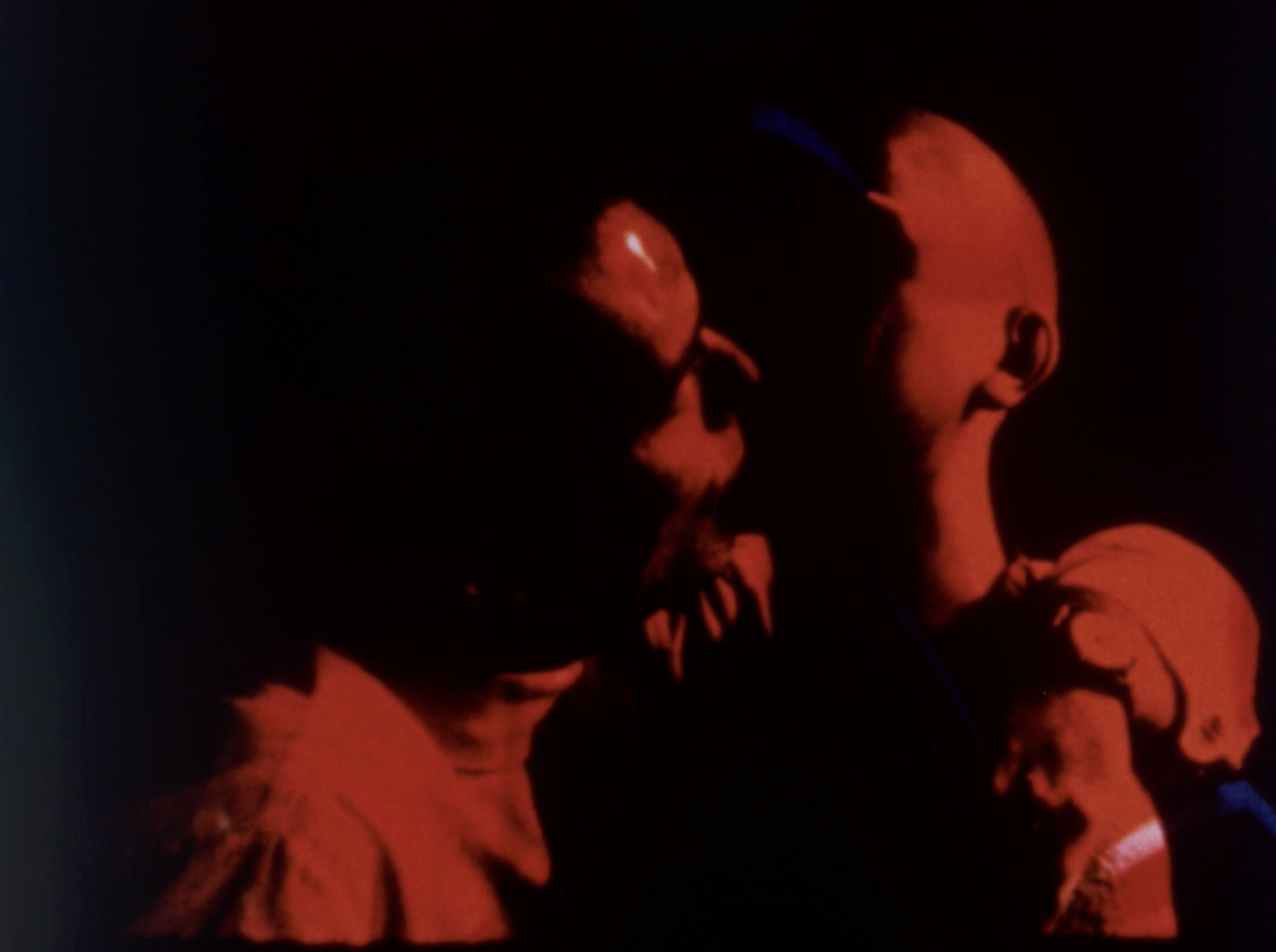
The domestic sphere proves no safer. Vollmund (Full Moon) frames eggs frying, cigarettes burning, Coke bottles bending, and a child’s cheerful “Let’s go,” all glimpsed through a circular aperture that turns the mundane into a pupil of surveillance. In Basis pH, the application of makeup is a study in exposure rather than beautification, as if each gesture were removing a layer of self-protection rather than adding one. It’s the private act as uncertain confession.

Berlin

Brehm’s engagement with pornography punctuates at regular intervals but refuses eroticism. Peng Peng links desire to violation by intercutting voyeuristic gazes with surgical imagery, whereas Berlin and Paris tint fleshly negatives green or red-blue until their physics appear industrial.

Röntgen

Self-portraiture assumes the identity of a malfunction. Chesterfield shows Brehm flickering beside a car while a metronome hammers machinically. In Charles, a drained, remorse-free face is doubled by a twin that never quite aligns, enacting a moral vacancy. Röntgen (X-Ray) meshes screaming vocals with inverted faces and vehicles in a radiographic exorcism. Such pieces insist that identity is not a stable referent but an affectation that appears only when stressed, inverted, or pulled apart.

Sonne Halt

As chronology grows, so does the gentility of Brehm’s touch. Licht (Light) is a standout in this regard: a hand caresses a lampshade again and again in a manner so tender that it borders on obsession. Sonne Halt (Sun Stop) freezes the sun between two towers as a red circle that pins luminosity to the board of life without extinguishing it. Cocktail shifts into a reflective register as Brehm diverts focus to his layered image, jazz sketching itself in the background.

Oxford

The selection concludes with uncanny simplicity. Oxford holds a pair of dress shoes against the firmament. Walking on air? Hello Mabuse converts a simple handshake into a bureaucratic nightmare, framed by ominous clocks. And Rolle returns to repetition as ritual, walking toward and away from the camera near a bale of hay until the act becomes a mantra.

Throughout PRAXIS, Brehm interrogates the image’s ability to signify anything beyond material agitation. The cumulative effect is fiercely corporeal, working directly into the viewer’s nervous system. Along the way, we learn how recognition and estrangement can collapse into each other, how ordinary objects can become alien through intensity, and how a soul caught in the act of looking cannot help but feel implicated in what it sees. What remains is a kind of hyper-alive exhaustion. Brehm exposes the vitality of the photographic trace even as he acknowledges the slow death embedded in every act of viewing. These fragments do not cohere, yet their incoherence is the point. Are we really so different?

Dóra Maurer: Thinking in Proportions (INDEX 046)

Thinking in Proportions hums with the integrity of a mind that treats perception itself as material. The mind in question is that of Dóra Maurer. Born in Budapest and trained as a printmaker, she did not enter moving pictures through story or representation but through process—the lifeblood of spatial relations. She describes her works as “displacements,” and each indeed alters the coordinates of seeing by measured degrees, thought revealing itself as something with weight and texture. Her structural rigor never hardens into rigidity. Instead, she builds systems in which freedom accumulates quietly, like breath made visible in winter. The viewer begins to sense that Maurer is a grammarian of matter whose proportions anchor themselves to the world with both scientific precision and metaphysical resonance.

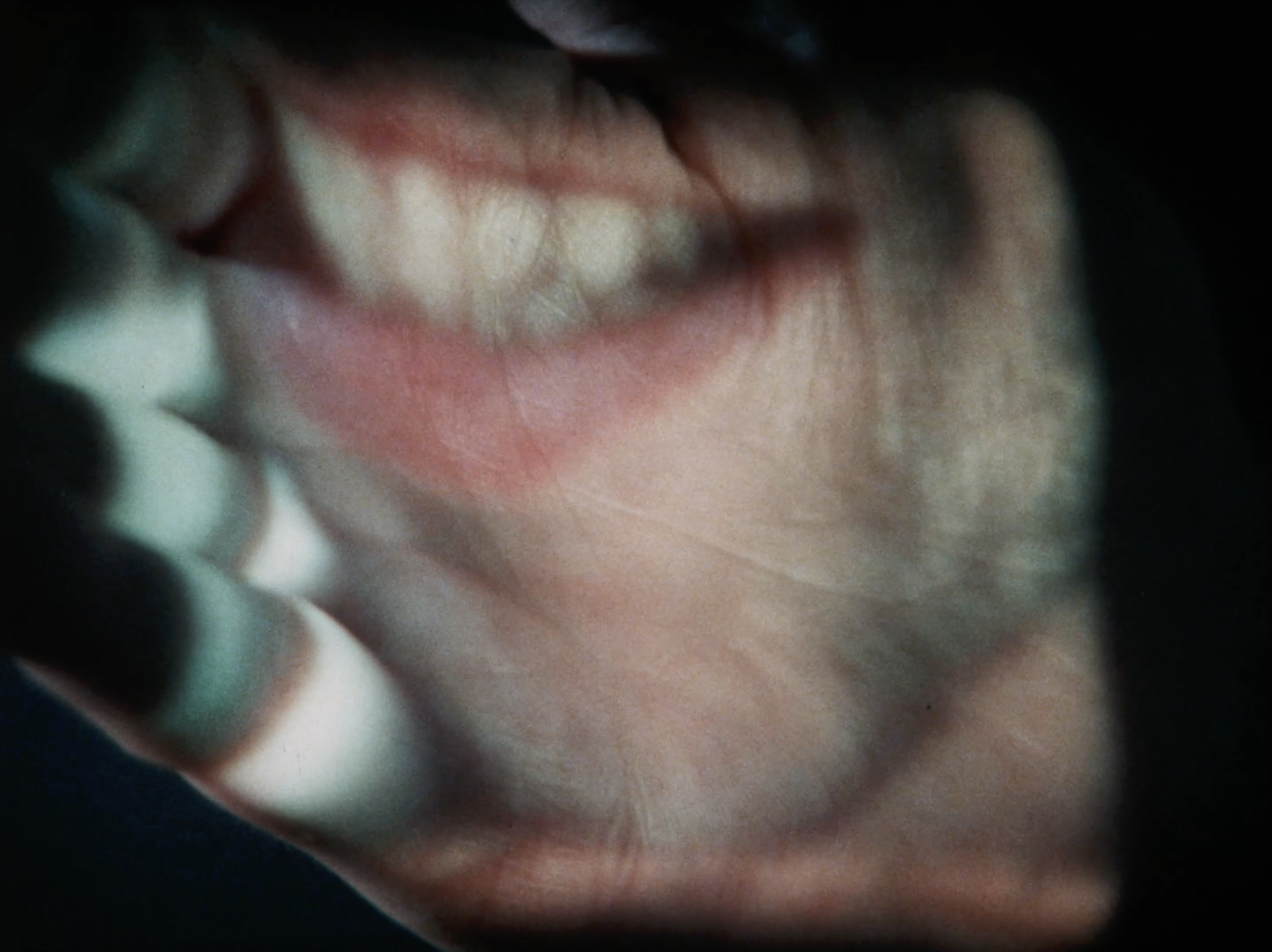
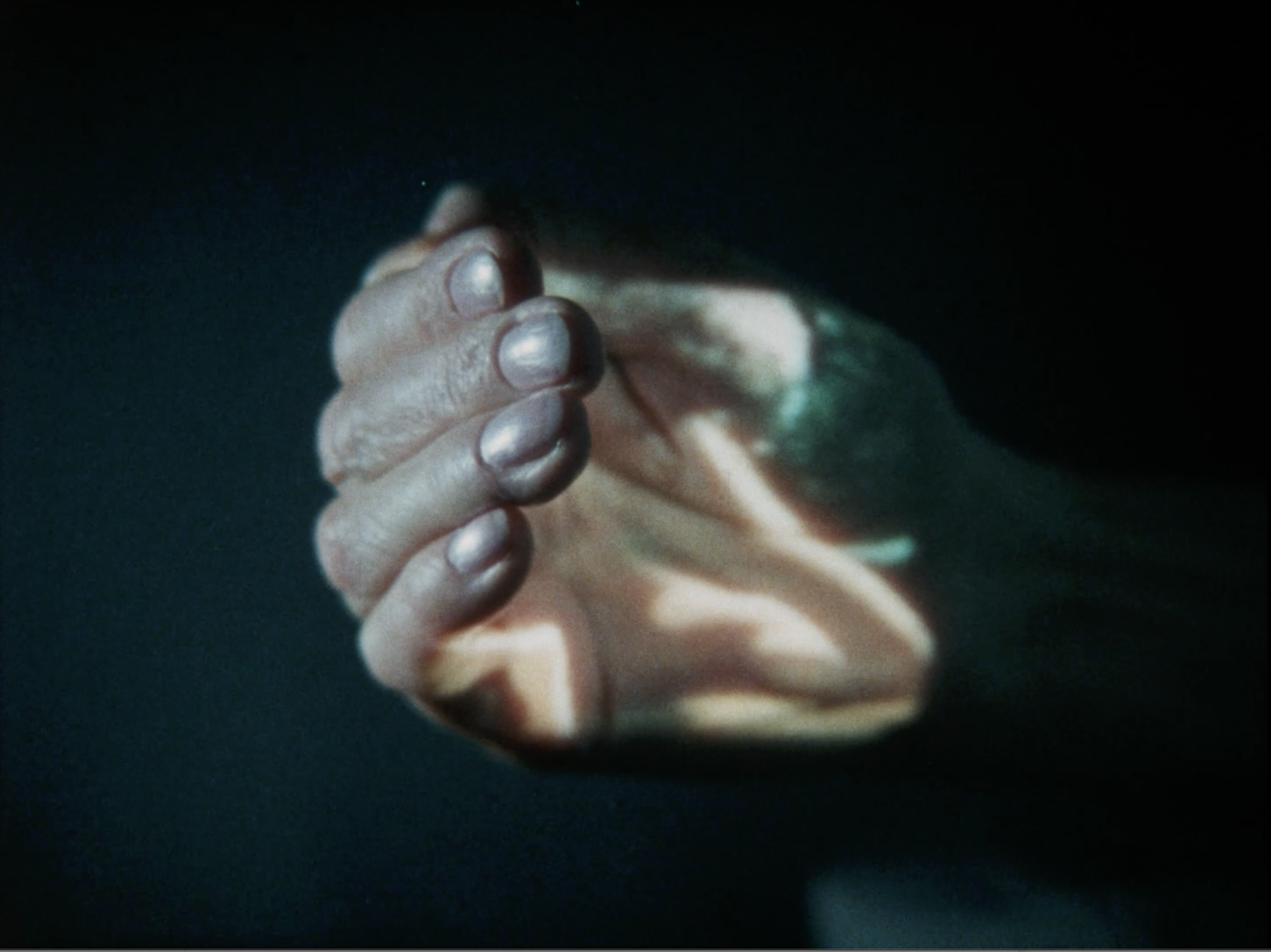
Learned Spontaneous Movements (1973) introduces this tension between rule and release through four takes of small gestures performed as Maurer reads: hair twirled, lips bitten, fingers moved toward the mouth in tiny cycles of self-soothing. Variations accumulate with the logic of an étude. The voiceover in an untranslated language becomes a ghost-signal whose meaning is withheld but whose cadence settles into the room. As takes multiply, comprehension erodes until only rhythm remains in unconscious behavioral patterning.

Relative Swingings (1973/75) is a mesmerizing exploration of a conical lamp swinging in space and recorded through a split-screen setup that reveals both the object and the mechanism filming it. Maurer exposes the infrastructure of perception, letting the camera that films the camera act as a kind of auxiliary consciousness. Mechanical grinding aligns with the lamp’s pendular arc. And then, a quiet miracle occurs as the object takes on a cosmic significance. The pleasure of watching it feels as if a thought had been suspended in the air and allowed to make its own skeleton visible.

Timing (1973-80) brings us closer to the body. A plain linen sheet becomes a screen, an object, and a problem. It is folded and unfolded while mirrored projections track its shifting geometry. The absence of sound lays bare the concentration at work, turning domestic labor into a contemplative action. The sheet’s creases are diagrams of invisible forces that echo contractions of memory, landscape, and skin.

Proportions (1979), Maurer’s first piece made with video, is intimate in its austerity. She uses a long roll of paper to measure her arms, legs, head, and torso, thus charting the room and the world around her. She walks with her hands, rolls her head across the paper, and marks every change of course through profound self-calibration. The message is undeniable: without us to insist on their significance, metrics would fall apart like so many atoms.

With Triolets (1980), she achieves a crystalline balance between three focal lengths, three subjects, and three sung tones that assume ceremonial force. Bodies and objects split and converge in a ritual of repetition that liberates rather than confines. The voices, sung in quiet invocation, lend the work an air of secular liturgy. It is among the cycle’s most resonant pieces, a sustained articulation of harmony born from constraint.

Kalah (1980) transforms an ancient Arabic board game into a synesthetic machine. Colored squares pulse with tones, evoking early video graphics or elemental sound scores. It appears playful on the surface, yet behind the game’s syncopation lies the proportional logic that threads through Maurer’s practice writ large. Strategy is now an acoustic and chromatic event.

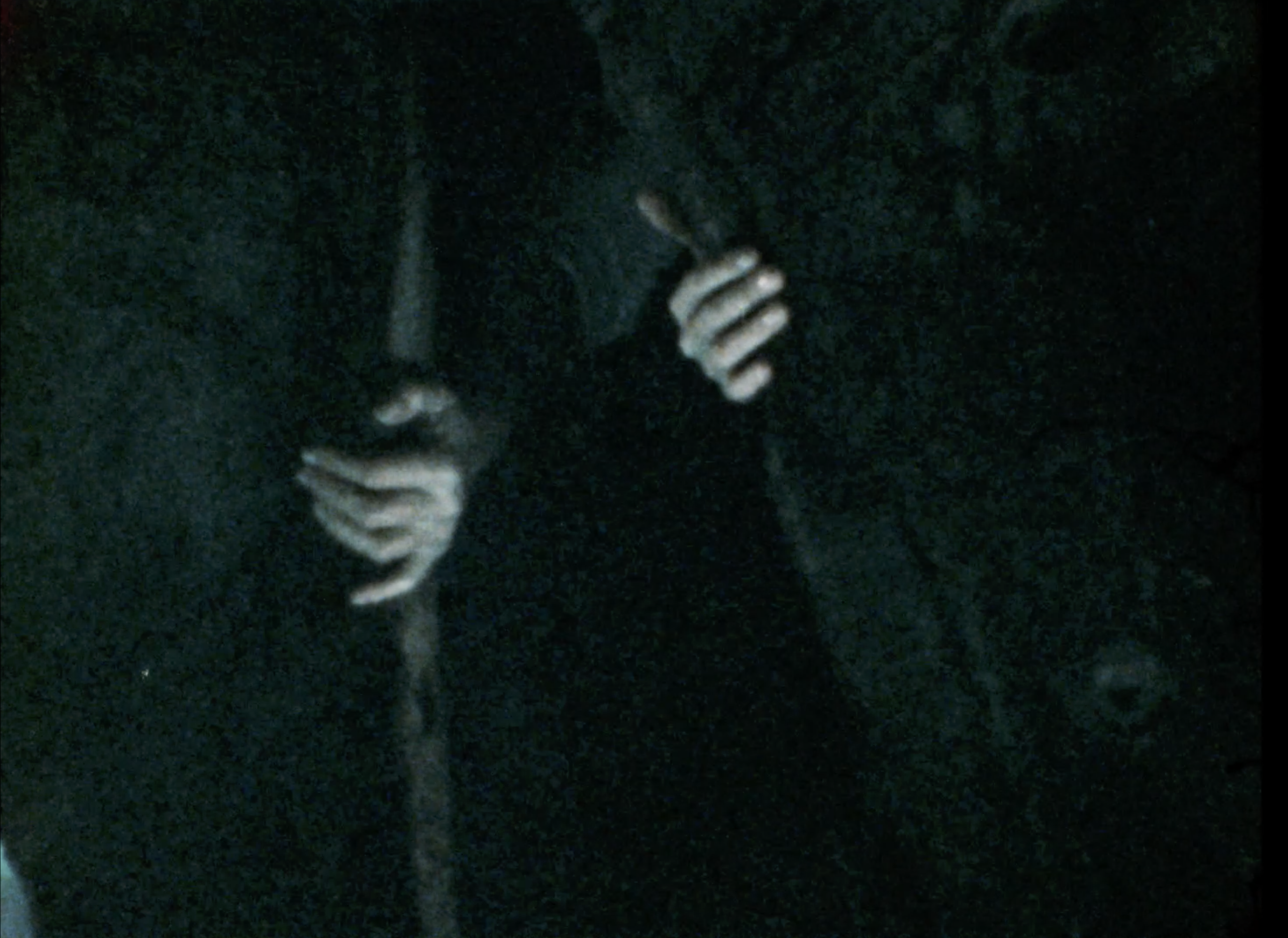
The Inter-Images trilogy (1989/90) stretches into mediation. Part 1, “Retardation,” shows a face glimpsed through rectangles that flicker like shuttered windows, each opening accompanied by electronic tones. Part 2, “Streams of Balance,” follows a nearly nude male dancer in a dark, overhead-lit space, mapping equilibrium with anatomical poise. Part 3, “Anti-Zoetrope,” places two men boxing within a cylindrical enclosure viewed through vertical slits, slowing violent motion into sculptural intervals.

The bonus piece, Space Painting, Project Buchberg (1982/83), anchors her cinematic and painterly intelligence. She moves through an outdoor environment as if drawing from it, painting with air and light while allowing landscape, stone, and shadow to render the action in a whispered manifesto. Art is not imposed upon space but coaxed from it, uncovered through engagement rather than declaration.

Throughout this artfully curated program, Maurer returns again and again to the idea that seeing is a disciplined act, a negotiation between structure and sensation. She seeks not to depict the world but to reorganize it proportion by proportion so that the viewer can relearn how to treat the eyes not as windows but as crucibles for the everyday.