My second in an ongoing series of Danish folk reviews is up here at RootsWorld. This one is a fascinating concept album by Hal Parfitt-Murray and Nikolaj Busk entitled Music from the Edge of the World.



My second in an ongoing series of Danish folk reviews is up here at RootsWorld. This one is a fascinating concept album by Hal Parfitt-Murray and Nikolaj Busk entitled Music from the Edge of the World.
My review of the Svøbsk Kvartet’s Bjergtaget is the first in a recent series of Danish folk reviews for RootsWorld online magazine, now available here.

I began this humble blog four years ago to the day. It has since grown into an obsession, and I cannot thank you all enough for keeping up. With less than 200 albums to go, my goal is within reach. Who’s with me?
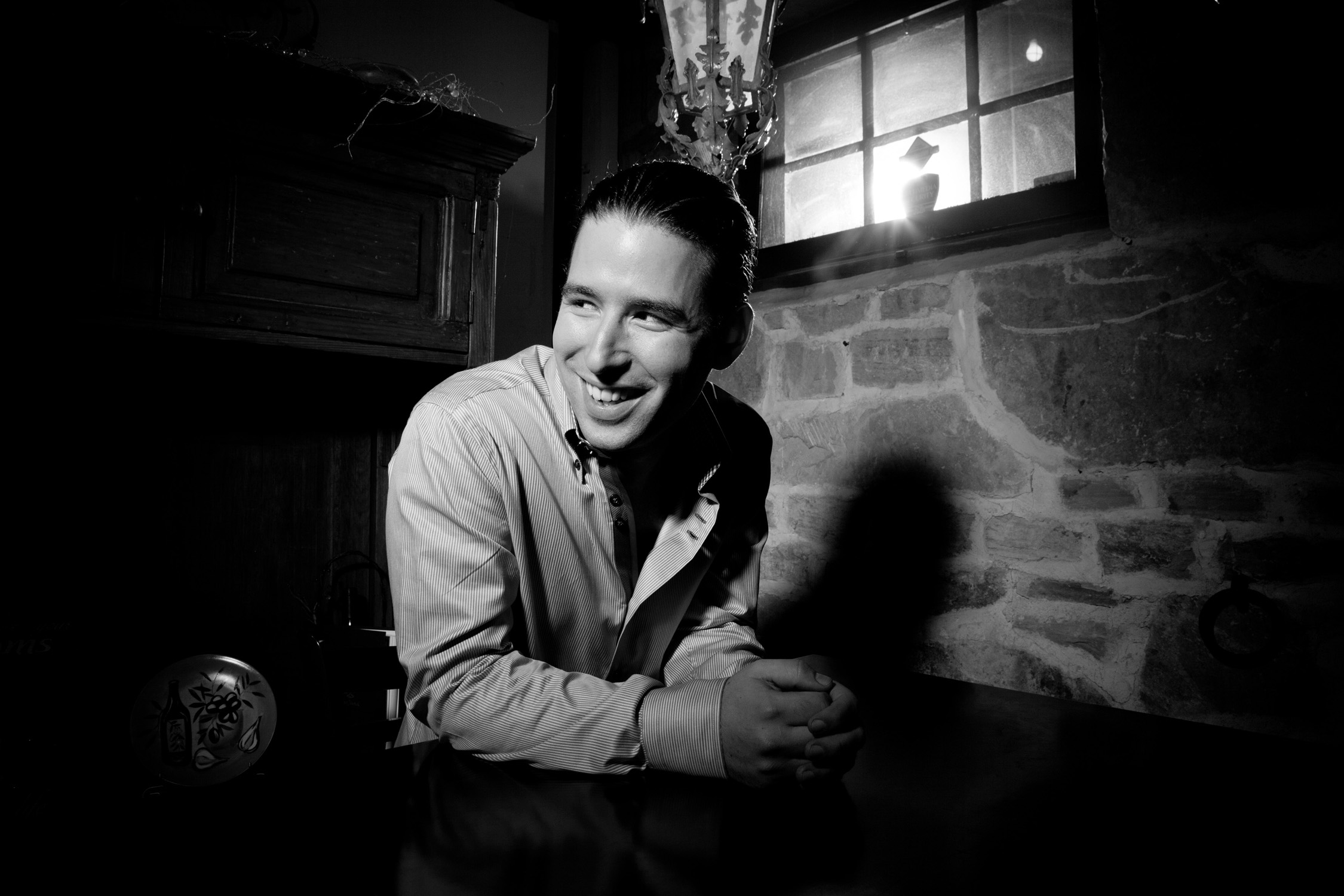
Alfredo Rodríguez
February 7, 2014
Barnes Hall, Cornell University
8:00 pm
After hearing pianist-composer Alfredo Rodríguez in the close quarters of Barnes Hall last Friday night, one could only feign surprise to know that he began his musical education as a percussionist before switching to piano at age 10. Whether through clipped breathing, clicks of the tongue or stamping of the feet, his awareness of the beat was front and center. This was surely one of many aspects of his craft that caught the ear of producer Quincy Jones, with whom he collaborated on his recent sophomore album, The Invasion Parade. We might further reflect on his Cuban heritage, which is to his playing as the moon is to night. Yet, if these biographical details meant anything, they were only as valid as the intrigue of his performance, which was, in a word, dynamic.
Rodríguez left no doubts about his roots, starting the program as he did with an idiosyncratic take on “Venga la Esperanza” by Cuba’s left-wing darling, Silvio Rodríguez. As he wove from somber beginnings a tapestry of increasing complexity, it was clear that Keith Jarrett has had a huge impact on Rodríguez, who cites the pianist’s legendary The Köln Concert as a life-changing influence. The more he played, the deeper his contrasts and densities became. The effect was such that when the occasional snippet of recognizable melody broke surface, we were reminded that at the root of it all was something worldly. Rodríguez followed up with an original composition, “El Güije.” Balancing dark undercurrents in the left hand with the sparkle of his right, the piece’s borderline-aggressive textures gave way to windswept dreamscapes at the turn of a weather vane.
The staggered raindrops of “Quizás, Quizás, Quizás” introduced a triptych of classic tunes rounded out by “Veinte años” and Ernesto Lecuona’s rousing “Gitanerías.” In them, elements of Messiaen, Bartók, and folk songs showed the full range of Rodríguez’s palette. His highs, always translucent, shone with special care. That said, he never stayed pretty for too long, if only to better appreciate the occasional moment of beauty we were allotted.
As is often the case with younger jazz musicians, Rodríguez emoted with blatant passion and tended toward passages of controlled chaos before finding purchase in his themes. Departures felt more like interjections, if not outright explosions, than variations. His tongue-in-cheek take on “Guantanamera,” for example, was a tour de force in technique, invention, and surprise. He approached this deathless tune from within—literally—by hitting the strings inside the piano before migrating to the keyboard proper. The result was a mélange of interpretations, more sketchbook than painting—which is precisely where he deviated from Jarrett.
Although Jarrett’s adlibs come pouring out of him sounding like fully formed compositions, Rodríguez allowed himself the indulgence of thinking out loud with relatively little interest in transition, stacking cell upon cell of distortion. Something of a curse for many improvisers that smoothes itself out over decades into seamless art, one senses in Rodríguez a “say-no-to-the-flow” attitude that suits him just fine. The result is neither more nor less conducive to the concertgoer’s listening pleasure, but is a methodological difference that requires sharp attention from both sides of the front row. He is an honest player, through and through.
None of this is to imply that that the concert was devoid of lyricism. As if to prove this, Rodríguez encored with an aching rendition of Ernesto Duarte’s “Cómo Fué.” As tender as tender can be, its somber farewell closed the circle, opening another of fond memory in its place.
(See this article as it originally appeared in The Cornell Daily Sun.)
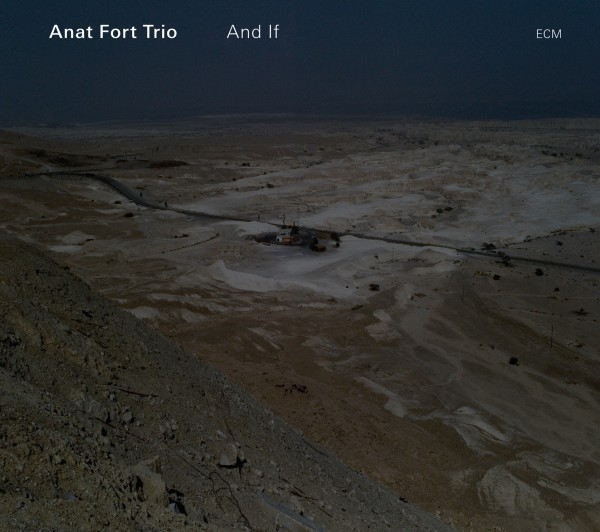
Anat Fort Trio
And If
Anat Fort piano
Gary Wang double-bass
Roland Schneider drums
Recorded February 2009 at Rainbow Studio, Oslo
Engineer: Jan Erik Kongshaug
Produced by Manfred Eicher
Anat Fort returns to ECM, now with the members of her working trio: bassist Gary Wang and drummer Roland Schneider. Together they put a decade of working experience into And If, which burrows deeper into the compositional soil tilled on A Long Story. With that album in mind the trio pays homage to Paul Motian—whose encouragement led to the first ECM collaboration—in two tracks dedicated to the master drummer. The first begins the disc with poetry metered by the heart, beating in response to life’s changing climates. Like the passing of one thought to another, it shuffles melodic impulses farther down the line. “Paul Motian (2)” closes the circle, taking inspiration from its namesake by never once succumbing to the pitfalls of predictability. Such tenderness justifies imagery like that of “Clouds Moving,” which proceeds with Vince Guaraldi-like ebullience in the ground line while luminous harmonies in the right hand draw rivers catching sun during flyby. Schneider’s feel for cymbals admirably fills Motian’s absence, as do his brushes beneath Fort’s arcs of flight in “Minnesota.”
Although the album is not without a clipped feather or two (the fleeting “If” and “Nu” balance tenderness and swing, respectively), for the most part it spreads its wings broadly. One cannot help but detect a classical tinge to the wind beneath. “En If” is but one example. Its mastery builds off primary colors, awaiting the light of day to mix variations between prose and poetry. The former we get from Fort’s storytelling fingers, while the latter flows effortlessly from the rhythm section.
“Something ’Bout Camels” revisits material from Fort’s label debut, given here a flowering treatment. The daybreak of Wang’s arco introduction canopies a desert sleeping soundly. A settlement stirs: eyebrows twitch, bodies stand upright, legs move, hands work, and the beats of earthen carriage guide wheels to turn. Schneider’s bassing droops, swishing away the flies with its tail and folding the wind into parchment, that it might calligraph Fort’s footfalls.
Yet nowhere does the trio come together so effortlessly as it does in “Lanesboro.” This ballad in a classic mode is the epitome of gorgeous. Like water over rocks, it conforms to the shapes of its progression with unforced, organic flow. The lyrical support completes Fort’s picture with understated bliss.
An anthem for the soul.
(To hear samples of And If, click here.)
“Aggressive but never forced” describes the music of Noel Johnston to a T. His is a veritable wall of sound across which is graffittied a diagram of fire, sweat, and professionalism. The Dallas area-based guitarist grew up in Southern California, where he began his musical training on violin from an early age before switching to cello at 7. In spite of his keen abilities with a bow, his fingers yearned for a pick. Hip to the fact that his passions as a performer lay elsewhere, Johnston laddered through the garage band toolkit from the bottom up, as it were: starting with drums, moving on to bass, and at last settling on guitar. A life-changing encounter with those six amplified strings came through the iconic work of Eddie Van Halen—so much so that when he plugged in an electric and played a power chord through a distortion pedal for the first time, he knew his fate had been sealed.
Johnston’s talents are as broad as his travels. At age 10, his family uprooted from the Golden State and replanted Down Under. After spending his teens in Australia, he attended college at USC, where teachers encouraged the budding guitarist to get some hardcore jazz under his belt. As an aspiring studio musician, they told him, one had to be a musical chameleon. Johnston took to the challenge like a squirrel to a feeder. An open mind and an insatiable desire to evolve got him into the renowned jazz program at the University of North Texas. Idols Johnston had long admired had passed through its hallowed halls, and it was only natural that he should follow in their finger taps. Of his influences the list is equally varied: everyone from Kenny Wheeler and Dann Huff to Pat Metheny and Bill Frisell, Tribal Tech and King’s X to Metallica and Whitesnake—each left a pin of conquest on the map of his development.
Although accustomed to a life on the move, Johnston found a home in the Dallas-Fort Worth scene, where he soon became a vital fixture. He has since been featured on over 40 albums—three as a leader, two as a co-leader. He has performed and/or recorded with local and international musicians alike, among them Joey Baron, Sheila E., Dave Liebman, Joe Lovano, Monica Mancini, Adam Nussbaum, Gary Willis, Lucky Peterson, and Kenny Wheeler, to name but an illustrious few. Of late, he can be seen alongside local jazz icon John Adams and on the Daystar (Christian television network) daily live program The Marcus & Joni Show. These and other developments—a regular teaching job at UNT, marriage, home, and a family—have secured him in the Lone Star State for good. With so many blessings poised like a whammy bar, Johnston has been fortunate to bend the pitch of his career to whatever tune suits him. His most recent studio effort, Salted Coffee, is the result of much refinement. With so many commitments warranting his attention, Johnston has taken full advantage of precious downtime to compress original melodies into diamonds he can be proud of: his songs, his sounds, his passions immortalized on disc, activated by lasers as precise as the music they read.
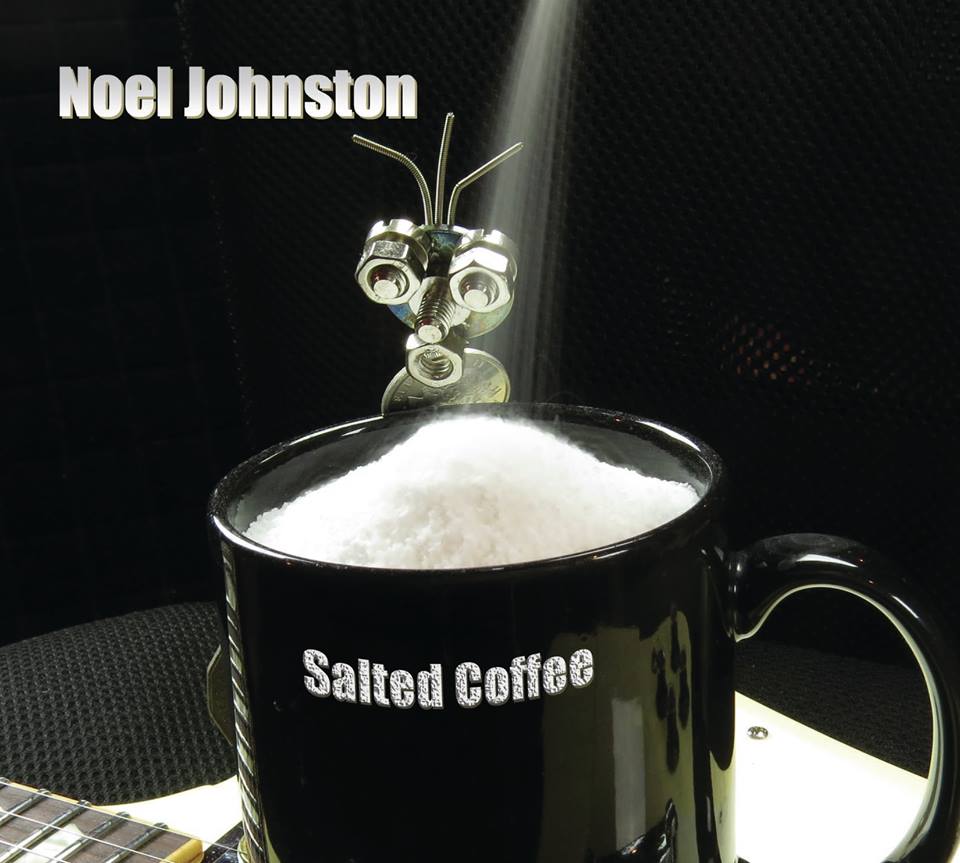
Although the title of Salted Coffee arose out of a caffeine-related practical joke, the music behind it is seriously electric. For his latest studio album, Noel Johnston is the first to admit a lack of agenda. These are simply songs he wanted to explore, songs he liked, songs he wanted to create. That said, we may easily read a deeper continuity in the set list, which proceeds from peaks to valleys and back again in a rollercoaster ride of melody and mood.
As an experienced producer, composer, and educator, Johnston is no stranger to the bandleader’s role. Salted Coffee proves him more than capable of breezing through the attendant challenges—and with such fine support in bassist Jeff Plant and drummer Jason “JT” Thomas, to boot. Together, the trio maps expansive territories, blasting its unique brand of heat across the cool surface of Joe Henderson’s classic tune “Inner Urge.” There’s a touch of the cosmic to the proceedings, as if the very life force of the music were trying to communicate with alien races. The Johnston original “Bat Tips” is another heavy hitter, the title of which comes from a favorite palindrome, reflected in the Möbius chorus and speech-inflected syncopations. A dark flier, indeed.
The album isn’t all steam and smoke, however, as attested by its downtempo turns. The Nat Simon standard “Poinciana” shows the band at its most laid back. Smooth and unerringly focused, it finds Johnston in a lilting mood, Plant even more so as he paints a fretless bass solo à la da Vinci. Yet even here the band cannot help but succumb to the music’s inherent drive, letting its inner force build as it will before coming down gracefully, spirit very much intact.
Guest keyboardist Shaun Martin gleams the cube on the funky halfpipe of “Big 8008,” another Johnston-penned joint, and further via Hammond organ on a cover of the Beatles’ “Because,” for which the band reaches the album’s profoundest heights of inspiration. Percussionist Greg Beck adds his own distinctive sheen to three tracks to round out the set. The latter include the grungy title track, which kicks off the album by launching the listener into a heartfelt universe of 80s glam throwbacks, and the ominous “Dark Blues,” a cinematic excursion that turns night into day. Lastly, the descending chords of Johnston’s wryly-named “The Fall” cantilever themselves into shadowy emotional territory. Plant’s mellifluous playing, combined with JT’s brushwork, put a cap on this gorgeous realm of contrasts.
The album’s clever mixture of metal grandeur, melodic ingenuity, and technical virtuosity make for one sharp cocktail indeed, and the breathing room it affords comes selectively and exactly when needed. The end effect is one of depth, appreciation, and good vibes.
Welcome to the jungle.
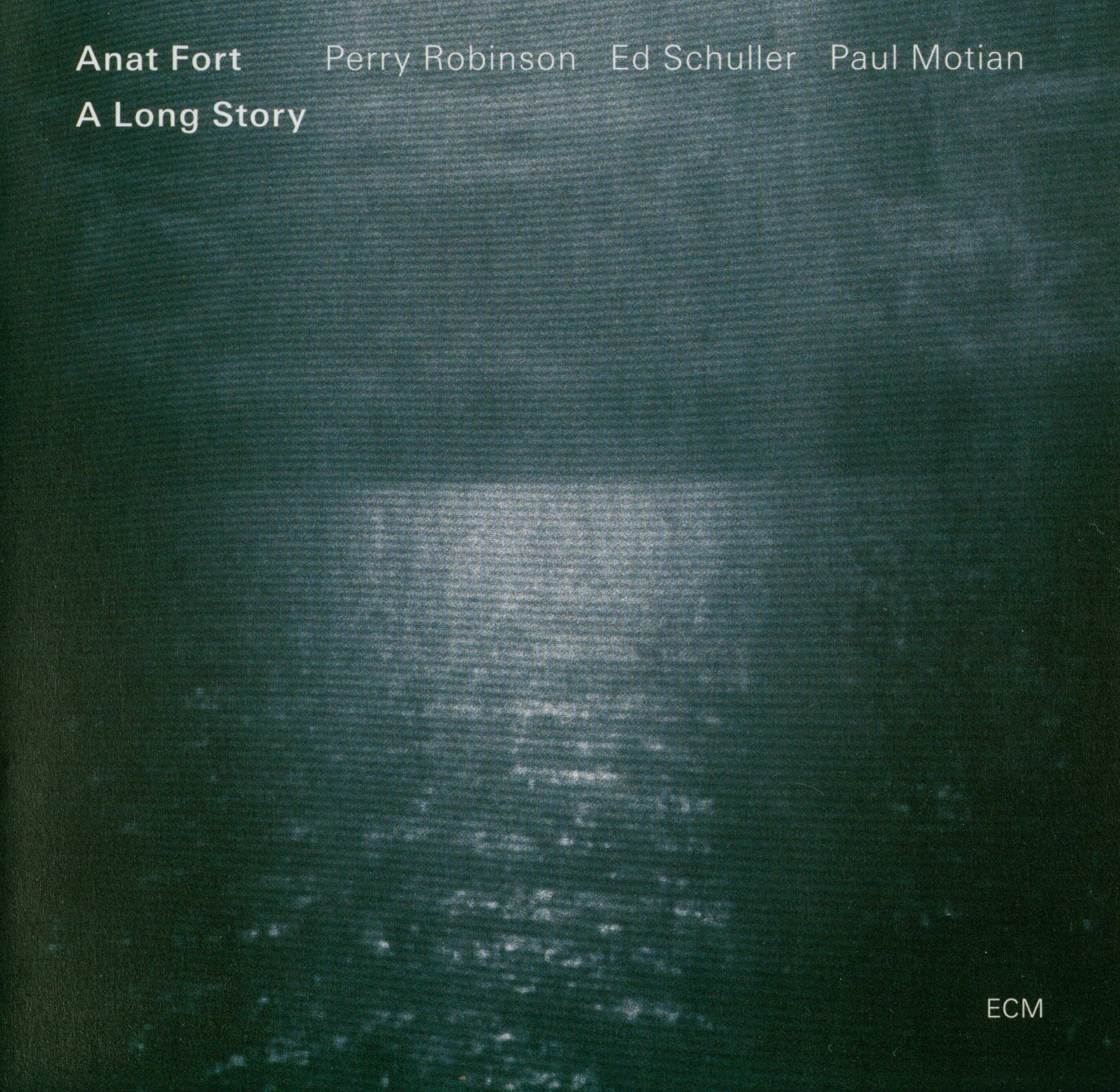
Anat Fort
A Long Story
Anat Fort piano
Perry Robinson clarinet, ocarina
Ed Schuller double-bass
Paul Motian drums
Recorded March 2004, Systems Two Studios, Brooklyn, by John Rosenberg and Max Ross
Edited and mixed May 2006 at Avatar Studios, New York, by Manfred Eicher, Anat Fort and James A. Farber
Produced by Anat Fort and Manfred Eicher
Israeli-born pianist Anat Fort in her ECM debut. An event to cherish for time to come. The album’s title, A Long Story, an understatement: an expression of the infinite joy that music brings to player and listener alike, a holy exchange of which the improviser is but a fleeting intermediary, yet whose name persists as the bringer of possibility. And so, alongside her name we must include those of bassist Ed Schuller, drummer Paul Motian, and clarinetist Perry Robinson. Schuller has a long story of his own playing with Motian and Robinson, and it was he who captured the interest of the veteran drummer, who in turn put it into producer Manfred Eicher’s hands. The ECM fit came naturally, and here we have the fruits.
One needn’t look at the album credits to know that the music comes from Fort’s pen. Original and committed should be at the top of her résumé. “Just Now” anchors the set in three variations, the first and last of which begin and end the album with their hymnody, the central of which inhales drought and exhales oasis fragrance. In them, Motian breezes through leaves. He is, in fact, a revelation throughout, especially in “Not A Dream?” (from which one can’t help but draw a line of flight to his tune “Lost In A Dream”). This one brings the quartet together in clearest focus, the interplay subtle, sculpted, and secure. His affinity for Fort’s music is obvious, responding dancingly as he does to everything going on around him. Fort approaches the keyboard in kind, kneading her melodies into cells of doughy surprise. In “Rehaired,” she engages Motian in more buoyant conversation. The two are simpatico in this trio setting. Motian carries the full weight of “Not The Perfect Storm,” bringing thunder and lightning to its opening moments before Fort joins the unerring chaos. Here the theme is farthest-reaching, coalescing and spreading—a flock of birds above a field in slow motion—until the last raindrops fall, hitting every leaf like a cymbal.
Robinson, too, is comfortable in his skin. He brings a classic sound to the table, but also a few surprises in his lettings go. “As Two” and “Something ’Bout Camels” make for a fine dual vehicle. He navigates the drunken corridors of the first, a low-slung slice of night, with finesse and switches to ocarina for the second, flitting bird-like through the open skies. And the free improv he shares with Fort in “Chapter-Two” develops a fluent contrast of grit and sparkle. Schuller is another integral force, setting the stage of “Lullaby” behind eyelid curtains and touching the air of “Morning: Good” as would a magician wand a hat. Fort’s pianism shines in his company, but also keeps one arm around the shoulders of a shadow, if only to remind us that every moon has a dark side.
In her composing, Fort never succumbs to sugar. Her leading lines are savory all the way. Neither does she ornament for mere effect, but rather speaks in tongues wholly wrapped around the music. Case in point: “Chapter-One.” A distillery in sound, it swirls and ferments, building body and flavor toward peak balance. A romping beat reveals itself intermittently from the soft tangle, until all that’s left is a feeling of having been here before. We know this music because it lives within, passed from Fort’s heart to ours.
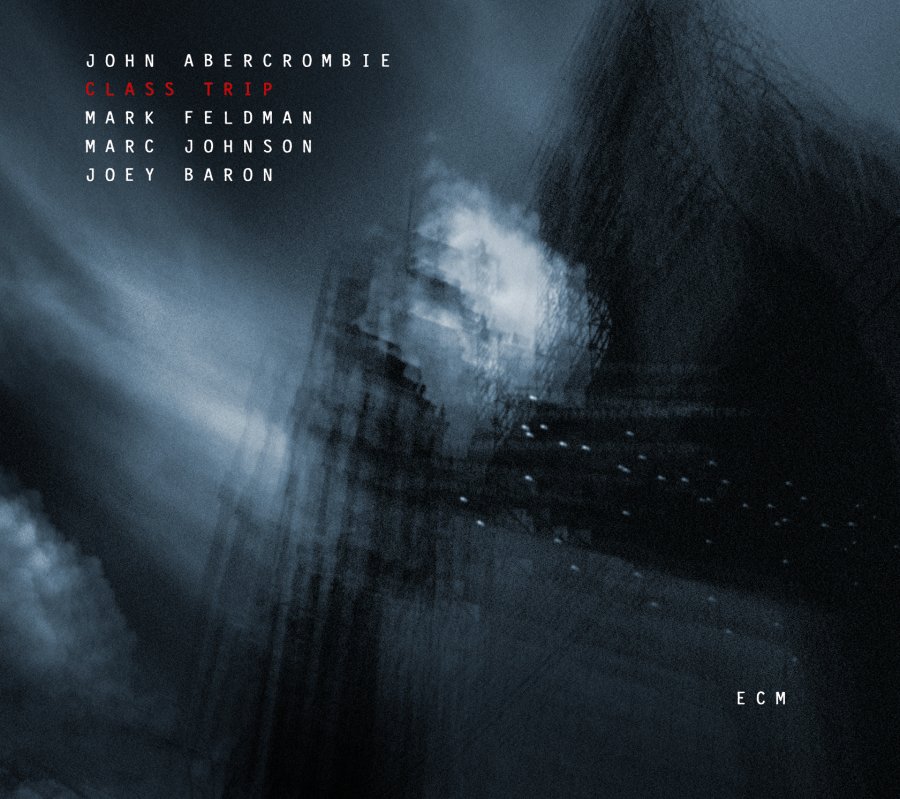
John Abercrombie
Class Trip
John Abercrombie guitar
Mark Feldman violin
Marc Johnson double-bass
Joey Baron drums
Recorded February 2003 at Avatar Studio, New York
Engineer: James A. Farber
Assistant: Aya Takemura
Produced by Manfred Eicher
Guitarist John Abercrombie’s journey through ECM space has brought him into orbit with a range of phenomenal satellites. Yet no solar system has been so enduring in effect as the quartet documented here. Since Cat ‘n’ Mouse, it has grown, as the title of that label debut would imply, in leaps and bounds. Nearly all of the music is by Abercrombie, the only exceptions being “Solider’s Song” by Béla Bartók (performed here in a lovely trio arrangement, sans bass, and taken from the composer’s 44 Duos) and the freely improvised “Illinoise” and “Epilogue.”
As ever, Feldman’s peerless art is a pleasure to hear among present company. His harmonic skills thread “Dansir” with a grammar all their own, matching Abercrombie’s snaking themes arc for arc. Moments of collusion with Baron also abound in the silken drama of this album opener. Abercrombie and Johnson are like creatures from the deep, bringing songs of the seafloor with them. As in all that follows, there is something almost secretive about the goings on, as if somewhere behind the ebony veneer an even deeper shade of heart is at work. Johnson’s early solo in “Risky Business” is the epitome of commentary in this regard.
From reverie to reverie the program travels, sporting in the brisker “Descending Grace” and becoming even livelier in “Swirls.” But the lion’s share sits at the paws of a slumbering beast, each tune airier than the last. At the navigator’s helm, Abercrombie brings requisite cartography—and all the sense of measurement and precision the metaphor implies—to his playing. He is the icing to the cake beneath, the median temperature between Feldman’s cool and Johnson’s warmth (cf. “Excuse My Shoes” or “Jack and Betty”). In the title track, anchored by a delightful pizzicato combo, he jumps deck into full dive and resurfaces with a handful of gold stamped FELDMAN. Like a skilled, unpretentious filmmaker, the violinist captures movement at the moment of its creation and tests its fate in the light. Another easy notable is “Cat Walk.” One of a handful of feline-themed tunes in the ECM catalogue, it is yet another showcase for Feldman, who stalks the galleys with eyes aglow. Abercrombie, too, is sprightly and agile with his soft pads. But it’s Johnson who comes up with the most evocative solo of them all.
Careful but never cautious, Class Trip is a dream come true for a group that is, thankfully, very much a reality.

John Surman
Brewster’s Rooster
John Surman baritone and soprano saxophones
John Abercrombie guitar
Drew Gress double-bass
Jack DeJohnette drums
Recorded September 2007 at Avatar Studios, New York
Engineer: Joe Furla
Assistant: Rick Kwan
Mixed June 2008 at Legacy Studio, New York by John Surman, Jack DeJohnette, and Joe Furla
Mastered by Christoph Stickel, Munich
Executive producer: Manfred Eicher
This jazzy outing with guitarist John Abercrombie, bassist Drew Gress (making here his ECM debut), and drummer Jack DeJohnette, sits multi-reedist and composer John Surman back in his most worn saddle. Only relatively straightforward (it’s not without its wild side), the album throbs like the beating heart that has given life to every stirring of this most peripatetic artist. His ECM discography is a compendium of riches, taking listeners through a sizable archive of solo dates, free jazz settings, classical commissions, music for stage and screen, and robust collaborations. Of the latter, his brass menageries with John Warren are especially memorable. And so, it is perhaps no surprise that Surman should pay respect by starting off the set with Warren’s “Slanted Sky.” The choice is duly appropriate: not only does it count every dollar of this fantastic quartet; it also establishes an eerily comfortable (and comforting) mood. As one of only two non-originals (the other being a lyrical take on Billy Strayhorn’s “Chelsea Bridge”) on the disc, “Slanted Sky” stands out for its structural difference. One sweep through its turnstile, and there’s no doubt you’ll be in good company for the next hour.
What a pleasure to hear Gress and DeJohnette playing side by side in “Hilltop Dancer,” their interactions as lithe as the title would have you believe. It’s a partnership not yet repeated for ECM, but one that bears ample fruit for the group’s melodic frontline to savor, as it does further in the title track and “Going For A Burton.” Both of these balance a gritty baritone atop an equilateral triangle of support, by turns slick and darkly whimsical.
Surman’s skywriting on soprano leaves its signature to dissipate into the oceanic blue of only two tunes, including the 11-minute “Counter Measures.” This one showcases the tonal mastery of each musician in kind, from Abercrombie’s undulating solo and Gress’s subtle pop to DeJohnette’s gluey tracings and Surman’s well-oiled joints, there’s plenty to admire on repeated listening. Yet this is really a baritone lover’s record. One spin of “Haywain,” and it all becomes clear, for what sounds like an entirely improvised tangle proceeds into unexpected unity.
Brewster’s Rooster is also an album with its own sense of humor, as expressed by the title “No Finesse.” It’s about as tongue-in-cheek as you might expect, for these musicians have finesse aplenty. Breathless yet secure, unhinged yet always close by, theirs is music that moves.
 Between Sound and Space: ECM Records and Beyond