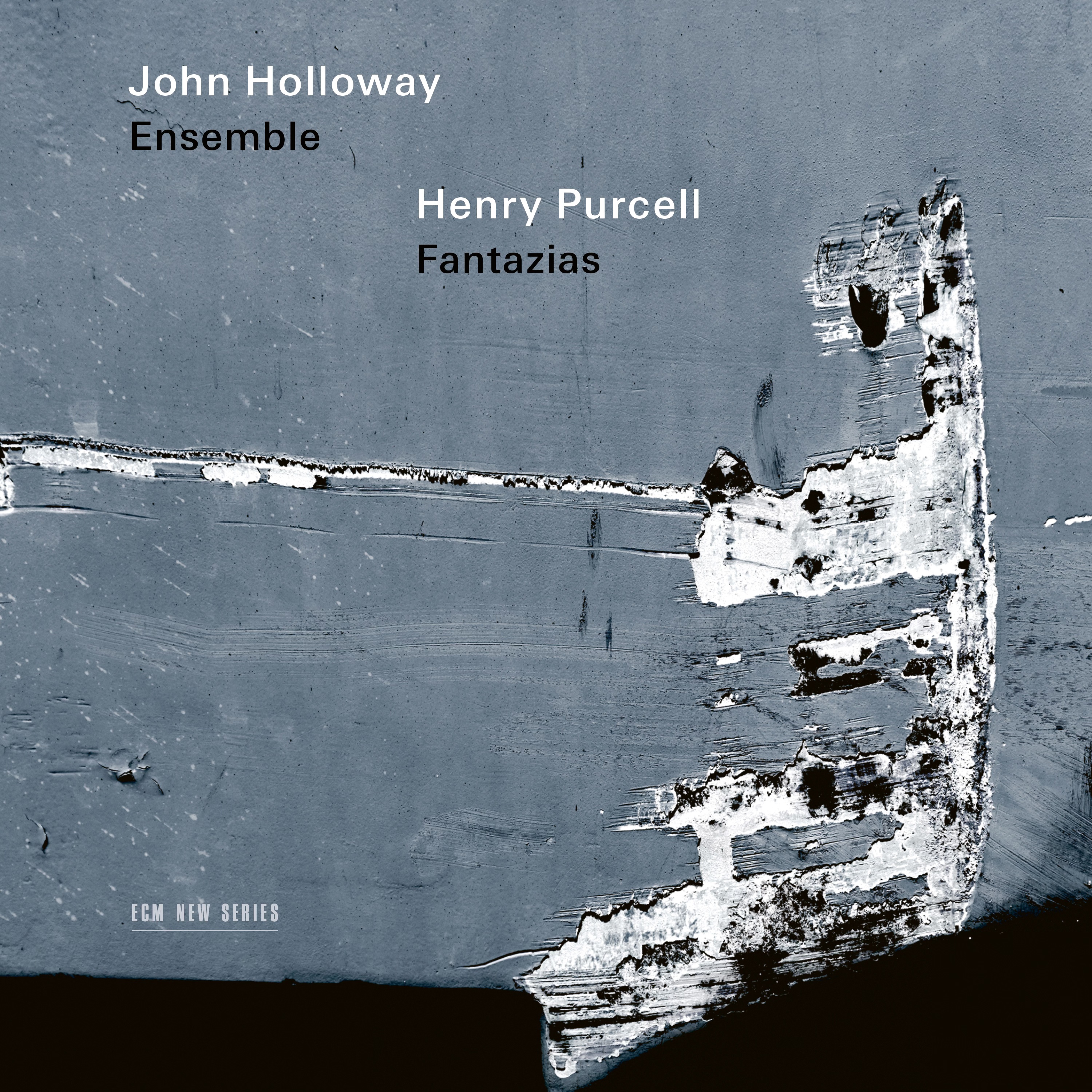
John Holloway violin Monika Beer viola Renate Steinmann viola Martin Zeller violoncello Recorded March 2015 at Radiostudio DRS, Zürich Engineer: Stephan Schellmann Cover photo: Thomas Wunsch Produced by Manfred Eicher An ECM/SRF2 Kultur coproduction Executive producer (SRF): Roland Wächter Release date: September 22, 2023
Henry Purcell (1659-1695), best known for his operas, was no less a formidable composer of instrumental music. His Fantazias are the pinnacle of the form, rich in their intermingling of counterpoint and polyphony. By the time Purcell put these to paper in 1680, the fantasia was over a century old. Despite being honed into a science by such estimable predecessors as William Byrd, William Lawes, John Jenkins, and Matthew Locke (whom Purcell replaced as “composer in ordinary with fee for the violin to his Majesty,” Charles II), it had fallen out of favor. Violinist John Holloway calls the present collection “a personal farewell to a kind of music, which in Purcell’s own chamber music would soon be superseded by sonatas.”
Leading an ensemble that includes violists Monika Beer and Renate Steinmann and cellist Martin Zeller, Holloway regards these 12 gems through a jeweler’s glass, cherishing every occlusion as a testament to its crafting through time. We encounter them here out of sequence, beginning with the river’s flow of No. 10. The sound is both creamy and metallic, sometimes allowing dreams to peek above the surface while at others pushing them into the mysteries of the current. Like No. 4, it affords a special sort of grace, pivoting from a seamless introduction into an intricate unfolding without changing skins. The ensemble matches with a palette that is equal parts shimmer and shadow.
Indeed, while these strings owe much of their grace to the composing, one cannot discount the players’ lifeblood. Like actors in a stage play, they embody these “characters” from within. In No. 6, for instance, Holloway’s violin laments like an agent of mourning while the others cross-hatch that inward focus with extroverted streaks of illumination. This dynamic reverses as the urgency heightens, and Holloway grabs hold of the future while the lower strings keep vigil to avoid forgetting the past. No. 9 is its companion in spirit: Even when it dances, it casts hedonism into the fire. Nos. 7 and 8 are equally wondrous in their contrasts, and their slips into dissonance reveal an improvisatory heritage, making them feel spontaneous, raw, and passionate.
In his liner notes, Holloway says, regarding the English composer’s handling of the form, that Johann Sebastian Bach “would certainly have acknowledged it as equal to his finest achievements in this art.” This is perhaps nowhere more obvious than in No. 5, the knotwork of which immediately suggests The Art of Fugue. Sitting on its right hand and left are Nos. 11 and 12. As translucent as they are viscous, they constitute a trinity of resolution that begs for more yet offers salvation only through silence.
While the above pieces are in four parts, Nos. 1-3 are in three. More intimate in form but no less expansive in scope, each is a dip into the heart of a creator whose font ran dry too soon.
Robert Levin fortepiano Recorded February 2017 and Feburary 2018 Großer Saal, Salzburg Mozarteum Foundation Engineer: Markus Heiland Cover: Fidel Sclavo Produced by Manfred Eicher Release date: September 16, 2022
Wolfgang Amadeus Mozart (1756-1791) is as much an enigma as an indelible emblem of what it means to be “classical.” In this seven-disc boxed set, a monumental achievement dedicated to one whose own achievements were nothing less than monumental, pianist Robert Levin offers a conspectus of the piano sonatas on the very fortepiano Mozart played from 1785 until his death and on which he composed The Magic Flute and his Requiem. Built by Anton Gabriel Walter in 1782, it speaks as one traveling out of time with a message of space.
Like much of Mozart’s writing, the music in these sonatas resulted from improvisations he later noted from memory—a spirit that Levin captures with charming honesty. The pianist’s historically informed approach heightens this effect, seeking to, in his own words, “revive a documented tradition” of embellishing repeats that goes back to C.P.E. Bach, whom Mozart greatly admired. Despite a fixed tripartite architecture across the board, there is great variation in mood, scope, and difficulty.
While Mozart is often cast as a poster child of vivaciousness, each sonata is best savored for its rich, sweet center. In these slower movements, genius bobs above and below the surface of a mind whose depths we can only begin to comprehend. We get a hint of this already in the Sonata No. 1 in C major, of which the Andante, nestled in neo-Baroque surroundings, is the music box of a childhood we’ve long forgotten.
Should that metaphor hint at immaturity, let such an illusion be shattered by a vision of the prodigy it manifests and which steps boldly into the foreground in the Sonata No. 2 in F major, cradling an Adagio that is the sonic equivalent of a precious stone. Even the Sonata No. 3 in B-flat major, with its lockstep opener and one-two punch of a conclusion, cannot steal the quiet thunder of the central movement between them. Such controlled ferocity must have been obvious to the composer himself when beginning his Piano Sonata No. 4 in E-flat major with an Adagio, pointing to the influence of Joseph Haydn, whose own sonatas he had then recently discovered.
Over the next four sonatas, expositions of stateliness and pastoralism bow to the dynamic brilliance of the Sonata No. 6. This D-major triptych is a stage drama in concentrated form, culminating in the final theme and variations. Spanning 15 minutes, they comprise the collection’s longest stretch, suggesting an orchestral sensibility.
This brings us to the pinnacle of Mozart’s engagement with the form: the Sonata No. 9 in A minor. Written in 1778, soon after the death of his mother, Anna Maria, its first movement sits on the throne of the collection. Morphing from extroversion to introversion and back again, its changes nourish Levin’s insights as a performer. The Andante here is the most holistic. Bursting into moments of passion but always returning to baseline, it sets up the concluding Presto and leaves us where we started: in wondrous anticipation. Along with its younger sibling, the Sonata No. 10 in C major, this is the form perfected.
Even “greatest hits,” including the Sonata No. 11 in A major, reemerge as hidden gems. The universally known Alla Turca lends itself to listening without prejudice, the familiar becoming new under Levin’s fingertips. Whether in the famous Allegretto grazioso of the Sonata No. 13 in B-flat major or the opening of the Sonata No. 16 in C major, Levin goes straight to the heart of these pieces so that we can feel them on their terms again.
The Adagio of the Sonata No. 12 in F major is a revelation, as is the Fantasia in C minor. Both soar in the present recording. The Sonata No. 18 in D major is among the shortest of the set, nevertheless a depth charge in its own right. The closing Allegretto is especially savory, and Levin handles it as an organic farmer would his finest crop.
Sprinkled throughout are unfinished sonata fragments newly completed by Levin and informed by his scholarly and creative approach to idiom. The sonata movement in C major is a pluralistic wonder. Another in B-flat major reveals a shimmering and ambitious architecture, while the last in G minor proceeds boldly from impressionism to realism. All three are a testament to what makes Mozart so comforting—namely, that he always has the destination in mind before his first step hits the ground.
What a gift for the seasoned and unseasoned alike, as fresh as the day it leaped forth from the soul of a life that, though cut short, was destined to resonate for all ages.
I appreciate your patience as I navigate some life changes (some negative, ultimately positive), which have taken much of my time away from listening and reviewing. I do hope to return to the ECM fold soon enough, as the universe allows.
Those who’ve been following me for a while may know I’ve been known to moonlight as an academic, and my latest book is a testament to all the hard work that went into earning my Ph.D. Here is the cover, and a description, for those interested:
In Fuzzy Traumas, Tyran Grillo critically examines the portrayal of companion animals in Japanese literature in the wake of the 1990s “pet boom.” Blurring the binary between human and nonhuman, Grillo draws on Japanese science fiction, horror, guide-dog stories, and a notorious essay on euthanasia, treating each work as a case study of human-animal relationships gone somehow awry. He makes an unprecedented case for Japan’s pet boom and how the country’s sudden interest in companion animals points to watershed examples of “productive errors” that provide necessary catalysts for change.
Examining symbiotic concepts of “humanity” and “animality,” Grillo challenges negative views of anthropomorphism as something unethical, redefining it as a necessary rupture in, not a bandage on, the thick skin of the human ego. Fuzzy Traumas concludes by introducing the paradigm shift of “postanimalism” as a detour from the current traffic jam of animal-centered philosophies, arguing that humanity cannot move past anthropocentricism until we reflect honestly on what it means for the human condition.
In his 1969 novella, Il castello dei destini incrociati (The Castle of Crossed Destinies), Italo Calvino presents a series of vignettes introduced by a nameless narrator who finds himself, after trials and tribulations, at the titular castle, which upon entering he realizes is a meeting place for wayward souls. Inside, a congregation sits around a table. Bound by a mysterious silence and with only a tarot deck at their disposal, these disembodied travelers proceed to lay down series of cards by means of which the protagonist interprets the life story of each. When at last comes time for Calvino’s alter-ego to tell his own story, he does so in a testimony concerned with space and time. He waxes expertly about mid-Renaissance hagiography, particularly St. Augustine in His Study. Painted in 1502 by Vittore Carpaccio, it depicts Augustine’s vision of St. Jerome:
“Also in the study where there reigns meditative serenity, concentration, ease,” our guide continues, “a high-tension current passes: the scattered books left open turn their pages on their own, the hanging sphere sways, the light falls obliquely through the window, the dog raises his nose. Within the interior space there hovers the announcement of an earthquake: the harmonious intellectual geometry grazes the borderline of paranoid obsession. Or is it the explosions outside that shake the windows? As only the city gives a meaning to the bleak landscape of the hermit, so the study, with its silence and its order, is simply the place where the oscillations of the seismographs are recorded.”
Calvino sets up a symbiotic relationship between what is visible and invisible in the painting through the final sentence quoted above. To make sense of it, one must be in two places at once. Both city and study are inhabitable manifestations of knowledge. The study is a storehouse of thought, a worldly archive in which the prominent thinker is but one of many animate tools. Whether the earthquake is imagined or actual, it is a failure of structural integrity, collapsing time into a measurable event.
Vittore Carpaccio, St. Augustine in His Study (1502)
The painting’s special affordance points to what Giorgio Agamben, lifting from Martin Heidegger, calls being “open to a closedness”—which is to say, knowing one’s finitude. Agamben frames this attainment of self-awareness not as something to which our species accedes but from which we distance ourselves. Where does that leave the artist? As Calvino avers, “the job of writing makes individual lives uniform”—another piece of bark to chew on.
I stay with Calvino a bit longer, if only because in the same chunk of text he establishes the intellectual wager echoed throughout Bar Italia, the first monograph from Argentine-born photographer Juan Hitters. Calvino’s interest in the earthquake, an upsetting of the scene’s “harmonious intellectual geometry,” informs my approach as a viewer. When he wonders, for instance, “Or is it the explosions outside that shake the windows?” Calvino is questioning the very apparatuses of interpretation by bringing out the pulse of a nominally static scene. And just as his narrator can only infer the full story from selected images, we are left with a photographic trail of breadcrumbs that quietly acknowledges its own closedness. Any subsequent embellishment is our own.
Is the camera that much different from the animal sitting stage right in Carpaccio’s painting, taking it all in emotionlessly yet with such grace as to render any reaction other than faith incomplete? Resting on an ever-present tripod to capture as much resolution as possible, and like the mind activating the shutter behind it in moments of captivation, Hitters’ instrument exists not to praise the wonders of the self but to show us the world by way of it. As for what that world contains, one need only flip to any page as one might spin a globe to land their finger on a land mass of interest. In the case of Bar Italia, that land mass is Emilia-Romagna, specifically the lesser-explored areas around its capital city of Bologna, which he has called home for the past four years.
“What I’m trying to convey are experiences,” he tells me over Zoom. “Finding myself as I do in a new place, I have to inhabit it. Inhabiting is a very active process of understanding the logic behind a place, making yourself known to a small group of people so that you can smile at them every morning and vice versa. Adaptation is crucial. It is how you accept your surroundings and affect them. This book shows an active way of inhabiting this new land, where I felt completely at home from the very beginning.”
Taking the train almost daily to explore nearby towns, Hitters expanded his cartographic reach, the lens always in tow. Along the way, home became about more than finding himself enamored with quotidian comforts. It was something ineffable in the air, a spirit that welcomed rather than rejected this new pair of lungs sharing its breathing space. Having tapped the heart within, he wanted to know more about the veins and arteries feeding it from without. Settling in also gave him a sense of safety:
“Italy reminded me so much of my childhood. I felt myself going back in time, visiting the old Argentina. Living in a huge city like Buenos Aires, one learns to be alert. But in Bologna, a much smaller city, it’s easy to walk around, which helps me enjoy this process.”
It may be no coincidence that one can always feel Hitters standing somehow in every scene he photographs, not only because his fingertip activates the shutter but also because his mere presence gives the light undeniable quality. On that note, he was struck by the region’s many porticoes, where the sun produced a “magical chiaroscuro” amid variations of reds and yellows. Even then, the immediately discernible magic of this interplay was only the beginning of his testimony, every bit as hidden as Carpaccio’s:
“Photography is all about light. I use reality as an excuse to photograph light. Light doesn’t exist in itself; it has to be enveloping a three-dimensional piece of matter to be noticed.”
This insight echoes the introductory essay by Alessandro Curti, who speaks of the “intricate anthropological interconnection” found in this work that “allows us to get in touch with his soul and experience an unusual Italy.” The operative word here is “unusual.” In fact, the Old French root word usuel means “current.” Thus, unusual denotes “not current”—which is to say, out of time.
And while we may muse poetically about the origins of light, it touches things with an undeniable materiality. In the context of Bar Italia, said materiality splashes itself across dilapidating walls, obscured windows, cobblestone alleyways, and the soft song of afternoon transitions. Did I say song? Indeed, because the book is as much about sound as light. This is to be expected, given that Hitters has contributed to album covers for ECM Records and Deutsche Grammophon, among other legendary music labels: “The way light works on these surfaces is poetry, just as sheer sound is poetry for John Cage. If sound is light, then shadow is silence. Bar Italia is my first album, in the musical sense.”
Like any great piece of music, there are shifts in mood and focus. And just as the same musical score will sound different at the hands of every individual musician, so do these places echo with the gaze put upon them. Their symphony of cloth, textures, doorways, walls, and covered vehicles is the product of meticulously curated sequencing, arrangement, printing, paper selection, and file optimization. Even its color scheme—which opens with warm overtures, followed by a slow movement of cooler spectrums, and ends in near-black and white—suggests a concerto. Calvino’s earthquake has now become a quickening heartbeat born of discovery.
One cannot help but notice, too, the orientation of it all:
“I have discovered that vertical is an extremely arbitrary format that helps me make very tight compositions. We are getting rid of this big problem of the horizon. I always compose during the photo shoot, without cropping. I think this way of seeing is what impressed the editor Stefano Vigni from Seipersei Edizioni, who liked the severe presentation of elements.”
In her foreword for the book, Luz Hitters talks about her father’s work in likeminded terms: “Harsh frames, somehow unforgiving, yet holding within them a compassionate gaze that unveils an improbable beauty.” This embrace of starkness lends the work a sense of integrity into which we are never intruders but rather co-observers. Just as Hitters lends himself to every scene, so are we invited to do the same…
In accepting that invitation, three moments stand out for their stoicism.
First is this image of an unoccupied seat:
Something about the sheer vacancy of its framing fills me with a sense of longing, motivated by no other desire than to be there if only to exist somewhere far removed. The composition speaks of a fascination with monochromatic color palettes, demonstrating how forthright Hitters is in showing things as they are: “It has to do with degradation, the discourse of what nature does to things over time. The more abstract it is, the more real it is. I am happy to tell small stories.” While these stories may be small, their impacts may live grandly in our minds.
Second is the recurring theme of drapes, of which the following instance is a quintessential one for me:
For while we cannot see what is behind the curtain, we see everything we need to see. It is explicit in its obscurity, a portal only the imagination can open. I ask Hitters what attracts him to this motif. His response:
“I like the suggestive nature of never telling something directly. I am always looking for mystery. These drapes provide that idea. It’s the same with the doors that take you to strange settings you don’t know. I have no ethical problems with those who manufacture a certain reality (Gregory Crewdson, David LaChapelle, Marcos López), but being a photographer, it’s difficult for me not to see all the setup. I prefer to make the photos as direct as possible. Oscar Pintor, Humberto Rivas, William Eggleston, Luigi Ghirri, and Stephen Shore are more my cup of tea.”
Third is the book’s final photo, which lends a hopeful air:
Here, the shadows aren’t so much silent as accompaniment to the light’s slow cadenza, working its way along every curve of metal fashioned in the image of security. So is it that he has come to see his own life.
And what of the book’s title?
“Every city in Italy has a Bar Italia. It’s something of a national cliché. The name has a strong relationship with pleasure and ordinary things that I find attractive. These are simple things—not beautiful, per se—but the way the sun hits them is special. Stefano and I didn’t want to make it romantic because many photographers have fallen into the Italy of the 50s and 60s, whereas we wanted to distance ourselves from that banality—which isn’t easy since Italy is so beautiful.”
Even so, Hitters has shown us there is beauty in the banal. Or maybe it’s because he has lost none of his passion for photography over a decades-long career. “I always pick up my camera with a smile,” he admits, also with a smile. In these photos, however, that smile often feels bittersweet, mourning a world ignoring the beauty of decay in favor of a streamlined here and now. In gifting us these slices of color, he opens a path forward because, ultimately, light is about time. It clutches our paltry chronologies like a handkerchief, wiping away tears over transient things, forever moving until it finds another place to land that we might never see with the naked eye.
Bar Italia is available in a beautifully printed edition from Seipersei Edizioni here. You may also purchase copies directly from Hitters by contacting him via his website or Instagram. The level of detail in this production, from the 150-gram GardaPat KLASSICA pages to the Fedrigoni Materica Clay cardstock binding that surrounds them, makes it worthy of the most discerning art enthusiasts. Stefano Vigni and the Seipersei team have handcrafted a unique work of art unto itself that belongs in your collection.
Juan Hitters signing copies of Bar Italia at the Fotografia Europea Festival, Reggio Emilia, April 28, 2024. (Photo credit: Luz Hitters)
Mediavolo is a band like no other. Based in Brest, France, they offer insight into the human condition with honest and patient attention. Back in 2014, I interviewed core members Géraldine Le Cocq and Jacques Henry, adding my own throughts on their discography as it then stood. Away Within is their first full-length release since that time, and I was recently honored to write the liner notes for it. The album is available on Bandcamp here. Once you dive in, you’ll never go back…
Normally, when fire burns, its smoke rises to become one with the sky. The smoke of WAZAMBA settles inward to become one with the self. This deeply resinous masterpiece from Parfum d’Empire opens with a kiss of red apple before fingernails of Moroccan cypress and aldehydes scratch ever so lightly along the nape of our awareness. There’s no escaping its allure; no matter where you turn, its sillage follows with the gentle persistence of a shadow.
Kenyan myrrh, olibanum, labdanum, and plum create an echo chamber that feels prayerful in its intimacy. Thus, the experience of this perfume becomes more individual the more it develops. Like a song, it reveals its chorus after the opening verses—a comfort to return to as we move throughout the day, revealing new shades of meaning.
Base notes of Somali incense (a sagacious presence throughout), fir balsam absolute, Ethiopian opoponax, Indian sandalwood, and fern wrap the skin in the vibrations of time travel, stepping beyond the here and now to take in the scents of places long buried and yet to be built. Uncannily enough, it makes us feel as if we were the portal rather than the ones stepping through it, absorbing the world around us so as not to forget it.
Behind WAZAMBA is the nose of Marc-Antoine Corticchiato, whose approach to the sacred crosses as many borders as the ingredients that come together in its glorious ritual. By harmonizing such seemingly disparate elements and cultures, he creates a warmth that melts snow into rivers. It is lesson that anyone with a political agenda might learn from, exhaling the will to power and inhaling a desire to know oneself again as a child of God.
Little-t “trauma” operates by a different MO from big-T “Trauma.” Throughout You Know What You Did, the debut thriller from K. T. Nguyen, we are pulled between the two in a narrative balancing act of such agility as to leave us en pointe at their intersection on every page.
Artist, mother, and wife Annie Shaw is more than this trifecta lets on. Living in suburban Virginia with her husband Duncan and their daughter Tabitha, she has buttered the bread of her life on both sides. And yet, molding between them is a sandwich of reruns involving incidents she would much rather forget. Dead bodies, bloodied hands, and other morbid highlights make us wonder just how much Annie may be capable of when her thoughts are allowed to roam. But roam is all they can do under the medication she takes to corral her OCD, which operates by its own rules of contamination that must be taken seriously whenever they jump the fence.
Haunted by thoughts of her mother, whose death is a leak in her otherwise airtight self-presentation, Annie sinks her canines into the absence as if something to devour in one bite. She worries what the authorities might think were they to scrutinize her magazine-worthy home (at one point described as a “Pinterest board come to life”), let alone the immaterial desires living under its roof. Above all, she fears herself.
We learn that Annie’s parents came from war-torn Vietnam to start afresh in the States. Yet the story of this turnaround is a myth to which she has grown apathetic. She lets the minds of those she encounters fill in its gaps with American grit and self-determination as an excuse to ignore their complicity in a genocide padded by hindsight. Wrapped in layers of denial, her heritage avoids the tip of the proverbial tongue like a cherry tomato dodges the prongs of the salad eater’s fork.
Lest we tokenize her emotional inheritance like the rest, Nguyen reminds us of just how broken everyone in Annie’s circle is. Duncan carries his own PTSD from as a Pulitzer-winning military field reporter. His refusal to talk about his work speaks of a silence inaccessible to Annie, who is constantly being forced to reveal her innermost thoughts, ever the one to “smooth things over.” The novel’s happiest people are those who have trained themselves in the art of looking the other way.
And so, when her long-time art patron goes missing, Annie starts to unravel, slipping down drains of thought that may or may not be her own. Throughout this storm of possibilities, refrains rear themselves. Whether in the rising temperatures of her showers (which seem to be her only solace) or in the admonitions of a mind in turmoil, she gives in to speculation at the risk of harm. Perhaps it’s no coincidence that said patron always says Annie’s name twice (“Anh Le, Anh Le”) or that her long-haired dachshund should be named Deja, implying that even the most indeterminate circumstances might be born of rehearsal.
In childhood flashbacks, we witness an upbringing tessellated with white squares of affirmation and black squares of a mother whose decline begets abuse. When everything in Annie begins to hurt, we realize she has always been in pain, but the extent of it is only clarifying itself now. After decades of Mother opening wounds and Daughter suturing them, the latter is left wondering who will supply the thread when it runs out.
Meanwhile, the rough patches are spreading. Annie takes compliments wherever she can get them. Upon meeting a handsome stranger, she relishes seeing herself in his eyes, as perfect as anyone can be in that blush of unfamiliarity before the truth sets in. But flowing through those endorphins is a curse, a toggle by which the internal bad and external good may switch places at any moment. Annie may be a “master of creating worlds,” but she can barely hold the seams of her own.
With adroit control over tension, Nguyen keeps us in check, even when we only have one foot in the circle of certainty. As the kinetic ending snaps everything into focus, we begin to question our allegiances to mental (in)stability, collective trauma, and self-made idealism.
While no one is innocent, that’s perhaps as it should be. We are all vagabonds from something: our pasts, our ancestors, our very selves. If anything, the moral gray areas in which these characters live confirm the messiness of the mundane. Thus, the biggest crimes are those committed in the everyday. Whether it’s Annie’s admission to hiding behind her husband’s privilege or a friend’s nonchalant acquiescence to infidelity, in each of these indiscretions floats a keyhole waiting to unleash the floodgates of sin—a painful yet necessary reminder that no war ever ends because the soul is a battlefield on which blood never dries.
You Know What You Did is available from Dutton in April 2024.
So writes Kimberly Nguyen in the opening poem of her visceral collection, Here I Am Burn Me. And yet, what becomes increasingly clear, page after blood-rimmed page, is that to name something can also be to unknow it—further to destroy it, colonize it, and erase its origins in favor of a master narrative. Nguyen bends that master narrative until it whitens, cracks, and snaps. Rather than rebuild something from those screaming fragments, she turns her back on their hollow breath to inhale a light fashioned in hands washed clean of their conspiracy. She rids herself not only of grime but also of the expectations placed upon her shoulders, already bruised from decades of trauma compressed into the occasional period. This is what she hears.
what’s the difference between war and its aftermath
A question without a question mark becomes a statement of truth. Such linguistic “errors” are highlighted throughout as markers of identity (or lack thereof), even as the tides of history crash against the shores of a geography one can never understand from a distance. Nguyen resists the water and flavors her soul with the salt that makes it fatal to drink yet life-giving to all else. Her voice echoes in bones and eyelids, earlobes and fingernails, ink and cane pulp. In the same breath, that yearning for water becomes explicitly self-defeating—a womb-like existence tempered by the enforcement of maritime mythologies. No matter how landbound we are, the threat of drowning is omnipresent. Thus, the act of writing is never unsubmerged but always subject to the same curling of contaminants. This is what she sees.
violence is not a language we were born with
Our faith is demonstrated only by the object to which we stitch the threads of our fallible professions. We might have the fullest confidence in thin ice, yet we will fall through it to our deaths; we might have no assurance in thick ice yet make it to the other side without incident. Violence flips this dynamic. Men in suits and other forms of camouflage have confidence in the weapons they worship, some of which far exceed their expectations for destruction. Meanwhile, those coerced into deploying them tremble so that their bodies force an error when training grounds resolve into battlefields. Fire and flame are equal partners in this elemental give and take, each a reflection of the other from night to day and back again. Likewise, every tongue has a sharp side and a dull side, and in her vacillation between the two, Nguyen plants her feet firmly in the squish of their overlap. Shooting down every word traversing that slick surface before it can escape is laborious. This is what she tastes.
i’ll be the one-line poem you take a black marker to, black out all the parts of me you don’t want to see
In the same way that some of these poems are footnotes, sprinkling their dead skin into places where primary content should never be relegated, Nguyen also sinks her teeth into science, physics, astronomy, and other subcutaneous layers of knowledge. Others are transmissions from outer space to inner, and vice versa. Still others are bifurcated, a conversation with the self, curling in a three-dimensional analogy of a four-dimensional dilemma. Behind closed eyelids, we encounter flashes of war, of Agent Orange, of fields ablaze, of eyebrows singed, of journeys interrupted, of soldiers remembered, of weaponry impossible to forget. And while communing with ghosts may be a privilege her father will not share, it is something she offers us maternally, sustaining the crossfire to lay it at our feet. This is what she smells.
a soft place for a sharp word to land
Rarely has such an apt description of the itinerant body been articulated. While the privileged among us spin a globe, close our eyes, and travel to wherever our finger lands, hers get tangled in a blur of ideologies, raking through cities, forests, and oceans as if they were nothing more than the topography of some enormous beast. Cuts and lesions allow navigation in darkness when torches fail to give up their ghosts. Snow is now skin, picked and collected as a record of self-harm as if to prove one’s aliveness by testing the body’s limits. This is what she touches.
you can love a plant and it can still wilt away
Grief is only the conscious delaying of one’s own demise, a reminder that every canon depends on death. The only way to heal an emotional wound is to scribble it out and write another one in its place, ad infinitum. In a world that feeds on lies, killing is the truest act, or so the powers that be would have us believe. Such is the script we follow to ensure success, living out dreams as if they were real, only to realize too late that everything we ever experienced happened to someone else. If a sixth sense is to be found amid the bramble through which we have been dragged, it is knowing that love is not a badge of honor but the thickest scab protecting us from further harm. Thank you, Kimberly, for tracing its contours with such care. We need more of this.
Here I Am Burn Me is available from Write Bloody here.
For every one that doeth evil hateth the light, neither cometh to the light, lest his deeds should be reproved. –John 3:20
Rudd is a fractured boy. Like a mirror thrown to the ground and glued back together, he splits the reckoning of anyone who looks into his eyes beyond the comfort of recognition. To the other kids at school, he is a non-entity. To his mother, he is a “vague and lifeless avatar of Mormon ideals.” To himself, he is someone else, a candle flickering at the lips of a force he struggles to define. While some of this dissociation may be attributable to the angst and ennui any teenager might experience after years of ostracization, much of it links to dark corner pieces in the greater puzzle of who he may or may not be.
Words and phrases run circles in his head, each a temporary fixation leaving a permanent scar in the body envelope of his upbringing. “Everything was humiliating but desperately needed,” the narrator observes, thus framing Rudd as a soul whose identity is necessarily suspect by default. It’s as if the religious life promised by the local community were not so much a lie as an alternative truth by which the stitches of his coming of age are constantly pulled out and retied, pulled out and retied. Over time, this cycle of disinterest in the things of faith leaves him wandering in cold denial.
Rudd’s father is dead—suicide, we learn—and the legacy of that inherited family trauma is just now beginning to undress itself in the glare of young adulthood. This is perhaps why, one day, he finds himself rummaging through the deceased parent’s effects. Among them is a letter from his mistress, whose handwriting is barely legible in its faded state (a sign, perhaps, of its need for resolution). Cryptic phrases like “duty in your flesh” and other information hint at a half-brother named Lael, whose existence comes as a quiet shock.
Rudd’s mother is disinterested in digging up the past. “We know the truth,” she avers; case closed. And yet, Rudd demands to know about this extramarital son, to which she replies: “The only bastard around here is you, and you weren’t born that way. You had to grow into it.” And with that, his quest for family leads him to Lael, who shares his apathy.
In the midst of developing a connection with the sibling he never knew, Rudd becomes aware of his power. “Lael could leak into him,” we are told, “but not he into Lael,” setting a precedent for a dynamic that only intensifies with time. While working on a research project for school, Rudd peels away a layer of resistance from the onion that is Lael. He learns about William Hooper Young, the grandson of Brigham Young convicted of murdering a young woman in the name of “blood atonement,” an obscure and recanted Mormon tradition that provided soul retribution through the killing of those who had sinned so egregiously that the redemption of Christ was deemed insufficient. The deeper he gets into this history, the more he feels it to be inchoate in his connection with Lael. Even the latter knows school projects are vanity metrics designed to keep students busy and instructors feeling self-righteous: “Teaching’s not about truth. It’s about comfort.”
Curtains appear throughout the novel. Whether Rudd is looking through them at an inner part of himself in moments of reflection or being told to reach through them in a secret temple ritual, described in painful detail in the book’s second section, they are omnipresent. At their whim, Rudd catches only glimpses of events in which he may or may not have participated, including exhuming his father’s corpse, flirting with the identity of William Hooper Young, and beginning to see value in the blood sacrifice. (“God has drawn a curtain between myself and heaven,” he admits, “and there is no parting it.”) But the more he falls into bouts of missing time to the point of surviving a crime so heinous that his memory of it is as indefinite as his possible involvement in it, the more holes acquire an intimate significance. Holes in memory, space, and time speak in chorus of the porosity of lived reality.
In a bravado third act, do-overs and attempts at refashioning memory, space, and time serve as a baseline for getting away with abuse and possibly worse. And yet, we get the feeling that in a town of such limited means (as attested by the upside-down “L” that serves as a “7” in the elementary school’s marquee), the only thing one can hope for is to slip through the fingers of accountability.
Ultimately, it is violence that connects these characters (some of whom I am at pains to reveal without spoiling the plot) and the religion that holds their lives together on the shakiest of outstretched palms. Only when they come to themselves do they realize just how far the feet of their self-justification have traveled in search of asylum. Any hope we might pine for is tempered by the novel’s mission statement: “These painful moments of lucidity, an affliction. What can we do but wait for them to pass?” And so, we stand in the shadow of our allegiances, but whether or not we question our complicity in what we’ve just read is another question entirely. Only you can answer that for yourself.
The Open Curtain is available from Coffee House Press and fine booksellers.