Glauco Venier Miniatures
Music for piano and percussion
Glauco Venier piano, gongs, bells, metals
Recorded December 2013, Auditorio Stelio Molo RSI, Lugano
Engineer: Stefano Amerio
Produced by Manfred Eicher
Release date: June 10, 2016
On Miniatures, pianist and composer Glauco Venier, heard most often on ECM among his trio with Norma Winstone and Klaus Gesing, makes a solo debut for the label. In the album’s press release, Venier references his childhood in northern Italy, from where an abiding tranquility and love of church music (heard here in arrangements of the 13th-century Ave Gloriosa Mater Salvatoris and Guillaume Dufay’s Ce jour de l’an) took root in his soul and to which he adds green branches in this diaristic and largely improvised (re)collection for piano and percussion. Under that latter designation are included tuned sculptures of Udine artist Giorgio Celiberti and the “somnambient” sculptures of Harry Bertoia.
“Ritual” opens with an unmistakable Bertoia, proving that ruptures in the space-time continuum, regardless of what science fiction would have us believe, are in reality subtle events comprised of countless micro-portals. From them issues not the dark matter of another universe but rather melodies of light that have been growing within us all along. “Byzantine Icon” is thus more than a metaphor, but a liturgical truth polished until it becomes a reflective surface. Here, as elsewhere, the percussion is barely noticeable, an organic part of the environment in which we hear these sounds taking shape. “Prayer” likewise glimpses from behind closed eyes at the state of the world around itself and suspends its judgment in favor of spiritual description. The effect is such that the piano-only “Serenity” feels like a distant memory, while the gong-like “Abstractio,” in which the keyboard stands untouched, pulls a prophetic shadow into view.
The composed pieces stem from a variety of sources, including Gurdjieff, Komitas, and singer-songwriter Alessandra Franco. The latter’s “Gunam” reveals a boundary-crossing heart at the center of this music, inscribed by the grace of unknowability. Thus is confirmed a higher power for the lowly interpreter, whose footprints cross over into the vast continent of “Madiba” and the intimate chamber of “Visible Spirit” with comparable trust: in the listener, in the producer, and in the gifts made possible by both.
Although Miniatures is dedicated to Mauro Valoppi, a Friulian poet who took his own life in 1993, its quiet vivacity moves onward, clutching friendship as if it were a photograph to be taken out when sadness requires a vessel. Only then does joy have room to stretch.
Kim Kashkashian viola Lera Auerbach piano
Recorded October 2013, Radio Studio DRS, Zürich
Engineer: Peter Laenger
Produced by Manfred Eicher
Release date: September 30, 2016
The 24 Preludes, Op. 34, of Dmitri Shostakovich (1906-1975), not to be confused with his 24 Preludes and Fugues, Op. 87, comprise the first half of this fascinating diptych. Transcribed for viola and piano in 2010 by Russian composer Lera Auerbach (b. 1973), and rendered by Auerbach at the keyboard with Kim Kashkashian on the viola, the resulting forest of sound is one into which the listener is immediately dropped via chromatic parachute. The tone is familiar, comforting, and wise, dreaming in its C major cradle like the foundation of the world. Although there are certainly jagged choreographies to be savored (e.g., Nos. 5 in D major, 9 in E major, and 18 in F minor) such as only Shostakovich could have devised, a deeply felt sense of humor balances the spectrum in Nos. 6 (B minor), 9 (E major), and 15 (D-flat major). Kashkashian’s uncanny connection to her instrument is resolutely expressed in the lyrical turns of No. 7 (A major) and 17 (A-flat major). Yet whether marching through the thicker settlements of Nos. 13 (F-sharp major) and 14 (E-flat minor) or dancing joyfully in 24 (D minor), she keeps her ears as open as possible to opportunities of freedom.
Drawing out lines of articulation from within the piano’s own vocabulary and grafting them onto the viola is no small task, given their divergence of material articulation, and Auerbach has accomplished something subtle and wonderful with respect to her source. Highlights in this regard include the Prelude No. 21 in B-flat major, which holds its ground in the cross-current of interpretation, and 23 in F major, wherein Kashkashian’s pliant tone and color blossom remarkably well.
Our forward-leaning duo follows with the Auerbach composition from which this album gets its name. Written in 2013 and dedicated to Kashkashian, it shows an intimate understanding of the viola’s internal vocabulary. In an interview with NHK Television in Tokyo, excerpts of which are included in the CD booklet, Kashkashian describes the title as referring to “some knowledge that we have, which we may not necessarily verbalize or rationalize. This knowledge allows us to see the truth, to be guided, to seek answers.” Thus, Auerbach walks between knowing and unknowing, favoring pregnant questions over barren answers. Like the viola itself, it exists comfortably in a liminal space. Above all, it is a transfiguration of thoughts into notecraft. The first movement, marked “Advenio”(meaning “to arrive at”), defines itself in real time, content in the narrative potential of every moment. Its pauses speak volumes while its utterances waste no breath of meaning. The second movement, “Cinis” (“ashes”), treats darkness as tenderness, lifting tears from the face they cling to like decals in search of order. Its implications, almost fully formed, hang from the viola’s guttural dips and falsetto highs. “Postremo” (“at last”) embodies a thematic impatience as if trying to become the very object of its own desire. Through a linguistic approach to tempi, it unfurls a mosaic of neural pathways, as does the fourth and final movement, “Adempte” (“to rescue”), which indeed brings salvific understandings to bear upon karmic falsehoods. Like a pyramid carved in negative space, it embraces geometry as a way of life—a sensibility perhaps informed by Auerbach’s experience as a sculptor. Either way, she understands music’s physical consequences.
Re: Seoul was produced in limited numbers to accompany the 2013 exhibition “ECM – Think of your ears as eyes” in the South Korean capital. A historically rich selection distinguishes it from other compilations, as does its artistic associations. From the Gary Burton Quartet’sSeven Songs For Quartet And Chamber Orchestra (ECM 1040) are unearthed two tracks. “Three” epitomizes that album’s Mike Gibbs focus, serving as a limber vehicle for Steve Swallow’s bassing, while the darker strings of “Nocturne Vulgaire” transition into Swallow’s own “Arise, Her Eyes.” Together, they polish facets of a gem whose occlusions are unlike any other. Because Seven Songs had yet to be reissued on CD at this point, the hard-to-find Seoul disc was even more a treasure.
Even deeper textures await in the opening tracks of Ralph Towner and John Abercrombie’s Five Years Later (ECM 1207). The two guitarists, playing acoustic and electric instruments, respectively, stretch a blemish-less canvas while simultaneously painting it. With a flowing care more commonly associated with string players, they render every phrase in slow, circuitous motion. As if to unmask that metaphor, “Runes,” from Keith Jarrett’s Arbour Zena (ECM 1070), treats its orchestra like some ancient body of water, its surface so reflective that bassist Charlie Haden must walk around it to keep the scene intact, even as Jarrett runs his fingers across it.
Two standouts from the Sam Rivers album Contrasts (ECM 1162), at this point also on the cusp of a reissue, show the saxophonist and bandleader in top form. Both “Circles” and “Solace” represent the album’s freer side and give trombonist George Lewis plenty of room to roam over the rhythm section of bassist Dave Holland and drummer Thurman Barker. This is deeply considered music that erases every footprint it leaves behind. That same description carries over without a skip in the Miroslav Vitous Group’s self-titled album (ECM 1185), from which we are treated to yet another significant unearthing, this time of the bassist’s original “When Face Gets Pale.” Here John Surman unleashes a powerful baritone, while the saxophonist’s own “Sleeping Beauty” lays those tensions to rest. Rounded out by Kenny Kirkland on piano and Jon Christensen on drums, this is a spirited dyad of waking dreams.
Yeahwon Shin’s “Lullaby,” a logical selection from her ECM debut (ECM 2337) that pairs the Korean singer with pianist Aaron Parks in one of the tenderest improvisations in the label’s entire oeuvre, sits comfortably alongside Norma Winstone’s “A Breath Away.” The latter setting of a Ralph Towner tune, taken from Dance Without Answer (ECM 2333), brings us somewhat full circle, best expressing the Seoul exhibition’s subtitle, “Think of your ears as eyes,” for in that sentiment exists ECM’s deepest ethos, one as much inspired by moving imagery as by recorded sound.
Miroslav Vitous double bass, keyboards Gary Campbell soprano and tenor saxophones Roberto Bonisolo soprano and tenor saxophones Aydin Esen keyboards Gerald Cleaver drums Nasheet Waits drums
Recording producer and engineer: Miroslav Vitous
Recorded March and May 2010, February and March 2011 at Universal Syncopations Studios
Assistant engineer: Andrea Luciano
Executive producer: Manfred Eicher
Release date: June 10, 2016
The bass of Miroslav Vitous has been a hub of creative activity since making its ECM debut on 1979’s collaboration with Terje Rypdal and Jack DeJohnette. In the intervening six years since leaving Weather Report, he had deepened his voice on the instrument, taking his arco dialects into more fluent directions than ever. Unlike its soft companion, Remembering Weather Report, which evoked the feel of his seminal band, this latest redux dives headlong into the cofounder’s originals that made Weather Report shine. Fascinating not only for its audacity, but also for its assembly, it pairs drummers Gerald Cleaver, occupying the left channel with saxophonist Gary Campbell, and Nasheet Waits, occupying the right with saxophonist Roberto Bonisolo. Rounded by Turkish keyboardist Aydin Esen, the sound is best realized on the tune “Seventh Arrow,” in which both sides of this improvisationally free equation flip on a glowing equals sign. Along with “Morning Lake,” which unleashes a quiet army of melodic water skeeters, it references Weather Report’s very first album from 1971 on Columbia.
The music of Joe Zawinul is a touchstone of the program, which opens with “Scarlet Woman Variations” in a necklace of reiterations as threaded by an electronically enhanced Vitous and the clarion sopranism of Campbell. In that same spirit the sextet takes on a reshuffled “Birdland Variations,” wherein joy abounds. Like the two “Multi Dimension Blues” of Vitous sandwiching it, it finds beauty behind closed eyes and open hands. Best described in Vitous’s own words as “two galaxies or universes pulling and affecting each other,” the two tandems therein create more than they replace. Esen’s atmospheric touches in “Birdland” evoke more of the same, only now with a more nostalgic feel that’s still fresh as a sunrise. Wayne Shorter’s “Pinocchio” gets an even freer treatment that traces the present band’s luminescence with astronomical precision.
In “Acrobat Issues,” Vitous rebinds an old book with burnished leather, leaving the gold stamping to the dialoguing tenors and the final stitching to his drummers. Hearing their interplay so beautifully recorded will give those familiar with Weather Report much to celebrate, while to those not it will serve as the eyepiece of a time-honored microscope looking in on a watershed moment of jazz history.
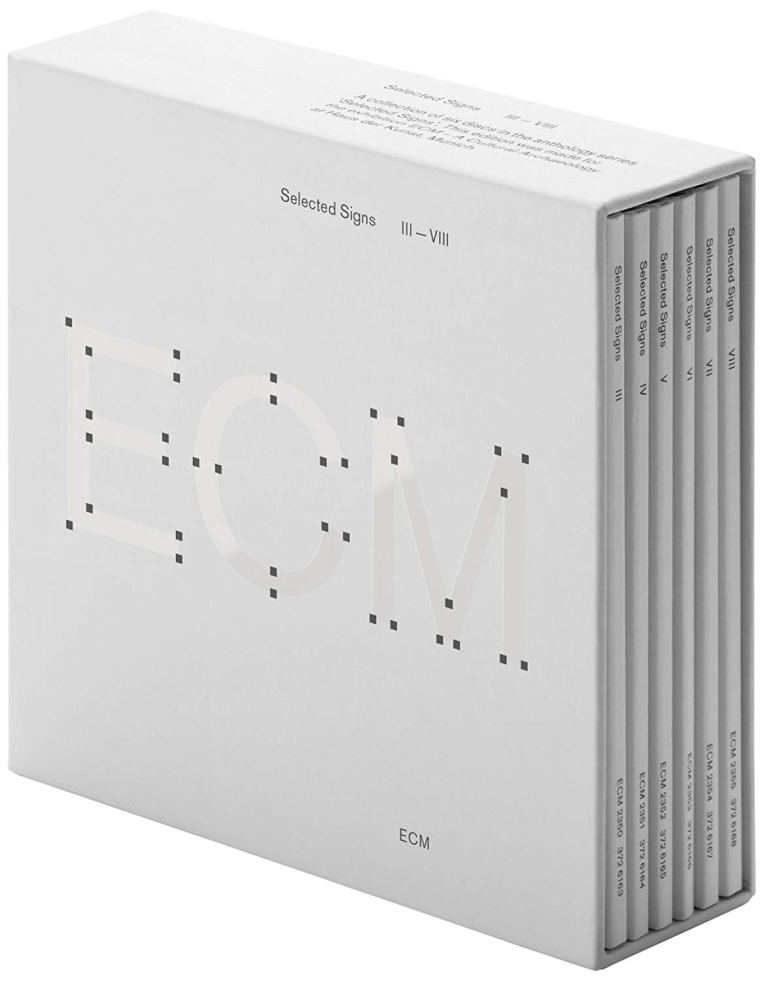
If a story is determined by its beginning and ending, then this Selected Signs boxed set, specially curated for the “ECM: A Cultural Archaeology” exhibition held at Munich’s Haus der Kunst in 2013, is a narrative of frayed edges. Put another way: an open circuit waiting for the listener’s magnetic field. Whereas the first sounds are from Heiner Goebbels’s Der Mann im Fahrstuhl, a multimedia drama born from technological anxieties, the last shape the lips of bard-among-us Robin Williamson, whose unaccompanied song “The World” examines the flesh’s place in endless creation.
Between these two extremes, as distant as they are connected by the six-CD spectrum they delineate, ECM Records founder and producer Manfred Eicher has gathered 85 sonic beacons all lit within his creative purview. Unlike Selected Signs I and II, both plucked from a younger catalog, the present collection feels more like the conspectus those predecessors never could have been. As such, it’s as close as the label has ever come to representing itself under one title.
The first disc maps its genetic profile from ECM’s New Series, exploring a variety of topographies, from the temperate zone of Steve Reich’s Music for 18 Musicians and Joseph Haydn’s The Seven Last Words to the peaks and valleys of Arvo Pärt’s Tabula rasa and C.P.E. Bach’s Fantasie für Klavier fis-Moll, while beyond those contrasts tapping into the connective tissue of Tigran Mansurian’s Testament, Betty Olivero’s Neharót Neharót, and Meredith Monk’s Scared Song. The latter, taken from the 1987 portrait Do You Be, is equally concerned with the storytelling impulse to which all humanity is connected by nature. It’s also a neurological masterpiece that realizes an intersection of freedom and intention such as only ECM could forge.
Disc 2 returns to decidedly German territory with a foray into the Hörstücke of Goebbels. This gnarled talisman of voices, orchestra, and saxophone is a jarring yet somehow logical lead-in to Giya Kancheli’s arresting Vom Winde beweint, the first movement of which floats Kim Kashkashian’s fleshly viola on a bodiless current of strings. This is followed by an excerpt of the Funeral Canticle by John Tavener, a composer who has yet to appear on the label. Despite being an outlier (this performance is taken from a 1999 Harmonia Mundi recording by the Academy of Ancient Music), it feels right at home and transitions seamlessly into the String Quartet No. 15 of Dmitri Shostakovich, as played by the Keller Quartet, which in turn opens a doorway onto the Hilliard Ensemble, whose renderings of Arvo Pärt’s Most Holy Mother of God and the 16th-century Spanish song “Tres morillas m’enamoran” (for which they are joined by saxophonist Jan Garbarek) are sandwiched by the Largo of Shostakovich’s Chamber Symphony op. 110. Echoes of that ashen, somber beauty blossom in slow motion throughout two Postludiums of Valentin Silvestrov.
Disc 3 is dedicated almost entirely to composer Eleni Karaindrou. Her music has been a reliable way station along the New Series path for decades. Twelve of the fourteen selections are grafted from Concert in Athens, while the last two are emblematic excerpts from The Weeping Meadow. The sheer depth of feeling in both the writing and the performances prove Eicher’s vision and its ability to embolden others in kind. The most compelling transition comes next via Garbarek’s Dis, the title track of which treats an Aeolian harp as a moving canvas for wooden flute. Closing out this intimate color shift are two songs from Jon Balke and Amina Alaoui’s multicultural Siwan, including the hedonistic “Ashiyin Raïqin,” in which Alaoui sings: “How lucky we are to find this spot for our sojourn.” No sentiment could be truer here. That project’s Iberian roots are echoed in the Passacaglia andaluz II and kindred smattering from Rolf Lislevand’s Nuove musiche.
Things get decidedly cinematic on Disc 4, wherein the ambient touches of Andrey Degatchev’s soundtrack to The Return trace their utterances across physical and metaphysical waters alike. Even the pastiche of Nils Petter Molvær’s seminal Khmer—every track of which, save the last, is preserved—feels like imagery in sound. “Song of Sang II” is transcendent in this and any context, an anthem for all time keening from a past without walls. A new outro is suggested in the spidery “Close (For Comfort)” from Eivind Aarset’s Dream Logic.
As if all of that didn’t already feel like a full-body dip into the ECM font, Disc 5 adds rays to the widening dawn from a range of jazzier persuasions. The Stefano Battaglia Trio regales us first with its 12-minute “Euphonia Elegy,” providing an oceanic set-up for the electronic groove of Food’s “Celestial Food” and the Tord Gustavsen Quartet’s acoustic “Prelude.” What follows takes us all over the ECM map, tracing a red line from the solo guitar of Egberto Gismonti’s “Memoria e Fado” (as well as his magical collaboration with Garbarek and Charlie Haden, “Carta de Amor”) and the vocal honesty of Norma Winstone’s “Like A Lover” to the freer language of the Christian Wallumrød Ensemble and trumpeters Ralph Alessi and Tomasz Stanko. Along the way we also find sacred geometries in the Byzantine renderings of pianist Vassilis Tsabropoulos and cellist Anja Lechner and the Colin Vallon Trio’s appropriately titled “Telepathy.”
Disc 6 chambers the oldest relics, starting with the Jimmy Giuffre 3’s premiere take on the Carla Bley classic “Jesus Maria.” Other archival gems in this final reckoning include “Time Will Tell” (Paul Bley, Evan Parker, and Barre Phillips), “Lonely Woman” (off the 1979 self-titled debut of Old And New Dreams), “Voice from the Past” (title track to Gary Peacock’s outstanding excursion with Garbarek, Stanko, and Jack DeJohnette), and “Kulture Of Jazz” by Wadada Leo Smith. Giving contrast to these precious diamonds are the worldly ores of “Langt innpå skoga” (Sinikka Langeland) and “Psalm” (Frode Haltli). In their dialogue, new orders are suggested, imagined, and liberated.
Because these selected signs, at the exhibition itself, were heard only through headphones or in walk-in listening stations, a strange balance of privacy and openness hovered in the background of their presentation. But like the field recordings interspersed throughout the sequence suggest, they were but itinerant souls in search of a home. And in this box they have found just that, waiting to become a part of yours.
Anja Lechner violoncello Kadri Voorand voice Tõnu Kõrvits kannel Tallinn Chamber Orchestra Estonian Philharmonic Chamber Choir Tõnu Kaljuste conductor
Recorded February 2013, Methodist Church, Tallinn
Recording engineer: Tanel Klesment
Mixed December 2014 in Tallinn by Maido Maadik, Manfred Eicher, Tõnu Kõrvits, and Tõnu Kaljuste
Produced by Manfred Eicher
Release date: March 18, 2016
Meticulously, motionlessly, secretly, he wrought in time his lofty, invisible labyrinth…. He eliminated certain symbols as over-obvious, such as the repeated striking of the clock, the music. Nothing hurried him. He omitted, he condensed, he amplified.
–Jorge Luis Borges, “The Secret Miracle”
Mirror documents a specially curated performance of music by Estonian composer Tõnu Kõrvits given on February 6, 2013. From a composer of great variety, here we find a microscopic array built around Estonia’s choral heritage. With particular emphasis on the music of Veljo Tormis, whom Paul Griffiths in his liner notes affirms “was evidently a father figure for Kõrvits, and there is something in this recording of a tradition being received by one generation from another,” the program treats human voices as expressions of soil and soul. Griffiths goes on to describe Tormis’s instinct to fortify what makes Estonia’s choral music unlike any other—a politically subversive move in a country wrapped in Soviet chains for much of the elder composer’s life. Such independent spirit peeks through the veneer of history in Peegeldused Tasasest Maast (Reflections from a Plainland). Written in 2013 for cello and choir, it is a fantasy on a song by Veljo Tormis with words by political poet Paul-Eerik Rummo. With a transparency as only the Estonian Philharmonic Chamber Choir can evoke, the voices weave a tapestry of shimmering shadows while the cello of Anja Lechner keeps them tethered like a prayer to earth-hugging flesh. A touch of kannel, an Estonian zither played her by Kõrvits himself, at the end foreshadows the instrument’s foregrounded presence in Tasase Maa Laul (Song of the Plainland). Cushioned in the forested voice of Kadri Voorand, this 2008 composition’s cries for peace and stability, planted in distant plains, reflect upon the suite for strings between them. Dating from 2010, Labürindid (Labyrinths) is as intimate as it is wide-ranging in feel and color, and shares a possible affinity with Erki-Sven Tüür, if in a more delicate vein. Over the course of seven parts, the last of which is like the watering of the preceding six seeds, Kõrvits paints with every bow in compound strokes of emotional transference.
Seitsme Linnu Seitse Und (Seven Dreams of Seven Birds) for cello, choir and strings, sets words by Maarja Kangro and Tõnu Kõrvits. Dating from 2009 and revised in 2012, this textural wonder, rightly described by Griffiths as “at once a choral suite and cello concerto,” finds voices stretched like a sky-blue page for Lechner’s avian cursive. Also in seven parts, it opens with fully formed life. The third part, which features a cello cadenza amid the whistling choir, is a dawn chorus in reverse, while the seventh shows unity through variation. Lechner’s playing, as always, is thoroughly considered, free yet controlled. As a translator, she understands what Kõrvits has not written into the score and draws out that subtext with utmost respect.
The last choral work is the Tormis-inspired Viimane Laev (The Last Ship). From 2008, its scoring for male choir, bass drum and strings, with words by Juhan Smuul, elicits a somber drama. Like Tormis’s finest oceanic excursions, including 1979’s Songs Of The Ancient Sea and 1983’s Singing Aboard Ship, it describes through the process of being described. Our postlude comes in the form of Laul (Song). Originally composed in 2012 for cello and (mostly pizzicato) strings, then revised for this performance, it is a fully contoured channel from light into darkness.
As in the Borges quote above, Kõrvits is one who reduces rather than elaborates. His notecraft is smooth as bone, given tendons and nerves through the listening.
Rolf Lislevand Baroque guitar, theorbo
Recorded April 2012, Auditorio Stelio Molo, Lugano
Engineer: Stefano Amerio
Produced by Manfred Eicher
Release date: May 20, 2016
Featuring music by Robert de Visée (ca. 1655-1732/33) and Francesco Corbetta (ca. 1615-1681), guitarist-composers in the employ of Louis XIV, this under-the-radar gem from ECM’s New Series finds Rolf Lislevand charting the divergent territories of the theorbo and Baroque guitar in a cross-hatched program.
De Visée’s sense of tactility is evident not only in Lislevand’s interpretations, but also in the writing itself. In Les Sylvains de Mr. Couperin and, especially, the piece from which the album derives its name, the theorbo’s emotional reach is fully examined. Their sounds are intimately connected to speech. “The dominant linguistic elements of French,” the performer writes, “are all there: the length of the musical syllables, the accents, created artificially by the ornaments, and above all the short, gestural, interleaved phrases constructed in a very clear rhetorical logic.” In this tongue he speaks semi-conversationally—never debating in the interest of affirmation but rather walking hand-in-hand around a question that chooses not to define its existence by an answer. The Chaconne en sol majeur is a masterstroke in this precise regard, laying down sonic sentences across a bridge of charm.
Corbetta, who served as de Visée’s teacher, flits above his own reflection in relatively whimsical yet philosophically inflected journeys. In the brilliant Partie de Chaconne en ut majeur, one can hear shades of the Iberian Peninsula, flamenco-like drama, and heart palpitations in a single strum. The focus on chording over individual voicings lends a dream-like quality. Indeed, whereas de Visée seems concerned with waking fantasies, here the colors are drawn from a whimsical font such as only closed eyes could contain. In this sense, the Caprice de Chaconne manifests the album’s most corporeal interests. Rooted as much in past as in future, it smiles as if to confirm the present moment as a magic of its own making. Not unlike the briefer Folie, it shines most when pausing for effect.
Here and there, Lislevand adds his own tasteful pieces, such as the “Intros” to Corbetta’sPassacaille en sol mineur and de Visée’s Passacaille en si mineur. They exist to strengthen an underlying sense of architecture, as indicative of a meticulous attention to time and its relationship to space. In service of that assessment, engineer Stefano Amerio went to great pains to recreate the halls of Versailles, where every inner detail of these instruments would likewise have blossomed like the hearts of those hearing them. Let those reverberations till the soil of yours in kind.
Kim Kashkashian viola Irini Karagianni mezzo-soprano Tassis Christoyannopoulos baritone Vangelis Christopoulos oboe Stella Gadedi flute Marie-Cécile Boulard clarinet Sonia Pisk bassoon Vangelis Skouras French horn Sokratis Anthis trumpet Maria Bildea harp Katerina Ktona harpsichord ERT Choir Antonis Kontogeorgiou choirmaster Camerata Orchestra Alexandros Myrat conductor
Concert production: The Athens Concert Hall
Recorded live November 19, 2010 at Megaron (Hall of the Friends of Music), Athens
Recording engineer: Nikos Espialidis
Assistants: Bobby Blazoudakis, Alex Aretaios, and George Mathioudakis
Edited and mixed March 2016 by Manfred Eicher and Nikos Espialidis
Mastering engineer: Peter DePian
Produced by Manfred Eicher
Release date: November 18, 2016
The theatrical text of Davidcomes to us by way of an anonymous poet from Chios Island. After its rediscovery, it was published in 1979 in a critical edition by Thomas Papadopoulos of the Bibliotheca Vallicelliana, and premiered with music by Eleni Karaindrou the following year. Here it is documented in full from a performance in November 2010, given as part of a three-day celebration in honor of Karaindrou and her work.
Despite a Catholic sheen, Davidis sprinkled with comic touches, popular locutions, and lyricism, as many such stage dramas would have been in the 18th century when it was written. The “Overture” opens the door into a characteristically three-dimensional world. Between the pointillist harp (Maria Bildea) and legato viola (Kim Kashkashian), it describes enough space for the orchestra, flute, harpsichord, and oboe to leave their traces across the sky in a message—as yet wordless—that renders the world beneath it a tesseract for moral transfigurations. From this garden emerges the instrumental flowers of “Repentance” and “Compassion,” which together reveal a pasture dotted with the footsteps of our titular protagonist. The first blush of song comes in the form of “Devils.” In this indulgent tune, baritoneTassis Christoyannopolous frolics through an itinerary of exuberant accomplishments, thus shoring up a house of words against the winds of change about to blow. Through deft use of choir, which magnifies his self-inflation, Karaindrou mirrors the feel of an opera buffa, rifling through scenes as if in an emotional flipbook.
“David’s Entrance” softens the landing of mezzo-soprano Irini Karagianni, whose rounded tone offers solace by contrast in “The Good Things in Life,” a somber reflection on the fleeting nature of our existence. Of all the good that passes by, she sings, may hearts latch on the residue and other virtues let go so calm and slow. This is followed by the beauties of “When I See,” in which Karagianni’s voice reveals a deeper, more dramatic palette that eerily recalls the soundtracks of Zbigniew Preisner. Equally concerned with ephemeral things, its tenderness reverberates in “David’s Lament,” wherein Christoyannopolous and choir link a chain of calls and responses, dripping with regret: Hear my dirge, o woods, listen and sorrow. And at my funeral, trees, grieve and wilt.
In “Psaltes,” the climate darkens into a vesper. Sounding like a Gregorian chant, its concern with wonders balances the depressions that precede it: May these fires burn the spirits; may the arrogance of fear now cease. After a trumpeted “Procession,” we find ourselves swaddled in the beauty of “Angel,” wherein divinely personified virtue takes flight in harp and strings: May your sweet trills make mortals awaken and studiously your company take pains to follow. Even more processional, however, is the grand “Finale.” Here the Holy Trinity is invoked as the choir marches to Jerusalem in search of grace and calmer breezes.
Although one needn’t have the translations at their disposal to enjoy its pastiche, David is best appreciated with the CD booklet in hand, so that its finer nuances leap forthright into the very place where its sounds begin and end: the center of the heart.
John Potter voice Anna Maria Friman voice Ariel Abramovich alto, tenor and bass vihuelas Jacob Heringman tenor and bass vihuelas Lee Santana alto and tenor vihuelas Hille Perl viola da gamba
Recorded February 2011 at Propstei St. Gerold, Austria
Engineer: Peter Laenger
Produced by Manfred Eicher
Release date: August 25, 2017
Not knowing a man, the virgin mother bore without pain the savior of the world, the king of angels himself suckled only by the virgin, her breasts filled from heaven
So begins Secret History, an album once buried in the ECM vault, recorded as it was in 2011, and brought to light six years after the fact. In this song, composed by Jean Mouton (1459-1522), we understand through the intertwining voices of John Potter and Anna Maria Friman the blessings of divine and fleshly life, wherein flowers a contradiction so mysterious that unity can be its only gift.
In his liner note, Potter outlines the project’s philosophical genesis: “Music history is traditionally written in terms of composers and the first appearance of their significant works,” he writes. “Performance history doesn’t work like that: it’s the story of what happens to music after it has been written down.” So saying, he has assembled for the fortunate listener a series of tunes that survive in the tablature of lutenists and vihuelists who recast sacred polyphony into barer mosaics.
The two supports of this thrumming loom are Josquin Desprez (c. 1455-1521) and his Spanish successor, Tomás Luis de Victoria (1548-1611). Although not typically linked in the manner they are here, both composers belong to a nexus of musical ideas that, while rooted in the church, took on lives of their own when itinerant string players arranged them as standalone vocal pieces. And while such “corruptions” might be seen far removed from their sources, they are in fact part of a larger, breathing organism that subsists on the spiritual food of interpretation. Potter and friends make this outward progression as clear as the notes have been resilient to the passage of time.
Victoria’s Missa “Surge Propera” is a tender spine, the separated vertebrae of which find cushioning in Josquin’s expansions of anonymous chants, thereby expressing the inchoate ability of melodies to shed their composers in favor of the God in whose honor they were penned. The mass, for its part, is so deeply intertwined with the Spirit that it cannot feel like anything but a benediction, even when its choral setting is condensed into the chamber of a single vihuela, played by Jacob Heringman. Other pieces by Josquin, such as the heartrending “Absalon fili mi” and “Nymphes de Bois,” brush gently against Victoria’s “O magnum mysterium,” which closes its eyes like the doors to a vestry, wherein rest sacraments of infinite musical possibility.
Heringman’s own Preludes, sprinkled throughout, are like the punctuation of a grammar that makes itself known gradually, intimately. The larger context, however, is still being written, and stalwarts like Potter are key voices in the conversation. His passion for innovation reveals an innovation already within; his attention to detail an openness of expression already active. Whether alone or with Friman by his side, matching every call with a response, he shows us that words once holding hands in circles now release their grip from ages past in favor of an unknown future.
Absalom my son, would I had died for you; I can live no longer but descend into hell, weeping.








 Between Sound and Space: ECM Records and Beyond