
My first encounter with the music of Paul Giger was on his ECM debut, Chartres. Guided only by the album’s cover, which at first seemed an ancient petroglyph before I knew it to be the map of the eponymous cathedral’s labyrinth, my teenage brain swam with visions of some worldly phantom trekking with his violin across oceans and continents, drawing out music from the living rock. It was only when ECM released a follow-up solo album, Schattenwelt, that I knew Giger to be flesh and blood, as the booklet revealed a photo of him at last. And yet, cloaked in the shadows of his music, it was easy to nourish my young impressions of what and who he was. How rare it is, then, that we get to see the hearts behind the skins of those we think we know through their art. Paul’s son Ramòn enables just such a glimpse in his 2013 documentary, Karma Shadub.
On surface, the film walks us through a mounting of its title piece (which first appeared on Alpstein) at Switzerland’s Abbey of Saint Gall. But this veneer bends the light to reveal a motive of emotional healing and conversation, becoming as it does a catalyst for sometimes-painful excavations of childhood, abandonment, and creation. This is not a film about music, but about where music comes from and how its progenitors live and act on either side of their art.
Karma Shadub was written for Ramòn around the time he was born as a celebration of life. In the context of that same child’s documentary statement all these years later, it serves as a looking glass into an uncertain past. The performance itself involves dancers, who under the choreographic direction of Marco Santi realize the corporeality of Paul’s music. The dancers also sing, mirroring the dialogic searching of the son, whose wondering and wandering of what might have been bleeds into the yet to be. Ramòn himself experiences a range of emotions when hearing the piece now: a binary star of pain and passion.
“When he asked me to make a film about this performance and the piece he had written for me,” says the filmmaker early on, “that was the moment I realized that I no longer know who he is.”
Ramòn, who calls Paul by his first name, seeks a relationship with this distant man—one who, much like the artist I’d imagined, takes pride in solitude. Ever his father’s son, Ramòn has taken on an artistic worldview. Yet where his father paints in sound, as director Ramòn does so in light. Before this he made made two documentaries as cameraman, the first being the portrait of a young autistic man and his relationship with the social worker who has become something of a father figure. A sign of things to come.
As both creator and a subject of the present film, Ramòn must confront a unique sort of exhaustion. Accustomed to teasing out the inner lives of his subjects, he was less prepared than he realized to do the same for himself. “I felt somewhat cruel, always demanding and taking from other lives, using them as the foundation of my work,” he humbly admits to me in an interview. “It’s different from music, where you have to dig inside yourself to create something.”
And dig Paul certainly did throughout Ramòn’s formative years, during which the father was often away for private excavations, though not without sending tapes from his travels. One of these, recorded at Chartres and including violin and ambient sounds of the garden, depicts a father reaching for proximity in defiance of physical separation. A beautiful sentiment, to be sure, but one that sits complexly with its recipient. As a leitmotif of the film, the tape is at once an expression of paternal love and obfuscation of its lucidity. The process seems emblematic of Paul: speaking volumes by not being there, and leaving just as much open to interpretation when present. It’s a dynamic mirrored in Ramòn’s attempts to elicit information from his father about the unknowns of his upbringing, which tend to reveal themselves more through silence than obvious articulation.


Where Ramòn wants this to be an honest and personal project, Paul fears being used for something that he cannot stand up to. In their constant state of negotiation, the two manage to tap out a fairly reflective surface from unrefined metal as they forge an alloy of their own. Just as the violin is at once a part of Paul and its own entity, so too does Ramòn resound through their interactions. The son feels he is not being understood by his father—left out, so to speak, of the latter’s creative equation—even as he becomes more aware than ever about his own character by way of not being acknowledged. None of which is to suggest that the film is a challenge or accusation. It raises uncertainties out of genuine hope for their resolution.
Because his conversations with Paul are touch and go, Ramòn turns to his biological mother for solace (Paul is remarried). Despite the separation, she recalls those early years with a certain fondness, and the smile that holds her face indicates the steadfastness of a mature heart that has no time to dwell on ifs. But her son, like the viewer, is still grappling with images versus realities.
Of both, the camera offers plenty by directing strict aesthetic attention to surroundings. Indeed, the film is not only about people, but also about places. Ramòn recalls a rural, almost utopian, upbringing, as confirmed by a visit to his childhood home. Such snippets of nature add to the feeling that both father and son have walked their own paths and are now seeking intersections.
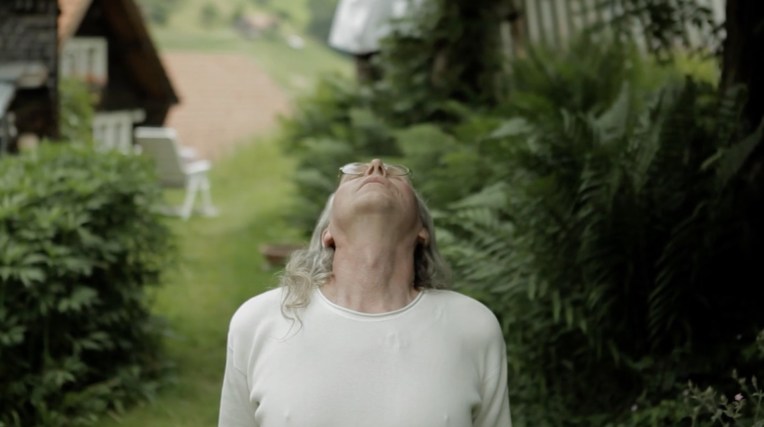
Camerawork and editing are significant enough to warrant symbolic interpretation. We get many shots, for instance, of Paul’s back, as if Ramòn were always trying to catch up to the man he follows. This yields another parallel, when Paul says, characterizing his struggles with the violin, “Where you try to undertake something real, that’s where life is happening.”
In this film, life is happening everywhere. In the music, both on and off the screen. In the solace of cathedral’s, both literal and metaphorical. And in the gift of seeing a world-class artist as a human being, knowing he is subject to the same complications as the rest of us.
Karma Shadub is available to watch on Vimeo demand here. Read on below for the rest of my interview with the director.

Tyran Grillo: One of the greatest values of watching Karma Shadub was how it made me think of myself as a parent. It was a reminder to treat my son’s childhood with even greater importance.
Ramòn Giger: People have experienced this film in very personal ways. Despite being just a very small story between me and my father, the feedback I’ve gotten has been massively varied. Some perceive it as you do, while others feel offended by it, but it always connects to the personal experiences of viewers in one way or another.
TG: The first scene, featuring you and a reticent Paul at the kitchen table, sticks out in my mind. The tension is real and relatable.
RG: He was very scared at first. Just as you had an experience of Paul’s music before you had a picture, his profession and what he does feed off a strong, mystical image. I now understand what he was afraid of. Having dedicated his entire life to achieving a perfect sound on this little instrument, he felt threatened by the mistakes I might expose.

TG: What was it like watching the film together?
RG: We watched a rough cut at some point. He also attended a few premieres with me. It was quite an emotional re-confrontation, which wasn’t easy for us.
TG: Have things changed in any significant way since the film?
RG: The changes weren’t as I expected them to be. I had more expectations of revealing secrets or having this total opening of my father toward me. After 50 hours of just talking about things in front of a camera, I realized in the end that I was the one creating distance in the relationship. I needed to act but not expect him to do something about it.
TG: You still have those cassette tapes he made for you. Do you remember how you felt at the time when you received them?
RG: I know that I loved them, and that I listened to them a lot. I can’t really tell how I felt back then; only as I perceive them today. I feel a lot of effort from his side, a need of being close to me and trying to give me a piece of himself while being away, but also a strangeness in how he talks to me. I also have the feeling that he doesn’t really take me seriously. So I guess, just as with the music, it’s different things at the same time. Being a father myself now, I’m more relaxed about it, because I know it’s okay to make mistakes and not be perfect about everything. My experience with Paul was not that he was away, but that he couldn’t admit that not everything was perfect, which used to confuse me as a child. I’ve grown up believing it’s important to make mistakes as a parent.
TG: Do you feel more empathy for Paul, now that you are a father yourself?
RG: It was my decision to leave this point open in the film, but in life we certainly got to a point where we feel much closer to each other than before.

Ramòn concludes our interview by telling me that Paul is someone who “lives fully in this world,” but we can also see the world living fully in him—which is to say, as an internal storm of contradictions. And maybe that’s all human beings, even at their best, can be.
Karma Shadub is available to either rent or download on Vimeo here.








 Between Sound and Space: ECM Records and Beyond