Between Two Sounds: Arvo Pärt’s Journey to His Musical Language (Book Review)

If I were to dump out a puzzle from its box and ask you to put it together, you’d likely start with the edge pieces, as we’ve all been taught to do. Recently, however, while watching my seven-year-old assemble one of his own, I realized this isn’t necessarily the best strategy. The puzzle he was working on was circular, and the circumference was uniformly white, surrounding a clear design in the center. From his perspective, it only made sense to start with what was fully articulated and work outward from there.

Arvo Pärt had the same effect on me.

Before encountering his Te Deum decades ago, I used to approach listening from the periphery, tracing the container from without before diving into the matter within. That blending of voices and strings, anchored by piano and wind harp, did not make its skin immediately obvious. Rather, it offered its heart front and center before veins, bones, and garments emerged through years of regard.

And now, Joonas Sildre’s Between Two Sounds: Arvo Pärt’s Journey to His Musical Languagedoes the same for the Estonian composer who didn’t so much redefine modernism as turn it inside out to remind us of where it originates.

I recently spoke with Sildre, who had the following to say when I asked him about the genesis of this project:

“During the early 2000s, I became a huge fan and admirer of Pärt’s music through a friend who had gifted me a CD ‘mixtape’ of his music. At the time, I was also on a spiritual journey in the early phases of Christianity. This certainly heightened my admiration of this music, which became the soundtrack of that journey. I was never very interested in Pärt as a person because I had learned that if you like someone’s music, their personality (or the availability of that information) does not add much to it. In 2005, it became apparent that this was the opposite in the case of Pärt: There was a 15-part radio show on Estonian Classical radio about his life (made by Immo Mihkelson). Listening to it and him talking about life, art, and spirituality, I recognized these topics to be dear to my heart, but rarely did I hear anyone expressing these things in union. At the time, in the early 2000s, I was looking for a story to tell in graphic novel format—when hearing Pärt’s radio interview, things clicked for me. There was no question of a different format.”

Immersed in the result of that journey, I am reminded of my own spiritual awakening, for which Pärt’s music was always a leitmotif, a call (at times clarion, at others whispered) that inspired sympathetic resonance into my very core. It’s only natural, then, that Sildre’s book should proceed in a musical manner.

As a visual composition, Between Two Sounds proceeds like something Pärt himself might have constructed (and how can I not smile at the similarity with my blog’s title?). We meet the composer in the dark, walking a line from eternity to eternity, his musings floating almost unrealistically in space. It takes effort to admit that the words have meaning and are not tricks of draft and debris across the unswept floor of time.

Golgotha, a place of the skull, the hill where death for one offered life to all, reminds us of the dark well from which God draws light. Directing the gaze and ears thusward seeds a relationship between flesh and spirit that can only be articulated through art.

Beyond these introspections, which stipple the larger narrative with resounding grace, we leap through Pärt’s chronological development. From his birth in Paide and early childhood in Rakvere to his confrontations with Soviet censorship and flourishing under the tutelage of Heino Eller at the Tallinn Conservatory, we are gifted a dynamic biography that seems to leap from the page, if not sometimes also sink into it. While that story is astonishing in and of itself (a particularly tense scene finds Pärt nearly losing his scores and tapes on the verge of his emigration to Europe), key moments speak across the years and geographical borders to my heart.

In doing his research for the biographical angle of the book, I wonder how it changed Sildre’s perception of the man himself as they came to know each other from acquaintances to friends:

“Pärt talks of another level where the music comes from. I’d like to think that connections and friendships also happen on that level, and there, we were friends even before I met him personally. During the years the work took, of course, I learned much more about him as a person, his life, music, and spirituality. I saw Pärt as a regular human, yet he always remained ‘not regular’ to me. He could be very simple and very deep at the same time (or at different times)—I guess this is almost a scientific definition of a genius. What surprised me is that Pärt, whom I had seen and learned from his music and his words, was actually himself, not some projection as it usually happens to be among public personas. Like he says (paraphrasing): In order to put Tintinnabuli music to paper, he actually had to change as a human being.”

That change develops through listening in Pärt’s early years. As a boy who learned on a broken piano, he comes to seek an upright language in a fallen world:

The line between “public” and “private” disappears in these moments of abandon, much to the humor of those around him. And yet, he reveres the notes on their terms, allowing their credo to suffice for what passes as communication in his immediate environment. The more he hears, the more he and everything around him pass into silhouette, not so much under the loudspeaker as a part of it.

The graphic novel is filled with novel graphics. Most remarkable among them is Sildre’s explicit visualization of notes.

Despite the apparent aggressiveness of their passage through the air, theirs is not so much a spirit of confrontation as of enlightenment. With the premiere of each new work, those fortunate enough to have been present are shaken to the core by a thrum to which they had, until then, turned a muffled ear:

“I did not want to use notes as they are a specific language for musicians; regular people cannot read and understand them. If I used them, even in a decorative way, the average readers would always feel that maybe they were missing something. So, I needed to step away from that language, but not too far. I ended up with the ‘dot and line’ method that I developed throughout the book. The look of these symbols would hint at the emotion and content of any given musical piece. With dots, I could use many design language tricks: size, placement, quantity, light and dark value, and context. Lines would symbolize the time but also the emotion: jagged lines versus smooth lines. A circle had an extra feature. It could also be used as a speech bubble or thought. So, overall, this small invention became very handy for telling that story. It became an intuitively understandable visual language.”

Sildre creates a tapestry with blank patches that can only be filled through hearing. Perhaps the longest thread running through this tapestry is one of religion, as Pärt’s conversion to the Greek Orthodox faith unfolds in a chain of snow and spring. His composition Sarah Was Ninety Years Old is a recurring stitch, beginning with his first exposure to his grandmother’s Bible and continuing throughout his life. The drums are the rhythm of salvation, the rapping of Christ’s knuckles on the heart’s splintered door.

And so, we are invited to close our eyes, open our ears, and release ourselves from the bondage of our sins. Although everything we think and do is imperfect, Pärt seems to say, we should never stop reaching for perfection. Because there is One who is perfect, and every song we sing must fill the footprints He left behind.


Sildre echoes this sentiment:

“Upon meeting Pärt, I had a feeling that he had so much old cultural heritage in him; he felt almost like he was from the ancient world. I had never met a person who would have so many ties to the old. At the same time, as time passed, I was pondering that the mentality and love Pärt expresses must be the future of humankind. So, he is from the past and future at the same time! It may sound strange, but this is still my strong feeling about him as a person.”

All of which connects to his aspiration for the book:

“I hope that the people who have not heard Pärt’s music will find it. And I hope that people who know his music will learn that there is a miraculous story behind the miraculous music.”

If there is any miracle to be found here, it is in knowing that human beings are capable of glimpsing the divine, however temporarily, all the while knowing that eternity is the only altar on which our humility can be laid with blessed assurance.

New Book

Dear readers:

I appreciate your patience as I navigate some life changes (some negative, ultimately positive), which have taken much of my time away from listening and reviewing. I do hope to return to the ECM fold soon enough, as the universe allows.

Those who’ve been following me for a while may know I’ve been known to moonlight as an academic, and my latest book is a testament to all the hard work that went into earning my Ph.D. Here is the cover, and a description, for those interested:

In Fuzzy Traumas, Tyran Grillo critically examines the portrayal of companion animals in Japanese literature in the wake of the 1990s “pet boom.” Blurring the binary between human and nonhuman, Grillo draws on Japanese science fiction, horror, guide-dog stories, and a notorious essay on euthanasia, treating each work as a case study of human-animal relationships gone somehow awry. He makes an unprecedented case for Japan’s pet boom and how the country’s sudden interest in companion animals points to watershed examples of “productive errors” that provide necessary catalysts for change.

Examining symbiotic concepts of “humanity” and “animality,” Grillo challenges negative views of anthropomorphism as something unethical, redefining it as a necessary rupture in, not a bandage on, the thick skin of the human ego. Fuzzy Traumas concludes by introducing the paradigm shift of “postanimalism” as a detour from the current traffic jam of animal-centered philosophies, arguing that humanity cannot move past anthropocentricism until we reflect honestly on what it means for the human condition.

The book is available here.

Juan Hitters: Bar Italia (Book Review)

In his 1969 novella, Il castello dei destini incrociati (The Castle of Crossed Destinies), Italo Calvino presents a series of vignettes introduced by a nameless narrator who finds himself, after trials and tribulations, at the titular castle, which upon entering he realizes is a meeting place for wayward souls. Inside, a congregation sits around a table. Bound by a mysterious silence and with only a tarot deck at their disposal, these disembodied travelers proceed to lay down series of cards by means of which the protagonist interprets the life story of each. When at last comes time for Calvino’s alter-ego to tell his own story, he does so in a testimony concerned with space and time. He waxes expertly about mid-Renaissance hagiography, particularly St. Augustine in His Study. Painted in 1502 by Vittore Carpaccio, it depicts Augustine’s vision of St. Jerome:

“Also in the study where there reigns meditative serenity, concentration, ease,” our guide continues, “a high-tension current passes: the scattered books left open turn their pages on their own, the hanging sphere sways, the light falls obliquely through the window, the dog raises his nose. Within the interior space there hovers the announcement of an earthquake: the harmonious intellectual geometry grazes the borderline of paranoid obsession. Or is it the explosions outside that shake the windows? As only the city gives a meaning to the bleak landscape of the hermit, so the study, with its silence and its order, is simply the place where the oscillations of the seismographs are recorded.”

Calvino sets up a symbiotic relationship between what is visible and invisible in the painting through the final sentence quoted above. To make sense of it, one must be in two places at once. Both city and study are inhabitable manifestations of knowledge. The study is a storehouse of thought, a worldly archive in which the prominent thinker is but one of many animate tools. Whether the earthquake is imagined or actual, it is a failure of structural integrity, collapsing time into a measurable event.

Vittore Carpaccio, St. Augustine in His Study (1502)

The painting’s special affordance points to what Giorgio Agamben, lifting from Martin Heidegger, calls being “open to a closedness”—which is to say, knowing one’s finitude. Agamben frames this attainment of self-awareness not as something to which our species accedes but from which we distance ourselves. Where does that leave the artist? As Calvino avers, “the job of writing makes individual lives uniform”—another piece of bark to chew on.

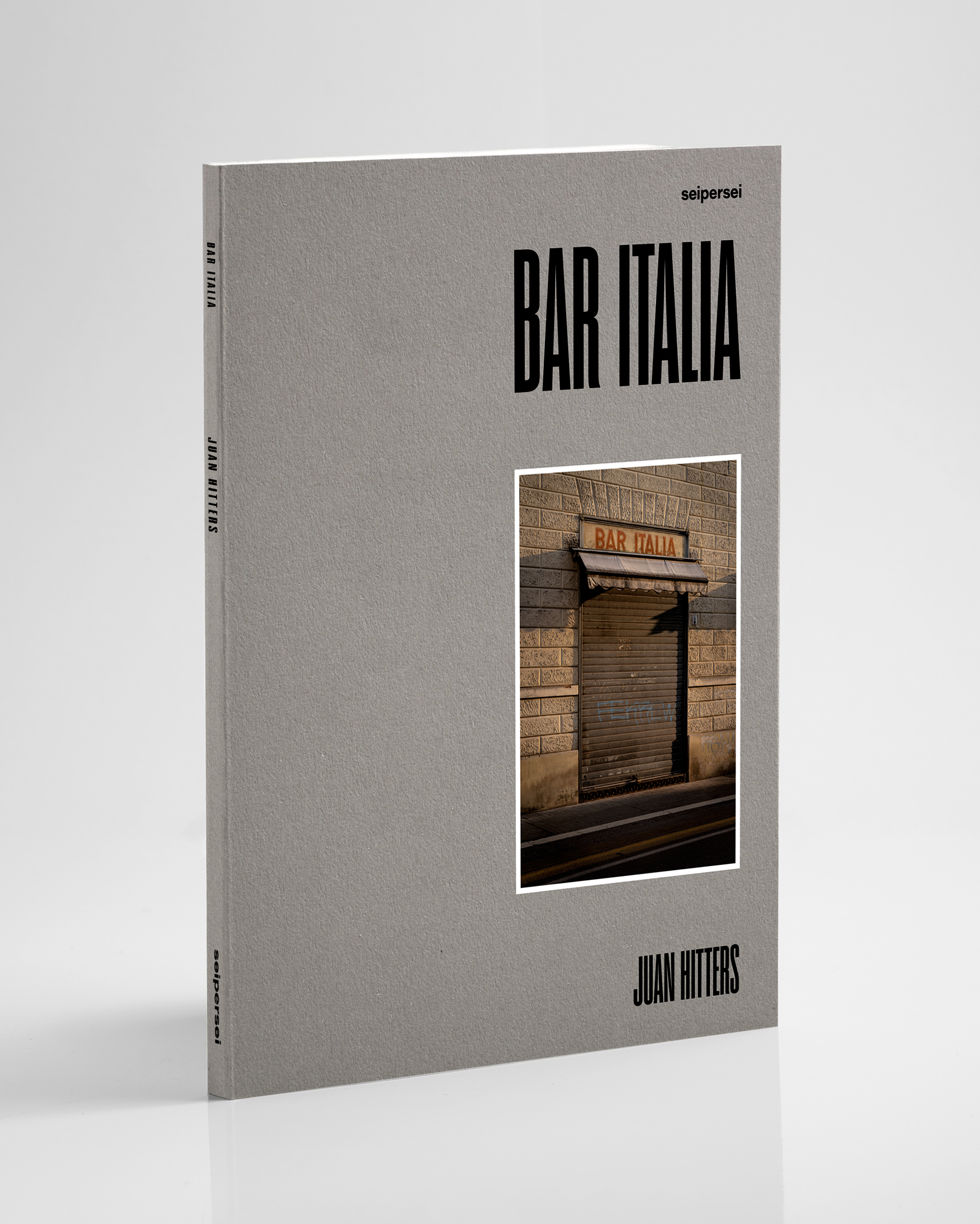
I stay with Calvino a bit longer, if only because in the same chunk of text he establishes the intellectual wager echoed throughout Bar Italia, the first monograph from Argentine-born photographer Juan Hitters. Calvino’s interest in the earthquake, an upsetting of the scene’s “harmonious intellectual geometry,” informs my approach as a viewer. When he wonders, for instance, “Or is it the explosions outside that shake the windows?” Calvino is questioning the very apparatuses of interpretation by bringing out the pulse of a nominally static scene. And just as his narrator can only infer the full story from selected images, we are left with a photographic trail of breadcrumbs that quietly acknowledges its own closedness. Any subsequent embellishment is our own.

Is the camera that much different from the animal sitting stage right in Carpaccio’s painting, taking it all in emotionlessly yet with such grace as to render any reaction other than faith incomplete? Resting on an ever-present tripod to capture as much resolution as possible, and like the mind activating the shutter behind it in moments of captivation, Hitters’ instrument exists not to praise the wonders of the self but to show us the world by way of it. As for what that world contains, one need only flip to any page as one might spin a globe to land their finger on a land mass of interest. In the case of Bar Italia, that land mass is Emilia-Romagna, specifically the lesser-explored areas around its capital city of Bologna, which he has called home for the past four years. 

“What I’m trying to convey are experiences,” he tells me over Zoom. “Finding myself as I do in a new place, I have to inhabit it. Inhabiting is a very active process of understanding the logic behind a place, making yourself known to a small group of people so that you can smile at them every morning and vice versa. Adaptation is crucial. It is how you accept your surroundings and affect them. This book shows an active way of inhabiting this new land, where I felt completely at home from the very beginning.”

Taking the train almost daily to explore nearby towns, Hitters expanded his cartographic reach, the lens always in tow. Along the way, home became about more than finding himself enamored with quotidian comforts. It was something ineffable in the air, a spirit that welcomed rather than rejected this new pair of lungs sharing its breathing space. Having tapped the heart within, he wanted to know more about the veins and arteries feeding it from without. Settling in also gave him a sense of safety:

“Italy reminded me so much of my childhood. I felt myself going back in time, visiting the old Argentina. Living in a huge city like Buenos Aires, one learns to be alert. But in Bologna, a much smaller city, it’s easy to walk around, which helps me enjoy this process.”

It may be no coincidence that one can always feel Hitters standing somehow in every scene he photographs, not only because his fingertip activates the shutter but also because his mere presence gives the light undeniable quality. On that note, he was struck by the region’s many porticoes, where the sun produced a “magical chiaroscuro” amid variations of reds and yellows. Even then, the immediately discernible magic of this interplay was only the beginning of his testimony, every bit as hidden as Carpaccio’s:

“Photography is all about light. I use reality as an excuse to photograph light. Light doesn’t exist in itself; it has to be enveloping a three-dimensional piece of matter to be noticed.”

This insight echoes the introductory essay by Alessandro Curti, who speaks of the “intricate anthropological interconnection” found in this work that “allows us to get in touch with his soul and experience an unusual Italy.” The operative word here is “unusual.” In fact, the Old French root word usuel means “current.” Thus, unusual denotes “not current”—which is to say, out of time.

And while we may muse poetically about the origins of light, it touches things with an undeniable materiality. In the context of Bar Italia, said materiality splashes itself across dilapidating walls, obscured windows, cobblestone alleyways, and the soft song of afternoon transitions. Did I say song? Indeed, because the book is as much about sound as light. This is to be expected, given that Hitters has contributed to album covers for ECM Records and Deutsche Grammophon, among other legendary music labels: “The way light works on these surfaces is poetry, just as sheer sound is poetry for John Cage. If sound is light, then shadow is silence. Bar Italia is my first album, in the musical sense.”

Like any great piece of music, there are shifts in mood and focus. And just as the same musical score will sound different at the hands of every individual musician, so do these places echo with the gaze put upon them. Their symphony of cloth, textures, doorways, walls, and covered vehicles is the product of meticulously curated sequencing, arrangement, printing, paper selection, and file optimization. Even its color scheme—which opens with warm overtures, followed by a slow movement of cooler spectrums, and ends in near-black and white—suggests a concerto. Calvino’s earthquake has now become a quickening heartbeat born of discovery.

One cannot help but notice, too, the orientation of it all:

“I have discovered that vertical is an extremely arbitrary format that helps me make very tight compositions. We are getting rid of this big problem of the horizon. I always compose during the photo shoot, without cropping. I think this way of seeing is what impressed the editor Stefano Vigni from Seipersei Edizioni, who liked the severe presentation of elements.” 

In her foreword for the book, Luz Hitters talks about her father’s work in likeminded terms: “Harsh frames, somehow unforgiving, yet holding within them a compassionate gaze that unveils an improbable beauty.” This embrace of starkness lends the work a sense of integrity into which we are never intruders but rather co-observers. Just as Hitters lends himself to every scene, so are we invited to do the same…

In accepting that invitation, three moments stand out for their stoicism.

First is this image of an unoccupied seat:

Something about the sheer vacancy of its framing fills me with a sense of longing, motivated by no other desire than to be there if only to exist somewhere far removed. The composition speaks of a fascination with monochromatic color palettes, demonstrating how forthright Hitters is in showing things as they are: “It has to do with degradation, the discourse of what nature does to things over time. The more abstract it is, the more real it is. I am happy to tell small stories.” While these stories may be small, their impacts may live grandly in our minds.

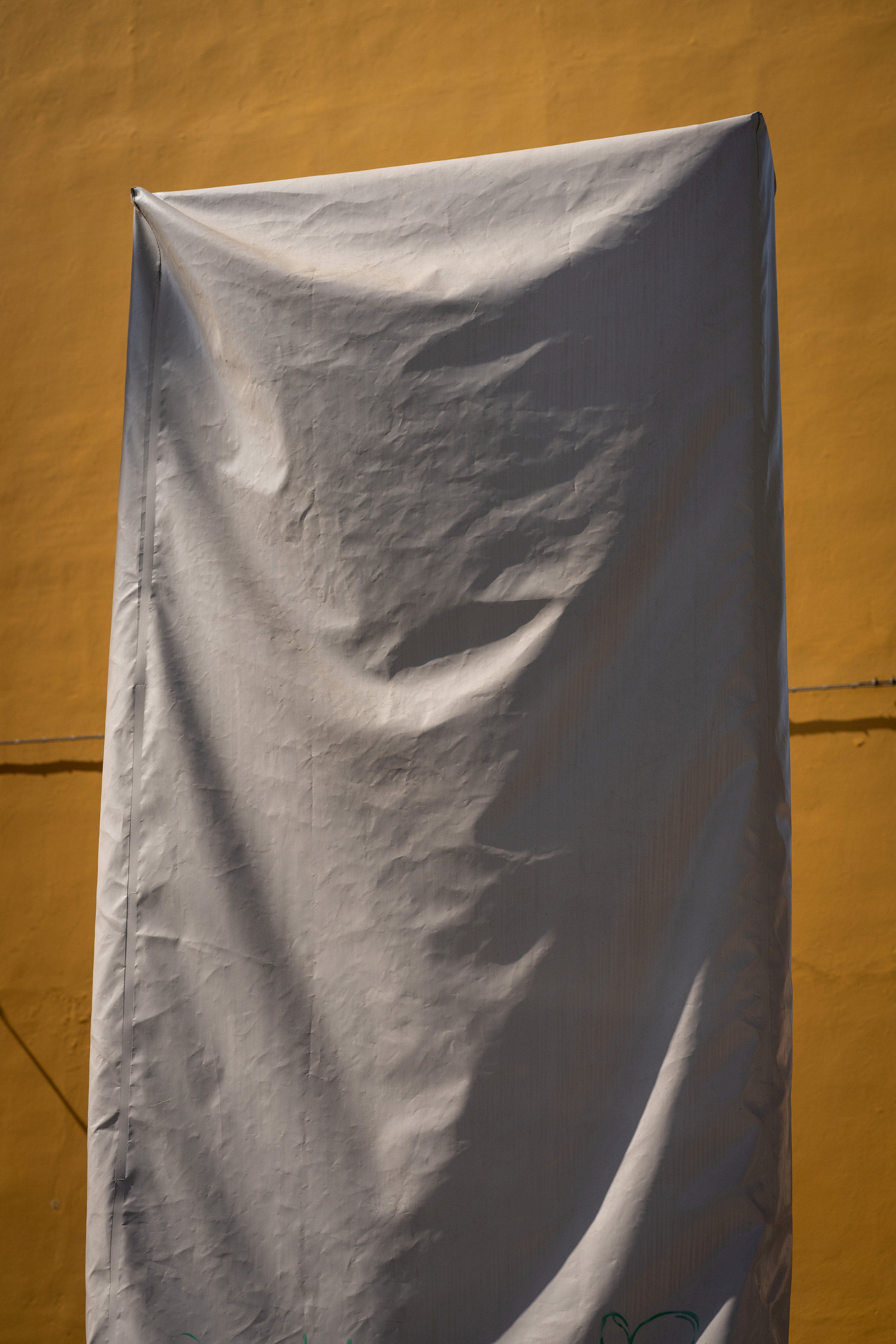
Second is the recurring theme of drapes, of which the following instance is a quintessential one for me:

For while we cannot see what is behind the curtain, we see everything we need to see. It is explicit in its obscurity, a portal only the imagination can open. I ask Hitters what attracts him to this motif. His response:

“I like the suggestive nature of never telling something directly. I am always looking for mystery. These drapes provide that idea. It’s the same with the doors that take you to strange settings you don’t know. I have no ethical problems with those who manufacture a certain reality (Gregory Crewdson, David LaChapelle, Marcos López), but being a photographer, it’s difficult for me not to see all the setup. I prefer to make the photos as direct as possible. Oscar Pintor, Humberto Rivas, William Eggleston, Luigi Ghirri, and Stephen Shore are more my cup of tea.”

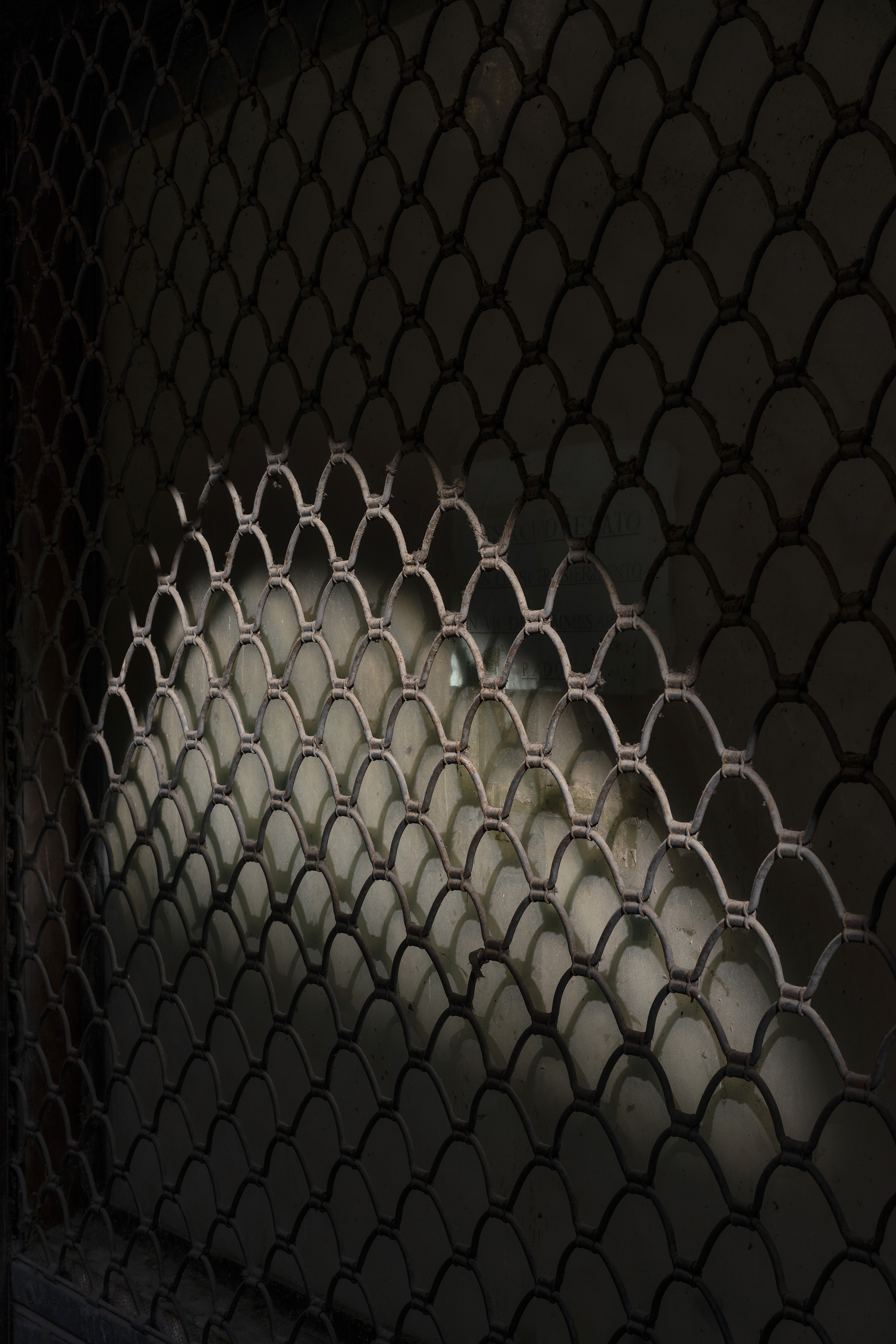
Third is the book’s final photo, which lends a hopeful air:

Here, the shadows aren’t so much silent as accompaniment to the light’s slow cadenza, working its way along every curve of metal fashioned in the image of security. So is it that he has come to see his own life.

And what of the book’s title?

“Every city in Italy has a Bar Italia. It’s something of a national cliché. The name has a strong relationship with pleasure and ordinary things that I find attractive. These are simple things—not beautiful, per se—but the way the sun hits them is special. Stefano and I didn’t want to make it romantic because many photographers have fallen into the Italy of the 50s and 60s, whereas we wanted to distance ourselves from that banality—which isn’t easy since Italy is so beautiful.”

Even so, Hitters has shown us there is beauty in the banal. Or maybe it’s because he has lost none of his passion for photography over a decades-long career. “I always pick up my camera with a smile,” he admits, also with a smile. In these photos, however, that smile often feels bittersweet, mourning a world ignoring the beauty of decay in favor of a streamlined here and now. In gifting us these slices of color, he opens a path forward because, ultimately, light is about time. It clutches our paltry chronologies like a handkerchief, wiping away tears over transient things, forever moving until it finds another place to land that we might never see with the naked eye.

Bar Italia is available in a beautifully printed edition from Seipersei Edizioni here. You may also purchase copies directly from Hitters by contacting him via his website or Instagram. The level of detail in this production, from the 150-gram GardaPat KLASSICA pages to the Fedrigoni Materica Clay cardstock binding that surrounds them, makes it worthy of the most discerning art enthusiasts. Stefano Vigni and the Seipersei team have handcrafted a unique work of art unto itself that belongs in your collection.

Juan Hitters signing copies of Bar Italia at the Fotografia Europea Festival, Reggio Emilia, April 28, 2024.
(Photo credit: Luz Hitters)

K. T. Nguyen: You Know What You Did (Book Review)

Little-t “trauma” operates by a different MO from big-T “Trauma.” Throughout You Know What You Did, the debut thriller from K. T. Nguyen, we are pulled between the two in a narrative balancing act of such agility as to leave us en pointe at their intersection on every page.

Artist, mother, and wife Annie Shaw is more than this trifecta lets on. Living in suburban Virginia with her husband Duncan and their daughter Tabitha, she has buttered the bread of her life on both sides. And yet, molding between them is a sandwich of reruns involving incidents she would much rather forget. Dead bodies, bloodied hands, and other morbid highlights make us wonder just how much Annie may be capable of when her thoughts are allowed to roam. But roam is all they can do under the medication she takes to corral her OCD, which operates by its own rules of contamination that must be taken seriously whenever they jump the fence.

Haunted by thoughts of her mother, whose death is a leak in her otherwise airtight self-presentation, Annie sinks her canines into the absence as if something to devour in one bite. She worries what the authorities might think were they to scrutinize her magazine-worthy home (at one point described as a “Pinterest board come to life”), let alone the immaterial desires living under its roof. Above all, she fears herself.

We learn that Annie’s parents came from war-torn Vietnam to start afresh in the States. Yet the story of this turnaround is a myth to which she has grown apathetic. She lets the minds of those she encounters fill in its gaps with American grit and self-determination as an excuse to ignore their complicity in a genocide padded by hindsight. Wrapped in layers of denial, her heritage avoids the tip of the proverbial tongue like a cherry tomato dodges the prongs of the salad eater’s fork.

Lest we tokenize her emotional inheritance like the rest, Nguyen reminds us of just how broken everyone in Annie’s circle is. Duncan carries his own PTSD from as a Pulitzer-winning military field reporter. His refusal to talk about his work speaks of a silence inaccessible to Annie, who is constantly being forced to reveal her innermost thoughts, ever the one to “smooth things over.” The novel’s happiest people are those who have trained themselves in the art of looking the other way.

And so, when her long-time art patron goes missing, Annie starts to unravel, slipping down drains of thought that may or may not be her own. Throughout this storm of possibilities, refrains rear themselves. Whether in the rising temperatures of her showers (which seem to be her only solace) or in the admonitions of a mind in turmoil, she gives in to speculation at the risk of harm. Perhaps it’s no coincidence that said patron always says Annie’s name twice (“Anh Le, Anh Le”) or that her long-haired dachshund should be named Deja, implying that even the most indeterminate circumstances might be born of rehearsal.

In childhood flashbacks, we witness an upbringing tessellated with white squares of affirmation and black squares of a mother whose decline begets abuse. When everything in Annie begins to hurt, we realize she has always been in pain, but the extent of it is only clarifying itself now. After decades of Mother opening wounds and Daughter suturing them, the latter is left wondering who will supply the thread when it runs out.

Meanwhile, the rough patches are spreading. Annie takes compliments wherever she can get them. Upon meeting a handsome stranger, she relishes seeing herself in his eyes, as perfect as anyone can be in that blush of unfamiliarity before the truth sets in. But flowing through those endorphins is a curse, a toggle by which the internal bad and external good may switch places at any moment. Annie may be a “master of creating worlds,” but she can barely hold the seams of her own. 

With adroit control over tension, Nguyen keeps us in check, even when we only have one foot in the circle of certainty. As the kinetic ending snaps everything into focus, we begin to question our allegiances to mental (in)stability, collective trauma, and self-made idealism. 

While no one is innocent, that’s perhaps as it should be. We are all vagabonds from something: our pasts, our ancestors, our very selves. If anything, the moral gray areas in which these characters live confirm the messiness of the mundane. Thus, the biggest crimes are those committed in the everyday. Whether it’s Annie’s admission to hiding behind her husband’s privilege or a friend’s nonchalant acquiescence to infidelity, in each of these indiscretions floats a keyhole waiting to unleash the floodgates of sin—a painful yet necessary reminder that no war ever ends because the soul is a battlefield on which blood never dries.

You Know What You Did is available from Dutton in April 2024.

Kimberly Nguyen: Here I am Burn Me (Book Review)

to name something is
to know it

So writes Kimberly Nguyen in the opening poem of her visceral collection, Here I Am Burn Me. And yet, what becomes increasingly clear, page after blood-rimmed page, is that to name something can also be to unknow it—further to destroy it, colonize it, and erase its origins in favor of a master narrative. Nguyen bends that master narrative until it whitens, cracks, and snaps. Rather than rebuild something from those screaming fragments, she turns her back on their hollow breath to inhale a light fashioned in hands washed clean of their conspiracy. She rids herself not only of grime but also of the expectations placed upon her shoulders, already bruised from decades of trauma compressed into the occasional period. This is what she hears.

what’s the difference between war and its aftermath

A question without a question mark becomes a statement of truth. Such linguistic “errors” are highlighted throughout as markers of identity (or lack thereof), even as the tides of history crash against the shores of a geography one can never understand from a distance. Nguyen resists the water and flavors her soul with the salt that makes it fatal to drink yet life-giving to all else. Her voice echoes in bones and eyelids, earlobes and fingernails, ink and cane pulp. In the same breath, that yearning for water becomes explicitly self-defeating—a womb-like existence tempered by the enforcement of maritime mythologies. No matter how landbound we are, the threat of drowning is omnipresent. Thus, the act of writing is never unsubmerged but always subject to the same curling of contaminants. This is what she sees.

violence is not a language
we were born with

Our faith is demonstrated only by the object to which we stitch the threads of our fallible professions. We might have the fullest confidence in thin ice, yet we will fall through it to our deaths; we might have no assurance in thick ice yet make it to the other side without incident. Violence flips this dynamic. Men in suits and other forms of camouflage have confidence in the weapons they worship, some of which far exceed their expectations for destruction. Meanwhile, those coerced into deploying them tremble so that their bodies force an error when training grounds resolve into battlefields. Fire and flame are equal partners in this elemental give and take, each a reflection of the other from night to day and back again. Likewise, every tongue has a sharp side and a dull side, and in her vacillation between the two, Nguyen plants her feet firmly in the squish of their overlap. Shooting down every word traversing that slick surface before it can escape is laborious. This is what she tastes.

i’ll be the one-line poem you take a black marker to,
black out all the parts of me you don’t want to see

In the same way that some of these poems are footnotes, sprinkling their dead skin into places where primary content should never be relegated, Nguyen also sinks her teeth into science, physics, astronomy, and other subcutaneous layers of knowledge. Others are transmissions from outer space to inner, and vice versa. Still others are bifurcated, a conversation with the self, curling in a three-dimensional analogy of a four-dimensional dilemma. Behind closed eyelids, we encounter flashes of war, of Agent Orange, of fields ablaze, of eyebrows singed, of journeys interrupted, of soldiers remembered, of weaponry impossible to forget. And while communing with ghosts may be a privilege her father will not share, it is something she offers us maternally, sustaining the crossfire to lay it at our feet. This is what she smells.

a soft place for a sharp word to land

Rarely has such an apt description of the itinerant body been articulated. While the privileged among us spin a globe, close our eyes, and travel to wherever our finger lands, hers get tangled in a blur of ideologies, raking through cities, forests, and oceans as if they were nothing more than the topography of some enormous beast. Cuts and lesions allow navigation in darkness when torches fail to give up their ghosts. Snow is now skin, picked and collected as a record of self-harm as if to prove one’s aliveness by testing the body’s limits. This is what she touches.

you can love a plant and it can still wilt away

Grief is only the conscious delaying of one’s own demise, a reminder that every canon depends on death. The only way to heal an emotional wound is to scribble it out and write another one in its place, ad infinitum. In a world that feeds on lies, killing is the truest act, or so the powers that be would have us believe. Such is the script we follow to ensure success, living out dreams as if they were real, only to realize too late that everything we ever experienced happened to someone else. If a sixth sense is to be found amid the bramble through which we have been dragged, it is knowing that love is not a badge of honor but the thickest scab protecting us from further harm. Thank you, Kimberly, for tracing its contours with such care. We need more of this.

Here I Am Burn Me is available from Write Bloody here.

Brian Evenson: The Open Curtain (Book Review)

For every one that doeth evil hateth the light, neither cometh to the light,
lest his deeds should be reproved.
–John 3:20

Rudd is a fractured boy. Like a mirror thrown to the ground and glued back together, he splits the reckoning of anyone who looks into his eyes beyond the comfort of recognition. To the other kids at school, he is a non-entity. To his mother, he is a “vague and lifeless avatar of Mormon ideals.” To himself, he is someone else, a candle flickering at the lips of a force he struggles to define. While some of this dissociation may be attributable to the angst and ennui any teenager might experience after years of ostracization, much of it links to dark corner pieces in the greater puzzle of who he may or may not be.

Words and phrases run circles in his head, each a temporary fixation leaving a permanent scar in the body envelope of his upbringing. “Everything was humiliating but desperately needed,” the narrator observes, thus framing Rudd as a soul whose identity is necessarily suspect by default. It’s as if the religious life promised by the local community were not so much a lie as an alternative truth by which the stitches of his coming of age are constantly pulled out and retied, pulled out and retied. Over time, this cycle of disinterest in the things of faith leaves him wandering in cold denial.

Rudd’s father is dead—suicide, we learn—and the legacy of that inherited family trauma is just now beginning to undress itself in the glare of young adulthood. This is perhaps why, one day, he finds himself rummaging through the deceased parent’s effects. Among them is a letter from his mistress, whose handwriting is barely legible in its faded state (a sign, perhaps, of its need for resolution). Cryptic phrases like “duty in your flesh” and other information hint at a half-brother named Lael, whose existence comes as a quiet shock.

Rudd’s mother is disinterested in digging up the past. “We know the truth,” she avers; case closed. And yet, Rudd demands to know about this extramarital son, to which she replies: “The only bastard around here is you, and you weren’t born that way. You had to grow into it.” And with that, his quest for family leads him to Lael, who shares his apathy. 

In the midst of developing a connection with the sibling he never knew, Rudd becomes aware of his power. “Lael could leak into him,” we are told, “but not he into Lael,” setting a precedent for a dynamic that only intensifies with time. While working on a research project for school, Rudd peels away a layer of resistance from the onion that is Lael. He learns about William Hooper Young, the grandson of Brigham Young convicted of murdering a young woman in the name of “blood atonement,” an obscure and recanted Mormon tradition that provided soul retribution through the killing of those who had sinned so egregiously that the redemption of Christ was deemed insufficient. The deeper he gets into this history, the more he feels it to be inchoate in his connection with Lael. Even the latter knows school projects are vanity metrics designed to keep students busy and instructors feeling self-righteous: “Teaching’s not about truth. It’s about comfort.”

Curtains appear throughout the novel. Whether Rudd is looking through them at an inner part of himself in moments of reflection or being told to reach through them in a secret temple ritual, described in painful detail in the book’s second section, they are omnipresent. At their whim, Rudd catches only glimpses of events in which he may or may not have participated, including exhuming his father’s corpse, flirting with the identity of William Hooper Young, and beginning to see value in the blood sacrifice. (“God has drawn a curtain between myself and heaven,” he admits, “and there is no parting it.”) But the more he falls into bouts of missing time to the point of surviving a crime so heinous that his memory of it is as indefinite as his possible involvement in it, the more holes acquire an intimate significance. Holes in memory, space, and time speak in chorus of the porosity of lived reality.

In a bravado third act, do-overs and attempts at refashioning memory, space, and time serve as a baseline for getting away with abuse and possibly worse. And yet, we get the feeling that in a town of such limited means (as attested by the upside-down “L” that serves as a “7” in the elementary school’s marquee), the only thing one can hope for is to slip through the fingers of accountability.

Ultimately, it is violence that connects these characters (some of whom I am at pains to reveal without spoiling the plot) and the religion that holds their lives together on the shakiest of outstretched palms. Only when they come to themselves do they realize just how far the feet of their self-justification have traveled in search of asylum. Any hope we might pine for is tempered by the novel’s mission statement: “These painful moments of lucidity, an affliction. What can we do but wait for them to pass?” And so, we stand in the shadow of our allegiances, but whether or not we question our complicity in what we’ve just read is another question entirely. Only you can answer that for yourself.

The Open Curtain is available from Coffee House Press and fine booksellers.

BIRD by Christina Rauh Fishburne (Book Review)

Between the covers of BIRD, Christina Rauh Fishburne offers a chapbook of moving images and emotional tableaux using words as her pigment and a keen sense of observation as her brush. Her prose poems are stories just beginning to petal open in the light of a reader’s eyes, each as fragrant with densely packed information as a human cell.

The scenes are as distinct as the verses describing them. While there are plenty of aerial views to take in, Fishburne dives ever inward as the pages flip by. From a scarecrow-stuck field and private garden to a dressing room and mollusk’s shell, she combines just enough ingredients to make a meal of the lesson at hand and consume it before moving on to the next.

Personalities plant their stakes along the way. Whether in the crow’s stark altruism, the albatross’s maritime legacy, or the barn owl’s untranslatable scream, the indifference of bare life to examined life renders our concerns at once universal and meaningless. This doesn’t mean we are always looking through nonhuman eyes; it does mean we are asked to consider how that gnaws at the ego.

Whereas impossibilities feel organic (“The sun was still and straight as a cowboy”), renderings of the quotidian and the agricultural (there is, for example, repeated mention of barley) feel starkly out of place, as if nature were only a construction of those who infringe upon it with the cutting of blades, the striking of matches, and the pulling of roots.

While the mood is generally retrospective, sometimes regretful, a certain resilience shines through with mounting clarity. Even darker passages like “Pheasant” embalm a youthful wonder that never seems to burnish. “Oyster Catcher” is a masterstroke of parental anxieties (“My child will be born quite soon. I receive her messages in sudden desperate grasping. She must be like me. She doesn’t like to be inside”) and confinement. In it, the pearl—for us, a sign of beauty and value—is a natural irritant, a bauble of sacrifice and forced honor that never quite reflects the visage of its wearer. 

Signposting our journey are four “takes” on the gull. Their encounters with wounded yet resilient souls court the temptation to exaggerate or revise personal narratives. Fishburne continually seeks such hypocrisies, throwing intimate spotlights on them to ward us away. Elemental touchpoints also throw the occasional roof over our heads. Of these, “Water” gets at the heart of the collection’s worship of transfiguration. We take a lot of turns together yet come out the other end with scars to show for our survival.

The animal, insofar as it reflects the human, has more self-awareness and investment in the world than we might think. The human, insofar as it reflects the animal, loses itself in rote survival. “There’s nothing worse than a flightless bird,” Fishburne tells us, giving us hope to build wings of our own from the scraps of lived experience.

Bird is available directly from Kattywompus Press here.

Brian Evenson: Father of Lies (Book Review)

In chapter 3 of Genesis, Satan makes his first cameo. By that point, God has commanded Adam to eat freely of every tree in the garden, with one proviso: “But of the tree of the knowledge of good and evil, thou shalt not eat of it: for in the day that thou eatest thereof thou shalt surely die.” Appearing as a serpent, Satan approaches Eve instead, echoing those fateful words on his forked tongue, “Yea, hath God said, ‘Ye shall not eat of every tree of the garden?’” So begins a chain of doubts and deceptions, tethering itself eventually to Father of Lies, the first novel by Brian Evenson.

Eldon Fochs is base but not basic. As a provost representing the local “Bloodite” Mormons, he commands respect, trust, and honor within his community. Yet the serpent’s voice rings in his ears like the vibrations of an empty skull. Empty is the operative word to describe Fochs, who serves as a willing vessel for that most ancient of mariners, steering the flesh into one fatal port of call before the winds of protection fluff his sails onward to the next.

Monitoring his disembodied crew of “loud thoughts”—not voices, he insists—is therapist Alexander Feshtig, at whose urging he unravels some of the fray of his childhood, passing off acts of violence as “dreams” and lightening his dark load in the face of uncertain accountability. Feshtig’s notes and battle of letters with his superiors (all of whom have a stake in keeping allegations of child abuse and murder under wraps), along with Fochs’s self-indulgent accounts in the first person, make for a morbid compass, the magnetic north of which points directly to the alter ego Fochs calls “Bloody-Head.” The latter’s interventions guide him into territories so wicked that he cannot help but come full circle into correction—or so he tells himself whenever the quotidian world seems poised to catch up with his perversions. Bloody-Head is neither a consequence of dissociative disturbances nor a projection of internal desires. He is, instead, the great tempter whose name and visage have been rendered for millennia on rock walls, stretched canvases, and human skin. And once he’s settled, no one dictates how long he can stay.

As a character study, Evenson’s narrative is a half-step removed from lived experience. His debut short story collection, Altmann’s Tongue (1994), prompted a critical response from his own Mormon leaders, who felt its frank sexual and thematic material went against the grain of doctrinal propriety. Refusing to succumb to their pressure to stop writing, he left a teaching job at Brigham Young University and the religious organization it represented. Although the seed of Father of Lies was already planted, this turn of events seems to have provided the increase. Here, he returns to those broken pieces, scrutinizing them in the light of retrospection and fashioning a catharsis of fiercely intimate proportion.

Seeing how far the church will gladly protect Fochs, lying to avoid soiling the undergarments of the Faith, hits close to home for me, too, as a survivor of spiritual abuse. When Fochs insists, “I know sin inside and out,” I believe him, if only because he is able to engage in that most horrific of illusions whereby he simultaneously swerves the wheels of innocent lives into oncoming traffic and sits behind the headlights that blind them moments before death.

Turning the secret into the sacred—or, if you prefer, treating the wrong as if it were right—is the only method of forgiveness by which Fochs can operate. Every killing is a “favor” to save a wandering sheep from reprobation, an act of such profound sacrifice that only a man of his supposed courage can bury the conscience so deep that its voice is muffled beyond recognition. And even when flowers of truth begin to bud from the rot, they are robbed of their fragrance before being given a chance to bloom. Thus, Fochs’s place on Earth is assured by the dint of a metaphysical contract. He knows his destination. Might as well destroy as many lives as possible on his way down. Feshtig puts it best: “Hell is crammed full of godly men.”

There’s no surprise in the ending, if only because we’ve seen it play out too many times in reality. The only spoiler here is Fochs, whose actions touch upon a sobering truth of the human experience: our addiction to crisis. Ignoring all the little (and not so little) signs that something is off gives us an excuse to swoop in as the savior when our complicity hits the proverbial fan. Therefore, what on the surface appears to be a slow burn of Mormonism soon forges a mirror in which we are asked to regard ourselves accordingly. Killing the body is one thing, killing the soul quite another—and how often we deny our readiness to flirt with that second sin!

The end effect of our time with Fochs is a scar. Whether in the anger one feels over the shuffling of apostolic cards or a child’s cry for salvation finding only the ears of her perpetrating father, the royal flush of revelation will abrade your heart as the conclusion lays its winning hand. After all, at the betting table of life, there’s nothing more frightening than a dealer who thinks himself righteous beyond reproach.

Paul Griffiths: Mr. Beethoven (Book Review)

If fiction is the art of revivification, then let Mr. Beethoven be one of the most self-aware products of its wonders. The 2021 novel from Paul Griffiths grafts archival leaves to branches of nourishing speculation to imagine a journey the German composer might have taken in 1833 (six years after his death) to America to finish an oratorio on the Biblical figure of Job.

Although the Handel and Haydn Society of Boston indeed considered commissioning such a work, the only motif of it we will ever know may be articulated in the mind’s ear as we read of its stumbling fruition and premiere. Written in a narratively and stylistically episodic style and using only statements recorded as having been uttered by Der Spagnol, it unfolds not unlike his Ninth Symphony, building a dome’s worth of clouds one wisp at a time until the light of something divine pushes its way through to illuminate the ground at our feet anew.

If any of this sounds too good to be true, that’s because it’s too true to be good. Whereas the “real” Beethoven—as if the persona of that name weren’t already enigmatized by our constant recapitulations—reads to us today like the quintessential poète maudit, he marks the zoetrope of this book in moments of pandering frustration but also, more importantly, cadenzas of openheartedness, interpersonal profundity, and sheer delight.

Hints of a holistic portrait shade the opening act, wherein we encounter Beethoven as an enigma aboard a ship in the Atlantic bound for New England. He is a figure rendered by charcoal in intercontinental candlelight rather than oil in the Roman sun. “A stare, from a stranger,” we are told, “can be a flooding of humanity through whatever dams of difference.” Thus, we see and feel through the eyes of characters as fleeting as their target’s evergreen status. Such moments point to one of the novel’s most brilliant aggregations of historical impulse in Griffiths’s ability to articulate Beethoven before his place in the canon, itself in flux at this point, was assured by the validation of hindsight. By the same token, it emphasizes the unique disjointedness of place one experiences at sea before making landfall in realms of emotional economy. Says the muse of takeaways: Recognition is never universal.

By the time he gets to Boston, Beethoven’s dishevelment reads not like a caricature of the man but as the ravages of a harrowing journey. When encountering subsequent dramatis personae, we view them as he does: in his polite disinterest in Lowell Mason (responsible for the commission), in his enjoyment of Quincy under the auspices of hostess Mrs. Hannah Hill (a widow in whose company the bee legs of his heart collect no small amount of pollen), in his disappointment with the Reverend Ballou (a dismal librettist whose failures end up provoking a textual revival), and in his enchantment with Thankful (a sign language teacher and interpreter variously dubbed his “ear” and “amanuensis”). Every instance in which Herr Beethoven shakes a hand, exchanges words, or consumes a morsel of food reinforces the illusion that the music is imminent.

Each chapter is a composition unto itself. Whether in his iridescent vignette on the Fourth of July or in the careful construction of possible yet unprovable interactions, Griffiths sews his story with a leitmotif of concerns that make it clear he is wrestling as much as we are with the implications of his reality. While Chapter 32 is almost entirely footnotes, 33 only dialogue with dynamic markings, and 38 a single run-on sentence, these artifices never feel out of place or contrived. Each is a libretto unto itself for a musical work yet to be written.

From the selection of voices to travails with the local punditry, the story arc is pulled like a shuttle through looms marked by clefs instead of wooden frames, culminating in a virtuoso performance from musicians and Griffiths alike, as the author provides a full text for the oratorio, interleaved with reflections such as:

“To this Boston audience, the music is untoward, beyond familiar reference points, and yet at the same time wondrous, perhaps most of all in its successions of harmonies, how they float, swerve or dive while also proceeding forward inexorably, how they keep their sights on that one sure path while sometimes veering to the side or soaring high above, carrying their first listeners into new air.”

The book’s constant fourth-wall breaking may be its greatest pleasure. At one point, Griffiths even invites us to call him out on his conceit, only to retreat further into its fascinating depths. Hanging on what-might-have-beens (“it could all so easily have gone a different way,” “Scraps of paper might have survived,” etc.), he is content to vary his approach to the theme at hand as a seasoned improviser at the keyboard.

Among the many things to adore about Mr. Beethoven is that it sidesteps the trap of forcing a creative swoon. Unlike The Agony and the Ecstasy, whose Michelangelo rhapsodizes in the presence of unhewn marble, itself a cipher for escape, we get none of the romantic privilege of the artist at work. Hints of influences, witting or not, also make this a joyful effort. Top notes of James Cowan’s A Mapmaker’s Dream and Thomas Pynchon’s Mason & Dixon and a splash of Umberto Eco in the middle make way for a powerful dry down that leaves plenty of room for Griffiths’s base notes to settle in the nose for the long haul. In the latter vein, nods to his own work (“Let me tell you,” says Mrs. Hill at one point, naming his Ophelia novel) remind us of who is telling the story. Setting aside such comparisons leaves us with a three-dimensional object to regard in the light of our hopeful imaginations. The more we turn the key, the more it can sing when we let go. 

Like the composer, we hear nothing yet feel every note.

Mr. Beethoven is available from New York Review Books (pictured below) for those in the U.S. or from Henningham Family Press (pictured above) for those in Europe.