Estonian Philharmonic Chamber Choir Tallinn Chamber Orchestra Tõnu Kaljuste conductor Recorded September 2022 Methodist Church, Tallinn Engineer: Tammo Sumera Design: Sascha Kleis Produced by Manfred Eicher Release date: April 25, 2025
“Fear not that thy life shall come to an end, but rather that it shall never have a beginning.” –John Henry Newman
The title of Tõnu Kaljuste’s lovingly curated program of works by Estonian composer Arvo Pärt comes from its leading composition, Littlemore Tractus. Like much of what is presented here, it is somewhat older (dating from 2000) but newly arranged by the conductor (in 2022). Scored for mixed choir and orchestra, it dramatizes words from the 1843 sermon “Wisdom and Innocence” preached by John Henry Newman in Littlemore, Oxford. In it, the English cardinal seeks refuge in the Lord, set apart from a world turning circles around its self-interest. Like a tornado in reverse, Pärt’s rendering transitions from destruction to the calm before the storm, serving listeners with something intangible. Even in the seven Greater Antiphons I-VII, a 2015 string arrangement of the Seven Magnificat-Antiphons from 1988, we can feel the tension between that which is touched and that which is felt. Each is a stained glass window, allowing us insight into that one place where light can only reach by grace: the heart. The last of these, “O Emmanuel,” is the magnificence of holiness distilled.
Cantique des degrés for mixed choir and orchestra (1999/2002) is a dynamic setting of Psalm 121, in which David looks to the Lord, ever sustaining and filled with life. Its parabolic structure, from internal to external and back again, ascends the steps to the Temple of Solomon, but casts a final look backward for want of other souls to save. The choir is recessive, never dominating the foreground even at its most glorious. This is followed by Sequentia for string orchestra and percussion (2014/2015). Originally written as part of the Robert Wilson production, Adam’s Passion, it offers a subliminal meditation on Christ’s death, burial, and resurrection. These Words… (2008) is scored for the same combination of instruments. No less expressive for its lack of text, it quotes Pärt’s own Psalom (last heard on 1996’s Litany) as an inward-looking catalyst.
L’abbé Agathon for soprano and string orchestra (2004/2008) is reprised from its appearance on Adam’s Lament in 2012, led by soloist Maria Listra in a much more intimate and contemplative interpretation. Based on a legend from the fourth century regarding an encounter between the Abbot Agathon and a leper (who is really an angel in disguise come to test his faith), it tells the story with programmatic flair, replete with a string-heavy transfiguration as the angel ultimately ascends heavenward.
The album ends with two supplications. Where Veni creator for mixed choir and orchestra (2006/2009) is a deep cry for forgiveness, Vater unser for mixed choir, piano, and string orchestra (2005/2019) sets the Lord’s Prayer. Thus, wisdom and innocence are shown to be things that none of us possesses except by the cross.
This is not music that one discovers but that one welcomes as a gift. From depth to depth, it anoints with the oil of understanding that God is indeed with us, wrathful yet forgiving of the harm we have inflicted upon his creation.
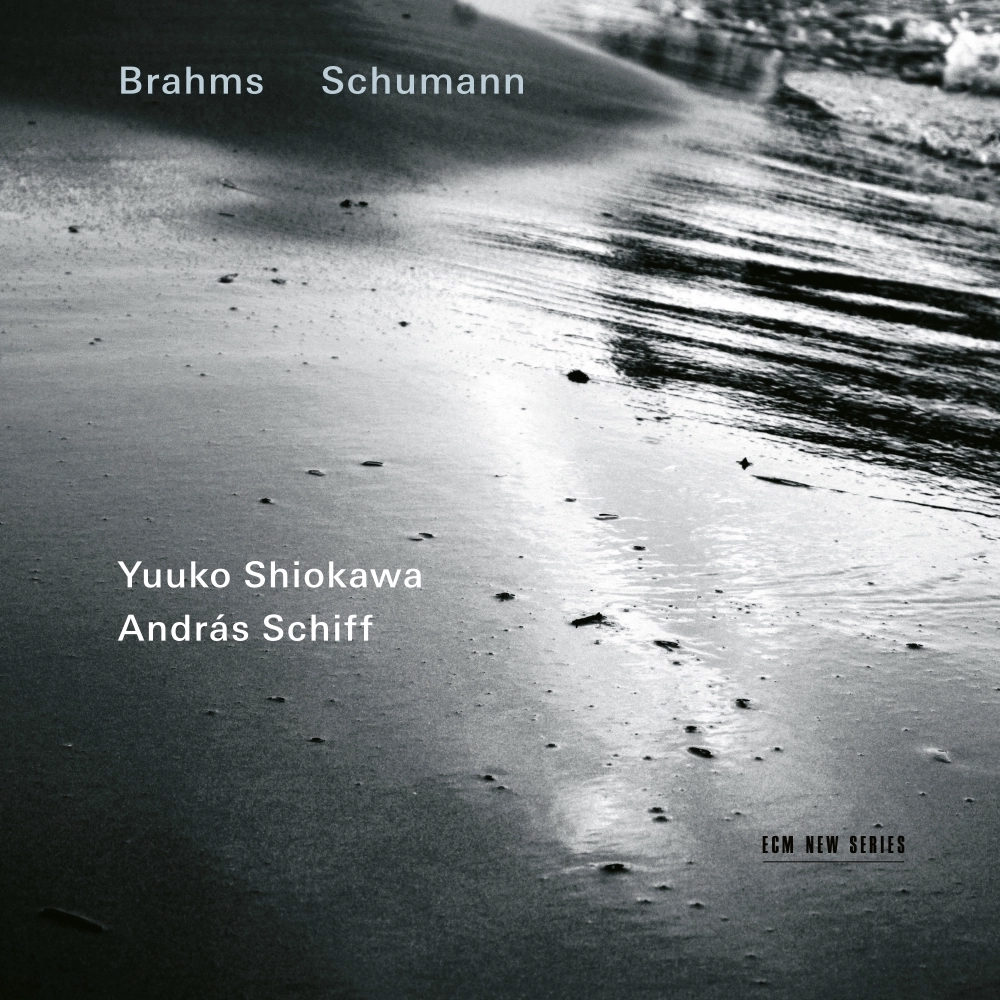
Yuuko Shiokawa violin András Schiff piano Recorded December 2015 (Brahms) and January 2019 (Schumann) Auditorio Stelio Molo RSI, Lugano Engineer: Stephan Schellmann Cover photo: Nadia F. Romanini Produced by Manfred Eicher Release date: October 11, 2024
In their second full disc for ECM New Series, violinist Yuuko Shiokawa and pianist András Schiff present two 19th-century sonatas of the highest caliber by Johannes Brahms (1833-1897) and Robert Schumann (1810-1856). The first half of the program is taken by Brahms’s Violin Sonata No. 1 in G major, op. 78. Composed in 1878, immediately after his violin concerto, it is affectionately known as the “Regenliedsonate” (Rain Sonata) for references to his two songs, “Regenlied” (Rain Song) and “Nachklang” (Lingering Sound), both gifted to Clara Schumann for her 54th birthday. We can easily share in her gratitude for finding those melodies she so cherished incorporated into a sonata of abundant riches, especially when considering that Brahms burned his early attempts at the genre. “Regenlied” opens the first and third movements, growing from the earth not as a sprout but as a fully formed tree. Like time-lapse photography, it allows us to see an entire life cycle in hindsight before we can fully grasp what is being reflected upon. Between the seamless notecraft in the violin and the piano’s dynamic underpinning, there is an orchestral sensibility at play. Despite the lively development, the outer husk is rooted in melancholy and emotional density. It whispers when it dances, shouts when it prays. The central Adagio is more funereal by contrast. As the violin works its lines from inner to outer sanctum, it never lets the wind get in the way of its grief. Meanwhile, the piano is more insistent and rouses its companion from slumber into the sharper edges of reality, leading it through every turn thereof without so much as a nick. The final stretch works through shaded pathways and hard-to-reach areas with sublime attention to detail, ending on a transcendent double stop.
Although Brahms’ great admirer Robert Schumann had never written a violin sonata, at the urging of Ferdinand David (concertmaster from the Leipzig Gewandhaus and the dedicatee of Mendelssohn’s violin concerto), he eventually relented. However, being displeased with his first attempt, he dedicated the Violin Sonata No. 2 in d minor, op. 121, to David instead. Clara and violinist Joseph Joachim gave its premiere in 1853. A massive piece in four parts, it turns the concept of “chamber music” on its head. Unlike this program’s accompanying sonata, it takes its time to mature (at 13 minutes, the opening movement alone is exactly half the length of Brahms’ entire sonata). It is also a profound litmus test of any duo’s attempts at the form, and in that respect, Schiff and Shiokawa defer to the score instead of their egos. The second movement is a soft burst of energy, giving shape to each motivic cell as if it were a brief dance to be savored before its steps are forgotten. From flowing to syncopated, we are carried through the third movement on the back of a groundswell that always keeps its shape, only enlarging and reducing before morphing into a tender staccato. The final movement is a masterclass in controlled drama that feels made for these four hands.
The sensitive playing, which gives its fullest, most heartfelt attention to every detail, is only matched by the recording. Engineer Stephan Schellmann brings a somewhat distant quality to the proceedings so as not to cloud the listener’s judgment with virtuosity. Instead, we are invited to sit in the back of the room, letting the music find us of its own volition, ready and waiting.
Estonian Philharmonic Chamber Choir Tallinn Chamber Orchestra Tõnu Kaljuste conductor Veiko Tubin reciter Annika Lõhmus, Triin Sakermaa soprano Maria Valdmaa soprano Iris Oja mezzo-soprano Indrek Vau trumpet Madis Metsamart percussion Linda Vood flute Recorded October/November 2020 at Methodist Church, Tallinn Engineer: Tammo Sumera Cover photo: Mari Kaljuste Executive producer: Manfred Eicher Release date: September 8, 2023
“I do not use folk song. It is folk song that uses me.”
The above words, famously spoken by Veljo Tormis (1930-2017), ring truer than ever in Reminiscentiae, the first album under conductor Tõnu Kaljuste devoted to the Estonian composer since his passing. The program guides listeners through a chain of foundational works, many of which receive their world premiere recordings here. None speaks to the ethos at hand quite like Tornikell minu külas (The Tower Bell in My Village). Scored for choir, two sopranos, reciter, and bell, it is the result of a commission by Kaljuste in 1978, who noted that many church bells were silent in Soviet Estonia, rendering houses of worship little more than empty shells. Because the tower bell signaled to all, regardless of age or creed, to take pause and know that the divine was watching over them, it was anathema to a self-interested secular government. And so, Tormis incorporated native folk songs to amplify the voice of the people, along with verses by Portuguese poet Fernando Pessoa, whose evocations (spoken here in Estonian by reciter Veiko Tubin) set a profound precedent: “I can see as much of the universe from my village as can be seen from anywhere on earth.” Through the tolling bell dotting the music as it unfolds, this sentiment reveals an underlying philosophical refrain that teeters between the sacred and the profane. As it continues to resound, only the soul can sing in return without fear of being heard by the wrong ears.
Mure murrab meele (Worry Breaks the Spirit)for choir and orchestra (1972/2020) is among a handful of works arranged by Kaljuste that also include Helletused (Herding Calls) for choir, soprano, and orchestra (1982/2020) and Hamleti laul I (Hamlet’s Song I)for choir and orchestra (1965/2020). Whereas the former intertwines memories of childhood with rural traditions, the latter sets the work of Estonian poet Paul-Eerik Rummo.This dark and brooding piece finds Hamlet confronted with discomforting repetitions and images he would much rather escape in favor of a self-sufficient world. As time and tide march on without him, he is left in stasis, pacing circles around his regrets.
Longtime listeners will rejoice to hear “Lauliku lapsepõli” (The Singer’s Childhood), reprised from 1999’s Litany To Thunder, in the full context of Kurvameelsed laulud (Melancholy Songs)for mezzo-soprano and orchestra (1979). This tripartite work cuts into the night like a knife into dark wood, leaving behind a distinct array of melodic shapes. It mixes youthful naivety with geriatric wisdom, while the orchestra adds selective commentary along the way.
All of these songs are spokes to the hub of the Reminiscentiae for orchestra. Composed between 1962 and 1969, they represent a cycle of all four seasons in a series of vignettes, of which Sügismaastikud (Autumn Landscapes) is the most cinematic. Of particular note are “Üle taeva jooksevad pilved” (Clouds Racing Across the Sky), which sweeps us up in its delicate urgency, and “Tuul kõnnumaa kohal” (Wind Along the Heath), with its tense drama. I dare say either would fit perfectly into a Hayao Miyazaki film. Talvemustrid (Winter Patterns) slows its heartbeat to the rhythm of hibernation. It rewards us with a view of the Northern Lights, while a trumpet resounds below in appreciation. The wind returns in Kevadkillud (Spring Sketches), only much smoother and more accommodating to changes in direction. As flora make themselves known in “Lehtivad pungad” (Buds Leafing Out), we feel the shift in the air before dances leap across the landscape, resting in the cuckoo’s call. Suvemotiivid (Summer Motifs) moves from arid climates, through a thunderstorm, toward a tender evening. Also included in the cycle is Kolm mul oli kaunist sõna (Three I Had Those Words of Beauty), which features Lina Vood on flute. It is a pastoral masterpiece that, along with the rest, allows us to appreciate Tormis anew through an instrumental lens.
Although Tormis’s music was rarely heard outside his native land until ECM opened the door, now that it has become a part of the global landscape, how privileged we are to sit at its feet and contemplate its observations at a time when people and places are burning at the stake. If anything, this is the album’s purpose: to unfold our memories until they are big enough to fit more of our thoughts, musings, and written words. Like time itself, it holds only as much as it is given.
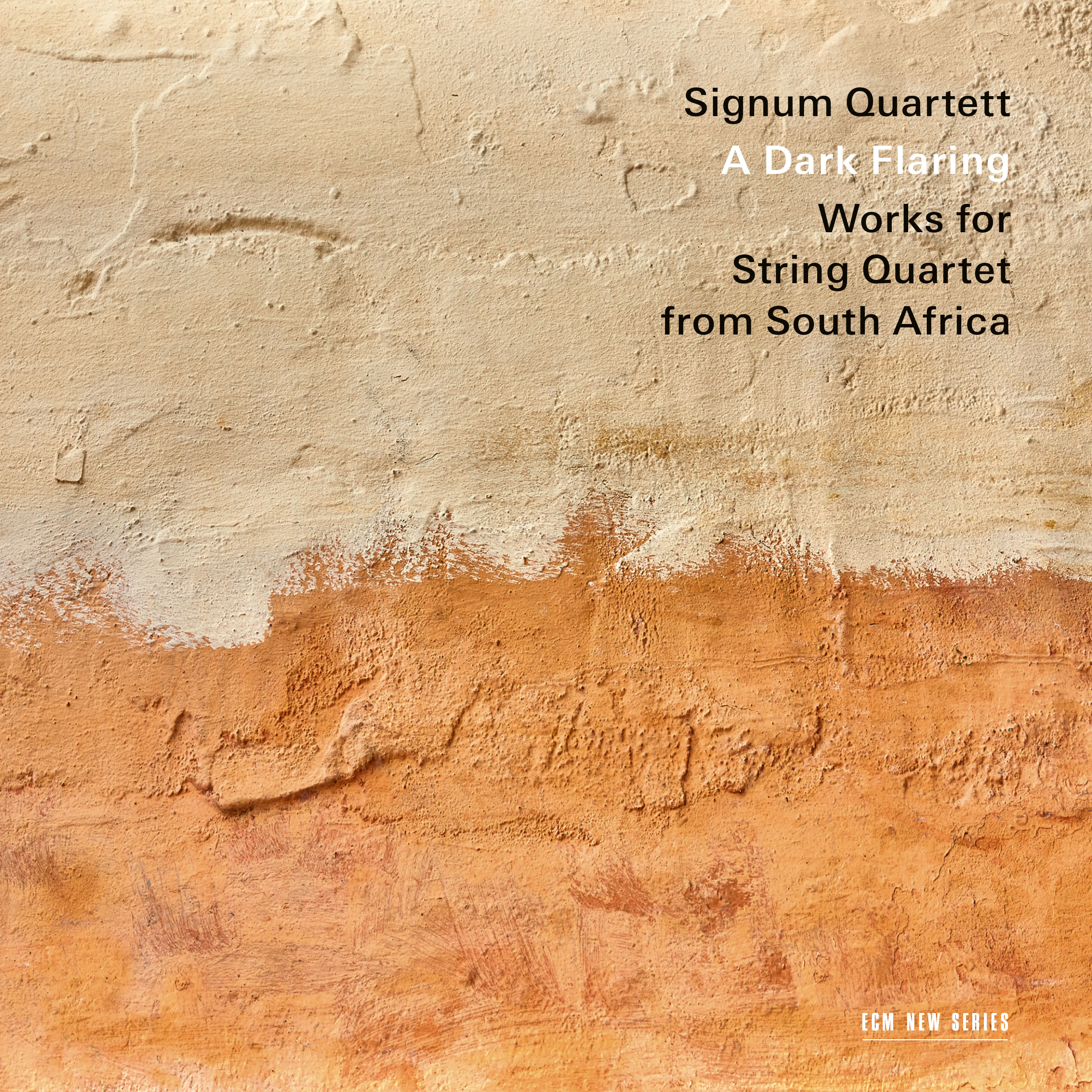
Signum Quartett Florian Donderer violin Annette Walther violin Xandi van Dijk viola Thomas Schmitz violoncello Recorded March 2022, Sendesaal Bremen Engineer: Christoph Franke Design: Sascha Kleis An ECM Production Release date: July 18, 2025
A Dark Flaring marks the second ECM New Series appearance of the Signum Quartett, following their renditions of Erkki-Sven Tüür’s chamber music on 2020’s Lost Prayers. With an even more evocative title through which to guide our listening, they present a singular program of selections from South Africa. In her liner notes, journalist and music critic Shirley Apthorp sets the stage for us most vividly:
“In both Xhosa and Zulu tradition, a healthy relationship with your ancestors is a prerequisite for wellbeing in the present; modern psychology is still catching up with much of what older cultures have known for centuries. While it remains a challenge to find a common thread between South Africa’s many and diverse cultures, this awareness could be said to knit together both the rainbow nation’s populace and the works on this recording.”
And in Komeng (2002), by Mokale Koapeng (b. 1963), we begin to understand just how wide the gap between mind and body can be. The piece takes its inspiration from “Umyeyezelo,” a celebratory song by Thembu musician Nofinishi Dywili (1928-2002). Dywili was a master of the uhadi, a single-stringed bow played with a stick akin to the Brazilian berimbau (an effect replicated here con legno). The song’s title means “ululation” and refers to a Xhosa coming-of-age ritual, the circular nature of which is organically expressed in the music’s structure. A play of sunlight on a child’s face, a swaying reed, a tree standing tall on the horizon: images of past and future comingle in the present, rendering such divisions of time meaningful beyond measure (to say they do away with them would be to undermine the music’s committed sense of time). A rocking motion in the cello, fragile pizzicato, and other liminal gestures from the higher strings add vital details.
Next is (rage) rage against the (2018) by Matthijs van Dijk (b. 1983), which begins innocently enough before imploding. It is directly connected to loss (the composer having lost his mother when he was 18) and personal trauma, paying homage to both the Dylan Thomas poem “Do Not Go Gentle Into That Good Night” and the band Rage Against the Machine. Toeing the line between fury and dark resignation, it exploits the limits of the string quartet’s capacity for depth and breadth. Stomping feet add necessary punctuation. The piercing sirens of its final act are thrilling, like a rock song being fed through the meat grinder of Penderecki’s Threnody for the Victims of Hiroshima until the bleeding slows to a trickle. A subliminal drone woven into the ending gives hope of a life beyond the chaos.
From the newest to one of the oldest of the program, we switch to the Five Elegies for String Quartet (1940-41) of Arnold van Wyk (1916-1983), who, in the late 1930s, became the first South African composer to study at the Royal Academy of Music in London. He also knew loss, having suffered the death of his mother and oldest sister by age 17. Despite being his first compositions for string quartet, these elegies immediately evoke Shostakovich in their fiercely shaded lyricism and were among a handful of early works that earned him great renown in his day. The balance of fluidity and razor-sharp insight is immediately apparent in his examination of war. The lively second movement, marked Allegro feroce, grabs the hem of joy but never manages to defrock the dark zeitgeist that flaunts it. The central Adagio is the mournful heart of it all, a forlorn viola solo against a backdrop of aftereffect: bomb smoke, fire ash, and tear stains. Only toward the end does the cello answer the call as if from the grave. And in the final movement, we encounter the most lyrical motifs, which build into a Beethovenian drama before ending in a near whisper.
Péter Louis van Dijk (b. 1953) is the father of Xandi van Dijk, violist of the Signum Quartett. His iinyembezi (2000) draws from John Dowland’s “Flow My Tears” (1596), as indicated by the Xhosa title (meaning “tears”), refracting the theme until it becomes a chain of half-starts and unrequited remorse. At one point, pizzicato playing evokes the mbira (African thumb piano), and the musicians even tap their instruments in kind. Over the course of 16 and a half minutes, it traverses continents’ worth of terrain, giving itself over to jubilation but always falling back into a bed of tentative truth claims. Despite the expressive depth at hand, it draws an ever-tighter circle of influence around itself until, like an ouroboros, it must stop just shy of self-extinction.
Robert Fokkens (b. 1975), who also studied at the Royal Academy of Music and has lived in the UK ever since, gives us Glimpses of a half-forgotten future (2012). An elegy to deaths in his own life, it too evokes the uhadi but bears further imprints of Cage, Feldman, Bach, and the French spectralists. Spaced out in three movements, the second of which leaps as if in an attempt to escape the clutches of grief, it finishes with microtonal contemplation, seemingly at odds with its surroundings.
The finale is an astonishing discovery in the form of the Quartet for Strings (1939) by Priaulx Rainier (1903-1986), another Royal Academy of Music graduate who studied with Nadia Boulanger, among others. Inspired by the music she grew up with in Zululand, she stayed on at the Academy as a professor of composition. Being a relatively early work, the Quartet for Strings eschews some of the technical challenges that would beset much of her later pieces, but it’s no less challenging for its emotional demands. Its opening movement, for one, teeters between lyricism and skepticism—or, if you will, between looking us straight in the eye and askance—while the trembling second movement dances at the edges of a fading memory. The third movement, marked Andante tranquillo, makes artful use of pizzicato cello and moves in flowing chords attached at the hip. Finally, a spirited Presto chews hard until it reaches bone in the viola. Sliding strings share the air with muted harmonics, a textural quality that makes me wonder whether she didn’t make an impression on composers like Boucourechliev later on.
If A Dark Flaring has a soul partner there in the universe, it is the Kronos Quartet’s seminal Pieces of Africa from 1992. If you admire that album as much as I do, then you’ll find plenty to savor in this one as well. Although born of a different stripe and spirit, it holds equally deep roots in its hands and refuses to let go of them from start to finish.
Estonian National Symphony Orchestra Olari Elts conductor German Hornsound Christoph Eß Marc Gruber Stephan Schottstädt Timo Steininger Recorded September 2022 Estonian Concert Hall, Tallinn Engineer: Tammo Sumera Cover photo: Jan Kricke Executive producer: Manfred Eicher Release date: May 23, 2025
If thou, LORD, shouldest mark iniquities, O Lord, who shall stand? But there is forgiveness with thee, that thou mayest be feared. –Psalm 130:3-4
In the book of 1 Samuel, the Bible records the birth and rise of the eponymous prophet who becomes a great mouthpiece for the God of Israel, only to end up appointing his two sons as judges at a time when such roles were divinely chosen in times of need, not by bloodlines. Seeing how his progeny are swayed by bribery and other improprieties, their subjects seek kingship instead. Although God warns that this will bring about nothing but bigger government and restricted freedoms, they double down on their decision. For that kingly role, he chooses Saul, who eventually crumbles under the weight of so much power—a tale all too familiar to us today and proof that there is indeed nothing new under the sun. And yet, none of this has stopped others from letting their faith speak through art in the face of regimes bent on crushing it underfoot.
A case in point is the Soviet empire, during which the inherent impulse to create was channeled into the service of the state. Echoes of this history are implicitly examined here by Erkki-Sven Tüür on Aeris. In his liner notes for the Estonian composer’s latest ECM New Series program, musicologist Kerri Kotta situates the importance of the symphonic form in the USSR, where the genre came to be upheld as high art. “If the motivation was largely propagandistic,” he writes, “composers still found opportunities in the symphony’s complex but abstract musical semantics to express their worldview and even be covertly critical of the authorities.” Such statements were worlds unto themselves, each a circle of birth, life, contemplation, and death. Tüür’s symphonies, Kotta goes on to say, “are musical journeys towards a wholeness which does not overlook the conflict of its parts but rather glimpses in them a means of moving forward towards greater inclusiveness.” In that respect, we can read his sonic language as one of liberation, to be sure, but also of substantiation. We must regard the sacraments of these offerings reverentially, knowing that they are as ephemeral as the words uttered over them yet as eternal as the resurrection to which they ping our internal compasses. Thus, even in the face of supremacy, music manages to speak more freely than (and in place of) those who compose it.
Tüür’s Symphony No. 10 “ÆRIS” (2021), which forms the centerpiece of this album, may be best read not as an expansion of all that came before in earthly majesty but rather as a reckoning of the shadows lurking within its rafters. Scored for a quartet of French horns and orchestra, it follows nature from creation to unity to dispersion. Opening with the low hum of darkness giving way to light, it separates the water from the firmament and cuts the Earth from its tether, like a newborn from its umbilical cord. A single piccolo sounds the first fowl of the air, and others join it to enliven the scene. Land animals open their eyes and hearts. Forests and gardens tangle into life. Bright slashes of light in the percussion and strings reveal open wounds of sin, while the horns blend even at their most commanding, ever the voices of prophecy. The clopping of a mule brings us into an era of agriculture, while martial tendencies hover all around. Rhythmic cross-cuts and tubular bells speak of the responsibility of kingship we were never meant to handle. Quiet passages of high mist and deeper contemplations funnel into a climax of harmonic flute, stretching out the heavens like a piece of paper on which the names of every believer are written before ending with a shiver and giving way to the inevitable entropy of time.
On either side of this juggernaut are two major orchestral works. Phantasma (2018) is an indirect homage to Beethoven, featuring time-traveling echoes of the Coriolan Overture. It sings in timpani and tremors, a veil through which one can see just enough of reality to believe it’s still there. As a leitmotif, these constitute a darkness that doesn’t oppress so much as float just beyond reach in dreams. As the atmosphere builds, and fluid runs of vibraphone and winds skirt the edges of our perception, climbing strings only make the fall that much harder. The piano haunts the background like a vestige of the past seeking physical contact in the present but never finding a body to inhabit.
De Profundis (2013) is based loosely on Psalm 130. The English horn introduces its arid theme before patterns of leaves imprint themselves on the ground as if to memorialize the trees that shed them. As a monument to fear (the beginning of all wisdom), it is the epitome of ashes to ashes.
This is Tüür’s most mature program to date, even without pulling on the theological threads running through it. Its power is self-sufficient enough to carry the full weight of its life force. In the end, however, it’s hard to avoid its piercing eyes, asking, “Has the proof of hindsight yet convinced you that God was right all along?”
Zsófia Boros classical guitar, ronroco Recorded March/April 2022, Auditorio Stelio Molo RSI, Lugano Engineer: Stefano Amerio Cover photo: Fotini Potamia Produced by Manfred Eicher Release date: April 14, 2023
Guitarist Zsófia Boros returns with her third program for ECM’s New Series. Pairing selections from Argentina with those of French composer Mathias Duplessy, the result may just be her most meticulously constructed dollhouse yet. Indeed, it’s as if every track were either a room or a piece of miniature furniture placed artfully within it.
We begin at the entrance with Duplessy’s “De rêve et de pluie.” The use of harmonics here, alternating with liquid arpeggios, evokes an architectural awareness of the surroundings. Boros traces the contour of the doorway, takes her shoes off in the foyer, and steps carefully inside to take it all in. Next, she tiptoes up the stairs built by Joaquin Alem, whose “Salir adentro” cradles a brief rhythmic tapping in its tenderness. It breathes almost dramatically despite the near-stillness, burrowing as an animal preparing for hibernation. From this dreamy escape, we enter the reality of the nursery, in which Quique Sinesi’s “El abrazo” crochets its lullaby. For this, Boros wraps a rubber band around the guitar strings—a muting technique she developed to allow her to practice while her children were sleeping. The effect is warm and familiar.
From there, Boros recedes into the kitchen, where Alberto Ginastera is cooking lovingly at the stove. His take on the “Milonga” is a spider-webbed tango, as savory as it is sweet. Moving on, we are led into the study, where two books bound by Duplessy lie open for our scrutiny. Whereas “Le secret d’Hiroshigé” recalls the sound of the Japanese koto, moving through paper screens as if they were made of air, “Perle de Rosée” is more botanical. With an understated quality that eschews the pitfalls of virtuosity in favor of its grace, it navigates fields of crops on the verge of being harvested. Meanwhile, a fire burns softly in the fireplace, where the kindling of Sinesi’s “Tormenta de ilusión” leaves us to regard some more unexpected turns of phrase. Played on the ronroco (the 10-stringed instrument for which it was originally written), it destroys memories of the past the tighter it tries to hold to them.
As we wander into the gallery, Duplessy treats us to a modest yet captivating private collection. In “Le labyrinthe de Vermeer,” we can sense oils, pigments, and brushstrokes coalescing into a coherent image. Each section has its own fragrance and distinct perspective. His “Berceuse,” the album’s pinnacle, draws a poignant ebb and flow, while “Valse pour Camille” expresses childlike wonder, coming of age in resonant strums.
We end in the greenhouse, where the album’s title piece by Carlos Moscardini casts its light on a bonsai tree. As a marvel of curation, it doesn’t so much mimic its larger cousins but shows what music is capable of at its most cellular level.
Alexander Lonquich piano, direction Münchener Kammerorchester Daniel Giglberger concertmaster Recorded January 2022 Rathausprunksaal, Landshut Engineer: Markus Heiland Cover: Fidel Sclavo An ECM Production Release date: November 8, 2024
After a years-long relationship with the Munich Chamber Orchestra, pianist Alexander Lonquich had an opportunity to perform Beethoven’s entire cycle of piano concertos over the course of an autumn evening in 2019. The present recording draws upon that collaboration as a gesture of preservation. Composed between 1790 and 1809, the five completed concertos are what the pianist calls “outward-looking creations” and give us insight into the composer’s depth and breadth of mind.
Lonquich begins, naturally, with the Piano Concerto No. 2 in B-flat major, op. 19, given that it was written first but published second due to Beethoven’s initial displeasure with it. Although its opening movement immediately calls Mozart to mind, there are plenty of distinctive colorations to enjoy in its ferocious ebullience, and its central departure into more delicate textures is a marvel. The Adagio is haunting for its sustain-pedaled penultima, setting up the final Rondo, which introduces a veritable horse race of energy to reckon with.
The Mozartian flavors continue in both the Piano Concerto No. 1 in C major, op. 15, and Piano Concerto No. 3 in c minor, op. 37. Whereas the former’s martial beginnings (bordering on overbearing with the occasional blast of timpani and brass) and symphonic conclusion speak with the inflection of a true Classicalist, the second movement adopts a romantic sway. Its soliloquy drips from Lonquich’s fingers like moonlit water, while the surrounding brushwork lends dimension to the scene. The wind writing is especially poignant, blending with the soloist as organically as a forest envelops every tree. The op. 37 mirrors this format almost to a T, beginning with another garagantuan Allegro con brio. At 17 minutes, it’s nothing to take lightly and flows more comfortably to my ears than its op. 15 counterpart. Perhaps it’s the minor key, the more mature writing, or a combination of the two, but whatever the formula, it is bursting at the seams with inspiration and invention, not least of all in the cadenza. (It also seems to foreshadow the Fifth Symphony in the same key, to be written five years later.) Between it and the foot-tappingly engaging third act is cradled another beautiful Largo. As an inward turn, it looks to itself as if through a glass darkly. Yearning for the future, it glows like an ember of possibility.
The Piano Concerto No. 4 in G major, op. 58, opens with even more resolutely symphonic textures, as winds and brass weave a tapestry of pastoral imagery. At 20 minutes, it is half the length of the average symphony and deserves regard as a universe unto itself. The piano’s entrance is timid, almost mocking, before it exuberantly courts the orchestra in a dance of ambitious proportions. Like the Rondo at the other end of the tunnel, it emerges confident, almost brash, in its virtuosity. The Andante con moto operates at a whole other level at their center. Originally conceived with the Orpheus myth in mind, it is by turns agitated and contemplative. This push and pull continues until the piano unfurls its grief alone in a tangled catharsis.
In his liner notes for the album, Lonquich conceives a title for the Piano Concerto No. 5 in E-flat major, op. 73: “Battle, Prayer and Folk Festival.” For while the opening joys seem set in stone, they quickly crumble as more desperate convolutions come to the fore before the piano moves to its highest registers in a rousing meta statement. The Adagio un poco moto, perhaps the most recognizable movement of the collection, is easily heard anew in the present rendering, so crisp are its articulations that the smoothness of their skin feels real to the touch. Beethoven himself in the score marks the piano’s entrance “like the break of dawn,” but as Lonquich notes, what follows “feels to me like the attraction of a nocturnal source of light, which seems to be robbed of its radiance just five bars before the end.” And in that regression, we feel all sorts of trepidations shuffling through the mind until we land on the rousing third movement, where the sun indeed has the last word. Despite its many asides, tempering the sense of victory with that of retrospection, the music moves forward with confidence. Beethoven holds the flowing arpeggios and boisterous dances in constant check so as not to let time rule over space. With a brief yet inspiring finale, it sweeps us away in its arms and runs as far as its legs will carry us.
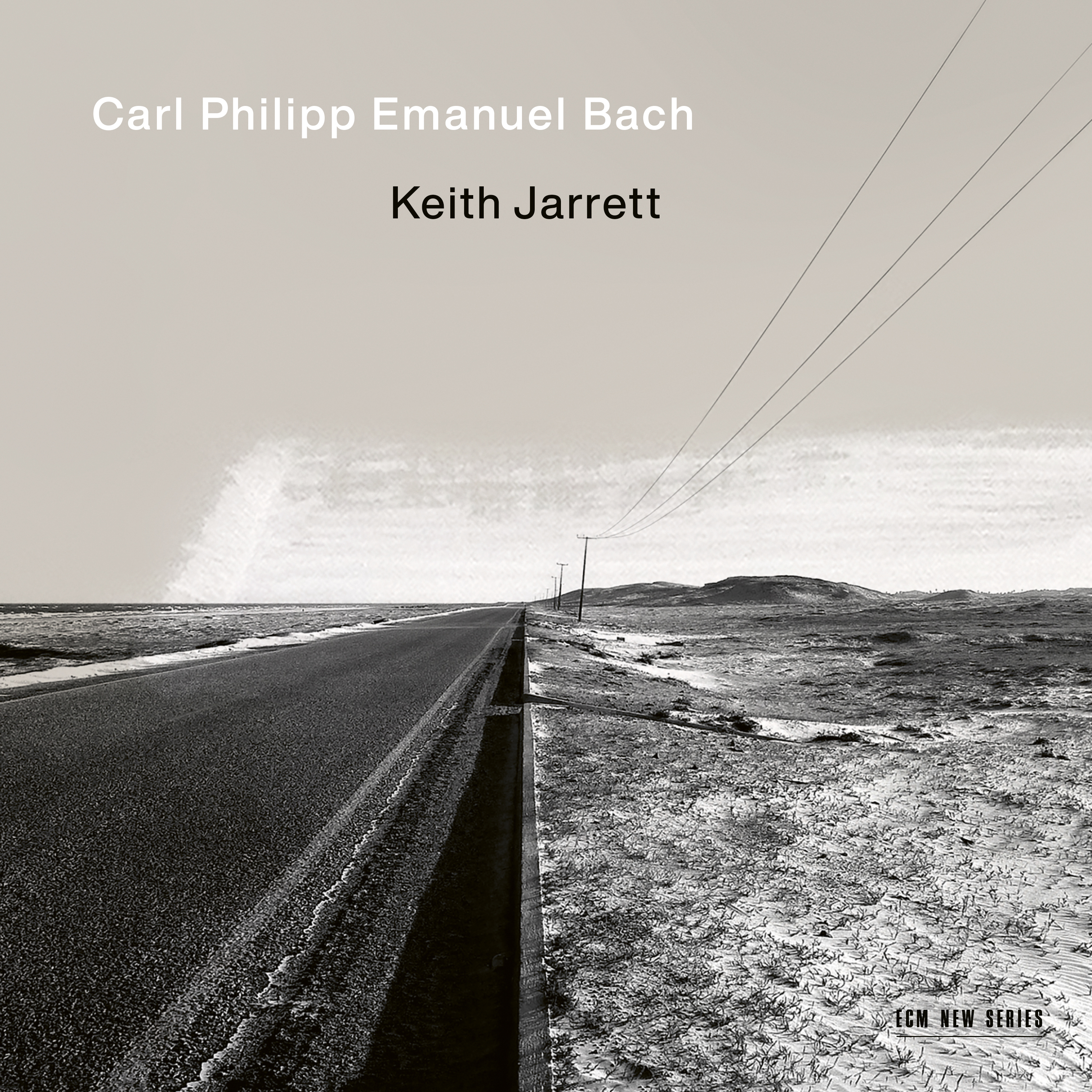
Keith Jarrett piano Recorded May 1994 at Cavelight Studio, New Jersey Engineer: Peter Laenger Cover photo: Mayo Bucher Executive producer: Manfred Eicher Release date: June 30, 2023
In his 2014 monograph, The Music of Carl Philipp Emanuel Bach, music historian David Schulenberg paints a compositionally focused portrait of Johann Sebastian’s second son. Despite living in his father’s shadow, his influence managed to shine a light through the veil of history by way of his seminal Essay on the True Manner of Playing Keyboard Instruments and the conduit he was purported to have furled between the Baroque and Viennese Classical schools. As a composer of nearly 1,000 works, his oeuvre is nothing to sneeze at, nor his style, as much an example of evolution in and of itself as of eras retrospectively defined.
As Paul Griffiths notes in the liner text for the present album, which documents Keith Jarrett’s traversal of CPE’s Württemberg Sonatas, the ocean between father and son may seem vast, even as it churns with currents of familiarity in concert with calls from more distant shores. Dedicated to Carl Eugen, Duke of Württemberg, this collection “makes the point about inheritance avoided, or qualificated, or contradicted, or accepted, whether with gratitude or resignation.” Although nominally composed in 1742/43 for the student who would soon ascend to his dukedom, Griffiths observes, “More likely it was for his own fingers he was writing, and for his own ears.” Jarrett, having only heard these pieces on harpsichord, felt compelled to make a piano version, resulting in this home studio recording from 1994, likewise also for his own fingers and his own ears. All the more honored we should feel to have it available three decades later.
Sonata I in a minor is glorious from the start. There are moments of intense poignancy, as in the Moderato, while the faster outer layers elicit feelings of joy that are always undercut by what Griffiths calls a “sad grace” throughout (I might also call it a glorious melancholy). The final movement, marked Allegro assai, carries astonishing depth in tow. What seems a lightly articulated dance has room for so much more than the listener can calculate. Jarrett brims with vitality and precision without ever letting go of the improvisational spirit for which he is known on the jazzier side of things.
The sheer clarity of Jarrett’s voicings, a profound match for the younger Bach’s own, is fully displayed in Sonata II in A-flat major, of which the concluding Allegro is especially vibrant for its multifaceted joys. Like a brick wall, each layer staggers, parallel to every other layer below and above it, adding strength to the overall design and function.
The opening of Sonata III in e minor is perhaps the most glorious of them all, revealing its heart from the first sweep of the second hand. The Adagio is nostalgia incarnate, while the Vivace—the briefest movement of the collection—peels itself away with unfiltered love. The pauses in Sonata IV in B-flat major make for passionate contrast, yielding an Andante of great beauty. Working in stepwise formation, it is a DNA helix surrendering to melodic sequencing.
The more these sonatas develop, the more they veer toward Father Bach, especially in the Adagio fugue of Sonata V in E-flat major. With sweeping intimacy, it pieces together its puzzle between gusts of wind and spirit. The final Sonata VI in b minor is another inwardly focused distillation that defends variegations of light and shadow. The clocklike Adagio is a gem, while the final Allegro glistens in the setting sun. Each is a different keyboard, two eddies in a bay coming together harmoniously, speaking the same truth but with different tongues.
Vox Clamantis Jaan-Eik Tulve conductor Recorded March 2021 at St. Nicholas Dome Church, Haapsalu Engineer: Margo Kõlar Recording supervision: Helena Tulve Cover photo: Jan Kricke Executive producer: Manfred Eicher Release date: June 2, 2023
O sing unto the LORD a new song: sing unto the LORD, all the earth. – Psalm 96:1
Gregorian chant was the experimental music of the medieval era. Here, filtered through the work of Norwegian organist, choir conductor, and composer Henrik Ødegaard (b. 1955), it blends into the folk music of his own country, all tied together by a contemporary classical idiom that takes two steps back for each one forward. In the throats of Vox Clamantis under the direction of Jaan-Eik Tulve, his sound feels as inevitable as the faith that binds it at the molecular level.
The Genesis of this musical Bible is Jesu, dulcis memoria (2014/15). Its dialogue of darkness and light draws from the liturgy of the Feast of the Holy Name of Jesus to establish the grandest of all dichotomies. As a drone appears underneath, followed by shifting chords, it opens itself to new shades of the text. Such is Ødegaard’s respectful approach to spiritual building, leading to an interwoven “amen.” From here, we get an even deeper dialogue in the inner heart work of Alleluia, Pascha nostrum. Its tender monophony speaks of Christ’s death, while O filii et filiæ(2015/21) offers Ødegaard’s examination of the resurrection. At its core is a 15th-century paschal hymn, building polyphonically through its refrain. Men’s and women’s voices make contact and separate, each a flock of birds gracing the sky with its murmurations. The Gregorian section concludes with a Kyrie and a Pater noster, the latter from a 13th-century Madrid codex, containing some surprising friction and sound colors.
Antiphons from a Scandinavian manuscript of the same century are the basis of the eight-part Meditations Over St. Mary Magdalene’s Feast in Nidaros (2017), which occupies the album’s largest portion. In her liner notes, Kristina Kõrver writes of the work, “It is as if the composer were literally sitting in front of a fragmentary manuscript, filling in the gaps and adding the missing lines, not as a scholar-restorer, but as a poet, a co-creator.” Whether working in tension or harmony with his sources, Ødegaard always seems to be exploring the material as one might repair a piece of old furniture, knowing that even the most seamless integrations will reveal themselves with subtle differences in hue, texture, and quality. The first and last sections are the most personal, revealing the composer’s penchant for unsettled yet cohesive harmonies. Their flow is always restrained so that our ears might be directed inward and our eyes upward.
When encountering Psalm 62 in the antiphonal “Mini osculum non desisti,” we find ourselves not torn but made whole, as if two parts of ourselves walking away from each other have turned around to meet in fellowship. Meanwhile, Canticum Trium Puerorum emerges organically from the chant of “Oleo caput meum non unxisti” as steam from boiling water. As Ødegaard continues to open our hearts to these possibilities, they begin to feel as natural as the souls rendering them. The choir shapes these with such grace as to be stilling in effect. In the setting of Psalms 148-150, a shushing sound feels like the rasp of pages being turned from the pulpit: a reminder that the Word was indeed made flesh. The deepest font is in the Magnificat, merging with “O, Maria, mater pia.” The resulting flow is so alluring that anything floating upon its waters would seem out of place. And that it does—at first. But something transformative happens as the women’s and men’s choirs align to illustrate the gospel’s power to seek, find, and restore unity.
If I were to compare the Meditations to a stained glass window, it would be analogous to the solder that holds together the panels rather than the panels of color themselves. It is a skeleton enshrouded by centuries of worship, made animate by the power of the lungs and the breath of life that fills them with the oxygen of salvation.







 Between Sound and Space: ECM Records and Beyond