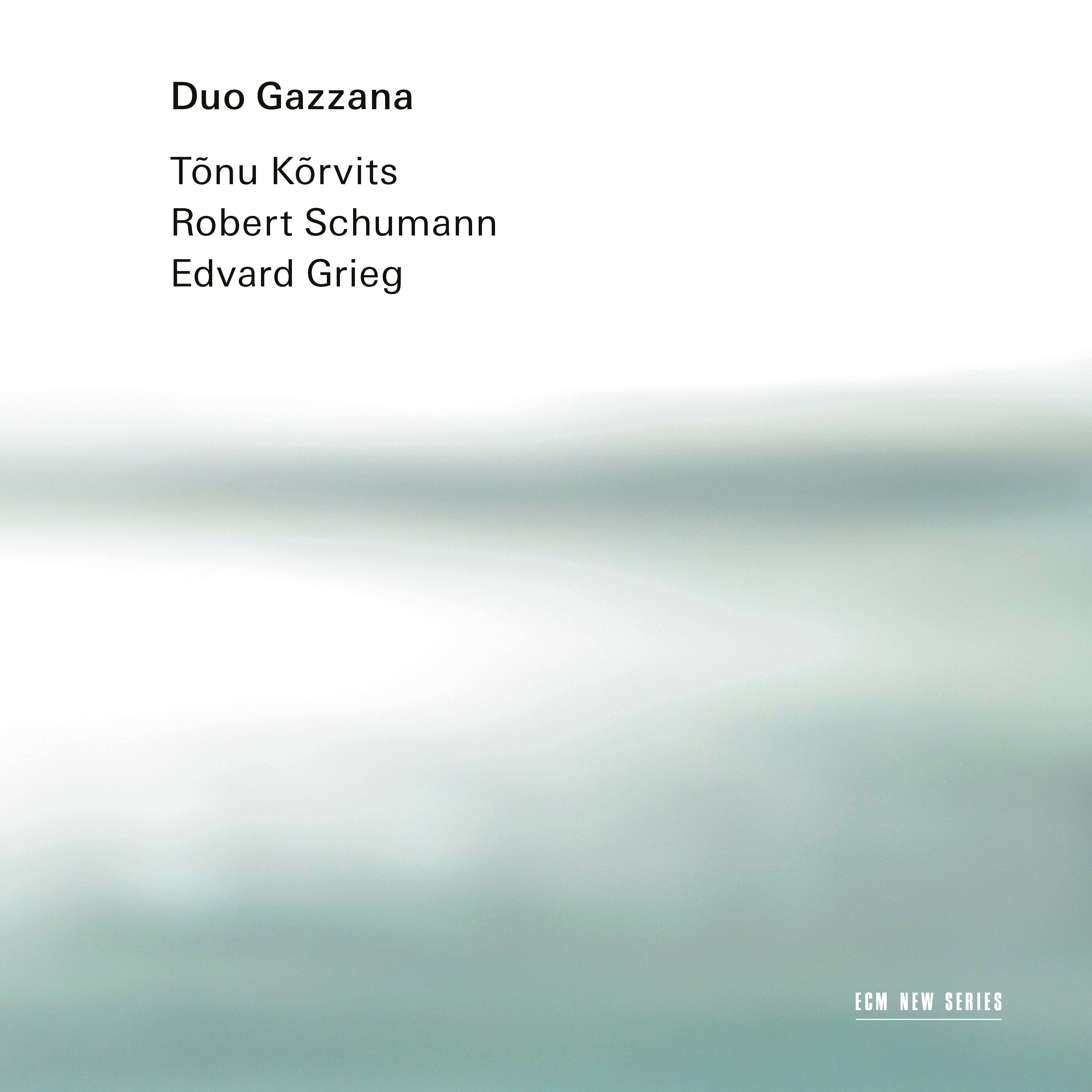
Duo Gazzana: Tõnu Kõrvits/Robert Schumann/Edvard Grieg (ECM New Series 2706)

Duo Gazzana
Tõnu Kõrvits/Robert Schumann/Edvard Grieg

Natascia Gazzana violin
Raffaella Gazzana piano
Recorded November 2021, Reitstadel Neumarkt
Engineer: Markus Heiland
Cover photo: Luciano Rossetti
Produced by Manfred Eicher
Release date: November 18, 2022

A new recording from the Gazzana sisters—Natascia on violin and Raffaella on piano—is always something to celebrate. But what they now present may be their finest in terms of programming, thoughtfulness, passion, and self-control. Making a special case for this assertion are the subtle shades of Tõnu Kõrvits’s Stalker Suite (2017), one of two pieces written for the duo by the Estonian composer. Despite being an homage to Andrei Tarkovsky’s eponymous masterpiece, the music occupies a world unto itself, not least because of its performers’ unobfuscated humanity. From the soft metallic pianism that introduces “Into The Zone,” we relive at least some of that journey, which seems to go deeper vertically the more it proceeds horizontally into abandoned areas of non-existence and timeless looping.

Kõrvits doesn’t so much describe the imagination of cinema but rather the imagination incinema. When the film’s characters, for instance, enter “The Room,” their musical equivalent doesn’t seek to recreate those dilapidated walls, the waterlogged detritus of lives unlived, or the ringing phone. Instead, it lives in the quiet unrest of a mind led by the hand to a mirror in which images disappear as quickly as they manifest.

As the Stalker notes in his “Monologue,” what we call passion is the friction between souls and the lives of the bodies they inhabit. Weakness, he goes on to say, is the companion of birth, whereas strength is the accompaniment of death. Thus, every note wavers in the delicate metaphysical tension between the two. Rich and pliant yet fiercely resolute against the blinding light, it touches the periphery that is no periphery. If anything is programmatic here, it is “Waterfall,” but even this comes with an implied proviso: You must not treat the image as an idol, for faith comes by hearing, not seeing. The Zone has been internal all along.

Notturni (2014), also in four parts, delineates another porous architectural enclosure. Kõrvits’s penchant for brevity is philosophically and hermeneutically suited to these pieces, which take ideas not as excuses for grand expounding or soliloquizing but as poems in miniature. And if a nocturne is supposed to be about the night, then these modern examples of the form show us that a darkened sky reveals what the daylight obscures with its glare. The relationship between piano and violin is especially profound in the third piece, where fluttering high notes in the keys mesh genuinely with lower voicings in the bow.

Between these modern ores lies the polished gemstone that is Robert Schumann’s Sonata No. 1 in A minor, op. 105, of 1851. In its flowering opening movement, the violin’s G string resounds like an alto in the forest. In the Gazzanas’ hands, it feels as natural as sunrise. Although formally divided into three movements, the central one being the most searching in its cautious approach, it finds resolution in the recession of its character. The folk-like qualities of its final act are a testament to the inner struggle of a composer wanting to look to the soil without having to trip over those buried therein.

Finishing out the program is the Sonata No. 3 in C minor, op. 45 (1887) by Edvard Grieg. For this rendering, they default to the composer’s own copy, which differs from the first published edition. The differences accentuate the Norwegian character, drawn by flowing brushwork and sometimes-gnarled textures. If the first movement is a robust ode to origins, then the second, marked “Allegretto espressivo alla Romanza,” is a contemplative gush of loving kindness. Moving in slow motion, it calms us before the storm of the final dance revels in a palette’s worth of colors. The Gazzanas masterfully navigate every twist and turn in this lush and yielding landscape. At once songlike and exuberant, they allow every glint of meaning to shine through to the rousing end.

Alexander Knaifel: Chapter Eight (ECM New Series 2637)

Alexander Knaifel
Chapter Eight

Patrick Demenga violoncello
State Choir Latvija
Riga Cathedral Boys Choir
Youth Choir Kam
ēr
Andres Mustonen
 conductor
Concert recording, March 2009
Jesuitenkirche Luzern
Engineer: Charles Suter
Assistant Engineers: Urs Dürr, Ruedi Wild
Executive Producer (SRF): Rolf Grolimund
Cover: Eberhard Ross
Co-production ECM Records/Radio SRF 2 Kulture
Release date: March 14, 2025

Set me as a seal upon thine heart, as a seal upon thine arm: for love is strong as death; jealousy is cruel as the grave: the coals thereof are coals of fire, which hath a most vehement flame.
–Song of Songs 8:6

The music of Alexander Knaifel (1943-2024) is a chain of lakes in the ECM New Series landscape. In this latest release, consisting of the slow-motion embrace that is Chapter Eight (1992/93), we encounter his setting of the eighth chapter of the Song of Songs. Conceived as a “community prayer,” it places a cello (played here by Patrick Demenga) at the center of three choirs arranged crosswise in a cathedral, itself listed among the instrumentation in the score.

Demenga is the welcomer whose song leads the way as the voices emerge from the wood- and stonework of the space itself, where human hands have left behind forms we can hear, see, and touch. Such tactility is at the heart of everything Knaifel composed. By stretching words and images to their breaking point, he showed how fragile our relationship to sound really is. For that reason alone, we should not be surprised that Chapter Eight is not a straightforward rendering of its source text, as verses are reordered, and not every one is accounted for. Some are also repeated (verse 1 appears six times, verse 6 appears five times, etc.), and by the time we get to the last of the piece’s 32 stanzas, we are reduced to fragments thereof. In that reduction, however, lies the key to understanding the truth we are being given: Scripture is nothing without its orality. And so, by favoring these far-reaching suspensions in his choral writing, the composer is redefining transcendence not as overcoming of the physical but as a manifestation of the liminal. The world seems to stop spinning, the clouds are no longer moving, and the sun is held in its dial. Through it all, the cello is a thread pulled through a veil not of our own making.

Although the passionate dialogue of Song of Songs is often read as a metaphor between the Jewish and Gentile churches at a time when Christ’s reconciliation had yet to be born out through the new covenant, Knaifel goes one layer deeper to highlight such tensions in every believing heart. While the cello and choirs become more unified in vision, they turn rapture into capture, whereby the body-solvent spirit is held gently in place by God’s plan. The repeated verses remind us that we must never leave others behind in our spiritual walk and that salvation is never ultimately about the self but is a means of glorifying the one who bestows it. The lover’s jealousy, therefore, is that of a God who hopes that all of us might lay our heads in his bosom. We feel this when Demenga’s bow falls from its perch (high notes like lasers through the mind) and scrapes the bottom of its fleshly allegiances (low notes like rusty chains through the heart). The singers move methodically, each syllable becoming a verse unto itself, the roles of call and response gradually reversing.

Thus, the pace of time becomes distorted, like seeing the world through a window down which drips a quiet rain. The storm is the language of faith, a test of our immaterial resolve against the material. And when we fail, we are ready to be lifted again and remade in the image of what we are meant for. And as these forces meet in the middle, they stand at the intersection of all things, whispering, “The unfinished statement is where life begins.”

This is music you can leave on to exist on its own terms until it becomes a part of the architecture you call home.

András Schiff: J. S. Bach – Clavichord (ECM New Series 2635/36)

András Schiff
J. S. Bach: Clavichord

András Schiff clavichord
Recorded July 2018
Kammermusikssaal H. J. Abs,
Beethoven-Haus, Bonn
Engineer: Stephan Schellmann
Cover photo: Jan Jedlička
Produced by Manfred Eicher
Release date: January 27, 2023

“When I’m at home, my day always begins with Bach. It used to be on the piano, now it’s on the clavichord, even before breakfast. After a few of the Inventions I feel reborn. My ears, my mind, soul and spirit are cleansed.”

Few keyboardic constructions feel as tangible as the clavichord. If only for that reason, it takes getting used to. Yet if you are willing to meet it on its own terms, its internal resonances and breadth of character soon become apparent. As the go-to of Johann Sebastian Bach, it deserves a spotlight in this music—not only for its sound but also for its spirit. For while its intimacy is a given (allowing as it did the luxury of private interpretation for both composers and enthusiasts), and its history and Bach’s relationship to it are well documented, there’s something about letting it sing for itself, and I can think of few hands more capable of doing just that than those of pianist András Schiff, whose humble admission crowns this review.
 
The six-part Capriccio sopra la lontananza del fratello dilettissimo (Capriccio on the departure of a beloved brother) is a delightful inauguration to the instrument’s flavor. Though lesser known than the Inventions and Sinfonias (a.k.a., the Two- and Three-Part Inventions, split between this album’s two discs), they speak nakedly and with the programmatic lucidity required of them. The bigger, canonical collection after them dons new garments (if not sheds old ones) in the present recording. Knowing that Bach likely intended them for the clavichord gives us a renewed understanding of their provenance. The faster movements (cf. Invention No. 4 in d minor, Sinfonia No. 15 in b minor) sparkle, while the slower ones (cf. Invention No. 2 in c minor, Sinfonia No. 4 in d minor) feel more robust than ever. The middle realm (cf. Invention No. 15 in b minor, Sinfonia No. 11 in g minor) gives us the best of both worlds. Such is the magic of the clavichord: Despite its slimmer character and build, it holds its own and then some in a basket woven of lower pitch (a’ = 404 Hz). One highlight in this regard is the lutelike Sinfonia No. 9 in f minor, which walks up a flight of stairs, making the pull of gravity palpable.
 
Between these are the Four Duets (of which No. 3 in G major is especially wholesome) and the Ricercar à 3 from Das Musikalische Opfere, which, along with the concluding Chromatic Fantasia and Fugue, is the biggest revelation herein. Whereas the orchestral sensibilities in one are still very much alive, albeit refracted and distilled, the other shows the subtlety of the “Bebung” technique, whereby the performer adds vibrato with vertical pressure of the fingertip. Thus, these pieces’ complexities become more apparent because they cannot hide within the piano’s cavernous architecture. The fugue is a wonder. Feet to ground, it knows where it stands and how to take joy in the life it has been freely given.

Ruth Killius/Thomas Zehetmair: Bartók/Casken/Beethoven (ECM New Series 2595)

Ruth Killius/Thomas Zehetmair
Bartók/Casken/Beethoven

Thomas Zehetmair violin, conductor
Ruth Killius viola
Royal Northern Sinfonia
Recorded live June 2014
at The Sage Gateshead
Engineer: Hannelore Guittet
Cover photo: Max Franosch
Executive producer: Manfred Eicher
Release date: February 17, 2023

The triptych on offer here is proof positive of violinist Thomas Zehetmair’s boldness as a conductor. With his wife, violist Ruth Killius, he brings together an intriguing assortment at the helm of the Royal Northern Sinfonia. Most surprising is British composer John Casken’s That Subtle Knot, which receives its premiere recording. This double concerto for violin, viola, and orchestra was written in 2012-13 and is dedicated to the present performers. Taking its inspiration from the poetry of John Donne, whose characteristic attention to physiological detail is beautifully mirrored throughout, it charts a course of passionate complexity through two movements. The lone viola of “Calm” unfolds in an unnamed wilderness, searching its past but finding traces of the future. As the violin steps foot onto the same landscape a divider’s distance away, the orchestra hints at natural obstacles between them: a mountain face, a ravine, a river too wide to cross. And yet, none of this bars one from knowing and empathizing with the other. Moments of dance-like energy are necessarily brief so that even when they reach a state of agreement, it is always mediated through the environment. Despite its title, “Floating” is rife with dramatic highs and lows. If anything, it floats in the sense of something being tossed about in the wind and never being allowed to land until it has been battered and bruised. Like a human relationship, it weathers the storm, finding its bearings the emotional lessons it has learned. The high note on which it ends is a testament to the power of perseverance.

What a fascinating companion this work has in the form of Béla Bartók’s Concerto for Violin and Orchestra. Although largely considered his final work, despite some controversy to the contrary, it is a shot in the dark of the year in which it was written (1945). Regardless of provenance and subsequent revisions, it proves itself more than ever to be a beacon of the viola repertoire at the touch of Killius’s bow. She arrives on the scene in a burst of light, courting the orchestra into a dance of knotted proportions. The more the Moderato develops, the tighter that knot becomes, unraveling itself only in dreams. There is nothing inviting or conciliatory about the viola’s restlessness. It is always unsettled, and therein lies the spell. Speaking of spells, one cannot help but be enchanted by the central movement, which speaks to the heart of this piece and its composer. Its brevity after the gargantuan first makes it all the more poignant. In the last, marked Allegro vivace, a superb articulation abounds. Every thought—both on paper and in the minds of those interpreting it—is lucid to the core, working into a concise and spirited finish.

And where to end this three-legged race? Why, in the well-worn yet crucial binding of Ludwig van Beethoven’s Fifth, of course. The urgency of its familiar opening statement is given special urgency while still giving those pastoral asides room to breathe. What is remarkable is that, despite this energy, which carries over even into the flowing violins of the slower second movement, the winds are never drowned. Rather, they speak like a Greek chorus, carrying omniscience in their hands. Also notable is the sheer delicacy of the pizzicato in the third movement, so crisply captured in this recording, and the breadth of the concluding Allegro, in which a not-so-subtle knot of grace and affirmation ties itself before our very ears.

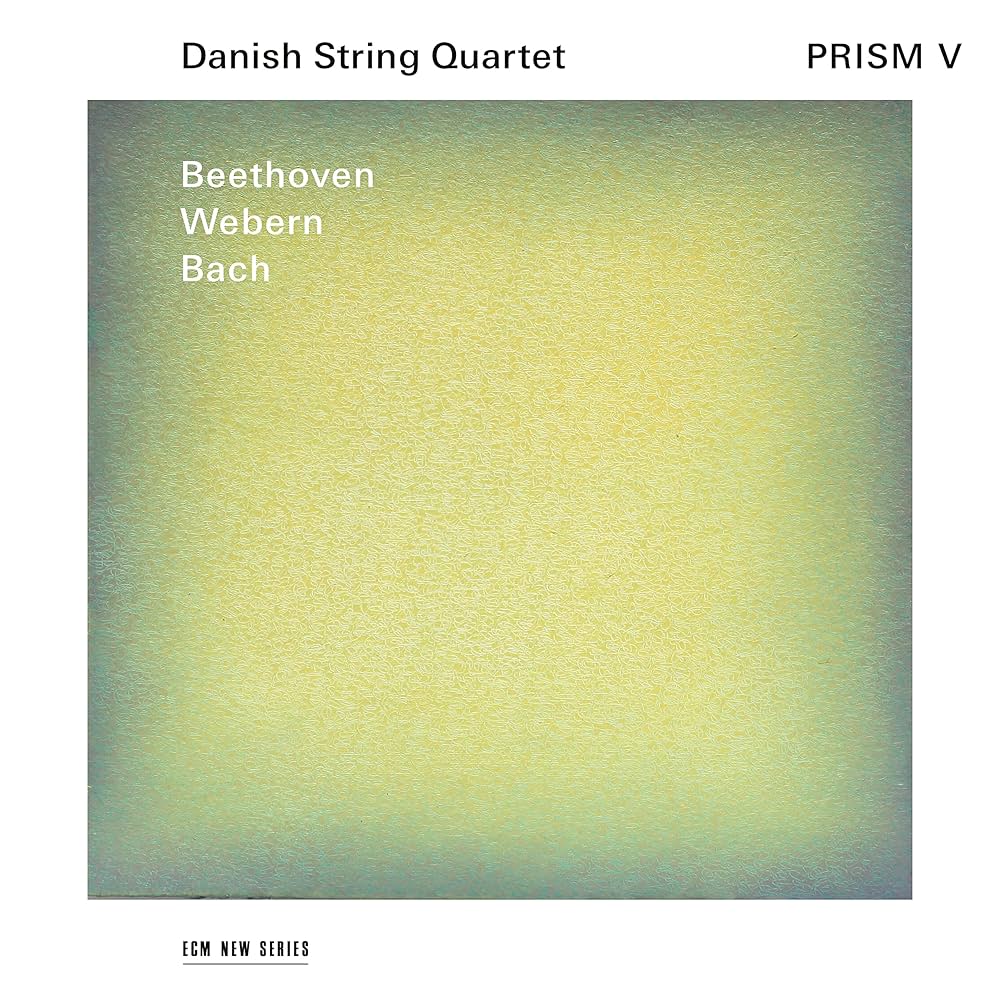
Danish String Quartet: PRISM V (ECM New Series 2565)

Danish String Quartet
PRISM V

Rune Tonsgaard Sørensen violin
Frederik Øland violin
Asbjørn Nørgaard viola
Fredrik Schøyen Sjölin violoncello
Recorded June 2021
Festsal, KFUM/KFUK, Copenhagen
Engineer: Markus Heiland
Cover: Eberhard Ross
Produced by Manfred Eicher
Release date: April 14, 2023

The Danish String Quartet concludes its nearly eight-year journey pairing Ludwig van Beethoven’s five late string quartets with works by Johann Sebastian Bach and later composers. Looking back, I can’t help but smile at how deeply and patiently the DSQ has fertilized the soil of this project to yield the richness of spring harvest.

As the musicians humbly observe, “Micromanagement is rarely a successful strategy when it comes to late Beethoven.” Therefore, if the music feels almost fiercely detailed, it’s because the relationships between the notes speak up for themselves at every turn. Indeed, it’s impossible to encounter the initial stirrings of the String Quartet No. 16 in F major, op. 135, wherein the composer returns not only to the quadripartite form but also to his astonishment of the past, without blushing. And what, you might wonder, is immediately apparent this time around? Nothing less than the undeniable realization that the late Beethoven deviates from other “standard” quartets of the repertoire (including his earlier own) in how inevitable it feels. Whether in the lucidity of the second movement or the dark pastoralism of the third, every sound takes on a physical appearance. The sheer grit the Danes bring to these contrasts is wonderous. Whereas the faster rites of passage would give little room for personal interpretation in less capable hands, in the present context, they are vessels in which the pudding of proof is artfully mixed. In the final stretch, which begins in gentler territory while also expressing great urgency, the call and response between cello and violins opens the door into a run across an open field where life itself becomes the map leading the way to the other side.

Anton Webern’s String Quartet of 1905 (the second of two he wrote that year) brought about a sea change in the genre. Although played in one continuous 18-minute stretch, it takes on a nominal structure in three sections (“Becoming,” “Being,” “Passing Away”) based on the work of painter Giovanni Segantini. Its shifts between darker and lighter keys, between exhalations and holdings of breath, would seem to mirror Beethoven, while its central fugue casts a shadow further back to Bach. The more one immerses oneself in it, the more fragmentary it becomes. As with the canvases that inspired it, one is tempted to isolate a mountain from land and sky, all the while missing out on the benefit of zooming in further on individual plants, puffs of cloud, and rocky imperfections that can only be described as “hymnal” in shape.

The setting for these diamonds consists of Baroque prongs. Whereas Bach’s chorale prelude, Vor deinen Thron tret ich hiermit, opens the program as one would wake up from a coma only to realize how much the world has not changed, the Contrapunctus XIV from The Art of Fuguereleases its pollen by the light of the moon, windswept in evening breezes to places we cannot touch until our bodies wither. Being unfinished, it ends mid-statement, leaving the remainder to toss about in the waves of our unworthy fancy. Sometimes, the best way to answer a question is by posing another.

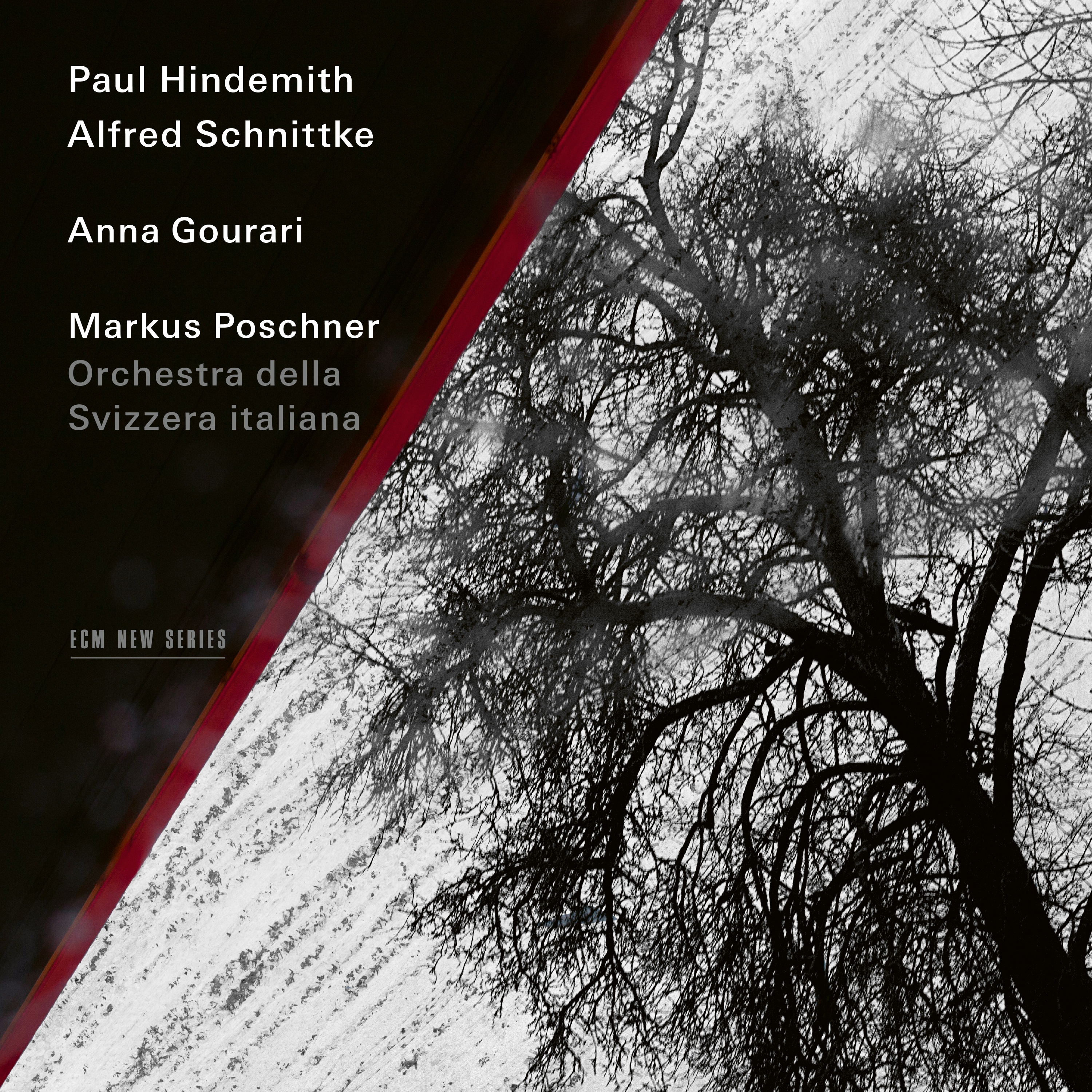
Anna Gourari: Paul Hindemith/Alfred Schnittke (ECM 2752 NS)

Anna Gourari
Paul Hindemith/Alfred Schnittke

Anna Gourari piano
Orchestra della Svizzera italiana
Markus Poschner
 conductor
Recorded December 2021, Auditorio Stelio Molo RSI, Lugano
Engineer: Wolfgang Müller (RSI)
Mixed January 2023 by Wolfgang Müller and Manfred Eicher
Cover photo: Fotini Potamia
Produced by Manfred Eicher
Release date: June 14, 2024

Since making her ECM debut with Canto Oscuro in 2012, Tatarstan-born pianist Anna Gourari has tread a distinct path. On that and two subsequent solo recitals, the breadth of her vision as a musician is matched only by her choice of repertoire, spanning the gamut from Bach and Chopin to Medtner and Kancheli. For the present program, she gives deference to two beacons whose light has often shined at her fingertips.

The Composers

In this program notes, Roman Brotbeck describes Alfred Schnittke (1934-1998) as a listener above all. As “one of the most idiosyncratic and enigmatic composers of the 20th century,” he was a resolute soul who didn’t so much search for sounds that were new but rather expressive of a higher power. In addition to his symphonies, choral works, and various configurations for orchestras and soloists, he wrote prolifically for film, seesawing throughout his life between his German roots and Russian upbringing, all the while examining a deepening Orthodox faith. As well versed in idioms as he was in subverting them, he operated like a linguist parsing morphemes to explore how they might be connected across seemingly insurmountable barriers of genre, style, and historicity. From his early days at the Moscow Conservatory to his later years in Hamburg, Germany, he was as much a polyglot as a polystylist who organically defied categorization.

“The reactions music evokes are not feelings, but they are the images, memories of feelings.” So wrote Paul Hindemith (1895-1963) in his 1952 collection of lectures, A Composer’s World. Like Schnittke, music was a field where he planted two sacred ideas for every secular. He was also a concert violinist/violist, an author, and a committed teacher. His composing was as much a reflection of extroversion as his daily life was of privacy. After studying at the Hoch Conservatory in Frankfurt, he served in the Imperial German Army, diving headlong into composing upon his return to civilian life. Fleeing the scourge of Nazism, he founded the Ankara State Conservatory at the behest of the Turkish government, thereafter arriving in America in 1940, where he taught at Yale and Cornell, among other institutions of higher learning, before living out the rest of his life in Switzerland and his native Germany. Throughout his steadfast career, he explored the tonal landscape with fortitude and creative boldness. He also greatly influenced the young Schnittke, whose side of the Venn diagram overlaps Hindemith’s by 29 years.

The Music

Schnittke’s Concerto for Piano and Strings (1979) has a special place in my heart. As a teenager, I discovered his music through the BIS recording label. This piece was featured on my favorite of the series (CD-377), where it was paired with the Concerto Grosso I of 1977 and the Concerto for Oboe, Harp, and String Orchestra of 1971. It wasn’t long before I learned of his death via my local classical radio station.

The opening piano of this gargantuan piece is an exercise not in contrasts but in constructs; the gentle stirrings morphing into giant broken triads and the ethereal entrance of strings are as cohesive as they are episodic. Over 23 minutes, this mashup of, in the composer’s words, “surrealistic shreds of sunrise from orthodox church music” and “a false burst of Prokofievian energy and a blues nightmare” succeeds with an uncanny beauty. As the orchestra attempts to engulf the piano in an almost Purcell-like wave of drama, the struggle feels as real as rain. In the end, the B-A-C-H motif emerges like a blush of red across bare skin, a comet frozen in time, a scar where the light of God shows through.

During the second half of his composing career, Hindemith became firmly entrenched in robust harmonic structures that overshadowed the expressionism of his youth even as they drew from it. In response to Hitler’s growing shadow, he wrote his opera, Mathis der Maler, in which the titular protagonist, Renaissance painter Matthias Grünewald, sought refuge in his art from the German Peasants’ War of 1524-25. During that period, Grünewald painted the Isenheim Altarpiece in Colmar, and it was this Hindemith expressed in musical form in this symphonic distillation from 1934. First is the “Angel Concert,” which takes the medieval song “Es sungen drei Engel” (Three angels were singing”) as its central motif. Its tripartite structure is just one echo of the Trinity. Like Schnittke’s own angelic concert, the music is richly varied yet utterly cohesive, if more accessible to lay ears. Next is the “Grablegung” (Entombment), which depicts the mother Mary, Mary Magdalene, and the apostle John mourning the death of their Savior. But that darkness is short-lived as the glory of Christ’s resurrection crashes into the foreground. Lastly, the “Versuchung des heiligen Antonius” (Temptation of Saint Anthony) nestles the patron saint from Padua (and contemporary of St. Francis) in a gaggle of monstrous creatures. Dissonance makes itself known, rendering the marching valiance of its unfolding all the more powerful. Brotbeck notes the significance of this movement’s subtitle (“Where were you, good Jesus, where were you? Why were you not there to heal my wounds?”) as painted into Grünewald’s portrait of Antonius: “Hindemith’s reference to this exclamation shows the autobiographical aspect of the symphony, as Antonius, who withdraws from society and is exposed to satanic temptations as a desert hermit, also reflects Hindemith’s personal situation in Nazi Germany.” Said temptations play out with churning drama.

After fleeing to the US, Hindemith came to write his ballet score, The Four Temperaments, in 1940 for George Balanchine. However, this theme and variations for piano and string orchestra never received its intended premiere, as the sinking of the Hood of Britain by the Bismarck of Germany cast a pall over composers of the latter persuasion. Nevertheless, we find another space in which politics seems even farther away. Here, we encounter a more metaphysical realm. Whereas the first variation flirts with melancholy and the fourth with jagged relief, the constellations between them blend concerto-like impulses with sonata-esque spirit. Duos, trios, and other combinations abound, each reaching for something familiar.

The Performers

Gourari approaches Schnittke with incredible drive and reflection. In a particularly dramatic middle section, she digs into the piano’s most nutrient-rich dirt, finding equilibrium even amid the drunken sway of violins struggling to maintain their own. She treats the instrument as an extension of herself, ever searching for a means to speak through its many intermediary mechanisms. From jazzy slurs to neoclassical aphorisms, medieval chants to postmodern geographies, she navigates it all with a compass that adapts to every shift of current.

The Orchestra della Svizzera italiana and conductor Markus Poschner work through the fleshly struggles of Hindemith’s Mathis der Maler with appropriate tension. They take stock of flesh and spirit equally, treating them as substances to render the compositional impulse as clay in the potter’s hands. There is a sense of having been somewhere tragic, carrying fragments of some tattered book or relic on the way to a church down to its last candle.

The Four Temperaments combines all of the above. In the second movement (first variation), Robert Kowalski’s solo violin lends a sense of mournful whimsy. Gourari is deeply in character throughout. The orchestra doesn’t act as a massive unit for which the piano is a mere decoration or accompaniment. Rather, it serves as a wellspring of material inspirations from which every key may be gathered.

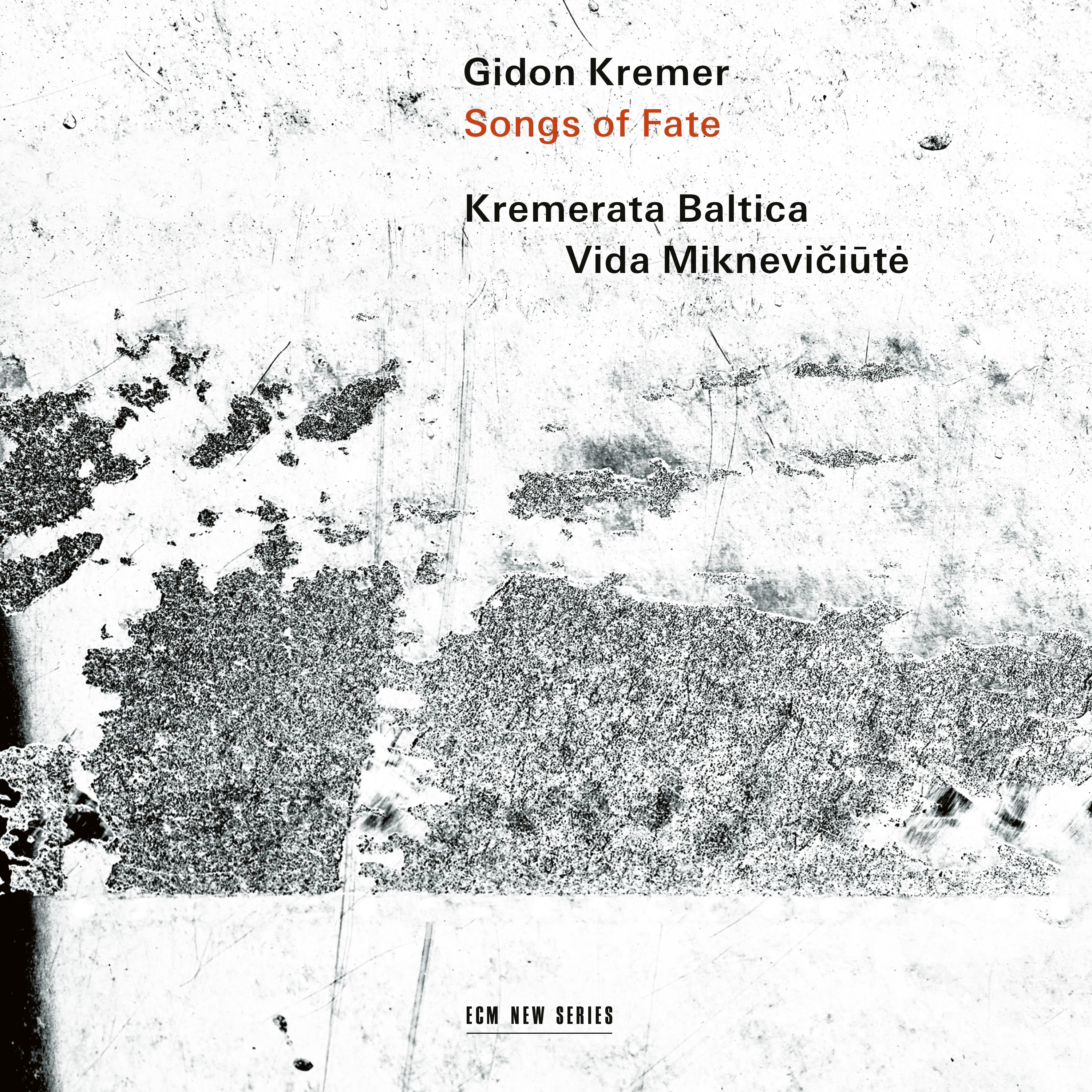
Gidon Kremer: Songs of Fate (ECM New Series 2745)

Gidon Kremer
Songs of Fate

Gidon Kremer violin
Vida Miknevičiūtė soprano
Magdalena Ceple violoncello
Andrei Pushkarev vibraphone
Kremerata Baltica
Weinberg/Kuprevičius
Recorded July 2019
Plokštelių studija, Vilnius
Engineers: Vilius Keras and Aleksandra Kerienė
Šerkšnytė/Jančevskis
Concert recording July 2022
Pfarrkirche, Lockenhaus
Engineer: Peter Laenger
Cover photo: Thomas Wunsch
Album produced by Manfred Eicher
Release date: January 19, 2024

The word fate comes from the Proto-Indo-European root meaning “to speak, tell, say.” In its Latinate forms, it took on the nuance of that which was spoken by the divine. Both senses give us doorways into the present disc, in which Gidom Kremer leads his Kremerata Baltica through the works of Mieczysław Weinberg (1919-1996) by way of living composers from the Baltic states. “This program,” Kremer notes, not coincidentally, “is meant to speak to everybody, reminding us of tragic fates along the way and that we each have a ‘voice’ that deserves to be heard and listened to.” In his brilliant liner notes, Wolfgang Sandner speaks of Kremer as an artist of multiple voices, having a “Jewish first name, German surname, Swedish ancestors, Latvian birthplace, three mother tongues, a love of Russian culture, and an imposed Soviet socialization.” And yet, these categories, he observes, dissolve the moment we utter them, for they are creatively inferior to the music that constantly defines (and redefines) the violinist and conductor’s sense of self.

For the past decade, Kremer has been a fervent champion for Weinberg via ECM (see, most recently, his traversal of the solo violin sonatas). Now, he reveals more obscure works by the Polish composer whose fragmentary yet coherent identity mirrors the interpreter’s own. From the dream-laden Nocturne (1948/49), arranged by Andrei Pushkarev for violin and string orchestra, to the dancing Kujawiak (1952) for violin and orchestra, a tapestry of sounds and textures blesses the ears. Between them are the tempered joys of Aria, op. 9 (1942), for string quartet, and three selections from Jewish Songs, op. 13 (1943), for soprano and string orchestra, on Yiddish poems by Yitskhok Leybush Peretz. The latter, originally published as Children’s Songs to avoid Soviet detection during the war, constitute a moving picture of thought, life, and action translated through the weakness of the flesh. Soprano Vida Miknevičiūtė navigates their pathways—by turns folkish and dramatic—as a needle in the dark.

Giedrius Kuprevičius (*1944) yields an equally substantial sequence bookended by two movements from his chamber symphony, The Star of David. The Postlude thereof is a duet between Miknevičiūtė and Kremer, in which David’s mourning for Saul and Jonathan funnels itself into introspection, connecting and gathering the soul. Between them are two refractions of the Kaddish, or Jewish prayer for the dead. In both, the mood implodes even as the heart struggles to contain every last molecule of sadness.

Before all this, we begin with the tremors of This too shall pass (2021) for violin, violoncello, vibraphone and string orchestra by Raminta Šerkšnytė (*1975). In listening (and we mustlisten) to Kremer’s lone voice emerging from an expanse that threatens to swallow us whole, we find cellist Magdalena Ceple joining not as an ally or hero but as a fellow questioner, one who throws kindling of doubt into the fireplace of mortality. Vibraphonist Andrei Pushkarev speaks of snow at first but soon reveals the language to be that of ice, thin and prone to breaking should one dare to overstep. By the time the orchestra shines its light, Kremer’s recitative has already laid bare the foundations of a story dislocated by memory. The world tries desperately to lock it into place, but it refuses—not through violent resistance but through the peace that comes from knowing who one is.

Concluding this fiercely intimate mosaic is Lignum (2017) by Jēkabs Jančevskis (*1992). Scored for string orchestra, svilpaunieki (ocarinas), chimes and wind chimes, it bids us to listen again, no longer to the instruments themselves but to the materials of which they are made. The violin’s dissonant entrance is the friction of leaves in an orchestral forest. Much like Erkki-Sven Tüür’s architectonics, Jančevskis looks to nature as a source of internal dialogue. As chimes grace our periphery just beyond the treeline, he reminds us that every word lost to the wind has a place to return to.

Anja Lechner: BACH/ABEL/HUME (ECM New Series 2806)

Anja Lechner
BACH/ABEL/HUME

Anja Lechner violoncello
Recorded May 2023, Himmelfahrtskirche, Munich
Engineer: Peter Laenger
Cover photo: Sam Harfouche
Produced by Manfred Eicher
Release date: October 18, 2024

A solo program is never a solitary endeavor. While it may nominally include a lone performer—in this case, cellist Anja Lechner, in her first such recording—it is ultimately a conversation with the music, engineer, producer, and oneself. And in the trifecta of composers assembled here, we are included in that conversation. Throughout the opening swoon of A Question, one among a handful from former Scottish mercenary Tobias Hume (c. 1579-1645), and its companion piece, An Answer, the beginning and the ending become indistinguishable. (I also like to think that the answer comes unintentionally in the snatch of bird song heard at the end of the latter track.) Harke, Harke features pizzicato colorations and bow tapping—and may, in fact, be the first score to feature a col legno instruction—for delectable contrast. These pieces are from Hume’s 1605 collection of dances and miniatures, “The First Part of Ayres,” welcoming us into a sound-world that begs uninterrupted listening.

German pre-Classicalist Carl Friedrich Abel (1723-1787), another viol master who returned to the form a century and a half later, yields two vignettes in d minor. Where his Arpeggio is an enchantment, shining across the strings in refracted sunrise, the Adagio is a piece of paper blown down a cobbled street by the wind of an oncoming storm.

Against this backdrop, the Cello Suite No. 1 of Johann Sebastian Bach (1685-1750) is a piece of a fallen star. In the Prélude, there is enough shadow to remind us that even the most joyful discoveries depend on sorrows, rendering their contours all the more pleasurable to behold. Lechner wields her bow as the weaver does a shuttle. From where she sits, the frays of the tapestry’s backside are within reach, while from our perspective, it is richly and coherently patterned. As the Allemande shapes the clouds and sky, the Courante and Sarabande populate the valley below with equal measures of vibrance and infirmity. In the Menuet, we encounter the tinge of old age, where eyes still sparkle with the naivety of youth even as they are tempered by the cataracts of regret. The final Gigue frees the soul from its cage.

Given how heartfully Lechner renders all of this, moment by precious moment, how can one not reflect upon her spirit of exploration and improvisation through a career as varied as her repertoire? We are all the more blessed by her ability to pull life from her instrument as one draws water from a well. Like the composer himself, even when repeating the same format in the Cello Suite No. 2, she holds the power of variation incarnate. This Prélude is a drop of ink preserved in water, holding its color and identity no matter how much the Allemande may jostle it. Lechner maintains a level voice, holding firm to the horizon so that the occasional flight toward the sun or dive toward the ocean floor feels all the more novel. In that sense, the Courante is as vivacious as the Sarabande is funereal, each a stage setter for the final footwork.

Further aphorisms from Hume, each addressing a different facet of the human condition, conclude the recital. By turns playful and sensual, they delight with such titles as Hit It In The Middle and Touch Me Lightly. The strongest musculature is reserved for A Polish Ayre, which reminds us of just how physical the cello can be. Throughout these interpretations, Lechner is ever the shaft of light to its prism, splitting a spectrum of mastery that can only flourish behind closed eyes. The result is an act of great intimacy built over years of trust with ECM and its listeners, giving her soil to plant a variegated garden of nourishment. She has the dirt under her nails to prove it. Let the water of our high regard be its rain.

Evgueni Galperine: Theory of Becoming (ECM New Series 2744)

Evgueni Galperine
Theory of Becoming

Evgueni Galperine electronics, sampling
Sergei Nakariakov trumpet
Sébastien Hurtaud violoncello
Maria Vasyukova voice
Recorded 2021/21, Studio EGP, Paris
Engineer: Aymeric Létoquart
Mixed November 2021, Les Studios de la Seine, Paris
by Evgueni Galperine, Manfred Eicher, and Aymeric Létoquart
Cover painting: Lorenzo Recio
Album produced by Manfred Eicher
Release date: October 21, 2022

If a composer is an author, then Evgueni Galperine is one who allows characters, actions, and places to speak themselves into logical corners, then breaks those corners to let the vacuum of space have a say. Based in Paris since 1990, the Russian/Ukrainian composer cites the language of cinema as his creative crucible. His first project in that regard was Andrey Zvyagintsev’s Loveless, a soundtrack he wrote sight unseen. (ECM listeners may remember another Zvyagintsev film, The Return, and its music by Andrey Dergatchev.) In the present program, Galperine tears his mise-en-scène from the pages of life itself. Whether reworking prerecorded material or responding to instruments in the moment, this “augmented reality of acoustic instruments” connects events of importance in his life. Aided by the contributions of Sergei Nakariakov (trumpet), Sébastien Hurtaud (cello), and Maria Vasyukova (voice), he breaks the electro-acoustic mold as he defines it, careful not to step on any shards left by the process to regard the partial reflections they offer.

Much of the work is personal, giving us glimpses into the experiences that have shaped his movements in the world. The most poignant is “This Town Will Burn Before Dawn,” for which Galperine imagined himself combing through the rubble of a destroyed futuristic city. “This simple idea took on a whole new meaning with the invasion of Ukraine,” he says, “the land of my father and of my childhood.” And while hope is found, it is unreachable. A cello stretches its arms but finds no contact in return, only an imagining of light amid ringing bells. Like “Soudain, le vide” later in the album, it is a requiem as much for the living as the dead. The flesh, it seems to whisper, is inseparable from shadow. “Oumuamua, Space Wanderings” is a more ambitious but no less intimate self-examination. Inspired by the oblong asteroid that enchanted the world with possibilities of interstellar contact in 2017, it writes its origin story with a Jon Hassell-esque morphology, nestled in an overlay of bright digital signatures and a seeking spirit.

With other influences ranging from Claude Debussy and Dmitri Shostakovich to György Ligeti and Arvo Pärt, a listening mind is clearly at work. Having such a list at hand prompts me to seek other paths of connection. The bellowing of low horns in “Cold Front” evokes the dawn-kissed expanse of Hans Zimmer, while the trumpet of “After The Storm” exhales like the foggy tropes of Ingram Marshall. To be sure, the high strings and beautiful dreams of “La lettre d’un disparu” make for an easy parallel with Pärt’s Tabula rasa. But they also bring me back to my first encounter with Three Pieces in the Olden Style by Henryk Górecki. If anything, my deep kinship with the Polish composer’s broad oeuvre rings truest for me throughout Theory of Becoming. I feel it in the translucent veil of “Kaddish” and the unrelenting textures of “The Wheel Has Come Full Circle”—not simply in terms of structure but in Galperine’s sense of time. It’s like he stretched out Old Polish Music thin enough to see the sun through without letting it rip, giving us a diffuse lens through which to regard the precariousness of our existence.

Even when the inspirations are of a more imaginative persuasion, they feel no less real. A childlike wonder reigns supreme in “Don’t Tell.” This melange of whistling, percussive clicks, trembling strings, and celesta is a record spinning backward. It cradles a flute like a newborn sibling, ending in a unified song of well-being. Lastly, “Loplop im Wald” refers to the magical bird solely capable of traversing Max Ernst’s mysterious painted forests. Tenser and moonlit, its Morse code trails ever outward into a calling of escape, hoping nature won’t come crashing down on itself before the journey can be completed.

With such a profoundly familiar sense of imagination to regard, we are left with only ourselves as companions, conversing until we implode as sound itself.