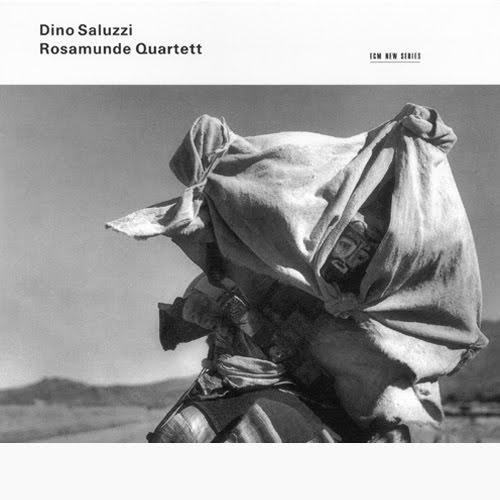
Dino Saluzzi/Rosamunde Quartett: Kultrum – Music for bandoneón and string quartet (ECM New Series 1638)

Dino Saluzzi
Rosamunde Quartett
Kultrum: Music for bandoneón and string quartet

Dino Saluzzi bandoneón
Andreas Reiner violin
Simon Fordham violin
Helmut Nicolai viola
Anja Lechner cello
Recorded March 1998, Propstei St. Gerold
Engineer: Markus Heiland
Produced by Manfred Eicher

The relationship between Argentinian bandoneónista Dino Saluzzi and ECM’s mainstay Rosamunde Quartett has produced some of the most intriguing cross-culturalisms the label has yet to offer. Not so much a coming together of genres as it is an unraveling of possibilities within them, Kultrum manifests much of the latent orchestrations lurking within Saluzzi’s compelling solo outings of years past. The inaugural “Cruz del Sur” is utterly emblematic of the project’s fecundity, cutting strings from the cloth of Saluzzi’s distinctive sound and winding them into a singular amalgamation of rustling and stillness. At once dolorous and laudatory, the sound strays ever so gently into the ecstatic harmonies of “Salón de tango,” in which sparks of confluence abound at every turn. Here, as in much of the album’s hour-long recollection, Saluzzi asserts his rhythmic and melodic authority with a humble joie de vivre. Generally, the music dons solemn clothing, as in its most potent moments between Saluzzi and Rosamunde cellist Anja Lechner, giving us a foretaste of their untouchable Ojos Negros session some eight years later. Every color they mix is rendered lighter by the surrounding musicians. Brief dissonances either slide with ease or are slowed to the point of non-existence. “Miserere” provides brittle catharsis in a brewing fugal storm. Pizzicato statements flash like lightning without thunder. “El apriete” wrings the heart of its sympathy and rehydrates it with renewed life, as if to shield us from the mournful edge of the album’s remainder, which erases thin lines from a darkening periphery before folding in on itself to end.

Much like Ástor Piazzolla, of whom he is heralded as the only legitimate successor, Saluzzi cuts an unmistakable form in any auditory context. His reach is already so orchestral that the present expansion seems only nature. And while the musical talents thereof are as high as one would expect in an ECM recording of this caliber, the compositions themselves are the real stars here, leading said talents into new directions. This is an album that inhales in black and white, but exhales only color. Assuming we are able to approach it with a blank canvas in mind, who knows what images might come of it?

<< Jack DeJohnette: Oneness (ECM 1637)
>> John Surman: Proverbs and Songs (ECM 1639
)

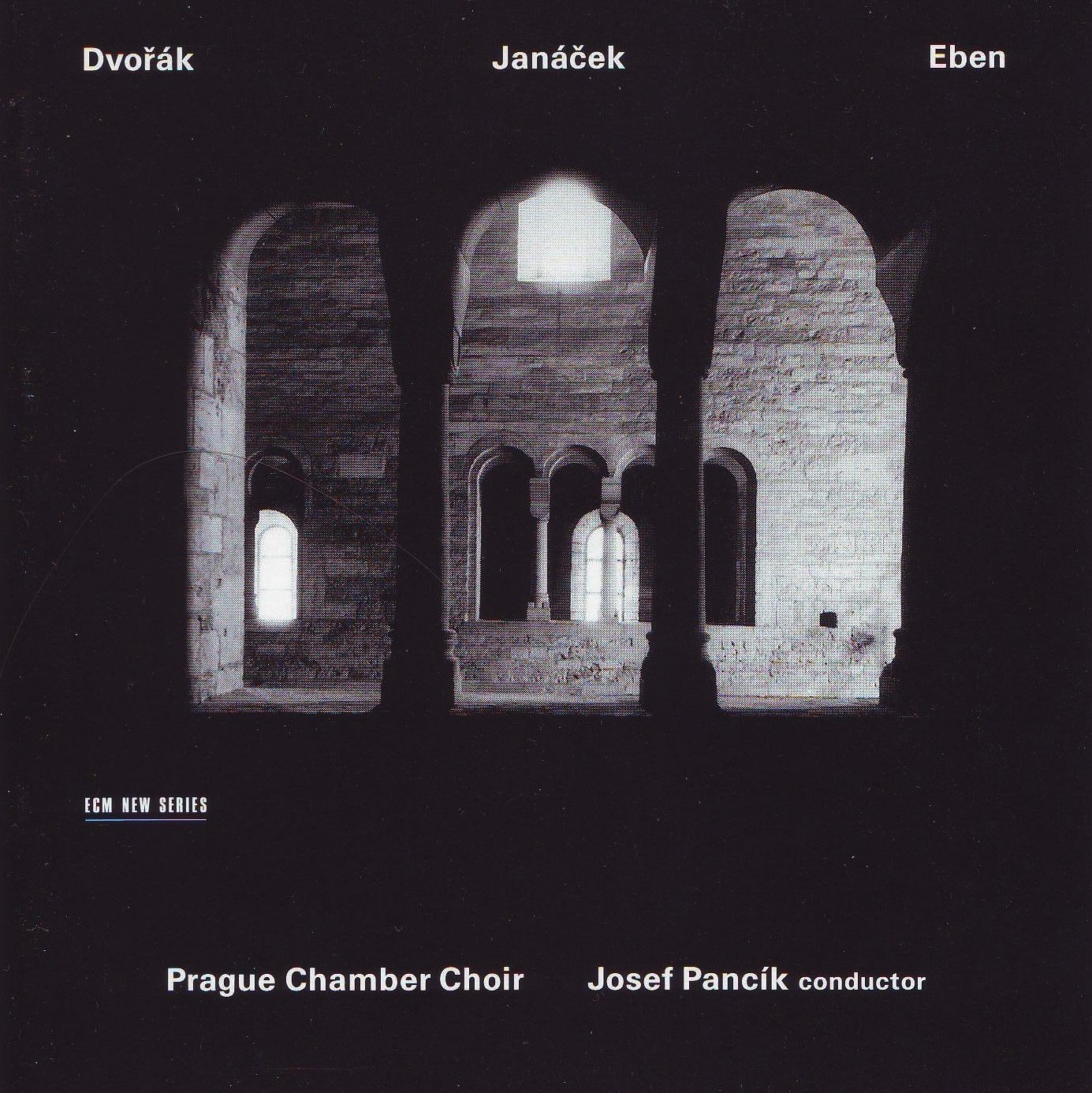
Prague Chamber Choir: Dvořák/Janáček/Eben (ECM New Series 1539)

Prague Chamber Choir
Dvořák/Janáček/Eben

Prague Chamber Choir
Dagmar Masková soprano
Marta Benacková alto
Walter Coppola tenor
Peter Mikulás bass
Lydie Härtlová harp
Josef Ksica organ
Josef Pancík conductor
Recorded November 1993 at Rudofinum/Dvořák Hall, Prague
Engineer: Markus Heiland
Produced by Manfred Eicher

Formed in 1990, and emergent in the newly independent Czech Republic, the Prague Chamber Choir offers in its only ECM appearance this harmonious program of Bohemian church music. In the accompanying liner notes, Antonín Pešek draws our attention to the thriving Catholic pulse beneath what was then a topical spread of patriotic provincialism, and in so doing allows us to contextualize the music as part of an auditory archive. The three works on this program are like a spectrum of light, gradating from ultraviolet to infrared in the space of an hour.

Antonín Dvořák may not have been primarily known as a choral crafter, but his “honorary” Mass in D major, op. 86 (1887), through which the composer pays homage to the ruins of the past without succumbing to the “progressive” tendencies of their rebuilding, has an allure all its own. The Kyrie is a lovely opening, each vocal line clearly articulated in a loose macramé of faith. Glittering moments from the tenors crash like the crest of a wave over a sandy organ. Four soloists arise from this dense tide, of which the soprano is arrestingly emotive. The Gloria provides an exuberant change of pace, again set aloft by a gorgeous tenor section. The 10-minute Credo, on its own a masterful composition, is perhaps a touch saccharine and longwinded, even if it makes the Sanctus all the more jewel-like for its brevity. The latter’s exuberant opening, transcendent organ solo, and mounting volume coalesce like an unforgettable memory. The famous, often singled-out Agnus Dei remains the high point of the piece, a lullaby in spiritual clothing.

Leoš Janáček’s humble offering is Our Father (1901), a sensitively set Creed with an unmistakable harp ostinato and lush organ writing. The insightful tenor solos stick to the mind like glue, bonding love and awe through a single human voice. Says Pešek of this piece: “The calls for bread reflect the feelings of the defiant plebian, who does not demand the ‘consecrated bread of tradition,’ but the daily bread of true humanity.” And indeed, we find in it as much secular as spiritual solidarity. Janáček’s protean understanding of the human voice was entirely his own, and comes through in the physical shape in which every note seems to be described. Arousing in its flavors and unique in its textures, the shattering Amen at the end rings in the head and in the heart long after its resonance fades.

The Prague Te Deum (1989) of Petr Eben is a fitting cap to this fountain of vocal wisdom. Eben’s ode to renewal after oppression has a somewhat antiphonal structure and pays strict attention to the rhythms of its text. Like the sociopolitical about-face that undergirds its creation, the music vacillates between dissonance and harmony, if not embodies both simultaneously, as it basks in the glow of an uncertain future. The upward-looking ending revels in its own sound in the face of a God whose silence is music.

This is a proclamatory album representative of a significant trajectory in European history, but one often obscured by ECM New Series heavyweights. The music is cumulative, the performances committed, and the sound crystalline. A worthy addition to any choral enthusiast’s collection.

<< Azimuth: “How it was then…never again” (ECM 1538)
>> Heinz Holliger: Beiseit/Alb-Chehr (ECM 1540 NS)

Bach: Six Partitas – Schiff (ECM New Series 2001/02)


Johann Sebastian Bach
Six Partitas

András Schiff piano
Concert recording, September 21, 2007, Historischer Reitstadel, Neumarkt
Engineer: Stephan Schellmann
Produced by Manfred Eicher

After completing his highly praised Beethoven cycle, pianist András Schiff returns to Bach in this spot-on live recording of the Six Partitas. Though published as his Opus 1, the Partitas were Bach’s last compositions for keyboard. Both reasons make it a keystone in the mythical Bach pantheon. Although “partita” is essentially a euphemism for “suite,” in Bach’s hands the form was opened to a freer and more complex sense of infrastructure and performative demands.

The introductions show both composer and performer at their best. The Praeambulum of Partita V is a tour de force of rhythmic urgency and dynamic control. The Fantasia of Partita III is another astounding inauguration, its resplendence cluing us into the genesis of the music to follow. The meditative Praeludium of Partita I contrasts sublimely with the Sinfonia of Partita II, the latter a stately lead-in to the courtliest of the Partitas. The accompanying Allemandes overwhelm with their sparks, conflagrating our souls into rapt attention. The pacing throughout is nothing short of extraordinary. Schiff’s sprightly Correntes glisten like rain-drenched leaves, tempering their surrounding flames with a quiet power.

Schiff truly excels in his ornaments. Take, for example, the heart-stopping trills of the Partita III Tempo di Minuetta, his detailed graces in the Passepied of the same, and the half-step motions of his Partita I Gigue. The Partita II Gigue provides some especially enlivening moments in which the right hand goes high and left hand carries the rhythm downward. Such motions broaden the expanse of the music into epic territories, which is all the more amazing for music that is so closely confined to the arm span of a single performer. Not to be outdone by his own passionate spirit, Schiff finesses his way through the Sarabandes of Partitas I and IV with the gentle persuasion of an aristocrat stripped to the naked heart. Also of note are the flowing syncopations of the Partita II Rondeau, played here to perfection in one of the performance’s most glorious turns. The following Capriccio pirouettes its way through a deft and vivacious choreography.

Schiff’s ordering—V, III, I, II, IV, VI—is conscious, moving in ascending keys from G major to E minor. It also carries us into the most heartfelt pieces therein. Partita VI is the castle of these sprawling grounds. Its lofty spaces give ample breathing room for the loveliest Sarabande of the collection, not to mention a strikingly forward-looking melody. Moving with a delicate ease and supreme comfort, it primes us for the epic Fugue through which all comes to a rousing close.

I have no interest in staking a claim in the already bristling ground of musical criticism as to whether Schiff is the better interpreter. All this humble admirer knows is that, like the other superstars to which one might compare him, he is unafraid to show us how he “feels” Bach. It’s not as if he accesses some pure core of the music that others do not, for he plays it as if it were his own. Whether or not one agrees with his stylistic choices, his commitment to them is undeniable. And perhaps said commitment is a more profound measure of the performer. If we consider some of the greats in this regard—Glenn Gould, Rosalyn Tureck, Sviatoslav Richter, and Tatiana Nikolayeva—we find in each a style without regret, an allegiance to a particular historical moment (or possible transcendence thereof, in the case of Gould), and a total lack of interest in relativity. Each performance is not an ingot to be judged against the quality and density of others, but is a reflection of the musician’s own creative makeup that is beyond petty comparison. Rather than look at how and why interpretations differ, as listeners we can only find the differences they bring out in ourselves. And are we not also contributing to the uniqueness of the performance? For the same music can change with our moods and circumstances. And so, when we approach the Partitas, perhaps it benefits the music more to consider what we have to bring to the experience that no other listeners can bring, just as we might expect the same for the musician performing it. For me, the strength of Schiff’s playing is that it duly reminds us of our role on the other side of the piano, foregrounding our engagement, which is the music’s lifeblood. We see this in Schiff’s Beethoven cycle, his Schumann, and his Goldberg Variations. And now, with the Partitas we are given a greater responsibility to provide that “live” feeling ourselves in whatever private chambers we inhabit, or with whomever we might share it. This music is always there for us.

Like Bach’s other masterworks for solo instruments, the Partitas have a distinctive aura of completeness about them, which is to say they feel entirely self-satisfied. And it is this satisfaction Schiff brings to his playing: not a sign of arrogance, of professed authority, nor even of excellent musicianship, but rather the consummation that the music invites in the performing and in the listening. This is the genius of Bach: not the music itself, but in knowing our ability to hear in it forgotten pieces of ourselves. It may not be universal music, but so help me if it isn’t universally musical.

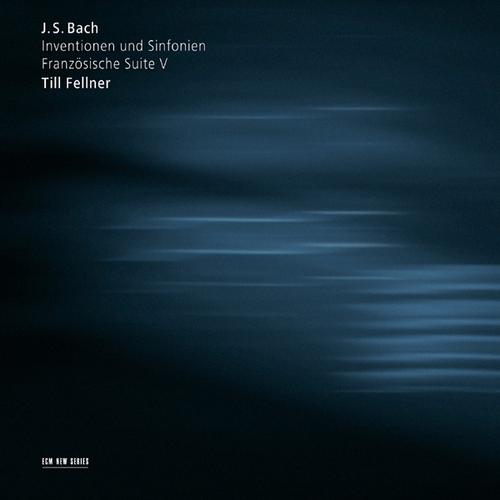
Bach: Inventionen und Sinfonien/Französische Suite V – Fellner (ECM New Series 2043)


Johann Sebastian Bach
Inventionen und Sinfonien/Französische Suite V

Till Fellner piano
Recorded July 2007, Mozartsaal, Wiener Konzerthaus
Engineer: Markus Heiland
Produced by Manfred Eicher

What is a “Bach interpreter”? Is it someone who draws from creative reserves to put as unique a spin as possible on much-performed repertoire? Must s/he be selfless and allow the music to “speak for itself”? After a four-year wait, Austrian pianist Till Fellner follows up his humble ECM debut recording of Bach’s Well-Tempered Clavier with the often overshadowed Two and Three Part Inventions, through which he answers these questions with one of his own: However Bach is painted, what is the image being maintained?

From note one, this is a clearer, more present album than Fellner’s somewhat murkier (and no less affecting) WTC. He holds up every piece to his jeweler’s eye, that we might better see its overall prismatic nature. His rhythms are protean and proper, giving the faster movements just enough pep to gain savory traction while lacing the slower ones with a luxuriant sweetness. As with his last studio effort, Fellner shows a profound ability to draw out the denser implications of the latter (particularly Inventions No. 6 and No. 7; Sinfonias No. 2, No. 6, and No. 7). The more rapid flights are so clearly separated in his fingers that one never gets lost in their overload of grace. From the gravid yet fluid treads of Inventions No. 4 and No. 8 to the trill-infused menagerie of No. 10 and the invigorating No. 13, each instructive development unfolds a new page in this evolving book. Two Sinfonias—No. 11 and No. 15—grow especially more complex with each new listen. Their aquatic transparency and sweeping runs bow like a servant at court to a faceless monarch of sound. Fellner caps the program with a spacious rendition of Bach’s French Suite No. 5. Showing again his supreme pacing in the opening Allemande, he continues through a must-stop-whatever-you’re-doingly gorgeous Sarabande on his way to a winged Gigue.

Intended as the Inventions were as mere didactic exercises, their lines are unmitigated and succinct. Yet for all their brevity, a macrocosm of chords swings between its molecular monkey bars. Fellner plays utterly pianistically, and in doing so makes no qualms about the newness his style can bring. The variable volume of the instrument is taken full advantage of by Fellner, who allows choice notes to ring out and descend. In doing so, he manages to pull off an astounding feat: reinvigorating Bach with utter complacency. Says Fellner of these pieces: “Literally every note counts.” But when he plays, it all comes down to one.

Erkki-Sven Tüür: Crystallisatio (ECM New Series 1590)

Erkki-Sven Tüür
Crystallisatio

Tallinn Chamber Orchestra
Estonian Philharmonic Chamber Choir
Tõnu Kaljuste Conductor
Recorded 1994-1995 at Estonia Concert Hall, Tallinn
Engineer: Maido Maadik, Estonian Radio
Produced by Manfred Eicher

Estonian composer Erkki-Sven Tüür (b. 1959) admits that we are products of our environment. To be sure, he and his compatriots would seem to have carved out a distinctive niche in the terrain of classical music, chipped from the ice that locked their creative heritage under Soviet rule. In the same breath, however, he cautions us about adhering our identities to any particular place over another, lest we shun the illustrative details of our indeterminable experiences. In that sense, there is something to be said for music, which in Tüür’s case is as close to audio refraction as one can get: there is no distinguishing its inner and outer upheavals. Enter architectonics, an abiding process through which Tüür discloses the chemical compositions of his singular auditory experiences. As a onetime prog rock musician, he brings a “band” sensibility to his sound, in which one hears an undeniable cohesion.

Architectonics VI (1992) for flute, vibraphone, and strings descends from violins into a series of complex resolutions. It is mathematical in the truest sense, making a case for chaos as its primary expression. Convoluted outbursts from winds, neither spastic nor deliberate, are punctuated by strings, shining a light into this lively debate of inter-instrumental politics.

Passion (1993) for string orchestra is a rare achievement. Its development recalls Henryk Górecki’s Third Symphony, working its way from ground level into the stratosphere of our emotional purview. Its shifts from minor to major keys glisten in a dew-drenched field, accepting the sun’s slow rise. There is, in this piece, as much lateral movement as vertical. Each stage is both a revival of the past and a rehearsal of the future. As the upper strings tighten their grip on reality, the cellos resound with a note for the ages, not unlike a certain tenor’s proclamatory crest in Arvo Pärt’s Magnificat, if relatively foreshortened.

Illusion (1993) for string orchestra dances with every sinew of its bowed body. Though brimming with dynamic suppleness, it turns every statement into a new paragraph. As double basses mark staccato points of articulation, violins reassert their seemingly innate desire to lead. Tõnu Kaljuste’s immaculate direction brings phenomenal dynamic control to bear as the piece builds into an ecstatic reinstatement, an aesthetic lock that grows progressively quieter until the final exultation.

Crystallisatio (1995) for 3 flutes, glockenspiel, strings, and live electronics ushers us into a congregation of drowsy banshees, draping themselves in the canopy of a darkened forest. Electronically processed flutes echo like spirits recast in the image of their own reflection. The cellos are given a mournful urgency, through which they enact a promise of daylight. The glockenspiel’s doublings tickle our very spirits with their arousing pinpoints. The frenzy mounts as the processing reveals its illusions more explicitly. We end on an overblown flute and a single glockenspiel note—a drop in the cosmic pond.

Requiem (1994) for soprano, tenor, chorus, triangle, piano, and strings is the masterpiece of this program, and beyond reason enough to buy this album. Written for friend and conductor Peeter Lillje, it gives us the clearest portrait of an artist working in real time. A struck triangle opens the proceedings, from which baritones spin the Introit. Strings operate sympathetically as the cellos double the tenor line, and the violins skip along their own skyward paths. A tenor introduces the Kyrie eleison as the violins continue their improvisatory pirouettes. Vocal constituents volley back and forth, while at their center a piano comes crashing down in a rupture of spiritual information. Altos and sopranos emerge from the rubble as wavering sirens. They keen and shout in Orff-like exuberance before cracking open a breathtaking Rex tremendae in tutti. A lithe soprano provides reflection in the Recordare. A violin wanders abstractly in timid, almost insectile, commentary. All the while, choral forces are gathering themselves toward a somber end that reenacts the cycle’s beginnings.

Violins play a key role throughout, scratching like an animal searching for something buried but long decayed, a kernel of faith long sprouted into the tree under which it claws in vain. The triangle that opens and closes the Requiem is proof positive that the most direct access to enlightenment isn’t always the grandest, but that sometimes the keyhole rupture of the blinking eye, and the single glint of light upon the tear that falls from it, are sufficient to show the way. The piano, too, plays a commensurate role, a voice of reason at center stage.

This is a transportive album—absolutely so—and one that I will always champion. Like the frozen surface of the jacket photo, it seems at first glance a field of stars, forever locked at the height of brightness. Although I do not feel that ECM’s subsequent Tüür releases have quite attained the magical realism of this one, anyone who shares an enthusiasm for Crystallisatio would do well to place the others alongside it. Tüür’s resolutions are always revolutions in that they, through the promise of completion, only bring forth further fragments for consideration. Rather than trying to achieve balance through this process, Tüür seems to want to make a meta-statement regarding the nature of his compositional process, which is constituted by a need for discourse and reevaluation. Like the tintinnabulations of Arvo Pärt, his atmospheres lay out for us the very topography of a nameless musical environment. Every turn brings about a new needle of contention by which to sew our physiological threads. This is music that makes no promises, yet in doing so fulfills countless numbers of them. As one of ECM’s most groundbreaking releases, second perhaps only to Giya Kancheli’s Exil, this is a must-have for the New Series enthusiast.

<< Meredith Monk: Volcano Songs (ECM 1589 NS)
>> Arvo Pärt: Alina (ECM 1591 NS)

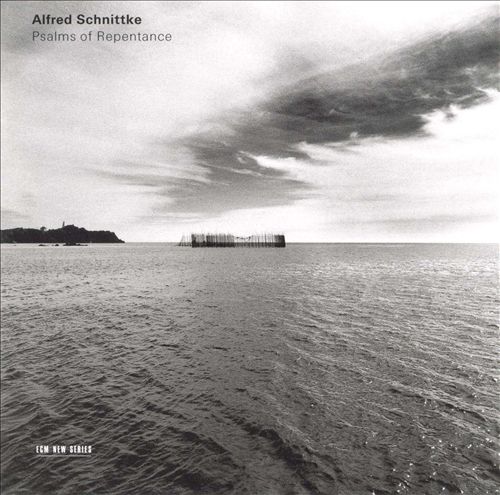
Alfred Schnittke: Psalms of Repentance (ECM New Series 1583)

Alfred Schnittke
Psalms of Repentance

Swedish Radio Choir
Tõnu Kaljuste conductor
Recorded at Högalidskyrkan, Stockholm, Sweden by P2 Swedish Broadcasting Corporation in February 1996
Engineer: Ian Cederholm
Produced by Manfred Eicher

There is a coastal town in Japan, documented by video and performance artist Yamashiro Chikako, where a neglected gate runs off the land and into the sea (not unlike the cover for First Avenue). As the camera tracks its crooked slats and sagging wire, we watch it being swallowed by the waters, marking a border that no longer has any physical meaning. Alfred Schnittke’s Psalms of Repentance are very much like that indefinable territory: the border is there, and at one time provided utilitarian purpose, but has now transcended itself into the realm of the abstract, where it survives only in memory. Because repentance also requires a conception of time and the emotional projections that bind us to its passage, charting one’s hardships in the printed score becomes an exercise in faith, whereby divinity is converted into audible form.

These settings of fifteenth-century poetry were composed to mark the millennial anniversary of Russia’s Christianization. While not known for a cappella choral music, Schnittke unravels himself in these pieces like no other. Each numbered section is its own flower in a plot that only expands with each listen, pollinating the life (and death) of its totality. The heartfelt tenor solo in II, for example, strips us to our core with its solemn insistence, marking the earth like farmland: regular scars gouged into the skin of the earth, from which arise the flora of regret. Dark swaths of orthodox atmosphere and glorious resolutions make IV one of the album’s profoundest sections, and give us the clearest picture of their composer’s distresses and affirmations alike. Women’s voices often gather in dissonant streams of commentary, such as can be heard in VI, while VIII floats from transparency to opacity. There is a quality to these shifts and to this music that can only be described in simile. Like a bolt of light from between the clouds, it is but a blink of cosmic eyes that stills the heart because one cannot think of anything else upon witnessing it. The final Psalm is a singular implosion to behold, its subdued insights melting into a sinful world, a river running through the gorges of a landscape chiseled in the likeness of history.

The instrumentally minded arrangements are sensitive to their texts, while also drawing out inner relationships with such weight that one remains immobile. The album’s recording level is low, thereby necessitating a quiet space for listening, and heightening its more declamatory moments. Conductor Tõnu Kaljuste lends his leading hands to the Swedish Radio Choir, whose earthen sound drips with energy. This is contemplative music at its finest from a composer who continues to enchant, now and forever.

<< Egberto Gismonti Trio: ZigZag (ECM 1582)
>> Pierre Favre: Window Steps (ECM 1584)

Herbert Henck: Alexandr Mosolov (ECM New Series 1569)

Alexandr Mosolov

Herbert Henck piano
Recorded March 1995, Festburgkirche, Frankfurt
Engineer: Andreas Neubronner

“I must compose, and my works must be performed! I must test my works against the masses; if I come to grief, I’ll know where I must go.”

These words, written by Alexandr Mosolov (1900-1973) in a 1932 letter to Joseph Stalin, reveal a composer of fierce disposition and ardent dedication to his craft. The young Mosolov, who had already fought for the Red Army but was discharged for PTSD, continued to see himself as an arm of the Revolution. After earning a living as a silent film pianist, during which time he studied music with Reinhold Glière and Nikolai Myaskovsky, Mosolov had made of himself a pastiche of trenchant modernism and preservationist grace. Of equal dedication is pianist Herbert Henck, who places Mosolov’s work squarely at the crossroads of late Scriabin and early Prokofiev, yet imbues this neglected contemporary with a shadow all his own. Despite being a staunch proletariat, Mosolov was met with resistance from the very faction in whose honor he composed. Enemies in the Soviet Composers’ Union even had him expelled for public disorder and sentenced to eight years in the Gulag. Fortunately, he was released after just as many months when his mentors vouched for his character in a bid for his freedom. During his recuperation, Mosolov extended his interest in the music of Central Asia, particularly in the folk songs in Turkmenistan and Kyrgyzstan, where he traveled to enrich his archive.

The 1920s were Mosolov’s most productive period, well represented by the selections offered here. The Sonata for piano No. 2 in B Minor op. 4 (1923-1924) gives us hints of the “futurism” for which he was most known in such orchestral works as Iron Foundry. Where Foundry is thrumming with productivity, the sonata’s contrast of high clusters and low chords reenact a failing industrial landscape. More confrontational than progressive, it treads with ever-heavier footsteps toward a goal it knows it cannot reach. A morose Adagio applies desperation as a cosmetic and admires itself in a mirror of repetition. Resolve is found only in the culmination of silence, from which the finale is reaped like a crop at the height of ripeness. The Two Nocturnes op. 15 (1925/26) constitute a ponderous, if dynamically diverse, pair, seemingly predicated on a traumatic inward glance and sketchable only in tragedy. After the heartrending opening movement of the Sonata for piano No. 5 in D Minor op. 12 (1925), we come to a whimsical aside, which dances like a childhood dream of Shostakovich before twisting ever so incrementally into a cloudy nightmare. The following Scherzo becomes a violent attempt to awaken oneself in a flurry of futile pinches, all tumbling inward into the physiological certainty that reality is so close and all the more unendurable for its lack of self-awareness. A gorgeous final movement coalesces in dense punctuations in the right hand before plunging into a pool of chords with only potential as life preserver.

Performances of Mosolov’s music were restricted until as late as 1985, since which time it has slowly crept into revival. Leading this quiet march was Detlef Gojowy (1934-2008), musicologist and tireless champion of modern Russian music, whose 1979 “Encounter with the Soviet Union” festival first exposed Henck to the previously obscured composer. Once again, Henck has turned his discovery into ours. He nourishes our ears with palpable meticulousness, playing these pieces as if for the first time, which in some ways he is, liberated as they have been from the annals of unwarranted censorship. These modest offerings are continually fascinating, for they always seem bound to a discernible core surrounded by storms of activity. The entire album is an effigy in sound, every musical gesture describing, however much in artifice, the contours, the ligamenture, the structural integrity of a human body whose only purpose is to burn in remembrance of those who once moved of their own accord. This album is truly a most splendid feather in Henck’s multifaceted cap, and a prime example of ECM’s tireless mission to give forgotten music our undivided attention.

<< Giya Kancheli: Caris Mere (ECM 1568 NS)
>> Eleni Karaindrou: Ulysses’ Gaze (ECM 1570 NS)

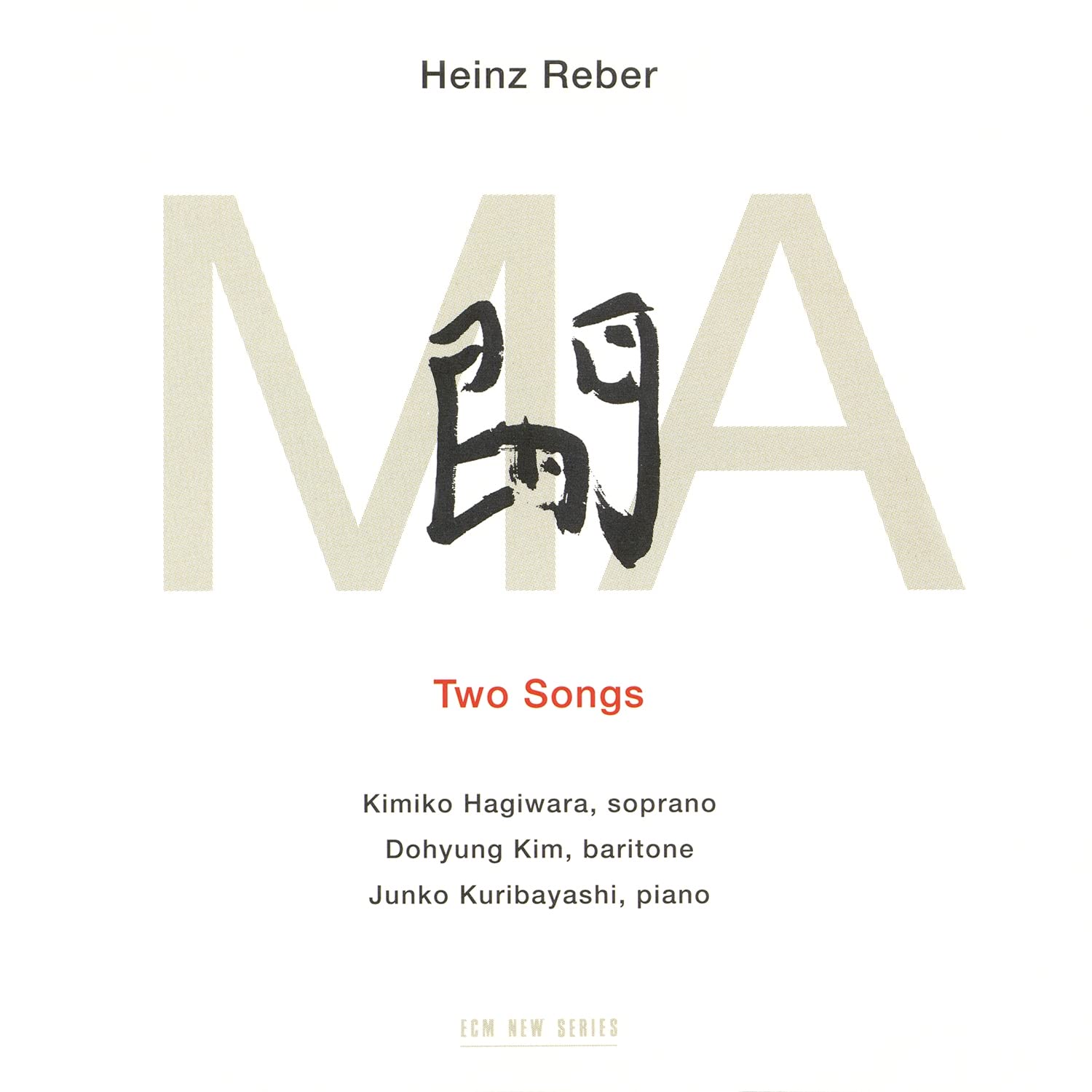
Heinz Reber: MA – Two Songs (ECM New Series 1581)

1581

Heinz Reber
MA – Two Songs

Kimiko Hagiwara soprano
Dohyung Kim baritone
Junko Kuribayashi piano
Recorded June 1994 at Radio DRS, Bern
Engineer: Hans Küenzi
Produced by Manfred Eicher

Freed from the weight of the will towards expression
things come and go.
where it is,
within us,
like an empty glass,
in which something may be poured at any moment.

Heinz Reber’s premature death in 2007 left a musical gap that is never likely to be filled. The Swiss composer didn’t so much chart new paths as abandon the idea of paths altogether. In their place, he enacted an idiosyncratic (yet unusually selfless) comportment of sound in which bodies, voices, and instruments came to describe their own conditions without academic partitions. All of which makes MA – Two Songs all the more remarkable. In its contradictory impulses, one finds auditory portraits of the Second Viennese School (think Arnold Schönberg, Alban Berg, and Anton Webern) and its tonal expansions, as well as, in the words of one press statement, the “relationship of Asiatic singers to the Romantic song tradition.” Although a fascinating album in its own right, as Reber’s projects usually are, this one bids our total attention in order to appreciate not only its texts and their conceptual milieu, but also the brittle agency of its voices, which breathe with all the beauty of a slow-motion breakdown.

“School of Vienna” lives in the depths of a piano, beyond which we hear only the acrobatic soprano of Kimiko Hagiwara. Her tender blend of forced vulnerability and highly trained exposition make for an especially balanced piece, one that both reifies and breaks everything a prototypical Lied should be. This 20-minute diatribe thus becomes an eloquent statement of its own incremental demise. The high note functions here neither as a point of resolution or fulfillment of expectation, nor as the promissory engagement with the listener through the articulation of a lyrical ploy. Rather, it secures the act of singing into place, each piercing vibrato a lynchpin of a broader vocal image. The language is soft to the aural touch, cautious in its extemporization, playing out the ruse of development with a secretly romantic pleasure before being washed out to sea in a robust waver. “School of Athens – School of Noh” drips upward from finger-dampened strings as baritone Dohyung Kim vocalizes the dramaturgy of Antigone alongside an aphasic Hagiwara. The latter reveals herself in fully sung sentences only in the second half, in which she is foregrounded. All the while, Junko Kuribayashi’s pianistic puffs of air act as pre-commentary to the text, opining on every secretive occasion before it is uttered.

As with the equally visceral Mnaomai, Mnomai, there has been a slippage of interpretation I feel I must address. In his liner notes, Hans-Klaus Jungheinrich notes that the “MA” (intermediate space) of the album’s title is a Japanese ideogram combining the characters for “door” (門) and “moonlight” (月) when in fact the calligraphed Kanji in question is made up of the characters for “door” (門) and “sun” (日), which combine to form: 間. While historically, “sun” could have been replaced with “moon” without any change in meaning, nowadays one will likely only see it as it is portrayed on the cover. A subtle error, to be sure, but one that misrepresents a language that is so often prone to a curious overlay of mystique. I point this out only to clarify the music’s underlying structure, as I personally fail to see the “sublime appeal of alienation” that is supposedly inculcated in these pieces. In a musical context at least, I don’t believe this is what MA is all about. To be alienated, especially at one’s own will, is to consciously set up a parallel space to the one being rejected, which is equally viable in its own nothingness. At any rate, Jungheinrich offers poignant insight when he notes the significance of Reber’s overt challenge in “a time of renascent xenophobia.” The combinations inherent in these pieces are unsettling in the present climate, for they posit music both as an act above the confines of the nation-state and one that highlights its own rootedness in land and ideology. As a historical document, music is already archival the moment it is rendered.

Is this deconstruction, or reconstruction? Refreshingly, Reber frames this question as moot.

<< Keith Jarrett Trio: At The Blue Note – The Complete Recordings (ECM 1575-80)
>> Egberto Gismonti Trio: ZigZag (ECM 1582)

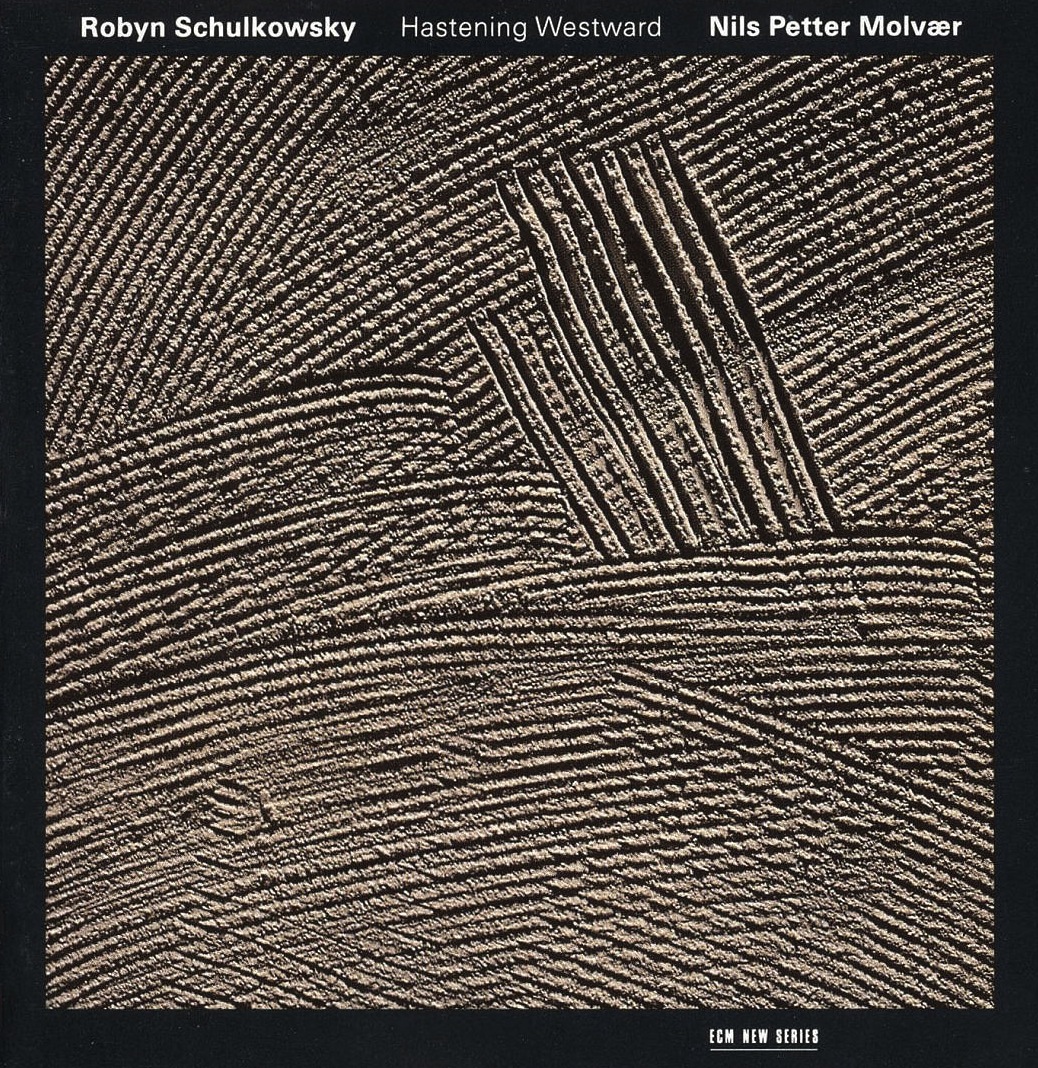
Robyn Schulkowsky/Nils Petter Molvær: Hastening Westward (ECM New Series 1564)

Robyn Schulkowsky
Nils Petter Molvær
Hastening Westward

Robyn Schulkowsky drums, gong, plate bell, crotales, cymbals, bronze bells
Nils Petter Molvær trumpet
Recorded January 1995 at Rainbow Studio, Oslo
Engineer: Jan Erik Kongshaug
Produced by Manfred Eicher

“Grain upon grain, one by one, and one day, suddenly, there’s a heap, a little heap, the impossible heap.”
–Samuel Beckett, Endgame

Berlin-based percussionist Robyn Schulkowsky, heard most recently with Kim Kashkashian on Hayren, joins forces with Norwegian trumpeter Nils Petter Molvær for a singular and lasting document. Schulkowsky has worked with some of the biggest names in modern music—Heinz Holliger, Karlheinz Stockhausen, John Cage, and Iannis Xenakis have all benefited from her dynamic breadth and open precision—but her performance style consistently balances humility with fortitude. In 1991, Schulkowsky composed a percussion ensemble piece entitled “Hastening westward at sundown to obtain a better view of Venus.” The title was lifted from Beckett’s final prose work, Stirrings Still, which, aside from being a vastly important book for Schulkowsky herself, sums up the feeling of this “extension” thereof most succinctly. Originally conceived as a solo project, the album was enriched with a snap decision from Manfred Eicher, who introduced Molvær into the mix. The two musicians had never met, but together they described a challenging world that remains effortless to explore.

The album is comprised of two works. Pier and Ocean, in three parts, begins freely, with more explosive drums lying in wait. Its final part is heaviest, shifting from shamanism to survivalism in a single beat. The title work fills out the bulk of the album. Over seven chapters of varying lengths, it takes its first steps in the whitened paragraphs of a wintry page. A lonesome piano airs its grievances in background. Deep drums inhale the air of mallet percussion. Yet no matter how enervated the music becomes, it always looks down at its own feet. Even the timpanic battle cries in Part 3 are laced with melancholy. Part 4 is the album’s most brilliant, as Molvær falls into a spread of echoed clangs, thus inaugurating a psychosomatic transition from rhythm into rhyme. Part 6 sounds like a seaplane landing on a lake, only we are the water receiving its foreign presence with the same yielding attention as we might give to a bird fishing from our depths. The final “hastening” is anything but, a slow drone with metallic percussion and a few brassy notes divinely attuned to the resonance of gongs.

Sadly, this project was never repeated. Considering the unusual confluence of events that produced it, however, a sequel is hardly necessary. Either way, what it has left behind is solid enough to withstand eons of peripheral development. Hastening Westward is a sublime experience that calls to you when you least expect it. It is neither the thrill of the hunt nor the agony of capture, but the single thread that connects them both.

<< Ralph Towner: Lost And Found (ECM 1563)
>> Mozart: Piano Concertos, etc. (ECM 1565/66 NS)