Christian Reiner: Joseph Brodsky – Elegie an John Donne (ECM New Series 2513)

Elegie an John Donne.jpg

Christian Reiner
Joseph Brodsky: Elegie an John Donne

Read by Christian Reiner
Recorded 2014-2017, Garnison 7, Wien
Recording engineer: Martin Siewert
Mastering at MSM Studio, München
Engineer: Christoph Stickel
Produced by Manfred Eicher and Wolf Wondratschek
An ECM and Joint Galactical Company Production
Release date: August 25, 2017

No man is an Iland, intire of it selfe; every man is a peece of the Continent, a part of the maine; if a Clod bee washed away by the Sea, Europe is the lesse, as well as if a Promontorie were, as well as if a Mannor of thy friends or of thine owne were; any mans death diminishes me, because I am involved in Mankinde; And therefore never send to know for whom the bell tolls; It tolls for thee.
–John Donne

Following his acclaimed readings of Friedrich Hölderlin’s Turmgedichte, by turns stark and revealing, Viennese actor Christian Reiner adds as many layers as he peels away in his approach to Russian-American poet Joseph Brodsky (1940-1996). Although Brodsky was imprisoned in his native Russia as a dissenter, he never explicitly engaged the issue of incarceration until later in life. His lack of self-importance was one of many facets that imbued his verses with microscopic insight into the human condition. Even when awarded the Nobel Prize for literature in 1987, he accepted the honor with humility. A vivid chunk of that humility can be found in what Reiner considers to be his masterwork—1963’s “Great Elegy to John Donne”—which is presented here in two German translations among a tract of shorter, life-spanning selections.

It was in prison, in fact, that Brodsky first read Donne, when a writer friend sent him a book by the English poet. Yet Brodsky’s “Elegy” is more than a paean to a kindred spirit; it’s the recognition of a voice caught between its earthly origins and heavenly destination. His litany of mundane objects—crystal, linen, stockings, and the like—read like a perverse genealogy of material lives. For in the same way that we have succumbed to the immaterial promises of recognition, so do the connective tissues of human and nonhuman experiences string the very tightropes along which our deepest anxieties vie for balance. Just as Donne has died, so too is the world drained of life, unable to finish its own diary with that final answer of Heaven or Hell. Everything is sinking in speech: voices whose owners refuse to identify themselves. Archangels and prophets, kings and slaves, martyrs and murderers—all depleting the same oxygen supply of moral spectra. “All things are distant,” Brodsky writes. “What is near is dim.” Endurance is a fantasy replicated in reality, wherein fingertips graze the backs of our necks with demonic tingling, forever unclear.

Reiner’s diction is characteristically architectural in nuance, as heard in the pained urgency of “In Memoriam Fedja Dobrowolskij” (1958). More importantly, he understands the pregnancy of a pause. His recitation of selected “Strophes” (1978) embodies that philosophy to the fullest, making of silence its own vocabulary. In the sensually inflected“From Nowhere with Love” (Aus nirgendwo in Liebe, 1976), the voice becomes the body, bouncing memories of communion off its own burnished mirror of expression. In the brief, morbid “A Polar Explorer” (Der Polarforscher, 1978), 40 seconds is enough to open the jar of hope and let its rancid contents spill out into the cold. “Lullaby” (Wiegenlied, 1992), by contrast, renders shades of redemption through fixation on immaculate maternity. Throughout these and more, Reiner adds weight to Brodsky’s lists and uncertainty to his spiritual invocations, treating words like shingles for a roof, beams for a doorway, and glass for a window. What we end up with, then, isn’t a house of coherence but a chapel of hard-won truths.

Eleni Karaindrou: Tous des oiseaux (ECM New Series 2634)

2634 X

Eleni Karaindrou
Tous des oiseaux

Savina Yannatou voice
Alexandros Botinis violoncello
Stella Gadedi flute
Vangelis Christopoulos oboe
Yannis Evangelatos bassoon
Dinos Hadjiiordanou accordion
Aris Dimitriadis mandolin
Maria Bildea harp
Eleni Karaindrou piano
Sokratis Sinopoulos Constantinople lyra, lute
Nikos Paraoulakis ney
Stefanos Dorbarakis kanonaki
Giorgos Kontoyannis percussion, Cretan lyra
String Orchestra
Argyro Seira concertmaster
Recorded October 2017 and January 2018 at Studio Sierra, Athens
Recording engineer: Giorgos Karyotis
Edited and mixed September 2018 by Manfred Eicher and Giorgos Karyotis
Produced by Manfred Eicher
Release date: January 25, 2019

“Why little birdy don’t you sing
As you used to sing before?
Oh, how could I,
They had my wings severed.”

In her eleventh album for ECM, Greek composer Eleni Karaindrou gifts us with some of her most poignant music yet. Poignant because, on a political level, it intersects with issues deeply relevant to today’s social climate and, while on a personal level shifting from the Theo Angelopoulos era that quietly ushered her artistry into global imagination.

Music for the play Tous des oiseaux by Lebanese-Canadian writer Wajdi Mouawad is subject of the album’s first half. As is characteristic of Karaindrou, it’s more than incidental but a living part of the dramaturgical landscape. And despite a wide array of instruments, including string orchestra, lyra, kanonaki, oboe, harp, flute, accordion, and cello, the mood is as intimate as it should be for a play centering on the love shared between an Arab American and a German-born Jew. The latter’s Zionist father, David, despite his anger over the relationship, must deal with the revelation of his own Palestinian birth, thereby sending him into a vicious spiral of identity politics.

The drone in which opener “The Wind of War” rests is an accurate representation of that spiritual unrest, the symbolic backdrop against which this story unfolds. As with any history, if you zoom back, it seems to unify in texture. But get close enough to regard individual lives within it, and suddenly conflicts of human error become obvious. Vocalist Savina Yannatou, familiar to ECM listeners as a bandleader in her own right, sings wordlessly, here as also in “Encounter” and “The Impossible Journey”—a voice still voiceless, because it is heard from afar. Even in Yannatou’s unaccompanied “Lament,” a 13th-century Greek song, she cannot pull words from their graves. As one of three solos, along with “Towards the Unknown” for flute and “Je ne me consolerai jamais” for cello, it consigns the fate of an entire people, grazed by breath and weaponry of chance.

In “The Dark Secret” and “David’s Dream,” both for string orchestra, individuals vie subtly for attention, but are drowned by collective trauma. Time becomes timeless, a variation on a theme, just familiar enough to feel real yet off-kilter enough to illuminate mysteries of waking life. “The Confession” adds to that milieu the beat of a drum: reality calling. Like the intersection of oboe and harp in “Why?” or the lyra, ney, and kanonaki of “Between Two Worlds,” it’s a dance without ground. A love divided by self.

Music for Iranian auteur Payman Maadi’s film Bomb, A Love Story constitutes the second half. As the first film Karaindrou has scored since Angelopoulos’s death, it’s a bittersweet milestone. Using the Israeli-Palestinian conflict to set in motion its narrative of self-searching, the film shows us not only that the personal is political, but also that the political is personal. Karaindrou’s soundtrack mirrors that philosophy by foregrounding the bassoon of Yannis Evangelatos, whose instrument—a marginal one in the woodwind family—echoes the marginality of the film’s characters. In this instance, the orchestra serves as omniscient narrator, sending shimmers of hope through “Love Theme,” in which the oboe of Vangelis Christopoulos and the piano of Karaindrou herself fall into shadow: dreams never realized. If not for that, “The Waltz of Hope” might not come across so much as a fantasy and “Lonely Lives” as truth. Further sentiments of travel (“Mitra’s Theme – Walking in Tehran”) and innocence (“Love’s First Call”) touch and part across maps of indifference. Which is why in the “Reconciliation Theme” we find the most instruments deployed at once, recalling the richness of Angelopoulos’s character studies. Only now that mist has been lifted, exposing figures whose every feature cries with vivid detail.

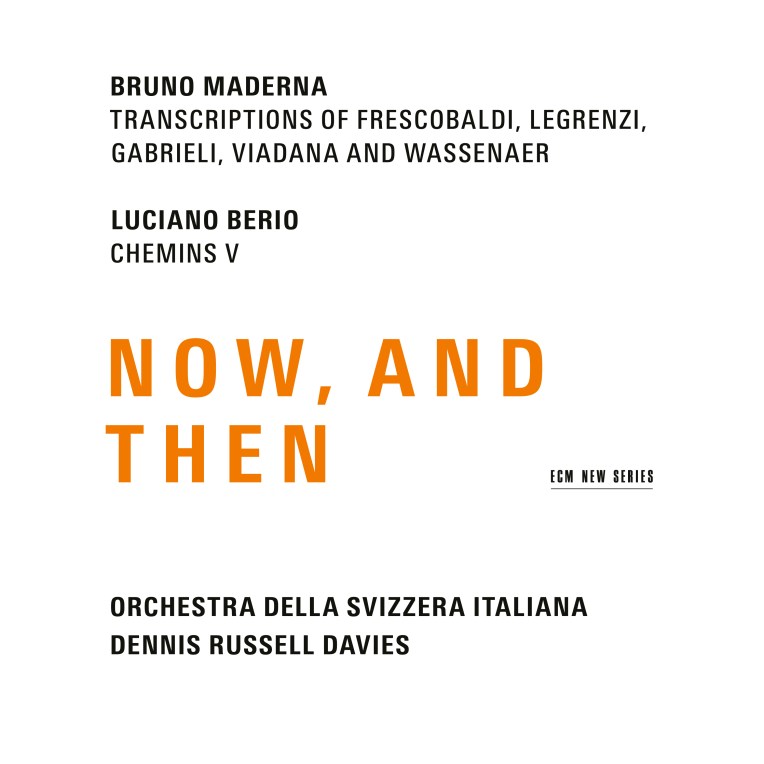
Bruno Maderna/Luciano Berio: Now, And Then (ECM New Series 2485)

2485 X

Bruno Maderna
Luciano Berio
Now, And Then

Orchestra della Szizzera italiana
Dennis Russell Davies
conductor
Pablo Márquezguitar
Recorded August 2015, Auditorio Stelio Molo RSI, Lugano
Engineer: Michael Rast (RSI)
Editing and mixing: Michael Rast and Manfred Eicher
Produced by Manfred Eicher
Release date: October 27, 2017

Bruno Maderna (1920-1973) was an instrumental force in contemporary music throughout the 1950s, when composers of “modern” persuasion were still struggling to at once uphold and break open the secrets of bygone masters. Maderna was no stranger to the past and had a particular fondness for the clarity of the Italian Baroque, as evidenced in his transcriptions of Girolamo Frescobaldi, Giovanni Legrenzi, Giovanni Gabrieli, Tommaso Lodovico da Viadana, and Unico Wilhelm van Wassenaer presented by the Orchestra della Szizzera italiana under the baton of Dennis Russell Davies.

It should come as no surprise that Maderna had a love for the theatre, as these pieces breathe like dramaturgical backdrops to well-studied action. While nearly all of them date from 1952, the sole exception is Gabrieli’s Canzone a tre cori (1969/72), of which Maderna’s recrafting turns glory into lyrical shadow. Frescobaldi’s Tre Pezzi (1952), by contrast, constitute an exercise in contradiction. Robust yet naïve, they move fluidly across and between planes of exposition. The liturgical center, comprised of a brief “Christe” and “Kyrie,” hints at a spiritual undercurrent before deferring to a regal finish. Against this, La Basadonna (1951-52) is a delightful interlude that dances with delicate assurance across this dioramic stage. As heartbeats of golden ages mesh into an elegy for silver futures, Viadana’s Le Sinfonie (1952) reads like an archive of memory. It’s portrait of Italian cities bustles with life and character. Of these, the buoyant “La Venetiana” recalls the programmatic brilliance of Carlo Farina. Last is the “Palestrina-Konzert” (1952) by Wassenaer. Once attributed to Pergolesi, this gorgeous triptych sets up an alluring Vivace through two slower precursors. Enchanting sonorities abound.

From all of these, we know that Maderna understood Baroque music as a giant wheel, sporting a clearly defined center from which regular spokes extended to an more open perimeter. His respect for that underlying architecture reveals its own.

Lodged therein, between the Legrenzi and Gabrieli, is Chemins V, a self-transcription of Sequenza XI (1987-88) by Luciano Berio (1925-2003), with whom Maderna founded Europe’s first electronic music studio, the Studio de fonologia musicale di Radio Milano. This piece, composed in 1992, receives its premiere recording here. Featuring guitarist Pablo Márquez on the instrument for which it was originally written, it’s a deeply psychological journey. Márquez navigates every topographical change with confidence, finding purchase on the narrowest of cliffs and staying grounded on the slipperiest of terrain. Brimming with Berio’s uncanny ability to make the beautiful eerie and vice versa, it treats the guitar as leading voice and internal percussion, ambulating without apparent direction until the subdued, shimmering finale. Worth the price of entry alone, this rare morsel in an already-rich covering speaks to the core of our being as a species at a time when uncertainty rules the day.

Burkhard Reinartz: Eine Olive des Nichts (ECM New Series 2435)

Eine Olive des Nichts

Burkhard Reinartz
Eine Olive des Nichts

Burkhard Reinartz conception, reciter
Anja Lais reciter
Bruno Winzen reciter
Recorded August 2013, Rheinklang Tonstudio, Köln
Recording engineer/sound design: Alexander Hardt
Album produced by Burkhard Reinartz
Release date: September 19, 2015

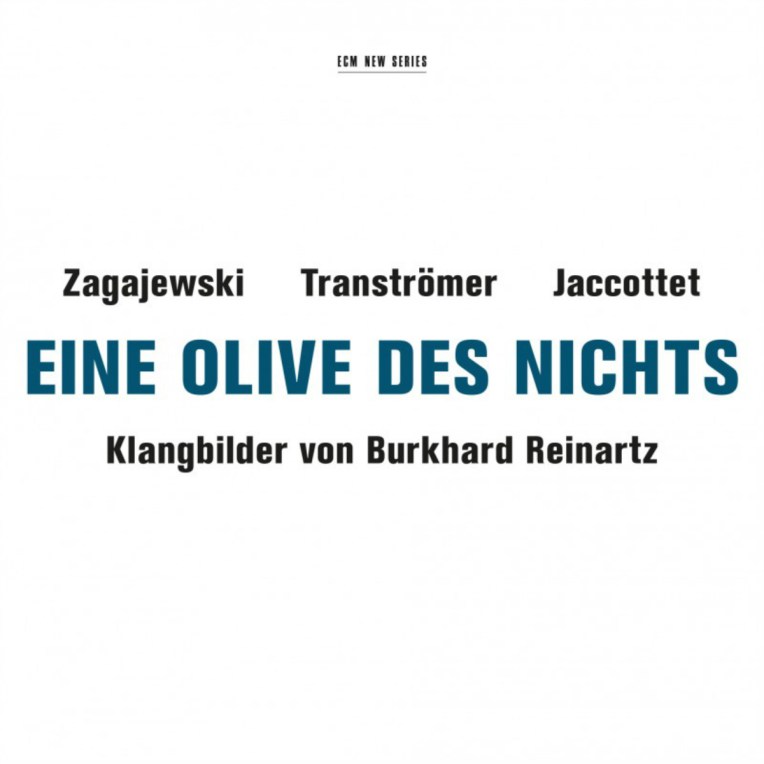
For Eine Olive des Nichts (An Olive of Nothingness), Cologne-based radio director Burkhard Reinartz has curated a personal collage of poetry by Adam Zagajewski, Tomas Tranströmer, and Philippe Jaccottet, as read by Anja Lais, Bruno Winzen, and Reinartz himself. More than a spoken word project, however, it coheres by virtue of music drawn from ECM’s vast back catalog by Eivind Aarset, Susanne Abbuehl, Jon Balke, Nik Bärtsch’s Ronin, the Stefano Battaglia Trio, the Wolfert Brederode Quartet, Ketil Bjørnstad, David Darling, Andrey Dergatchev, Mathias Eick, Sidsel Endresen, Morton Feldman, Food, Michael Galasso, Paul Giger, Jon Hassell, Arve Henriksen, the Benedict Jahnel Trio, Meredith Monk, Arvo Pärt, Michele Rabbia, Trygve Seim, Steve Tibbetts, Tomasz Stanko, the Bobo Stenson Trio, the Tarkovsky Quartet, Steven Kovacs Tickmayer, and the Christian Wallumrød Ensemble, amounting to a play without a stage, if not a film without images.

Unlike Re: ECM by Ricardo Villalobos and Max Loderbauer, in which ECM snippets were stretched into barely recognizable washes of ambience, or, at the other end of the spectrum, Christian Reiner’s bare readings of Friedrich Hölderlin on Turmgedichte, here a haunting medium between the two is struck. Interwoven with the poets’ reflections on their art and pockmarked with plenty of nostalgic moments for label listeners, this montage of creations and creators speaks with a timeless quality, as if one could enter and exit it at any moment and it would continue flowing, with or without us.

Reinartz

Even without a shred of German recall, ECM completists and adventurous listeners alike will find purchase in this project’s deft blend of speech and sound. One can also appreciate the intimacy with which the poetry is read—so intimate, in fact, that one feels like they shouldn’t be there, as if the words were intensely private, fogging the mirrors between conscious and unconscious awareness.

The mixing of samples is seamless, passionate dip into the label’s oeuvre. Whether in the nocturnal tinges of Hassell’s “Blue Period” and Darling’s “Darkwood IV” or the sun-drenched excursions of Tibbetts’s 12-string, in the downward rhythmic spirals of “Modul 42” by Nik Bärtsch’s Ronin or the poignant elegy of Stanko’s “Dirge For Europe,” the inner lives of familiar tunes reveal fresh perspectives of association. Much like the poetry they surround, meanings in this music are suggested by their connection to lived experiences, and through those connections invite us to graft our own.

Meredith Monk: On Behalf Of Nature (ECM New Series 2473)

2473 X

Meredith Monk
On Behalf Of Nature

Meredith Monk & Vocal Ensemble
Sidney Chen, Ellen Fisher, Katie Geissinger, Meredith Monk, Bruce Rameker, Allison Sniffin
voices
Bohdan Hilash 
woodwinds
John Hollenbeck percussion
Allison Sniffin piano, keyboard, violin, French horn
Laura Sherman harp
Recorded June 2015 at Avatar Studios, New York
Engineer: James A. Farber
Assistant: Akihiro Nishimura
Produced by Manfred Eicher
Release date: October 21, 2016

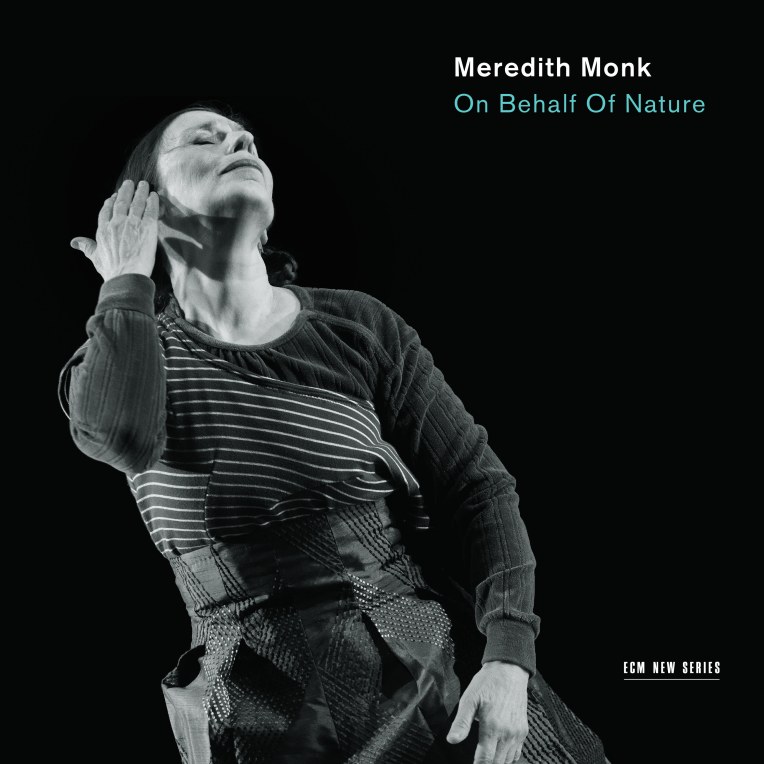
Since 1981’s Dolmen Music, Meredith Monk has contributed an integral DNA segment of ECM’s evolution as a label. But at no time in history has she felt as poignant as in On Behalf Of Nature. Tracing echoes of relevance to today’s social, spiritual, and terrestrial climate, the album is a mouthpiece for those who are voiceless, epitomized in the lone wooden flute that opens “Dark/Light 1.” As a call born of its own will to be heard, it flowers by nourishment of an egoless sun. Such can be also said of Meredith Monk and her vocal ensemble, whose own voices shape that same will selflessly, dutifully, necessarily—because opportunities to do so are dwindling more rapidly than can be articulated by breath and touch. By these signs is established a grammar that lives beyond codification, yet which is felt in the body even as it wanders into our dreams.

While the 19 offerings placed on this altar of creative sacrifice belong to the same ecosystem, Monk seems to link them to three distinct streams of consciousness. The most visceral of these is accessible in three pieces titled “Environs,” in which the fearful heart trembling at the core of a scarred earth sheds both light and darkness on injuries in which we would much rather never admit complicity. Deep yet delicate, these are about as honest as music gets.

A second stream is heard flowing through the album’s largest forests, which acclimate themselves in the prepared piano of “Ritual Zone,” the prophetic violin of “Memory Zone,” and the joyful cries of “Harvest.” Further gifts emerge in “Duet with Shifting Ground,” “Evolution,” and “Water/Sky Rant.” The latter’s harp-infused anthem of abuse, recovery, and hope is perhaps the most powerful statement Monk has ever committed to record. Each of these is a chamber of truths that have existed since the dawn of humanity, reminding us that harmony must be chosen, not expected. As by the ligaments of “Spider Web Anthem,” cohesion requires patient work and purpose by which to cultivate it.

Such connective tissue is the mantra enlivening interlinear pieces throughout. Through them flow the base elements of all life, whether natural (“Eon”) or human-made (“Pavement Steps”). Therein beats the heart of a question that cannot be spoken yet whose answer is so clear as to be anxiety-inducing. It is not the planet itself but those on it without the means to communicate their traumas across electronic signals or paper who sing. On Behalf Of Nature, then, is their stage: an album so relevant as to be worthy of beaming into outer space in the hopes of clearing a path to salvific inner spaces.

Arvo Pärt: The Deer’s Cry (ECM New Series 2466)

2466 X

Vox Clamantis
Jaan-Eik Tulve artistic director and conductor
Mari Poll violin
Johanna Vahermägi viola
Heikko Remmel double bass
Taavo Remmel double bass
Robert Staak lute
Toomas Vavilov clarinet
Susanne Doll organ
Recorded September 2013 and 2014 at Tallinn Transfiguration Church
Veni Creator recorded June 2007 at Dome Church of St. Nicholas of Haapsalu
Engineer: Igor Kirkwood, Margo Kõlar (Veni Creator)
Recording supervision: Helena Tulve
Mastering: Manfred Eicher and Christoph Stickel at MSM Studios München
Executive producer: Manfred Eicher
Release date: September 9, 2016

For now we see through a glass, darkly; but then face to face: now I know in part; but then shall I know even as also I am known.
–1 Corinthians 13:12

While in Capernaum, Jesus is invited into the house of Simon the Pharisee. There, a woman, identified in the Scriptures only as “a sinner,” approaches Jesus with an alabaster box of ointment. Much to the astonishment of the house, she washes his feet with her tears, wipes them with her hair, and anoints them. When confronted by Simon about his acceptance of this act, Jesus replies by pointing out the fact that Simon offered no water for his feet or ointment for his head: “Her sins,” he says of the woman, “which are many, are forgiven; for she loved much: but to whom little is forgiven, the same loveth little.” This episode, recorded in the Gospel of Luke 7:36-50 and arranged for choir by Arvo Pärt as And One of the Pharisees (1992), is the spiritual center of a new program dedicated to the Estonian composer. Not only for its illustration of salvation through faith, but also because it serves as a loose metaphor for sacred music today. Like that sinner, Pärt washes our ears against the verbal abrasions of pharisaic intellect, his offerings thus denounced by “wisdom” of the popular yet confirmed by the Holy Spirit. In the present setting, countertenor Mikk Dede provides a vulnerable personification of Simon, while baritone Taniel Kirikal balances the equation as our humbling Savior.

Although Pharisees comes later in the sequence, its seeds are already being watered in the opening title work, The Deer’s Cry (2007). Drawing on the words of St. Patrick, it is a meditation on God’s omnipresence. Here, as in the other a cappella prayers that follow, including the Alleluia-Tropus (2008/10) and Habitare fratres in unum (2012), compact structures embody quiet resolution. Each is a link in a chain of infinite being, a harmonization of flesh and spirit through the Word, touched by graces of which we are unworthy.

Longtime Pärt listeners will notice echoes of the familiar, such as Virgencita(2012), which is eerily reminiscent of Psalom (1985/91), and a version of Summafor four voices, wherein the circle of this seminal 1977 piece is squared. Gebet nach dem Kanon (1997), from the Kanon Pokajanen, is a child wandering in search of purity, only to find himself crying in a world of corruption, his voice ignored by all except the Father whose hand shields him from brimstone. Da pacem Domine (2004/06), too, reads differently from previous ECM appearances. Where the latter felt like a telescope, now it is a microscope.

Rounding out this journey are three works for voices and chamber instruments. In Von Angesicht zu Angesicht (2005), scored for soprano, male choir, clarinet, viola and double bass, said instruments evoke the trembling fear that is the beginning of all wisdom. Pärt takes a lived understanding of that precept by following the rhythms of Biblical recitation. Veni Creator (2006), for mixed choir and organ, hovers on the brink of transfiguration and is one of his most haunting compositions. Sei gelobt, du Baum (2007), for male choir, violin, lute and double bass, is another textual wonder. Its words, by Viivi Luik, praise the tree for its wood, by which violins and organs might be built for His glory, each note released therefrom a spore returning to its creator.

Despite, if not also because, Pärt’s marked shift over the years from inner to outer, there’s an ethic of sharing in these shorter pieces. Now that his music is known worldwide, one tastes in it something grander left for listeners to decide, a piece of a mosaic that can only be completed when all us take the time to see it being made up of us all. That such profundity comes across so directly is testament to Vox Clamantis and director Jaan-Eik Tulve’s willingness to let everything speak for itself.

Erkki-Sven Tüür/Brett Dean: Gesualdo (ECM New Series 2452)

Gesualdo

Erkki-Sven Tüür
Brett Dean
Gesualdo

Estonian Philharmonic Chamber Choir
Tallinn Chamber Orchestra
Tõnu Kaljuste conductor
Recorded February 2014 at The Tallinn Methodist Church
Engineer: Maido Maadik
Edited and mixed December 2014 by Maido Maadik, Manfred Eicher, Erkki-Sven Tüür, and Tõnu Kaljuste
Produced by Manfred Eicher
Release date: September 18, 2015

I die, alas, in my suffering,
And she who could give me life,
Alas, kills me and will not help me…

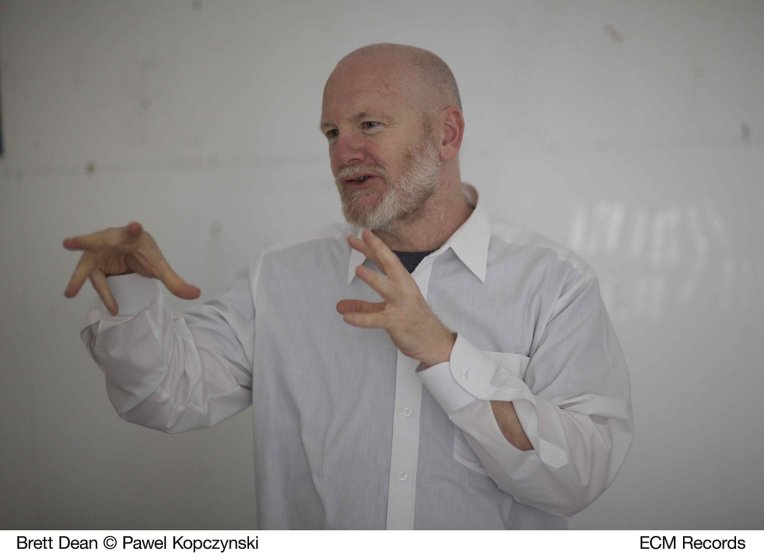
These words, originally sung as Moro lassofrom the Sixth Book of Madrigalsby Carlo Gesualdo da Venosa (1566-1613), recede to let their notes carry on alone in a transcription for string orchestra by conductor Tõnu Kaljuste. This inward look, by proxy, of a composer whose trespasses have been relegated to an afterthought by his oeuvre newly emphasizes repentance trickling through the historical cracks. Echoes of that repentence, in both melody and metaphor, ripple across Carlo (1997). Written by Australian composer Brett Dean, here making his ECM debut, it marshals the Estonian Philharmonic Choir and Tallinn Chamber Orchestra via compressions of space and time. As displacements of the original seed multiply, we hear fear and trembling emerging from within, gradually pared down to morbid whispers and cries of pain, as if to recreate the crime scene that would define Gesualdo’s life, so that when his polyphony returns, it feels like self-deprecation.

Tüür

Given that Carlo is somewhat reminiscent of Erkki-Sven Tüür’s Requiem (1994), no other composer would feel so well included to round out the program. Tüür’s own arrangement of the motet O crux benedicta spotlights a younger Gesualdo, allowing a slightly more optimistic glow to escape. This is followed by L’ombra della croce (2014), a piece for strings that exists somewhere between Illusion and Passion (both from 1993), and Psalmody (1993/2011). This last piece draws a line back to In Spe, a prog-rock band Tüür led between 1979 and 1982. As a dialogue between electric piano, orchestra, and choir, it speaks more to the flesh than to the spirit, at the same time fashioning youth into a crucible of nostalgias. Throughout its 22 minutes, one encounters a chronology of Tüür’s compositional development, from architectonic tinkerer to mosaic master. There’s even a touch of American minimalism to keep the experience centered, well aware as Tüür is that music bleeds.

Dean

Because he is one of the ECM New Series’ integral figures, any new Tüür material on disc is cause for celebration. Yet this pairing with Dean exceeds expectation and heralds a true return to form, such that by its end the album reveals itself to be at once a homecoming from, and departure for, a long journey.

O sorrowful fate,
She who could give me life,
Alas, gives me death.

Alexander Knaifel: Lukomoriye (ECM New Series 2436)

Lukomoriye

Alexander Knaifel
Lukomoriye

Oleg Malov piano
Tatiana Melentieva soprano
Piotr Migunov bass
Lege Artis Choir
Boris Abalian conductor
Recorded February 2002 at The Smolny Cathedral, St. Petersburg
Engineer: Victor Dinov (St. Petersburg Recording Studio)
Recording supervision: Alexander Knaifel
Mastering: Boris Alexeev (engineer)
An ECM Production
Release date: April 20, 2018

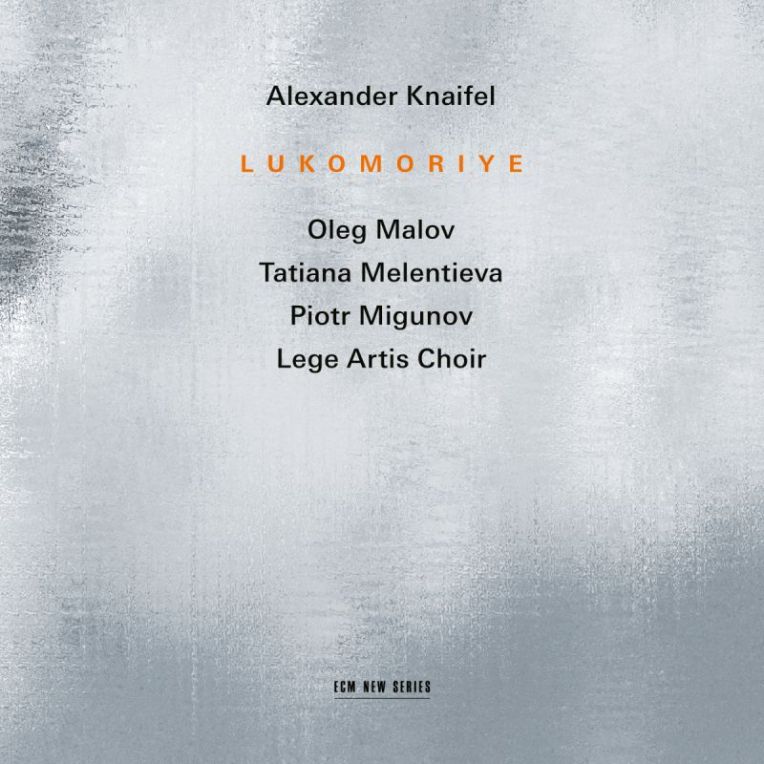
As the fourth ECM New Series album dedicated to the music of Alexander Knaifel, Lukomoriye is both continuation and departure from previous discs. In the former sense, it pulls us deeper into the recesses of his faith; in the latter, it engages with more secular—though no less inspired—material. The program’s pillars rise from prayers to the Holy Spirit. Both O Comforter (1995) and O Heavenly King (1994) are written for choir, the second adding to that foundational grammar the punctuation of vibraphone and piano. Like Jeremiah in the pit, they look upward for grace. Their bead-like structure welcomes a thread of spiritual seeking, marking the passage of voices from firmament to soil as if to show us that the opposite trajectory is possible.

This Child (1997), played by pianist Oleg Malov, follows the Gospel of St. Luke. It opens with a single chord, played as if at a far corner of the room, before proximate notes finish the sentence. This sets up the Godly call and prophetic response, articulating questions that can only be answered by salvation. O Lord of all my life (2006), sung by bass Piotr Migunov to Malov’s electronically processed accompaniment, bonds itself with stillness. Through its 16 minutes of rewarding intimacy, Migunov sings with a vulnerability that recalls Sergey Yakovenko in Valentin Silvestrov’s Silent Songs. A prayer of St. Ephraim the Syrian, wherein humility is preached, and a poem from Pushkin, wherein idealism is crushed into a sinner’s prayer, render the sonic equivalent of a two-way mirror.

From the Word to the World, we are invited to A mad tea-party (2007), in which a heavily reverbed piano breaks its own suspension by the delicate play of a more immediate instrument, evoking both the frustrations and excitations of this pivotal scene in Lewis Carroll’s Alice’s Adventures in Wonderland. Such contrasts might be counted as child-like impulses were it not for the conscious use of silence, touches of percussion, and whispers. Kindred details abound in Bliss (1997), wherein the composer’s wife, soprano Tatiana Melentieva, revives Pushkin. Her voice masterfully captures every shade of mythological revelry at hand with barest support from Malov at the piano.As in the title composition (written in 2002 and revised in 2009), even fully formed sentences flit through trees like birds in search of a new dawn, taking on the magic of their surroundings as they travel ever inward.

The ghost of Pushkin lingers in Confession (2003/04). Here Malov intones the words inaudibly, exploring love, carnality, and desire through the keyboard instead, every note as delicate as the balance of flesh and glory that every composer faces, yet few of which channel with such humility.

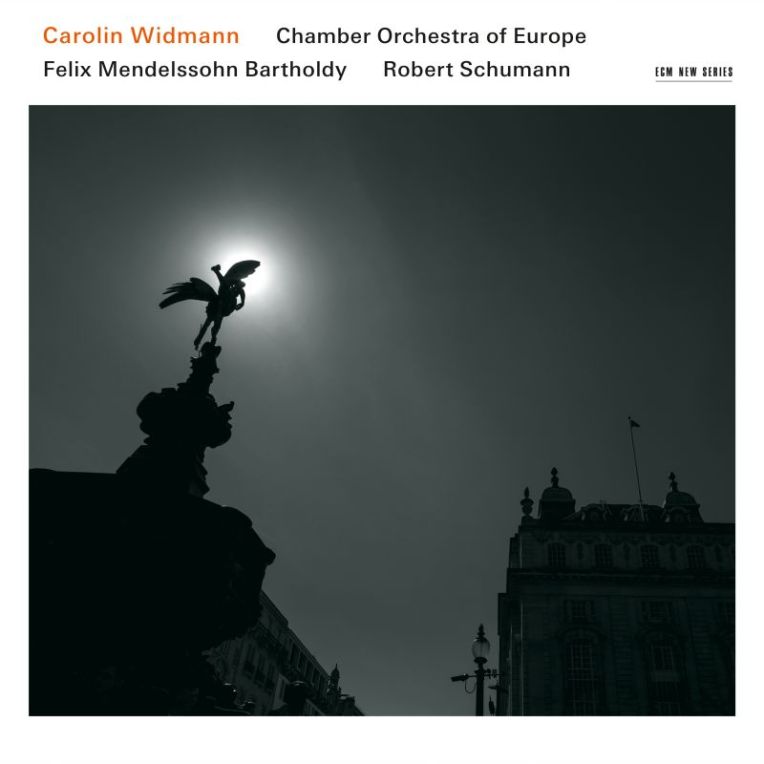
Carolin Widmann: Mendelssohn/Schumann (ECM New Series 2427)

Widmann Mendelssohn

Carolin Widmann
Mendselssohn/Schumann

Carolin Widmann violin, direction
Chamber Orchestra of Europe
Recorded July 2014, Festspielhaus Baden-Baden
Engineer: Rainer Maillard
Produced by Manfred Eicher
Release date: August 26, 2016

Until now, violinist Carolin Widmann has reexamined mostly chamber territories on ECM. For this disc, recorded in 2014 and released two years later, she leads the Chamber Orchestra of Europe as both director and soloist in a program of two marquee-worthy concertos by Felix Mendelssohn Bartholdy and Robert Schumann.

The opening theme of Mendelssohn’s Opus 64, composed in 1844, in addition to being one of the most recognizable in the Romantic violin repertoire, shines from Widmann’s interpretative sun like the dawn. What follows in this monumental movement, marked “Allegro molto appassionato,” is more than fiery sermon of the bow, but a full narrative rich with character development, conflict, and hyperrealism. As Jürg Stenzl writes in his liner notes, Mendelssohn was caught between something of a rock and hard place, unsure of whether to continue in the virtuosic fashion of Paganini or follow the orchestral persuasion of Beethoven. If anything, he struck an unprecedented balance between the two, allowing the soloist to shine while also giving the orchestra something lyrical and texturally relevant to say. The central movement—an Andante leading into a transitional Allegretto—is a lyrical bridge to the famous finale, across delicate leaps of intuition turn into robust statements of purpose. Playfulness undergirds every chromatic arc and emboldens Widmann’s benchmark performance with a subtle combination of grit and fluidity. That each of these three movements is shorter than the last is indicative of a distilling approach, whereby the composer peels away one unnecessary layer after another until an unblemished fruit remains.

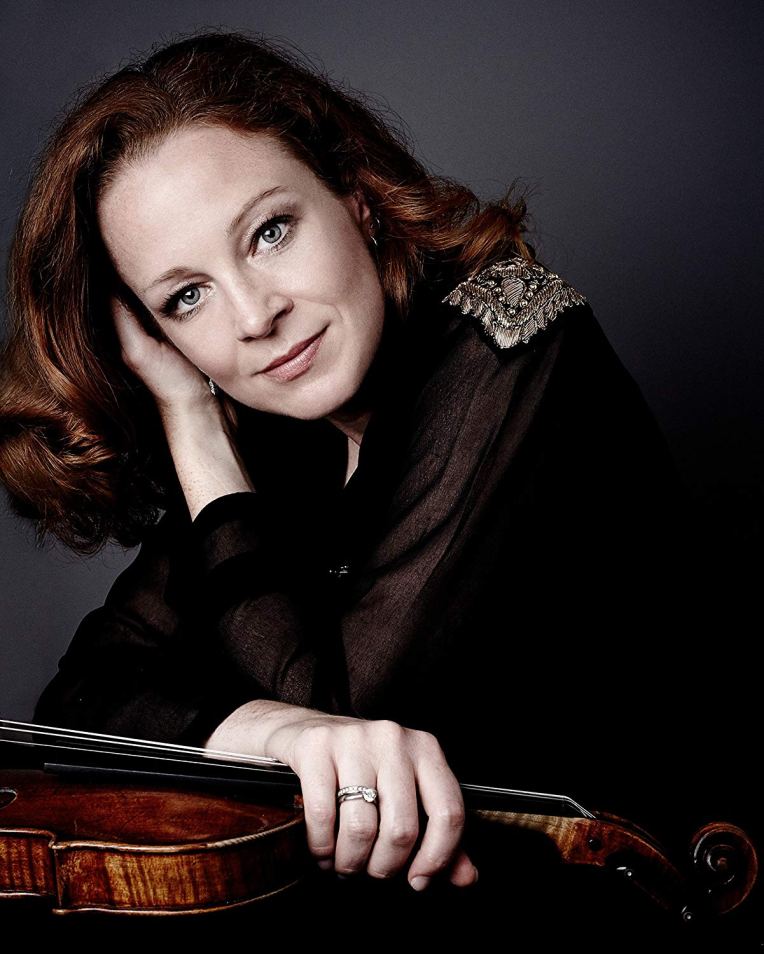
CW
(Photo credit: Lennard Rühle)

Schumann’s concerto of 1853, unlike Mendelssohn’s widely heralded masterpiece, went unpublished until 1937, dismissed as it was along with his late works as insubstantial. How much of that perception was due to musicological analysis and how much to a growing mythos around his mental downfall is difficult to quantify. Following in the immediate wake of his Opus 31 Fantasy, the concerto is both a return to form and an eschewing of it. If Mendelssohn’s first movement was a short story, then Schumann’s is a novella. Yet despite it gargantuan form, taking up nearly 16 minutes of duration in the present performance, it leaves more than enough room for the listener to find solace, reflection, and understanding. And despite its many colors, there’s a certain trustworthiness to its flow, as emphasized by Widmann’s choices of tempo and dynamics. The second movement, designated “Langsam” (slow), nevertheless speaks with urgency, while the restrained third dances but always keeps one foot on the ground. With bolder, more jagged lines, Schumann expands his vocabulary in and through the score. Widmann’s translations thereof make it understandable in any language.