András Schiff: Encores after Beethoven (ECM New Series 1950)

Encores after Beethoven

András Schiff
Encores after Beethoven

András Schiff piano
Concert recordings at Tonhalle Zürich, March 2004-May 2006
Engineer: Stephan Schellmann
Produced by Manfred Eicher
Release date: November 25, 2016

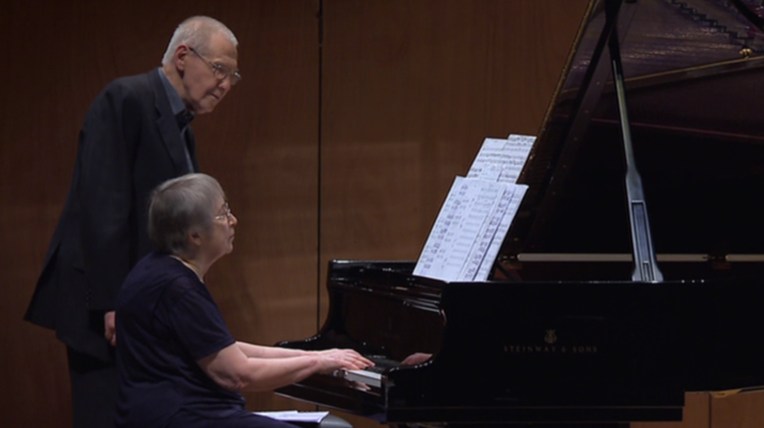
For this collection of encores, recorded during his cycle of the complete Beethoven piano sonatas yet never released until now, pianist András Schiff presents selections that, in his own words, “are closely related to the previously heard sonatas.” More than that, however, when taken as their own program, relationships within these pieces are as deep and meaningful as between them. Each is a satellite of the Beethovenian mothership, beaming down messages of darkness and light in kind.

The Allegro assai in e-flat minor from Schubert’s from Three Piano Pieces (D 946) introduces the disc with a synchronicity of medium and message that indeed echoes Beethoven in its grammar. With a dramaturgy perhaps only describable as oceanic, it sparkles with lunar pull. The Allegretto in c minor (D 915) that follows unfolds by means of a subtler narrative structure, spiraling in on itself, now with deliberation over desperation.

Alongside this door, Schiff opens another marked Mozart in the form of the little Gigue in G major (KV 574). This altogether exquisite piece is an Escherian staircase in sound, and serves as prelude to “Papa” Haydn’s Sonata in g minor (Hob VXI:44). That Beethoven deeply admired Haydn can be no secret after bathing in these spring waters. Schiff’s further distillation is worthy of that admiration as well, and feels as organic as the music is calculated, marrying as it does delicate restraint with robust linearity.

Were it not for the applause, Schubert’s Hungarian Melody in b minor (D 817), might be overwhelmed by the aftereffects, but as it stands inhales and exhales a full color palette in this folkish dance. Played, as written, from the heart, its charm is magnified tenfold by this performance.

Standing equally alone yet inseverable from the surrounding tissue, Beethoven’s Andante favori in F major (WoO 57), last heard on Volume V of Schiff’s magnum traversal, echoes an even more wholesome quality and shows just how completely Beethoven was able to tell a story.

How appropriate that we should end where it all began: with Bach. Between the tastefully wrought balustrade of the Menuet I and II from Partita No. 1 in B-flat major (BWV 825) and the Prelude and Fugue in b-flat minor (BWV 867) fromThe Well-Tempered Clavier, Book I, one can almost taste the dust of Bach’s architectural wonder, which in this context seems like a return to fundamentals. Bones before flesh, and breath before bones.

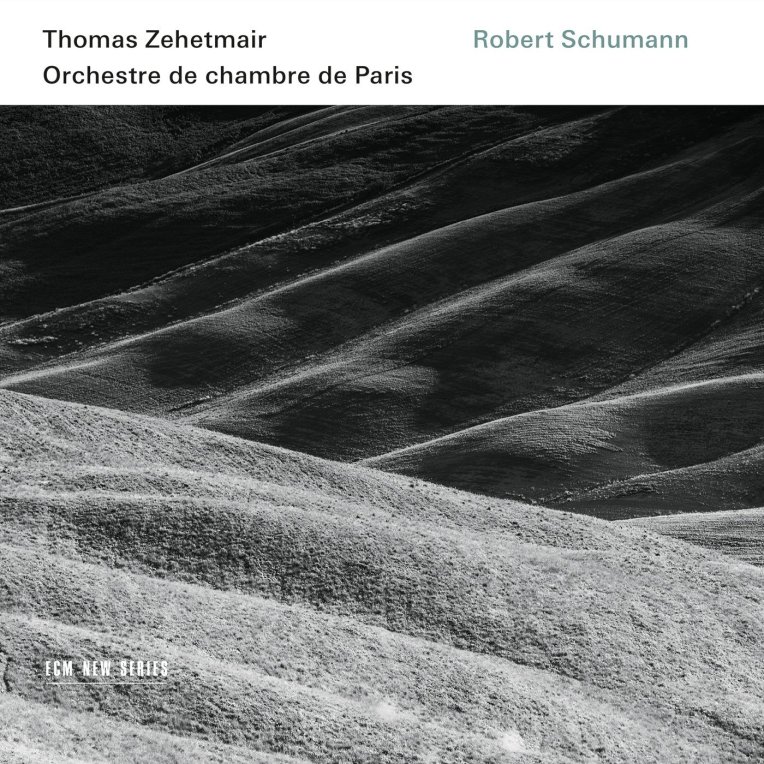
Thomas Zehetmair: Robert Schumann (ECM New Series 2396)

Zehetmair Schumann

Robert Schumann

Thomas Zehetmair violin, direction
Orchestre de chambre de Paris
Recorded February 2014, Théâtre des Champs-Elysées, Paris
Tonmeister: Hannelore Gurtet
Recording supervision: Guido Gorna
Engineer: Frédéric Briant
An ECM Production
Release date: March 18, 2016

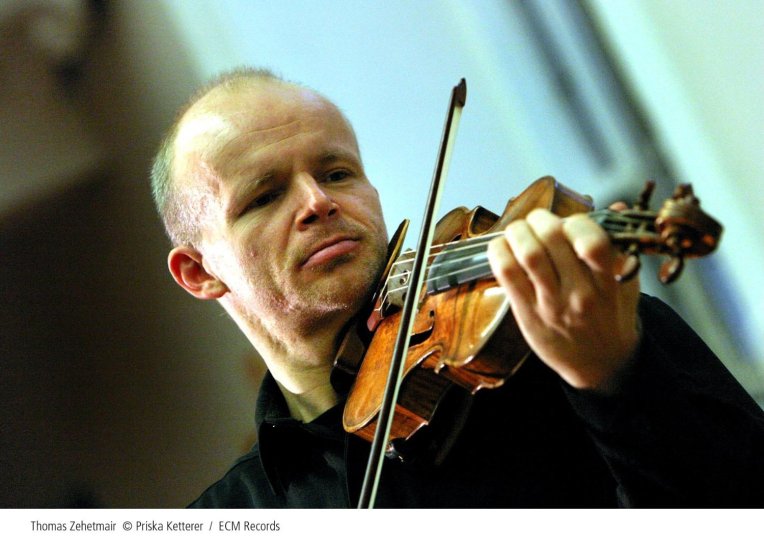
The music of Robert Schumann (1810-1856) has slowly coalesced on ECM’s New Series into a poetic genre all its own. In the capable hands of violinist Thomas Zehetmair, who rendered the labyrinthine depths of the German composer’s string quartets in equal parts crystal and shadow, and here conducting the Orchestre de chambre de Paris in an even more dynamic program, it has taken on new life.

Zehetmair

For the Violin Concerto of 1853, Zehetmair plays from an Urtext edition to which he himself made important contributions, poring laboriously over the original manuscript to correct the piece’s many errors and elevate it to its deserved status in the pantheon of violin literature. The first movement is almost a concerto in and of itself, moving with the force of an ocean wave crashing on shore. The second movement is emblematic of its composer’s flair for merging strength and delicacy, and of the soloist’s ability to balance the two with artful resonance. As he and the orchestra leap into the final stretch with elasticity, we find ourselves nearly overwhelmed by invention. Few concertos feel as corporeal as this, seeming to pull on every tendon and sinew until it trembles with joy. Although originally thought unplayable by violinist Joseph Joachim (for whom it was written) and Clara Schumann, and never heard until 1937, this recording lends it a resplendent inevitability. Zehetmair’s direction is as vibrant as his playing, and in both one finds an abundance of insight.

The Symphony No. 1 (“Spring”), op. 38, of 1841 emerged only after many failed attempts, and in its present iteration abounds with Beethovenian exuberance, but always with that indefinable touch for which Schumann was so highly regarded. The programmatic flair of the first and fourth movements, in combination with the robust exposition between them, articulates a timeless pastoralism in concise terms. It’s an atmosphere rightly shared by the Phantasy for Violin and Orchestra, op. 131, of 1853. It brilliantly concludes the program, funneling every impulse that preceded it into a flourishing ecosystem of ideas. Ironically enough, in this rendering it feels more reflective of reality than the preceding two works, if only by virtue of its fiery exegesis. Zehetmair brings his all to the table, leaving not a single crumb to show for it.

The engineering is appropriately raw and clear—so clear, in fact, that a page turn is audible in the right channel in the first movement of the Violin Concerto—and allows us to feel immersed but never assaulted.

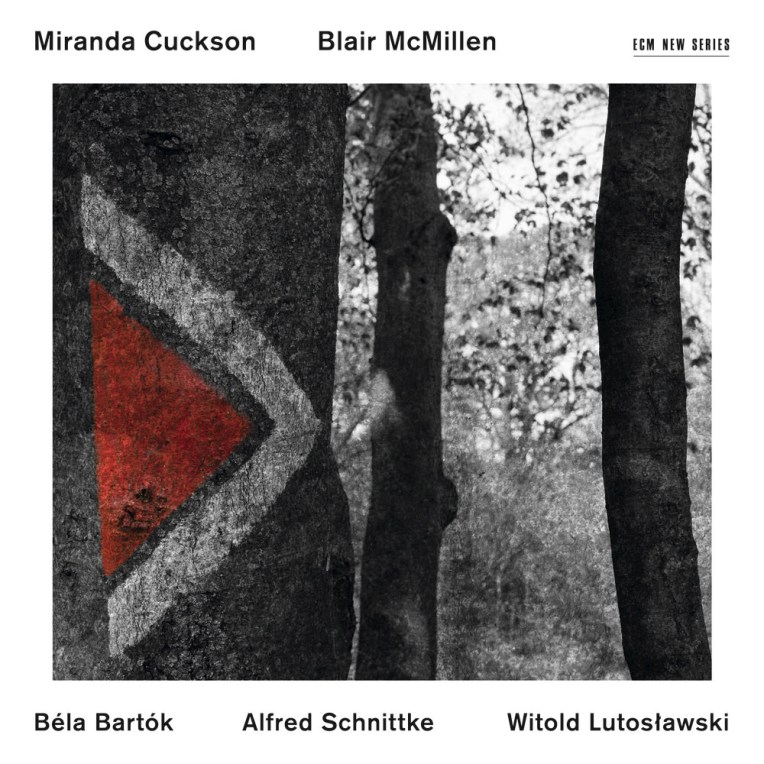
Miranda Cuckson/Blair McMillen: Bartók/Schnittke/Lutosławski (ECM New Series 2446)

Bartók:Schnittke:Lutosławski

Bartók/Schnittke/Lutosławski

Miranda Cuckson violin
Blair McMillen piano
Recorded January 2015, Auditorio Stelio Molo RSI, Lugano
Engineer: Markus Heiland
Produced by Manfred Eicher
Release date: April 15, 2016

Violinist Miranda Cuckson and pianist Blair McMillen make their ECM New Series debut in a program of three 20th-century Slavic masterworks. The two-part Sonata No. 2, Sz 76, of Béla Bartók (1881-1945) was composed in 1922, a time when Bartók was deeply into expressionism yet content in mapping two idiosyncratic detours for every step he took in someone else’s shoes. It opens with a profoundly simple statement, intoning the same note on the violin six times across the palimpsest of a piano key strike. Cuckson makes each iteration distinct before swimming against the delicate cascade that ensues.

Bartók’s folk influences are by turns clear and obscure, weaving with playful assurance throughout his compositional fabric, and the push and pull between the instruments has never sounded so continuous as in this rendition. The dancing Allegretto gives a range of insights into the composer’s distilling process, which by virtue of its underlying force makes an overlying confidence necessary to carry it across in performance. In that regard, Cuckson’s bow feels like two feet: separate yet guided by the same brain. McMillen’s artful exuberance likewise uproots colorations with systematic abandon. The piece ends as intimately as it began, forgetting every leap as a temporary severance from the gravity of mortality.

Cuckson and McMillen
(Photo credit: Caterina di Perri)

The Sonata No. 2 “Quasi una sonata” of 1967/68 is a brilliant dip into the font of Alfred Schnittke (1934-1998), whose previous ECM appearances have been equally marvelous. The subtitle here means “like a sonata,” thus betraying the composer’s disdain for the constraint of something so pedantic. Its brazen chords, exaggerated silences, and whimsical details showcase the spaciousness of Markus Heiland’s engineering. Cuckson’s navigations of every angle are wonderous to behold, and McMillen’s presence feels at once responsive and directive. From the airy and mysterious to the grounded and profane, vignettes cohere by the unwavering creativity of both artists. The more insistent and programmatic the music becomes, the less one needs to cloak it in expectations. The default mode of this anti-sonata, then, isn’t pretty entertainment but on-the-ground activism. Ending as it does, violin alone and swooning, it has no qualms over dissolution.

From the pen of Witold Lutosławski (1913-1994) comes the Partita for Violin and Piano (1984), finishing the program with something conceptually between its two predecessors. Comprised of three through-composed pillars and garlanded by two ad-libbed sections between, it is a somewhat gloomier yet no-less-playful exposition of plurality. The first movement, marked “Allegro giusto,” is distinguished by its vertigo-inducing glissandi. Such meticulous imbalances work their way through everything that follows, finding only partial traction in the final Presto, as if resolution were the very antithesis of happiness. This leaves us with a wealth of impressions to choose from, any one of which might describe these pieces just as well, yet which falls short of touching fingers around motifs that have no use for category.

Playing Pärt

Playing Pärt

Playing Pärt

Directed and filmed by Dorian Supin
Release date: October 12, 2012

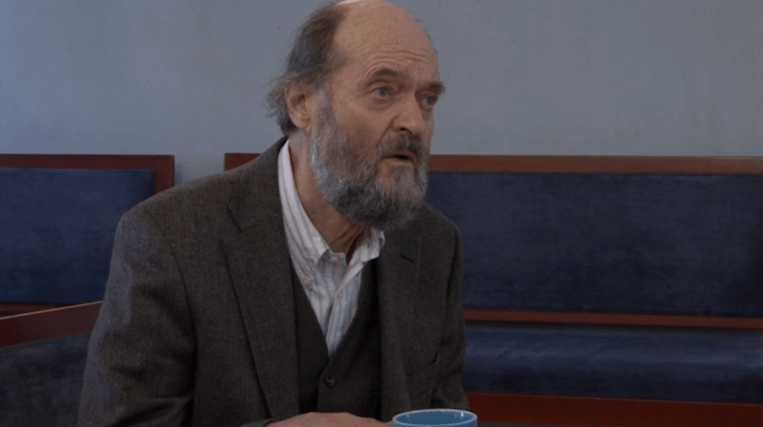
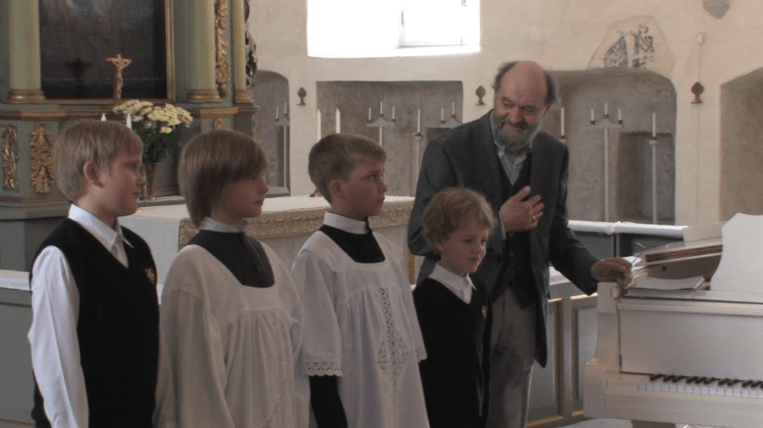
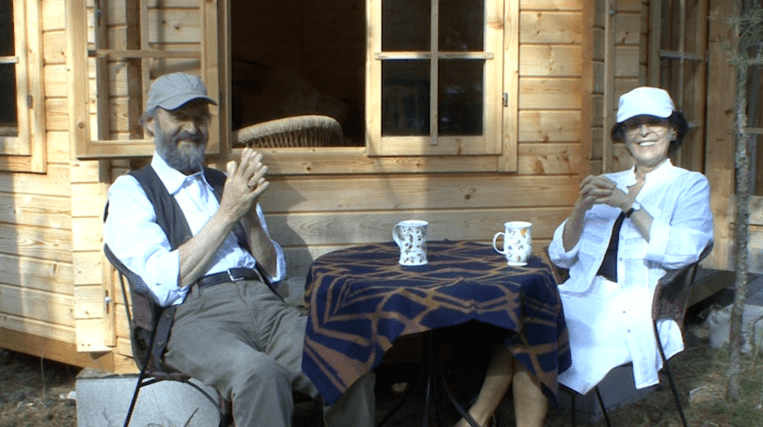
In 2011, the Old Town Music School of Collegium Educationis Revaliae and the International Arvo Pärt Centre put on a student concert of Pärt’s music at St Michael’s Church in Tallinn. Playing Pärt documents both this historic performance and the rehearsals leading up to it, supplemented by interviews with the composer and his wife, Nora.

02

Said concert is a charming, in-depth survey of Pärt’s legacy, and of the beauty that gives it resonance. Many pieces on the program will be familiar to ECM listeners: organ works Trivium and Pari Intervallo (the latter arranged here for four guitars), Da Pacem Domine (arranged for four recorders), and the solemn Für Alina are standouts among them. Spiegel im Spiegel, for its balance of tension and prayer, is another. Throughout, a quiet respect prevails by way of a “local” feeling that cannot be replicated in the international concert hall. These melodies, however familiar, paint even more direct lines to the heart when so endearingly performed. Like fragrances in sound, they waft through the senses, following ancient channels of memory even while forging new ones.

14

Delightful surprises abound. First and foremost are “The Cycle of Four Easy Dances,” from the 1959 collection Music for Children’s Theatre, including the rarely heard “Butterflies” and the evocative “Dance of the Ducklings,” replete with dissonant splashes of webbed feet. Just as alluring is “I’m Already Big,” a children’s song composed when Pärt was a student. The focus on youth feels as poignant as it does inevitable, and makes indelible impressions in such choral settings as Veni Creator (a 2006 commission from the German Bishops’ Conference), Bogoróditse Djévo (a 1990 commission from Cambridge King’s College Choir, based on a Church Slavonic hymn to the Virgin Mary), and Vater Unser (composed in 2005 and based on a German translation of the Lord’s Prayer), for which the composer at the piano accompanies a quartet of singers.

18

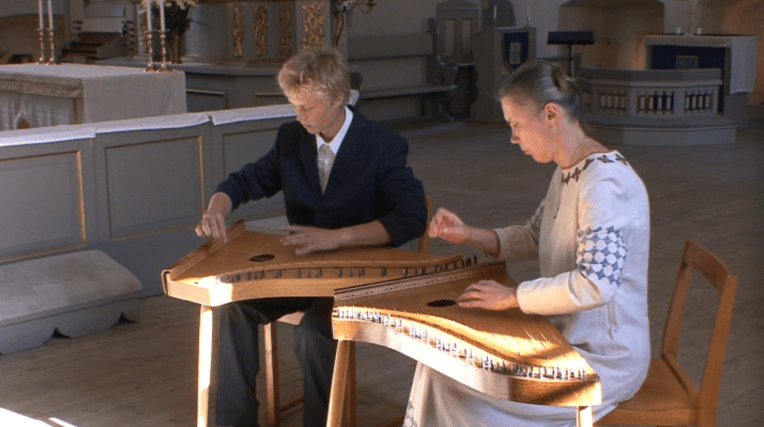
Other highlights are Ukuaru Waltz, originally composed for the film Ukauru (1973, dir. Leid Laius) and performed on two chromatic kannels (plucked zithers), the aleatoric Diagramme (Pärt’s opus 11), and Variations for the Healing of Arinushka, a solo piano piece composed in 1977 while daughter Ariina was recovering from an appendix operation. Trepidations and hope of light breathe through every note.

16

Yet it’s in the rehearsals where Pärt’s humilities come out in full attendance. More than providing insight into the mind of a world-renowned composer, they reveal the soul of a man whose entire concept of art is nothing without faith in eternity. He understands the quality of sound, and the beauty of it being played with heart. If anything, and for that very reason, he’s more demanding of the children’s pieces, which in all their etudinal simplicity allow the interpreter’s soul to resound. During a rehearsal of “Butterflies,” for instance, he says, “It’s essential for the music to have some kind of secret. That’s the case of the butterfly as well. It’s a mysterious creature.” For him, the rudiment is sacred.

04

His music has materiality, and he treats it accordingly. Whether stressing the positions of a pianist’s hands while playing Für Alina or chiding himself for inclusion of inappropriate dynamics in the original score to “Dance of the Ducklings” (upon hearing which, he exclaims, “A beautiful piece. Did I compose it?”), he upholds the value of any given moment to shape something unexpected, personal, and true.

12

We encounter echoes of this philosophy in his conversations with Nora. In these, the subject of the interpreter is a red thread, pulling at questions of authority versus idiosyncrasy, and concluding that one must be both strong and gentle in order to play music with genuine feeling. “It has to be born in the soul of the interpreter,” he says, for in the body thereof is something concrete and in the metaphysical thereof is something ineffable. “The composer,” he goes on to say, “can learn a lot from the interpreter.” Most musicians, Nora agrees, are unresponsive to this suggestion. It’s like trying to explain how the sun shines. Hardship, Pärt adds, helps people understand this. Children notice it, too. Hence, the concert. They are straightforward, avers Nora, whereas professionals are contending with “a thousand different traditions.” Innocence allows performers to take notes seriously. She further likens music to the optical effect of two binocular images merging into one, a simile I would extend to the listener’s relationship to what’s being heard. Countless motifs out there are waiting to blend into our own. Let this film be a reminder of our openness to the spiritually healthiest ones.

11

ECM and Streaming

Eicher Hand

Official press release from ECM Records:

Over the past week we have begun the process of entering streaming, and from November 17th, the full ECM catalogue will be available to subscribers to services including Apple Music, Amazon, Spotify, Deezer, Tidal and Qobuz. This simultaneous launch across the platforms – facilitated by a new digital distribution agreement with Universal Music – invites listeners to explore the wide range of music recorded by our artists in the course of nearly five decades of independent production.

Although ECM’s preferred mediums remain the CD and LP, the first priority is that the music should be heard. The physical catalogue and the original authorship are the crucial references for us: the complete ECM album with its artistic signature, best possible sound quality, sequence and dramaturgy intact, telling its story from beginning to end.

In recent years, ECM and the musicians have had to face unauthorized streaming of recordings via video sharing websites, plus piracy, bootlegs, and a proliferation of illegal download sites. It was important to make the catalogue accessible within a framework where copyrights are respected.

ECM Press Office
Munich, November 14, 2017

Heinz Holliger: Machaut-Transkriptionen (ECM New Series 2224)

Machaut-Transkriptionen

Heinz Holliger
Machaut-Transkriptionen

Muriel Cantoreggi viola
Geneviève Strosser viola
Jürg Dähler viola
The Hilliard Ensemble
David James countertenor
Rogers Covey-Crump tenor
Steven Harrold tenor
Gordon Jones baritone
Recorded November 2010, Radio Studio DRS, Zürich
Engineer: Andreas Werner
Executive producer: Manfred Eicher
U.S. release date: November 6, 2015

To
the eye, go,
to the moist—
hurricanes,
hurricanes, from wherever,
particle drift, the other,
you
know the one, we
read it in the book, it was
meaning.
–Paul Celan, “Stretto”

Whether as composer, oboist, or conductor, Heinz Holliger never ceases to delight and surprise. His commitment to classical music has produced some of the most enduring documents on ECM’s New Series, including one of that imprint’s indisputable masterpieces, the Scardanelli-Zyklus. Here we have yet another turnaround, one that speaks with the open style in which Holliger has become so fluent. Featuring a host of accomplished interpreters—including the now-defunct Hilliard Ensemble—bringing to life a 21st-century cycle of works around the 14th-century French composer Guillaume de Machaut, the Machaut-Transkriptionen (2001-09) represent nearly a decade’s worth of thinking and rethinking through the past in a language of the future. Scored for an unusual combination of four voices and three violas, it weaves direct transcriptions of Machaut into Holliger’s idiosyncratic odes to the same.

Holliger Portrait

This is one of those distinctively ECM projects, which, like Ricercar, unravels the avant-garde core of centuries-old music. The compact macramé, for example, that is Machaut’s hallmark is on full display in the program’s introductory Biaute qui toutes autre pere, wherein something more than ink and paper have convened to elicit vital sounds. If the feeling of this balladry is loving and sincere, even more so is Holliger’s enhancement of its rules in his own Ballade IV for three violins. More than ever before, Holliger has built his cathedral out of transparent stone, blacking out the windows, so that the sunlight might be its dominant form of expression. In this sense, Holliger is engaging with Machaut not as the target of an homage, but as the living force of an artist whose music breathes in the winds that shake his boughs. Use of untempered harmonics, transcribed note for note from the original, allows incidental commentary in this regard to seep through.

A second diptych, this time around Machaut’s Ballade XXVI: Donnez, Seigneur, transforms the gently sloping path of the original—in which countertenor David James at once renders the skin and the heart keeping it alive—into the wilder detours traced by the present recasting. And while the latter may seem more oblique in its structure, it also shares with its referent a clarity of expression. Both are neural mappings, very much alive in and beyond the confines of a single recorded performance. Even the wordless Hoquetus David of Machaut and Holliger’s responsory Triple Hoquet feel more like pieces of the same puzzle than distant cousins separated by time. Holliger gives us something of a granular synthesis of the former, an embodiment of Celan’s hurricane in the fullest sense.

A single voice retains the melody of Machaut’s Lay VII in a standalone arrangement, while guided improvisations flesh out its branches with unpredictable fruit. The Hilliards are best equipped to handle this flower without damaging a single petal. A beautiful piece that challenges not through its dissonances but through its consonances, as does its analogous In(ter)ventio a 3 und Plor- / Prol- / Or- atio for three violins, which from recitative beginnings morphs into a staggered prolation of time signatures, based on the Complainte of Machaut’s Remede de Fortune. That same piece lingers on in the final statement, in which it is combined with an “Epilogue” that unites voices and strings in quadrilateral fashion, distilled until only friction remains.

In a universe of countless musical systems, Holliger and his celestial body of work have always charted unprecedented orbits through the space-time continuum. Given the way in which he has refracted himself through Machaut, the sublimity of their intersection is clear, for both have stumbled on the fragility of human contact, tracing its origins just shy of rupture.

Márta and György Kurtág: In memoriam Haydée (ECM New Series 5508)

In memoriam Haydée

Márta and György Kurtág
In memoriam Haydée
Játékok – Games and Transcriptions for piano solo and four hands
Piano Recital
Cité de la musique, Paris
22 September 2012

Márta and György Kurtág piano
Filmed September 22, 2012 at Cité de la musique, Paris
Directed by Isabelle Foulard
An LGM Télévision production in association with Cité de la musique
Producer: Sabrina Iwanski
Executive producer: Pierre-Martin Juban

In September of 2012, Hungarian composer György Kurtág and his wife Márta gave a concert at Cité de la musique in Paris to honor the memory of a dear friend, musicologist Haydée Charbagi (1979-2008). Their program, as adventurous as it was delightful, combined piano transcriptions for two and four hands, exuding such intimacy that it’s a wonder the audience didn’t just melt away from all the love in the hall. For those not present, this DVD bears witness to the Kurtágs’ unbridled passion for each other and the music that passes between them. The program’s bulk is culled from György’s own Játékok (Games), an ever-growing miscellany of dedications to the living and dead alike. It’s also a tribute to classical roots on the whole, as indicated by the composer’s transcriptions of Bach chorales—each a towering trunk among his otherwise microscopic foliage.

2

There’s something dark yet wondrous about the first dissonances that creep from the stage. Saying hello with a farewell, György approaches the score as if it were a poem (such philosophies were, in fact, the subject of Charbagi’s thesis). And perhaps nothing so omnipresent as poetry could express either the compactness or vigor of each brushstroke. As observer, Márta stands like an appreciative statue before joining him at the keyboard. At times, she caresses him on the shoulder after he finishes a solo, an unspoken signal to connect the dots.

1

Those very points of light sparkle in pieces like Flowers we are…, which in conjunction with the pantheonic Baroque selections enables a poignant contradiction: namely, that Bach’s music eminently looks forward while György looks backward, leaving us in the middle like the binding of an open book. His own responsory is as much a reflection of the one to whom it is dedicated (Joannis Pilinszky) as the composer who vaulted the form.

3

With most at or under a minute, these concert selections are rife with inflection. There are moments of staggering beauty, especially in the Hommages, such as the Hommage à Christian Wolff, with its tip-toed notecraft, the resonant Hommage à Stravinsky – Bells, and the Hommage à Farkas Ferenc in its multiple incarnations, each more nuanced than the last and ideally suited to the composer’s greatest interpreter, Márta.

5

Campanule, as with so much of what transpires, expresses the pregnancy of emptiness, and the potential for healing amid broken motifs. This would seem to be the underlying message also of playful asides such as the fierce exchange of single notes that is Beatings – Quarelling and the kindred Furious Chorale. Another elliptical piece, Study to Pilinszky’s “Hölderlin, gives musical interpretation of a poem written for Mr. Kurtág and reinforces the concert’s overarching theme, while the dramatic (Palmstroke) and the programmatic (Stubbunny and Tumble-bunny) trip over one another in search of continuity.

4

Director Isabelle Soulard focuses on these passages in close-cropped framings, allowing the tender lattice of Aus der Ferne, written for the 80th birthday of Alfred Schlee, and the confectionary first movement of Bach’s E-flat major Trio Sonata (BWV 525) to shine all the brighter among this crowd of lamentations. For if anything, György’s art is about remembrance—a point driven home by the three encores, all of which reiterate pieces featured in the main program: the Hommage à Stravinsky and two of the Bach arrangements. Were it not for programs and obsessive musical minds, we might not even notice the repetition, as life consists of nothing but.

6

Giya Kancheli: Chiaroscuro (ECM New Series 2442)

2442 X

Giya Kancheli
Chiaroscuro

Gidon Kremer violin
Patricia Kopatchinskaja violin
Kremerata Baltica
Recorded December 2014 at Lithuanian National Radio and Television, Vilnius
Engineers: Vilius Keras and Aleksandra Suchova
Mixing and mastering at Emil Berliner Studios, Berlin by Rainer Maillard, Manfred Eicher, and Vilius Keras
Produced by Manfred Eicher
U.S. release date: November 6, 2015

“Despite the world’s obvious achievement, our planet is still torn by bloody contradictions. And no progress in artistic activity can withstand the destructive force that easily cancels the fragile process of construction. (…) I write for myself, without having any illusions that ‘beauty will save the world.’”
–Giya Kancheli

The words of a composer-in-exile who lives so deeply inside time that he creates outside of it. Kancheli speaks them not in the interest of putting forth a mission statement, but to assess the measure of his art against the metric of history, the last century of which has birthed some of its brightest galaxies and darkest nebulae. In the context of his personal astronomy, Kancheli seeks out vestiges of indifference in a world built on denial of the same. On this disc you will find no healing but the honesty of a mixed spirit. Surely, the music not only abides by such sentiments but also thrives on their shadows.

The 2010 title composition, first in a program of two, is scored for violin and chamber orchestra. Despite its perennial format, it reads neither like a concerto nor a tone poem, but rather a procession led by one who follows his own invisible nature. The feeling of inseparability is strong as these figures—nodes in a pathway of nerves—bond and separate. The bass drum rumble that opens their 23 prosaic minutes of communication signals the subterranean heart of it all, which by virtue of the shimmering strings that follow sews its raiment anew. As in the music of Valentin Silvestrov, the piano here adopts a commentary role. Its very involvement reveals an internal expanse rivaled in scope among his previous works perhaps only by Trauerfarbenes Land.

Violinist Gidon Kremer and his Kremerata Baltica handle every note with the admiration of a curator. Kancheli opines humbly about the musicians’ contributions and recognizes that the simplicity of his thematic moon shines by the light of many suns. In this recording, he dubs Kremer the “true author” of Chiaroscuro and he himself its “co-author.” The level of integration and respect achieved from both is something to behold with awe. Likewise, the distance and birdlike liquidity of Kremer’s high notes in the final phase.

Kancheli and Friends

At a slightly longer duration of 25 minutes, Twilight (2004) is scored for two violins and chamber orchestra. Kremer is joined by protégé Patricia Kopatchinskaja, last heard on ECM playing the music of Galina Ustvolskaya. Although it is Kancheli’s first piece for this instrumentation, and written at Kremer’s behest, it will feel familiar to the Kancheli initiate. Inspired by a row of poplar trees outside his Antwerp studio, whose significance became clear to him after a brush with death, it treats life as a gift twice given. The addition of a second leading voice emphasizes this metaphor and changes the landscape considerably, collapsing the former procession into a molecule of new rotations. Merest hints of Kancheli’s past thematic staples whisper through the overgrowth, speaking through the photosynthesis of the present. Interrelationships of soloists and orchestra are gnarled and rooted, each pouring out from the last in the manner of a divided cell. Melodies and atmospheric changes occur with such aching force that it is all one can do to keep the skeleton from trembling.

Twilight abounds in prismatic effects. Like an enhanced chamber music, it magnifies the immediacy of smaller forces with implications of unwritten futures. A direct emotional line takes shape from motif to motif until a naked mystery prevails. Kancheli is therefore correct in his self-assessment: This is not an album in which to seek sanctuary. That being said, one may discern a ray or two in the bleakness of its canvas, for to the interpreters’ authorship must be added the listener’s own.

As is always the case with the Kancheli experience, moments of apparent eruption are in fact the opposite. Nowhere truer than in this program, where the occasional outburst is, if anything, an “inburst,” pushing the focal point ever farther toward forgetting. Cavernous engineering thus allows the orchestra’s solitude to come spilling out in consumption of tension. We do well to see these dynamic affordances, like album’s title, as variations on a grander theme—in this case of mortality, and the parentheses that are its beginning and end.

Kancheli’s most important recording since Exil.

(To hear samples of Chiaroscuro, please click here.)

Feldman/Satie/Cage: Rothko Chapel (ECM New Series 2378)

2378 X

Morton Feldman/Erik Satie/John Cage
Rothko Chapel

Kim Kashkashian viola
Sarah Rothenberg piano, celeste
Steven Schick percussion
Houston Chamber Choir
Robert Simpson conductor
Cage and Satie recorded May 2012 at Stude Hall, Rice University in Houston
Feldman recorded February 2013 at The Brown Foundation Performing Arts Theater, Asia Society Texas Center
Programme: Sarah Rothenberg
Tonmeister: Judith Sherman
Engineer: Andrew Bradley
Editing assistant: Jeanne Velonis
Mastered at MSM Studio, Munich by Judith Sherman and Christoph Stickel
Produced by Judith Sherman
An ECM Production
U.S. release date: October 23, 2015

To encounter a painting of Mark Rothko (1903-1970) is to stand not before but within it. The more one gazes, the more blended one becomes into its borderless horizons. This dynamic is duly obvious in Rothko Chapel, a nondenominational space hung with his canvases and where visitors, observes pianist Sarah Rothenberg, “actually inhabit the paintings from the inside.” After the chapel’s posthumous opening, composer Morton Feldman (1926-1987) was asked by philanthropists Dominique and John de Menil to pen a tribute, and thus the centerpiece to Rothenberg’s carefully assembled program was born.

Said program was originally presented by Houston-based Da Camera, an organization that Rothenberg has lead since 1994, and under the auspices of which she presented a 40th Anniversary Concert at Rothko Chapel in 2011. Translating the energies of this event into a studio experience transcends the qualities of a reproduction, for the musicians’ raw talents move so organically as to yield an original work of art with immersive qualities all its own.

Rothko Robinson

From the rumbling timpani that opens Rothko Chapel alone, one already knows that the composer must have been both admirer of, and friend to, the artist. That he was, and their penchant for debate and banter codes its way into every click of aperture as the nearly 30-minute piece unfolds. Then again, it might be more accurate to say that Feldman’s masterwork “infolds,” for like a thought compressed into pigment, it colors the mind with simple yet deeply planar contrasts. Other percussive elements shine as the underside to a viola’s burnished top. These two might seem oppositional, were it not for Kim Kashkashian, in whose rooted bowing one may hear the spirit of hues and forms that put Feldman’s cells in an inner tandem not unlike that of the Rothkos themselves. The presence of choir, then, surely manifests the darkness into which Rothko’s angles seem to forever recede. Feldman’s sounds are thus every bit as painterly as Rothko’s applications were sonic. Each follows its own frequency toward a common endpoint—which is to say, a point without end. Individual voices, bowed and throated alike, constitute not “solos” but single bands of fuller spectra. As Rothenberg details in her beautiful liner notes, Feldman recognized the logical impossibility of expressing stasis in music, even if one may feel an illusion of it, for as the choir ends in mid-impulse, leaving us suspended in the void of those permeating rectangles, it is all we can do to inhale the illusion before it leaves us.

In this context, the soundings of Erik Satie (1866-1925) and John Cage (1912-1992) are drops in an ever-expanding pond. Satie was a focal point of Cage’s contemplative life, and much like Rothko to Feldman served to enhance a diffuse and intimate science. Satie’s obsession with time, as Cage saw it, surely helped both composers to recognize the value of space. Cage’s Four2 (1990) and Five (1988), both for choir, train the ear on a different field of overlaps. The bleed-through of these voices is that of watercolor, touching the paper’s edge as if it were a new beginning all the same. Higher voices ring out with the announcement of a barely-risen sun, soaking the clouds with generative power and carrying over denominators of motivic cells until they are stretched beyond recognition. The multiplicity of singers yields a selfless quality, which finds fullest expression in ear for EAR (Antiphonies). This 1983 piece for choir and tenor soloist transmits wordless impulses into a meditation on emptiness.

The latter, in being framed by the first two of Satie’s four Ogives for piano, seems even more an exercise in balance: between flat and sharp, loud and quiet, inner and outer. Nos. 1, 3, and 4 of Satie’s Gnossiennes similarly daub the program, each spread until it touches another. Their appearance is all the more vivid for their gentle persuasions, touches of the wrist leading us down a path that crumbles behind us as we tread. Rothenberg’s approach to the keyboard assures that these famous pieces feel familiar on their own terms.

It has been fascinating to watch Cage’s 1948 In a landscape evolve through the New Series. This is its third appearance on ECM’s classical imprint, marking programs by Herbert Henck and Alexei Lubimov. Ending an album as it does here, it feels all the more natal. Its arpeggios are as profound as the C-major prelude of Bach’s Well-Tempered Clavier, and here absorb the resonance of that canonical past with hints of an unknown future.

These composers, and the artists from whom they gathered inspiration, may have been the avant-garde, but in them was also something far older, as primal as it was primary, that spoke to creation as the lotus of ego and its sonorous destruction.

(To hear samples of Rothko Chapel, please click here.)