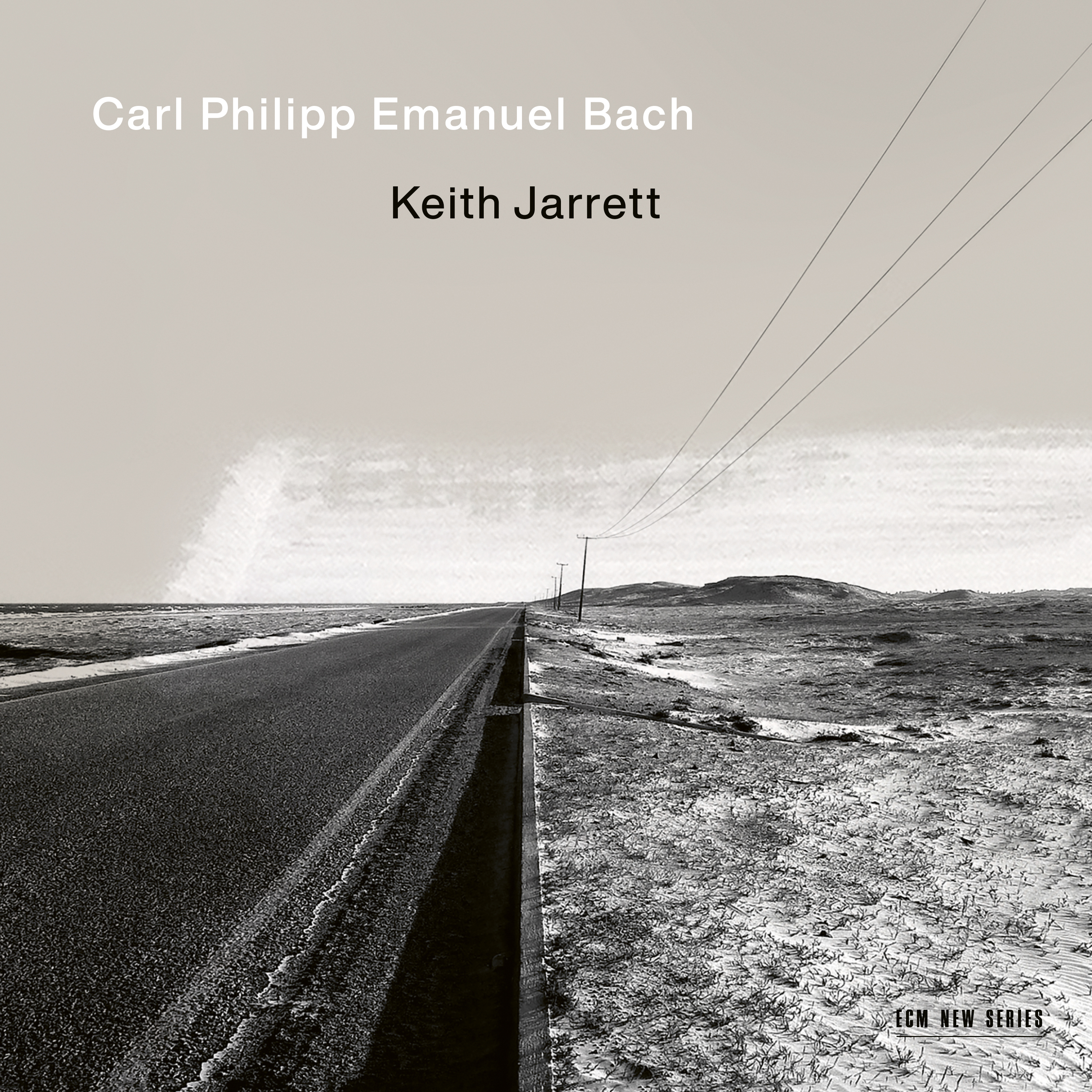
Keith Jarrett piano Recorded May 1994 at Cavelight Studio, New Jersey Engineer: Peter Laenger Cover photo: Mayo Bucher Executive producer: Manfred Eicher Release date: June 30, 2023
In his 2014 monograph, The Music of Carl Philipp Emanuel Bach, music historian David Schulenberg paints a compositionally focused portrait of Johann Sebastian’s second son. Despite living in his father’s shadow, his influence managed to shine a light through the veil of history by way of his seminal Essay on the True Manner of Playing Keyboard Instruments and the conduit he was purported to have furled between the Baroque and Viennese Classical schools. As a composer of nearly 1,000 works, his oeuvre is nothing to sneeze at, nor his style, as much an example of evolution in and of itself as of eras retrospectively defined.
As Paul Griffiths notes in the liner text for the present album, which documents Keith Jarrett’s traversal of CPE’s Württemberg Sonatas, the ocean between father and son may seem vast, even as it churns with currents of familiarity in concert with calls from more distant shores. Dedicated to Carl Eugen, Duke of Württemberg, this collection “makes the point about inheritance avoided, or qualificated, or contradicted, or accepted, whether with gratitude or resignation.” Although nominally composed in 1742/43 for the student who would soon ascend to his dukedom, Griffiths observes, “More likely it was for his own fingers he was writing, and for his own ears.” Jarrett, having only heard these pieces on harpsichord, felt compelled to make a piano version, resulting in this home studio recording from 1994, likewise also for his own fingers and his own ears. All the more honored we should feel to have it available three decades later.
Sonata I in a minor is glorious from the start. There are moments of intense poignancy, as in the Moderato, while the faster outer layers elicit feelings of joy that are always undercut by what Griffiths calls a “sad grace” throughout (I might also call it a glorious melancholy). The final movement, marked Allegro assai, carries astonishing depth in tow. What seems a lightly articulated dance has room for so much more than the listener can calculate. Jarrett brims with vitality and precision without ever letting go of the improvisational spirit for which he is known on the jazzier side of things.
The sheer clarity of Jarrett’s voicings, a profound match for the younger Bach’s own, is fully displayed in Sonata II in A-flat major, of which the concluding Allegro is especially vibrant for its multifaceted joys. Like a brick wall, each layer staggers, parallel to every other layer below and above it, adding strength to the overall design and function.
The opening of Sonata III in e minor is perhaps the most glorious of them all, revealing its heart from the first sweep of the second hand. The Adagio is nostalgia incarnate, while the Vivace—the briefest movement of the collection—peels itself away with unfiltered love. The pauses in Sonata IV in B-flat major make for passionate contrast, yielding an Andante of great beauty. Working in stepwise formation, it is a DNA helix surrendering to melodic sequencing.
The more these sonatas develop, the more they veer toward Father Bach, especially in the Adagio fugue of Sonata V in E-flat major. With sweeping intimacy, it pieces together its puzzle between gusts of wind and spirit. The final Sonata VI in b minor is another inwardly focused distillation that defends variegations of light and shadow. The clocklike Adagio is a gem, while the final Allegro glistens in the setting sun. Each is a different keyboard, two eddies in a bay coming together harmoniously, speaking the same truth but with different tongues.
Vox Clamantis Jaan-Eik Tulve conductor Recorded March 2021 at St. Nicholas Dome Church, Haapsalu Engineer: Margo Kõlar Recording supervision: Helena Tulve Cover photo: Jan Kricke Executive producer: Manfred Eicher Release date: June 2, 2023
O sing unto the LORD a new song: sing unto the LORD, all the earth. – Psalm 96:1
Gregorian chant was the experimental music of the medieval era. Here, filtered through the work of Norwegian organist, choir conductor, and composer Henrik Ødegaard (b. 1955), it blends into the folk music of his own country, all tied together by a contemporary classical idiom that takes two steps back for each one forward. In the throats of Vox Clamantis under the direction of Jaan-Eik Tulve, his sound feels as inevitable as the faith that binds it at the molecular level.
The Genesis of this musical Bible is Jesu, dulcis memoria (2014/15). Its dialogue of darkness and light draws from the liturgy of the Feast of the Holy Name of Jesus to establish the grandest of all dichotomies. As a drone appears underneath, followed by shifting chords, it opens itself to new shades of the text. Such is Ødegaard’s respectful approach to spiritual building, leading to an interwoven “amen.” From here, we get an even deeper dialogue in the inner heart work of Alleluia, Pascha nostrum. Its tender monophony speaks of Christ’s death, while O filii et filiæ(2015/21) offers Ødegaard’s examination of the resurrection. At its core is a 15th-century paschal hymn, building polyphonically through its refrain. Men’s and women’s voices make contact and separate, each a flock of birds gracing the sky with its murmurations. The Gregorian section concludes with a Kyrie and a Pater noster, the latter from a 13th-century Madrid codex, containing some surprising friction and sound colors.
Antiphons from a Scandinavian manuscript of the same century are the basis of the eight-part Meditations Over St. Mary Magdalene’s Feast in Nidaros (2017), which occupies the album’s largest portion. In her liner notes, Kristina Kõrver writes of the work, “It is as if the composer were literally sitting in front of a fragmentary manuscript, filling in the gaps and adding the missing lines, not as a scholar-restorer, but as a poet, a co-creator.” Whether working in tension or harmony with his sources, Ødegaard always seems to be exploring the material as one might repair a piece of old furniture, knowing that even the most seamless integrations will reveal themselves with subtle differences in hue, texture, and quality. The first and last sections are the most personal, revealing the composer’s penchant for unsettled yet cohesive harmonies. Their flow is always restrained so that our ears might be directed inward and our eyes upward.
When encountering Psalm 62 in the antiphonal “Mini osculum non desisti,” we find ourselves not torn but made whole, as if two parts of ourselves walking away from each other have turned around to meet in fellowship. Meanwhile, Canticum Trium Puerorum emerges organically from the chant of “Oleo caput meum non unxisti” as steam from boiling water. As Ødegaard continues to open our hearts to these possibilities, they begin to feel as natural as the souls rendering them. The choir shapes these with such grace as to be stilling in effect. In the setting of Psalms 148-150, a shushing sound feels like the rasp of pages being turned from the pulpit: a reminder that the Word was indeed made flesh. The deepest font is in the Magnificat, merging with “O, Maria, mater pia.” The resulting flow is so alluring that anything floating upon its waters would seem out of place. And that it does—at first. But something transformative happens as the women’s and men’s choirs align to illustrate the gospel’s power to seek, find, and restore unity.
If I were to compare the Meditations to a stained glass window, it would be analogous to the solder that holds together the panels rather than the panels of color themselves. It is a skeleton enshrouded by centuries of worship, made animate by the power of the lungs and the breath of life that fills them with the oxygen of salvation.
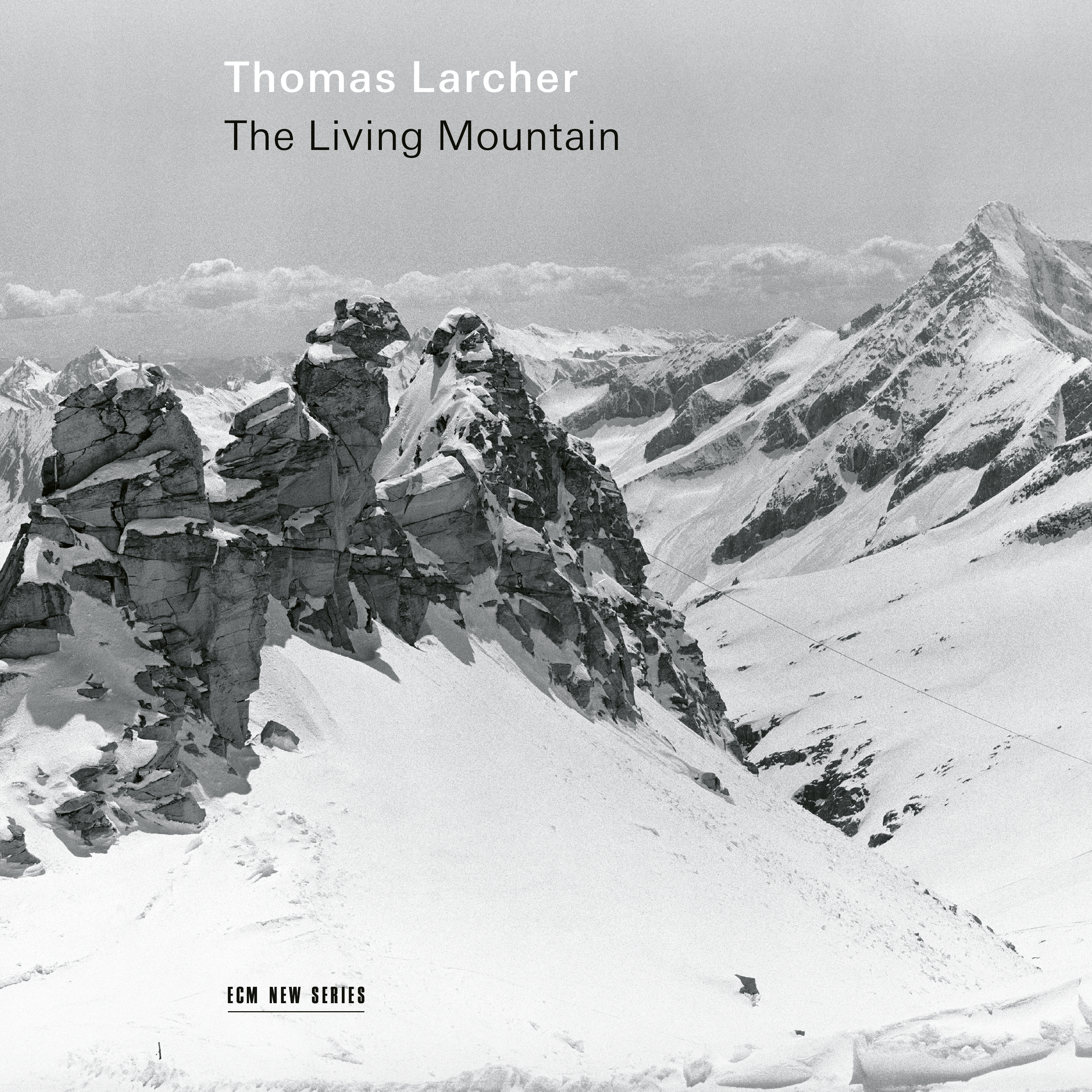
Sarah Aristidou soprano Alisa Weilerstein violoncello Aaron Pilsan piano Luka Juhart accordion André Schuen baritone Daniel Heide piano Münchener Kammerorchester Clemens Schuldt conductor The Living Mountain / Ouroboros recorded June 2021 Bavaria Musikstudios, München Unerzählt recorded May 2022 Gemeindezentrum Weerberg Engineer: Christoph Franke Cover photo: Awoiska van der Molen Produced by Manfred Eicher Release date: October 6, 2023
“At first, mad to recover the tang of height, I made always for the summits, and would not take time to explore the recesses.” –Nan Shepherd
The Living Mountain is the fourth ECM New Series album dedicated to the work of Thomas Larcher, whose previous programs have proven the Austrian composer to be, much like his mentor Heinz Holliger, a human magnifying glass. His attention to detail grows only more precise as his instrumental forces increase. Meanwhile, the chamber works unfurl in grand (but never grandiose) imaginings of times and places that we would never experience except through the filter of his awareness of the past. The eponymous song cycle for soprano and ensemble is a particularly vibrant example. Composed between 2019 and 2020, it sets selections from the memoir by Scottish poet Nan Shepherd, whose own penchant for highlighting the intimate in the vast suits Larcher’s sensibilities hand in glove.
From an introductory heartbeat, the landscape pulses with the music of blood flow, visceral and true. Larcher articulates this anatomy with surgical precision on his way to Part II, where we feel ourselves on the verge of falling over. That sense of vertigo—at once glorious and terrifying—sweeps through every crevice. Singer Sarah Aristidou expresses Shepherd’s words as if they were her own. Whether in brief expulsions of accordion breath or the hammering of piano strings, the diurnal reigns supreme. The final movement’s evocation of snow, as sparkling and wind-roused as it is blinding, runs down the text’s spinal cord.
At the other end of this proverbial tunnel is another song cycle, Unerzählt (2019-20), this one for baritone and piano based on the poetry of W.G. Sebald. These vignettes turn stills into moving pictures. Moods range from the programmatic (e.g., “Die roten Flecken,” which evokes the red spots on Jupiter in dramatic fashion, and the prepared piano rattlings of “Wenn die Blitze herabfuhren”) and the morose (“Am 8.Mai 1927”) to the contemplative (“Gleich einem Hund”) and painterly (“Blaues Gras”). One highlight is “Es heißt daß Napoleon,” from which we get this wry piece of historical revisionism:
They say that Napoleon was colorblind & blood for him was as green as grass
The delicacy of Larcher’s setting brilliantly toes the line between mockery and empathy. Another standout is the final song, “So wird, wenn der Sehnerv zeerreißt”:
And so, when the optic nerve is torn, the silent airspace turns as white as the snow on the Alps.
Thus reconnected to the snowy expanse in which we began, we can take strange comfort in its inhospitable nature—which, in the end, makes us all the more human. Pianist André Schuen and baritone Daniel Heide mesh beautifully, allowing bell-like sonorities to percolate through deeper gravel.
Stretching out the darkness between these is Ouroboros (2015). Cellist Alisa Weilerstein and the Munich Chamber Orchestra navigate three movements, opening with a dance of slow-motion detections. Despite the nominal instrumentation, the piano plays a vital moderating role in this relationship. Neither call nor response, theirs is a symbiosis that implies an eternal path to nothingness. The tempestuous middle movement deals in fear with a squealing, unrelenting grind. The conclusion reveals an ethereal balancing act, Weilerstein reaching the most pristine high notes I’ve heard on a cello in a long time before a frenzied crackle of fire and ash consumes itself. As the flame goes out, it moans one last time, just before comprehension and death become one and the same.
Natascia Gazzana violin Raffaella Gazzana piano Recorded November 2021, Reitstadel Neumarkt Engineer: Markus Heiland Cover photo: Luciano Rossetti Produced by Manfred Eicher Release date: November 18, 2022
A new recording from the Gazzana sisters—Natascia on violin and Raffaella on piano—is always something to celebrate. But what they now present may be their finest in terms of programming, thoughtfulness, passion, and self-control. Making a special case for this assertion are the subtle shades of Tõnu Kõrvits’s Stalker Suite (2017), one of two pieces written for the duo by the Estonian composer. Despite being an homage to Andrei Tarkovsky’s eponymous masterpiece, the music occupies a world unto itself, not least because of its performers’ unobfuscated humanity. From the soft metallic pianism that introduces “Into The Zone,” we relive at least some of that journey, which seems to go deeper vertically the more it proceeds horizontally into abandoned areas of non-existence and timeless looping.
Kõrvits doesn’t so much describe the imagination of cinema but rather the imagination incinema. When the film’s characters, for instance, enter “The Room,” their musical equivalent doesn’t seek to recreate those dilapidated walls, the waterlogged detritus of lives unlived, or the ringing phone. Instead, it lives in the quiet unrest of a mind led by the hand to a mirror in which images disappear as quickly as they manifest.
As the Stalker notes in his “Monologue,” what we call passion is the friction between souls and the lives of the bodies they inhabit. Weakness, he goes on to say, is the companion of birth, whereas strength is the accompaniment of death. Thus, every note wavers in the delicate metaphysical tension between the two. Rich and pliant yet fiercely resolute against the blinding light, it touches the periphery that is no periphery. If anything is programmatic here, it is “Waterfall,” but even this comes with an implied proviso: You must not treat the image as an idol, for faith comes by hearing, not seeing. The Zone has been internal all along.
Notturni (2014), also in four parts, delineates another porous architectural enclosure. Kõrvits’s penchant for brevity is philosophically and hermeneutically suited to these pieces, which take ideas not as excuses for grand expounding or soliloquizing but as poems in miniature. And if a nocturne is supposed to be about the night, then these modern examples of the form show us that a darkened sky reveals what the daylight obscures with its glare. The relationship between piano and violin is especially profound in the third piece, where fluttering high notes in the keys mesh genuinely with lower voicings in the bow.
Between these modern ores lies the polished gemstone that is Robert Schumann’s Sonata No. 1 in A minor, op. 105, of 1851. In its flowering opening movement, the violin’s G string resounds like an alto in the forest. In the Gazzanas’ hands, it feels as natural as sunrise. Although formally divided into three movements, the central one being the most searching in its cautious approach, it finds resolution in the recession of its character. The folk-like qualities of its final act are a testament to the inner struggle of a composer wanting to look to the soil without having to trip over those buried therein.
Finishing out the program is the Sonata No. 3 in C minor, op. 45 (1887) by Edvard Grieg. For this rendering, they default to the composer’s own copy, which differs from the first published edition. The differences accentuate the Norwegian character, drawn by flowing brushwork and sometimes-gnarled textures. If the first movement is a robust ode to origins, then the second, marked “Allegretto espressivo alla Romanza,” is a contemplative gush of loving kindness. Moving in slow motion, it calms us before the storm of the final dance revels in a palette’s worth of colors. The Gazzanas masterfully navigate every twist and turn in this lush and yielding landscape. At once songlike and exuberant, they allow every glint of meaning to shine through to the rousing end.
Patrick Demenga violoncello State Choir Latvija Riga Cathedral Boys Choir Youth Choir Kamēr Andres Mustonen conductor Concert recording, March 2009 Jesuitenkirche Luzern Engineer: Charles Suter Assistant Engineers: Urs Dürr, Ruedi Wild Executive Producer (SRF): Rolf Grolimund Cover: Eberhard Ross Co-production ECM Records/Radio SRF 2 Kulture Release date: March 14, 2025
Set me as a seal upon thine heart, as a seal upon thine arm: for love is strong as death; jealousy is cruel as the grave: the coals thereof are coals of fire, which hath a most vehement flame. –Song of Songs 8:6
The music of Alexander Knaifel (1943-2024) is a chain of lakes in the ECM New Series landscape. In this latest release, consisting of the slow-motion embrace that is Chapter Eight (1992/93), we encounter his setting of the eighth chapter of the Song of Songs. Conceived as a “community prayer,” it places a cello (played here by Patrick Demenga) at the center of three choirs arranged crosswise in a cathedral, itself listed among the instrumentation in the score.
Demenga is the welcomer whose song leads the way as the voices emerge from the wood- and stonework of the space itself, where human hands have left behind forms we can hear, see, and touch. Such tactility is at the heart of everything Knaifel composed. By stretching words and images to their breaking point, he showed how fragile our relationship to sound really is. For that reason alone, we should not be surprised that Chapter Eight is not a straightforward rendering of its source text, as verses are reordered, and not every one is accounted for. Some are also repeated (verse 1 appears six times, verse 6 appears five times, etc.), and by the time we get to the last of the piece’s 32 stanzas, we are reduced to fragments thereof. In that reduction, however, lies the key to understanding the truth we are being given: Scripture is nothing without its orality. And so, by favoring these far-reaching suspensions in his choral writing, the composer is redefining transcendence not as overcoming of the physical but as a manifestation of the liminal. The world seems to stop spinning, the clouds are no longer moving, and the sun is held in its dial. Through it all, the cello is a thread pulled through a veil not of our own making.
Although the passionate dialogue of Song of Songs is often read as a metaphor between the Jewish and Gentile churches at a time when Christ’s reconciliation had yet to be born out through the new covenant, Knaifel goes one layer deeper to highlight such tensions in every believing heart. While the cello and choirs become more unified in vision, they turn rapture into capture, whereby the body-solvent spirit is held gently in place by God’s plan. The repeated verses remind us that we must never leave others behind in our spiritual walk and that salvation is never ultimately about the self but is a means of glorifying the one who bestows it. The lover’s jealousy, therefore, is that of a God who hopes that all of us might lay our heads in his bosom. We feel this when Demenga’s bow falls from its perch (high notes like lasers through the mind) and scrapes the bottom of its fleshly allegiances (low notes like rusty chains through the heart). The singers move methodically, each syllable becoming a verse unto itself, the roles of call and response gradually reversing.
Thus, the pace of time becomes distorted, like seeing the world through a window down which drips a quiet rain. The storm is the language of faith, a test of our immaterial resolve against the material. And when we fail, we are ready to be lifted again and remade in the image of what we are meant for. And as these forces meet in the middle, they stand at the intersection of all things, whispering, “The unfinished statement is where life begins.”
This is music you can leave on to exist on its own terms until it becomes a part of the architecture you call home.
András Schiff clavichord Recorded July 2018 Kammermusikssaal H. J. Abs, Beethoven-Haus, Bonn Engineer: Stephan Schellmann Cover photo: Jan Jedlička Produced by Manfred Eicher Release date: January 27, 2023
“When I’m at home, my day always begins with Bach. It used to be on the piano, now it’s on the clavichord, even before breakfast. After a few of the Inventions I feel reborn. My ears, my mind, soul and spirit are cleansed.”
Few keyboardic constructions feel as tangible as the clavichord. If only for that reason, it takes getting used to. Yet if you are willing to meet it on its own terms, its internal resonances and breadth of character soon become apparent. As the go-to of Johann Sebastian Bach, it deserves a spotlight in this music—not only for its sound but also for its spirit. For while its intimacy is a given (allowing as it did the luxury of private interpretation for both composers and enthusiasts), and its history and Bach’s relationship to it are well documented, there’s something about letting it sing for itself, and I can think of few hands more capable of doing just that than those of pianist András Schiff, whose humble admission crowns this review.
The six-part Capriccio sopra la lontananza del fratello dilettissimo (Capriccio on the departure of a beloved brother) is a delightful inauguration to the instrument’s flavor. Though lesser known than the Inventions and Sinfonias (a.k.a., the Two- and Three-Part Inventions, split between this album’s two discs), they speak nakedly and with the programmatic lucidity required of them. The bigger, canonical collection after them dons new garments (if not sheds old ones) in the present recording. Knowing that Bach likely intended them for the clavichord gives us a renewed understanding of their provenance. The faster movements (cf. Invention No. 4 in d minor, Sinfonia No. 15 in b minor) sparkle, while the slower ones (cf. Invention No. 2 in c minor, Sinfonia No. 4 in d minor) feel more robust than ever. The middle realm (cf. Invention No. 15 in b minor, Sinfonia No. 11 in g minor) gives us the best of both worlds. Such is the magic of the clavichord: Despite its slimmer character and build, it holds its own and then some in a basket woven of lower pitch (a’ = 404 Hz). One highlight in this regard is the lutelike Sinfonia No. 9 in f minor, which walks up a flight of stairs, making the pull of gravity palpable.
Between these are the Four Duets (of which No. 3 in G major is especially wholesome) and the Ricercar à 3 from Das Musikalische Opfere, which, along with the concluding Chromatic Fantasia and Fugue,is the biggest revelation herein. Whereas the orchestral sensibilities in one are still very much alive, albeit refracted and distilled, the other shows the subtlety of the “Bebung” technique, whereby the performer adds vibrato with vertical pressure of the fingertip. Thus, these pieces’ complexities become more apparent because they cannot hide within the piano’s cavernous architecture. The fugue is a wonder. Feet to ground, it knows where it stands and how to take joy in the life it has been freely given.
Thomas Zehetmair violin, conductor Ruth Killius viola Royal Northern Sinfonia Recorded live June 2014 at The Sage Gateshead Engineer: Hannelore Guittet Cover photo: Max Franosch Executive producer: Manfred Eicher Release date: February 17, 2023
The triptych on offer here is proof positive of violinist Thomas Zehetmair’s boldness as a conductor. With his wife, violist Ruth Killius, he brings together an intriguing assortment at the helm of the Royal Northern Sinfonia. Most surprising is British composer John Casken’s That Subtle Knot, which receives its premiere recording. This double concerto for violin, viola, and orchestra was written in 2012-13 and is dedicated to the present performers. Taking its inspiration from the poetry of John Donne, whose characteristic attention to physiological detail is beautifully mirrored throughout, it charts a course of passionate complexity through two movements. The lone viola of “Calm” unfolds in an unnamed wilderness, searching its past but finding traces of the future. As the violin steps foot onto the same landscape a divider’s distance away, the orchestra hints at natural obstacles between them: a mountain face, a ravine, a river too wide to cross. And yet, none of this bars one from knowing and empathizing with the other. Moments of dance-like energy are necessarily brief so that even when they reach a state of agreement, it is always mediated through the environment. Despite its title, “Floating” is rife with dramatic highs and lows. If anything, it floats in the sense of something being tossed about in the wind and never being allowed to land until it has been battered and bruised. Like a human relationship, it weathers the storm, finding its bearings the emotional lessons it has learned. The high note on which it ends is a testament to the power of perseverance.
What a fascinating companion this work has in the form of Béla Bartók’s Concerto for Violin and Orchestra. Although largely considered his final work, despite some controversy to the contrary, it is a shot in the dark of the year in which it was written (1945). Regardless of provenance and subsequent revisions, it proves itself more than ever to be a beacon of the viola repertoire at the touch of Killius’s bow. She arrives on the scene in a burst of light, courting the orchestra into a dance of knotted proportions. The more the Moderato develops, the tighter that knot becomes, unraveling itself only in dreams. There is nothing inviting or conciliatory about the viola’s restlessness. It is always unsettled, and therein lies the spell. Speaking of spells, one cannot help but be enchanted by the central movement, which speaks to the heart of this piece and its composer. Its brevity after the gargantuan first makes it all the more poignant. In the last, marked Allegro vivace, a superb articulation abounds. Every thought—both on paper and in the minds of those interpreting it—is lucid to the core, working into a concise and spirited finish.
And where to end this three-legged race? Why, in the well-worn yet crucial binding of Ludwig van Beethoven’s Fifth, of course. The urgency of its familiar opening statement is given special urgency while still giving those pastoral asides room to breathe. What is remarkable is that, despite this energy, which carries over even into the flowing violins of the slower second movement, the winds are never drowned. Rather, they speak like a Greek chorus, carrying omniscience in their hands. Also notable is the sheer delicacy of the pizzicato in the third movement, so crisply captured in this recording, and the breadth of the concluding Allegro, in which a not-so-subtle knot of grace and affirmation ties itself before our very ears.
Rune Tonsgaard Sørensen violin Frederik Øland violin Asbjørn Nørgaard viola Fredrik Schøyen Sjölin violoncello Recorded June 2021 Festsal, KFUM/KFUK, Copenhagen Engineer: Markus Heiland Cover: Eberhard Ross Produced by Manfred Eicher Release date: April 14, 2023
The Danish String Quartet concludes its nearly eight-year journey pairing Ludwig van Beethoven’s five late string quartets with works by Johann Sebastian Bach and later composers. Looking back, I can’t help but smile at how deeply and patiently the DSQ has fertilized the soil of this project to yield the richness of spring harvest.
As the musicians humbly observe, “Micromanagement is rarely a successful strategy when it comes to late Beethoven.” Therefore, if the music feels almost fiercely detailed, it’s because the relationships between the notes speak up for themselves at every turn. Indeed, it’s impossible to encounter the initial stirrings of the String Quartet No. 16 in F major, op. 135, wherein the composer returns not only to the quadripartite form but also to his astonishment of the past, without blushing. And what, you might wonder, is immediately apparent this time around? Nothing less than the undeniable realization that the late Beethoven deviates from other “standard” quartets of the repertoire (including his earlier own) in how inevitable it feels. Whether in the lucidity of the second movement or the dark pastoralism of the third, every sound takes on a physical appearance. The sheer grit the Danes bring to these contrasts is wonderous. Whereas the faster rites of passage would give little room for personal interpretation in less capable hands, in the present context, they are vessels in which the pudding of proof is artfully mixed. In the final stretch, which begins in gentler territory while also expressing great urgency, the call and response between cello and violins opens the door into a run across an open field where life itself becomes the map leading the way to the other side.
Anton Webern’s String Quartet of 1905 (the second of two he wrote that year) brought about a sea change in the genre. Although played in one continuous 18-minute stretch, it takes on a nominal structure in three sections (“Becoming,” “Being,” “Passing Away”) based on the work of painter Giovanni Segantini. Its shifts between darker and lighter keys, between exhalations and holdings of breath, would seem to mirror Beethoven, while its central fugue casts a shadow further back to Bach. The more one immerses oneself in it, the more fragmentary it becomes. As with the canvases that inspired it, one is tempted to isolate a mountain from land and sky, all the while missing out on the benefit of zooming in further on individual plants, puffs of cloud, and rocky imperfections that can only be described as “hymnal” in shape.
The setting for these diamonds consists of Baroque prongs. Whereas Bach’s chorale prelude, Vor deinen Thron tret ich hiermit, opens the program as one would wake up from a coma only to realize how much the world has not changed, the Contrapunctus XIV from The Art of Fuguereleases its pollen by the light of the moon, windswept in evening breezes to places we cannot touch until our bodies wither. Being unfinished, it ends mid-statement, leaving the remainder to toss about in the waves of our unworthy fancy. Sometimes, the best way to answer a question is by posing another.
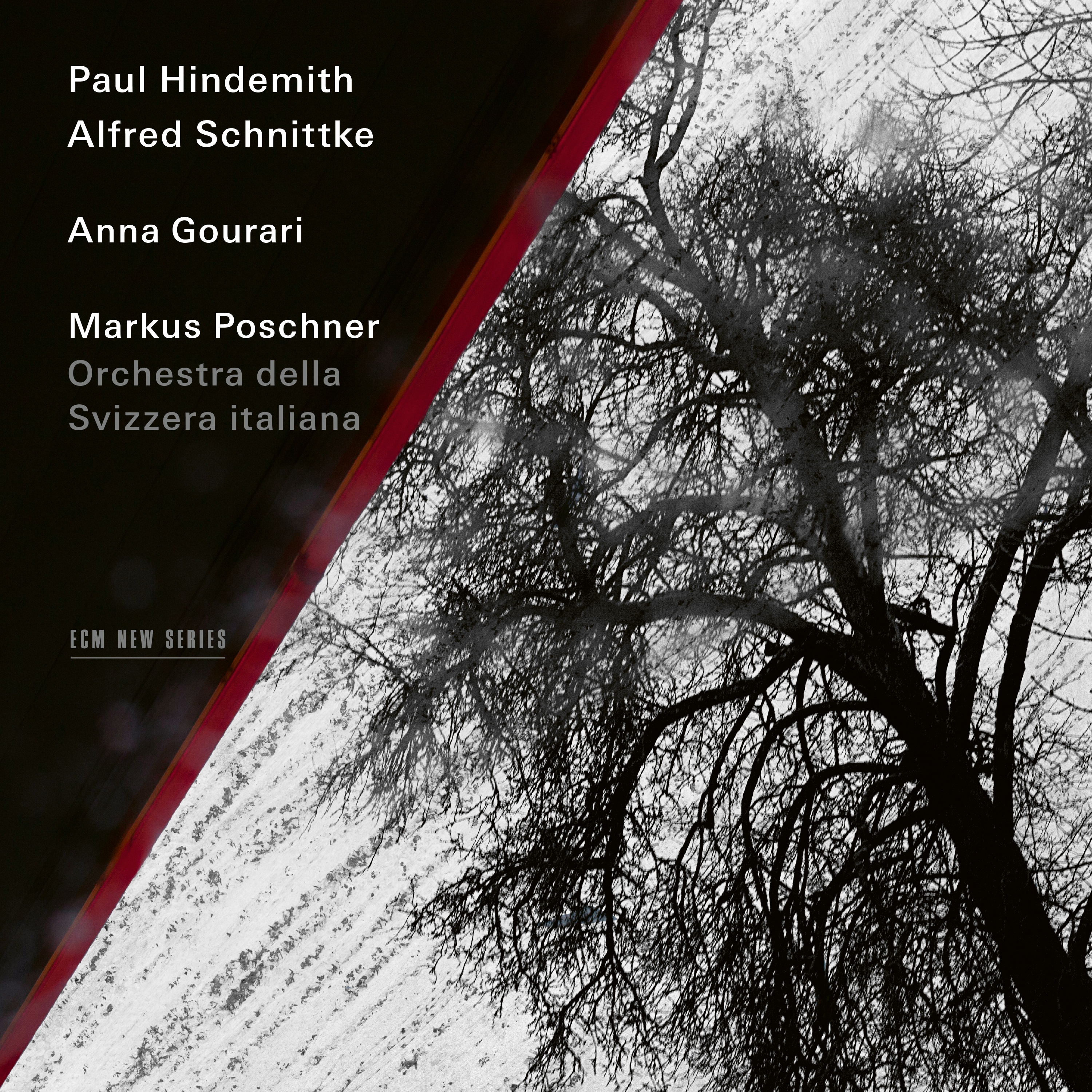
Anna Gourari piano Orchestra della Svizzera italiana Markus Poschner conductor Recorded December 2021, Auditorio Stelio Molo RSI, Lugano Engineer: Wolfgang Müller (RSI) Mixed January 2023 by Wolfgang Müller and Manfred Eicher Cover photo: Fotini Potamia Produced by Manfred Eicher Release date: June 14, 2024
Since making her ECM debut with Canto Oscuroin 2012, Tatarstan-born pianist Anna Gourari has tread a distinct path. On that and two subsequent solo recitals, the breadth of her vision as a musician is matched only by her choice of repertoire, spanning the gamut from Bach and Chopin to Medtner and Kancheli. For the present program, she gives deference to two beacons whose light has often shined at her fingertips.
The Composers
In this program notes, Roman Brotbeck describes Alfred Schnittke (1934-1998) as a listener above all. As “one of the most idiosyncratic and enigmatic composers of the 20th century,” he was a resolute soul who didn’t so much search for sounds that were new but rather expressive of a higher power. In addition to his symphonies, choral works, and various configurations for orchestras and soloists, he wrote prolifically for film, seesawing throughout his life between his German roots and Russian upbringing, all the while examining a deepening Orthodox faith. As well versed in idioms as he was in subverting them, he operated like a linguist parsing morphemes to explore how they might be connected across seemingly insurmountable barriers of genre, style, and historicity. From his early days at the Moscow Conservatory to his later years in Hamburg, Germany, he was as much a polyglot as a polystylist who organically defied categorization.
“The reactions music evokes are not feelings, but they are the images, memories of feelings.” So wrote Paul Hindemith (1895-1963) in his 1952 collection of lectures, A Composer’s World. Like Schnittke, music was a field where he planted two sacred ideas for every secular. He was also a concert violinist/violist, an author, and a committed teacher. His composing was as much a reflection of extroversion as his daily life was of privacy. After studying at the Hoch Conservatory in Frankfurt, he served in the Imperial German Army, diving headlong into composing upon his return to civilian life. Fleeing the scourge of Nazism, he founded the Ankara State Conservatory at the behest of the Turkish government, thereafter arriving in America in 1940, where he taught at Yale and Cornell, among other institutions of higher learning, before living out the rest of his life in Switzerland and his native Germany. Throughout his steadfast career, he explored the tonal landscape with fortitude and creative boldness. He also greatly influenced the young Schnittke, whose side of the Venn diagram overlaps Hindemith’s by 29 years.
The Music
Schnittke’s Concerto for Piano and Strings (1979) has a special place in my heart. As a teenager, I discovered his music through the BIS recording label. This piece was featured on my favorite of the series (CD-377), where it was paired with the Concerto Grosso I of 1977 and the Concerto for Oboe, Harp, and String Orchestra of 1971. It wasn’t long before I learned of his death via my local classical radio station.
The opening piano of this gargantuan piece is an exercise not in contrasts but in constructs; the gentle stirrings morphing into giant broken triads and the ethereal entrance of strings are as cohesive as they are episodic. Over 23 minutes, this mashup of, in the composer’s words, “surrealistic shreds of sunrise from orthodox church music” and “a false burst of Prokofievian energy and a blues nightmare” succeeds with an uncanny beauty. As the orchestra attempts to engulf the piano in an almost Purcell-like wave of drama, the struggle feels as real as rain. In the end, the B-A-C-H motif emerges like a blush of red across bare skin, a comet frozen in time, a scar where the light of God shows through.
During the second half of his composing career, Hindemith became firmly entrenched in robust harmonic structures that overshadowed the expressionism of his youth even as they drew from it. In response to Hitler’s growing shadow, he wrote his opera, Mathis der Maler, in which the titular protagonist, Renaissance painter Matthias Grünewald, sought refuge in his art from the German Peasants’ War of 1524-25. During that period, Grünewald painted the Isenheim Altarpiece in Colmar, and it was this Hindemith expressed in musical form in this symphonic distillation from 1934. First is the “Angel Concert,” which takes the medieval song “Es sungen drei Engel” (Three angels were singing”) as its central motif. Its tripartite structure is just one echo of the Trinity. Like Schnittke’s own angelic concert, the music is richly varied yet utterly cohesive, if more accessible to lay ears. Next is the “Grablegung” (Entombment), which depicts the mother Mary, Mary Magdalene, and the apostle John mourning the death of their Savior. But that darkness is short-lived as the glory of Christ’s resurrection crashes into the foreground. Lastly, the “Versuchung des heiligen Antonius” (Temptation of Saint Anthony) nestles the patron saint from Padua (and contemporary of St. Francis) in a gaggle of monstrous creatures. Dissonance makes itself known, rendering the marching valiance of its unfolding all the more powerful. Brotbeck notes the significance of this movement’s subtitle (“Where were you, good Jesus, where were you? Why were you not there to heal my wounds?”) as painted into Grünewald’s portrait of Antonius: “Hindemith’s reference to this exclamation shows the autobiographical aspect of the symphony, as Antonius, who withdraws from society and is exposed to satanic temptations as a desert hermit, also reflects Hindemith’s personal situation in Nazi Germany.” Said temptations play out with churning drama.
After fleeing to the US, Hindemith came to write his ballet score, The Four Temperaments, in 1940 for George Balanchine. However, this theme and variations for piano and string orchestra never received its intended premiere, as the sinking of the Hood of Britain by the Bismarck of Germany cast a pall over composers of the latter persuasion. Nevertheless, we find another space in which politics seems even farther away. Here, we encounter a more metaphysical realm. Whereas the first variation flirts with melancholy and the fourth with jagged relief, the constellations between them blend concerto-like impulses with sonata-esque spirit. Duos, trios, and other combinations abound, each reaching for something familiar.
The Performers
Gourari approaches Schnittke with incredible drive and reflection. In a particularly dramatic middle section, she digs into the piano’s most nutrient-rich dirt, finding equilibrium even amid the drunken sway of violins struggling to maintain their own. She treats the instrument as an extension of herself, ever searching for a means to speak through its many intermediary mechanisms. From jazzy slurs to neoclassical aphorisms, medieval chants to postmodern geographies, she navigates it all with a compass that adapts to every shift of current.
The Orchestra della Svizzera italiana and conductor Markus Poschner work through the fleshly struggles of Hindemith’s Mathis der Maler with appropriate tension. They take stock of flesh and spirit equally, treating them as substances to render the compositional impulse as clay in the potter’s hands. There is a sense of having been somewhere tragic, carrying fragments of some tattered book or relic on the way to a church down to its last candle.
The Four Temperaments combines all of the above. In the second movement (first variation), Robert Kowalski’s solo violin lends a sense of mournful whimsy. Gourari is deeply in character throughout. The orchestra doesn’t act as a massive unit for which the piano is a mere decoration or accompaniment. Rather, it serves as a wellspring of material inspirations from which every key may be gathered.





 Between Sound and Space: ECM Records and Beyond