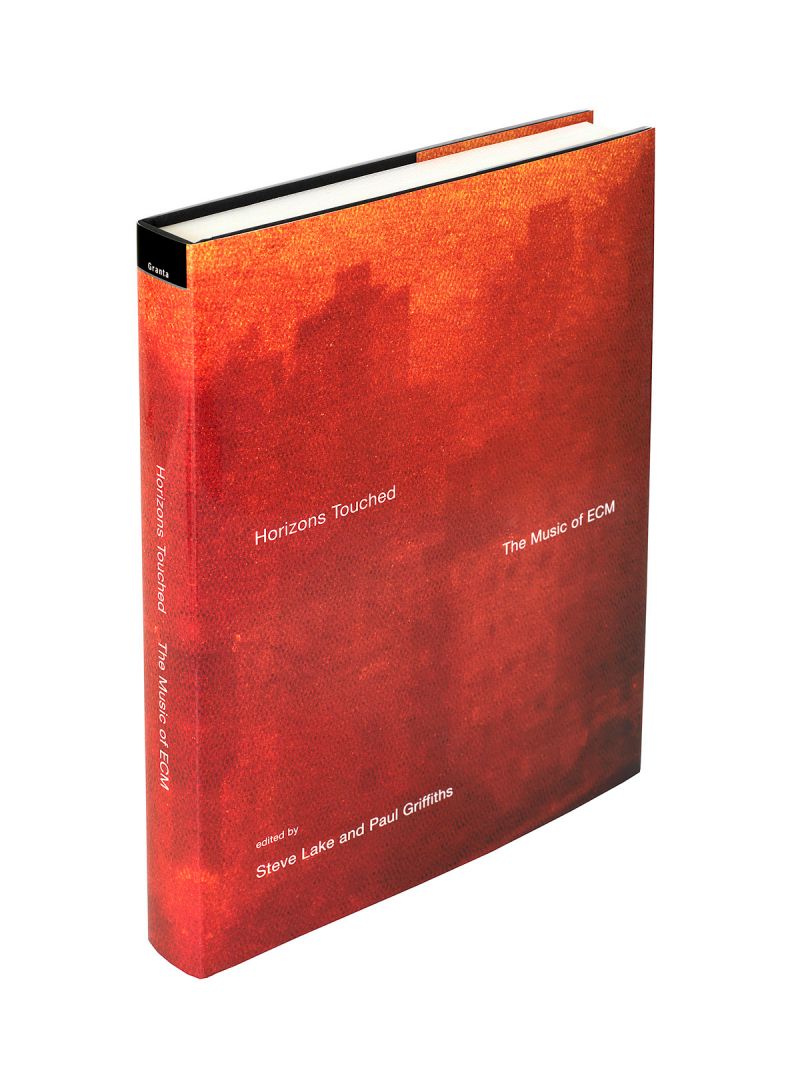
Horizons Touched: The Music of ECM

Horizons Touched

It’s all our music.
–Robert Frost, “The Self-Seeker”

I. A Living Archive

Few record labels compel us to approach them in any way other than chronologically. ECM is one of them. Its catalogue does not merely document music made; it charts ways of listening learned, unlearned, and learned again. Horizons Touched: The Music of ECM arrives, then, not as a monument erected after the fact but as an attempt to take measure of a phenomenon still in motion, to listen back without closing the ear to what has yet to sound.

The importance of this book, devotedly published by Granta Books in 2007, lies precisely here. Rather than offering a definitive account of ECM, it gathers voices, memories, and reflections in a way that mirrors the label’s own refusal of finality. It does not summarize so much as resonate. In doing so, it becomes something rarer than an institutional history: a field of attentiveness, an act of collective listening directed both backward and forward. What is preserved is sensibility over consensus.

In his introduction, Steve Lake rightly calls ECM a “work-in-progress.” Indeed, ECM is not a repository of completed statements but a living archive in which the contributions of everyone who makes it a reality function as vital organs within a larger, thriving body. The questions posed throughout the book are as follows: How does one listen to a past that refuses to settle into style, school, or doctrine? How does one write about music that has always positioned itself slightly ahead of its own reception?

Before ECM and its leadership under bassist-turned-producer Manfred Eicher, no one had thought of space in jazz in quite the same way. Through Eicher’s early work with engineers Martin Wieland and Jan Erik Kongshaug, the recording studio itself emerged as an unspoken player, an active participant rather than a neutral container. Light entered sound. Atmosphere became structural. Silence was no longer an absence but a condition. Yet even this often-cited “ECM sound” resists fixation, not because it lacks identity but because it repels reduction.

Given that so many locations, musicians, and traditions have passed through the label, to distill its ethos into a single style would be to flatten precisely what has given it life. As Eicher admitted in a 1999 interview, “All that can be really said about the ‘ECM sound’ at this point is that the sound that you hear is the sound that we like.” From this deceptively modest admission unfolds an expansive reality. What began as a jazz imprint grew far beyond the conventions of genre, making room for folk music, film soundtracks, electro-acoustic alchemy, and, with ECM New Series, classical streams grafted into the same current. Even there, the borders remain porous: Jan Garbarek improvising alongside the Hilliard Ensemble; curated excerpts from a Heiner Goebbels sound installation; Keith Jarrett playing Bach’s French Suites on harpsichord.

Horizons Touched matters because it understands this permeability not as a problem to be solved but as a condition to be honored. Enabled by over 100 contributors, the book presents itself as an “oral history,” though the term hardly captures its scope. What emerges instead is a polyphonic portrait of a label that has always worked obliquely through implication, atmosphere, and trust. Like the music it documents, the book does not insist. It invites. And in doing so, it affirms ECM as a listening practice still unfolding.

II. Seeing as Listening

It is telling that, following Lake’s opening statement, the essays do not begin with Eicher but with “Our Music: Synopsis for a Film” by Jean-Luc Godard and Anne-Marie Miéville. The filmmakers speak of seeing as listening, and few in their art would know better. This inversion of sensory hierarchy sets the tone for what follows.

Eicher’s essay, “The Periphery and the Centre,” originally delivered as a speech upon receiving the Kultureller Ehrenpreis of the City of Munich in 2005, continues this meditation on margins and essence. He speaks of the ECM office in Munich, located in what he calls “a no man’s land of industrial culture” at the periphery of things. Having been there myself, I can attest to its uncanny contradiction of placelessness and situatedness. Yet Eicher cautions against romanticizing such things: “We must never settle too comfortably at the periphery—the margin should only be a source, a spot from which to grasp the essence of the centre.”

His reflections braid together formative years in music school and the cinema, early encounters with Godard and others yielding a profound understanding of the overlaps between ears and eyes. For Eicher, atmosphere is not decorative but catalytic. “The atmosphere produced at a recording session,” he writes, “should be inimitable and awaken the desire to make changes or, where necessary, to improve and perfect.”

III. Redefining Tradition: European and Northern Voices

John Fordham’s “ECM and European Jazz” traces how figures like Jan Garbarek and Eberhard Weber became pioneers not by breaking with tradition but by redefining it as personally as possible. Weber’s admonition to his band—“you can play anything, as long as it doesn’t sound like jazz”—was a refusal of complacency. As Americans like Keith Jarrett, Bill Frisell, and Pat Metheny entered the fold and collaborated with European musicians, the sound expanded further. British artists such as Norma Winstone and John Taylor, alongside Kenny Wheeler in the influential Azimuth trio (with Ralph Towner welcomed into the circle), contributed to this widening field. Saxophonists John Surman—particularly in his solo recordings—and Evan Parker, with his Electro-Acoustic Ensemble, ensured that the threat of typecasting never fully took hold.

On the mainland, artists like Louis Sclavis, Enrico Rava, Tomasz Stańko, and Miroslav Vitouš laid the groundwork for a new canon. And then there are the Scandinavians, whose presence Michael Tucker explores in “Northbound: ECM and ‘The Idea of North.’” What Tucker calls “a multi-hued Northern aura” begins with Afric Pepperbird, Garbarek’s historic recording with Terje Rypdal, Arild Andersen, and Jon Christensen. Yet this “North” is less a geographic persuasion than an idea taking shape in those who inhabit it or yearn toward it.

To my ears, few albums embody this sensibility more adroitly than Rypdal’s If Mountains Could Sing. But the Northern idea is not all cool washes and snowbound stillness. There is also unrest and existential fervor, as in the shamanic charge of Garbarek’s Visible World, which, despite its cool sheen, is rich with colorful flame. Even in the gentler worlds of Tord Gustavsen and Mathias Eick, there is a nomadism that never feels quite settled in its skin.

IV. Liminal Spaces and Less is More

This sense of in-betweenness finds articulate expression in Ivan Moody’s 2004 conversation with Jan Garbarek, “On Parallel Lines.” Garbarek speaks candidly about the difficulty critics have in placing his music. Jazz and classical camps alike often seem unsure how to approach it, leaving it to resound in a liminal space. “I consider myself extremely lucky,” Garbarek says, “because ECM already has a given audience, and they don’t really think of it as jazz or classical: it’s just a certain approach.”

Their dialogue ranges across questions of collaboration with musicians from other traditions, converging on a shared belief that constraints can be the most liberating conditions for creation. “I only seem to have dreams when I’m awake,” Garbarek remarks, a line that feels like an unofficial ECM motto.

V. New Series: Shadows, Voices, and Reinvention

The ECM New Series emerges throughout the book not as an offshoot but as an intensification of the label’s core ethos. John Potter’s “Early Music Discoveries and Experiments” marvels at Eicher’s uncanny ability to bring together musicians, ideas, and inspirations no one else would think to combine—most famously in Officium, but also in the Dowland Project.

Helen Wallace’s “Musicians of the New Series” observes that “the musicians who make ECM recordings are shadowy presences.” (My own early encounters with the New Series included Paul Giger’s Chartres. I remember trying to imagine what he looked like, how he moved while playing. When a clearer photograph finally appeared on Schattenwelt, it felt like seeing, through time, a mythical figure brought briefly into focus.) Wallace also notes the lack of musician biographies in the CD booklets, emphasizing that these recordings arise not from contracts but from shared visions and relationships with living composers illuminated by deeply human interpretations, resting in a nest of empathy.

Peter Rüedi’s “Continuity in Change: The Metamorphoses of Keith Jarrett” goes on to frame genius as a state of constant reformation rather than a sustained pinnacle. Jarrett’s “many-sidedness,” of “supernatural proportions,” exemplifies this restlessness. Rüedi speaks of the hymnic quality shared by Jarrett’s music and ECM: an ember that glows with varying degrees of warmth, sometimes sparking fires that take on lives of their own beyond the hearth.

VI. Free Playing, American Roots, and the Canvas Without an Edge

Josef Woodard’s “ECM and US Jazz” reminds us that the label has always been “a source of cohesion” for American artists and a further corrective to simplistic notions of the “ECM sound.” The label’s genesis lay with Mal Waldron, and figures like the Art Ensemble of Chicago brought incendiary free-jazz energy into its orbit. Jack DeJohnette, Pat Metheny, John Abercrombie, Ralph Towner, Bill Frisell, Joe Lovano, Peter Erskine, Paul Bley, Paul Motian, Steve Swallow, Gary Burton, Chick Corea, and Charles Lloyd all testify to a lineage of hard-edged expressivity as much as lyric spaciousness.

In “The Free Matrix,” Steve Lake’s interview with Eicher, free playing again emerges as a foundational principle. Eicher recalls early encounters with Paul Bley and identifies a “special electricity” shared by artists as varied as Glenn Gould, Chick Corea, and Keith Jarrett—an ability to act as “an inspired catalyst whatever the context.” Music, Eicher says, is “a canvas without an edge.” He recounts the genesis of the label’s name, inspired by Werner Goldschmidt’s Wergo series and Stockhausen’s From the Seven Days, leading him to imagine loosening borders through the idea of an “edition” (borrowed from the world of visual art) of contemporality. Thus, Edition of Contemporary Music was born. He likens the label to a sea: “A continuous movement of undercurrents and unexpected drifts… But sometimes the sea is tranquil, and stays tranquil.”

Keith Jarrett’s essay, “Inside Out: Thoughts on Free Playing,” deepens this philosophy. He distinguishes between artists who treat nothingness as lack and those who understand it as a state “pregnant with everything.” His notion of having “accidents on purpose” feels like a quiet manifesto for improvisation.

VII. Forms, Covers, Folkways, and Modernist Echoes

ECM’s visual identity receives eloquent treatment in Lars Müller’s “The ECM Cover.” Müller sees the label as transforming its musical philosophy into the realm of vision. The covers rarely illustrate the music directly, yet they exist in harmony with it—two verses from the same poem, not mirror images.

Karl Lippegaus, in “Colours, Densities, Forms,” traces how ECM reshaped folk music through artists such as Egberto Gismonti, Anouar Brahem, Lena Willemark, Savina Yannatou, Eleni Karaindrou, Gianluigi Trovesi, Shankar, and Dino Saluzzi. He also recounts asking Eicher why ECM albums open with five seconds of silence. Eicher laughed: “People need time to sit down, don’t they?”

Paul Griffiths’s “Against the Grain: Modernist Voices” reframes modernism not as rupture but as continuity. For example, in Thomas Demenga’s fifteen-year traversal of the Bach cello suites—paired with works by Holliger, Veress, and Isang Yun—Bach emerges as modern for his time, just as modern works echo the past. Griffiths writes lovingly of Holliger and Kurtág as poets, a lineage that includes the spoken-word forays of Bruno Ganz (to say nothing of Griffiths’s own).

Hans-Klaus Jungheinrich’s “All Roads Lead to Bach” both confirms and dismantles Bach’s mythic status. Bach was no passive vessel of divine inspiration but a laborious musical scientist whose work fell out of favor for decades. Returning to Bach, Jungheinrich argues, is an anti-Romantic gesture, one that resonates deeply with jazz musicians like Jarrett. Yet ultimately, the metaphor inverts itself: not all roads lead back to Bach; they stem from him outward into space and time.

VIII. Instruments, Futures, and the Listener’s Life

John Cratchley’s “ECM and the Guitar” charts the instrument’s breadth across the label—from Abercrombie, Towner, Connors, Frisell, Tibbetts, Rypdal, and Metheny to figures like Keith Rowe, Mick Goodrick, Derek Bailey, and Christy Doran—extending into the next generation with Jacob Young.

John Kelman’s “Present and Future Songs” characterizes ECM as a place of discovery. Alongside its mainstays, it has consistently welcomed new voices: Trygve Seim, Christian Wallumrød, Tord Gustavsen, Savina Yannatou. What unites them, Kelman writes, is not style but vision: “All hold humanity as paramount; all ask that music be accepted as a contradiction, engaging perfectionist ideal and practical imperfection.”

Geoff Dyer’s “Editions of Contemporary Me” offers a listener’s diary, his discovery of ECM entwined with the formation of his inner life. It makes me nostalgic for my own early listening sessions with friends, before digital fragmentation fractured albums into isolated tracks.

Further interviews, such as Griffiths and Lake’s with Eicher, reaffirm that the New Series was never a departure, only a continuation of ECM’s inner spirit. Thomas Steinfeld’s “Words and Music” explores the “aesthetical alliances” listeners inevitably draw across the label’s vast terrain.

IX. Voices, Engineers, and the Hand Holding the Key

Interleaved among the essays, Horizons Touched offers biographical sketches and first-person statements from ECM’s musicians, each a small window that opens onto a whole climate. These fragments do not merely annotate the label’s history; they humanize its method. They remind us that ECM’s continuity is not a doctrine but a chain of encounters: one musician hearing another across a room, across a record, across years, then walking away altered.

Jan Garbarek’s recollections of meeting Don Cherry glow with this catalytic force. Cherry’s folk sensibilities did not function as ornament or exotic garnish; they sank into Garbarek’s musical bloodstream, shaping how the saxophonist would understand melody as something older than genre, something carried like a story rather than “played” like a role. John Surman, too, appears not as a solitary figure descending fully formed but as someone who fell in with the Norwegian jazz scene by way of circumstance and gravity via Karin Krog’s quintet with Arild Andersen, Jon Christensen, Garbarek, and Terje Bjørklund—a scene, then, as a confluence of players finding shared weather.

The book is equally attentive to the invisible labor that turns vision into sound. Iro Haarla’s memories of bringing her partner Edward Vesala’s musical worlds to life are among the most moving examples. Vesala would sing ideas into a tape recorder—raw transmissions, half-formed, urgent—and Haarla would transcribe them, arrange them, translate the unrepeatable into something held and shared, using those recordings and other means of transmission. Here, creativity is shown not as solitary lightning but as an act of listening so deep it becomes architecture.

Generational echoes reverberate as well. Trygve Seim recalls his first encounter with Jan Garbarek—not in person, but through the spell of Eventyr, which set him on the path toward the saxophone at a time in his life when he was more interested in sports. That detail matters: it gives us the unmistakable sense of a life diverted by sound, a horizon touched early enough to become destiny.

From the New Series world, Kim Kashkashian offers a statement that feels like reassurance and challenge: the intense preparation of a recording is precisely when “preconceived notions are abandoned and the music is created anew.” ECM’s paradox—rigor as the gateway to freedom—finds proof in her fearless championing of Kurtág, Mansurian, Kancheli, and so many others, repertoire approached not as museum artifact but as living material, remade in the present tense. András Schiff appears, too, animated by a seeking spirit that never settles for attainment, spurring him toward greater interpretative levels, as if interpretation were not a finishing touch but an ethical pursuit, a way of staying in motion.

Anouar Brahem’s reflections widen the field again, returning us to that Godardian hinge where sight and sound exchange roles. He speaks of the silence that precedes image and the music that follows it, a dynamic mirrored in many bands along the ECM spectrum, where what is withheld becomes part of what is said, and where the breath before the phrase is meaning. Annette Peacock, in turn, expresses gratitude for Manfred Eicher, whose prophetic understanding of her essence became a leitmotif at ECM, less the discovery of a new artist than the recognition of someone already speaking in her own dialect, waiting for ears fluent enough to listen.

Several statements arrive like aphorisms—compact, paradoxical, strangely complete. Christian Wallumrød’s reflections on harmony and freedom turn composition and improvisation into mirror arts: “You write something because you couldn’t improvise it, and you improve something because it couldn’t be written.” Carla Bley’s slow, forward-thinking approach to making music is distilled into another truth earned over decades: “My solos usually end because I’ve had to abandon them.” Such statements suggest minds always moving ahead of what the hands can say.

Folk tradition is not treated as a quaint inheritance but as a living accumulation. Ale Möller speaks from deep knowledge, describing folk music as cumulative and locating ECM’s contribution in inward intensification, “increasing the inner density in music by reducing the external.” Dino Saluzzi sharpens this imperative by insisting on emotional sensitivity as the bridge to freedom: “Art doesn’t need muscles.” Robert Wilson’s poetic hymn to ECM (stylized as “Every Color Maginable”) extends the label into chromatic metaphysics. And Gidon Kremer, attentive to the bond between composer, performer, listener, articulates his love for Eicher’s vision of bringing them lucidly to us: “ECM stands for music intent on communicating something to us.”

Taken together, these voices form their own ensemble, less a supplement to the book than its beating heart. They do what ECM has always done at its best: place the “work” back into the work, the human back into myth, reminding us that the key is never merely the catalogue, the studio, the aesthetic.

The book closes not with an argument but with a gesture. Paul Griffiths raises a glass in the form of a prose poem written in Ophelian, in which meaning and music collapse into one another: “The key is in his hand. The key is his hand. There’s music in that hand.” The image lingers, unfinished, as if the act of letting go is where melody begins.

Leading up to this closing utterance is a dotted path of voices whose work has shaped ECM as surely as any score or improvisation. Reflections from photographers and visual artists—Roberto Masotti, Jan Jedlička, Jim Bengston, Mayo Bucher, Thomas Wunsch, Dieter Rehm—remind us that ECM’s sound has always traveled with an image, even when that image defies the conventions of illustration. Their contributions affirm the label’s belief that vision and music are parallel arts, each extending the other’s reach without collapsing into it.

Equally essential are the engineers, those who inhabit the threshold where intention becomes vibration. Peter Laenger, Jan Erik Kongshaug, James Farber, Stefano Amerio, and Gérard de Haro speak from within the studio’s invisible architecture, where listening is technical and moral. Amerio’s remark—“Recording for ECM means opening your mind to 360 degrees”—could stand as an epigraph for the enterprise. It names a practice of attention that is spherical rather than linear, attuned not only to what is played but to what surrounds it, precedes it, remains after it fades.

In ending this way, Horizons Touched refuses closure in the conventional sense. Instead, it disperses authorship, returning the music to the many hands that have shaped it, hands that frame images, tune microphones, adjust distances, wait for silence to speak. The key does not lock the door behind us. It stays in the hand, warm, provisional, ready to be passed on.

X. The Horizon Remains Open

Horizons Touched does not seek to close a circle. It leaves it slightly ajar, breathing. ECM has always seemed less concerned with preservation than with readiness for the next silence, the next alignment of breath and intention, the next sound that arrives without asking permission. To listen in this way is to relinquish certainty. It means accepting that meaning does not always announce itself, that music may resist immediate comprehension, that its most lasting truths often surface obliquely, long after the final note has faded. ECM’s legacy, if it can be called that, is not a fixed aesthetic but a discipline of sustained attention.

In this sense, the future of listening suggested here is neither utopian nor nostalgic. It is quieter, more demanding. It asks for patience in a culture of acceleration, for depth in a time of surfaces. It asks us to sit with ambiguity, to trust that what has not yet resolved may still be working on us, shaping us from within. The music does not rush to meet the listener; it waits. And in that waiting, something essential is restored.

Perhaps this is the true horizon being touched. Not a distant line toward which we move but a threshold we learn to inhabit. A space where sound and silence exchange roles, where intention loosens its grip, where listening becomes less about capture than encounter. The future implied by Horizons Touched is one in which music continues to arrive from unexpected directions, carrying with it traces of many worlds, yet asking only one thing in return: that we be present enough to hear it.

The horizon remains open because it must. To close it would be to mistake listening for possession. And ECM, at its heart, has never been about owning sound—only about making room for it, and trusting that what enters will know what to do next.


Thomas Strønen/Time Is A Blind Guide: Off Stillness (ECM 2842)

Thomas Strønen/Time Is A Blind Guide
Off Stillness

Thomas Strønen drums
Ayumi Tanaka piano
Håkon Aase violin
Leo Svensson Sander violoncello
Ole Morten Vågen double bass
Recorded December 2021 at Rainbow Studio, Oslo
Engineer: Peer Espen Ursfjord
Mixed July 2024 by Manfred Eicher, Thomas Strønen, and Michael Hinreiner (engineer) at Bavaria Musikstudios, München
Cover: Fidel Sclavo
Album produced by Manfred Eicher
Release date: December 5, 2025

Off Stillness begins not with sound but with a memory, one that Thomas Strønen carries like a stone kept in the pocket of his youth, made rounder and smoother with time. His recollection of slipping unnoticed through a café kitchen in Tønsberg to witness his first jazz concert at age 15 is more than nostalgia; it’s an origin story. There, engulfed in the sounds of Jon Balke’s Oslo 13, was a revelation. Rhythm, he discovered, was not a grid but a worldview, a way for the body to converse with the unseen.

From this quiet prelude, the latest iteration of his band Time Is A Blind Guide opens with “Memories of Paul,” a piece that feels like stepping into the half-light of Rainbow Studio, a space that does not merely record music but seems to cultivate it. Despite the title, this is not a tribute to Motian or Bley so much as a meditation on the tension between lineage and selfhood. Ayumi Tanaka’s piano breathes first, the faint stirring of a creature waking in its natural habitat. Håkon Aase’s violin is a drifting breeze, Leo Svensson Sander’s cello a subterranean hum, and Ole Morten Vågan’s bass a slow-moving tide beneath the surface. Strønen’s drumming is the pulse of the room itself, a presence woven so delicately into the others that extracting any single thread seems almost sacrilegious.

As the album moves inward, the climate changes with “Season.” Here, the strings take on an arid beauty, as if we’ve been transported into a landscape shaped by centuries of shifting winds. The piece proceeds like an archaeological dig through sand and sovereignty, yet from this dryness small harmonies bloom, each a tiny flower of possibility pushing through historical sediment. The music astonishes by how much it conveys with so little, conjuring a vastness that feels earned rather than imposed.

The ensemble’s paradoxical strength, its ability to move loosely while bound by deep listening, emerges even more fully in “Fall.” The piece sways like a great creature with an internal compass that needs no magnetic north. Its journey nourishes itself, leaving behind traces—melodic footprints, rhythmic indentations—for the listener to follow. Time is not measured but wandered through.

The mood softens with “Tuesday,” a piece stripped to its essentials, left bare so its poetic speech can resonate. Whether the musicians play in unison or diverge into their own small eddies, they inhale and exhale as a single lung. It is tenderness as a means of clarity.

A shift occurs in “Cubism,” where architecture abounds. The piece balances on a precarious structure of boards and cylinders, a slow-motion circus act in which each rotation differs subtly from the last. Strønen provides the chemical uplift, one reaction setting off the next. Tanaka’s piano becomes an alkaline counterpoint to the more acidic strings, and together they settle into an equilibrium that feels strangely, beautifully neutral. The music is precise without being rigid, playful without losing its center.

Abstract shapes drift into form with “Dismissed,” which begins like an experiment suspended in midair. Its irregular surfaces soon accumulate heat, expanding into outbursts of collective energy. Metallic tensions shimmer and collapse, highs and lows collide, and the piece finally dissolves into a sonic steam rising from a cooling forge.

Then comes “In Awe of Stillness,” which glistens with a self-generated glow, moving as if guided by impulses as old as they are unnameable. Just when it feels ready to drift away, it recoils slightly, a moment of satoric self-recognition. This pause resets the ensemble for the next step in its nomadic journey. Even as the piece thickens into louder phrases and hints of groove, it never sacrifices atmosphere. Nothing is ornamental; everything breathes.

By the end, one realizes that Off Stillness is as much a pilgrimage as an artistic statement. Its stories do not unfold in straight lines but in spirals, circling back to that teenage boy in Tønsberg who planted a seed that has now grown into a tree in its own right. The music invites repeated listening not to decipher it but to inhabit it, each return revealing new details, like light shifting across the same landscape at different hours.

For all these reasons, it may well be—both in craft and in spirit—the ECM album of the year. There is truly nothing else like it.

John Scofield/Dave Holland: Memories of Home (ECM 2860)

John Scofield
Dave Holland
Memories of Home

John Scofield guitar
Dave Holland double bass
Recorded August 2024 at NRS Recording Studio, Catskill NY
Engineer: Scott Petito
Cover photo: Juan Hitters
Produced by Dave Holland and John Scofield
Release date: November 21, 2025

Guitarist John Scofield and bassist Dave Holland, two musicians with such distinct sonic identities, join forces for a duo album that is as mighty as it is intimate. Despite having crossed paths countless times over the decades, whether onstage with giants like Herbie Hancock and Joe Henderson or in high-octane settings like ScoLoHoFo, Memories of Home marks their first album as a duo.

The idea had lingered for years, even surviving a pandemic-scrapped tour in 2020. When they finally hit the road in late 2021, the chemistry was immediate. By the time they toured again in 2024, making a record felt inevitable. The result mirrors their live sets with its blend of new and revisited originals shaped by decades of shared musical language. Their overlap in taste and technique makes the pairing feel natural, while their differences keep the music alive, alert, and constantly evolving.

A major point of connection, of course, is Miles Davis. Scofield’s mid-80s stint and Holland’s late-60s tenure offer a rare shared lineage, and you hear echoes of that history right away in the opener, “Icons at the Fair.” Built from the chord movement of Herbie Hancock’s version of “Scarborough Fair” (a session both musicians played on), the tune’s wistful intro quickly settles into a buoyant groove. Scofield’s rounded tone is an elegant vehicle for his improvisational flights, and the two musicians trade roles like seasoned copilots, each taking the lead before easing back into support. Holland’s solo radiates that trademark close-eyed smile, matching Scofield’s buoyancy beat for beat.

Scofield revisits several of his own classics here, each transformed by the duo format. “Meant to Be” adopts a darker hue than its earlier incarnations, its fluid changes and easy-living feel revealing two players fully at ease with themselves and each other. Holland pulls his solo seamlessly from the texture, almost as if it had been hiding there the whole time. Later, “Mine Are Blues” brings their full energies to the forefront. The drive is infectious, with the pair finishing each other’s phrases in a display of rhythmic and melodic telepathy. Scofield’s crunchy, tactile tone is on point. “Memorette,” swankier and more rhythmically playful, finds a lovely twang in the guitar and Holland sounding lush and resonant beneath it all.

Holland contributes several reimagined pieces from earlier in his career. “Mr. B,” his tribute to Ray Brown, brings out a delicate, cerebral side of Scofield, who responds to Holland’s writing with gorgeous restraint and curiosity. “Not for Nothin’,” first heard on Holland’s 2001 quintet album of the same name, reveals new secrets when reduced to its essentials. Here, the tune becomes lightning in a bottle—lean, open, and unexpectedly adventurous. Scofield seems newly inspired by the stripped-down setting, exploring bolder shapes and touches of abstraction.

The guitarist’s ballad “Easy for You” emerges as a quiet triumph that carries a gentle energy and a deep love for life. At over eight minutes, it gives both players space to breathe, to stretch, and to enjoy the subtleties of their wholesome interplay.

The album closes with two Holland compositions. “You I Love” is a vivacious romp, brimming with delight, while the contemplative, pastoral mood of the title track draws out the earthy, country-tinged side of Scofield’s playing. Like ending credits to a Western, it rides off slowly, tracing the silhouette of a hero dissolving into sunset. It’s both a musical farewell and a gentle summation of everything the duo shares.

Mal Waldron: Free At Last (Vinyl Reissue)

“I feel if you look back too much,
you trip when you take a step forward.”
–Mal Waldron

Although Mal Waldron began his career in jazz as an alto saxophonist, playing in the long, tapering shadow of Charlie Parker, fate would soon guide him back to the keyboard. The piano was, for him, not just an instrument but a resonant vessel sailing in the tempests and calms of his cross-hatched personality. His classical training gave him a compass; his improvisational instincts supplied the wind. A prolific writer of tunes—angular yet melodic, pensive yet full of forward motion—he became an indispensable sideman to the luminaries of his era, including John Coltrane, Art Farmer, Jackie McLean, and, above all, Billie Holiday, with whom he shared a natural rapport. Their collaborations seemed to hover between worlds—her voice the smoke, his chords the fire.

But every light casts its own darkness. Waldron’s journey was interrupted by a nervous breakdown that landed him in the hospital. And then, at his seeming lowest point, when he was invited to Paris to score a film. It was more than a job; it was a turning point, a new way of listening. Each city he touched thereafter—from Bologna to Cologne and, ultimately, Munich—became another note in the unfolding score of his reinvention. By 1967, he had settled in Munich. Along the way, he crossed paths with Swiss bassist Isla Eckinger and drummer Clarence Becton, another American expatriate whose trajectory brought him across the pond into a music scene unlike any other.

Free At Last, a title that feels both biographical and prophetic, ended up being one of three studio recordings Waldron made with ECM’s founder, Manfred Eicher, the others being The Call (JAPO) and the elusive Spanish Bitch (Victor Japan). In Waldron’s rhythmic restraint, in his careful placement of silence and tone, surely Eicher glimpsed a growing philosophy of sound, one defined not by density but by depth, not by volume but by presence. Waldron’s subsequent decades would see him traversing genres, yet always with the same chiseling intent: to refine expression until it gleamed with truth.

Now, in this two-LP reissue, gloriously packaged in a gatefold sleeve with all the original artwork, plus new liner notes by Steve Lake (from which I’ve distilled much of the information above), we are granted with both the familiar and the newly unearthed. The 1969 session unfolds again like a memory recalled in sharper resolution, joined by alternate studio takes on sides III and IV. The all-Waldron set list remains startlingly modern. From the very first shimmer of Becton’s cymbals on “Rats Now” to the closing sparkle of “Boo,” Eicher’s curation of space and clarity is already very much alive. Listening to it in 2025 feels less like revisiting an old field and more like standing again in its soil, still fragrant, still fertile, still yielding. To reap this harvest after more than half a century is to marvel at how sound, once released, can resist decay.

As noted in my first-impressions review, the trio’s momentum is undeniable in “1-3-234” and “Rock My Soul.” Both skip across a sunlit surface like stones whipped by practiced hands. Yet it is in the quieter pieces that Waldron reveals his most robust intentions. Whether mixing shadow and sparkle in “Balladina” or masterfully blending poetry and prose in “Willow Weep For Me,” he makes us acutely aware that emotions are points of departure, not destinations. Eckinger’s bass hums with empathy, Becton’s drumming reacts in real time like reflected light, and together they guide the listener on a journey worth savoring.

Among the newly released takes, the extended “Willow” is especially revealing. Each gesture seems to weigh more, to linger longer. One senses them circling not around a song but around a feeling, its perimeter undefined, its center perpetually receding. As in the photograph of the LP I took above, their coming together stands as a testament to the power of a vision that, even as the tide of history swirls and churns around it, remains true to itself to this day.

Steve Tibbetts: Close (ECM 2858)

Steve Tibbetts
Close

Steve Tibbetts guitar, percussion, piano
Marc Anderson percussion, gongs, handpan, loops
JT Bates drums
Recorded 2021-2024 in St. Paul by Steve Tibbetts
Drums recorded at 8vb Studio, Minneapolis by JT Bates
Mastered by Greg Reierson at Rare Form Mastering
Cover photo: Joel and Norris Tibbetts
An ECM Production
Release date: October 24, 2025

“Music is a twilight language.
The job is to translate some shadow into sound.”
–Steve Tibbetts

On his 11th album for ECM, guitarist Steve Tibbetts returns with his ever-present ally, percussionist Marc Anderson, joined by drummer JT Bates for a session of immense intimacy. If long-standing classics like Exploded View and Big Map Idea have attuned your ears in a certain direction, you can safely put those expectations aside. This time around, Tibbetts offers us imploded views and small map ideas. And while these are meticulously yet organically crafted as per usual, to appreciate their full potential requires meditation, repeat listenings, and an openness to disconnecting oneself from the FOMO of our digital lives in service of something far more subliminal and enduring.

All the more appropriate, then, that the album should take its first steps with “We Begin,” wherein a deep and sinuous sound stretches from horizon to horizon. Like many of the pieces here, it unfolds in multiple numbered parts, each embodying an interlocking experience that builds on the last. In Part 2, for example, the introduction of hand drumming gives traction and earthiness to the proceedings, even as Tibbetts morphs from one register to the next, swapping terrains with the ease of a fox changing the color of its fur without even thinking. The seasons are his compass, trudging through the underbrush as winter approaches. The delicate patter of canine footsteps is audible now and then, marking the forest floor with rhythms older than all of us put together.

In “Away,” another tripartite wonder, hints of distant thunder begin to encroach on our audible view. Without an umbrella, Tibbetts constructs one out of the materials at hand: his strings provide the metal spines, the percussion the webbing between them, and the melodies themselves the rod and handle where they meet. And even though the rain never comes, that’s okay. The beauty was in the anticipation of the downpour.

Not all is ferns and fronds, as “Remember” offers some grittier textures, recalling the solo work of Andy Hawkins. What’s fascinating here is how the title can be read as a metaphor for listening: both require a certain sensitivity to sounds and movements beyond one’s control. There is a sense of flow that exists just outside of time, especially in the piano Tibbetts adds to Part 2, lending an even more nostalgic tinge to the whole.

“Somewhere,” “Anywhere,” and “Everywhere” are something of a triptych in their own right. Consisting mostly of short intakes of breath, they cradle within them the slowest of burns in Part 3 of “Somewhere.” (It’s also a literal burn, as the tubes in Tibbetts’s amp catch fire at the 4’06” mark—listen for their satisfying decay!) Beyond that, one encounters hints of whale song, death knells, and other dark turns, all finding their final rest in “We End.” It’s a flower without a vase, gifted instead to the water’s surface.

Throughout this mellifluous journey, we are guided by two distinct voices. One is the 12-string, which Tibbetts strings in double courses rather than the standard octaves; the other, his acoustic and electric six-strings, on which he drops the low A and E down to G and C, respectively. “There’s always a bass drone available,” he notes of the effect. “That tends to keep all the tunes in the same key. I’m comfortable with that, having spent some time around gamelan ensembles, Tibetan longhorns, court music from Java, Hardangar fiddle from Norway. Most of the world’s music stays in one key or another.” True, and all the more reason to appreciate the yearning, keening quality of his touch. Like the sitar, so much happens after contact has been made.

This is by far the most delicate of Tibbetts’s albums, but for that reason, it speaks more directly to the heart. There is something uniquely tensile here such as only he can articulate. He is a master of suspensions: even in silence, one feels the slack in his gut. The cumulative effect borders on an autonomous sensory meridian response, where the creaking of strings and frets makes the very spine of the universe tingle. A shooting star in slow motion, it possesses time-lapse qualities. And just when you think Tibbetts will lift off and leave you behind, he touches down back on the soil and ensures your safe travels.

Sokratis Sinopoulos/Yann Keerim: Topos (ECM 2847)

Sokratis Sinopoulos
Yann Keerim
Topos

Sokratis Sinopoulos lyra
Yann Keerim piano
Recorded February 2024
Sierra Studios, Athens
Engineer: Giorgos Kariotis
Cover photo: Jean-Marc Dellac
Produced by Manfred Eicher
Release date: October 17, 2025

There is nothing quite like the sound of the lyra when Sokratis Sinopoulos takes it in hand. The instrument exhales an ancient soul into the modern air, and few musicians draw from its strings such a fusion of myth and immediacy. From his quartet recordings, Eight Winds and Metamodal, this more intimate duo with pianist Yann Keerim distills their chemistry into an even deeper alchemy of tone and silence. Their collaboration of nearly twenty years has ripened into an art of pure intuition, where melody and freedom speak the same language.

At the album’s heart lies Béla Bartók, whose Romanian Folk Dances serve as both axis and atmosphere. Yet it is in “Vlachia,” one of four original pieces inspired by the Hungarian composer, where their vision truly unfolds, as melancholy and art relate like light through water. The piano’s chords rock gently, a cradle of memory, while the lyra hovers between waking and dreaming, resisting the lull of its own tenderness. “Valley,” by contrast, opens like a watercolor, the soul of the landscape awakening at dawn, when even the smallest stones remember their own luminosity. Between the modally inflected interlude “Mountain Path,” with its blues-tinted horizons, and the quietly breathing “Forest Glade,” the musicians walk among elderly oak, beech, and elm, each exhaling the voices of forgotten peoples, their songs hanging in the air.

The Romanian Folk Dances themselves are reimagined here as meditations on time’s elasticity. “In One Spot,” normally brief and fleeting, becomes a slow unfurling, each phrase examined as though through a magnifying glass instead of a telescope. What was once a dance is now an act of remembrance, a transmission through hands, hearts, and breath. Keerim’s improvisations shimmer with restraint, unveiling the dance as a living organism rather than a set of steps. “Sash Dance” begins like a gift being unwrapped, its introduction a flowering reverie, before the familiar theme emerges, tender as an heirloom passed from parent to child. Sinopoulos’s harmonic touch is radiant, his bow tracing lines that dissolve as soon as they are drawn, while Keerim decorates with the grace of rain gathering on the edge of a leaf.

A solo lyra ushers us into “Dance from Bucsum,” its lament carrying the weight of centuries. Gradually, it finds vitality again, as if memory itself were relearning its steps. The piano’s entrance is light breaking through foliage. “Romanian Polka” delights in this interplay, its bowings and pluckings coaxing the piano into a rhythmic embrace. The music feels rooted in the soil, yet perpetually on the verge of flight. “Fast Dance” is not so much quickened as transfigured. What was once earthy now becomes spectral, its pulse sifted through the mesh between moments.

“Stick Dance” closes the circle, beginning in abstraction before broadening into a spacious terrain of inspiration. There is such reverence here that one hesitates to call it an ending at all. In returning to the first of Bartók’s dances, the album folds time in upon itself, reviving what it has just allowed to rest. It becomes not a conclusion, but a threshold, suggesting that each listening might return us to the beginning with altered ears.

As Sinopoulos and Keerim write in the album’s booklet:

“Our Topos is where tradition meets the present, the Balkan Mountains meet urban space, the music of the countryside meets contemporary creation. Our Topos is where we meet and interact, shaping our individual and common identities.”

Indeed, Topos is less a location than a living field, a place where listening itself becomes part of the composition. Between the lines of melody and silence, we, too, are invited to breathe, to dwell, to remember. And as the final tone recedes, one wonders whether the music has ended at all or merely crossed into another realm, where echoes continue to shape the clouds, unseen but never lost.

Muthspiel/Colley/Blade: Tokyo (ECM 2857)

Wolfgang Muthspiel
Scott Colley
Brian Blade
Tokyo

Wolfgang Muthspiel guitars
Scott Colley double bass
Brian Blade drums
Recorded October 2024 at Studio Dede, Tokyo
Engineer: Akihito Yoshikawa
Assistant engineers: Ryuto Suzuki and Yo Inoue
Mixing: Michael Hinreiner (engineer), Manfred Eicher, and Wolfgang Muthspiel
Bavaria Musikstudios, Munich
Cover photo: Juan Hitters
Album produced by Manfred Eicher
Release date: September 26, 2025

For its third studio outing, the trio of guitarist Wolfgang Muthspiel, bassist Scott Colley, and drummer Brian Blade lays down its most complex and adventurous session yet, fittingly recorded amid the electric calm of its titular city. The band achieves simpatico liftoff from the start in its swinging take on Keith Jarrett’s “Lisbon Stomp.” With a forthright delicacy that is hard to come by these days, they make the music come alive with fluid precision, every note free yet placed right where it needs to be. The plane lands on a more unsettled note with Paul Motian’s “Abacus,” for which Muthspiel slips into echoing distortions for a crunchier sound. Blade taps directly into Motian’s painterly attention to detail, his wider palette eliciting a tactile commentary, while Colley’s solo unpacks every shadow he casts.

Between these two telephone poles, the filaments of Muthspiel’s originals stretch, each charged with varying intensities of voltage. The moods are as distinct as the writing is strong. From the lyrical balladry of “Pradela” to the tongue-in-cheek angularity of “Weill You Wait,” he evokes a spectrum’s worth of times, places, and moods. The latter piece, with its oddly captivating contours, shows just how deeply the guitarist is willing to dive to find his voice.

His wingspan feels broadest when the melody becomes a form of searching, reaching toward something far beyond what the eye can see. This is most evident in “Flight,” which turns the proverbial landscape below into a resonating instrument. Its aerodynamic theme rides one thermal to the next without so much as a wing flap. The blend of acoustic and electric signatures gives the track a rare three-dimensionality.

At just two and a half minutes, “Roll” is the album’s briefest cut but also among its liveliest. With a nod to Weather Report, it radiates that same exuberant sense of living in (and for) the moment. Like the album as a whole, it foregrounds Muthspiel’s talents without stepping on the toes of his bandmates. Colley and Blade are not accompanists but equal protagonists in a story that emerges chapter by chapter into a shared narrative.

“Christa’s Dream” lingers as the most haunting turn, full of transcendence and half-existence, visible yet intangible, like a ghost in the light of day. It gives way to “Diminished and Augmented,” wherein oblique acoustic stylings blossom with playful grace. There’s a hint of Ralph Towner in its balance of leaping precision and sliding ease.

“Traversia” ventures farthest into unconventional harmonies, taking cues from Messiaen’s bold colors while achieving near-Renaissance purity of tone through the use of a capo. Originally written on a children’s guitar, it retains an innocence even as it matures in real time, the arco bass weaving a thread of quiet majesty through it all.

The folk-inspired “Strumming” pays deference to Bob Dylan and Leonard Cohen, refracted through a seamless idiom. Muthspiel’s ember-infused guitar rides atop Blade’s locomotive brushes, creating a boundless sense of space where synthetic and human energies meet. It’s a song of rudimentary joy and quiet surrender, a reminder that sometimes the simplest gestures have the deepest resonance.

In the end, Tokyo feels less like a document and more like a meditation in motion of three travelers translating memories into sound. What Muthspiel, Colley, and Blade achieve here is an equilibrium between structure and spirit. It is jazz as weather: unpredictable, fleeting yet timeless.

John Taylor: Tramonto (ECM 2544)

John Taylor
Tramonto

John Taylor piano
Marc Johnson double bass
Joey Baron drums
Concert recording, January 2002
CBSO Centre, Birmingham
Engineer: Curtis Schwartz
Cover photo: Jean-Guy Lathuilière
An ECM Production
Release date: September 19, 2025

As a dedicated ECM listener, few things excite me as deeply as seeing a neglected catalog number filled (in this case, 2544) and the unvaulting of an archival recording from a musician no longer with us. To have both in one release is a cause for rejoicing. 

Pianist John Taylor (1942-2015) has a storied history on ECM, having made his label debut on 1977’s Azimuth with Norma Winstone and Kenny Wheeler, and since appearing on projects with John Surman, Peter Erskine, and Jan Garbarek, among others. The present recording, captured live in January of 2002 at the CBSO Centre in Birmingham during a Contemporary Music Network Tour, predates the classic Rosslyn with the same trio by only a few months. In fact, “Between Moons” is shared between the two. The bandleader’s ballad walks amiably from shadow to streetlight, letting its thoughts wander as they will to places and people yearned for. With a tenderness only visible behind closed eyes, it slides into delicate propulsions without a hint of force.

Yet it’s in “Pure and Simple,” another Taylor original, where the concert begins by throwing us into the deep end. The title is an ironic one, as there’s nothing pure and simple about it. This chameleonic tune changes colors and faces at the drop of a hat, dancing its way through a gallery of scenes, influences, and moods. The interplay is cosmically telepathic, treating every shift as a stage of development in an organism that still feels like it’s growing all these years later. Johnson manages to both stay within the lines and leap beyond them with great joy, while Baron anticipates every move with fluid precision.

Steve Swallow’s “Up Too Late” is the set’s juicy center. An epic romp through boppish territory, it finds Taylor exuberantly balancing play and rigor. Despite the robustness of its dramaturgy, there’s a masterful restraint that holds its own in the first act before the keyboard unleashes a deluge of liberation. This inspires Baron to unpack his snare like a bag of rattlesnake eggs as Taylor defenestrates his allegiance to form and Johnson sings through his arco vibrato.

The title track by Ralph Towner, first heard with its composer and Gary Peacock on 1994’s Oracle, brings us back to center with Johnson plucking by his lonesome before Taylor emotes his way into frame. The resulting carpet is unfurled one careful turn at a time, a plush and forgiving surface on which to travel toward the 15-minute juggernaut that is Taylor’s “Ambleside.” Opening with finger-dampened strings and percussive tapping, it courts us with understated allure before the theme introduces itself forthrightly. The resulting groove inspires playful turns from all concerned. Baron is on point with his hand drumming, leading the trio into a most delicate and ethereal finish.

Fans of Taylor shouldn’t even hesitate to make this album a part of their collection.

Alice Zawadzki/Fred Thomas/Misha Mullov-Abbado: Za Górami (ECM 2810)

Alice Zawadzki
Fred Thomas
Misha Mullov-Abbado
Za Górami

Alice Zawadzki voice, violin
Fred Thomas piano, vielle, drums
Misha Mullov-Abbado double bass
Recorded June 2023 at Auditorio Stelio Molo RSI, Lugano
Engineer: Stefano Amerio
Cover painting: Emmanuel Barcilon
Produced by Manfred Eicher
Release date: September 13, 2024

Collected on our travels and taught to us by our friends, these are songs we have learnt and loved together. Gathered from Argentina, France, Venezuela, Poland, and the deep well of Sephardic culture, these folk tales speak to the moon, the mountains, the rain, the madness of humans, and the prophecies of birds.

The above is more than a collective artist statement from Alice Zawadzki (voice, violin), Fred Thomas (piano, vielle, drums), and Misha Mullov-Abbado (double bass). It’s also an example of how traditions, regardless of geographical distance, are organs of a larger body. Said body is literal, not metaphorical, insofar as it connects all of humanity at the internal level (the blood), even when the external (the voice) seems so disparate. The album’s title, Za Górami, says the same. Although it translates to “Behind the Mountains,” it is the Polish idiomatic equivalent of “Once upon a time…,” less a prompting of place than of possibility—not unlike the selections gathered here.

Within the trio’s curation of material, there is a liberal sprinkling of Sephardic songs. And yet, while some of the most well-worn treasures of the repertoire, including “Los Bilbilikos” (The Nightingales) and the lullaby, “Nani Nani,” are to be expected, the tact of each arrangement is remarkable. Even when the latter builds to an almost rapturous conclusion, it never loses sight of slumber’s healing effect. Such restraint is only made possible by a receding musicianship that lets the verses speak for themselves. This is increasingly rare to hear in Ladino programs, which can feel over-arranged as early music ensembles seek to outdo one another, favoring the interpreters over the interpreted. Not so in the hands of Zawadzki, who pours vocal plaster into “Dezile A Mi Amor” (Tell My Love) and “Arvoles Lloran Por Lluvias” (The Trees Weep For Rain) as if they were footprints in a landscape to be disturbed as little as possible. The tone and shape she brings to even wordless improvisations constitute natural delineations of their source material.

In Gustavo Santaolalla’s “Suéltate Las Cintas” (Untie The Ribbons), we find a most suitable modern companion. Steeped in the composer’s characteristically cinematic qualities, it lends itself to broader strokes in an instrumental economy. Thomas’s pianism is a warm evening breeze that equalizes the ambient air of its chamber and the lovers breathing it in. Its denouement alongside Mullov-Abbado’s heartbeat weaves a veil of privacy before Zawadzki renders their ecstasy a poetic afterimage. Another kindred spirit awaits in “Tonada De Luna Llena” (Song Of The Full Moon) by Venezuelan singer Simón Díaz, which yields some of the most evocative descriptions:

I saw a black heron
Fighting with the river
That’s how your heart
Falls in love with mine

The moon, even when not explicitly mentioned, is a constant presence in these songs, shining on the maiden in “Je Suis Trop Jeunette” (I’m Too Young, after Nicolas Gombert) who dreams of being swept away from her family. Her internal conflict is only heightened by the prepared piano in the upper registers, which carries over into the title song by Zawadzki, after the Polish traditional about a girl who defies her mother and ends up dancing her life away. “Gentle Lady,” Thomas’s setting of James Joyce, is a folk song in and of itself, stepping out of time to unravel its literary knot with grace.

ECM listeners familiar with the label projects of Savina Yannatou, Arianna Savall, and Amina Alaoui will feel swathed in comfort here, even as they are caught up in the unique flow that only this trio can bring forth from the hillsides of their wanderings. How fortunate we are that their paths have aligned on this side of the mountains.