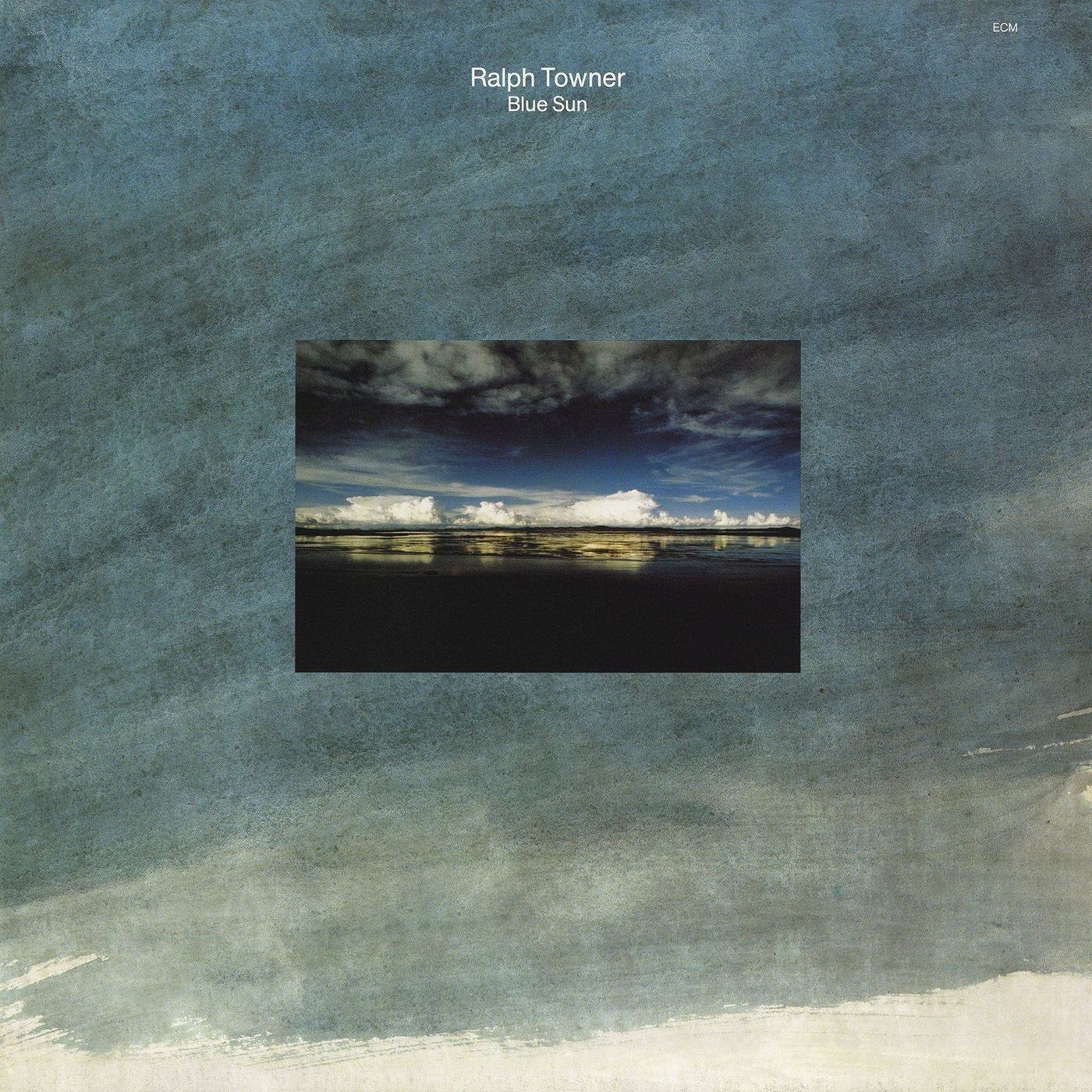
Ralph Towner: Blue Sun (ECM 1250)

1250

Ralph Towner
Blue Sun

Ralph Towner 12-string and classical guitars, piano, synthesizer, French horn, cornet, percussion
Recorded December 1982 at Talent Studio, Oslo
Engineer: Jan Erik Kongshaug
Produced by Manfred Eicher

If there were ever any doubts as to Ralph Towner’s consummate abilities, though one would need to travel far to encounter them, they can only have been put to rest with the release of Blue Sun. A near highpoint in Towner’s extensive discography, it might have shared the summit of 1980’s Solo Concert were it not for a few frayed threads. Towner’s compositions are already so harmonically dense in their solo form that other instruments merely externalize what is already so internally apparent to them, so that the intimate pickings of “The Prince And The Sage,” “Mevlana Etude,” and “Wedding Of The Streams” hover most clearly before our ears. At the same time, there is something skeletal about his playing that cries for flesh. Not for want of completeness, nor out of lack, but rather through the his balance and inward posture, a flower-like duplicity that embraces both blooming and wilting in the same breath.

Among the potpourri of instruments that Towner plays here, his Prophet 5, while nostalgic, sometimes gets in the way. It seems unnecessary, and evokes more the novelty of using one when his talents on so many other acoustic options were readily available to him. These “unnatural” sounds turn a concave sound into a glaringly convex one. “C.T. Kangaroo” in particular, while playful enough, jumps out as an anomaly in the album’s otherwise majestic mood. The lack of guitar also renders it incongruous. Elsewhere, however, synth textures do blend nicely, as in the floating pianism of the opening title track, and in “Rumours Of Rain,” to which a French horn adds vocal depth. “Shadow Fountain” also makes adept use of electronic textures, bubbling like water on a sunny day.

Towner fans will want to check this one out for sure, but newbies may want to hold off.

<< Harald Weiss: Trommelgeflüster (ECM 1249 NS)
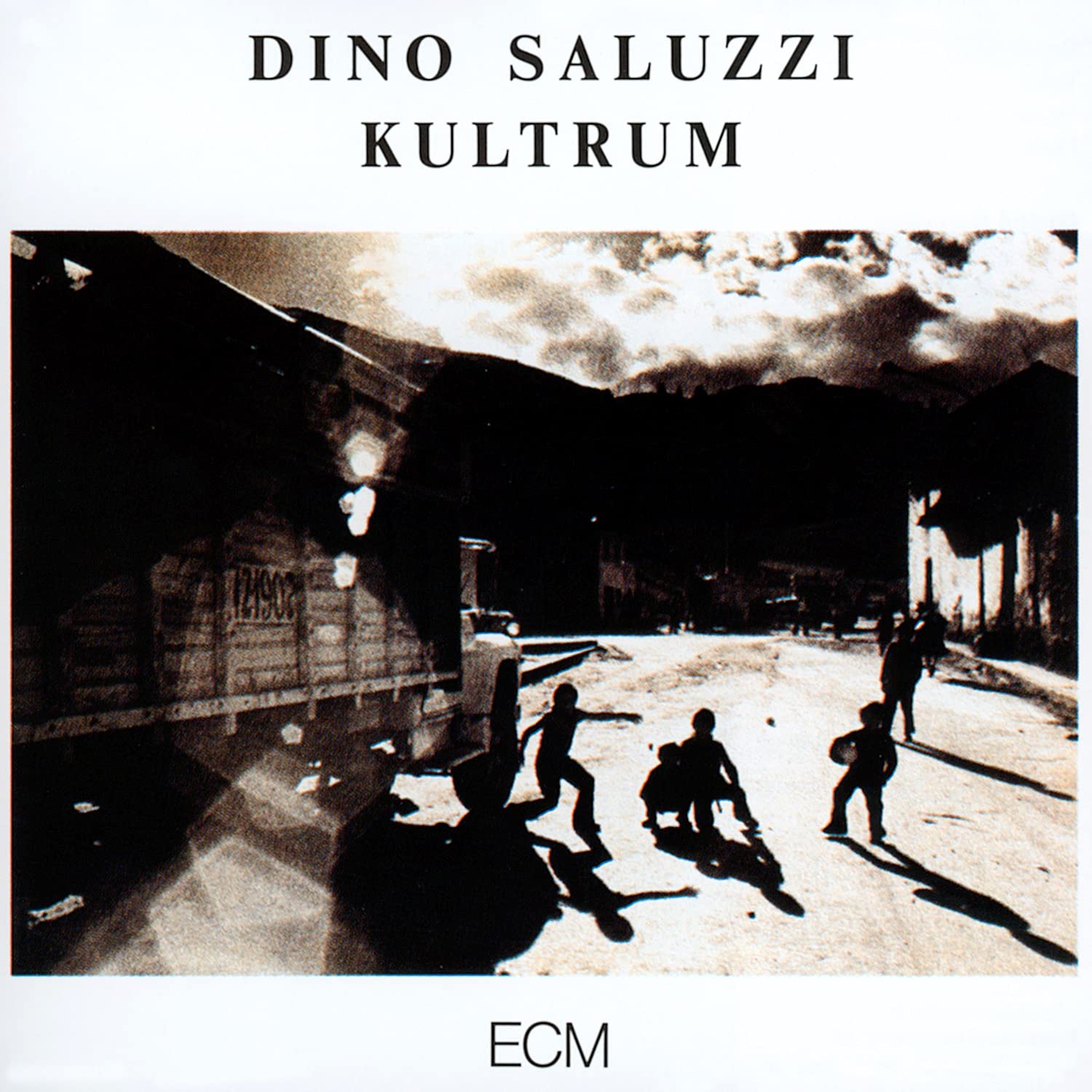
>> Dino Saluzzi: Kultrum (ECM 1251)

Lester Bowie: All The Magic! (ECM 1246/47)

1246_47

Lester Bowie
All The Magic!

Lester Bowie trumpet
Ari Brown tenor and soprano saxophones
Art Matthews piano
Fred Williams bass
Phillip Wilson drums
Fontella Bass vocals
David Peaston vocals
Recorded June 1982, Tonstudio Bauer, Ludwigsburg
Engineer: Martin Wieland
Produced by Manfred Eicher

“This is for you, Louie.”

For his second ECM album as leader, the late trumpeter and all-around wise guy Lester Bowie presented us with this intriguing twofer. The A session is dominated by two longer cuts. The first, “For Louie,” is an ode to Satchmo to end all odes. Clear and present trumpeting wails and jackknifes against the fluttering keys of Art Matthews (who also enlivens the runaround of Bowie’s “Spacehead”) as soul man Ari Brown finger-paints with his charcoal tenor. As if that weren’t enough to whet your appetite, vocalists Fontella Bass, Bowie’s wife and co-writer of the hit “Rescue Me,” and her younger brother David Peaston lay on the gospel. Incidentally, the b-side to “Rescue Me” was a song called “Soul of the Man,” and this is exactly what we hear. The school band feel of Albert Ayler’s “Ghosts” then haunts us only briefly before plunging us into the album’s second major opus. The “Trans Traditional Suite” is a sultry nod to transience in a rolling tide of brushed drums and cascading piano. This opens halfway through into a free-for-all of convoluted joy, as if to flesh out these songs’ essential message to embody in sound what it claims through word. Brown’s tenor solo speaks loudest here. The band caps things off with a legato version of “Let The Good Times Roll.” Bowie spits fire, fluttering and soaring by turns alongside that same heady tenor. Bass and Peaston reappear, matching Bowie’s penchant for humor tit for tat.

The B session, though bound by the same spirit, couldn’t be more different in execution from its counterpart. Here we find Bowie in a 35-minute solo excursion that reveals his artistry in the flesh. From the flying harmonies of the two Organic Echoes (for which he plays into an open piano) and the tongue-in-cheek ceremony of “Dunce Dance,” and on to the experimental whimsy of “Thirsty?” (in which he blows as if through a drinking straw) and “Miles Davis Meets Donald Duck” (exactly what it sounds like), Bowie abides by a richness of color that is uniquely his own. Other highlights include the church bell sweep of “Almost Christmas” and the affectionate “Deb Deb’s Face.”

This album is so rich that you may not feel a need to listen to it often, but when there’s room for it, it’s sure to hit the spot and then some.

<< Michael Galasso: Scenes (ECM 1245)
>> Charlie Haden: The Ballad Of The Fallen (ECM 1248)

Miroslav Vitous: Journey’s End (ECM 1242)

1242 X

Miroslav Vitous
Journey’s End

Miroslav Vitous bass
John Surman soprano and baritone saxophones, bass clarinet
John Taylor piano
Jon Christensen drums
Recorded July 1982 at Talent Studio, Oslo
Engineer: Jan Erik Kongshaug
Produced by Manfred Eicher

Although bassist Miroslav Vitous never quite achieved the brilliance of his work with Weather Report, he did produce some intimations of it in the studio as he embarked on a solo career. Much of that old spark still flares on Journey’s End. “U Dunaje U Prešpurka,” in which he spins from a Czech folk song motif a cosmic sound with drummer Jon Christensen and reedman John Surman on bass clarinet, proves most fortuitous, as Surman builds enigmatic, freestanding structures atop constantly shifting tectonic plates. The quartet’s palette is broadened with the addition of John Taylor on keys, and under whose guidance the album’s titular journey really begins to take off. Christensen’s urgency carries across a deep flavor, only accentuated by its surroundings, and left to trace the piano’s tracks. “Only One” features its composer on electric bass, pairing nicely with Surman’s unmistakable baritone. Surman himself offers two tunes, flying high with his soprano in “Tess” before reprising the baritone in the sprightly “Paragraph Jay,” which also showcases Vitous’s dexterous versatility. We also get a vibrant group improvisation in “Carry On, No. 1” before Taylor closes us out with his soprano-led “Windfall.” This forward-thinking piece brings us full circle and finds in every turn of phrase the key to unlocking unknown futures. 

With sweeping brushwork the music on Journey’s End manages to be at once painterly and spontaneous, describing vast landscapes with but a flick of the sonic hairs. A lovely addition to any Vitous or Surman fan’s shelf.

<< Bill Frisell: In Line (ECM 1241)
>> Walcott/Cherry/Vasconcelos: CODONA 3 (ECM 1243)

Bill Frisell: In Line (ECM 1241)

ECM 1241 CD

Bill Frisell
In Line

Bill Frisell electric and acoustic guitars
Arild Andersen bass
Recorded August 1982 at Talent Studio, Oslo
Engineer: Jan Erik Kongshaug
Produced by Manfred Eicher

I had the great fortune of seeing Bill Frisell by his lonesome in the summer of 2009 at Northampton’s Iron Horse, where he employed a rather modest set of equipment consisting mainly of digital pedal delays, unfolding from one guitar a ghostly map of sound. This process of self-generation seems to have always been at the heart of his musical output, and no album approaches that feeling as intimately as In Line. His sound is so full that bassist Arild Andersen’s reverberating swaths of darkness reveal an inner voice of the guitar in “Start” and carry Frisell’s suggestive lilts to distant conclusions. Andersen’s role is not to be ignored, sharing as he does a sensual conversation with Frisell in “Three” and providing a tearful backdrop to “Godson Song.” Here, Frisell’s guitar also gently weeps, slithering under the bass’s watchful eye, ever at the edge of naivety. The intertwining electrics of “Two Arms” tighten like a finger trap into a wormhole toward “Shorts,” which recalls childhood with its unintended (?) allusion to “Three Blind Mice.” These brief flashes of nostalgia make their way carefully down the spiral staircase of “Smile On You” and out onto “The Beach,” a stunning soundscape for processed electrics that moves like a train through a tunnel and crests atop Andersen’s slithering harmonics. The title track steps out of the album’s default monochrome with the gamelan colors of its detuned acoustics. The more clean-cut leads take us farthest in a final blissful gasp.

ECM 1241 LP
Original cover

Yet if we’re going to talk about bliss, then our lips must shape the word “Throughout,” which names the album’s most inescapable embrace. This piece would also provide the basis for Gavin Bryars’ heavenly 1986 adaptation, Sub Rosa. The chord progression itself speaks volumes and gives breath to the lead electric as it sings with all the restraint at its disposal.

Like an opera singer who cuts through all the trained vibrato now and then with that single crystalline note, Frisell’s phrasings tremble on a watery surface, glinting occasionally with the light of a distant sun. In that light is hope, and this hope one encounters ECM’s core philosophy of silence. If you only own one Frisell album, make it this.

<< Meredith Monk: Turtle Dreams (ECM 1240 NS)
>> Miroslav Vitous: Journey’s End (ECM 1242)

Denny Zeitlin/Charlie Haden: Time Remembers One Time Once (ECM 1239)

1239 X

Denny Zeitlin
Charlie Haden
Time Remembers One Time Once

Denny Zeitlin piano
Charlie Haden bass
Recorded live at Keystone Korner, San Francisco, July 1981
Engineer: Robert Shumaker
Produced by Manfred Eicher

Recorded in the intimate confines of San Francisco’s legendary Keystone Korner, Time Remembers One Time Once brings together the insight of bassist Charlie Haden and the Bill Evans-esque keys of Denny Zeitlin. Zeitlin is that rare breed of musician who holds down a stable and highly regarded day job—in his case, as a clinical professor of psychiatry—while managing to keep abreast of the jazzier side of life. Now in his early seventies, Zeitlin is still going strong in both the office and the studio. Although these lives would seem utterly separate—as a musician he goes by “Denny,” while as a professional he is known as “Dennis”—Zeitlin finds an abiding passion in both. And indeed, after the vampy, kalimba-like intro of Haden’s “Chairman Mao,” we find intimations of both in the soft thrum of its therapy. Haden makes for an ideal partner in this regard, as with each return he plays with our expectations, working his magic with a ceremonious smolder. Like its title, “Bird Food” (Coleman) scatters itself along the ground of our sonic attention and nibbles at it in thematic piles. The joining of this duo creates some the most sweeping sounds here. In the wake of such uplift, the tenderness of an old standby, “As Long As Their’s Music,” is magic to the ears. Laying down his smooth pianism over a pulpy firmament of bass, Zeitlin cradles us with paternal care into the arms of the title track. This goes down just as smoothly, like the honeyed tune that it is, and walks to the beat of its own heart. A gossamer precursor to Jasmine, “Love For Sale” is another lozenge of goodness. Haden brings his liturgical magic to the slow-moving cadenza that is his “Ellen David,” while Coltrane’s “Satellite” pairs gorgeously with another old-timer, “How High The Moon.” Luiz Eça’s “The Dolphin” also goes down easy, leaving us with nothing but a clean aftertaste from this unsung slice of ECM pie.

We all know that Haden can do no wrong, yet after listening to this out-of-print recording (though it is available digitally) it’s clear that neither can Zeitlin. A discovery to be treasured time and again.

<< Dave Holland: Life Cycle (ECM 1238)
>> Meredith Monk: Turtle Dreams (ECM 1240 NS)

Pirchner/Pepl/DeJohnette: s/t (ECM 1237)

Werner Pirchner / Harry Pepl / Jack DeJohnette

Werner Pirchner tenor vibes, marimba
Harry Pepl ovation guitar
Jack DeJohnette
 drums
Digitally recorded on a Sunday afternoon in June 1982 at Tonstudio Bauer, Ludwigsburg
Engineer: Martin Wieland
Produced by Manfred Eicher

Vastly under-recognized malleter and composer Werner Pirchner sharing the same studio with guitarist Harry Pepl and drummer Jack DeJohnette? What could go wrong? Quite a bit, unfortunately. The opening “Africa Godchild” starts intriguingly enough, seeming to creep from the soil like an awakening locust. Pirchner describes with his marimba the feelers of a friend testing the air and finding only the welcoming glow of sunrise, while DeJohnette’s tom-heavy drumming calls forth the swarm. Yet despite these evocative beginnings, Pepl’s Ovation soon becomes distracting, and the chorus effect applied to it makes its chording sound perpetually out of tune. When soloing, however, it sounds fantastic, as the force of the playing cuts through the warble that constricts it. In “Air, Love and Vitamines,” the guitar again feels out of place, despite the lovely improvisatory stretch from Pirchner’s vibraphone. “Good-bye, Baby Post” fares little better, and Pepl’s crackling solo is too little too late. He shows admirable melodic acuity in the closing “Better Times In Sight,” but is once more undermined by the amping, which would have benefited greatly from a cleaner treatment.

This unusual collaboration could have been something special. Technical criticisms aside, its major stumbling block comes from the musicians’ lack of communication. Each draws a sphere that only seems to intersect tangentially with the other two. This might have been a gem of a recording had only Pirchner and DeJohnette been there to lay it down. In a catalogue as vast as ECM’s, one can hardly be surprised to encounter a forgettable effort now and then. Sadly, this may be one of them.

Dave Holland: Life Cycle (ECM 1238)

Life Cycle

Dave Holland
Life Cycle

Dave Holland cello
Recorded November 1982 at Tonstudio Bauer, Ludwigsburg
Engineer: Martin Wieland
Produced by Manfred Eicher

Holland picks up here where he left off on Emerald Tears with this overlooked solo album, which finds him swapping his usual upright for cello. While Holland is obviously no stranger to the instrument, it is such a rare pleasure to hear the cello alone at his bow. The bread and butter of this set is the eponymous five-parter, which indeed seems to trace a life from beginning to end. It is not only a cycle, but also its affirmation, such that the birth cries of “Inception” rend us with the thrill of being in a way that suggests awareness of a former existence. The sensorial “Discovery” walks us through a feeling-out of the world, adding sound to the richness of its growth. This pathos continues on through the inward-gazing “Longing” and “Search,” both of which hone their emotive capstones in the psychological and biological. The latter’s title might as well be a slogan for the album as a whole, where the overarching realities of its path are marked by time and space, on through a funkier “Resolution.”

The album’s remainder offers up a potpourri of technical flourishes and fragrant artistry. The linear meditations in “Sonnet” slumber alongside the finely chiseled “Runes,” which is not only a standout, but also brings Holland’s bass-minded lyricism to the fore most evocatively. A shake of the kaleidoscope gives us the erratic turns of “Grapevine,” and intimations of Hindemith in “Chanson Pour La Nuit.” In this last, we find the death that is silence, awaiting rebirth at the next press of PLAY.

Holland has a clean, if slightly rough-around-edges, sound on the cello, and brings his pizzicatist’s sense to this date’s mostly arco playing. Each gesture becomes its own life, released the moment his fingertips leave the strings. In this way, the album speaks not only to the evolution of an artist, but also to the art of evolution.

<< Pirchner/Pepl/DeJohnette: s/t (ECM 1237)
>> Denny Zeitlin/Charlie Haden: Time Remembers One Time Once (ECM 1239)

Arild Andersen: Molde Concert (ECM 1236)

ECM 1236

Arild Andersen
Molde Concert

Bill Frisell guitar
John Taylor piano
Arild Andersen double-bass
Alphonse Mouzon drums
Recorded live August 1981 at the Molde Jazz Festival, Norway
Engineer: Tore Skille

Arild Andersen created some of the most melodic jazz in the latter half of the twentieth century, and the music on this CD reissue of 1981’s (A) Molde Concert adds 20 glorious minutes of unreleased material to this historic date at the prestigious Norwegian festival. Here, the bassist is joined by names which, though now celebrated, were still fledgling at the time: guitarist Bill Frisell (still seeking out his characteristic warble among the increasingly populated trees of the 1980s), pianist John Taylor, and ex-Weather Reporter Alphonse Mouzon on drums. These days, such a line-up would create another—long out the door of wherever they might be playing. Yet if the audience’s reactions are any indication, back then it must have been a welcome surprise.

After an elastic opening, “Cherry Tree” slingshots into a set consisting entirely of Andersen originals, save for the romping “Dual Mr. Tillman Anthony” (Miles Davis) that concludes the show. From the beginning, the breadth of arrangement is apparent, Frisell laying out embracing themes as Andersen and Mouzon work double time. A tumbling Taylor spins his own brand of liquid magic into “Targeta,” bringing its blissful chording into a slow-motion groove. If every solo tells a story, then most prosaic on Molde is Frisell’s here. “Six For Alphonse” is a standout. Featuring rich interplay between guitar and piano, it also explodes with a stellar solo from Mouzon. “Nutune” is far more viscous, a creeping vessel over the helm of which hunches Andersen’s loamy bass. His subsequent duet with Frisell in “Lifelines” dances Weber-like and carries us gently into the epic “The Sword Under His Wings,” which after a few stirrings of blown leaves, spirals into a more shapely cyclone. Andersen delights with a rare arco solo before springing into a forward groove backed by Mouzon and Taylor as Frisell hurls his bends skyward. After the whimsical provincialism of “Commander Schmuck’s Earflap Hat,” the rough-hewn ore of Frisell’s strings hardens into “Koral.” The band’s inspiring precision works to a heartwarming finish that is the essence of Andersen’s soulful wit. “Cameron” bristles with Frisell’s sonic quills, each brushed back carefully with the grain, while “A Song I Used To Play” serves up a steaming bowl of nostalgia.

Andersen’s recognition of these young talents is proof of both his incisive mind and welcoming spirit. The depth of his choices is enhanced by the pristine recording, which holds up well after all these years. For those Andersen fans wanting the perfect balance of ice and fire, look no further.

<< Hajo Weber/Ulrich Ingenbold: Winterreise (ECM 1235)
>> Pirchner/Pepl/DeJohnette: s/t (ECM 1237)

Chick Corea: Trio Music (ECM 1232/33)

ECM 1232_33

Chick Corea
Trio Music

Chick Corea piano
Miroslav Vitous bass
Roy Haynes drums
Recorded November 1981 at Mad Hatter Studios, Los Angeles
Engineer: Bernie Kirsh
Produced by Manfred Eicher

Trio Music boasts the same formidable lineup—pianist Chick Corea, bassist Miroslav Vitous, and drummer Roy Haynes—as on the seminal Now He Sings, Now He Sobs. Yet formidable is not a word I would use to describe this curious double album, for as many peaks as there are, it is in the valleys where the most potent combinations occur. Half of this diptych is painted by improvisations: five for trio and two for duo. The trios are intense and from the first chart themselves through engaging, if wayward, territory via Haynes’s astute “cymbalism” and Vitous’s determined phonics, all the while enlivened by Corea’s full-on sound. From the thick to the thin of things, the second trio sounds like an infirmed train dreaming in spats of its onetime locomotive glory, while even more fractured affairs await us on the horizon of the third. Some of the more effective comings together can be found on the fourth, as when pointillist pianism sews itself into snare with lightning-fast kinship. The final trio, on the other hand, features a looser, perhaps prepared, piano and amplified arco bass and drums, which after a bit of running around are mixed together in a staccato brew. The two duets between Corea and Vitous are fascinating in and of themselves, winding down their personal rabbit holes with multifarious conviction. The last tune of first disc, “Slippery When Wet,” is exactly that, this one penned by Corea. After some lithe snare work it slides effortlessly into an upbeat swing.

For the second disc, we are treated to a hunk of Monk. Thelonious lives and breathes (he would pass away not three months after this album was recorded) in these hip arrangements. And certainly in “Rhythm-A-Ning” we get to see what this trio is truly capable of, for as intriguing as the improvisations are, there is something transcendent about the ring of their swing in Monk’s world. From these hot threads is spun a lasso that holds our attention with excitement and joy. Haynes, reason enough to buy this album, steals the show here, as also in the ascending quality of “Think Of One” and throughout the inescapable groove of “Hackensack.” Not to be outdone, however, are Vitous, who adds piles of jazz club beauty to “Eronel” and enhances every playful step of “Little Rootie Tootie” with his nimble fingerwork, and the unforgettable Corea, who, as he does in each of these, spreads his warmth and sparkle in turn over the gently burned toast of “’Round Midnight” and “Reflections” with a lushness all his own.

One need hardly expound at such length upon this album. The music speaks with far more eloquence. Highly recommend for the lovely Monk set alone, but give the improvisations a chance, and you will surely find a wealth of colors to explore again and again.

<< Eberhard Weber: Later That Evening (ECM 1231)
>> Everyman Band: s/t (ECM 1234)