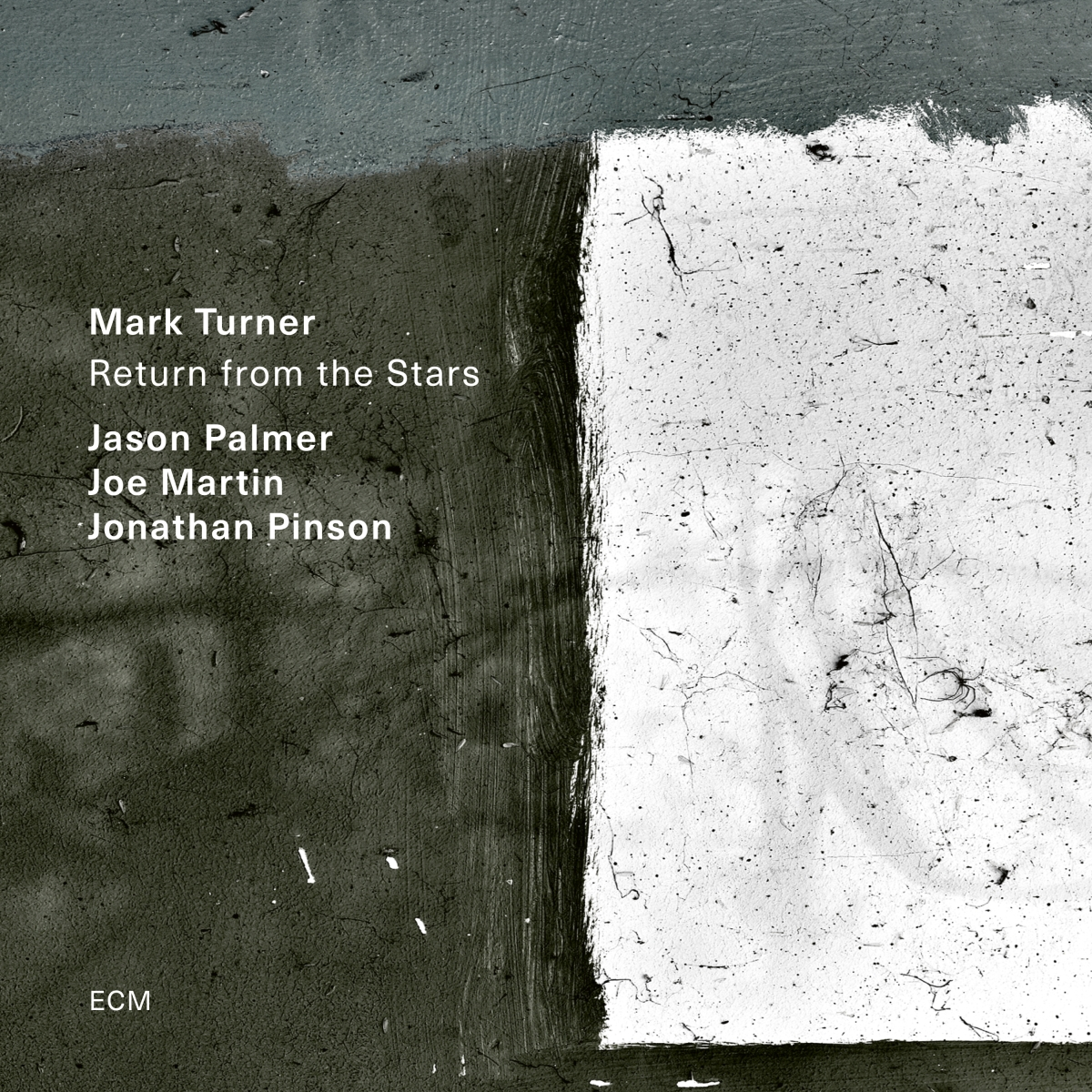
Mark Turner tenor saxophone Jason Palmer trumpet Joe Martin double bass Jonathan Pinson drums Recorded November 2019 at Sear Sound Studio, New York Engineer: Chris Allen Mixed September 2021 at Studios La Buissonne by Manfred Eicher and Gérard de Haro Mastering: Nicolas Baillard Production coordinator: Guido Gorna Cover photo: Thomas Wunsch Produced by Manfred Eicher Release date: March 25, 2022
Admirers who have traced the influences of Mark Turner will know of his interest in science fiction. More than the inspiration for an evocative title or two, the underlying ethos running through his work like dark matter in a timeslip could come from no other genre, articulated as it is in a language that feels as spatial as it does temporal. As Stanisław Lem wrote in Solaris: “We have no need of other worlds. We need mirrors.” In the bell of Turner’s tenor saxophone, one indeed finds a mirror for scrutinizing our egos in melodic ways.
Return from the Stars puts Turner back on the ECM map, carrying over bassist Joe Martin from 2013’s Lathe of Heavenand adding drummer Jonathan Pinson and trumpeter Jason Palmer for eight originals. The lack of keyboard allows for two crucial things to happen. First, it opens the ears to Turner’s compositional prowess, graceful yet given to unexpected turns and shades of meaning. Second, it opens space in the recording and exchanges between the musicians. The resulting music, smooth without filling in every gap, invites listeners to ruminate and appreciate the inner workings at hand. Against a rhythm section digging its heels only when needed (and without ever overstating the issue), interplay between horns unfolds organically (Turner is always moving from one terrain to the next while Palmer seems to work his awl into the wood of his thinking, uncovering ever-deeper layers of meaning). Sitting among the evocative gems of “Bridgetown” and “Nigeria II,” tracks like “Terminus” and “Lincoln Heights” walk in places that have been lived in. Throughout, the writing is suggestive rather than declamatory. The titles of “It’s Not Alright With Me” and “Unacceptable” evoke a playful gray area between frustration and freedom from it. The blurring of such dichotomies is a sign of maturity: letting emotions speak for themselves rather than shouting in their place. In “Waste Land,” too, I get the feeling that these pieces are always growing and that we are privy to some of their prime phases.
(This review originally appeared in the April 2022 issue of The New York City Jazz Record, a full PDF of which is available here.)
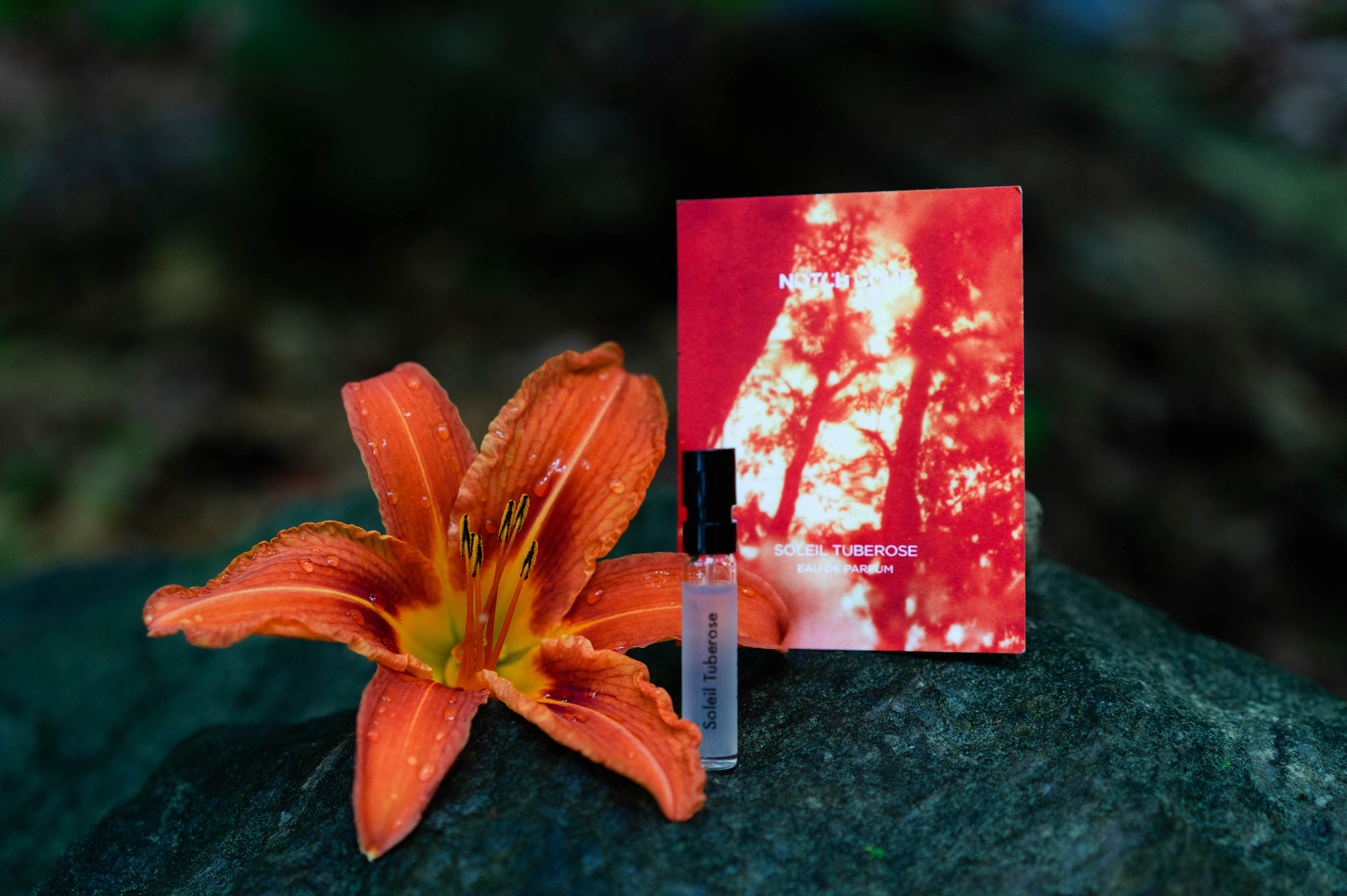
Likely anyone who has been listening to ECM for a significant amount of time knows the Gertrude Stein quote that follows the label’s ever-expanding catalog like a shadow: “Think of your ears as eyes.” But here is a rare instance that asks you to think of your nostrils as eyes. Introducing Notch Code, a niche perfume house from South Korea dedicated to creating scents based on artistic works: in this case, two images by photographer Woong-Chul An, which should be familiar to ECM fans as the covers for Anja Lechner and François Couturier’s Moderato cantabile and Jack DeJohnette’s In Movement. After reaching out to the company, I was grateful to receive a discovery set with matching blotter papers for this review.
Moderato cantabile is the inspiration for Soleil Tuberose. Featuring notes of cardamom, pink pepper, rose, black pepper, tuberose, musk, sandalwood, and cedarwood, this evocative fragrance almost lingers on the tongue. The elements are respectfully combined, with enough separation to seek them out individually. Each asserts clarity as part of a collective sound that blurs the lines between them. The pink pepper hits the nose first, followed by the rose and tuberose, before the woody base steps into the foreground during the dry-down period. Fans of tuberose who want a softer feel of this difficult-to-balance ingredient will find much to savor.
In Movement finds new olfactory life in Musk Eternity, a choral blend of musk, frankincense, orchid, and jasmine. The floral elements work synergistically to elevate the normally darker musk and frankincense into fruitier territory. This one immediately evokes the crystalline masterpieces of UK perfrumer Thameen (especially The Hope). Such low warmth and intimacy deserve to be called twilight in a bottle.
The sillage of both perfumes is gentle yet noticeable. Longevity is modest (around three to four hours on my skin), making it suitable for casual wear or for situations in which an understated entrance is required. Like the fine albums with which they are associated, each must be put on to be remembered.
Jorge Rossy vibraphone, marimba Robert Landfermann double bass Jeff Ballard drums, percussion Recorded September 2020, Jazz Campus Basel Engineer: Daniel Dettwiler Assistants: Daniel Somaroo, Eric Valle, and Alexander Beer Cover photo: Max Franosch Mastering: Christoph Stickel Executive producer: Manfred Eicher Release date: November 5, 2021
After making his ECM debut on drums as part of Jakob Bro’s Uma Elmotrio with Arve Henriksen, Jorge Rossy returns as leader, this time swapping out drumsticks for mallets. Equipped with his trusted vibraphone and marimba, the Spanish multi-instrumentalist glides his way through a suite of originals.
“Post-Catholic Waltz” is quintessential Rossy in all respects. It opens with a smooth, understated introduction before allowing the vibraphone to make its presence known as if on the most unobtrusive red carpet imaginable. His bandmates, bassist Robert Landfermann and drummer Jeff Ballard, move in step into deeper forest, carrying a wealth of implications, only some of which will see the light of day. Rossy’s approach is always to the point. Were it rendered in speech, every word would count. This is especially true of “Taínos,” which breathes with a measured vocabulary against a nested rhythm section. That said, Rossy credits his sidemen for being soloists in equal measure rather than traditional supports. In this respect, “Adagio,” “Scilla e Cariddi,” and “S.T.” form braids of three distinct yet complementary colors. The title track, too, with its adventurous percussion and arco lines, paints with an enchantment that requires full commitment from all members.
Despite the generally preference for slides and jungle gyms on this proverbial playground, the trio makes sure to get in some good swinging on “Maybe Tuesday” (a nod to George Gershwin’s “The Man I Love”) and “Ventana.” Their focus is on texture and tactility rather than blend, per se, although the trio coheres without stepping on each other’s toes. With just as much shimmer as shadow, these tunes breeze their way through the changes in organic shifts of light. Like the quiet tango of “Adiós” that closes out the set, it treats every gesture as a paragraph’s worth of ideas and leaves the listener to unravel the details.
The only outlier in this set, “Cargols,” comes by way of Chris Cheek, alongside whom Rossy played as part of Steve Swallow’s Into The Woodwork quintet. This slow-motion jaunt is the album’s fulcrum. As such, it carries much of the weight that follows in its yielding net. It is itself a portal into a world in which Rossy operates under the banner of rhythm, reminding us that here, too, his role is significantly bound to the pulse.
Shai Maestro piano Jorge Roeder double bass Ofri Nehemya drums Philip Dizack trumpet Recorded February 2020, Studios La Buissonne, Pernes-les-Fontaines Engineer: Gérard de Haro Mastering: Nicolas Baillard Cover: Mayo Bucher Produced by Manfred Eicher Release date: January 29, 2021
After making his ECM leader debut with The Dream Thief, pianist Shai Maestro returns with bassist Jorge Roeder and drummer Ofri Nehemya, adding to their mix trumpeter Philip Dizack (in his debut for the label) for a sound that feels as solitary as it does tapped from the veins of collective experience. If this album’s predecessor was a reflection of past harmonies, this follow-up holds a mirror to the future. Forward-looking tendencies are immediately apparent in “Time,” which after a clear opening thesis dissipates into the gentlest of body paragraphs, and (speaking of mirrors) “The Thief’s Dream,” wherein new secrets abound. In these blushes of information, window-framed views outline the possibilities of constant change. Similar atmospheres in the title track and the brief “GG” uphold chance encounters as examples of purposeful living.
If any glimpses of permanence are to be caught, one might find them in tracks like “Hank and Charlie” (an elegiac tribute to Hank Jones and Charlie Haden) and Duke Ellington’s “In a Sentimental Mood” (the only tune here not written by Maestro). By focusing on ephemeral subjects, they reinforce the solidity of what’s left behind in the process of memorializing them. The same holds for the album’s deepest moments, reserved for such master narratives as “Mystery and Illusions,” which further highlights the musicians’ strengths. From the gentle way Dizack lays down the theme like a parent transferring a napping baby from arms to crib to the graceful drumming and piano aside, and Roeder’s dancing synchronicity drawing a thread through it all, the band’s sense of touch makes a statement of its age, for the ages. Like “Compassion” (a solo offering from Maestro) or the concluding “Ima” (a wonder to behold), it is a new level of music making that must be heard to be believed.
(This review originally appeared in the January 2022 issue of The New York City Jazz Record, a full PDF of which is available here.)
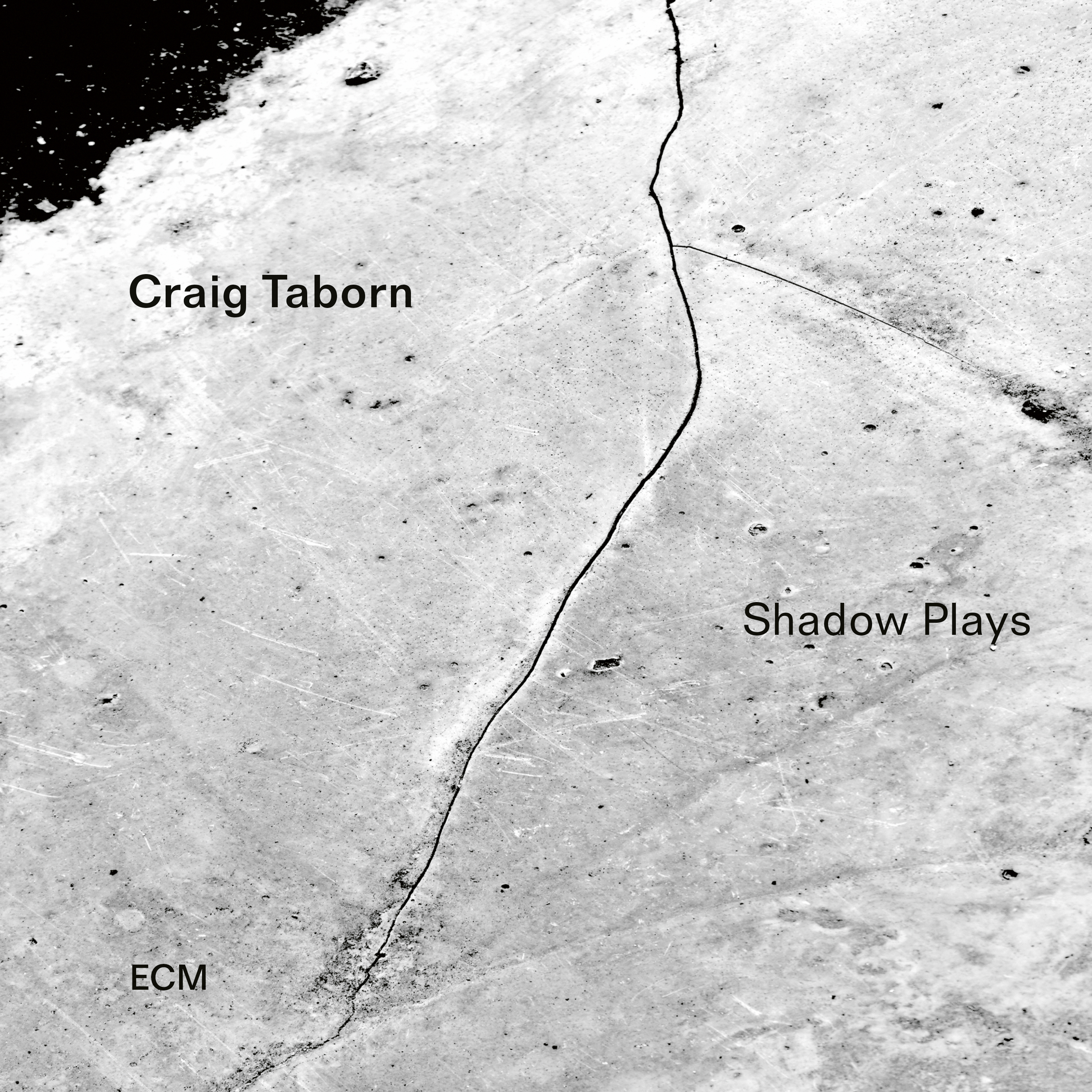
Craig Taborn piano Concert recording, March 2, 2020 Wiener Konzerthaus Engineer: Stefano Amerio Cover photo: Thomas Wunsch Produced by Manfred Eicher Release date: October 8, 2021
Since releasing Avenging Angel, Craig Taborn’s first spontaneous recital for ECM, a decade ago, the pianist’s traversal on the label has brought him to collective enterprises with the likes of Roscoe Mitchell, Thomas Morgan, and Chris Potter. All the while, his language has been as much his own as it has been a force of adaptation to contexts big and small. If that earlier effort can be said to evoke disembodiment, then let Shadow Plays be its embodied other half. From the gestures that open “Bird Templars,” one gets the sense that each of Taborn’s hands is a traveler engaged in a slow-motion contest for a single path ahead. And yet, there is no feeling of animosity—instead, a sense of wonder, especially as the music quiets in the left, allowing the right to offer its soliloquy in the spirit of accompaniment. If it is possible to whisper through a piano, then Taborn has accomplished that here. “Discordia Concors” and “Concordia Discors” both offer frantic searches for meaning balanced by the jauntier rhythms of “Conspiracy Of Things” between them. These pieces find themselves pulled to the keys by a gravitational force they cannot quite escape.
The jazziest inflections await interpretation through “A Code With Spells” and the concluding “Now In Hope,” both of which convey honeyed textures with cinematic sensibilities, each coated by resistance against the storms that have barraged us over the past year and a half. The most epic stretches are reserved for “Shadow Play,” in which chords resuscitate the possibility of harmony. As one of the cleanest concert recordings I’ve heard, it felt like I was the only one in the room: an intimacy we need more of than ever.
(This review originally appeared in the January 2022 issue of The New York City Jazz Record, a full PDF of which is available here.)
Eberhard Weber bass Concert recording, August 1994 Théâtre des Halles, Avignon Recording producer and engineer: Gérard de Haro Mixed May 2021 at Studios La Buissonne Cover painting: Maja Weber Cover background: Thomas Wunsch Executive producer: Manfred Eicher Release date: November 5, 2021
In 1994, during a solo European tour, bassist Eberhard Weber appeared at the Théâtre des Halles in Avignon under the auspices of the Festival International De Contrebasse, organized by Barre Philips. Much of the material presented in this recording came to the stage by way of Pendulum and Orchestra, echoes of which germinate seeds given more time to sprout. Recognizing familiar themes throughout this set of seven is as joyous as experiencing how much they change in a live context.
Setting the tone for this traversal is Weber’s “Pendulum,” a meditation that gives both rhythmic underpinnings and flights of fancy their space to sing. This is the signature of Weber’s overhanded style: he allows all gestures to make use of the air. His five-string custom instrument is an extension of his body, articulating the balance of playfulness and inner pulse as only he can.
“Trio For Bassoon And Bass” makes flowing use of overdubs for an intimate orchestra. In this composition, Weber allows the bass to interpret itself—a form of therapy that sends blood to the ears where it is needed. Without so much as a blink of interruption, he allows motifs to spread beneath the subcutaneous layers of our listening like tattoos in sound. This tune in particular allows him to flex his virtuosic muscles with unmatched stride and depth of character. Astounding here are less the denser rises and more the quieter passages in which he brings out his most artful details—each affording an unimpeded view into his heart as a musician.
The faster excursions are breathtaking in their ways. Take “Ready Out There,” for instance, which clarifies its purpose from the first step. Its otherworldly atmosphere is superseded only by its harmonic language, through which is expressed a novel’s worth of environments, actions, and enough moral glue to hold them all together.
“Silent For A While” leverages more understated overdubbing, Weber’s swelling loops drifting toward an island of promise. Thus, he turns colors into structural elements. “Delirium” likewise exhibits a melodic edge that only sharpens with speed. A faint drone gives him just enough backbone to turn an invertebrate impulse into a vertebrate melody that shines with conviction.
“My Favorite Things” is yet another overdubbed gem. That the backdrop stays within the same lilting key makes the melody taut in its reflectiveness. It also gives Weber freer license to make of it what he will, turning the title into a mission statement rather than a pleasantry. “Air” ends things without self-accompaniment. A tender and breath-heavy farewell, it gives way to restfulness and active dreams—and that is where it remains.
There is an unshakable poignancy to this album, as underscored by its title, which implies the story of a bygone era. The age of this document makes its appearance 27 years later ghostlike in reminiscence of a genius whose future remains uncertain. Either way, we live with the knowledge that such glimpses of eternity are here to savor thanks to ECM’s dedication to contributions that will outlive us all.
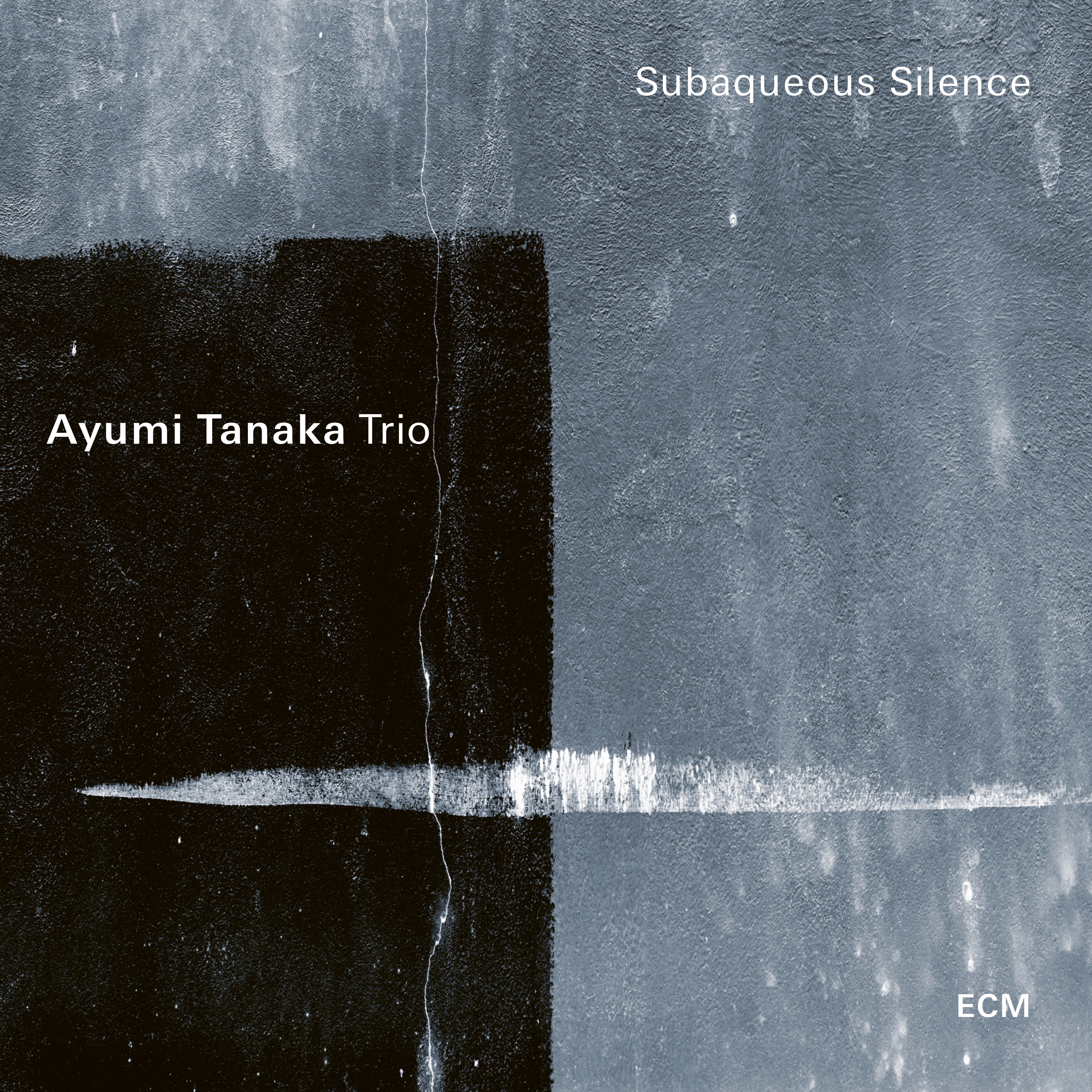
Ayumi Tanaka piano Christian Meaas Svendsen double bass Per Oddvar Johansen drums Recorded June 2019, Nasjonal Jazzscene Victoria, Oslo Engineers: Daniel Wold, Ingar Hunskaar (mix) Cover photo: Thomas Wunsch Mastering: Stefano Amerio Album produced by Manfred Eicher Release date: October 29, 2021
Following her introduction to the ECM constellation via Thomas Strønen’s Time Is A Blind Guide, and more recently in her appearance alongside the drummer and clarinetist Marthe Lea in Bayou, pianist Ayumi Tanaka shines her starlight as leader across a spectrum of humbling atmospheres. In the hands of her bandmates, bassist Christian Meaas Svendsen and drummer Per Oddvar Johansen, Tanaka’s music for trio introverts the form in a way that makes us feel subcutaneously placed as listeners. Thus, we can immediately detect her appreciation for molecularity. Any ECM admirer will understand that this concept is suited to the label, where suspending articulation in favor of physics is an almost sacred leitmotif. I asked Tanaka in an email interview whether her approach to space is a conscious decision:
“In the process of making this album, I always aimed to answer my fundamental question: ‘What would I like to hear?’ As a result, the music has space to invite silence, allowing us to hear sound surrounding and within us, and take note of musical sound more deeply, when it arrives.”
That image of arrival is a profound one to consider in the album’s opener, “Ruins.” For while it does take precedence by virtue of being our doorway into Tanaka’s sound-world, it has been singing long before we encountered it, as it will continue to when we leave it. For now, we have its attention, sharing a room as lines with neither beginnings nor endings invite us to float somewhere between inhalation and exhalation. Brushed drums and understated bass evoke creaking trees and winter-kissed leaves while the piano speaks in the language of silhouettes before shaking the boughs of their snowy dusting and moving into the future with echoes of the past in its arms. Holding these images in mind, I ask about Tanaka’s connection with the natural world:
“Since I was a child, I always enjoyed being in nature and listening to its sounds. When I am in the forest, listening to the birds, water dripping, the trees shaking in the breeze, I feel that it is more perfect than music—everything is harmonized. I am trying to learn from the sound of nature. I would like to create music that would resonate with nature.”
We hear this as much in “Ruins II” as in “Zephyr.” Both speak of landscapes vaster than can be expressed under a single title. The depth soundings of the latter improvisation for piano and malleted drums evoke the debris of human action, swirling like so much dust in the winds of collective memory. Hence “Black Rain,” a picture of time’s ablution against the wrongs of our political missteps. While the title, for me, evokes the postwar novel by Ibuse Masuji, Tanaka sees it as about more than Hiroshima and Nagasaki:
“There are things we need to learn from the past and need to carry with us to end and avoid more wars and conflicts.”
This message of hope wavers in every shadow of Subaqueous Silence. Its purpose is indeed broader than specific tragedies would have us believe; it is a formulation of the human condition written in the ink of experiential harmonies. These are the underlying tensions of “Ichi.” Here is the singularity of existence unrolled like a scroll on which a single human life has been recorded with varying levels of realism. Where one moment might find a flash of childhood rendered in vivid clarity, the next only hints at an experience too painful to bear with whispering brushwork. In that sense, I find myself wondering how (and whether) aesthetic considerations are central to the flow at hand. Given that Tanaka was born and raised in Japan and has lived and worked in Oslo for the past decade, it would be easy to draw bicultural conclusions along those lines. This characterization, however, may be far too concrete to inject into the processes documented here:
“I am not sure if I want to have an aesthetic of my music at this point in my life because I want to discover something in each moment. Being in the moment and dedicated to the music is something I am always trying to do. ‘Find your own voice’ is something that Misha Alperin, an amazing pianist and my mentor, was always saying to me. It stays in my mind and I am always seeking that. All my experiences in Norway definitely had a big influence on my musical expression. On the other hand, since I moved to Norway, the more I have sought my own approach and the more I have started to realize my deep Japanese roots and to appreciate the beauty of Japanese culture, especially in art and music. Delving into two such different cultural environments is a gift that has shaped my musical expression.”
By way of example, “Towards the Sea” teaches us that a journey is nothing but a chain of small ones linked to form a retrospective trajectory. Every gesture tells a story within a story until only single words are left to stand in for memories. This implies, too, that music is a universal language and an appropriate medium through which to explore these modalities. Tanaka agrees:
“Since I was 15 years old, I have seen music as a ‘universal’ language. When I was invited to perform my compositions in Germany, I was very moved by this experience because I felt that universal language at work. Music is a gift. It consoles us, questions us, gives recognition of something within us. I am hoping that people experience my music in their own way. I hope I will be able to give something to someone through music because music has helped me in life.”
The title track is the culmination of all of this and more: gestures born in climates, geographies, and eras that are as much drawn together as pushed away by the distances that separate them. With a heavying presence and biological self-awareness, it works its percussive prayers in the sunlight of a future age when dreams are the only things that will be real. This is the music of aftermath and new beginnings wrought in earth, stone, and wood. It searches, unafraid to share its discoveries so that we might know the honesty in which they were embraced, then freed. Instrumental highlights abound, but their cohesiveness goes against the spotlighting of “solos” or moments of interest. Surely, this connectivity cannot exist without the trust of her bandmates and producer?
“I am very lucky to have the trio members who have built trust and respect over the years. I think Christian and Per Oddvar are really good listeners, not only musically but also in general. They are open-minded and flexible in their capacity of accepting things in each moment. Christian and I were studying at the Norwegian Academy of Music at the same time, and Per Oddvar is the musician who we had been listening to. Given our common education in improvised music in Norway, I think we naturally evolved a mutual understanding. In addition to that, we happen to have common interests in ancient Japanese music, arts, and culture. It reflects on the way we play the music together. Also, the music Manfred has produced is one of the strongest reasons I am here now. I deeply appreciate his trust and confidence in my music. That personal recognition is something I carry with me.”
Said extends to the listener who, while not present during the recording, is retroactively invited to absorb every reaction as it emerges. Such intimacy is rarely given and primes our ears as pages for inscription. And so, in the wake of these expressions, I find myself returning to the question of finding one’s voice:
“Facing myself is often hard, especially when I am working alone, but it is rewarding. The joyful element is when I find my voice through collaboration with others. I think it’s natural that our voices change because we are changing all the time through all the experiences we have. I am working on finding my own voice with the hope that my musical expression becomes deeper and deeper every day.”
Keith Jarrett piano Recorded live July 3, 2016 at Béla Bartók Concert Hall, Budapest Producer: Keith Jarrett Engineer: Martin Pearson Cover photo: Martin Hangen Mastering: Christoph Stickel Executive producer: Manfred Eicher Release date: October 30, 2020
From the 2016 European tour that gifted us with Munich 2016 comes this improvised solo concert from Keith Jarrett recorded at Béla Bartók National Concert Hall in Budapest. The pianist’s Hungarian heritage and love of the venue’s namesake gave the experience a homecoming feel that fed into every note he rendered, whether spontaneous or previously held in mind. Jarrett has since held the result in high regard as epitomizing what he is capable of at the keyboard—and rightly so, because what we have here is crafted in a spirit of such welcome that one might easily forget the album was released during a time of social distancing and quarantines.
In twelve parts spanning two CDs, Jarrett digs deep within to give much without. I offer this image as something more than a metaphor; he is physically mining his cells in search of the ore that we on the outside might call splendor. That said, there’s nothing lofty about the music that results from this process of elimination. If anything, it builds ever downward to build a private kingdom. Remarkable, then, that we might share in its retrospective pleasures.
From the moment Jarrett lays hands to instrument, he touches fertile soil from which to yield the striking contrast of his shadowy left and playful right. A dance-like quality struggles to be heard but instead feels the temptation of convention slip off like clothing that is far too big for its body. This music is also very fibrous, as if Jarrett were tying a knot, fraying the leftover end, then tying a smaller one, and so on until even his nimble fingers can no longer separate the strands. Part II works its way into the silhouette dreamed of on a traveler’s pillow. It turns this way and that but only changes its outline, neither approaching nor receding. After Part III pulls out the weeds, Part IV offers a dark, jazzy affair with smoky trails and squinting brilliance. Though restrained, it feels unbound in its emotional impulses, as ancient as an image on a cave wall drawn in the dying light of day. So begins an epic harvest of which the ripest fruits are picked in rhythms woven from strands of convolution, development, and dissolution. The sweetest among them is Part VII, which elicits some of the most astonishing textures Jarrett has ever liberated. It moves with a depth of feeling that can only have been arrived at when one has less of life ahead of them than behind. Near contenders include Part V, a lyrical aside that curls like a diagram of relativity into the innermost thoughts of childhood, and Part VIII, the near-constant fluttering of which evokes the wings of an angel just out of reach.
After the bluesy Part XII, Jarrett takes an evolutionary leap from fundament to firmament in two encores: a sweeping take on “It’s A Lonesome Old Town” and the achingly comforting “Answer Me, My Love.” Thus, we are left with a lifetime’s worth of listening in the dimensions of a delineated object. And even as the atmospheric shifts of the heart turn their eyes toward a brighter tomorrow, they never seem to forget the lightless void from which they emerged into being.
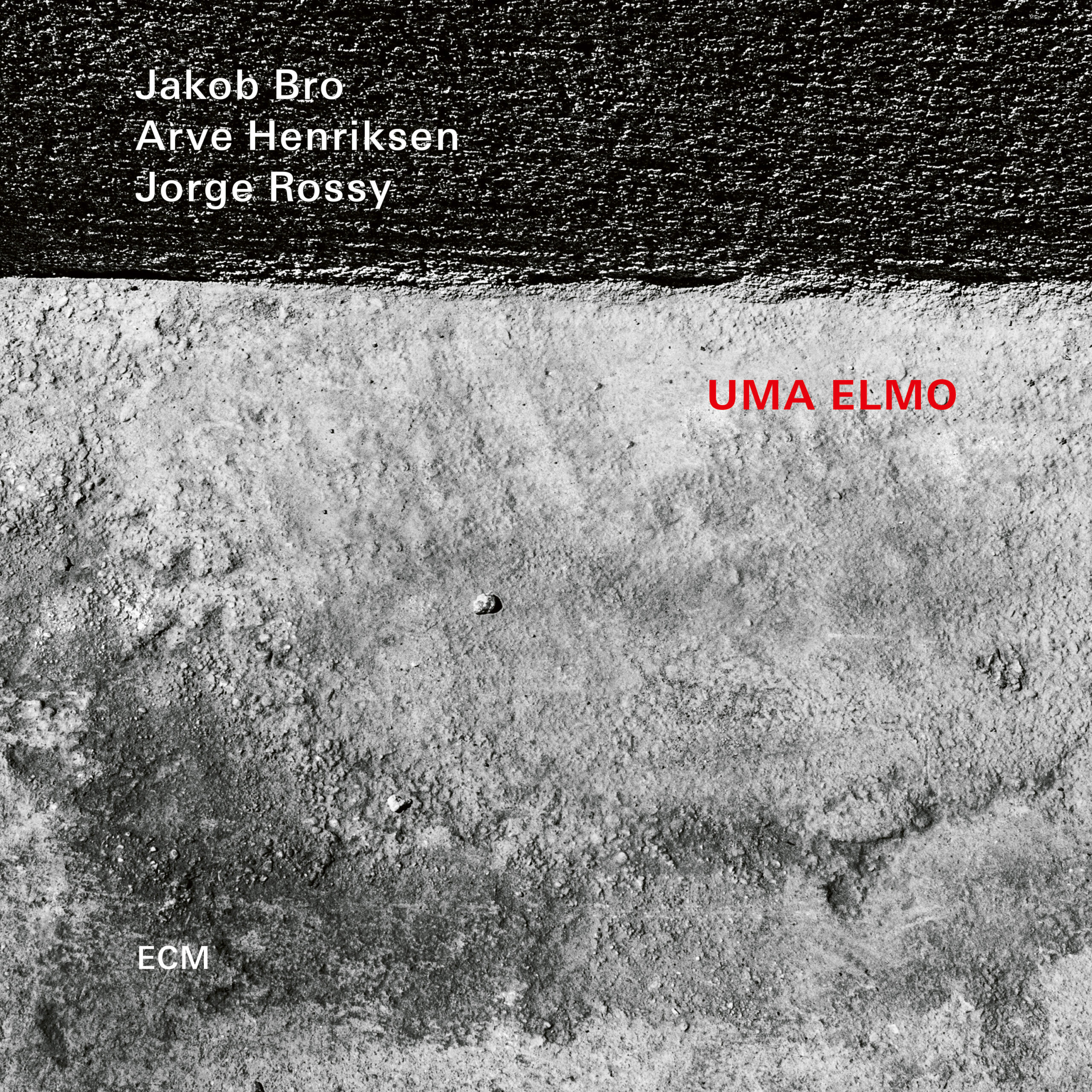
Jakob Bro guitar Arve Henriksen trumpet, piccolo trumpet Jorge Rossy drums Recorded September/October 2020, Auditorio Stelio Molo, RSI, Lugano Engineer: Stefano Amerio Cover photo: Jean-Marc Dellac Produced by Manfred Eicher Release date: February 12, 2021
When Jakob Bro lays his hands on an electric guitar, the guitar lays its hands on us. This chain reaction of touch was already apparent when the Dane painted the shadows of early appearances on Paul Motian’s Garden of Eden and Tomasz Stanko’s Dark Eyes. Since then, after a flight of leader dates on Loveland and a welcome home away from home on ECM since 2015’s Gefion, Bro has varnished a personal altar, placing upon it a family of melodic proportions. Indeed, the title of the present disc is derived from his children’s middle names, each a cypher of lives yet to be lived yet already full beyond delineation. Having written much of this material while his second, still a newborn at the time, was napping, Bro offers eight tunes that flow like scenes of video. Not knowing its biological origins, however, Uma Elmo evokes for me an uninhabited island that flourishes in sound, each tree the bearer of fruit that can only be discovered through listening.
The trio convened here is so new that it had never played as such before entering the studio for this session. Nonetheless, trumpeter Arve Henriksen and drummer Jorge Rossy, each of whom has charted separate paths through the label, are natural companions. Through names and motifs alike, Bro reaches out to other allies, whether living or non. Inspired by his collaborative transversal with Motian, “Reconstructing A Dream” funnels the drummer’s pliant architectural sensibility with reverence. Henriksen’s fluted playing widens the landscape with its breath and Rossy’s brushing opens its heart as Bro’s enhancements glisten in downward prayer.
“To Stanko” is a poignant reminder of how intersections can yield paths in their own right. Its mournful qualities shapeshift beyond the confines of a mere dedication, wandering through the Great In-Between as might a song in search of lyrics. “Beautiful Day,” like the album as a whole, is patient in its exposition. Bro is just as content providing liquid texture (as also in the later “Housework”) as he is providing a solid backbone. And though Henriksen grazes the clouds without releasing a single drop of rain, climatic changes abound in tracks like “Music For Black Pigeons” (in memory of Lee Konitz, who gave the piece its title) and “Slaraffenland,” ebbing and flowing to diurnal rhythms.
High points of the set are to be found in “Morning Song” and “Sound Flower.” In the latter especially, Bro’s manipulations glow against the backdrop Rossy’s poetry and Henriksen’s siren song. Bro takes the hand offered by the dawn, shakes it in welcome, and pulls its possibilities into frame. The effect is so restrained that whenever the guitar voices itself more overtly, it feels like a momentary embrace before release. Despite often moving at a crawl’s space, this music is quick to locate its spiritual heart. Like the last star of night hanging on to its light in the face of the rising sun, it continues to shine even when it fades from view.






 Between Sound and Space: ECM Records and Beyond