Jøkleba: Outland (ECM 2413)

Outland

Jøkleba
Outland

Per Jørgensen trumpet, vocals, kalimba, flute
Jon Balke electronics, piano
Audun Kleive electronics, drums, percussion
Recorded May 2014 at Madstun, Fall and Rainbow Studio, Oslo
Engineers: Audun Kleive and Jan Erik Kongshaug
Mixed by Audun Kleive
Mastered by Bob Katz
Produced by Jøkleba
Release date: October 24, 2014

Is it the sea you hear in me,
Its dissatisfactions?
Or the voice of nothing, that was your madness?
–Sylvia Plath, “Elm”

Although Per Jørgensen (trumpet, vocals, kalimba, flute), Jon Balke (electronics, piano), and Audun Kleive (electronics, drums, percussion) had already made four albums as Jøkleba before debuting on ECM under that same name, each musician had been involved in numerous other productions for the label. That said, this set of literarily themed improvisations leaves its own set of fingerprints, the whorls of which are spectral in range. By the second track, “Bell Jar,” itself a saline flush of digital impulses and organic trumpeting, the listener will know whether leaving or staying feels like the right thing to do.

To be sure, there’s much to admire here. From the visceral mountain calls in “Blind Owl” and “Horla” to the moonlit twinges of “The Nightwood” and “Below The Vulcano,” this trio knows how to craft a mood from scratch with cinematic lucidity. And while each musician contributes a personal energy throughout, for me it’s Jørgensen as vocalist who links the most creative chains. He plays the trumpet as if it were his own voice and sings as if his throat were honed in brass. The album’s most intriguing passages are his to carry. “Brighton,” for example, unfolds with the cadence of a Butoh dance, rich with meaning in the subtlest of movements.

Amid these abstractions, the appearance of piano and drums in “Rodion” feels like an oasis in the desert. “One Flew Over” gives further traction to the keyboard, and by that deference hints at something more pre than post. By the end, we’re left with a slipstream narrative that neither fulfills a promise nor answers a question. And perhaps that’s the way they prefer it.

Avishai Cohen: Big Vicious (ECM 2680)

2680 X

Avishai Cohen
Big Vicious

Avishai Cohen trumpet, effects, synthesizer
Uzi Ramirez guitar
Jonathan Albalak guitar, bass
Aviv Cohen drums
Ziv Ravitz drums, live sampling
Recorded August 2019, Studios La Buissonne, Pernes-les-Fontaines
Engineers: Gérard de Haro and Romain Castéra
Mastering: Nicolas Baillard
Produced by Manfred Eicher
Release date: March 27, 2020

Big Vicious marks the studio debut of trumpeter Avishai Cohen’s eponymous band. Already six years old, this assembly with Uzi Ramirez (guitar), Jonathan Albalak (guitar, bass), Aviv Cohen (drums), and Ziv Ravitz (drums, live sampling) embodies the canyon-wide leap of evolution Cohen has taken across ECM’s terrain since Into The Silence in 2016. This album is distinguished by its digital sheen, which through a web of guitars and live sampling shines the light of a distant future on the darker here and now. It’s a sensation amplified by the project’s silent partner, Tel Aviv musician-producer Yuvi Havkin (a.k.a. Rejoicer), who served as Cohen’s cowriter (another new direction for the frontman) on such tracks as “Honey Fountain” and “Teno Neno.” Where the former lifts the spirit by chains of echoing sentiment, even as it redraws boundaries of the flesh from which it stretches a hand toward hope, the latter tune speaks of moonlight in the language of a star.

From start to finish, Cohen fulfills the role of a storyteller gathering characters, dialogue, and settings, and in his combinations of those elements forges history. Throughout “Hidden Chamber,” his trumpet is a warrior of light, a reminder that politics forces us into places where tongues of strife lose their sense of taste. Cohen’s composing paves us a viable detour. From the propulsive bassing of “King Kutner” to the regressive groove of “This Time It’s Different,” every melody oils our skin through the thorny bramble of adversity.

The brightest heavenly bodies are the band’s arrangements. Beethoven’s “Moonlight Sonata,” for one, is reborn. Shedding every possible shade of cliché, it lives in a space only ECM can provide. Massive Attack’s “Teardrop” gets an equally postlapsarian treatment and harks to the earliest days of Big Vicious, when Cohen and friends mainly played 90s covers. The original lyrics of this song are appropriate in describing the present sound:

Water is my eye
Most faithful mirror
Fearless on my breath
Teardrop on the fire
Of a confession

Likewise, messages ooze from the ground as if during a spring thaw. Each is artfully crafted, traveling upward in a vortex of self-regard.

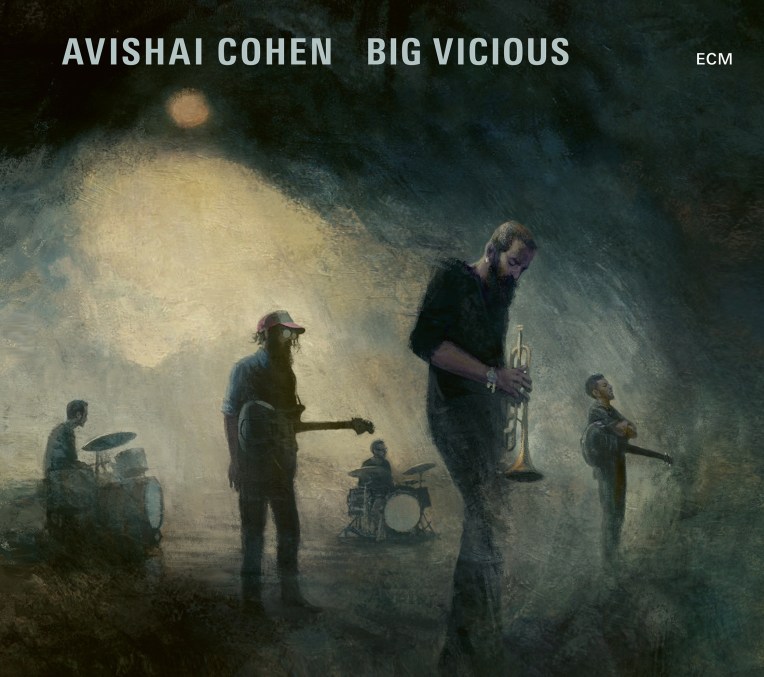
Of especial note is the album’s cover, a painting by David Polonsky, perhaps best known for Waltz with Bashir. Like the image itself, this is music that eschews photorealism in favor of something touched by hands, materials, and movement. It is also the visual equivalent of the album’s closer, “Intent,” which is so smooth that you might just find yourself blending in with your surroundings, wherever you happen to be.

Wolfgang Muthspiel: Angular Blues (ECM 2655)

2655 X

Wolfgang Muthspiel
Angular Blues

Wolfgang Muthspiel guitar
Scott Colley double bass
Brian Blade drums
Recorded August 2018 at Studio Dede, Tokyo
Engineer: Shinya Matsushita
Assistants: Yuki Ito and Akihito Yoshikawa
Mixed at Studios La Buissonne by Manfred Eicher, Wolfgang Muthspiel, and Gérard de Haro (engineer)
Mastering: Nicolas Baillard
Album produced by Manfred Eicher
Release date: March 20, 2020

On Angular Blues, Wolfgang Muthspiel revives the format of his 2016 ECM leader debut. Rejoined by drummer Brian Blade yet inviting bassist Scott Colley in place of Larry Grenadier, the Austrian guitarist serves a full course of originals with a couple of surprises added to taste. The members of this trio share what Muthspiel calls a “love of song” and perhaps no more succinct a term could so accurately describe their rapport. Longtime listeners won’t be surprised that Muthspiel has brought together players who understand the value of space: how to shape it, to be sure, but more importantly how to let oneself be shaped by it in kind.

The narrative impulses of the opener, “Wondering,” harness the flexibility of Muthspiel’s acoustic playing, which in this context meshes with bass while kissed cymbals draw the z-axis of a three-dimensional sound. Moods cycle between gentility and insistence and shades between. The title track is aptly named for revealing a delicately virtuosic side to the energies at hand. “Hüttengriffe” follows with a soft-hewn anthem.

The remaining tunes find Muthspiel plugged-in, jumping into the amorphous body of his electric guitar. In “Camino” he is equally at home, his fingers free to engage in metaphysical play. As a thinly veiled tribute to the late John Abercrombie—not only in style but also in the way Muthspiel drafts his solo—it’s a highlight that deserves close listening. Others include “Kanon in 6/8,” which shows the trio at its deepest level of synergy (it’s also offset by the digitally enhanced “Solo Kanon in 5/4”), and bebop-influenced “Ride.” Two standards fill in the gaps. Where Cole Porter’s “Everything I Love” moves vertically, “I’ll Remember April” ends this worthy set on a horizontal plane.

(This review originally appeared in the April 2020 issue of The New York City Jazz Record, a full PDF of which is available here.)

Nils Landgren/Jan Lundgren: Kristallen

Kristallen

Trombonist/vocalist Nils Landgren and pianist Jan Lundgren unite for an intimate and, as its title implies, multi-faceted program. The single-vowel difference in their surnames feels appropriate, as their set list is comprised of two distinct yet compatible decks of cards shuffled into each other. One of those decks is instrumental, the other vocal. Of the former persuasion, Lundgren’s “Blekinge” introduces a windswept pastoralism. A canvas brushed and primed for itinerant melodies, it uses the listener’s attention as a palette from which to draw its colors. Amid a smattering of Swedish folksongs, including “Byssan Lull” and “Värmlandsvisan” (both reworked into delicate grooves), they plant the evergreens of “Norwegian Wood” and Keith Jarrett’s “Country.” Standing tallest among these, however, is Abdullah Ibrahim’s “The Wedding,” whose foliage glows with tender nostalgia before the snow sets in.

On the sung side of things, we’re treated to a bluesy take on another Beatles classic, “I Will,” wherein the duo gives us plenty of atmosphere to chew on. Standards “Didn’t We” and “The Nearness Of You” rub shoulders of equal height with Lundgren’s own “Why Did You Let Me Go” and “Lovers Parade.” The latter unfold with especial clarity, wintry and sincere. Landgren’s singing is every bit as brassy as his trombone is throated and lyrical: each informs the other.

Whichever lens through which we choose to view this album, we can be sure that these carefully chosen selections, cropped until their borders achieve a balance of definition and open-endedness, reveal a deeply personal sensibility at play. The result is an effect as inevitable as its pairing, a choose-your-own-adventure story in sound that asks of us only to take the first step.

(This review originally appeared, in condensed form, in the March 2020 issue of DownBeat magazine.)

Julia Hülsmann Quartet: Not Far From Here (ECM 2664)

Not Far From Here.jpg

Julia Hülsmann Quartet
Not Far From Here

Uli Kempendorff tenor saxophone
Julia Hülsmann piano
Marc Muellbauer double bass
Heinrich Köbberling drums
Recorded March 2019, Studios La Buissonne, Pernes-les-Fontaines
Engineer: Gérard de Haro
Mastering: Nicolas Baillard
Produced by Thomas Herr
Release date: November 1, 2019

Fans of pianist Julia Hülsmann’s work will find familiar flavors enhanced by the unique spice of tenor saxophonist Uli Kempendorff being added to her long-running ensemble. He’s most vividly showcased on “Le Mistral,” one of two tunes contributed by bassist Marc Muellbauer. What begins with a quiet stirring develops into a freely interlocking sound—one honed by years of experience and held together by the band’s open-ended circuitry.

The poetry of Kempendorff’s playing is forthcoming, and the same holds true of his writing, even as “Einschub” is harmonized enigmatically. Most of the composing credits, though, go to Hülsmann. From the opening caress of “The Art Of Failing” to the masterful “No Game,” she treats every instrument as a vital ligament of the same appendage, pointing and flexing to the rhythms of emotional desire. With the tenderness of morning light gaining slow but steady purchase on the corner of a bedroom window, she follows a natural order of things.

Drummer Heinrich Köbberling throws a couple of his own coins into the proverbial fountain, including “Colibri 65,” which furthers the bandleader’s apparent mission of summoning placid, distinct airs.

The set is upheld by two versions of “This Is Not America,” a song written by David Bowie in collaboration with Pat Metheny and Lyle Mays. With broken nostalgia, it winds a melodic tangle from which escape is an easy but deeply unattractive option.

(This review originally appeared in the February 2020 issue of DownBeat magazine.)

Maciej Obara Quartet: Three Crowns (ECM 2662)

Three Crowns.jpg

Maciej Obara Quartet
Three Crowns

Maciej Obara alto saxophone
Dominik Wania piano
Ole Morten Vågan double bass
Gard Nilssen drums
Recorded March 2019, Studios La Buissonne, Pernes-les-Fontaines
Engineer: Gérard de Haro
Mastering: Nicolas Baillard
Produced by Steve Lake
Release date: October 25, 2019

After their 2017 ECM debut, Unloved, Polish saxophonist Maciej Obara and his quartet make their return with Three Crowns. In addition to six new tunes from the bandleader, the album features improvisational renderings of music by one of the most significant composers of the 20th century: Henryk Mikołaj Górecki (1933–2010). Though Górecki’s work has been subjected to improvisational treatments before, these renditions bear special distinction for being sanctioned by his family, whom Obara came to know while living in Katowice, where the composer once was based. The first Górecki interpretation, “Three Pieces In Old Style,” is so beautifully reimagined that it sounds as if it’s emanating from another world. Pianist Dominik Wania opens in a deeply respectful mood, allowing Obara’s incisive tone to keen overhead, while bassist Ole Morten Vågan and drummer Gard Nilssen roam a rain-kissed landscape below.

“Blue Skies For Andy” is among the stronger Obara originals—not only for its melodic strength but also its patience. It has a classic sound that feels warm to the ears, as precise as it is free. Other highlights range from the savvy urbanism of “Smoggy People,” notable for Wania’s postmodern swing, to the more geometric “Glow,” which recalls the tightly knotted compositions of fellow altoist Tim Berne. Obara’s bandmates grow in real time, though nowhere so maturely as on “Mr. S,” an homage to trumpeter Tomasz Stańko that rolls in on a wave of melancholy and sunshine in equal measure. Like the title track, it’s flexible and always attached to something pure and knowable. There is no mystery here. Only life.

(This article originally appeared in the January 2020 issue of DownBeat magazine.)

Keith Jarrett: Munich 2016 (ECM 2667/68)

2667|68 X

Keith Jarrett
Munich 2016

Keith Jarrett piano
Recorded live July 16, 2016
at Philharmonic Hall, Munich
Producer: Keith Jarrett
Engineer: Martin Pearson
Mastering: Christoph Stickel
Executive producer: Manfred Eicher
Release date: November 1, 2019

The more I listen to Keith Jarrett’s improvised concerts, the more I shy away from the adjective “solo” to describe them. Not because I live under a delusion that it isn’t just him translating energies that 99.99 percent of us could only hope to detect, but because each iteration of this asymptotic journey at the piano reminds me of the ghost of yet another former self who goes on playing in an alternate reality even after he lifts his hands and takes a bow amid the applause of this one.

Throughout this two-disc recording, which documents a July 16th performance in the city and year of its title, Jarrett unveils 12 numbered sculptures of possibility, each more freestanding than the last. Not that the path between them is linear. What begins in Part I—the set’s longest, just shy of 14 minutes—as a many-tentacled deep sea creature has by Part III already morphed into a landbound shepherd. The latter’s hymnal qualities light a gospel fire in the underground railroad lantern of Part IV before dissolving into the child’s dream that is Part V.

Part VI marks another change of face, uniting questions of mountains above with answers of valleys below. The contortions of Parts VII, IX, and XII are ages between, giving way to meditations in which un-pressed keys speak as truthfully as their contacted neighbors. Few are so profound in this regard as Part XI, of which a certain air of finality is only as permanent as the wind on which it’s written. It whispers as an antidote to the shouting match that has become our lives.

In light of all this, we get a trinity of shades in Jarrett’s choice of encores. In “Answer Me, My Love,” he embraces the past as if it were a dying future. In “It’s A Lonesome Old Town,” he embraces the present as if it were the only hope of peace. And in “Somewhere Over The Rainbow,” he lets go of all three states of mind, knowing that honesty of expression is the only wave we can catch to keep him visible as he follows one horizon in search of the next.

Kit Downes: Dreamlife of Debris (ECM 2632)

Dreamlife of Debris.jpg

Kit Downes
Dreamlife of Debris

Kit Downes piano, organ
Tom Challenger tenor saxophone
Lucy Railton cello
Stian Westerhus guitar
Sebastian Rochford drums
Recorded November 2018
at St. Paul’s Hall, University of Huddersfield
and St. John the Baptist, Snape
Engineer: Alex Bonney
Produced by Sun Chung
Release date: October 25, 2019

Following his 2018 ECM headliner debut, Obsidian, Kit Downes returns at the organ (and piano), this time among friends, including saxophonist Tom Challenger (heard for a spell on Obsidian), cellist Lucy Railton, and drummer Sebastian Rochford. The latter is heard prominently in the concluding “Blackeye,” a piece cowritten by Downes and Challenger. Its thicker brushstrokes fill a rather different sort of canvas than the ones preceding, albeit touched by the same palette.

“Sculptor” opens with Challenger’s bare tone, a kiss of sun on the morning glory of piano that then imbues the scene with its color. Also lurking is guitarist Stian Westerhus, a new addition to the Downes nexus who is rightly described by Steve Lake in his liner notes as, at times, a “near-subliminal participant.” Twinkling like starlight in “Bodes,” his guitar emotes under tension of utterly non-invasive strings. The latter tune is the album’s masterstroke: a fully narrative journey from cradle to grave that catches as many life experiences as it can before passing them on like an inheritance in faith of continuation.

Comforting about Downes as composer is his underlying sense of open-endedness. Titles such as “Pinwheel” and “Sunflower” suggest interconnections just beyond their titular surfaces—not only in Railton’s liquid threading, but also in their ability to turn melody into substance (if not the other way around). “Circinus” and “Twin” make sense of the organ as if it were a text to be interpreted in humility. Both elicit an undeniably cosmic feel, strangely rendered in textures of flesh and soil.

The only piece not by Downes is “M7.” Composed by his wife, bassist and vocalist Ruth Goller, this organ solo centers its energies in sustained pedal points while spreading open the periphery as one might a pair of hands. In its cradle, the entire album’s heart dents a pillow woven from old maps and cartographic sketches, each drawing closer to an undiscovered country but never quite reaching it. Content to float wherever the current may lead, it closes its eyes and redraws its path in the language of a dream, where the only songs that matter are those without words.

Avishai Cohen/Yonathan Avishai: Playing The Room (ECM 2641)

Playing The Room.jpg

Avishai Cohen
Yonathan Avishai
Playing The Room

Avishai Cohen trumpet
Yonathan Avishai piano
Recorded September 2018, Auditorio Stelio Molo RSI, Lugano
Engineer: Stefano Amerio
Produced by Manfred Eicher
Release date: September 6, 2019

Although trumpeter Avishai Cohen and pianist Yonathan Avishai have known each other and played together since they were teenagers in Tel Aviv, this is their first recording as a duo. The title refers to an offhand comment made by producer Manfred Eicher, who during the recording of Avishai’s Joys And Solitudes remarked, “Avishai [Cohen] should play this room.” The duo session documented here happened just a few days later, only now in the Auditorio Stelio Molo RSI at Lugano in place of Studios La Buissonne. And play the room they do. Not only in the sense of liberating a delightful mix of standards and original contributions to the modern songbook, but also because, like seasoned thespians, they inhabit their narrative roles with full physical commitment.

The set’s door is pushed open by said original contributions, starting with “The Opening” by Cohen, which seems to flower into audibility of its own volition to be heard. Piano and trumpet communicate so deeply, even when not playing at once, resulting in one of the more evocative beginnings to grace an ECM program quite some time. Avishai’s “Two Lines” is an equally introspective, if darker, companion, by whose gestures are activated shared memories. Cohen here is especially broad of emotional brush and paints with the abandon of a child.

John Coltrane’s “Crescent” kicks off the album’s airborne remainder, cycling through its own self-awareness and in that process attaching feather upon feather in anticipation of flight. Cohen rises and sets like the stars, while Avishai navigates by their movement. The effect is such that when Duke Ellington’s “Azalea” cracks open the scene like an egg of dawn, its classic sounds feel not so much reborn as reawakened. As in Ornette Coleman’s “Dee Dee” and Stevie Wonder’s “Sir Duke,” they approach the evergreen as an opportunity for pruning instead of replanting.

Whether in the comforting shades of “Ralph’s New Blues” (Milt Jackson) or the gorgeously rendering of “Kofifi Blue” (Abdullah Ibrahim), Cohen and Avishai stay true to form because they understand the form of truth. In their hands, and by the spatial allowances of Eicher and engineer Stefano Amerio, these tunes resonate with nothing more than what they were meant to be. All of which makes inclusion of “Shir Eres (Lullaby)” by Sasha Argov (1914-1995) poignant beyond measure. Not only because it’s an emotional touchstone in the hearts of the musicians, but also because it pulls the sky like a blanket over our ears, that we might better hear the sounds of our own heartbeats. Thus, Playing The Room is the sonic equivalent of the “moon illusion”—when our closest satellite appears bigger on the horizon than it does in the sky due to its visual proximity to earthbound objects. Once risen, however, it tells us just how far we’ve come, and how much infinitely farther we have to go.