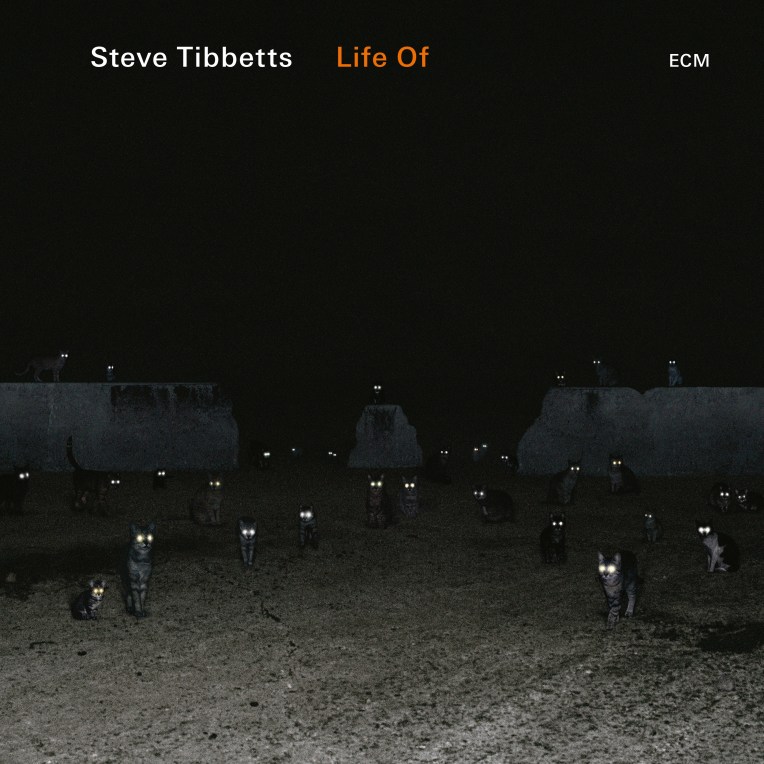
Steve Tibbetts: Life Of (ECM 2599)

2599 X

Steve Tibbetts
Life Of

Steve Tibbetts guitar, piano
Marc Anderson percussion, handpan
Michell Kinney cello, drones
Recorded in St. Paul
Engineers: Steve Tibbetts and Greg Reierson
Mastered by Greg Reierson at Rare Form Mastering
An ECM Production
Release date: May 18, 2018

Physically speaking, guitars are solids. In the hands of Steve Tibbetts, they turn into liquids. For his ninth ECM outing, the Minnesotan guitarist puts on his most intimate pair of interpretive glasses yet, pouring said liquids into 13 dedicatory vessels. Tibbetts again holds close to his Martin D-12-20, a 50-year-old 12-string acoustic that has become as much a part of him as he of it. To that trusted palette he adds streaks of piano and field recordings of Balinese gongs. As ever, percussionist Marc Anderson serves as copilot for the journey, while cellist Michelle Kinney (last heard on Big Map Idea) provides underlying circulation.

As if in service of the latter metaphor, “Bloodwork” openly introduces the album in response to a procedure underwent by his ill sister. In it one can hear, as suggested in the album’s press release, the clinical precision with which this music materializes. And yet from that attention to detail emerges an entirely organic sound, replete with human variations and misalignments. All of which is reflected in the fact that Tibbetts plays his guitar with nearly-worn frets and old strings, giving it, in his own words, “a mellow, aged sound, with its own peculiar internal resonance.”

Those familiar with his body of work will have come to expect arrangements that transcend borders while embracing a sometimes-gargantuan sound. Here, however, he zeroes in on seeds beneath the fields he has been tending all these years. Indeed, the baseline beauty of “Life Of Mir”—one of 10 eponymously themed tracks named for loved ones or those Tibbetts has simply observed—teems with life as would the ripest soil. “Life Of Emily” also feels very much alive, trading earth for flesh in a prism of fatherhood, sunlight, and hints of oncoming rain.

The percussion is attuned to every moment in which it is employed, never mere decoration but siphoning its energy from an internal chemistry. Take in the occasional footstep in “Life Of Lowell” or the whispering cymbal in “Life Of Dot,” and you’ll surely feel it, too. At rare moments, as in “Life Of Joan” and “Life Of El,” these forces combine in a mosaic, fitting together shapes and colors in honor of memory. Like the album as a whole, “Life Of Someone” holds the past as an archive for the future—a time capsule already aged before it reaches the ear.

Life Of culminates, appropriately enough, with “Start Again,” a nine-minute swirl of mental images and other formless pigments made audible through the care of an artist who treats every note as ground on which to walk.

Masabumi Kikuchi: Black Orpheus (ECM 2459)

2459 X

Masabumi Kikuchi
Black Orpheus

Masabumi Kikuchi piano
Recorded live October 26, 2012 at Tokyo Bunka Kaikan Recital Hall
Recording director: Satoshi Takahashi
Recording engineer: Masatoshi Muto
System engineer: Shinya Tanaka (SCI)
Mixed at Rainbow Studio, Oslo by Manfred Eicher and Jan Erik Kongshaug (engineer)
Album produced by Manfred Eicher
Release date: April 1, 2016

Recorded live on October 26, 2012 at the Tokyo Bunka Kaikan Recital Hall, Black Orpheus presents the late Japanese pianist Masabumi Kikuchi (1939-2015) in a solo improvised concert. While some players, when given this much room to roam, travel ever inward, Kikuchi is that rare exception who builds monuments ever outward, and it’s all we can do to grab a railing or window for the ride. Having played with many greats across as many eras of jazz history—including Elvin Jones, Gil Evans, Miles Davis, and Paul Motian—Kikuchi was sufficiently prepared to strike his own match. And while his fire may have burned slowly but surely in an unassuming corner, its smoke infused the entire structure surrounding it. Such is the possessive effect of his music, which in Part III especially plays hooks to our loops in spiritual Velcro. Even before that, as Part I unspools its dreams into reality, thus revealing what Ethan Iverson in his liner notes calls Kikuchi’s “extraordinary vulnerability and corresponding extraordinary magic,” the truth of his hands is already obvious.

Kikuchi 1

Kikuchi’s sense of space is more about the space of sense. In Part IV, for instance, his ability to shape the resonance of a single note is like that of a master sitar player in his treatment of decay. His fingers feel connected to the key long after the hammer hits, indeed working that extraordinary magic into sounds otherwise thought of as liberated. And while there are more convoluted strains to be found here, as cultivated in Parts VI, VIII, and IX, there’s nothing remiss about their breathing patterns. That they share the same lungs as Part VII, a deeply affective sandwich of cloud-soft bread and raw meat, is all the more remarkable. Each mode nourishes the other, so that whether painting a moving image one frame at a time in Luiz Bonfá and Antônio Maria’s “Black Orpheus” or evoking the quiet joys of “Little Abi,” a tune written for his daughter, he understands that human bone is both the most resilient and weakest architecture, capable of bearing more weight than anything the body housing them can create before it collapses.

Kikuchi 2

Carla Bley Trio: Andando el Tiempo (ECM 2487)

Andando el Tiempo

Carla Bley Trio
Andando el Tiempo

Carla Bley piano
Andy Sheppard tenor and soprano saxophones
Steve Swallow bass
Recorded November 2015, Auditorio Stelio Molo RSI, Lugano
Engineer: Stefano Amerio
Produced by Manfred Eicher
Release date: May 6, 2016

Andando el Tiempo, like any Carla Bley record, is more than a document; it’s a living testament to a genius whose relevance is as lasting as her need to express it. And express it she has for over two decades with the trio presented here. With saxophonist Andy Sheppard and bassist Steve Swallow she has forged a triangle of almost-divine equality. Like its predecessor, Trios, the present session distills enormous ideas with natural assurance, but unlike that 2013 masterpiece does so through a program of entirely new material.

The title suite consists of three pieces, each dealing with the subject of addiction, as inspired by watching a friend go through the transformation of recovery and the great sacrifices required to grab hold of light when darkness is closing in from every side. “Sin Fin” represents that first step of self-awareness required to start on the path to freedom from substance abuse. The measured assessments woven into its melodic denouement are deeply illustrative of this process. Bley’s pianism evokes a vicious cycle of medication while Swallow offers glimpses of hope. But it’s the brush of Sheppard’s visceral tenor that absorbs most of Bley’s compositional ink, shedding its allegiance to demons for want of heavenly understanding. “Potación de Guaya” waters those seeds of faith with Sheppard’s life-giving soprano and Swallow’s yielding affirmations. After all this inwardness, “Camino al Volver” breaks the shell of dependence in favor of a brighter day. Its realism shows through in controlled exuberance.

Bley Trio

“Saints Alive!” is a more conversational piece that treats each instrument as a voice with something to say. Its free and easy atmosphere goes down like a tall glass of peach iced tea on a summer’s evening. In closing, “Naked Bridges/Diving Brides” takes its inspiration from Felix Mendelssohn and the poem “Peking Widow” by Paul Haines, who wrote the libretto for Bley’s Escalator Over The Hill. Written as a wedding gift for Sheppard and his wife Sara, it ties the final bow on a gift that no other coming together of musicians could have produced, making for one of the most honest and personal experiences to grace ECM’s catalog in years.

Vijay Iyer/Wadada Leo Smith: a cosmic rhythm with each stroke (ECM 2486)


2486 X

a cosmic rhythm with each stroke

Vijay Iyer piano, Fender Rhodes, electronics
Wadada Leo Smith trumpet
Recorded October 2015 at Avatar Studios, New York
Engineer: James A. Farber
Assistant: Akihiro Nishimura
Produced by Manfred Eicher
Release date: March 11, 2016

Labyrinths, lines among lines – A mesh
Difficult to destroy
Yet one must
Walk
Nothing more
Out of chaos, form – silence
–Nasreen Mohamedi, diary entry, 1968

That pianist Vijay Iyer looks up to Wadada Leo Smith as a “hero, friend, and teacher” is nowhere so beautifully obvious as on this, their first duo record. He recalls his five years spent with the trumpeter’s Golden Quartet, in which he and Smith “became a unit within the unit generating spontaneous duo episodes as formal links.” Said balance of spontaneity and form accurately describes an artistic process that adds as many layers as it peels away.

The seven-part a cosmic rhythm with each stroke came about in response to Indian artist Nasreen Mohamedi (1937-1990), whose diary yields every title therein. “All becomes alive” introduces electronic augury as spinal tap, while Smith’s castings reveal a divination that feels simultaneously digital and analog. There’s tension here, but it has no teeth to masticate Iyer’s block chords. Instead, it marvels at its own narrative unfolding, one word at a time. These dynamics fluctuate all the way to “Notes on water,” in which synthesized elements bring the suite to its origami conclusion. Along every crease in between—whether through the muted proclamations of “The empty mind receives,” the frenetic grammars of “Labyrinths” and “A cold fire,” or the ambient depths of “A divine courage”—we encounter a biographical fingerprint. The forensic tools required to piece these together into a coherent identity are as much drawn from the listeners as the performers.

Iyer Smith
(Photo credit: John Rogers)

Their investigation is bookended by two outlying compositions. Iyer’s “Passage” refuses to see either palette or canvas as flat surfaces, emphasizing instead their three-dimensionality and capacity for absorption. What begins as a delicate, John Cagean landscape morphs into a bolder ode to time and space. If Iyer’s pianism speaks in acrylics, then Smith’s trumpeting revels in the split tails of calligraphic brushstrokes, reading between their lines a language of metonymic potency. Smith’s “Marian Anderson,” dedicated to the contralto and civil rights activist of the same name, fits together broader temporal scaffolding upon a likeminded foundation. The end effect rolls itself into a seed of origins, ready to sprout at the slightest contact of our listening water.

Ferenc Snétberger: In Concert (ECM 2458)

Ferenc Snétberger In Concert

Ferenc Snétberger
In Concert

Ferenc Snétberger guitar
Concert recording December 2013, Liszt Academy, Grand Hall, Budapest
Engineers: Stefano Amerio, Giulio Gallo
Mixed at Artesuono Recording Studios, Udine by Stefano Amerio, Manfred Eicher, and Ferenc Snétberger
Produced by Manfred Eicher
Release date: March 11, 2016

Recorded live in December of 2013 at Budapest’s Franz Liszt Academy of Music, In Concert archives a deeply personal performance by Hungarian guitarist Ferenc Snétberger. As his ECM debut, it instantly calls to mind Ralph Towner’s Solo Concert in format, sharing further affinity with Keith Jarrett for including “Somewhere Over the Rainbow” as encore. The ECM comparisons are more than cursory, as Snétberger grew up inspired by the label’s stalwarts, including Egberto Gismonti and Johann Sebastian Bach.

Much of the eight-part suite, entitled “Budapest,” that comprises the program is improvised, though built around heartfelt melodies of Snétberger’s design. Amid a spiraling association of history and spontaneous creation, an original voice emerges. “Part 1,” for instance, builds its castle on a faraway hill yet makes it feel as if it overlooks our own back yard. The cleanliness of tone, coated in just the right amount of varnish, resonates with a depth matched only by the recording. “Part 2” is meant to evoke Bach’s tonal voicings, and beyond that embraces a certain intimacy unique to the German composer. With a lyrical assurance that’s never cloying, Snétberger taps into something essential, as also in the Astor Piazzolla-inspired “Part 3,” wherein every sway of the curtain reveals a biographical whiff of the breeze that moved it. The samba sandwich of “Part 4” contains a monophonous passage of astonishingly vocal quality. The freely improvised “Part 5” serves as a virtuosic segue into “Part 6,” which treats the surface tension of a pond as canvas for photorealistic sound painting. If “Part 7” is the sunlight, then “Part 8” is the tree intercepting it for shade: an ideal vantage point from which to ponder the concluding rainbow in all its quiet glory.

Ferenc Snétberger

Having mentioned Towner and Jarrett at the start, it’s only fitting to end with them in mind, as much to say that Snétberger’s ECM debut belongs rightly alongside those giants of solo improvisation.

Jon Balke: Warp (ECM 2444)

2444 X

Jon Balke
Warp

Jon Balke piano, sound images
Piano recorded September 2014 at Rainbow Studio, Oslo
Engineer: Jan Erik Kongshaug
Sound images recorded and processed at Madstun by Audun Kleive and Jon Balke
Field recordings by Jon Balke
Mixed September 2015 at RSI Studio, Lugano by Jon Balke, Manfred Eicher, and Stefano Amerio (engineer)
Mastered at MSM Studios, Munich by Christoph Stickel
Produced by Jon Balke and Manfred Eicher
Release date: February 12, 2016

In a catalog rich with singular artists, the ECM discography of Jon Balke is without parallel. On Warp, the Norwegian pianist retracts his improvisational claws into even deeper levels of possibility, seeking connections between sound, environment, and the infinite spaces that blur where one ends and the other begins. It’s more than a formula, but a philosophy that has guided his work for the label from the very beginning. Combining freely rendered passages on the piano, recorded at Oslo’s Rainbow Studio, with field recordings and electronics, he doesn’t so much guide the listener as allow himself to be guided as one through uncharted landscapes of expression.

Despite the many kinds of samples, ranging from sounds captured in an Istanbul mosque to an airport announcement read by his daughter Ellinor, there is a uniformity to their purpose as substance. In this sense, it’s almost counterintuitive to spotlight particular tracks over others: each is a vital organ that cannot be removed without compromising the entire organism. The album, then, is more like a film shot in one take, each scene coordinated through a meticulous rehearsal of script, foley, and camerawork—a remarkable feat, given the collage aesthetic at play.

Warped Balke

From the beginning, internal dialogues are the norm, whether through abstract meanings or their material production. Much of the latter is metallic in origin, torn from broken machines and other castaway objects yearning for recovery. Shades of church organ lend sanctity to memories that have no purpose but to shed their skin to make room for one degraded copy after another until only stillness remains. Although it’s tempting to interpret all this as an exercise in nostalgia, its sheer presence is enough to dispel such staid notions of emotional suggestion. Rather, it bleeds as if to remind us of its vitality, filling a cup so transparent that every gesture shows through. And when voices sing, they touch a finger to its rim, ringing out with astonishing contrast.

Warp is that rare exemplification of “ambient” music in that it doesn’t create atmosphere for the mere sake of it, but with such a sense of physicality that listeners can’t help but feel like they’ve walked through someplace neither sacred nor profane, but content in having been graced, if only once, by our attention.

DeJohnette/Coltrane/Garrison: In Movement (ECM 2488)

In Movement

In Movement

Jack DeJohnette drums, piano, electronic percussion
Ravi Coltrane tenor, soprano and sopranino saxophones
Matthew Garrison electric bass, electronics
Recorded October 2015 at Avatar Studios, New York
Engineer: James A. Farber
Assistant: Akihiro Nishimura
Mastering: Nicolas Baillard
Produced by Manfred Eicher
Release date: May 6, 2016

This groundbreaking session presents drummer Jack DeJohnette alongside saxophonist Ravi Coltrane and electric bassist Matthew Garrison. Having played with their legendary fathers—John Coltrane and Jimmy Garrison—DeJohnette understands that repeating history is easy, but that only someone of his patience and experience can reform it. Says DeJohnette of his bandmates, here making their ECM debut, “Ravi and Matthew are aware of their heritage, but part of the intention of their music is to be recognized for who they are—and that’s already apparent. That’s why I play with them, because they have their own voices.”

In Movement is nothing if not a tribute project. That said, it’s a tribute to many things—some more easily definable than others. When playing the music of the greats, the musicians open their hearts and minds in equal measure. Coltrane the father, for one, gets a serious nod with the trio’s take on “Alabama,” a tune overwhelmingly pregnant with retrospection and taking on a feeling of such historical significance that it feels more like a prayer than a social statement. Coltrane the son lends it visual urgency, dipping his fingers into the ashes of modern discontent and forming an image not unlike the album’s cover art, while Garrison engages in thick description amid DeJohnette’s splashing cymbals.

The title track rests on a bed of electronics (courtesy of Garrison), listing through its changes like a boat along water. Coltrane’s soprano dances, a restless exegete who communicates in gestures rather than words. A brilliant dive inward that acts like a doorway into the alchemy of “For Two Jimmys.” Dedicated to Jimmy Garrison and Jimi Hendrix, it glistens like the ripest of fruits on the vine. With ritualistic abandon, it charts one mystery after another, plotting fresh strata in DeJohnette’s mastery.

Trio In Movement

The Miles Davis/Bill Evans gem “Blue In Green” pairs DeJohnette on piano with Coltrane on soprano for a nocturnal meditation before the Earth, Wind & Fire classic “Serpentine Fire” emerges as if freshly washed in the one element missing from the band’s iconic name. DeJohnette’s funky snare evokes a bygone era in futuristic grammar, while Coltrane unleashes one of his most inspired cadenzas on record.

All of which seems like a preamble to “Rashied.” Bearing dedication to Rashied Ali, this tune documents Coltrane’s first studio excursion on the sopranino saxophone, an instrument that feels tailor-made for his temperament and resonates powerfully alongside the drums in a duo setting. This fiery pieceearned a standing ovation from the crew at New York’s Avatar Studios, where the album was recorded, and rightly so: it’s revitalization incarnate. In the wake of this extroversion, “Soulful Ballad” returns DeJohnette to the keys for a somber farewell. As with “Lydia” (named for DeJohnette’s wife), it adds a dash of sweetness to an otherwise savory program.

Bassist Henry Grimes once said that being an innovator means coming out the other side another person. And in that sense, each of these musicians has come into his own, apart from who he once was. The difference here is that we know them through their creative action, instantly and irrefutably, and can only shake our heads at the planetary alignments working in their favor.

Ralph Alessi: Quiver (ECM 2438)

Quiver

Ralph Alessi
Quiver

Ralph Alessi trumpet
Gary Versace piano
Drew Gress double bass
Nasheet Waits drums
Recorded September 2014 at Rainbow Studio, Oslo
Engineer: Jan Erik Kongshaug
Mixed October 2015 at Avatar Studios, New York by James A. Farber (engineer), Manfred Eicher, and Ralph Alessi
Produced by Manfred Eicher
Release date: February 19, 2016

Trumpeter Ralph Alessi returns to ECM, following his leader debut for the label, with an ace band of pianist Gary Versace, bassist Drew Gress, and drummer Nasheet Waits. This time around, his signature balance of openness and angularity is in fuller effect, made even more prosaic by Versace’s touch. Gress brings his own thorough palette to the studio, while Waits—with whom Alessi first played in Fred Hersch’s quintet—walks a delicate seam both inside and outside the pocket.

Alessi Solo

Over the course of ten originals, Alessi guides his painterly cohort through a gamut of hues. From the primer of “Here Tomorrow,” he moves ever-onward toward the next brushstroke before the current one has even the slightest chance to dry. As a player of genuine dynamism, Alessi treats the melancholy of “Window Goodbyes” (the title references his five-year-old daughter’s habit of waving from the window as he leaves for a tour) and “Shush” with as much rapt attention as any upbeat blending (of which the album is bereft until the closing “Do Over”).

The rubato “Smooth Descent” is a wondrous exhibition for Versace and Gress, both of whom widen its scope with every note they choose. “Gone Today, Here Tomorrow” and “Scratch” are the most cubist detours of the set, although both leave plenty of room between Alessi’s blasts of exposition to find our own way. Through it all, he shows narrative purpose in his playing. Whether in the somber intro of “Heist” or colorful exegesis of “I to I,” he understands the value of any language—in this case, music—to provoke meaning in the flesh. We might therefore think of the album’s blushing title track as the trembling of a body, although it makes just as much sense to imagine it as a bag slung across the back, each arrow it holds a melodic weapon rounded to heal rather than harm.

Michael Formanek’s Ensemble Kolossus: The Distance (ECM 2484)

2484 X

Michael Formanek’s Ensemble Kolossus
The Distance

Ensemble Kolossus
Loren Stillman alto saxophone
Oscar Noriega alto saxophone, clarinet, bass clarinet
Chris Speed tenor saxophone, clarinet
Brian Settles tenor saxophone, flute
Tim Berne baritone saxophone
Dave Ballou trumpet
Ralph Alessi trumpet
Shane Endsley trumpet
Kirk Knuffke trumpet, cornet
Alan Ferber trombone
Jacob Garchik trombone
Jeff Nelson bass trombone, contrabass trombone
Patricia Franceschy marimba
Mary Halvorson guitar
Kris Davis piano
Michael Formanek double bass
Tomas Fujiwara drums
Mark Helias conductor
Recorded December 2014 at Systems Two, Brooklyn, NY
Engineer: Jon Rosenberg
Mixing: David Torn
Mastering: Christoph Stickel and Manfred Eicher at MSM Studios, München
Executive producer: Manfred Eicher
Release date: February 12, 2016

After two eminent quartet outings for ECM, The Distancedemonstrates Michael Formanek’s redefinition of big band jazz. Although the bassist and composer cites influences as diverse as Olivier Messiaen and Charles Mingus, his music is more than the sum of its parts, a palette that yields fresh hues with every listen. Drawing on talents both within and without his usual camp, the album pays equal tribute to the known and unknown and activates the sound of each and every player.

Most of this sonic continent is inhabited by denizens of Formanek’s octagonal Exoskeleton Suite. The suite is introduced by a prelude that embodies its title better than anything that follows it. The bandleader’s soloing indeed acts like a protective shell around the many chemical reactions taking place within it. Analyzing them with scientific precision are pianist Kris Davis and drummer Tomas Fujiwara, both of whom turn method into esotery in compact sweeps of accord.

In light of this opening statement, “Part I – Impenetrable” feels like newfound freedom. Pewter cloudbursts give way to Loren Stillman’s nostalgic altoism, which like a child overturning a log uncovers a wriggling ecosystem that would otherwise remain hidden. “Part II – Beneath the Shell” fast-forwards into evening, where a groove inhales the secrets exhaled by its predecessor. Chris Speed works his tenor into the very heart of things, while Kirk Knuffke’s cornet flickers like a candle in a room that smells of rum and ink. “Part III – @heart” is a showpiece for trombonist Ben Gerstein, whose elicitation of harmonics and other peripheral signatures works into a string-bending, metallic fringe of extreme beauty.

“Part IV – Echoes” is a rift in vast ocean waters, of which trumpeter Ralph Alessi and trombonist Alan Ferber are master navigators. Where Alessi cuts his map with an X-ACTO knife, Ferber glues those pieces into a new one, leaving guitarist Mary Halvorson to recalibrate the compass in “Part V – Without Regrets.” Taking the flow into unexpected directions, she forges a chamber aesthetic to the rhythms slithering between her strings. “Part VI – Shucking While Jiving” features a string of brilliant soloists, including Tim Berne on baritone saxophone, Brian Settles on tenor, Jacob Garchik on trombone, and Jeff Nelson on bass trombone. This one marks a tectonic shift in place and time. Smooth yet also pockmarked with worthy interruptions, its atmosphere combusts by influence of ecstatic kinesis. “Part VII – A Repitle Dysfunction” returns to the fragmentary intimacies of Part V, only now with the wall-breaking marimba of Patricia Franceschy and clarinet of Oscar Noriega. Fujiwara and Davis, too, shine through the ruins with their ancient light, as precise as an eclipse. All of which funnels into “Part VIII – Metamorphic,” a collective improvisation for the full ensemble that describes a landscape formed as if through-composed.

EK
(Photo credit: John Rogers)

The suite’s prelude is itself preluded by the title track, which eases Settles onto a locomotive track of horns and brushed drums. The force of it moves just so, blurring trees on its journey toward empty coastline. In a development so misty and cinematic that it could almost be mistaken for a Gavin Bryars ensemble piece, it interlocks with its surroundings—less like a puzzle and more like a leaf among a spray of others.

Formanek has always been unafraid to bend his scores to their limits and let their rougher edges flap for want of new connections, but here his art achieves even deeper relevance in that regard. The result is not a message in a bottle, but a bottle in a message.