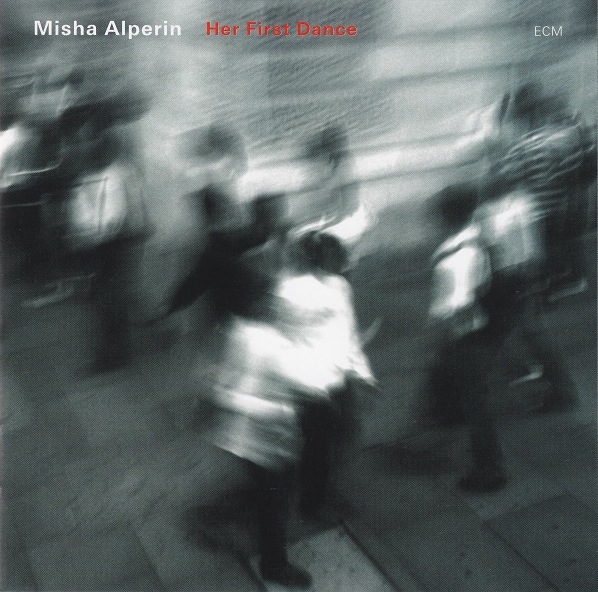
Misha Alperin: Her First Dance (ECM 1995)

Her First Dance

Misha Alperin
Her First Dance

Misha Alperin piano
Arkady Shilkloper French horn, flugelhorn
Anja Lechner violoncello
Recorded July 2006, Auditorio Radio Svizzera, Lugano
Engineer: Stefano Amerio
Produced by Manfred Eicher

After a decade-long absence, Russian pianist-composer Misha Alperin returns to ECM with his most fragrant release to date. He retains cellist Anja Lechner from the last session, Night, and rejoins his longtime ally, horn player Arkady Shilkloper. The deeper (if only for being the oldest) relationship of the two is with Shilkloper, who since 1990’s Wave Of Sorrow has been a constant companion throughout Alperin’s ECM tenure. In fact, the only piece not by Alperin on this album, “The Russian Song,” flows from Shilkloper’s pen in a lovingly arpeggiated duet for French horn and cello, with no piano between them. The remaining pieces comprise a mixed palette of solos, duos, and one trio. The latter, “Tiflis,” again features French horn, only now working a mournful charge between cells of piano and cello. It’s a stunning, lyrical voyage that works its subtle ways into the mind.

Of Alperin’s piano solos the listener is treated to a wide variety. From the tintinnabulations of “Vayan” (which veers down unexpected avenues of twilight) to the sprightly virtuosity of “Jump,” each is a transfiguration, a whirling dervish of melody. Eyes closed and heart open, Alperin passes, ghost-like, through the tenderness of “April In February” and the Bach-like grandiosity of “Via Dolorosa” with equal attention, such that each becomes a waterfall droplet made audible through slow motion.

Piano and flugelhorn make for a profound combination in the title track. Here the keyboard is distant, and the music all the more intimate because of it, as if it were being played in a chamber of the mind, personal and untouched by the outside. There is a spin and a sway to this tune, fleshed by the childhood implied by its title, by the magic of kindness that pulls flowers from the soil before the world at large can paint them with words.

Piano and cello make two somber appearances. “A New Day” turns like a ballerina in a music box, Alperin dotting the edges of Lechner’s spinal lines with light impulses of grace, while “Frozen Tears” breathes cinematic reality through a steady pulse and wavering foreground.

Together, these vignettes boil down to a beauteous representation of Alperin’s diction. Secure and sparkling, it speaks as it lives: which is to say, from the heart.

Paul Motian Band: Garden of Eden (ECM 1917)

Garden of Eden

Paul Motian Band
Garden of Eden

Chris Cheek tenor and alto saxophone
Tony Malaby tenor saxophone
Jakob Bro guitar
Ben Monder guitar
Steve Cardenas guitar
Jerome Harris bass
Paul Motian drums
Recorded November 2004, Avatar Studios, New York
Engineer: James A. Farber
Produced by Manfred Eicher

Paul Motian was nothing if not unpredictable, and on Garden of Eden he degausses the jazz landscape not for the first time. The album represents a headlong dive into bebop roots, but also a tangling of their pathways. More than his refashioning, however, it is the instrumentation that holds the most surprises. In addition to bassist Jerome Harris (previously heard alongside the legendary drummer on Bill Frisell’s Rambler), Motian welcomes not one or even two but three guitarists (Jakob Bro, Ben Monder, and Steve Cardenas) and tenorists Tony Malaby and Chris Cheek (also on alto duty) for a session that is equal parts comfort food and new wave. Interestingly enough, the former comes from Motian’s newer tunes, while qualities of the latter infuse the tried and true.

Two Charles Mingus tunes open the set with a stage-setting contrast of temperatures and climates. “Pithecanthropus Erectus” finds Motian in a state of subtle swing, spearheading cool, spacious pockets of force. Beneath tasteful soloing from Cheek and chromatic flourishes from Malaby, Harris works his groove-mind, even as the guitarists kindle the music’s inner glow. Despite, if not because of, the assembly, such progressive tunes seem to float, while the leisurely crawl of “Goodbye Pork Pie Hat” is far denser due to its high emotional thread count. Through its crosstalk of guitars and reeds echoes a graceful photosynthesis.

Motian’s snare is profound in its variety. A sound at once hollow and resonant, it begs attention, a light visible in the thickest fog. It is central to his craft not only as a player, but also as a composer. In this role Motian excels beauteously with seven viscous originals, in particular the title track, which moves like globules in a lava lamp and, along with Jerome Kern’s “Bill” (from the musical Show Boat), paves the album’s dreamiest thoroughfares. Other wonders: the slipstream “Mesmer,” in which Motian spackles highlights with his cymbals, characteristically insistent yet accommodating; the spider-webbed guitars of “Prelude 2 Narcissus” and “Manhattan Melodrama,” each a radiation of moonlight; and “Etude,” which has put on some shadows since its appearance on 1982’s Psalm.

Cheek and Cardenas each contribute a tune. “Desert Dream” is the saxophonist’s modal vision, a haunting piece of cartography that side-winds into the guitarist’s “Balata.” In both, themes act as concave bookends to even more concave departures. The wave takes us back to finish, looking to Thelonious Monk’s “Evidence” and Charlie Parker’s
“Cheryl” for closure. Both manifest the full tactility of bebop, thus cinching one of Motian’s finest records on any label.

Is this where jazz is going? Hardly. This is where jazz already was. It only took a genius like Motian to hear it that way. A crime not to savor.

Savina Yannatou & Primavera en Salonico: Sumiglia (ECM 1903)

Sumiglia

Savina Yannatou
Primavera en Salonico
Sumiglia

Savina Yannatou voice
Primavera en Salonico
Kostas Vomvolos accordion, qanun, kalimba
Yannis Alexandris tamboura, oud, guitar
Michalis Siganidis double-bass
Kyriakos Gouventas violin, viola
Harris Lambrakis ney
Kostas Theodorou percussion
Recorded May 2004 at Rainbow Studio, Oslo
Engineer: Jan Erik Kongshaug
Produced by Manfred Eicher

Two years after the release of her ECM leader debut (although really a preexisting live recording repackaged as such), Savina Yannatou returns with her first album recorded under the label’s auspices at Rainbow Studio in Oslo. Sumiglia is at once a departure from and a deepening of the Greek singer’s extraordinary gifts, bound by nothing save her own imagination. Flanked as always by Primavera en Salonico, a band of dynamic expressive power, Yannatou graces another characteristically eclectic program of folk songs. Her voice is like a head of hair: thicker in some places, thinner in others, containing a wealth of reflections and colors, but always rooted and growing. Her wisdom is thus animated, blowing in winds from a thousand isles.

In spite of the studio comforts, one experiences Sumiglia as if a live recording, pulsing as it does with only thinly mitigated vibrancy. Like its predecessor, this album begins with a violin solo—a modest introduction that betrays nothing of the ensuing profusions. “Evga mana mou” thus opens with a nod to Yannatou’s homeland, a bridal song of farewell to family and friends. Adopting a tone that is delicate as a butterfly yet sharp as the bird that hunts it, the singing navigates a droning landscape with free surety. Other Greek songs include the tender, spring-like “Yanno Yannovitse” and the beautifully arranged “Ela ipne ke pare to,” which walks with a light kalimba step and a slight Arabic curl, further proving that sometimes the most bone-humming singing is that which is on the verge of fadeout. Within this frame, listeners are whisked away on a carefully sequenced journey. From the droning of Spain (“Muineira”) through the forests of Ukraine (“Ta chervona ta kalinonka”) to the twists of Albania (“Smarte moj”), there’s something for nearly everyone to grasp along the way.

Regardless of the roles she adopts, Yannatou remains painterly and self-aware. In the Moldavian song “Porondos viz partjan,” for one, she takes on the voice of an orphaned child, her evening wanderings matched step for step in arco starlight. In the Sicilian “Terra ca nun senti,” for another, she darts through mazes of war-weary angst. Other flybys of the Mediterranean yield the gravelly, fairytale affectations of “Orrio tto fengo” and the whimsical romanticism of “Sta kala lu serenu,” both from Italy. A stopover in Corsica in the album’s title track draws Yannatou’s voice like a thick rope through darkness, heaving histories and mysteries in equal measure. We feel that depth of mourning for times past.

The album’s delights take us inland and beyond. “Sedi Yanna,” a well-known Bulgarian folk song, receives an invigorating treatment, with just the exact amount of lilt and forward motion. It is also a perfect representation of the band’s clarity, which despite the density of its execution remains crystal clear. The lyrical fire of “Ganchum em yar ari,” from Armenia, warms us to “Tulbah.” This last is a Palestinian song that shows the Primavera at its chameleonic best. Whether riding the wave or swaying to the rhythm of calmer currents, the band adapts.

In addition to its many other virtues, Sumiglia is yet another feather in the cap of engineer Jan Erik Kongshaug. Known, of course, for his spacious treatments of various jazz configurations, here he brings an immediacy that serves the music as much as it serves us. A bravura showing from every angle.

Paul Motian Trio: I Have The Room Above Her (ECM 1902)

I Have The Room Above Her

Paul Motian Trio
I Have The Room Above Her

Bill Frisell guitar
Joe Lovano tenor saxophone
Paul Motian drums
Recorded April 2004, Avatar Studio, New York
Engineer: James A. Farber
Produced by Manfred Eicher

I Have The Room Above Her continues drummer-composer Paul Motian’s depth-journeying with guitarist Bill Frisell and saxophonist Joe Lovano, who, in line with Motian’s free, integral thinking, compress coals into diamonds with every meeting captured on record. Here especially, they prove that, “power trio” though they may be, their power thrums beneath the flowers rather than shining down on them.

The lion’s share of this, the trio’s third outing for ECM, is comprised of new Motian material, although backward glances do lurk here and there. Among the latter, “Dance” is the quintessential blast from the past. Not only because it comes from Motian’s 1978 album of the same name, but also quite simply because of his youthful, euphoric playing. Thelonious Monk’s “Dreamland,” which caps the set, balances darkness and light with equal profundity—an affirmation of all things that resound. And then there is, of course, the title track, which in these six simpatico hands yawns into something far beyond its roots (in the musical Show Boat) and establishes a dark street scene in its place. As after-midnight stragglers enjoy the drunken air, a lone figure ambles his way through, slips into cold sheets, and dreams of a time when ill-fated hearts might beat as one. It is Lovano who evokes this lonely routine, swaying through the night with inebriated pall but also a hard-won beauty that burns in the chest like a star.

The greatest secrets of Room, however, can be found glistening in Motian’s “Osmosis Part III,” which begins the album as if midsentence yet brims with consummate sentiment. Frisell provides enchanting starlight by way of his tasteful electronic looping. Lovano, meanwhile, brings the pulse of the moon, and Motian the dance of its light upon water. There is savory thinking in this first encounter, and much more to be found in repeat listening, where the business of “Odd Man Out” (notable for Lovano’s channeling of Charles Lloyd) sits comfortably alongside the softer alloys of “Shadows,” and the percolating snare of “The Riot Act” (enhanced by computerized reflections from Frisell) funnels organically into the bluesy whimsy of “The Bag Man.”

Above all, it is the aching melodies that bloom widest. Be they the modal strains of “Harmony” or the shifting tectonics of “Sketches,” chains of notes seem to rain from Motian’s cymbals, even as his bandmates evaporate them back into cloud forms. As spoken through the anthemic qualities of “One In Three,” each theme leads listeners like torchlight through a cave. It traces archways of stone and glyph, only to find naked and inviting cause.

For as long as Motian walked this earth and spoke his rhythms true, he left few fuses as surge-proof as this. Part of an unfathomable circuit, it will forever be, running on an electricity all its own.

Marc Johnson: Shades of Jade (ECM 1894)

Shades of Jade

Marc Johnson
Shades of Jade

Joe Lovano tenor saxophone
John Scofield guitar
Eliane Elias piano
Marc Johnson double-bass
Joey Baron drums
Alain Mallet organ
Recorded January and February 2004 at Avatar Studios, New York
Engineer: Joe Ferla
Produced by Manfred Eicher and Elaine Elias

If you had heard only Marc Johnson’s ECM debut with his Bass Desires quartet, you might be forgiven in thinking that the bassist was an extroverted player by default. Yet, listening to his rounded commentaries on such albums as Rosslyn and Class Trip, it’s easy to see how this, his third leader date for the label, reveals in him a tender heart that holds beauty and integrity in highest esteem. Shades of Jade complements his full sound with an even richer tapestry of carefully chosen bandmates, including the painterly and good-humored Joey Baron at the drums, tenorist Joe Lovano, guitarist John Scofield, and, in her debut for the label, Brazilian pianist Eliane Elias (who also produces alongside Manfred Eicher). The result is something as timeless as the set’s opener, “Ton Sur Ton.” It is, along with the title track, co-composed by Johnson and Elias. Both rock a delicate balance of guitar and sax that is smooth, hip, and subtle. The composers, here and throughout, lay the ground in shaded Morse code. Baron splashes delicately around as Scofield and Lovano complete things, clinging leisurely like sunbeams on water’s surface.

With exception of the epilogue, Johnson and Elias individually compose the album’s remaining tunes. To his own, the bassist reaches back to his defining years will Bill Evans through an artful shuffling of touch and go. He is, for the most part, by his pen deferential, as both “Blue Nefertiti” and “Raise” put Scofield in the spotlight, dancing nimbly through the changes. The latter tune adds the organ of Alain Mallet for some flavor. Yet the highlight, of both subset and album, is his bass solo “Since You Asked.” Accompanied by a whisper of cymbals, it is an utterly personal dialogue between deep and deeper.

It is in the context of Elias’s writing that Johnson comes more overtly into his own. Whether through the deep circulation he provides in the trio setting of “Snow” or in the album’s ballad du jour, “All Yours,” he carves out prime singing space amid Elias’s flowing keys. For her part, the composer gets plenty of shine time in her denser moments, as in “Apareceu,” which calculates an even smoother ratio of bread to butter alongside Lovano’s champagne sparkle, and in the curtains of “In 30 Hours” that billow from the wind of a passing memory.

Shades ends with exactly that in the form of a haunting take on the Armenian folk song “Don’t Ask of Me” (a.k.a. Intz Mi Khntrir). Its echoes burn forlorn afterimages into the night. Droning, keening, dreaming. As if the music alone weren’t enough, the album is an engineering gem, managing to bring out inner warmth while retaining all the immediacy of a live set. And in the end, is not immediacy what jazz is all about?

Tord Gustavsen Trio: The Ground (ECM 1892)

The Ground

Tord Gustavsen Trio
The Ground

Tord Gustavsen piano
Harald Johnsen double-bass
Jarle Vespestad drums
Recorded January 2004 at Rainbow Studio, Oslo
Engineer: Jan Erik Kongshaug
Produced by Manfred Eicher

Norwegian pianist Tord Gustavsen has forged one of the true concept outfits of modern jazz. In the two years since his ECM debut, he, along with bassist Harald Johnsen and drummer Jarle Vespestad, has looked behind the Scandinavian mirror into the roots that feed his spectrum. Navigating a growing network of original tunes, the trio comes into its own on The Ground, a timeless sophomore effort that implies many peripheral constellations even as it brightens the stars of its own.

In a press release interview, Gustavsen has noted the “hymnal” qualities of his music, which over many months of touring have taken on a collective purpose of their own. The end effect seamlessly combines the shape-shifting of opener “Tears Transforming,” which drifts freely between major and minor keys in a balancing act of inner peace, and the title track, which is the longest of the album yet is somehow also the most concise, for it indulges in the pathos of reflection with all the starry-eyed wonder of childhood. Both braid chains of circles and spirals, taking on fresh dustings of pollen, as if the scents of a thousand fields were mingling as one. This is the eponymous ground, where all fertile songs are born.

Johnsen and Vespestad are sidemen only insofar as they complete a triangle to which every side gains integral purchase. Melodically speaking, bassist and drummer contribute just as much color as Gustavsen in “Being There.” As also in its companion track, “Twins,” the musicians take obvious comfort in those nearly imperceptible moments that redefine us with every breath. Although Gustavsen’s status as leader is more than nominal (all the melodies are his) he tugs ever so gently at the reins to shape the flow at given moments. If anyone, it is Johnsen whose tread presses freshest into the soil, leaving Vespestad to brush away the traces, lest their path be followed.

Among its many virtues, The Ground includes such quintessential turns as “Colours of Mercy” and “Token of Tango.” Both play to the band’s blending strengths, while also giving just dues to the blues. Their encroaching sense of nostalgia only deepens as the album’s context grows. In this regard, the two-minute solo piano “Interlude” adds a touch of cabaret, while the dance-like “Curtains Aside”—with its rolling snare, lumbering bass, and bright pianism—breaks the fourth wall between artist and audience.

Above all, The Ground proves once again that Gustavsen’s trio is most assured at its tenderest moments. “Sentiment” and “Edges of Happiness” are but two examples. Each evolves from simple stirrings to windswept reverie, holding its peak only briefly. The lull is grand ruler. And just when you think the trio couldn’t get any gentler, they emit a signal like “Reach Out and Touch It,” and with it the realization that sometimes the most profound epiphanies are those left alone.

Accordingly, this album doesn’t have highlights so much as noteworthy shadows. Like the tune “Kneeling Down,” it offers respect to the art that moves its mind, body, and soul to such sonorous action without needing to proselytize. In the same way that turning a Rubik’s cube offers up endless possibilities yet maintains its shape no matter what schemes its colors take on the surface, The Ground holds true to its geometry even as rainbows ring their way down its skin.

A standout achievement for both the musicians involved and the label that has so graciously involved them.

Jan Garbarek: In Praise of Dreams (ECM 1880)

In Praise of Dreams

Jan Garbarek
In Praise of Dreams

Jan Garbarek tenor and soprano saxophones and/or synthesizers, samplers, percussion
Kim Kashkashian viola
Manu Katché drums
Recorded March and June 2003 at Blue Jay Recording Studio, Carlisle, MA (Engineer: James Farber), A.P.C. Studio, Paris (Engineer: Didier Léglise), and in Oslo
Edited, mixed, and completed at Rainbow Studio, Oslo, by Jan Garbarek, Manfred Eicher, and Jan Erik Kongshaug (Engineer)
Produced by Manfred Eicher and Jan Garbarek

By the release of In Praise of Dreams, six years had elapsed since Jan Garbarek’s RITES. Where that earlier album was something of a meta-statement for the Norwegian saxophonist-composer, here we get a comforting regression into terrains that are familiar, if drawn with new pigments. Of those pigments, violist Kim Kashkashian is perhaps most striking. More than her tangential associations with composers Eleni Karaindrou and Tigran Mansurian, it is her richness and depth of feeling that make Kashkashian such an intuitive musical partner for Garbarek. Drummer Manu Katché, aside from notable appearances on earlier Garbarek albums (including his definitive Visible World), pours a sensitivity all his own into the mix. Indeed, sensitivity is name of the game throughout this meticulous album, which bows to improvisatory freedoms at select moments of abandon.

Usual Garbarek elements abound: the graceful tone of his horn, a tasteful array of electronics and keyboards, and a feeling of dance turned into song. Yet what makes Praise so worthy of just that is its melodic integrity. Every tune finds its own burrow, where it dreams comfortably of life on a different plain. Between opener“As seen from above,” which overlays tender reed lines over a groundswell of piano and sampled drum riffs, and the concluding “A tale begun,” the latter a congregation of breath and bow that extends one of the most beautiful roots into ECM’s soil, a sense of oneness with nature prevails. The ensuing dramaturgy keeps us ever in sight of Garbarek’s shadow, racing across the ground in birdlike shape toward some illusion of stillness.

Along the way, the listener is treated to a veritable storybook of textures. Kashkashian’s ebony qualities work most cinematically in “One goes there alone” and in the title track. Pulsing beats connect feet to earth as lines of deference are exchanged above. Garbarek melodizes freely with eyes closed, prepared for whatever light or dark may come, while Kashkashian shuffles tension and release with likeminded ease. In this regard, “Knot of place and time” is an emblematic title, marking as it does the spatiotemporal crossroads at which stands so much of Garbarek’s writing, a spirit that needs the translation of recording to make its landscapes seem real.

Sometimes, those landscapes are arid. Long untouched by sole or palm, they nevertheless shine with immediacy. Across them Kashkashian provides the regular curlicues of wind through which Garbarek threads his cries. “Cloud of unknowing,” for one, rests on a harp-like arpeggio and splits unison lines into separate journeys, each spurred by a delicate percussive undercurrent through the dunes into unexpected waters. Other times, as in “Iceburn,” the conditions are wintry, beginning fragmented but arriving at the same crystalline ever after. In these caverns the piano becomes a relic, memory of a time that is no longer with us. Like the carousel of “Scene from afar” and the lyrical train ride into which it morphs, it’s all in the mind.

These are but some of the highlights of a trajectory, flowing from horizon to horizon in a jet stream fully shrouded with intention, that is nothing without the listener’s own secrets. As yet unwritten, they stand in the exact center of a suspension bridge that could bend either way. Take the first step, and see where the next will take you.

Stephan Micus: Life (ECM 1897)

Life

Stephan Micus
Life

Stephan Micus bagana, Balinese and Burmese gongs, Bavarian zither, bowed bagana, dilruba, dondon, kyeezee, maung, nay, shō, Thai singing bowls, Tibetan chimes, Tibetan cymbals, tin whistle, voice
Recorded 2001-2004 at MCM Studios

Life takes its inspiration from a Zen Buddhist kōan. The function of a kōan, or riddle, is to test one’s resolve in the face of doubt, the latter born from overdependence on worldly logic (think “What is the sound of one hand clapping?). The goal is not to “solve” but to become the riddle. In this particular kōan, a monk and his master discuss the meaning of life, and through his usual array of diverse instruments and singing (here entirely in Japanese), Micus does just that. He becomes what he performs. Distinct to the riddle of life is its elliptical reasoning: it begins and ends with the same answer. Micus chooses to express this distillation by moving from complex to barest arrangement.

Micus listeners will know many of the instruments through which he speaks: Bavarian zithers, shō (Japanese mouth organ), Thai singing bowls, nay, Tibetan chimes and cymbals, and the sarangi-like dilruba. For Life he adds to his palette the maung (Burmese gongs) and the bagana, an Ethiopian lyre that produces a uniquely entrancing buzz by way of leather strips threaded between its strings.

Narration One And The Master’s Question
A monk, looking for the essence of life, left his monastery at a young age to travel through China. After many years, on his return to the monastery, his old master asked him, “What is this life?”

The bagana extends the album’s thickest spokes, and through its subterranean chirring sets the wheel slowly spinning. Mouth organs cross canvas like floating-world clouds, allowing just enough of the scene to take shape before our eyes, that our ears might take in the Micus voice, magnified ten times over. Despite the wheel metaphor, in this cycle there is no center, only a diffuse matrix of breath and contact. An Irish tin whistle unspools its birdlike call by means of a language that is as ephemeral as its understanding of eternity. The voices grow, turning into feet whose steps—indicated by Bavarian zithers—seek a horizon of intimate hope.

The Temple

Like its namesake, this instrumental interlude for (for 5 Thai singing bowls, 2 dilruba, and 2 nay) expresses serenity through perception of barest movement, the force of which is at once cause and effect of a lone figure’s presence. The nays and arco draws turn like lily pads on water, held by unseen tethers as the atmosphere holds a cloud.

Narration Two
The monk said…

Twelve chanting voices, again embracing the buzzing bagana, bear their peace in unison, thus giving space to:

The Monk’s Answer
“When there are no clouds over the mountain the moonlight penetrates the ripples of the lake.”

Here the drone of six dilruba interacts with the voice, authorial but not proselytizing, transcendent but self-aware. The monk’s words bid the listener to look within in order to be without.

Narration Three
The master became angry and said…

The master’s neurological impulses, each a pylon of the mind standing guard over itself, are vocally expanded. Their collective power sweeps a giant yet gentle hand across land and ocean water.

The Master’s Anger
“You are getting old, your hair is gray, you have just a few teeth left and still you have no understanding of life.”

The catharsis of this moment, a cut in the skin of contentment, marks the voice’s tail with jangling footsteps. Through crash of cymbal and beat of drum, internal conflicts are made external and crushed by soles of passing strangers.

Narration Four
The monk lowered his eyes, tears streaming over his face. Finally he asked his master…

The voices, now numbering 17, reach their grandest magnification. These are the album’s droning lungs, etched into being by the bagana, now bowed, in cavernous antiphony. All of which leads us back to:

The Monk’s Question
“What is this life?”

Accompanying himself on Balinese and Burmese gongs, Micus sings more tenderly and with greater resonance, wavering as if a reflection on moonlit pond.

The Sky

Evoked through the solo shō and drawn in wisps vapor, the sky unfolds but also tucks into its deepest indigo.

The Master’s Answer
“When there are no clouds over the mountain the moonlight penetrates the ripples of the lake.”

Hence, the solo voice which ends things by beginning them. Taking comfort in the emptiness of response, the words melt into pure sound, taking with them all the care that would hold us back.

Life Koan

Savina Yannatou & Primavera en Salonico: Terra Nostra (ECM 1856)

Terra Nostra

Savina Yannatou
Primavera en Salonico
Terra Nostra

Savina Yannatou voice
Lamia Bedioui voice
Primavera en Salonico
Lefteris Ahgouridakis percussion
Yannis Alexandris oud, guitar, tamboura
Kostas Vomvolos kanoun, accordion, caliba, tamboura
Kyriakos Gouventas violin
Harris Lambrakis nay
Michalis Siganidis double-bass
Antonis Maratos percussion
Tassos Misyrlis cello
Recorded live in Athens, November 2001
Sound engineer: Vangelis Kalaras
Remixing and sound processing: Yannis Paxevanis, Studio “N,” Athens
Editing: Yannis Christodoulatos
Mastering: Chris Hatzistamou and Yannis Christodoulatos, Athens Mastering

Savina Yannatou is a wonder. As well versed in classical and jazz as in traditional and folk repertoires, the Greek singer turns every melody she handles into an alloy entirely her own. By the time this album was committed to digital in 2001, she had twenty years of acclaimed recordings, performances, and collaborations behind her—five with Primavera en Salonico. From the brilliance of what’s captured on this, her ECM debut (repackaged from its original appearance on Lyra), here’s hoping there will be twenty more.

Savina

To describe Yannatou’s relationship with Primavera is to describe the spark of flint and fire. The result is a conflagration that dances with innumerable colors. Some of those colors are easily identifiable as cultural, spanning as they do a variety of locative sources. Others are not so amenable to labeling, for they arise out of Yannatou’s effortless code switching and extended vocal techniques. Among those techniques, we are treated to everything from unadorned lullabies (as in “Adieu Paure Carnavas,” which comes from Provence) and swirling enchantments (“I’ve told you and I say again,” a Greek traditional from Asia Minor) to trance states of speech-song (the Caribbean traditional “Ah Mon Dié”) and cathartic ululations (“El Barquero,” by way of the seaside Spanish village of Asturia). In this vein we have also “Ballo sardo,” a Central Sardinian tune with whimsical touches glinting off an already compelling surface. In it, Yannatou sings, “Be careful, barons, to moderate your tyranny / otherwise I swear to you that you will lose your power,” effectively flagging the shattering power that one sweep of the lips can possess. The pen may be mightier than the sword, she seems to say, but the mouth outdoes them both.

The topography of Terra Nostra is thus varied as the cultures that populate it. The mournful violin that introduces “With the Moon I’m Walking,” a Greek traditional from Kalymnos Island and the concert’s prologue, shifts tectonically beneath Yannatou’s crosscurrents. It’s an appropriate starting point, a place of questioning and cosmos that sets up much of what will soon be answered. Highlights to follow include “Ivan Nadõnka Dúmashe” (Ivan Said to Donka), a song from the Bulgarian province of Eastern Rumelia. The region’s Turkish and Greek minorities can be heard in the kanoun, a Middle Eastern zither that shines starlight across a bed of lyrical regret. Nay virtuoso Harris Lambrakis—of an ensemble rich with instrumental talent—is a noteworthy facet of Primavera’s vibrant sound. His contributions to “A Fairy’s Love Song” (traditional from the Hebrides) and others draw threads of longing throughout.

Since the beginning of the Yannatou/Primavera collaboration, Sephardic music has been a vital part of the group’s programming, and in this performance we are treated to four examples. The upbeat and full sound of such refreshing, if also surreally realized, songs as “Jaco” and “Los Bilbilicos” lends uplift, while the strong percussive drive of “Tres Hermanicas Eran” looses a dream from slumber, made reality by the tactile force of the performance. In these songs we feel Yannatou at the center of crowded streets, where her immediate surroundings curl into a ball at her feet and purr to the tune of her descriptive powers.

Five songs feature co-vocalist Lamia Bedioui, who was born in Tunisia but has been based in Greece for nearly two decades. She brings a likeminded cross-culturalism to the group, beguiling in a handful of Arabic songs, such as the Meredith Monk-esque “Yiallah Tnem Rima” (Let Rim Sleep), a lullaby from Lebanon that carves brief passage through caves and sand with its largely vocal palette, and a rubato version of the undying “Wa Habibi.” She also heads the jangling fragmentations of the Italian Renaissance tune “Madonna de la Grazia” (Italian Renaissance) with equal parts tact and abandon.

What makes this record blossom is the interactive prowess of its musicians. Primavera stays true to its name, gathering all the power of the eponymous season to resurrect these songs from the depths of a long winter. Through clever instrumental pairings (of, for example, oud darting through jazzy bass lines) and juxtapositions of sacred and secular, Yannatou and her band prove that, once everything sprouts, it all becomes one homogeneous field, across which we are bid to run for love of living.

Alternate Terra
Alternate cover