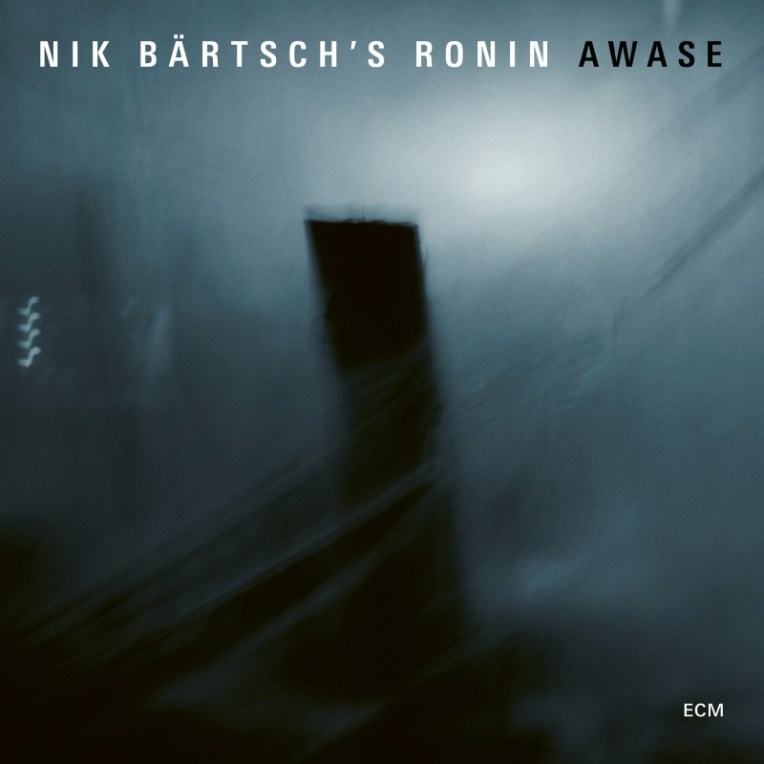
Nik Bärtsch piano Sha bass clarinet, alto saxophone Thomy Jordi bass Kaspar Rast drums
Recorded October 2017, Studios La Buissonne, Pernes-les-Fontaines
Engineers: Gérard de Haro and Nicolas Baillard
Produced by Manfred Eicher
U.S. release date: May 4, 2018
The booklet for Awase, Swiss pianist Nik Bärtsch’s latest release with his band of Ronin, quotes French theorist Roland Barthes: “The sign is a fracture which only ever opens onto the face of another sign.” Perhaps no other statement better expresses the fractal nature of this music, for the more one zooms in on its precisions, the more one senses its freedoms expand. Joined by Sha (bass clarinet and alto saxophone), Kaspar Rast (drums) and newest recruit Thomy Jordi (bass), Bärtsch finds himself rooted in a familiar ethos while sprouting new verdure.
The album continues his “modular” approach, by which larger bodies coalesce from elemental forces. The newest of these, “Modul 60” and “Modul 59,” open and close the album with hints of a concentrated future. Where the latter emotes in liminal territory, the former is a direct link to Continuum, Bärtsch’s previous record for ECM with his Mobile project. Any nods to the past, however, are refracted through a brighter coming of age: a sound that once ran now leaps. The ritual groove of “Modul 58,” for instance, is at once what we might expect and a fresher take on group integration, a taste of perpetual motion shown in the band’s willingness to let details express themselves to the level of ecstasy. “Modul 36” reveals the deepest change; known to any longtime listener of Bärtsch, here it takes on the uniformly colored properties that would seem to extend the band’s evolutionary path. It’s a classic yet forward-thinking groove, one that feels like a childhood home renovated from the inside out. “Modul 34” is another early tune, only now making its studio debut. There’s an almost digital quality to it, nuanced by human touch.
Awase is also a departure for including a non-Bärtsch original by Sha: the enigmatically titled “A.” Gradually building an ocean out of a water droplet, its waves flow to the magnetic suggestions of an itinerant philosophical compass. Like the album as a whole, it toes the line between light and shadow with every intention of shedding its ego to both along (and by) the way.
(This article originally appeared in the May 2018 issue of The New York City Jazz Record, a full PDF of which is available here.)
Ben Monder electric guitar, electric baritone guitar, Fender Bass VI Pete Rende synthesizer Andrew Cyrille drums Paul Motian drums
“Oh, What a Beautiful Morning,” “Triffids,” and “Dinosaur Skies” recorded October 2010 at Sear Sound
Engineer: James A. Farber
“Tendrils,” “Tumid Cenobite,” “Gamma Crucis,” “Zythum,” and “Hematophagy” recorded December 2013 at Brooklyn Recording
Engineer: Rick Kwan
Mixing Engineer: Rick Kwan
Produced by Sun Chung
U.S. release date: October 30, 2015
For his ECM leader debut, New York guitarist Ben Monder brings his improvisational destinations to fruition with respect for every musical step in reaching them. The album’s circle is opened and closed by two solo arcs: “Tendrils” and “Dinosaur Skies.” Where the former comes out of the woodwork as if after a long and melodic hibernation, the latter is a dragon’s breath turned into music.
Constellations fill the spectrum between as Monder sings through a variety of guitars and tunings. “Gamma Crucis” and “Zythum” triangulate with Pete Rende on synthesizer and Andrew Cyrille on drums. Both pieces are geological surveys of highest order. Monder and Rende release so much likeminded stardust, it’s all they can do to clarify that they’re two nebulae working independently of time. Cyrille’s tracery is the dark matter between them, a dimension in which concrete rhythms have no gravity.
Guitarist and drummer make art as duo on “Hematophagy” and “Tumid Cenobite.” In the absence of electronics, their language feels closer to home, each his own weather front blending into collaboration. Although the landscape below them is desolate, it wavers with memories of rivers and greenery. Monder’s stirrings are like those of a creature in the leaves of Cyrille’s reforesting. With each sunrise, they dissolve dust into breathable air.
Poignantly, late drummer Paul Motian joins Monder for two further duets. First is a starlit take on the Rodgers and Hammerstein classic “Oh, What a Beautiful Morning.” It’s beautiful indeed to hear Motian’s brushes, pulled as if from beyond some mortal curtain, springing to vibrant life of their own impulse. There’s something fully alive about this music—not only because of the tune, but also because of the way it rolls off the musicians’ proverbial tongues like a psalm. Recognition is not a precondition for enjoyment, however, as Monder’s ambience forges new relationships using familiar actors. His searing explosions make steam of ocean water, leaving lost cities exposed to sunlight for the first time in eons. Then there is “Triffids,” a spontaneous blush of tenderness that eludes capture by microphone and digitization. It is, rather, a force that knows us before we may consciously seek it out in the listening. Motian’s feel for internal rhythm is profound.
Monder navigates the paths before him with confidence because he defines them as he goes along. Leaving behind uncertainty, he uses gentility as fuel for a strong spirit. It’s perhaps no coincidence that the track titles recall the histrionic wordplay of the Cocteau Twins, for with likeminded boldness he does away with consensus articulations in favor of the emotional resonances beneath.
Sokratis Sinopoulos lyra Yann Keerim piano Dimitris Tsekouras bass Dimitris Emmanouil drums
Recorded April 2014 at Sierra Studios, Athens
Engineer: Giorgos Karyotis
Produced by Manfred Eicher
U.S. release date: January 15, 2016
Sokratis Sinopoulos is a master of the lyra, a bowed instrument whose lilt has polished a handful of ECM gems, including soundtracks of Greek composer Eleni Karaindrou (notably, The Weeping Meadow) and the Athens Concert of Charles Lloyd and Maria Farantouri. Despite its small size, the lyra is capable of painting holistic landscapes, and none so sweeping as those at Sinopoulos’s touch. After years of being a vital yet overshadowed sideman, Eight Winds finds the virtuoso making his debut as leader. Although the lyra comes preloaded with centuries of tradition, the music produced by the quartet assembled here— rounded out by pianist Yann Keerim, bassist Dimitris Tsekouras, and drummer Dimitris Emmanuel—is resolutely forward-looking. For this recording, as special in the listening as it was in the making, I sense a unity of purpose beating in the hearts of everyone involved. This is demonstrated by the album’s title alone, which charts not only the cardinal directions, but also the twin cross bisecting them. In each of the album’s 12 original tunes, the navigational freedom of those winds is palpable.
The title track opens with the bandleader’s distinctive sound. His lyra, as obvious to anyone tasked with analogizing it, has a distinctly vocal quality. Even before the jazz trio configuration in which Sinopoulos has situated himself becomes apparent, like a singer he has tasted the theme at hand and savored it to the brink of dissolution. All I can find myself thinking while absorbing the results of this collaboration in kind is that this is a first in jazz, an album that only Manfred Eicher and ECM could produce with such integrity of vision.
Much of this album moves at a pace of lives no longer lived. One strain of “Yerma” or “Lyric” is enough to reveal the folk roots feeding each improvisational leaf. Whether interacting with Keerim’s piano or Tsekouras’s bass, Sinopoulos puts his trust at the center. The melodies are so developed that they sound like ancient motifs rescued from obscurity, conjuring up images of a past you never knew was in you. In this respect, “Aegean Sea” is the most inviting tune of the set, if also for depicting an important location for its composer. Emmanuel’s hand-drumming brings it to an even earthier level.
Because the lyra is associated with dancing, tunes like “Street Dance” and “In Circles” inspire and energize. These are balanced buy “21st March” and “Forever,” which take stock of brokenness and find harmonies beneath its dissonant rubble. In both, Sinopoulos shows us just how many feathers his instrument has, while touching on the Byzantine musical interests of his formative years.
His delicacy is artfully supported by his bandmates. At no point do they drown out his whispers (a feat for which both musicians and engineer are praiseworthy). As the title track variation that ends the album, everything that precedes it is a gradient of oneness: an asymptote conquered by faith.
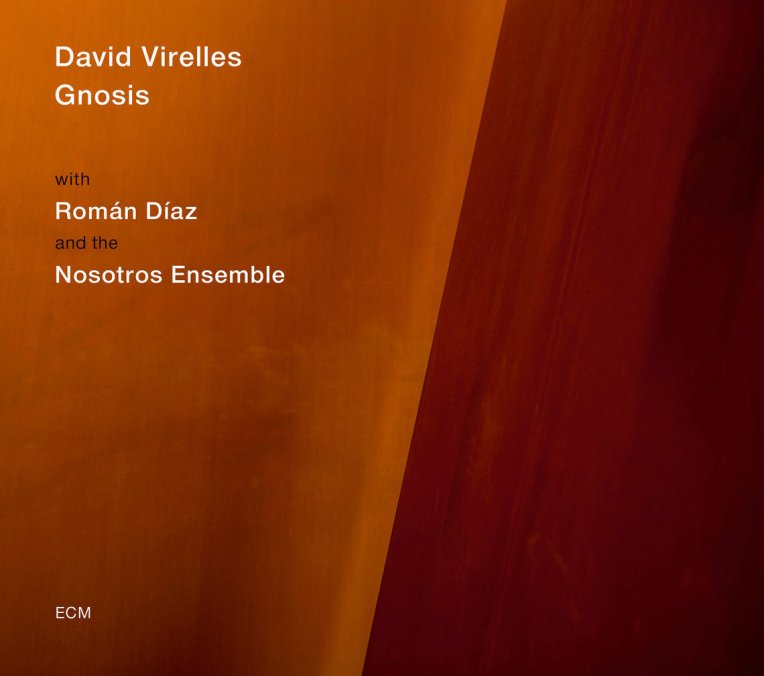
Melvis Santa background vocals
Recorded May 2016 at Avatar Studios, New York
Engineer: James A. Farber
Assistant: Nate Odden
Mixed December 2016 by James A. Farber, Manfred Eicher, and David Virelles
Produced by Manfred Eicher
David Virelles understands that to make music of the future, one must delve into the past. Somewhere in the middle we find Gnosis. On his third album as leader for ECM, Virelles polishes the mirror of his Cuban roots, also as a prism of the chamber music sensibilities that informed his training under such composition teachers as Henry Threadgill. One couldn’t dream of a better assembly of musicians than the brotherhood of rhythm makers and guiding voice of poet/percussionist Román Díaz to bring these wonders to fruition. Bassist Thomas Morgan, flutist Allison Loggins-Hull and a modest string section complete the puzzle.
Each of the album’s 18 originals could be the start of another album. In this context, they work as one body. Whether in Virelles’ six solo piano pieces—including lyrical “De Ida y Vuelta I” and delicate “Dos” (arranged by Threadgill)—or in ensemble forays such as “Del Tabaco y el Azúcar” and “Tierra,” Virelles renders every dissonance an initiation into life. His pianism, especially in “Fitití Ñongo,” is ecstatic yet ponderous and speaks of an artist who understands the preciousness of time.
Morgan and Loggins-Hull are key players, balancing the pull and push of anchor and sail. Like a ship, Gnosis indeed needs water to give it purpose, even as those same oceans pose the constant threat of drowning. Virelles’ awareness of this tension sets his music apart by way of an organic postcolonial philosophy. Through it all, Díaz is the voice of land when sky is all we’ve ever known. His call and response in the ambient “Erume Kondó” is one of the profoundest things to grace these ears in a long time and speaks to what Díaz himself calls the “reciprocal language” of secrecy. According to Virelles, the album’s title “in this context refers to an ancient collective reservoir of knowledge.” Here, then, is the light of a star that died long ago but whose patterns are still perceptible, rewoven under a new name as an offering to the unborn.
(This review originally appeared in the January 2018 issue of The New York City Jazz Record, a full PDF of which is available here.)
Mette Henriette saxophone Johan Lindvall piano Katrine Schiøtt violoncello Henrik Nørstebø trombone Eivind Lønning trumpet Sara Övinge violin Karin Hellqvist violin Odd Hannisdal violin Bendik Bjørnstad Foss viola Ingvild Nesdal Sandnes violoncello Andreas Rokseth bandoneón Per Zanussi double bass Per Oddvar Johansen drums, saw
Recorded 2013-2014 at Rainbow Studio, Oslo
Engineer: Jan Erik Kongshaug
Mixed November 2014 in Oslo by Manfred Eicher, Mette Henriette and Jan Erik Kongshaug
Produced by Manfred Eicher
U.S. release date: November 20, 2015
Norwegian saxophonist and composer Mette Henriette Martedatter Rølvåg enters the ECM universe with a self-titled album of doublings. First, as a two-disc affair, it is among the most formidable debuts for the label in recent years. Second, it is a union of contrasts, balancing composition and improvisation, declaration and whisper, with a straightforwardness that is Mette’s métier. Moreover, the album is a chain of coupled voices, as instruments converge and diverge in an alternating chain of what she calls “elongations” and “miniaturizations.”
Although the trumpet was Mette’s first instrument, in an interview for this album’s press release, she waxes fatefully about her switch to saxophone: “I knew that this was what I’m meant to do. […] I have to tell my stories, and early on I had a feeling of how I was going to do that. […] Soon I would also enjoy disappearing into the theoretical aspects of music but at the beginning it was something more primitive, a response to an inner urge.” For demonstration of this autobiographical concept, we need listen no further than the first disc, simply titled o. Featuring a trio comprised of Mette on saxophone, Johan Lindvall on piano (and who also contributes original compositions), and Katrine Schiøtt on cello, it is a veritable chess board of thematic impulses.
Immediately noticeable is the crackle of Mette’s saliva across the reed, which gives the saxophone textural authenticity as an apparatus of musical translations. In that technique is proven not only Mette’s patience in letting notes awaken, but also the personal associations imbuing those notes with meaning. The nocturnal calls of “.oOo.,” for instance, are meant to evoke the call of an owl (one of the first sounds she remembers hearing), while the breathiness of “3 – 4 – 5” conveys a menagerie of emotions so tender they cannot be broken. By the time we encounter the first full-throated notes of “all ears,” the listener has been primed with a fullness of register and physicality comparable to Mette’s own.
The logic of her sound is that such shorter pieces feel the most expansive while the longer ones feel compressed and circular. In either case, one feels this music growing in real time, as if every cell of its body were genetically acquired.
Despite knee-jerk comparisons to other free jazz greats such as Evan Parker, Mette had no such musicians in mind when developing her musical language. Her primary inspirations are more nature than nurture, as made clear in the second disc, given the enigmatic title Ø. Here we have a “sinfonietta” for which the trio is absorbed into a 13-piece band that includes drummer Per Oddvar Johansen (of the Christian Wallumrød Ensemble) and the Cikada String Quartet. Individual track titles are even more suggestive of their composer’s inner life, a storybook dusted off from attic storage and rebound through interpretation.
The addition of musicians enhances intimacy tenfold. The wind-through-leaves snare of “passé” makes for a fitting introduction, and bassist Per Zanussi adds a deeper element to this chemical mixture as strings produce a crispier layer of shine. All of this elicits a grittier side in Mette’s playing. The Cikadas lend a cinematic touch to occasional interludes, as painterly as their titles (“veils ever after” being a quintessential example). The build of “wildheart” from whisper to shout is a highlight of this disc, as are the relatively aggressive turns of “late à la carte.” As with the first, however, some of the most compelling tracks are the shortest, like the one-minute blush of piano and strings that is “this will pass too.” And if “off the beat” is the most urban tune, then “wind on rocks” is an atmospheric free dive into the wilderness.
Mette Henriette is a story written in lowercase, whose genesis is one for the pages of ECM lore: “One Saturday night in Oslo I saw a poster for Dino Saluzzi at the Cosmopolite. I thought: I should hear this, especially because I’m also writing for bandoneon in my ensemble. When is the gig? Oh, it’s today. When does it start? In twenty minutes! OK! So it was a very quick walk to Cosmopolite. It was packed, but I found a place on the stairs, and by chance I was next to where Manfred Eicher was sitting. We spoke in the interval and I told him about my project. He had been recording at Rainbow, and listened to some of my music.”
And now, we too can join hands with fate in listening to this constellation appear from first star to last.
Graham Haynes cornet, flugelhorn, electronics Steve Lehman alto saxophone Mark Shim tenor saxophone Vijay Iyer piano, Fender Rhodes Stephan Crump double bass Tyshawn Sorey drums
Recorded April 2017 at Avatar Studios, New York
Engineer: James A. Farber
Assistant: Nate Odden
Mixed May 2017 by Farber, Eicher, and Iyer
Produced by Manfred Eicher
Vijay Iyer’s fifth record for ECM is the pianist’s most engaging yet. Over ten scenes, Iyer directs an original storyline with his freshly-cut diamond of a sextet. Graham Haynes (cornet, flugelhorn, electronics), Steve Lehman (alto), Mark Shim (tenor), Stephan Crump (bass) and Tyshawn Sorey (drums) are not only actors playing multiple roles; they’re also real-time producers, editors and sound designers.
“Poles” and “Threnody” provide opening and closing credits. Both nurture storms of activity from raindrops, as if celebrating the end of a draught. They also balance the mutual extremes of locking and unlocking. In the latter vein, the leading horns take turns in “Down To The Wire” and in the title track, revealing the underlying irregularities that make this music so exciting. Like oranges, Haynes, Lehman and Shim’s solos are at the peak of flavor when juiced. No wonder, when their bandleader has given them so much soil and sunshine in which to ripen.
Iyer’s clairvoyance smiles across the delightful “Nope,” breathes to fullest capacity throughout “Into Action” and expands on South Indian beats in “Good On The Ground.” The latter two are masterstrokes—thematically and in execution. The rhythm section understands that being sportive can be serious and Sorey digs especially deep. Haynes also has his monologues in “End Of The Tunnel” and “Wake,” both of which work in the cerebral tendrils of his electronics.
Far From Over is a call to listening. More importantly, it’s listening to a call, as most evident in “For Amiri Baraka.” Here the core trio of Iyer, Crump and Sorey teaches the hard lesson shrouded by all this enjoyment. Baraka himself said it best: “There cannot be any apprenticeship for freedom.” Jazz may be heard as a genre of emancipation, but Iyer understands that freedom is illusory until actualized, that communal action is the embodiment of humanity’s reach for its flame and that music is one way to keep us from getting burned in the process.
(This review originally appeared in the October 2017 issue of The New York City Jazz Record, a full PDF of which is available here.)
Ches Smith drums, vibraphone, timpani Craig Taborn piano Mat Maneri viola
Recorded June 2015 at Avatar Studios, New York
Engineer: James A. Farber
Assistant: Akihiro Nishimura
Produced by Manfred Eicher
U.S. release date: January 15, 2016
After sideman appearances with Robin Williamson and Tim Berne’s Snakeoil, percussionist Ches Smith presents a bounty of original compositions on his first ECM album as leader. In the hands of his cosmically capable bandmates and label stalwarts—pianist Craig Taborn and violist Mat Maneri—Smith’s material behaves as exactly that: a substance to be formed and reformed with cymatic detail.
The title track opens the album, appropriately enough, with chimes. Microtonal harmonies from Taborn and barest caress of viola strings build anticipation over resonant vibraphone touches. From the piano arises a sweeping cinematic landscape as the mist resolves into clearer bow lines and forceful drumming. This piece shares breath with other such delicacies as “Isn’t It Over?” and “I Think.” In both, Smith treats grooves like rocks in his shoe—which is to say, as ephemeral yet memorable. And in these metallic core samples, striations of exactitude are unnecessary. As if in response to an underlying declaration of freedom, Maneri works his songcraft like a master boatman who has lost his oar but not his sense of propulsion, moving along the water with ease by power of thought instead. The effect is such that by the time Smith brings traction, the shoreline has already been confirmed as an illusion. Whether in the microscopy of “It’s Always Winter (Somewhere)” or the angular reverie of “For Days,” each member of this trio paints a halo of deference around the others’ heads, so that even the mischievous “Wacken Open Air” emits a near-palpable blast of respect.
(Photo credit: Caterina di Perri)
“Barely Intervallic” is the first of the album’s two deepest wells. This one is Maneri’s knot to unravel. The combinatory textures of Smith and Taborn allow every note from the violist a chance to speak. The monochromatic color scheme of “I’ll See You On The Dark Side Of The Earth,” on the other hand, is Taborn’s chamber of intimacy. Maneri and Smith are minimal here, the latter’s tracery is especially poignant as a lunatic origami ensues at the fringes of cohesion. In this medieval blues, distilled from the future to meet in the blessing of the here and now, Smith and his bandmates forge new understandings that suggest themselves by their very coexistence.
As in my review of Avishai Cohen’s Into The Silence, I feel compelled to note the beauty of seeing this trio at the 2016 New York City Winter Jazzfest, and how much more attuned I felt experiencing its wonders in a live setting. Perhaps it’s the blush of first exposure, but I would encourage anyone reading this to seek out the trio in person wherever and whenever possible. Not that the studio album is unworthy—just that, like a perfume, there’s only so much you can learn about its scent through the hearsay of this or any other review before getting a bottle of it to your nose.
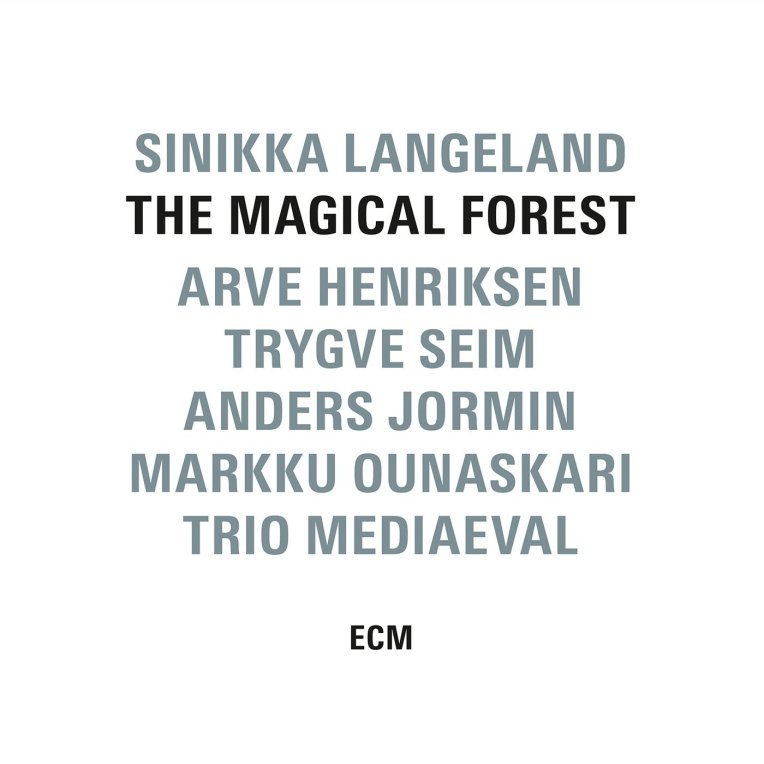
Sinikka Langeland kantele, vocals Arve Henriksen trumpet
Trygve Seim soprano and tenor saxophones Anders Jormin double bass Markku Ounaskari percussion Trio Mediæval Anna Maria Friman vocals
Berit Opheim vocals
Linn Andrea Fuglseth vocals
Recorded February 2015 at Rainbow Studio, Oslo
Engineer: Jan Erik Kongshaug
Produced by Manfred Eicher
U.S. release date: August 5, 2016
On The Magical Forest, Norwegian kantele virtuoso Sinikka Langeland reconvenes her “Starflowers” quintet (with saxophonist Trygve Seim, trumpeter Arve Henriksen, bassist Anders Jormin, and drummer-percussionist Markku Ounaskari), adding to that quilt the patchwork of voices known as Trio Mediæval. Any of these names will be familiar across the spectrum of ECM followers, but their shared love for Scandinavian folk music has never been so clear as in this latest project.
In contrast to previous albums, the kantele is a largely supportive presence, almost airy in its backgrounded-ness. This gives Langeland’s unaffected singing—and, more importantly, the imagery laced into it—room to roam. Of central significance in that regard is the sacredness of space. Not only in the immaterial sense, but also in the physical landscapes of nature at large and their shaping of reality as we’ve come to understand it over millennia of spiritual seeking.
The album’s opening trifecta sets its thematic charge as the rising sun ignites the day into breaking. “Puun Loitsu” (Prayer to the Tree Goddess) is based on a rune song text from the Finnskogen, or Forest Finns, whose migratory settlements in Norway and Sweden have become reliquaries for creation myths and other origin stories, glistening anew in the varnish of Langeland’s diction. The wiry strains of the kantele offer hints of song, which emerges first in monotone before being taken up in Trio Mediæval’s chanting response. “Sammas” crystallizes the running theme in its evocation of the “world pillar” (axis mundi), a column of infinite energy binding Heaven to Earth and circling around the North Star. The lyrics, with their Trinitarian framing, demonstrate one way in which Christian elements have found their way over the centuries into these mystical traditions. The light-bearing qualities of Henriksen’s trumpeting deepen these underlying messages, which “Jacob’s Dream” makes even more apparent. This retelling of the biblical Patriarch’s vision emphasizes the permanence of verticality over the fleetingness of horizontality. The “ladder,” then, is not climbable by the body but constitutes the body itself: a DNA helix spun from godly breath. Once the words are sung, the instrumentalists brilliantly unravel an improvisational second half. Seim’s tenor and Henriksen’s trumpet move in tandem, drawing rungs between them as they travel.
Trees continue to dominate the landscape in “Køyri” and “Karsikko.” The latter, which names a memorial trunk on which the names of the dead are carved, is based on a variant of the hymn “I Know of a Sleep in Jesus’s Name,” and Langeland’s communications with Henriksen make for some picturesque unfolding in both songs. “Pillar to Heaven” likewise strengthens an interconnectedness of things.
As so often happens on a Langeland album, animals figure heavily into the symbolism of The Magical Forest. “The Wolfman” recounts a man named Johan who, according to legend, lived as a wolf yet died as a man. The inseparability of soil and sky resurfaces, as Ounaskari’s cymbals seem to scale the clouds. “Kamui” takes a relatively documentarian turn in its depiction of Hokkaido, Japan’s indigenous Ainu, whose annual ritual killing of a bear cub is described in empathetic detail, while Trio Mediæval intones the titular “Kamui,” an Ainu word meaning “God” and referring to both the sacrifice and the deity honored by it. This leaves only the title track, an instrumental foregrounding the bird-like calls of Seim (now on soprano saxophone) and Henriksen while Jormin’s arco bassing slithers in the underbrush.
All of which makes me think that the album’s title is somewhat misleading. For indeed, what the listener encounters here is not a forest that is magical but a magic that is forested.
(See this article as it originally appeared in RootsWorld online magazine here.)
Avishai Cohen trumpet Bill McHenry tenor saxophone Yonathan Avishai piano Eric Revis double-bass Nasheet Waits drums
Recorded July 2015, Studios La Buissonne, Pernes-les-Fontaines
Engineers: Gérard de Haro and Nicolas Baillard
Produced by Manfred Eicher
U.S. release date: February 12, 2016
Following his appearance as sideman on Mark Turner’s Lathe of Heaven, Avishai Cohen makes his leader debut for ECM Records. Bearing dedication to his late father, Into The Silence teams the trumpeter with a fantastic band of his own that includes tenor saxophonist Bill McHenry, pianist Yonathan Avishai, bassist Eric Revis, and drummer Nasheet Waits. This effort marks the first time the band had, as such, stepped foot inside a studio, and the results hark back to the golden age of ECM in both texture and mood. From its spacious arranging and freely realized originals to its classical roots (the solo piano music of Rachmaninoff was a conscious inspiration) and cross-pollination of styles, Cohen’s musical identity speaks at once from without and within.
Through the six-sided prism of as many tunes, Cohen shines a light as only the darkness of mourning could yield. The muted lines of “Life And Death” feel as much celebratory as elegiac. Cohen thus asserts himself as more than a voice among the voiceless, as if the album’s titular silence were not the absence of sound but a personal choice to protect one’s dreams. Here, however, we are bathed in dreamlike qualities with such melodiousness that it’s all we can do to not imagine the many fates that must have convened to produce this patient bit of magic. Avishai’s pianism is another ripe fruit in the band’s gift basket. Morphing from barest comping to bluesy climatic shifts and sparkling tails, he is a comet in an already starry sky. The end of this opener, though a postludinal afterthought, is just as substantial as what comes before it.
“Dream Like A Child” only deepens the spell craft of its predecessor. Unmuted yet just as vulnerable, Cohen undoes the ribbon of this offering to reveal a melodic ocean just aching to crash on the listener’s shore. The pianism is majestic yet aptly proportioned, mirroring the underlying respectful altitude at every turn: just when you think it has gathered enough momentum to soar, it touches its feet to the earth. Though things do cohere in more groove-oriented ways as the rhythm section builds a higher and higher wall from which Cohen and McHenry must jump, there’s no doubt that the ground will hold its foundation through Waits’s textural reinforcements.
The title track expands on ECM’s evolving ethos of ritualistic jazz, as drums and microtonal harmonies in the piano interlock with downright spiritual patience. Again, the band flirts with groove but foregoes that sweetness for a cerebral savory. These strategies become more evident with repeat listens (for this is, indeed, an album you’ll want to return to time and again). Waits is an organic force here, moving from tumbling abstractions to tight snare rolls at the flick of a wrist, his plumage fully outstretched.
Somberness, however, is never far behind, and “Quiescence” bottles its fragrance like a master perfumer. Cohen’s trumpeting is the center of a vocal solar system, shining through planets forged in thematic space dust. Lengths of days and seasonal changes are determined by the gravitational pull of nostalgia, so that by the next track, “Behind The Broken Glass,” one knows that fragmentation is a universal law. Cohen proves that, in the wake of any emotional shattering, no effort of putting the pieces back together will produce a clean reflection, for it will always bear the scars of its undoing. The breadth of his inspirations has brought him to this humble (and humbling) realization in his career, and finds empathetic amplification in his bandmates that funnels in the solo piano reprise of “Life And Death” that ends the album’s journey.
Having seen this project with a different roster at the 2016 New York City Winter Jazzfest, I can attest to the raw, living power of its music. So much so that, following that experience, this studio date feels somewhat tame by comparison. So: see them in person if you can, but revel in the wonders of this “second best” all the same, for in them is a pilot light that ECM lit nearly five decades ago, and which continues to burn pure and warm despite the winds of change.










 Between Sound and Space: ECM Records and Beyond