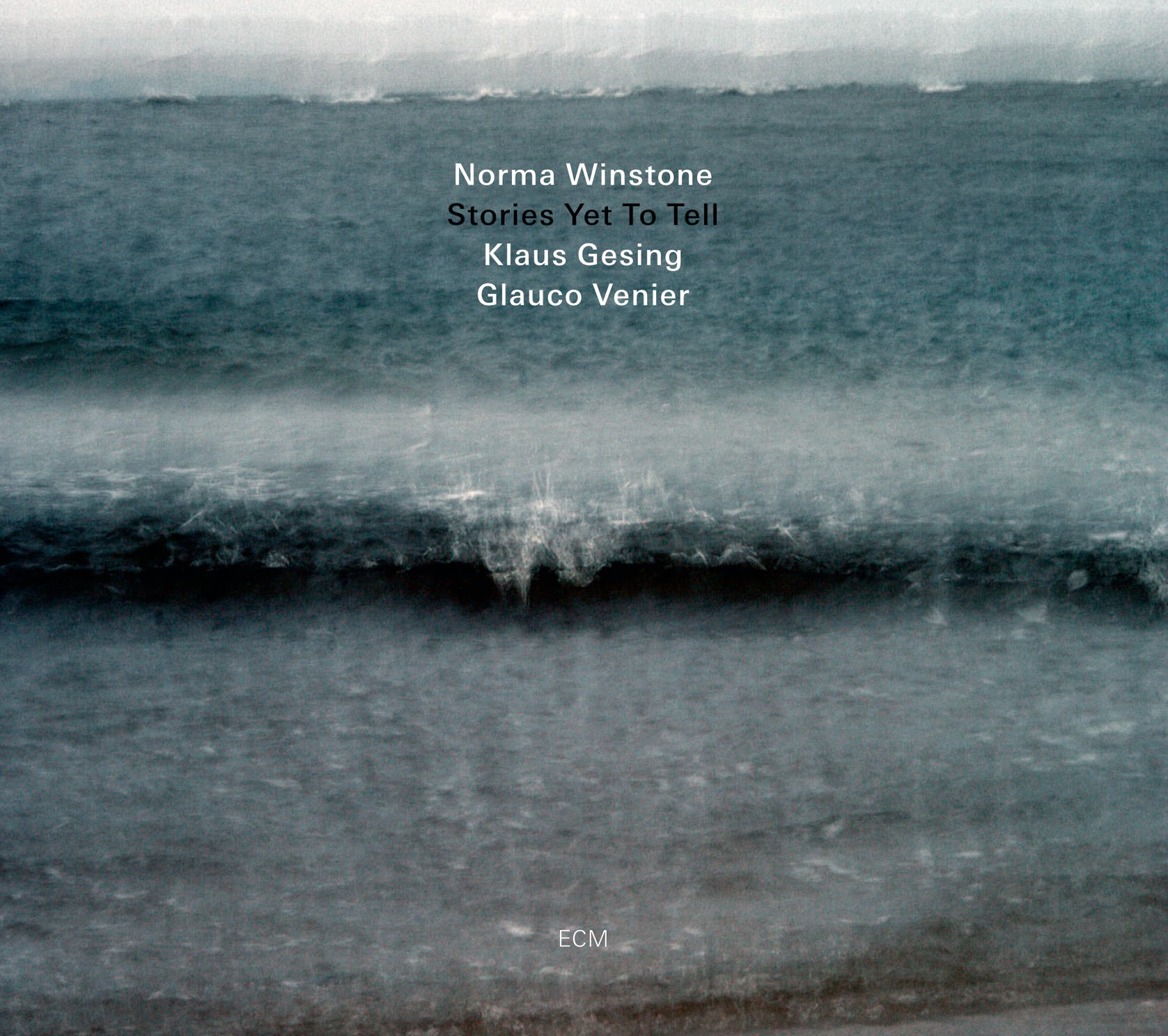
Norma Winstone: Stories Yet To Tell (ECM 2158)

Stories Yet To Tell

Norma Winstone
Stories Yet To Tell

Norma Winstone voice
Klaus Gesing bass clarinet, soprano saxophone
Glauco Venier piano
Recorded December 2009 at Arte Suono Studio, Udine
Engineer: Stefano Amerio
Produced by Manfred Eicher

While walking home on 8 October 2014, I was listening to Norma Winstone’s Stories Yet To Tell on my iPod. The opening song, “Just Sometimes,” had already enchanted me with its tender traversal of the heart’s shadowed chambers. Its bittersweet emotions lingered on in my mind as the second track, “Sisyphus,” held my ears captive. Named for the Corinthian king of Greek mythology forced to endlessly roll a giant boulder up a hill, the song evokes the curse of repetition in Glauco Venier’s pianism and the vain hope of breaking free in the tension of Klaus Gesing’s bass clarinet. While immersed in the atmosphere of this music, I felt a tap on my shoulder. I pressed PAUSE, removed my headphones, and turned to see my friend Andy, who had terrible news: our dear mutual friend Taylan had committed suicide that morning.

In the weeks following this tragedy, my iPod remained stuck halfway through “Sisyphus,” stymied like my desire for listening. By the time I returned to the song, I couldn’t help read the myth into Taylan’s untimely end. His life, it seemed, had thrown one boulder too many in his path, and he’d grown tired of rolling them upward in vain. While learning to cope with my grief, I was also comforted by the album’s title. It was a gentle reminder that, although he was gone, stories of Taylan’s legacy as a musician (he was an electronics genius for whom Evan Parker’s The Eleventh Hour was a life-changing record) had yet to be told. It was only a month later that I had the courage to continue where I’d left off in “Sisyphus,” which will forever be for me an elegy.

It’s not entirely morbid, however, to read a certain understanding of mortality into Winstone’s craft, singing as she so often does of moments that are fleeting, captured only through imagination. In the sadness of “Among The Clouds,” the retrograde of “Goddess,” and the wordless farewell of “En mort d’En Joan de Cucanh,” Winstone and her attuned trio understand that directions below are written in scripts above. Each song searches for meaning in a world that so often denies the divinity of simplicity. Furthermore, Winstone’s lyrics, especially in “Rush” and “The Titles,” linger on impermanence and, like the second, break down the theatrical stage of experience into its component parts.

In a few tracks, Winstone uses her voice as wordless instrument, employing melodic flight paths in the service of folk songs and lullabies. And even when she does inhabit the domicile of language, as in the tender “Like A Lover,” she does so with an insightful balance of coarse action and empty heroism, all the while keeping fear at bay with the shapes of her mouthing. She demonstrates that those of us still living must recognize that death is not an end but the first sentence in a story waiting for the spark of remembrance to reveal its narrative arc.

(To hear samples of Stories Yet To Tell, click here.)

Taylan
Taylan Cihan
(June 13, 1978 – October 8, 2014)

Steve Kuhn Trio: Wisteria (ECM 2257)

Wisteria

Steve Kuhn Trio
Wisteria

Steve Kuhn piano
Steve Swallow bass
Joey Baron drums
Recorded Sptember 2011 at Avatar Studios, New York
Engineer: James A. Farber
Assistant: Tim Marchiafava
Produced by Manfred Eicher

Pianist Steve Kuhn, bassist Steve Swallow, and drummer Joey Baron make sweet music together, for sure, but an unquantifiable feel for that music is what sets this dream trio apart, and nowhere so clearly as in the lion’s share of Kuhn’s tunes presented on Wisteria. The complexities thereof become more readily apparent in these core settings. Above all, “Adagio” reveals a triangle within a triangle within a triangle. First is Baron’s sparkling pool, next bordered by Swallow’s equilateral bassing, all molded by Kuhn’s resounding redraws, and with a multi-dimensional sound enhanced to crystalline effect by engineer James Farber, fewer geometries could be more sublime. Further gems last heard on Promises Kept include the study in contrasts that is “Morning Dew,” the lyrical “Pastorale” (then again, when is Kuhn not lyrical?), and that album’s title cut, which achieves here even greater densities than in the former’s orchestral couch.

Wisteria is not without its groovier moments (cf. “A Likely Story”), but tends toward the softer end of the spectrum whenever possible. This only serves to gel the intensity of emotion throughout. Exemplary in this regard is the album’s opener, “Chalet,” in which the trio’s mesh sets a unified tone. It also reveals the inimitable presence of Swallow, whose early solo unlocks much of the joy about to ensue, and whose two contributions—“Dark Glasses” and “Good Lookin’ Rookie”—span the horizon from solemn to ecstatic, sunset ochre to raindrop blue, with class.

Three standalone tracks complete the set. Carla Bley’s “Permanent Wave” lays on the nostalgia so thick that you’ll swear you heard it a long time ago, with a drink in hand and only a memory to keep you company. “Romance” (by Brazilian singer-songwriter Dory Caymmi) brims with blind affection and proves yet again just how masterfully Kuhn approaches the art of the finish. And then there is the title track by Art Farmer, in whose band Kuhn and Swallow played half a century ago. This shadow-swept reverie says it all with so little.

Wisteria is about as positive as jazz gets. So much so that one can feel the smiles rippling all around as one pebble after another is dropped into the sacred font of improvisation from which each of these musicians so artfully drinks, and with enough tenderness to go around for even the most resilient soul.

(To hear samples of Wisteria, click here.)

Stefano Battaglia Trio: The River of Anyder (ECM 2151)

The River of Anyder

Stefano Battaglia Trio
The River of Anyder

Stefano Battaglia piano
Salvatore Maiore double-bass
Roberto Dani drums
Recorded November 2009, Auditorio Radiotelevisione svizzera, Lugano
Engineer: Stefano Amerio
Produced by Manfred Eicher

Stefano Battaglia always seems to have a root planted in mythical worlds. Where often he embraces those worlds as hidden inspirations, here the Italian pianist turns them inside out, yielding the journey that is The River of Anyder. Named for the river of Thomas More’s Utopia, the word “Anyder” is a pun meaning “waterless.” Like the music spun from its current, it embodies a contradiction between word and action. With this in mind, we might very well dismiss this album’s track titles altogether, for they mark not a mapping but a deconstruction of space by way of melody and affect.

Battaglia 1

We may indeed recognize “Minas Tirith” as the capital of Gondor in Tolkien’s The Lord of the Rings and imagine its fortress hewn in white rock. But then we might miss out on the music’s decidedly ashen palette, the wide-mouthed net of shadows cast by Battaglia’s ascending arpeggios in unity with bassist Salvatore Maiore, or the cymbals of drummer Roberto Dani rattling like coins in a giant’s pocket. We may hear the poetry of Rumi suffused in “Ararat Dance” and “Ararat Prayer,” risking too deep a reading by ignoring their already ornate surfaces, the standalone evocations of Maiore’s bassing, or the gilding of inaction that holds it all together.

We may get swept away by two tracks referencing the mythical island of Bensalem in Sir Francis Bacon’s New Atlantis, but fail to see that the trio’s interactions at moments leave the earth altogether. From the soft padding of his left hand to the tireless runs of his right, Battaglia navigates a profoundly varied topography with the freedom of one who walks without compass, who stops the wind and redirects it with every step taken. Whether contemplating the prayerful disposition of Hildegard von Bingen in the droning “Sham-bha-lah” or rowing the currents of the title track, Battaglia and his bandmates somehow slingshot around the dark side of the moon every time, placing them far from where they started.

Perhaps the only unity between spirit and production is “Anywhere Song.” This defining track concludes the set with a vision from Oglala Sioux Black Elk, who from atop the highest mountain sees all children of earth under one tree. It is, perhaps, the album’s deepest message: that in this tangle of keys, strings, and sticks, something so humble as a so-called jazz trio can look beyond its means and into the face of origins that compels those means to begin with. These are musicians who tell story and scripture alike.

The River of Anyder, then, is more than a catalogue of allusions. It is a pacifist’s statement, a bid for peace for a world in pieces.

(To hear samples of The River of Anyder, click here.)

Ketil Bjørnstad: Remembrance (ECM 2149)


Remembrance

Ketil Bjørnstad
Remembrance

Ketil Bjørnstad piano
Tore Brunborg tenor saxophone
Jon Christensen drums
Recorded September 2009 at Rainbow Studio, Oslo
Engineer: Jan Erik Kongshaug
Produced by Manfred Eicher

Ketil Bjørnstad’s Remembrance came together at the suggestion of producer Manfred Eicher, who convened the Norwegian pianist-composer in the studio with legendary drummer Jon Christensen and master saxophonist Tore Brunborg for a set of 11 naturally unfolding ballads. Although Bjørnstad and Christensen had famously worked together on The Sea, and despite the music’s arpeggiated undercurrents, the feeling is not so much of water as of sky, with a touch of horizon for reference. Certain portions (Part V, for example) may approach the coast, but their vessels ultimately skim cloud and vapor, not ocean.

Interactions between the three musicians are globular and free-forming, but root themselves in Bjørnstad and Christensen (it was a recording of them, in fact, that inspired Eicher’s vision of this project to begin with). And so, by the time we encounter their gorgeous duetting in Part VI, we know that we have reached the true heart of the album—not only for being the numerical middle but also for distilling a vision of textural clarity. Here, as throughout, Bjørnstad’s soft backpedaling gives full attention to the drummer’s sunglow. Christensen drums with characteristic impressionism, but also with a sense of voice that few others bring to the kit. Parts VII and IX explore further possibilities in the duo, each attuned to the adaptive forces of the other’s creative play.

Despite the musicians’ ability to paint with luminescent urgencies, the trio settings are most unified at a whisper. Brunborg’s reed stretches a tether between emotional territories in the remaining tracks, each more lyrical, more soulful, than the last, until their nostalgic petals break bud in the aerials of Part XI. The songs with Brunborg are also the album’s tenderest. It’s as if the addition of a distinctly air-born voice elicits a ripple effect of empathy from the two percussion instruments, a regression into childhood sensibilities. And yet, beautiful as the melodies are, Remembrance is a must-have for fans of Christensen. If you’ve ever laid stick to cymbal, you’ll know why.

(To hear samples of Remembrance, click here.)

Paul Motian: Lost In A Dream (ECM 2128)

Lost In A Dream

Paul Motian
Lost In A Dream

Chris Potter tenor saxophone
Jason Moran piano
Paul Motian drums
Recorded live February 2009 at the Village Vanguard, New York
Engineer: James A. Farber
Produced by Manfred Eicher

Drummer Paul Motian, saxophonist Chris Potter, and pianist Jason Moran: the kind of dream you want to get lost in. This equilateral triangle of melody, form, and affect came together at Motian’s behest for a week of performances at New York’s Village Vanguard, from which he and producer Manfred Eicher culled the present disc. These live morsels reflect a cross-section of Motian’s career as both performer (by this point having shared about a decade of history with Potter and a single performance with Moran) and composer (all the tunes, some new and some old, are by Motian, except for a sweet take on Irving Berlin’s “Be Careful It’s My Heart”).

Among the album’s many benefits, it’s particularly wonderful to hear Potter, a player known for his robust command and dynamism, emote with such artful delicacy. In both “Birdsong” (last heard on TATI, in the company of Enrico Rava and Stefano Bollani) and “Mode VI,” Potter elicits tons of emotional power by his restraint. In the latter tune especially, which opens the album with a whisper, he fans the trio’s creative pilot light in pastels and charcoals. He also knows when to set the horn aside, letting Moran and Motian play on as a duo, drums brushing away the piano’s footprints in a dance as melodic as anything elicited at the keyboard. Motian is indeed the core of this music’s being, turning on a ballerina’s toe in a light made audible by breath, reed, and chamber.

If not obvious already, Motian and his bandmates are as much painters as they are musicians. Their evocative skills turn simple titles like “Casino” and “Blue Midnight” into moving pictures. A lone figure sits at the betting table, a losing hand before him. The only real comfort comes from the piano bar, the music of which slices through his inebriation like a paper cut, an Ace of Spades flicked toward the heart, where it remains lodged in hopes that something other than its pip might bleed. The looseness of such moments best exemplifies the photo montage on the album’s cover, which teases out regularity from city streets. (At one point, Potter and Moran lapse into simple scales, as if to remind themselves that even abstraction begins with practice.) Here is where the musculature of the trio becomes paramount, as tactile as its subject matter is ethereal.

The title track is the most grounded tune. Moran’s playing is sumptuous here. The gently insistent rhythm hints at swing, but shelves catharsis for another day. “Ten,” by comparison, ups the heat with a bubbling, rubato energy that draws the crowd. It is the exhale to the inhale of “Drum Music” and “Abacus,” established tunes that reference Motian’s classic Le Voyage. Where one unleashes a torrent of startlingly fractal music, the other cradles the most masterful turn of the set in the form of Motian’s solo. Bookended by thematic confirmations, it is the genius of an artist speaking as one with his instrument rather than through it. It lingers on the palate long after the finish, drawn through the concluding “Cathedral Song” beneath the skim of Moran’s night sailing and Potter’s hymnal moon.

This trio, in this context, emotes so tenderly that it might collapse in on itself were it not for the strength of its bones. It speaks to us as it speaks to the cosmos: without the need for translation. Your body comes pre-equipped to decode its poetry, and when you buy this album, you are giving yourself a sacred gift. If you love jazz, then do your heart some good and bring these sounds home. A masterpiece, pure and simple.

Stefano Battaglia/Michele Rabbia: Pastorale (ECM 2120)

Pastorale

Pastorale

Stefano Battaglia piano, prepared piano
Michele Rabbia percussion, electronics
Recorded September 2008 at Artesuono Studio, Udine
Engineer: Stefano Amerio
Produced by Manfred Eicher

An album of piano and percussion duets may seem unusual, but, by the time of this recording, pianist Stefano Battaglia had been playing with the form for well over a decade. With Michele Rabbia he has spun a core thread, but always in the tapestries of his ensemble projects. With the release of Pastorale, that thread blossoms into a quilt of its own making. Most fascinating about the duo, in this context, is a mutual willingness to expand their sound into digitally enhanced territories.

Coincidentally or not, Rabbia’s organic electronics haunt only the religiously titled tracks. “Monasterium” walks a tightrope between light and dark toward a perfect balance of the two in a way demonstrated also by the album as a whole. The mesh of foregrounded piano and metallic overlay in “Oracle” hints at a wealth of introspection in the distance, visible but unreachable. “Spirits of Myths” furthers this marriage of the living dark, burning low, muted preparations of the piano in the sun and sparkle of Rabbia’s circuitry, conferring a shared inner core as Battaglia and Rabbia become distortions of themselves. Over time, they seek reflection in dialogues between light and metallic surfaces: the clasp of an old Bible; a doorknob polished by decades of turning; a ring that, once worn, is never taken off. By contrast, the atmosphere of “Kursk Requiem” is thick and submarine. The piano marks the procession of technological voices in high-pitched feedback whispers, looping even as they fragment. Even the album’s opening “Antifona libera” (dedicated to Enzo Bianchi, Prior of the Monastic Community of Bose in northern Italy) with its resonance hints at a mercy as resolute as it is mysterious.

On that note, the track “Metaphysical Consolations” might just as well have yielded the album’s title, for it best describes the processes of communication it entails. As it stands, the actual title track practices more than it preaches. Its prepared piano nets drums and gongs, rumbling and singing by turns, seeking flesh through abstraction and in that flesh a feeling of divine order. In this instance alone, it seems, Battaglia’s dissonance is more an expression of tactility than of distortion, giving the ears purchase in a crumbling scene, his right hand the insistent traveler whose map grows with each fearless step. In similar exploratory spirit, the duo mines folk veins in the smoother, jazzier “Candtar del alma” and the modally inflected “Sundance in Balkh.” Even the fully improvised “Tanztheater,” named for the style created by its dedicatee, choreographer Pina Bausch (also the subject of a 2011 documentary by Wim Wenders), carves tunnels beneath the driven architectures above, and with them the possibility of caving in at any moment. Such proximity to destruction confers on the music an emblem of honesty that reduces the act of creation to a skeleton and composes its blood anew.

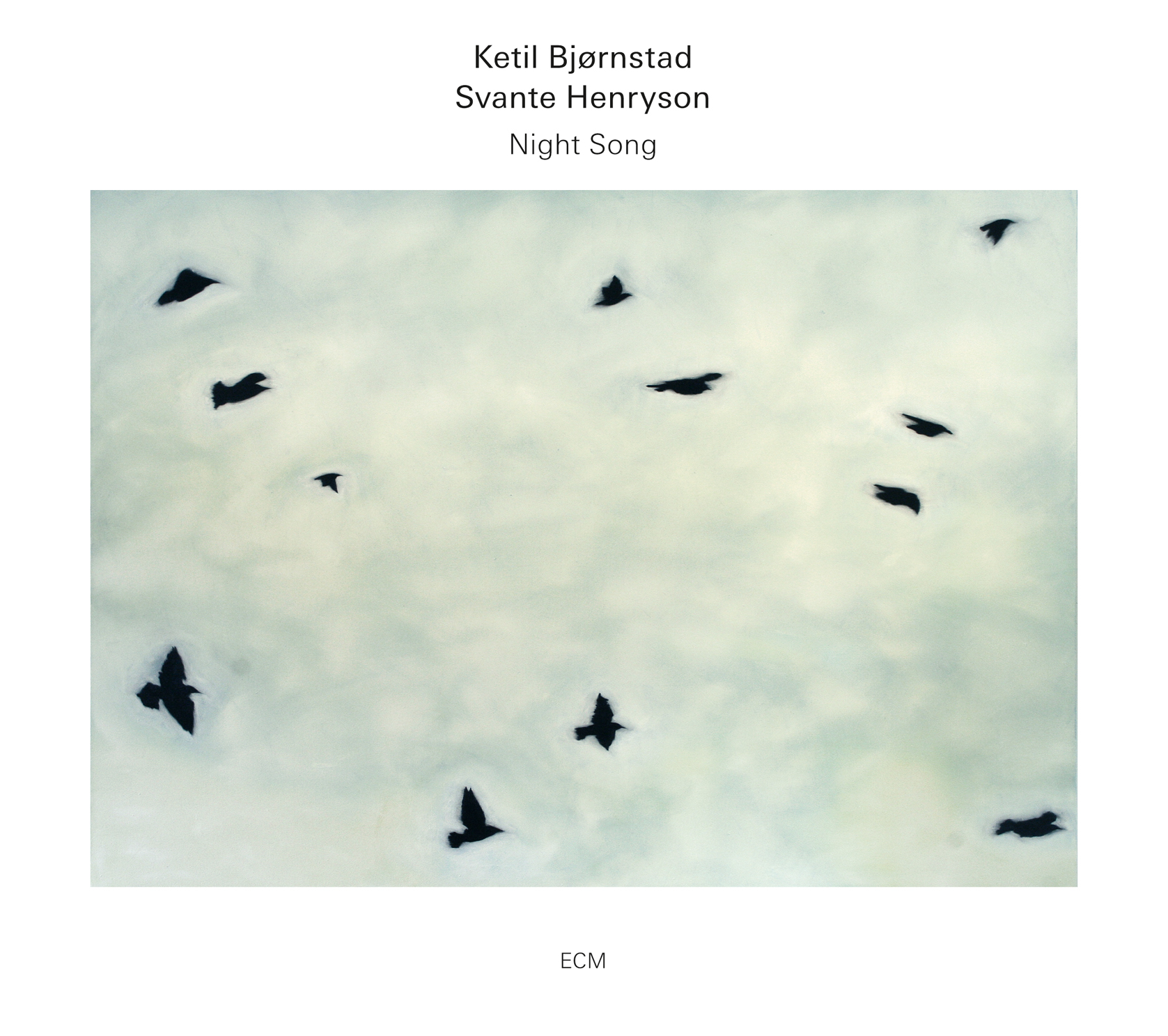
Ketil Bjørnstad/Svante Henryson: Night Song (ECM 2108)

Night Song

Night Song

Ketil Bjørnstad piano
Svante Henryson violoncello
Recorded January 2009 at Rainbow Studio, Oslo
Engineer: Jan Erik Kongshaug
Produced by Manfred Eicher

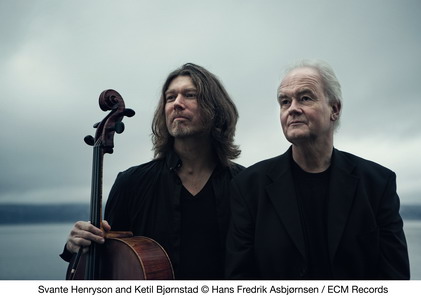
Pianist, composer, and author Ketil Bjørnstad has been long obsessed with Schubert, going so far as to sneak into his school gymnasium as a teenager to play him. “Schubert’s almost naïve openness, his existential sense of wonder and his emotional passion make him at the same time both concrete and mythical,” says Bjørnstad in his liner text. Hence Night Song, which pays tribute to, and engages in dialogue with, the Austrian great. For this project he is joined by Svante Henryson, a multi-instrumentalist and musical chameleon who plays cello alongside Bjørnstad. And by “alongside” I mean exactly that, for the two musicians recorded, at producer Manfred Eicher’s request, as closely as possible, so as to avoid the divisive tendencies of headphones and glass partitions. Bjørnstad: “It is always special for a musician when an ECM production evolves through a dialogue with Manfred Eicher from the very beginning. It can perhaps be compared to what an actor feels, when working with a film director.”

Ketil Svante

The nature of this piano-cello pairing is, however, rather distinct from Bjørnstad’s acclaimed collaborations with cellist David Darling, despite the identical instrumentation. Like Darling, Henryson is a gentle-minded musician, one who whispers more than he sings in the title track, which bookends the album with an “Evening Version” and “Morning Version.” There is, however, in his own music (Henryson pens four of the album’s 16 tracks), an altogether idiosyncratic grace. His arpeggios are of the same planar existence as our own, whereas Darling’s seem to float up from the very earth. Songs (for that is indeed what they are) like “Fall” and “Tar” inhale light and exhale pure, cinematic description—which is to say, by means of a music as visible as it is audible. Henryson’s pizzicati in “Reticence” and “Melting Ice” add further layers of breath, activated by a brooding play of shadows.

Due to the Schubert connection (crystallized in the thinner air of “Schubert Said”), one might think that Night Song would sound more romantic, but like much of Bjørnstad’s chamber music it emotes from a heart seemingly teleported from the late Renaissance. The transitions marked out by tracks like “Visitor” and “Share” from inward prayer to full-throated incantation tickle the senses. To better manifest these transitions, Bjørnstad substantially expands his coverage of the keyboard (note the low range of “Edge” and, by contrast, the glittering rays of “Sheen”). Wherever he may be on the spectrum, he always performs with forgiveness. Henryson, too, unravels coils of life force in the hopeful “Serene” and, in the album’s most songlike turn, “Chain.” His precision in the latter is astonishing for its balance of trepidation and peace.

Bjørnstad’s music begs image, movement, and reconsideration of time. In this sense, Night Song may just be his most intimate recording yet, a gem of expression clawed in silver and carefully polished until it is worthy of being slipped on the finger of a hidden muse.

(To hear samples of Night Song, click here.)

Tord Gustavsen Ensemble: Restored, Returned (ECM 2107)

Restored, Returned

Tord Gustavsen Ensemble
Restored, Returned

Tord Gustavsen piano
Tore Brunborg tenor and soprano saxophones
Kristin Asbjørnsen vocals
Mats Eilertsen double-bass
Jarle Vespestad drums
Recorded January 2009 at Rainbow Studio, Oslo
Engineer: Jan Erik Kongshaug
Produced by Manfred Eicher

Restored! Returned! The lost are borne
On seas of shipwreck home at last:
See! In a fire of praising burns
The dry dumb past, as we
Our life-day long shall part no more.
–W. H. Auden, “Warm are the Still and Lucky Miles”

Norwegian pianist Tord Gustavsen, who prior to Restored, Returned released three of ECM’s most beloved trio albums, now adds to that tapestry the lyrical threads of saxophonist Tore Brunborg and, in her first appearance on the label, vocalist Kristin Asbjørnsen. Gustavsen, who additionally switches out bassist Harald Johnsen for Mats Eilertsen and holds on to drummer Jarle Vespestad, styles the album as a “collection of cherished memories” rather than as a unified whole and consequently backgrounds himself a little in order to let his collaborators glow unobstructed.

Tord

Although a fascinating addition to the Gustavsen nexus, Asbjørnsen’s rendering of poetry by W. H. Auden may guide listeners down forking paths. Her tone is closest to Sweden’s Karin Dreijer Andersson (best known for her associations with Röyksopp): which is to say, an enchanting mixture of childlike vulnerability and strength beyond her years. With the very balance of clarity and mystery that Gustavsen attributes to Auden’s verses, Asbjørnsen engenders a chain of invitations to higher understandings of the same. Which is perhaps why the album more frequently concerns itself with wordless poetries in the form of intimate cradlesongs. Some, such as the three so-called “Left Over Lullabies,” are more obviously of this kind. In them, Asbjørnsen emerges gently, organically, gathering nebulous strands into themes, which Brunborg then unpacks in riverbed flow. In these instances, Asbjørnsen’s grammar is entrancing and works best when she adlibs with Gustavsen alone, crafting melody out of her own stardust rather than ink on the page. Other lullabies—namely, “The Child Within,” “Spiral Song,” and “The Gaze”—have reeds in mind. In all three, the piano spins a cocoon of introduction, letting Brunborg’s motives break wing of their own accord.

The surrounding songs dip forthrightly into the poetic font. Whether in the gospelly “Lay Your Sleeping Head, My Love,” the folkish diptych of “The Swirl / Wrapped In A Yielding Air,” or the fully developed “Your Crooked Heart,” Asbjørnsen’s throaty delivery feels grounded in love at every moment. She embraces daybreak through Auden’s words, touched by supporting musicianship that finds power not in strength but nuance of force, a force by which the expressive minutiae of experience drink sun without fear of cloud. The title track is likewise a stirring of photosynthetic impulses, growing by a season that abides by its own philosophy of recovery.

For those new to Gustavsen, start at Changing Places and work your way here. Like the fully improvised instrumental “Way In,” his art builds doorways of entry one cell at a time, so that by the time the full body is born, we are already a part of it. The songs may indeed be isolated, but they also yearn for continuity with past and future voices, holding scriptures on the tongue for grace of unity. This journey is far from over.

(To hear samples of Restored, Returned, click here.)

David Virelles: Mbókò (ECM 2386)

Mbókò

David Virelles
Mbókò

David Virelles piano
Thomas Morgan double bass
Robert Hurst double bass
Marcus Gilmore drums
Román Díaz biankoméko, vocals
Recorded December 2013 at Avatar Studios, New York
Engineer: James A. Farber
Assistant: Akihiro Nishimura
Produced by Manfred Eicher

David Virelles first dipped his oar into ECM waters from the vessel of Chris Potter’s phenomenal The Sirens and, more apparently, on Tomasz Stanko’s Wisława. The 30-year-old pianist, born and raised in Santiago de Cuba but now headquartered in Brooklyn, cites a range of musical influences, from Afro-Cuban sounds to Bach to Thelonious Monk. On Mbókò, his first leader date for the label, he taps even deeper origins. The album’s subtitle—“Sacred Music for Piano, Two Basses, Drum Set and Biankoméko Abakuá”—points to those origins while also disclosing its unique instrumentation. The biankoméko is a four-drum ensemble (also including sticks, cowbell, and shakers) of the Abakuá, a fraternal secret society of Cuba with West African roots. Around this ritual core Virelles enlists the services of Thomas Morgan and Robert Hurst on basses (heard left and right of center, respectively), Marcus Gilmore on drums, and Román Díaz on the biankoméko. As an integral participant and circle-maker of the album, Díaz brings his especial knowledge of a talking drum known as the bonkó enchemiyá to spinal effect, around which the nerves of Virelles’s piano parts took organic paths during the music’s genesis. It is a language more ancient than speech, one that flowers through the ritual power of improvisation and makes itself known like a puppet lifted by its strings.

Virelles (Photo credit: Juan Hitters)

Because this album’s multivalent title is its sunrise and sunset, I use its three distinct meanings to divide this review as follows.

Fundament

The Abakuá faith derives from Carabalí beliefs, by way of southern Nigeria. Most Abakuá rituals are known only to initiates, and may involve purification and communion with the dead. According to Professor Alan West-Durán, the Abakuá accommodate two orders of drums—one more symbolic, the other the biankoméko heard here—in their religious practice. The latter are typically associated with dances of the Íremes, a reincarnated soul believed to be present during ceremonies or, in the case of occasional public rituals, with the demonic Ñáñigos. And yet, as William Luis elaborates in his book Culture and Customs of Cuba, the Abakuá Society, contrary to being discriminated as a supposed gang of thieves, is “a religious and mutual aid organization that works in the interest of its members.” Any secrecy surrounding the Abakuá is fundamentally a defense mechanism, a means of protecting their spiritual beliefs in a state of indefinite displacement. The Abakuá identity, in fact, goes as far back as 1836, although Carabalí presence in Havana dates further to the eighteenth century, when the Middle Passage uncoupled thousands of Nigerian slaves from their homeland and plugged them into the Cuban trade circuit.

Sugar cane

The music of the Abakuá—and, by extension, Virelles’s reimagining of it—wears masks. It does so not as a means of assumption or transposition, but to deepen the experience of self-expression. “Wind Rose (Antrogofoko mokoirén),” for instance, begins in the piano’s depths, a dream of the unconscious given voice through instrumental contact. It’s an awareness of enmeshment in all things, the knowledge that somewhere beyond any personal radius is another world, one step away. We may hear this in the percussion, which gives ground to the piano’s flotation. Only these two forces—ivory and skin—establish a perimeter of mood. Inside becomes outside. Like the sugar cane, the communication between Virelles and Díaz unites stalk and root. It is profound for having no interest in profundity. It steps from the shadows into candlelight in “The Scribe (Tratado de Mpegó),” where a fluttering beat gives rise to our first encounter with bass. There is an impactful solemnity to this triangle. It would seem to allude to an ancient past in which the mind was a force of nature—was, in fact, nature incarnate—and needed only blink to find its meal. Virelles brings an astonishing level of detail to the keyboard in this space. His smallest gestures move mountains. The split bassing of “Transmission” later in the set reveals even more such gestures, each the messenger of an underlying pulse. The splash of hard-won pianism that intros “Biankoméko,” too, lends gravity to the subtlest shadows. At the same time, it’s a sound that stirs the waters until ancestral currents are released, shaping rock and soil by the scraping of divine fingernails. The rhythmic waterfall of “Antillais (A Quintín Bandera)” allows Gilmore to unleash the most mindful color he has to offer, while “Aberiñán y Aberisún” clears a path for Díaz to sing. Although his voice recedes as quickly as it emerges from the surrounding forest, his ripple effect is such that all notions of unity are forever altered. This welcoming of spirit slips behind the unopened eye, leaving the sunrise bereft of reflective surface. In its place, the lush flora of “Seven, Through The Divination Horn” stretch their unbreakable vertebrae in the dawn, warm and acknowledged. “Stories Waiting To Be Told” gives us Virelles the Storyteller. The dream-walk of his inaugural solo lays a jagged, horizontal path, intersecting the vertical with sprawling rhythms and winding improvisations: the inhale to the others’ exhale. In light of this, giving praise to “The Highest One” paints not in upward but inward strokes. It is the opening of self to the selfless, or of the known to the unknown, as in the 40-second track, “Èfé (A María Teresa Vera),” that closes this ceremony as it began, our brothers of the keys and the drum pulling the already and the yet-to-be into the now.

The Voice

Abakuá initiates praise the Divine Voice. For them, sound is a sacred energy to be worshipped. Its highest leaders carry memory of the Voice within. Such responsibility is written in the energy of belonging. It bespeaks a love of private knowledge, an affirmation that just because one is relegated to the margin doesn’t mean one can’t also redefine that margin as its own territory. Mbókò is thus a record of the peacekeeper, of the knowledge-bringer, of the one who holds a mirror to the world as the surest way of preserving it.

(To hear samples of Mbókò, click here.)