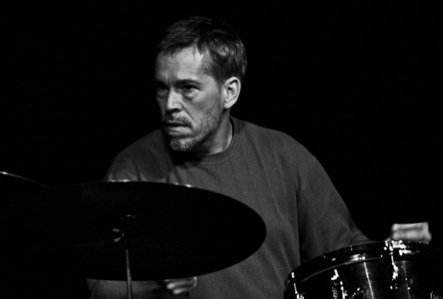
Mat Maneri: Trinity (ECM 1719)

Mat Maneri
Trinity

Mat Maneri violin, viola
Recorded July 1999 at Gateway Studio, Kingston
Engineer: Steve Lowe
Produced by Steve Lake

There’s something about the title of “Pure Mode,” prologue to Mat Maneri’s first solo album, Trinity, that describes his abilities just right. Like the nine improvisations that follow, it jumps off of a prewritten motive (in this case, by Matthew Shipp) and offers us a four-stringed experience like no other. Maneri goes unplugged this time, feeling out the forest of richness already ingrained into the wood and gut at his bow. He stews in every design for what it’s worth and walks along a slippery melodic slope as if it were dry and even ground. If we take “Almost Pretty” as a mirror, then we know this project is anything but vain, for Maneri consciously eschews the trappings of virtuosity that so often loom before the solo performer like a locked door. He is instead interested in the intricacies of that mechanism. He coaxes it open through disinterest alone. The scuttling crabs of this tidal song do not tempt him. Theirs is a rhythm he does not need. We might, then, look to the title track for a snatch of mission statement. In its 10-minute passage rests the winged key to another realm entirely, one that walks a bridge of half-light. Thus he traces the shores of his own dreams, christening John Coltrane’s “Sun Ship” on its raga-like voyage to the earth’s center. The unerring valences of his notecraft are nowhere more apparent. His quiver stocked with idiomatic arrows, he looses them into the sky, knowing they will never heed gravity. Such artistry extends into the visual, as in “Blue Deco,” for which Maneri treats the violin like paint. He chooses air in place of canvas and renders a world alone. This, along with “Veiled,” is the most chamber-like excursion of the program, a void of interpretable dots and dashes that peaks in children’s squeals. In each, solid walls of pizzicato break the flow. “Iron Man” (Eric Dolphy) and “Lattice” (Joe Morris) form another pair. Wrought in heavy matter and spindling filigree alike, they wander drunkenly into the distilled tonic of “November 1st.” This we can sip and savor, a duster for the cobwebbed staircases of the mind. Meanwhile, the house is littered with “Lady’s Day Lament.” Riffing on a tune by his father, Maneri loosens every nail until the entire structure hums.

Whether or not Mat Maneri’s sound-world will divide listeners is irrelevant, for it already fuses so many disparate strands into a single precious current that everyone gets swept up in it all the same. Open your mouth and drink it. You will never drown.

<< Anour Brahem Trio: Astrakan Café (ECM 1718)
>> Karl Amadeus Hartmann: Funèbre (
ECM 1720 NS)

Elina Duni Quartet: Matanë Malit (ECM 2277)

Elina Duni Quartet
Matanë Malit

Elina Duni voice
Colin Vallon piano
Patrice Moret double bass
Norbert Pfammatter drums
Recorded February 2012, Studios La Buissonne, Pernes-les-Fontaines
Engineers: Gérard de Haro, Nicolas Baillard
Produced by Manfred Eicher

“This album is the echo of my childhood, my exile and my reconciliation with the two worlds that have shaped me—the Albania of my roots and the Switzerland of my life today.”

Matanë Malit. Beyond the mountain. The title of Elina Duni’s ECM debut. Yet something more. A call to the spirit in whose hands rests the diary her quartet inscribes with accounts of a tormented past. With one eye longing for her childhood in Albania, another taking in the classical, blues, and jazz traditions into which she has since grown, Duni treats every word that crosses her lips as if it were the first. By paying homage to the land of her birth, she forges a land in and of itself, each song a tectonic plate beneath the soil of the group’s atmospheric arrangements.

It was pianist Colin Vallon, with whom Duni studied at Berne’s Hochschule der Künste, who encouraged the developing singer to mine the past for inspiration. Her duo work with Vallon formed the seed of the current project, fleshed further by drummer Norbert Pfammatter and Vallon’s trio bassist, Patrice Moret.

In assembling this program, the quartet had to clean out the dust of political distortion that had gathered in its crevices, for many of the songs therein found themselves lyrically changed to suit the propaganda machine of a fervent communist regime. The titular shepherdesses of “Çobankat” long once more for self-sufficiency in the face of an inflexible marriage tradition, their voices wafting over the hills through Duni’s earthen diction with determination, beauty, and wit. Such individualism surely ruffled the feathers of agitprop pundits, who recast these once “progressive” women as “brave” allies bringing provisions and darning socks for anti-fascist partisans in the mountains. Such history further informs “Mine Peza,” a verse often sung by Duni’s maternal grandfather, who fought alongside those very partisans at the mere age of 12. Written under Mussolini’s shadow, it tells the tragic story of its eponymous hero, ending the album on its most solemn note:

Let’s cast off the chains
of this cruel occupation
cries the mother.
But the gun in the hand
of the treacherous soldier
shoots the mother dead.

Along the way, however, we do find moments of joy in a place where even the longest political arms cannot reach: the human heart. The secret love made manifest in “Ka një mot” (For a year) begins the album with youthful optimism, and is emblematic of the group’s democratic energy. Duni’s presence is close as a whisper, even as it seems to sing from a distance. Moret, Pfammatter, and lastly Vallon buffs every rock of this landscape until it speaks. There is also the invigoration of “U rrit vasha” (The girl has grown up), a wedding song from Kosovo that finds a living smile in every change of terrain.

The girl has grown up
in our mountains.
Her body is tall like a cypress
and the birds sing.

“Erë pranverore” (Spring breeze), a once-forbidden song from 1962, rises from the ashes here a beautiful organism. Every muted sentiment rejoices anew at the wonders of a life without borders. Vallon’s muted strings provide a percussive and melodic backbone as Duni follows roads to lovers in full bloom. True to the history being told, however, she looks also at the destitute. We stand with the “Vajzë e valëve” (Girl of the waves) as she yearns for her husband who may never return, invisible as he is among the waves of his vocation. Her love remains potent against the attacks of violent waters, but for how long?

Beautiful birds
my only hope lies in you.

And many of us will relate to the shattered protagonist of “Unë ty moj” (Me and you), whose love proclaims itself far too late, only to find the idol of its affections in the arms of another.

Burn my soul,
burn.

There are, too, the hero songs, which place emphasis on Albania’s vast diaspora. “Kjani trima” (Cry brave ones), for one, pits us against the mighty Ottoman Empire and searches futilely for those lost in the aftermath. Like the evocative “Ra kambana” (The bells are ringing), this is a song of the Alvanitas, Albanians living in northern Greece. “Çelo Mezani,” for another, tells of a local southern Albanian hero whose tragic death by bullets leaves a despondent mother behind. Heartrending even without knowledge of its content, the music embraces his fallen body and inters it with palpable care. Each note is a quiet cry, a reflection upon waters long disturbed but still as glass in memory.

Duni pens the most effective song of the set. Setting verse by the great Ismail Kadare, her “Kristal” fits seamlessly into the rest. A dance of death and forgetting, it lets us fall until we are at peace with what has transpired. “Poetry,” writes Duni in her liner notes, “is what guides and fascinates me,” and this is precisely what we feel coursing through the music even when she absents herself from it. Her silences and wordless flights lift us into a world preserved beyond not only the mountains but also the clouds, giving space for her band mates to expand upon what is painted before us. Their palette is the Albanian language itself, and by extension its heritages; their canvas, the mirror of ignorance that still surrounds this neglected republic. In paying due respect to the past, they have created an anthem for the future.

And when you remember the old house,
the friends we’ve lost
and those who are gone.
You will remember me too
like a stranger.
Like a statue whose arm you broke
in a wild embrace!

(To hear samples of Matanë Malit, click here. See this review in its original form at RootsWorld here.)

Evan Parker Electro-Acoustic Ensemble: Drawn Inward (ECM 1693)

Evan Parker Electro-Acoustic Ensemble
Drawn Inward

Evan Parker tenor and soprano saxophones, khene
Philipp Wachsmann violin, viola, live electronics, sound processing
Barry Guy double-bass
Paul Lytton percussion, live electronics
Lawrence Casserley live electronics, sound processing
Walter Prati live electronics, sound processing
Marco Vecchi live electronics, sound processing
Recorded December 1998 at Gateway Studio, Kingston
Engineer: Steve Lowe
Produced by Steve Lake

The spheres of composition and improvisation are not so far apart. In fact, Evan Parker and his Electro-Acoustic Ensemble seem to say, they are as inseparable as water from the ocean. Since 1992 the Ensemble has gone, as the title of its 1997 debut suggests, toward the margins, and is content in the asymptotic nature of those margins. This follow-up welcomes Lawrence Casserley and his computer wizardry into an already eclectic admixture of sound processors, thus enhancing the overall atmosphere with real-time entanglements. Because the result feels so much like an aural diary, I can only offer a written one in return.

(1) there is a jagged line in the egg, and the light that spills from it sings, crackling like rain on tarp. in the crooner’s sigh there are wounds, in his laughter there is healing.

(2) aroused from my dream, i creep like a shadow toward the lighted window, throw open its transparent lungs and breathe in the dew-kissed air. but a serpent in the sky mars this otherwise idyllic dawn with S-curved passage, the only afterimage to linger in these eyes as it wriggles through gauzy cloud cover and parhelia. Parker’s lockdown is arresting, a Glassean riff turned on its head and spun like a top.

(3) to travel in the homeland is to walk away from yourself. catharsis of will and locomotion. in the absence of progress, the feet quicken their pace. in the absence of goals, they slumber even as they ambulate. hidden in the watering can behind the barn is the drop i left before parting for the city, where only sewer drains collected the tears of so many others and stirred them into an underground cocktail, never again to be tasted. it is not so radical to think that one might live here, but to think that one might die here. i can turn the radio dial however much i want, but will never find the beacon that i crave. instead, a diffuse comfort whereby the winds of opportunity blanket me with their hush.

(4) to look into the spouting bowl is to blind yourself to the truths of which it is an indifferent receptacle. i can lasso these words to its underwater circus yet fear i might not have the strength to hold on ’til i reach bottom. a fidgety existence i lead when it’s all i can do not to fall away from others’ attention.

(5) the music tells me i can deploy my love as an agent of unrest and offers in that possibility a temptation in whose surface i cannot see myself reflected. my heart is already lost to the cause. i stand in a booth on the corner making collect calls to strangers, my fingers all a-blur at the number pad in their furious attempts to communicate.

(6) i have found it: the spinning globe of circumstance on which i was trapped like a drone on a treadmill. now i can hold it, toss it as a child would a ball. but in so being endowed, i find there is only guilt and discomfort, and the knowledge that the top of the pyramid is a lonely place. i can only follow my wayward guides, playing the part of the child again as i slide down its brick-laid slope.

(7) back to concrete, i run pell-mell, pushing the capabilities of my social craft to the flexible limits of their stature, dangling before myself a carrot of progress. i cannot want this; i must let it want me. somewhere in the body of a cello, my bones are breaking and mending by the laser vision of gas stove flame.

(8) at home in the universe…nowhere else i’d rather be. it is our terrarium, our humid sanctuary, our light and love.

(9) i am writing on ice, using the ink my mother gave me. i let myself seep into the surface, tracing imperfections with newfound script.

(10) they have captured something in the frame, glued it inside with the adhesive of acceptance. timetables and train tracks curl into a tangled ball, it’s shadow the signature in the lower left-hand corner.

(11) the thread has unraveled and the secret is out. i am here only so long as i write myself to be. i take your hand and bid you to take another’s, so that by the end we stand as one. this is the music that goes on in the attic when we are asleep, in concerts attended by mice and other wall dwellers. if we are drawn inward to anything, it is ourselves.

<< Eleni Karaindrou: Eternity and a Day (ECM 1692 NS)
>> Peter Ruzicka: String Quartets (ECM 1694 NS
)

Maneri/Phillips/Maneri: Tales of Rohnlief (ECM 1678)

Tales of Rohnlief

Joe Maneri alto and tenor saxophones, clarinet, piano, voice
Barre Phillips double-bass
Mat Maneri electric 6-string and baritone violins
Recorded June 1998 at Hardstudios, Winterthur
Engineer: Martin Pearson
Produced by Steve Lake

Tales of Rohnlief is an exercise in recitation. Joe Maneri’s histrionics call out to grasslands and briny spray. He preaches at the edge of the world, where rocks cut like scissors through wrapping paper: only a push and not a squeeze. In his voice is all the landscape one needs to find purchase for the journey that follows. The voice expresses itself by way of throat and reed, a pitch-bent nightmare turned frosty and sweet. It pales into a spontaneous croak as Barre Phillips and Mat Maneri press their palms to an elaboration of surrender. And with that, these three uncannily attuned improvisers touch the sky with more sky. A break in the clouds reveals a backdrop of revelry.

“A Long Way From Home” feels like anything but, so intimate is its delivery. It whisks us through points of contact as familiar as our subcutaneous selves, and just as sensitive to the errant touch. Mewing cats trade places with stone idols flicking their tongues in the face of condemnation, licking away the possibility of failure as a hand wipes away condensation. Paltry rhyme schemes fail, however, to express the depth of this game of halos. We may, then, search for another method to the genius we now face. I propose that we turn our ears away from what is being told and focus rather on the telling itself. For if we look beyond titles like “When The Ship Went Down” and “The Aftermath,” neither of which help us despite the wonders of their contents, we realize that the inaugural voice has never left us. Its register curls a ghost’s hand and guides us through the gnarled lessons of “Bonewith” until, lo!, it casts its oracle shadow across the “Flaull Clon Sleare” and watches, silent, as we attempt to “Hold The Tiger” (a particularly brilliant pop-up). Watery yet never watered down, the song cackles. “The Field” is another notable mention, if not for its mournful qualities then for the color of its blood. Three dark and winding paths bring us to the tongue-tied destination of “Pilvetslednah.” Now that he’s shown us the yard, Joe welcomes us into his home, forever full of warmth.

There is so much sincerity in this music that it hurts.

<< András Schiff/Peter Serkin: Music for Two Pianos (ECM 1676/77 NS)
>> Alexei Lubimov: Messe Noire (ECM 1679 NS
)

Joe Maneri/Mat Maneri: Blessed (ECM 1661)

Joe Maneri
Mat Maneri
Blessed

Joe Maneri alto and tenor saxophones, clarinet, piano
Mat Maneri violin, electric 6-string and baritone violins, electric 5-string viola
Recorded October 1997 at Hardstudios, Winterthur
Engineer: Martin Pearson
Produced by Steve Lake

The stone gate. Vagary of an age lost to the water that swallows its knees. To listen to this record is to step through that gate, and find on the other side not ocean but a new kind of air in which water and vapor bleed like the sun’s light from the moon, the parent in the child. Many father-son teams have thus riddled the history of jazz, but between Joe and Mat Maneri one not only hears the biological bonds at play, but feels their electrical charge, and nowhere more so than on this first duo recording for ECM. Much can be made of the microtonal grammar that Maneri Senior has perfected over decades and which rests so intuitively at his fingertips, but at the end of the day it’s all about physicality and attunement. “If I play a thousand microtones, what’s that worth if the rhythm isn’t happening,” he tells us. “In some ways the rhythm is the most vital part of what we’re doing.” Listening to them emote is akin to listening to Paul Motian on the drums. Such is their fluency. Comparing them and their fashionable counterparts, however, is night and day. Which is to say, night on Earth and day on a different planet. By the same token, there is something so deeply integrated about the playing that we cannot help but look inward to find its pulse.

And yes, we may search for the pulse, but in doing so forget that the search is itself the pulse. Its most potent strain breathes through the lungs of “There Are No Doors,” “Never Said A Mumblin’ Word,” and the title track, all three of which feature Maneri Senior at the piano. If the titles seem to be proclamations, it’s only because the Maneris practice what they preach, tracing the crevices of experience for all the grit we’ve left behind. From this they build microscopic castles and flag them with rapid eye movement. “Sixty-One Joys” is perhaps the most achingly beautiful animal Maneri Junior has ever tamed, an electric baritone violin solo that drinks pathos like honey and exhales sugar in the raw. The insectile blues “From Loosened Soil,” another thing of elemental attraction, bridges us into “Five Fantasies,” which draws on Webern’s bagatelles and ends on a light scream. “Is Nothing Near?” comes closest to an identifiable place, a place where reedmen convene to spit life in the dead of night. Waves of arco fortitude flounder in slow motion, the outtakes of a film starring cigarettes and rainwater. And what of light? For this, we turn to “Body And Soul,” an acoustic violin solo knocking at the door of a homespun dream. It is the rat in the kitchen who eyes the cheese, the teacher in the classroom who nods off mid-lesson, the child in the playground who sees a rainbow and cries, “Race You Home.” The clarinet gets a klezmer test spin in “Gardenias For Gardenis” before shifting into a Lombard Street drive in “Outside The Whole Thing.” At the end of it: a hole in the ground.

Unearthed is what this music is, like a gold nugget or gemstone—only these two mavericks are not interested in priceless rarities but rather take exquisite interest in the sifted dirt. When watered by the gifts of these performances, the dirt burgeons with syllables. They may not be of a language we can all produce on command, but it is one we can always translate.

<< Mats Edén: Milvus (ECM 1660)
>> Philipp Wachsmann/Paul Lytton: Some Other Season (ECM 1662
)

Benedikt Jahnel Trio: Equilibrium (ECM 2251)

Benedikt Jahnel Trio
Equilibrium

Benedikt Jahnel piano
Antonio Miguel double-bass
Owen Howard drums
Recorded July 2011, Auditorio Radiotelevisione svizzera, Lugano
Engineer: Stefano Amerio
Produced by Manfred Eicher

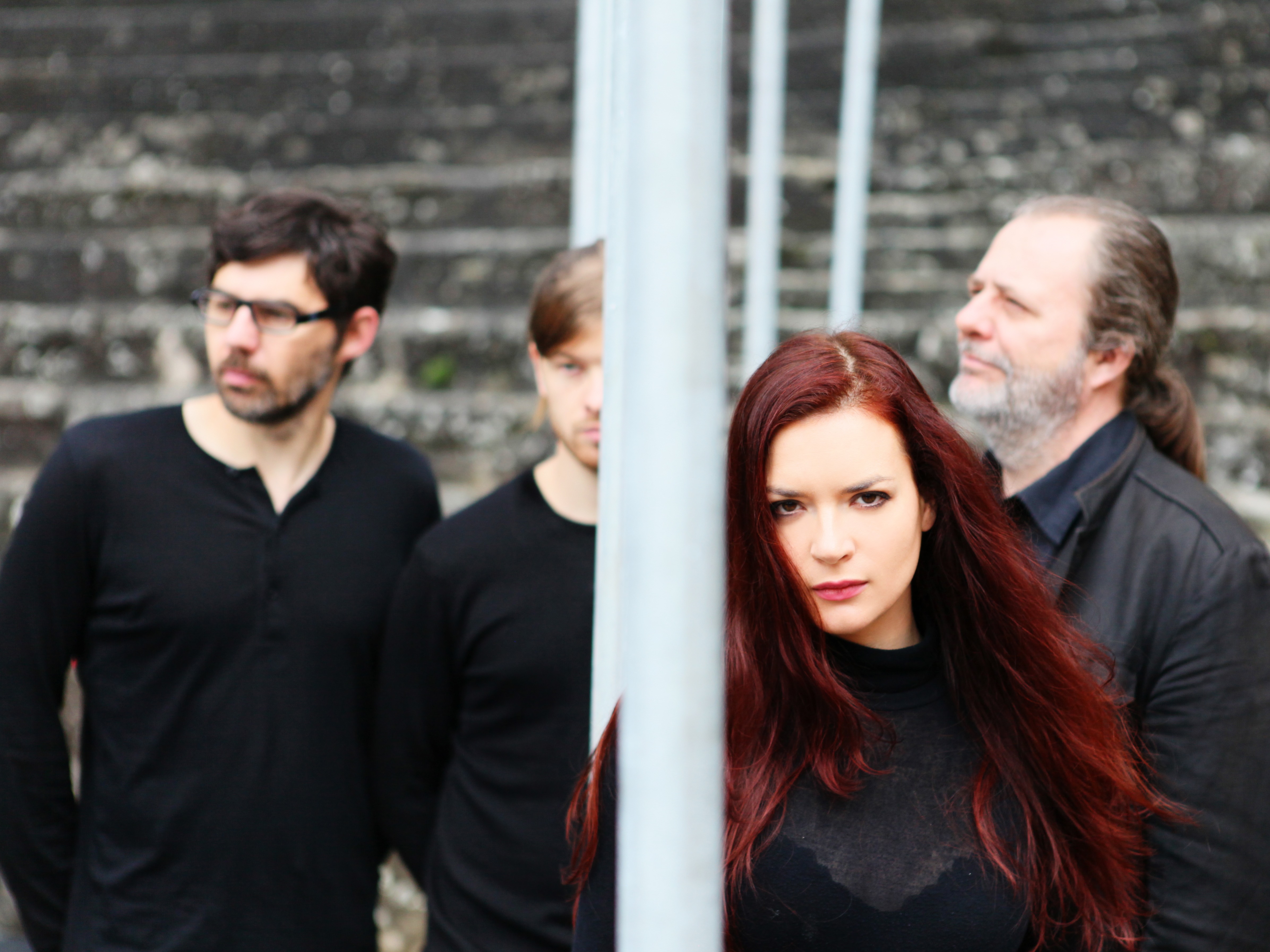
Making its ECM debut is the phenomenal Benedikt Jahnel Trio, for whom Equilibrium is more than a title. Under direction of the eponymous German pianist, already familiar to label listeners as a backing member of Cymin Samawatie’s “Cyminology” project, the Trio marshals two of the New York contemporary jazz scene’s brightest—bassist Antonio Miguel (by way of Spain) and Owen Howard (by way of Canada)—who share his penchant for strong dynamic twists, meticulous rhythms, and lyrical touch. Recorded at the same Lugano studio that has brought such sparkle to recent recordings by Amina Alaoui, Marcin Wasilewski, and Bobo Stenson, this leader date retains engineer Stefano Amerio and follows a similarly eclectic trajectory through a set of seven originals.


(Photos by Uli Zrenner-Wolkenstein)

From the muted-string depths of “Gently Understood” we can draw analogy to the work of Nik Bärtsch’s Ronin. Similar is the Zen groove aesthetic and modular approach that has its roots in the Trio’s first album (unsurprisingly, Modular Concepts), uncoiling from a filamented core lasting gestures of great melodic sweep. Howard’s tracings build character, coalescing into an idol of dreams. After a light intro, the theme of “Sacred Silence” speaks in undulating phrases. It whisks away our angst with the flutter of an eyelash and leaves us primed like archival paper for the impressions that follow. Miguel in his solo follows the paths left behind by tears to their sources as Howard whites out every vein with a nocturnal sigh.

For all its auspicious beginnings, “Moorland & Hill Land” brings smiles to the faces of its history, for in being so remembered they live anew, unimpeded by the shackles of convention into which they were born. Jahnel is both the voice of reason and its crumbling philosophies. As the snowball rolls and the slope increases, the overall sound becomes only more permeable, and ends with a flick of the wrist, striking a match of silence. Howard’s delicate interactions between snare and cymbals make “Wrangel” the most rhythmically deft track of the set. Miguel keeps us keyed into reality, while Jahnel brings fantasy so close we can taste it. Together, “Augmented” and “Hidden Beauty” form a decidedly rubato interlude toward the final (and title) track, which closes the door and opens another. Here is the traction and romance of life in less than ten minutes.

The Trio’s approach to soloing is remarkable. Vague is the cordoning of instrumental voices. In its place, an effortless symbiosis, an equilibrium of contribution. Like an archaeologist, the Trio moves clods of earth before working methodically at the details with brushes and breath, leaving only the value of every sonic relic to shine as it once did before it was buried.

Without question, among ECM’s Top 5 releases of 2012.

(To hear samples of Equilibrium, click here.)

Bobo Stenson Trio: Indicum (ECM 2233)

Bobo Stenson Trio
Indicum

Bobo Stenson piano
Anders Jormin double-bass
Jon Fält drums
Recorded November and December 2011, Auditorio Radiotelevisione svizzera, Lugano
Engineer: Stefano Amerio
Produced by Manfred Eicher

The anticipation of a new Bobo Stenson Trio release may be too much to bear, but the release of one is too much to ignore. This seventh album for ECM finds the Trio in new rags and old. Bill Evans’s “Your Story” was a favorite of Paul Motian, to whom the present version is dedicated, and starts the set off on a bittersweet note. It’s a heartfelt solo from Stenson that gives us perspective on the life of an artist whose contributions to the genre were incomparable. It also lulls us into a state of such openness that “Indikon,” the first of three freely improvised tracks, can be the only logical way to proceed. Along with its like-mindedly titled cousins, it reveals the album’s innermost thoughts. The title track even more so, as it threads slow and spiraling footprints along a haunting arco wire. Breathing room narrows to the point of claustrophobia, and slumbers there under a blanket of dead leaves. Here is the trio in its finest cohesions, spontaneous yet blossoming with organic comfort. Stringing one eureka moment after another, none of the musicians ever tries to lead the others, opting instead for close-eyed trust. “Ermutigung,” a protest song by East German dissident and Hanns Eisler protégé Wolf Biermann, levels off a scoop of political history with a smoothness of execution few can match. Fält’s subtleties keep its textures porous and susceptible to whatever comes in Stenson’s flights of abandon. Jormin steps forth in his deepest solo of the set and sweeps us like autumn into the cavernous “Indigo.” Amid rustlings of toms and cymbals, we hear the echo of a faraway song, changed by its journey from source to destination. Jormin pens two tunes. Between the frozen lake sheen of “December” and the creeping rays of “Sol” there is another album’s worth of imagery to ponder. The latter’s beginnings are remarkably enigmatic, every stroke of the horsehair a branch ready to fall. Both embody a depth of solitude that can only be seen in optimistic light. Jormin also offers his co-arrangement with Sinikka Langeland of a traditional Norwegian Ave Maria, which over its nearly eight-minute articulation of church rafters and prayerful thanksgiving recalls his work with Stenson on Matka Joanna. “La Peregrinación” is yet another unassuming vehicle for the bassist. Written in 1964 by late Argentine composer Ariel Ramírez, it sways like a playground swing in the wind of a tumultuous past. The lilting feel, maintained throughout, is all kinds of wonderful and fades into a sparkling finish. “Event VI” is adapted from George Russell’s eight-part suite, Living Time, thus bringing the Bill Evans connection full circle. Fält is as colorful as ever in his attempts to evoke the orchestral flavors of the original. Danish composer Carl Nielsen gets a nod in “Tit er jeg glad,” while another from across the water in Denmark, Ola Gjeilo, gets his in “Ubi Caritas.” Both are brushed and polished to a resonant shine, the second keening in aching curves of finality.


(Session photo by Nadia F. Romanini)

It’s encouraging to know that bands like Stenson’s exist. What the trio lacks in quantity, it makes up for in quality and, more importantly, in its ability to morph into a new animal with every title uttered from its lips. In this sense, “Indicum” is more than a vision of what could be. It is the solution to darkness.

(To hear samples of Indicum, click here.)

Manu Katché: s/t (ECM 2284)


Manu Katché

Jim Watson piano, Hammond B3 organ
Nils Petter Molvær trumpet, loops
Tore Brunborg tenor and soprano saxophones
Manu Katché drums, piano solo on Dusk On Carnon
Recorded March 2012, Studios La Buissonne, Pernes-les-Fontaines
Engineers: Gérard de haro and Romain Castera
Produced by Manfred Eicher

French-Ivorian drummer Manu Katché first caught my ear on Jan Garbarek’s Visible World, for which he provided a comforting balance of the smooth and the jagged. Since then, I’d heard him lurking in many of the saxophonist’s records, including Ragas and Sagas, I Took Up The Runes, and Twelve Moons. Yet it wasn’t until 2005’s Neighbourhood that he blossomed before my ears as a composer of economy, straightforwardness, and panache. Thus began the Manu Katché “band,” the makeup of which has changed with every album since. Horns remain a constant, and this latest effort puts him in studio contact with Nils Petter Molvær on trumpet and Tore Brunborg on reeds, along with Jim Watson on piano and Hammond B3. Molvær is a particularly welcome addition to the roster. Like Katché, he’d been a sideman for his fair share of memorable ECM sessions, including projects with singer Sidsel Endresen and Arild Andersen’s Masqualero, but his breakout moments came as a leader on 1997’s Khmer. As for Watson, he and Katché share a double life in the world of popular music—the former with Meshell Ndegeocello, the latter with Peter Gabriel—and for this outing the keyboardist takes the place of bass and completes an unbeatable (no oxymoron intended) rhythm section. This constant change in lineup speaks to the maturation of an artist whose instrument is so often forgotten in the grander mix, for even among these fiery talents his voice rings with a binding energy all its own.


(Session photo by Monika Rokicka)

It’s no coincidence, then, that those drums should lead us into the smoothness of “Running After Years,” the first of ten new originals. From its monochromatic groove and descending horn lines, we get a prime taste of Katché’s melodic sensibilities and of his band’s invaluable contributions toward realizing them. Molvær takes the first solo, walking avenues on winged heels. “Bliss” turns the lights down even lower on this city of love, giving Watson a chance to go a-Hammonding on fresh snowfall. “Loving You” funnels moonlight into the quietest corners of the heart, and with the last shows that keyboard and drums could take this album and run at any time if they wanted to. Molvær’s Jon Hassell-like touches in “Walking By Your Side” paint over an already smoky sky with charcoal before Brunborg’s tenor rides a wave of organ to distant shores. “Imprint” is a song without words, a quiet anthem for the departed that bleeds good memory. Its contrast to the surrounding tracks is starkly beautiful, and leaves us cored for the fluid energy Brunborg brings to “Short Ride.” As extroverted as its predecessor is veiled, it shows Katché’s kit skills at their bubbliest. “Beats & Bounce” is an easy favorite. Swinging from a piano hook that stays with you, this emblematic tune finds itself from the get-go and doesn’t let go. At moments you’d swear there was a bass there in the mix, but it’s Watson all the way. “Slowing The Tides” pushes us deeper into the album’s nocturnal engineering, through which organ wavers like dragon’s breath. The band ends its tenure on “Loose.” This simple chapter turns our protagonists inward, leaving only Katché alone at the piano for “Dusk On Carnon.” Originally trained on the instrument, he shucks the music from its husk, offering an ear to those who will partake.

With a feel for the evocative that is his trademark, Katché’s self-titled latest brings freshness wherever it goes. One listen is all it takes to convince us of its sheer enjoyment.

To hear samples of Manu Katché, click here. And for some footage in the studio, look no further: