Jakob Bro: Taking Turns (ECM 2543)

Jakob Bro
Taking Turns

Lee Konitz alto and soprano saxophones
Bill Frisell guitar
Jakob Bro guitar
Jason Moran piano
Thomas Morgan double bass
Andrew Cyrille drums
Recorded March 2014 at Avatar Studios, NY
Engineer: James A. Farber
Mixed August 2024
by Thomas Vang (engineer) and Jakob Bro
at The Village Recording Studio, Copenhagen
Cover design: Sascha Kleis
Album produced by Manfred Eicher
Release date: November 29, 2024

When I put this album into my computer, iTunes mistakenly named it “Exuding.” Then again, maybe the algorithm was trying to tell me something. As introspective as the music of Jakob Bro is often thought to be, it also chambers a creative fire that indeed exudes waves of inspiration. In this Copenhagen session, recorded in 2014 but given to the world a decade later, we encounter Bro in a mode of fearless exploration whereby coal is compressed into raw diamonds. Joining him are guitarist Bill Frisell, pianist Jason Moran, bassist Thomas Morgan, and drummer Andrew Cyrille.

At this point, except for Moran, Bro had shared a stage and/or studio with all the musicians gathered here. For example, his association with Lee Konitz goes back to 2008, when Paul Motian recommended that the two collaborate. And yet, as most under-the-skin jazz usually does, the all-original set glistens with the first-time-ness of its possibilities, especially given its delayed release. 

From the initial stirrings of “Black Is All Colors At Once,” it’s obvious that the notion of taking turns is subjective and at the whim of every moment. Its airy yet substantial sound takes an inch of history and gives a pound of cure, hiding its soul in places light cannot reach. If Konitz is a voice to be heard here, how much more so in his rare turn on soprano in “Haiti.” Alongside Cyrille’s cinematic cymbals and Bro and Frisell’s dialogism, there’s plenty of sun to go around.

“Milford Sound” is the band’s dreamiest calling card. The title, which references both Milford Graves and a fjord in New Zealand’s South Island, proves a revelatory beacon for Moran, who finds his stride band like a sole to its shoe. The unforced language of the guitars questions as much as it answers, Morgan and Cyrille trading periods and commas with perfect fluency all the while. Other reference points include New York’s Chinatown in “Pearl River” and memories of Argentina in “Mar Del Plata.”

The music also invites us to make our own associations. When listening to “Aarhus,” for example, I cannot help but remember my time in the city’s ARoS art museum. One note, and I am back strolling through its rainbow-colored rotunda, starting in the deepest reds and working toward indigo. Meanwhile, “Peninsula” suggests the liminal geographies that so often attract me, eschewing groove in favor of what speaks clearly enough through flow and circumstance.

These are travelers who have circled the world (and then some) whose paths have not only crossed here but become one for a while. How privileged that we should be invited to join them on this leg of the journey.

Tomasz Stanko Quartet: September Night (ECM 2650)

Tomasz Stanko Quartet
September Night

Tomasz Stanko trumpet
Marcin Wasilewski piano
Slawomir Kurkiewicz double bass
Michal Miskiewicz drums
Concert recording, September 9, 2004
at Muffathalle, Munich
Mixing: Manfred Eicher, Marcin Wasilewski, and Stefano Amerio (engineer)At Bavaria Musikstudios, Munich
Cover photo: Caterina Di Perri
Produced by Manfred Eicher
Release date: June 21, 2024

Recorded on September 9, 2004, at Munich’s Muffathalle, this surprise from the archives reveals as much about the late trumpeter Tomasz Stanko as it obscures. The live session finds him in the company of pianist Marcin Wasilewski, bassist Slawomir Kurkiewicz, and drummer Michal Miskiewicz, the trio with whom he shared stages from 1993 to 2017. “We were growing by his side, and he was watching us,” Wasilewski recalls about working with the man who was their mentor in every sense. “Every concert we played with him was important—the most important, almost as if it was the last one. That’s the approach he taught us: ‘When you play music, play it at a thousand percent!’” One hears that ethos revived throughout September Night, making it a vital document that deserves to wrap its arms around the shoulders of Suspended Night and Lontano, where it chronologically lands between.

I will never forget seeing Stanko with his New York Quartet in 2013. I still get whiffs of that octane now and then in the brain. But listening to “Hermento’s Mood,” which opens this all-original set, I am reminded of the ethereality he was uniquely capable of—a continuation of the song he held inside. Like “Elegant Piece” later in the show, it’s a flower that blooms only in moonlight.

Stanko’s ability to jump from exuberance to the depths of the soul never ceased to amaze. “Song For Sarah” is a prime example, just as comfortable grazing the bottom of the ocean in search of treasures long forgotten (of which this recording is one) as “Celina” is at home throwing its slow-motion strike across the proverbial plate. Even the freely improvised “Kaetano” cannot help but flirt with contradiction, shifting from urban meandering to a scenic train ride conducted by the rhythm section and exposited by Wasilewski.

Lest we forget the brilliance of Stanko’s backing band and the enmeshment of which they continue to be humble champions, we need only point to “Euforila” as a beacon of their craft. Opening with a lacy bass solo, it finds the band doing what it does best: knitting itself together while allowing plenty of open space between every instrument. As a determined body of water, they work around everything in their way without skipping a beat. Wasileswki is bright and joyful, while Stanko’s delicate punch of a solo is hot to the touch. Yet nothing can stop Miskiewicz from making the biggest waves below, crashing and roaring into the conclusion. Contrasting this is the closing “Theatrical,” which casts its ring into the fires of Mordor and walks away unscathed.

Incidentally, this concert was part of the “Unforeseen” symposium, co-curated by Munich’s Kulturreferat and the musicology department of the Ludwig Maximillian University, a week-long event that yielded two further ECM live albums: Evan Parker’s Boustrophedon and Roscoe Mitchell’s Composition/Improvisation Nos. 1, 2 & 3. If such companions feel radically different, it’s because freedom assumes a bespoke form here. Whereas Parker leaps skyward and Mitchell digs into the earth, Stanko is most comfortable riding that indefinable horizon between them.

Gianluigi Trovesi/Stefano Montanari: Stravaganze consonanti (ECM 2390)

Gianluigi Trovesi
Stefano Montanari
Stravaganze consonanti


Gianluigi Trovesi piccolo clarinet, alto clarinet, alto Saxophone
Stefano Montanari concertmaster
Stefano Rossi second violin
Claudio Andriani viola
Francesco Galligioni violoncello
Luca Bandini double bass
Emiliano Rodolfi oboe
Pryska Comploi second oboe
Alberto Guerra bassoon, dulciana
Riccardo Balbinutti percussion
Ivano Zanenghi archlute
Valeria Montanari harpsichord
Fulvio Maras percussion, electronics
Recorded January 2014 at Sala musicale giardino, Cremona
Engineer: Roberto Chinellato
Mixed September 2021 at Artesuono Studio, Udine
by Gianluigi Trovesi, Stefano Montanari, Guido Gorna, and Stefano Amerio (engineer)
Cover photo: Luciano Rossetti
An ECM Production
Release date: February 24, 2023

Italian reed virtuoso Gianluigi Trovesi and baroque violinist Stefano Montanari (doubling here as concertmaster) lead an ensemble of period instruments for a fresh take on the music of the 15th through 17th centuries. Meshing melodies from towering figures of the Renaissance and Baroque with equally visionary interpretations, the program manages to carve new initials into old pillars without marring their beauty. Some new compositions by Trovesi, plus a couple of improvisations with Fulvio Maras (percussion, electronics), complete the mix.

The album’s title, which translates as “consonant extravagances,” offers an accurate description of what is happening sonically, creatively, and even spiritually. “The Witches’ Dance” (from Henry Purcell’s opera Dido and Aeneas) leads off on a courtly foot. Purcell makes a handful of appearances throughout, most gorgeously as a motivic inspiration for Trovesi’s “For a While.” Like all of his pieces, it benefits from the robustness of Corrado Guarino’s arrangements, which take advantage of the period instrument ensemble under Montanari’s charge. The latter brings the crispness of strings to “Consonanze stravaganti” by Giovanni Maria Trabaci (an influence on Girolamo Frescobaldi), Guillaume Dufay’s Missa L’homme armé, and a sonata by Giovanni Battista Buonamente. Whether threading his alto through Andrea Falconieri’s “La suave melodia” or revealing his compositional wonders in “L’ometto disarmato” and the alto clarinet jaunt of “Bergheim,” Trovesi is a force of nature shapeshifting between song and cry on the turn of a dime. If the past is alive in his sound, then so is the future.

(This review originally appeared in the January 2024 edition of The New York City Jazz Record, a full PDF of which is available here.)

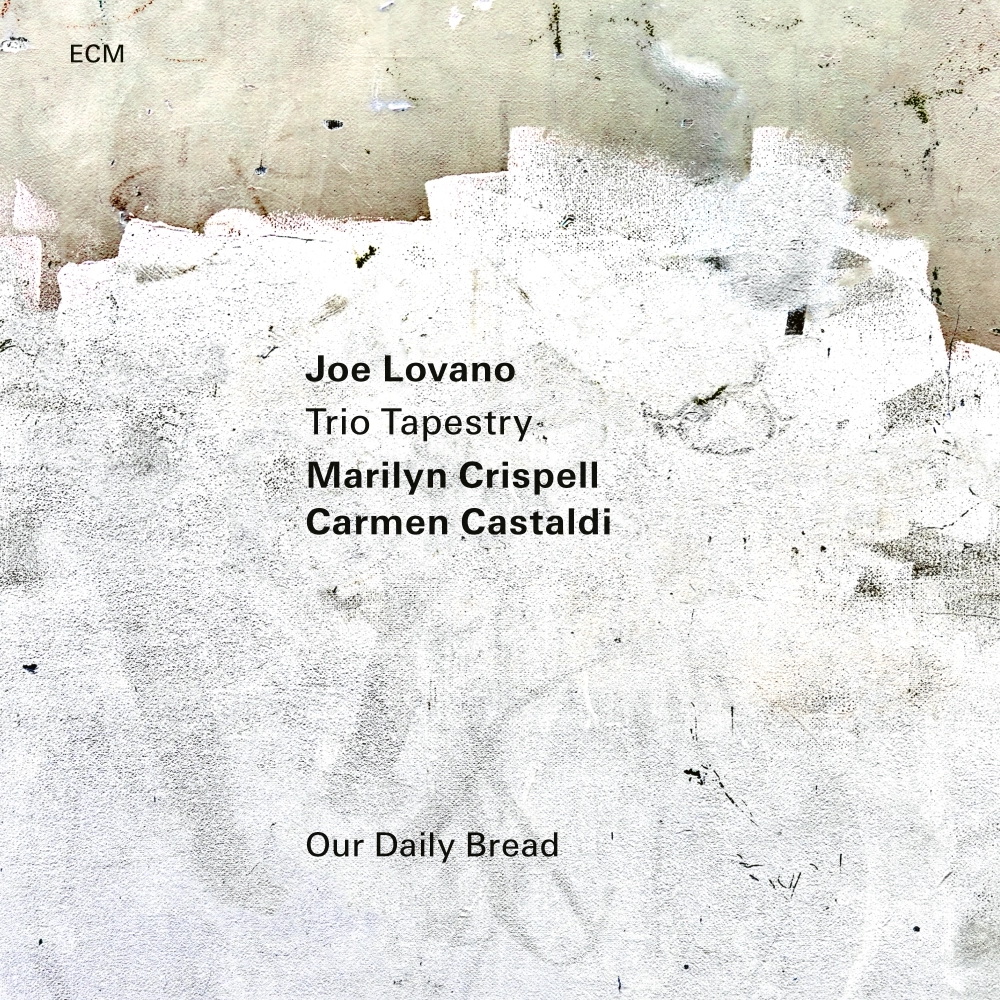
Trio Tapestry: Our Daily Bread (ECM 2777)

Trio Tapestry
Our Daily Bread

Joe Lovano tenor saxophone, tarogato, gongs
Marilyn Crispell piano
Carmen Castaldi drums, gong, temple bells
Recorded May 2022, Auditorio Stelio Molo RSI, Lugano
Engineer: Stefano Amerio
Cover photo: Thomas Wunsch
Produced by Manfred Eicher
Release date: May 5, 2023

Joe Lovano’s Trio Tapestry is one of the profoundest projects to grace ECM records in recent years, and for this, the group’s third round, we are welcomed into a chamber within a chamber within a chamber. This set of eight Lovano originals, each written exclusively for the project, draws from the wells of pianist Marilyn Crispell and drummer Carmen Castaldi, whose gifts of abundance unwrap themselves to reveal one grace after another.

“All Twelve” takes a 12-tone approach to the proverbial welcome mat, greeting us with open arms and closed eyes. Lovano takes liminal account of Crispell’s architecture, rendering an experience that takes two steps inward for every step outward. The ghosts of albums past linger with a loose developmental feel. Every motif, as much a child of atmosphere as of melody, works a speech-like filigree into every wall, sconce, and pew. Like “The Power Of Three” and “Crystal Ball” that come later, its introspections have the presence of someone who has absorbed the world to squeeze out only its most inclusive drops.

Despite an overarching solace, there is variety to be found. Where “Rhythm Spirit” is a heartfelt duet for tenor and drums highlighting breathy lows and delicate highs, “Grace Notes” floats the tarogato on a seascape of dreamy complexion, Castaldi’s cymbals hinting at a groove that never catches, buried instead in the crashing brine. On “One For Charlie,” Lovano returns to tenor with a monologue dedicated to the late Charlie Haden.

At the heart of this session are two balladic verses. The snaking indeterminacy of “Le Petit Opportun” and the title track’s potent lyricism give us plenty to savor even as they savor us. This is chaos theory in slow motion and proof that if this album is a match between day and night, the latter has surely won.

(This article originally appeared in the August 2023 issue of The New York City Jazz Record, a full PDF of which is available here.)

Jakob Bro/Joe Lovano: Once Around The Room – A Tribute To Paul Motian (ECM 2747)

Jakob Bro
Joe Lovano
Once Around The Room: A Tribute To Paul Motian

Joe Lovano tenor saxophone, tarogato
Jakob Bro guitar
Larry Grenadier double bass
Thomas Morgan double bass
Anders Christensen bass guitar
Joey Baron drums
Jorge Rossy drums
Recorded November 2021 at The Village Recording, Copenhagen
Engineer: Thomas Vang
Cover photo: Woong Chul An
Produced by Manfred Eicher
Release date: November 4, 2022

Guitarist Jakob Bro and saxophonist Joe Lovano head an ensemble that includes bassists Larry Grenadier and Thomas Morgan, bass guitarist Anders Christensen, and drummers Joey Baron and Jorge Rossy in a sprawling tribute to drummer and composer Paul Motian. That the set includes only one tune by Motian proper (“Drum Music”) is by no means an oversight but a testament to its dedicatee’s spirit, which continues to glow in musicians who cup its embers with reverant care. Rather than simply recreate or distill Motian’s personal and creative principles, the band expands on them with heartfelt accuracy.

“As It Should Be” is the first of two pieces by Lovano (the second being “For The Love Of Paul”). It also opens the curtain with a swell of patient beauty as only ECM could render. The atmosphere is rich, far-reaching, yet always firm in its immediacy. Bro’s guitar architects the pulsing kingdom over which Lovano’s tenor reigns supreme, a melodic giant of kindest temperament. The freely improvised “Sound Creation” follows with a near-ritual quality, made all the more clairvoyant by Lovano’s tarogato before the tenor dances in its dust clouds.

Bro offers two tunes of his own: “Song To An Old Friend” and “Pause.” Between delicate arpeggios and tender melodizing, he stands to the side of either foreground, content in avoiding the spotlight to be heard rather than seen. Nestled between them is the above-mentioned “Drum Music,” which yields scorching playing from the leads. After some thoughtful building, a squeal for the ages from Lovano’s tenor makes for an unforgettable catharsis.

That the recording was made on the 10th anniversary of Motian’s death only shows how much he lives on in the articulations of those who knew him best. Having played in the drummer’s trio with Bill Frisell for 30 years, Lovano should know that a strong metaphysical melody can be enough to make the departed feel near again.

Keith Jarrett: Bordeaux Concert (ECM 2740)

Keith Jarrett
Bordeaux Concert

Keith Jarrett piano
Recorded live July 6, 2016
at Auditorium, Opéra National, Bordeaux
Producer: Keith Jarrett
Engineer: Martin Pearson
Mastering: Christoph Stickel
Cover photo: Max Franosch
Executive producer: Manfred Eicher
Release date: October 14, 2022

Every new release of a Keith Jarrett recording activates something old—ancient, if you will. By this, I mean to suggest that his immaterial approach to a resolutely material instrument invites us to appreciate the synergy of being and non-being. To experience his notecraft, whether in person or via ECM’s relentless charting of his footsteps, is to understand that a physical body is required to interpret even abstract realities. And in the 13-part odyssey we have here, we encounter one of the most spiritual gifts to take flight from Jarrett’s fingertips.

From the same tour that brought such wonders to light as Munich 2016 and Budapest Concert comes this July 6th performance at the Auditorium de l’Opéra National de Bordeaux. In this spontaneous mosaic of waves and dissolutions thereof, he articulates an ocean’s worth of expanse. If Part I can be said to burst forth as if in need of being heard after a long silence, Part XIII intones the whisper of low tide. Between them, he unleashes a rhapsodic account of muscle and morality.

Flexibility is central to these pieces in the making, nowhere more so than in Part III. This breath of fresh balladic air is road music for the heart. There’s something painfully final about it, a tearful evocation of mortal ends. It also passes on hope to those left behind. Occasional dissonances hint at bittersweetness, always returning to the foreground with bits of the past polished and placed carefully on an altar for the future.

So begins a grand sequence of somber inner visions. Without ever losing sight of a certain playfulness of childhood (as in the spiral staircase of Part V), he navigates hymnal block chords (Part VI) and savory vamps with grace. Crooning his way through the valley, he ensures that beauty never becomes an idol. For while the lyrical fulcrum of Part VII, for example, veers into sunlight, Jarrett is quick to don the shades of Part VIII, bringing temperance such as only the blues can claim.

But if the feeling of farewell peaks in Part XII, it’s only because the destination is nearer than our point of departure. In such moments, we step outside of time, wearing it like a coat. We can reach into any pocket and pull out an episode of our lives, slicing away at infinity like a doctor in search of a cure.

Ralph Alessi Quartet: It’s Always Now (ECM 2722)

Ralph Alessi Quartet
It’s Always Now

Ralph Alessi trumpet
Florian Weber piano
Bänz Oester double bass
Gerry Hemingway drums
Recorded June 2021, ArteSuono Studio, Udine
Engineer: Stefano Amerio
Mixed December 2022 at Radiostudio RSI, Lugano by Manfred Eicher and Stefano Amerio
Cover: Fidel Sclavo
Produced by Manfred Eicher
Release date: March 17, 2023

Trumpeter Ralph Alessi returns to ECM with his fourth leader date for the label, this time with a newly minted European quartet that reflects his relocation to Switzerland in 2020. Alongside Florian Weber (piano), Bänz Oester (bass), and Gerry Hemingway (drums), he carves out a vivid baker’s dozen of original material.

“Hypnagogic” not only sets a tone but also establishes the album’s heart, the veins and arteries of which are traced with anatomical faithfulness by Alessi and Weber. It’s one of a handful of duo turns (including the subcutaneous title track) building on their nearly 20-year relationship as sonic allies. Abstract yet comforting, their dialogues feel like waking from a dream yet holding on to its fading tendrils. The effect is such that when the light of “Migratory Party” reveals a rhythm section trailing an even longer history, the band’s ability to balance independent voices and melismatic intermingling reigns supreme.

Both as musician and composer, Alessi creates constant washes of color. Whether in the groovier strains of “Residue” (a fantastic testimony of Oester’s talents) or in the nocturnal urbanism of “The Shadow Side” and “Diagonal Lady,” he navigates every moment as a director would a scene of actors improvising within a loose script. The latter two tunes have a three-dimensional feel that yields the album’s deepest magic.

When at its most forthright (“His Hopes, His Fears, His Tears” and “Everything Mirrors Everything”), the band swings forward and backward rather than side to side, while the dramatic resolution of “Hanging by a Thread” leads perfectly to the concluding “Tumbleweed,” bringing us back to where it all began.

(This review originally appeared in the April 2023 issue of The New York City Jazz Record, a full PDF of which is available here.)

Enrico Rava/Fred Hersch: The Song Is You (ECM 2746)

Enrico Rava
Fred Hersch
The Song Is You

Enrico Rava flugelhorn
Fred Hersch piano
Recorded November 2021
Auditorio Stelio Molo RSI, Lugano
Engineer: Stefano Amerio
Cover: Fidel Sclavo
Produced by Manfred Eicher
Release date: September 9, 2022

Pianist Fred Hersch makes his ECM debut in intimately grand fashion with maestro Enrico Rava on flugelhorn. Their meeting at Lugano’s Auditorio Stelio Molo RSI yields some of the most effortless jazz you’ll likely hear this year. Hersch’s opening embrace eases us into Antônio Carlos Jobim’s “Retrato em Branco e Preto” as if the set could open no other way, fanning expository poetry in place of lantern flame. An old-town quality prevails, navigating cobblestone streets on tiptoe yet never losing its footing.

Contrary to immediate expectation, this is followed by a free improvisation, which tempers the familiar with new shades of meaning. George Bassman’s “I’m Getting Sentimental Over You” gets a delicate and rhythmically endearing treatment, while the title track by Jerome Kern is enigmatically transformed into a crystalline snowdrift of memory. Thelonious Monk’s “Misterioso” walks a fine line between dream and reality, giving way to artful abstractions that reveal two minds with lifetimes more to say, as do the originals that precede it. Whereas “Child’s Song” (Hersch) conveys innocence with a nostalgic, summery feel that harks to yesteryears, “The Trial” (Rava) renders an entanglement of spiral staircases and other modern architectural details. All of this leaves Hersch alone with “’Round Midnight,” floating into the promise of a new day, uncertain though it may be.

These musicians achieve the extraordinary by sounding like one unit without sacrificing their voices. They dance as few know how, unfolding a love letter one page at a time until only a wax seal seems appropriate to protect its contents from the sun’s bleaching touch.

Julia Hülsmann Quartet: The Next Door (ECM 2759)

Julia Hülsmann Quartet
The Next Door

Uli Kempendorff tenor saxophone
Julia Hülsmann piano
Marc Muellbauer double bass
Heinrich Köbberling drums
Recorded March 2022
Studio La Buissonne, Pernes-les-Fontaines
Engineer: Gérard de Haro
Mastering: Nicolas Baillard
Cover photo: Thomas Wunsch
Produced by Thomas Herr
Release date: August 26, 2022

Although Julia Hülsmann has crafted a hearty sequence of trio records for ECM, including 2017’s Sooner and Later, there has always been something even more intimate and honed about her quartet with tenor saxophonist Uli Kempendorff, bassist Marc Muellbauer, and drummer Heinrich Köbberling, as is refreshingly obvious throughout “Empty Hands,” in which Hülsmann throws notes like petals onto the waters of life to see where they might flow. As they did on this album’s predecessor, Not Far From Here, these effortlessly attuned musicians navigate her sound with familial affinity. After “Made Of Wood” deconstructs the introductory mood, a melodic breeze wafts over the keys, carrying over into “Jetzt Noch Nicht.” Taking two forms—initially as a duet with Kempendorff, later as a swinging outing for all four—it delicately offsets tracks like “Fluid,” an emblematic realization of their capabilities that rejoices in the ongoing moment.

Muellbauer contributes three originals with a more geometric approach to time and harmony. In his “Polychrome,” the piano is a wavering shadow, the saxophone a refraction of light stepping sideways past us, while in “Wasp At The Window,” a locomotive whimsy ensues. The landscape outside our window remains the same, but its description changes along the way. Hülsmann’s ability to carry so much cargo in so fine a mesh is marvelous. Kempendorff and Köbberling offer a tune apiece. The former’s “Open Up” balances emotiveness and restraint, and the latter’s “Post Post Post” is a standout for its liminal expressivity.

No Hülsmann set would be complete without an ode to the popular canon, and her reading of Prince’s “Sometimes It Snows In April” is no exception. With charming comfort, it promises hope at the end of a long and harmful tunnel that none of us saw coming.