These post-pandemic years have been slim for live concerts on my end, but a week ago, I had the great pleasure of seeing Nik Bärtsch’s Ronin much closer to home than usual in a very special concert with guest Sumie Kaneko on koto. Click the photo below (courtesy of MIT Video Productions) to read my review in full at All About Jazz.
On October 1, I had the distinct pleasure of seeing violist Mat Maneri and pianist Lucian Ban perform selections from their latest ECM album, Transylvanian Dance, and more. Click the picture below to read my full review for All About Jazz.
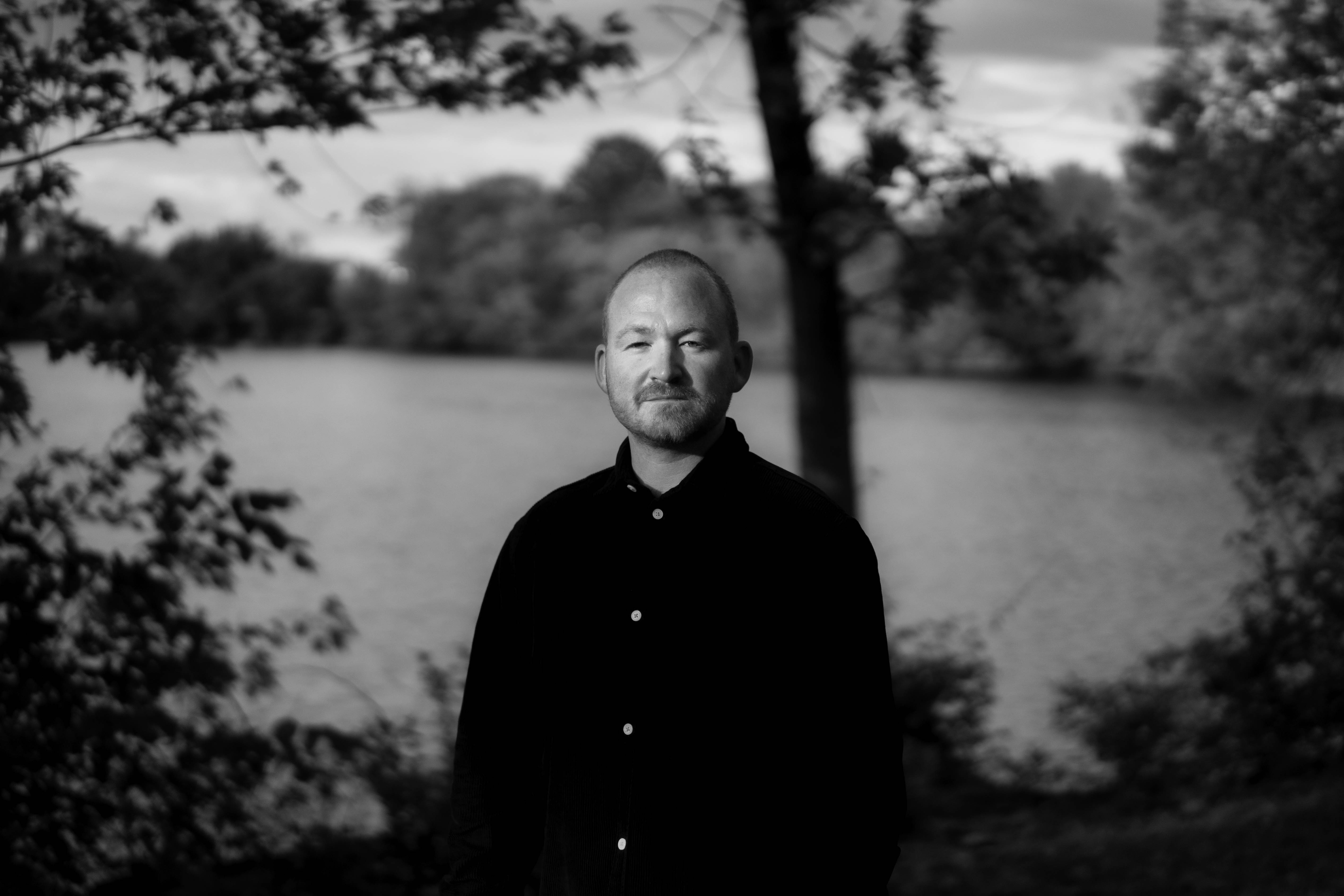
On May 25, 2023, reed virtuoso and composer Sha graced the suburbs of Greater Boston with a private house concert, his last performance of a six-month residency in the States. As the focal point of an eclectic crowd bound by trust and camaraderie, he embodied a sense of belonging rarely felt in a musical setting since the pandemic siloed musicians from their listeners. I was deeply grateful to have witnessed this unfolding, working its regeneration through a series of themes connected by tissue grown moment by precious moment. In the company of such warmth, mutual admiration, and creative seeking, along with a sprightly pug named Zoe (more on her below), we had only affirmation to share in the resonant chamber Sha created for those gathered.
Best known for his work with Nik Bärtsch’s Ronin, the Swiss outfit in which he adds critical exhalations to wood and wire, Sha had never considered himself a “solo” artist until he was asked to play in that capacity for a music festival in Tehran. The suggestion of that experience led to his first unaccompanied album, Monbijou, a 35-minute suite of three pieces originally recorded in the hollows beneath the box girder bridge it was named for. Listening in such intimate quarters, however, it was clear that in his approach, the artist is never alone. Rather, we were invited by default into a sense of community teetering between mortality and charity.
The title composition began as if from afar, activating the bass clarinet like a fog horn calling out to the souls of the recently departed. Thus, it welcomed variations of color and monochrome with minimal embellishment. On the latter note, despite a modest yet potent array of foot pedals, Sha kept his technological interventions tasteful and sincere, using them not to mask the sounds but cultivate them. (Even his liberal use of circular breathing felt like a necessary apparatus.) Whether adding reverb to mimic the music’s cavernous origins or making use of loops to consummate the palette at hand, he never once let the artifice of his accoutrements hinder appreciation of what was otherwise being rendered before us in real time.
A magical hiccup occurred when, at one point, the above-mentioned Zoe barked in the background. Sha happened to catch her instinctive utterance in a loop, recycling it like a wordless mantra between rasps of intercession for some minutes. Through the insight of repetition, the canine voice became a haunting textural element, a sense of home lost amid the waves of a future calm.
Sha’s uniquely percussive approach to his instruments called forth a fresh aura of expression in primordial terms, reminding us that rhythm is necessarily collective. From this tunnel emerged a train loaded with melodic freight, placing us at the windows, where we could watch as if listening (and vice versa). The scenery flowed by on repeat until changes suggested a forward progression into territories yet to be rendered.
For the second piece, “MM,” Sha horizontalized the bass clarinet to make way for an alto saxophone, in the bell of which he sharpened an array of motivic pencils to mark the paper of our regard. With a requiem’s solemnity, he cast a shadow across the room, made all the more bittersweet for making me acutely aware of the cars going by outside the window. Knowing they would never hear or share these moments with us, I felt honored to be privy to them. As in the brief “Intro,” ironically closing the set by way of encore, its hints of dance turned every pause into a portal of understanding for the wider world, quieting into the rustle of clothing as we prepared to applaud what we had just been given.
Just as the sun’s corona cannot be seen without covering its source, Sha’s music reveals its spirit through obfuscation. This was especially apparent when the digital cloak fell, leaving lungs and bass clarinet to converse with the space’s signature frequency, fading like a technology whispering its final will and testament.
(All pre-concert photos by Tyran Grillo, except for Zoe, who appears courtesy of her gracious human family.)
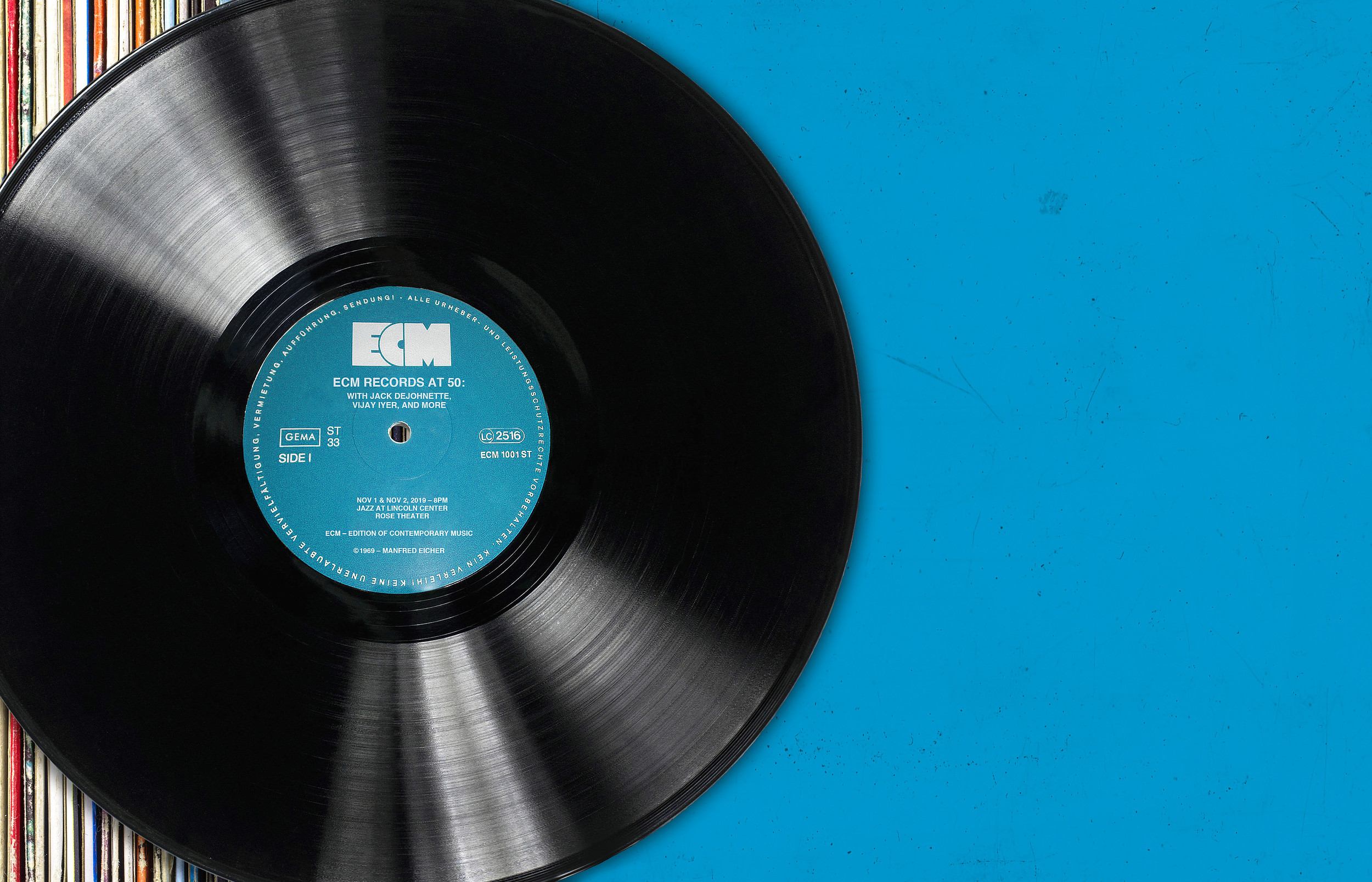
My latest review for All About Jazz is of the recent “ECM Records at 50” performance at Lincoln Center in New York City. Click the image below to read the full article.
On November 1 & 2, 2019, Jazz at Lincoln Center will present two nights in celebration of ECM’s 50th anniversary. The lineup will be the same on both nights. I will be there to review the November 2 show for All About Jazz.
The roster is as follows:
Tenor Saxophone Ravi Coltrane, Joe Lovano, Mark Turner Trumpet Ralph Alessi, Avishai Cohen, Enrico Rava, Wadada Leo Smith Guitar Bill Frisell Guitar and Piano Egberto Gismonti Piano Fabian Almazan, Nik Bärtsch, Marilyn Crispell, Giovanni Guidi, Ethan Iverson, Vijay Iyer, Shai Maestro, Andy Milne, Craig Taborn Piano and Voice Meredith Monk Cello Anja Lechner Bass Dezron Douglas, Matthew Garrison, Larry Grenadier, Drew Gress, Thomas Morgan, Barak Mori Drums Carmen Castaldi, Andrew Cyrille, Jack DeJohnette, Mark Ferber, Ziv Ravitz, Nasheet Waits
Tickets are available here. Hope to see some of you there!
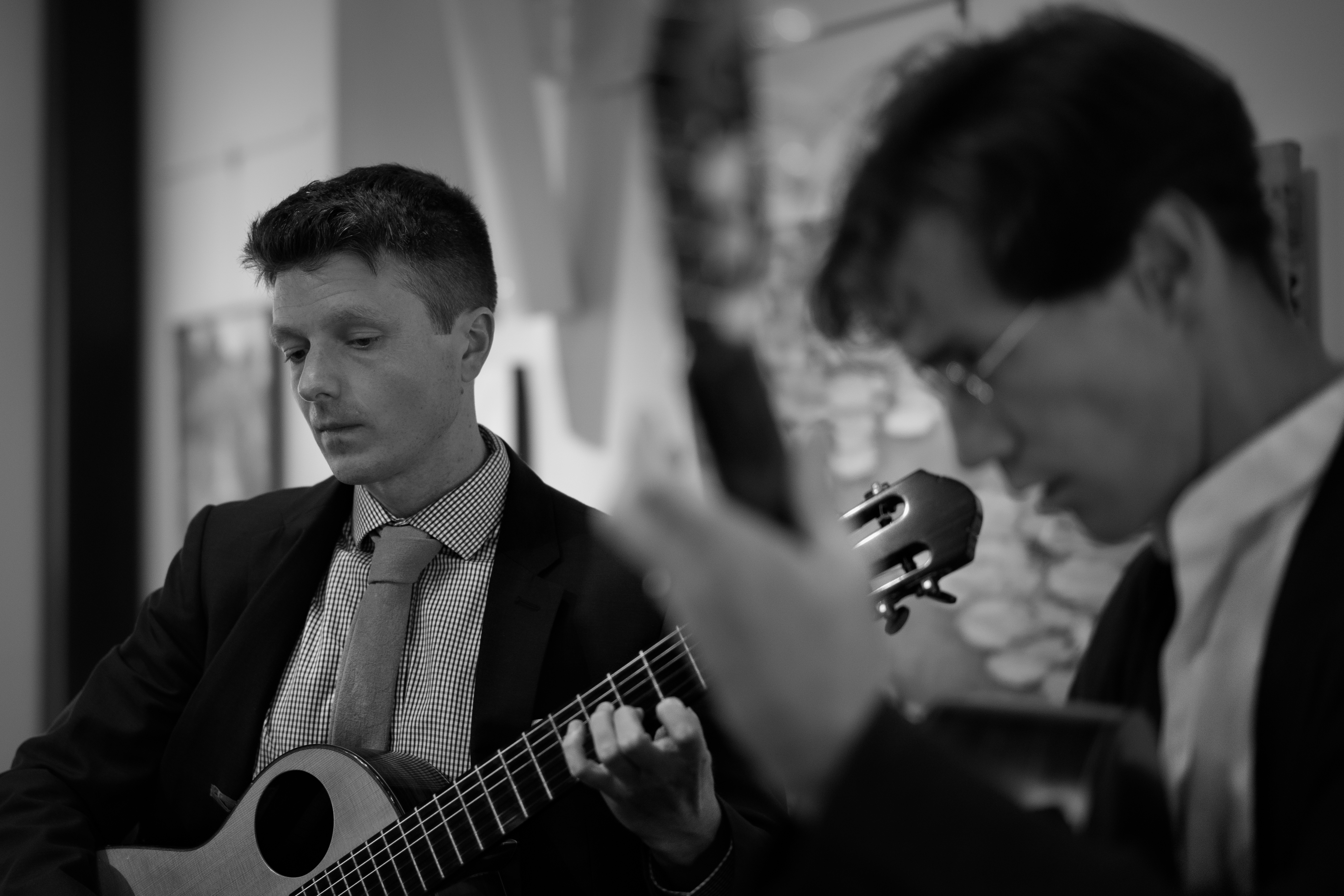
On 27 July 2019, Joseph Ricker and Jamie Balmer—a.k.a. Duo Orfeo—graced Stonington, Connecticut’s La Grua Center for the fourth time, presenting European art music of the 19th century arranged for classical and electric guitars. The program’s title, Peculiar Arabesques, is shared also by the duo’s latest album, which deepens a diurnal approach to repertoire. For just as a famous chorale by Robert Schumann, from his Album für die Jugend, opened the concert with a tune that was clearly a product of its era, so did Ricker and Balmer close with Maurice Ravel’s Pavane pour une infante défunte, which by virtue of its watery textures and resplendent final chord comfortably transcended boundaries of time drawn by subsequent listeners.
Between those two poles of evocation, each an answer to its own question of motivic faith, we encountered a range of geographic and cultural materials. Of these, two selections from Isaac Albéniz’s Suite Española, struck that same balance between past and future, articulated with a fine touch within a circle of intimate regard. The second of these was an emblematic example of the duo’s proprietary blend of freedom and restraint. Five pieces from Reynaldo Hahn’s La Rossignol Éperdu were even more wonderous, weaving strands of recollection through sonic photographs in color schemes that, while faded, retained their complex interrelationships. Two mazurkas by Frédéric Chopin were also highlights, walking a tightrope between sul ponticello and sul tasto phrasings while holding firm to a melodic core.
Other evocative journeys included Enrique Granados’s Danzas Españolas, in which architectural splendor shared oxygen with quieter pictures of history and Ferdinando Carulli’s Andante varié de Beethoven. During the latter, a woman in the audience sat on the floor to work on her crocheting. In addition to her willingness to meet art with art, it seemed to serve as a metaphor for what all of us were hearing: a spool of filament unraveled and refashioned through a combination of instrument and human touch. And while the difference of guitars was certainly noticeable and appropriately chosen, adding especial vibrancy to the Ravel, it was more so the way in which they were handled that proved them worthy of expression.
My latest article for All About Jazz is of a recent concert given by the Carla Bley Trio at Dazzle Jazz in Denver. Click the photo below to read my full review.
My latest review for All About Jazz is of the two-night ECM showcase at this year’s Winter Jazzfest in New York City. Click the photo below to read on:
Simone Dinnerstein and A Far Cry Goldberg Variations Mechanics Hall Worcester, Massachusetts February 9, 2019
In her cycle of poems inspired by Johann Sebastian Bach’s Goldberg Variations, Alice B. Fogel describes the opening Aria: “All phases have beauty. Or in shaping time was Bach lost to all but the count, not consonance? One in the other, carriage and contained, body and spirit, hitched, indivisible.” Apt images to consider in relation to this masterwork for keyboard, wherein mathematical and unquantifiable principles intermingle until one cannot separate the two. Fogel’s words speak to the inherency of Bach’s art, and of the spark by which centuries of listeners have kindled its psychosomatic flames.
Pianist Simone Dinnerstein keeps her own fire for Bach close to heart yet guides its warmth in a manner anyone can understand. After being invited by the string orchestra A Far Cry to lead a new ensemble arrangement of the Goldberg, she became part of an experience which, though insurmountable in concept, unraveled so organically as to feel inevitable. Bathed in the Aria’s wordless songcraft, it was impossible to be unmoved. Dinnerstein’s touch, as delicate as it was forthright, was a precise sequence of suspensions and emulsions. Like a photograph developing in the ears, it revealed its totality one gradation at a time. My six-year-old son, taking notes beside me, wrote down: “I like the music. It’s very relaxing, soft and slow.” Dinnerstein’s simplicity—a difficult tone to strike when technical demands weigh heavily in the balance—thus spoke to a child’s unfettered worldview as much as to his father’s verbose classical allegiances.
Variations 1, 8, and 16 were variously buoyant, soaring and resplendent. In all of these the violins took on a leading quality that recalled Bach’s Brandenburg Concertos. Accents from every string were tastefully chosen and rendered. Whether delineated in the jazzy bass line of Variation 2 or the playful minutiae of Variation 5, there were more valleys than peaks to navigate from one end of this palindrome to the other. Rare passages in which either the piano or the orchestra played without the other therefore came across with that much more intimacy.
The hall’s collective breath had more avenues to travel in the slower Variations, of which the plucked conversation between cello and viola in 17 was a wonder. Even more so Variation 25, which Dinnerstein imagined as a chorale and therefore called upon the musicians to set aside their instruments and sing. Had it continued long enough, we might have started singing ourselves. Another highlight was Variation 28, for which Dinnerstein plucked the piano’s inner strings like a recumbent harp while the orchestra stretched this typically busy section into an open weave. The music ended as it began, with the piano alone, looking into the timeless mirror of which this performance was a heartfelt reflection.
As with the best tributes, A Far Cry didn’t so much add as draw out from within. All the more appropriate that Dinnerstein should be presented with a key to the city of Worcester by Mayor Joe Petty before the concert began, for indeed she gave us a key of her own design to the Goldberg unlike any fashioned before.










 Between Sound and Space: ECM Records and Beyond