Translating Time: Leonidas Kavakos Concert Review

Time
in places
becomes
so thin
you can see
through its
fading material.
–Lera Auerbach

On Thursday, 3 February 2011, Cornell University’s Bailey Hall was graced by one of the world’s preeminent violinists. Having achieved this status through, among many other accomplishments, standout readings of Ravel’s Tzigane and the neglected works of Enescu (ECM, 2003) as well as his award-winning violin concertos of Sibelius (Bis, 1992) and Mendelssohn (Sony Classics, 2009), Athens-born Leonidas Kavakos has charted a rich swath of sonic territory. And therein lies the rub. With such a hefty cache of threads from which to spin his musical webs, a musician of Kavakos’s stature is faced with an unenviable amount of repertory choices. In a day and age when contemporary music is undergoing a deep shift into uncertainties and sometimes less-than-successful pastiches, this means a mounting challenge to give voice to underrepresented composers. Enter the music of Lera Auerbach, from whose Preludes for Violin and Piano, Op. 46 Kavakos and his accompanist, Enrico Pace, offered a hefty selection at the heart of the evening’s performance.
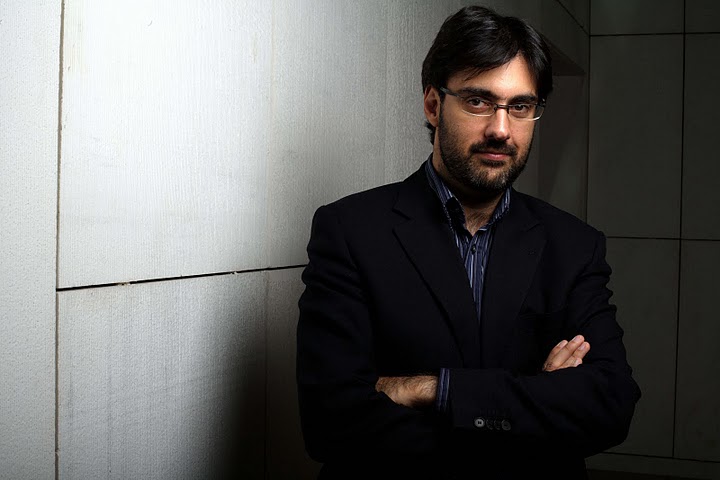
Leonidas Kavakos (Tchaikovsky Competition publicity photo)

Born in 1973 on the Siberian border and sufficiently endowed with the gifts of her predecessors (Schnittke comes immediately to mind) and contemporaries (particularly Kancheli and Silvestrov) alike, Auerbach has emerged as one of her generation’s most influential voices. She is also an accomplished poet in her native Russia, where her writings have already been incorporated into literary curricula as required reading. To be sure, the Preludes speak with a grammar uniquely their own. That being said, listeners of the parenthetically aforementioned may find her motivic paths well-worn. At some moments deliberately contrived and at others innocent, the Preludes have been called a Well-Tempered Clavier for the 21st century. Such comparisons do nothing, however, to obscure what is already her rather cloudy aesthetic.

Since composing her first major opera at age 12, Auerbach has been no stranger to the complexities of vocal representation, but negotiating the “voice” of a single violin set against its most intimate partner, the piano, is a poetry in and of itself. Hers is what I might call “postludinal incidentalism.” Put another way, the music plays like a requiem for one who has yet to pass, and nowhere more so than in the fleeting march that was the Prelude No. 1. Its metronomic beginnings and breathy ascents set the tonal contrasts for all that followed. The strident yet haunting pianism of No. 18 unraveled what Kavakos could not with merely four strings at his disposal. From the long sustains of No. 20 to the pseudo-romanticism of No. 12, each contributed a potent cell to the overall kaleidoscopic effect. Also intriguing were the morose etude-like scales of No. 16 and the turbulent Bach deconstruction built into No. 24.
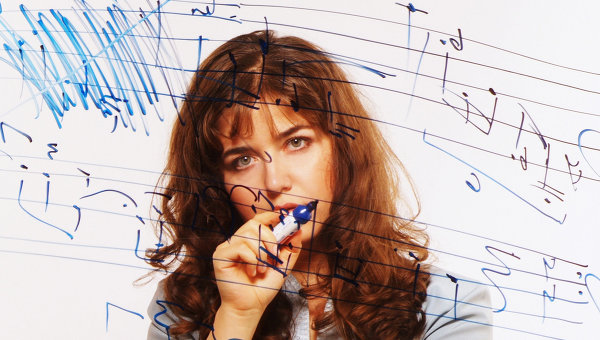
Lera Auerbach (photo courtesy of Auerbach’s official site)

Auerbach is a force to be reckoned with and one well adjusted to discerning contemporary audiences. Her plurivocity engulfs but never dominates. Unfortunately, many of her subtleties were lost in the shadows of the program’s opener. The origins of Prokofiev’s weighty Sonata No. 1 in F minor, Op. 80 in Stalinist Russia tend to mask this admittedly despondent work with associations of darkness and deprecation. Such interpretations are only underscored by the composer, who himself characterized the piece’s most recognizable motifs as “wind passing through a graveyard.” In the hands of our consummate duo, said wind was stilled in the eye of a storm that one could see but could not hear. The sonata’s four movements consisted of two pairs of Andantes followed by brisker counterparts. The funereal mood of the first struggled to hold its resolve in the glare of Kavakos’s glistening trills. Every double stop felt like an internal conversation over Pace’s Debussean tintinnabulations. The ensuing Allegro was pulled off with gusto. Staggered rhythms and crunchy arpeggios popped with requisite verve while a seesawing motif on the D and A strings seemed to caress the violin’s very architecture. And as the horsehairs went flying, I began to hear the music not as a conservation so much as conversion—from sentiment to statement, and from thought to action. The undulations of the third movement were accentuated by highs that glowed like hand-blown glass. So angelic was this passage that the final movement came almost as a shock, so that one now looked back on the Andantes as unrecoverable catharses. It also harbored an unexpected moment of whimsy when the sheer power required for this finale loosened a peg. As Kavakos stopped to retune, he graciously quipped, “It happens sometimes. We’ll try again.” And try again they did, giving an even sharper rendering the second time around. Amid more dangling horsehairs and gypsy flair, the duo finished with panache.

If any connection was to be drawn between the Prokofiev and Auerbach, it was that both were dark in theory but in practice danced on lines of light. Which leads us to Beethoven’s Violin Sonata No. 9 in A major, Op. 47 that concluded the program. Known as the “Kreutzer,” it was premiered in 1803 by its dedicatee, violinist George Bridgetower, with the composer at the piano. A subsequent disagreement prompted an outraged Beethoven to rededicate the piece to Rodolphe Kreutzer, the finest violinist of the time, who found the sonata “outrageously unintelligible” and refused to privilege it with his bow. If the first half of the evening’s performance felt curiously chosen, perhaps it seemed even more so in light of the inevitable “wow” factor that Kavakos and Pace unleashed through Beethoven. Wherever the variations ran, we could be sure that they never left their thematic mothers’ sights. And where the high notes from the Russians scintillated, here they trembled with a profound sense of emotional upheaval. This constant negotiation of tension and release worked its way into every lucid afterthought to spill from Pace’s fingers. The Andante, by contrast, unfolded in a slow skip. With protracted exuberance, every playful rumination from the violin found its better half in the keyboard. Kavakos’s delicacy made of these vignettes a window into the imagination of experience. Pace had us at A major with the raw statement that signaled the final Presto, and which worked through its anticipations with fortitude to the very end.

In spite of his reputation for symphonic density, as a chamber composer Beethoven clearly wanted his musicians to breathe. In the case of the Kreutzer, he accomplished this by placing strategic gaps throughout the score. These gaps allowed our musicians plenty of space in which to spread their wings together. This unity made all the difference and stretched a fine canvas upon which to brush in a lovely encore in the form of the “Garden Scene” from Korngold’s “Much Ado About Nothing” suite.

Kavakos’s instrument, an “Abergavenny” Stradivarius dating from 1724, was more than a mere vehicle for the music and provided a bird’s-eye view of the landscapes at hand. Sitting in the second row as I was, I could hear its every vulnerable detail. Its raspy highs and liquid lows coalesced into a formidable sound palette. Sadly, the same could not be said for the Steinway from which Pace struggled to elicit anything more than a muddy blur of sound, not to mention that anyone with perfect pitch would have cringed at the tuning problems in the lower register. Add to this an unpleasant squeak in the sustain pedal, and one begins to recognize Pace’s talents all the more for having poured on his meticulous attentiveness undeterred. The latter two issues at least were rectified during intermission, after which the Beethoven shimmered with noticeably brighter syncopations and octaval consonance.
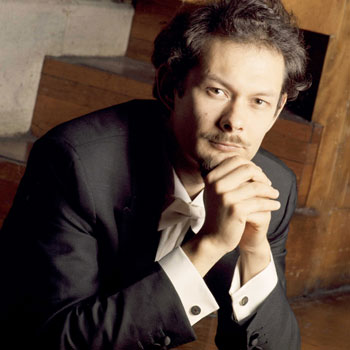
Enrico Pace (photo courtesy of Amadeus Online)

Pace is himself a native of Rimini, hometown of famed director Federico Fellini, who once said, “A different language is a different vision of life.” And perhaps nothing could better sum up the effect of this concert. Each piece inhabited such a distinctly “linguistic” space that it seemed the audience was hard-pressed to test its fluency across the board. At the very least, one can only admire the program’s adventurous spirit, even if it did not quite work as a whole. It also gave us the audible resumes of two performers at the peaks of their careers.

All in all, it was as fine a way to spend an evening as any, and I imagine that everyone walked away with mental tethers trailing behind them to an equally disparate selection of moments. As for this listener, though Kavakos is certainly a fiery performer when he wants to be, I left taking comfort in his conservatism, which continues to provide a valuable alternative to the histrionics of a Gidon Kremer or the technical favoritism of an Anne-Sophie Mutter. His restraint indicates a mind for which music is primary and its effects open to the indeterminacies of life itself.

(This review was published in its original form at the Cornell Daily Sun.)
Arvo Pärt: Te Deum (ECM New Series 1505)

ECM 1505

Arvo Pärt
Te Deum

Estonian Philharmonic Chamber Choir
Tallinn Chamber Orchestra
Tõnu Kaljuste conductor
Recorded January 1993 at Lohjan Kirkko, Finland
Engineers: Peter Laenger and Andreas Neubronner
Produced by Manfred Eicher

I too repented deeply and sorrowed much that I had grieved God,
And that peace and love were lost on earth because of my sin.
My tears ran down my face.
My breast was wet with my tears, and the earth under my feet;
And the desert heard the sound of my moaning.
–Staretz Silouan

It was a balmy evening on the 30th of October, 1995, as I and a throng of eager listeners filed into the Trinity College Chapel in Hartford, Connecticut. On the program: the Estonian Philharmonic Chamber Choir and the Tallinn Chamber Orchestra. It is an experience not even a lobotomy could erase from my memory. Bathed in the Chapel’s cascading acoustics, the musicians sounded nothing short of revelatory. Being in their presence after only recently having discovered the music of Arvo Pärt allowed me to appreciate at an even more visceral level the utter dedication represented by their combined forces. Whatever was in the air was beyond magic. The stillness of our hearts was surely palpable. That these brilliant singers and instrumentalists had traveled so far, carrying with them a most glorious music and message, was a miracle to me. I doubt that a single soul in that space felt anything less than all-consuming gratitude for the opportunity afforded to them.

Pärt’s Te Deum was the centerpiece of a program that also included works by Veljo Tormis, Einojuhani Rautavaara, J. S. Bach, and more from Pärt himself. While one can hardly compare the live experience to the recorded one, by no means is this album a lesser organism. The piece’s emergence hinges on a prerecorded wind harp, tuned to notes D and A, providing a constant drone that flirts with our awareness. (During the concert, I noted a few in the audience craning their necks to see where the sound was coming from, leading me to believe they were hearing it for the first time. I can only imagine what it must have been like to have one’s inaugural experience of the Te Deum in such a context, and I like to think it only added to the mystery of it all, as if hallucinating an indefinable voice from the very rock beneath their feet.) After the main “theme” is laid out, the strings climb to life from low to high registers, almost like a death throe in reverse—a resurrection, if you will. As Pärt himself explains, he felt it necessary to “draw this music gently out of silence and emptiness.” And so do we encounter hushed moments that are never entirely removed from their backdrop. To these subtle orchestral energies, Pärt adds three choirs and a prepared piano. The non-vocal instruments are like the gospel writer—or, in Pärt’s case, the composer—weaving new patterns from tattered post-Messianic threads. Text and music work in tandem, at times uniting in exultant crescendos (what theologian Frank Church Brown calls “radical transcendence”), while at others circling the central line of tintinnabular consciousness like a prophet’s quill. The piece ends with reiterations of “Sanctus” in triplicate over a sustained chord on strings, underscoring the holiness of the musical act therein. I was in tears by the end of the 1995 performance, so moved was I by the intensity of the living, breathing entity that sang through every fiber of my physical and psycho-spiritual being. I found myself floating, holding on to my earthly existence by the thinnest of tethers. At the same time, I could not deny my own gravidity, looking deep as I was into the self and finding solace in the delicate balance that is mortality. Anything that I had ever lost in life had been either regained or forgotten at that moment in favor of less tangible possessions. Neither could I help but be overwhelmed by the fact that, after chancing upon this music through the airwaves, I should be able to witness it physically, experiencing its sheer volume in the blessing of real time. The Te Deum is a statement on statement, a quantification of the utterance via the merest particle of its articulation. In reading so humbly into his sources, Pärt has rendered inspiration palatable through his own sense of hymnal adoration. One is hard-pressed to reconstruct the Te Deum for those who have yet to peer through its many windows. And though no review, however voluminous, does it a modicum of justice, I can only hope these words at least begin to express its potential effect.

Next on the album is Silouans Song, an especially moving piece for string orchestra and another I had the great fortune of hearing during the same concert. The piece is dedicated to Archimandrite Sophrony, a disciple of Staretz Silouan (1866-1938), who led a monastic life in the Russian Monastery of St. Panteleimon on Mount Athos starting in 1892. Staretz is a title given to a monk “whose God-given wisdom and insight enable him to serve as a spiritual guide for others.” And what better way to express such a life than through his musical equivalent? The melodies are drawn directly from Silouan’s psalmnodic writings, and their basis in the written word engenders a sacred sort of engagement with the listener. As one of Pärt’s most unflinching statements of faith, Silouans Song rings true as a profession of the spiritual life.

And then there is the Magnificat, an achievement that is beyond words precisely because words are its alpha and omega. The depth of Pärt’s pacing and his attention to breath and pause all forge a most distinct path toward a consciousness in which one need no longer carry the burden of self-aggrandizement. There is a stunning climax in which the tenor rises above the rest at the end of the line “Suscepit Israel puerum suum” (He hath received Israel his servant). During the choir’s performance of this piece, Kaljuste lifted his trembling hand to draw that very note forth with even greater urgency. It is an image I always carry with me when listening to it.

Closing out this vibrant album is the Berliner Messe, a profound statement of Pärt’s liturgical persuasion. Originally for SATB soloists and organ, and later (as recorded here) for mixed chorus and strings, it interpolates into the standard mass text two stunning Alleluias and a Veni Sancte Spiritus, the latter being a Pentacostal text that welcomes the redeeming qualities of the Holy Spirit. The axial Credo molds a shape not unlike his earlier Summa, while the final Agnus Dei withers like a flower in slow motion into static resolution.

Te Deum stands as one of ECM’s most enduring testaments to the powerful symbiosis between sound and silence. With this recording, label and composer transformed the aural landscape of this one faithful listener. It is unique in my life for so many reasons, from the banal (it is the only ECM recording I ever owned first on cassette) to the sacred (its sounds reformed my worldview in a way no other music has). This is a recording to change lives and one that will forever stand the test of time, for it is time incarnate.

<< The Hilliard Ensemble: Codex Speciálník (ECM 1504 NS)
>> Kim Kashkashian: Lachrymae (ECM 1506 NS)

Eleni Karaindrou: Elegy of the Uprooting (ECM New Series 5506 & 1952/53)

Eleni Karaindrou
Elegy of the Uprooting

Maria Farantouri voice
Vangelis Christopoulos oboe
Socratis Sinopoulos Constantinople lyra, laouto
Maria Bildea harp
Konstantinos Raptis bayan
Sergiu Nastasa violin
Renato Ripo violoncello
Stella Gadedi flute
Nikos Guinos clarinet
Sopcratis Anthis trumpet
Spyros Kazianis bassoon
Vangelis Skouras French horn
Aris Dimitriadis mandolin
Christos Tsiamoulis ney
Panos Dimitrakopoulos kanonaki
Andreas Katsiyiannis santouri
Andreas Papas bendir, daouli
Eleni Karaindrou piano
Hellenic Radio and Television Choir
Antonis Kontogeorgiou choirmaster
Camerata Orchestra
Alexandros Myrat conductor
Recorded live March 27, 2005 at Megaron (Hall of the Friends of Music), Athens
Engineers: Nikos Espialidis, Andreas Mandopoulos, and Bobby Blazoudakis
Produced by Manfred Eicher

“What am I, if not a collector of vanished gazes?”
–Theo Angelopoulos, Ulysses’ Gaze

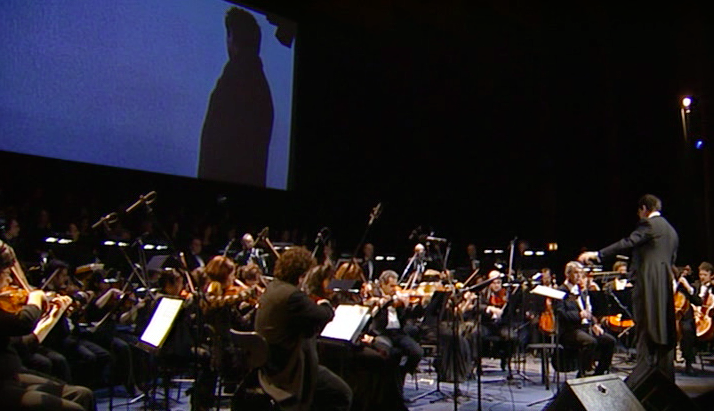
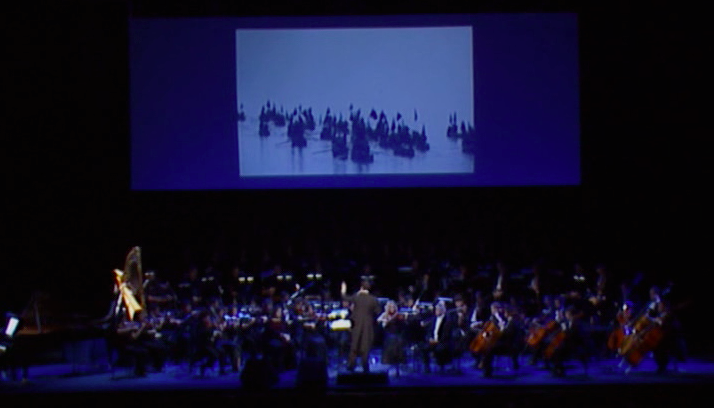
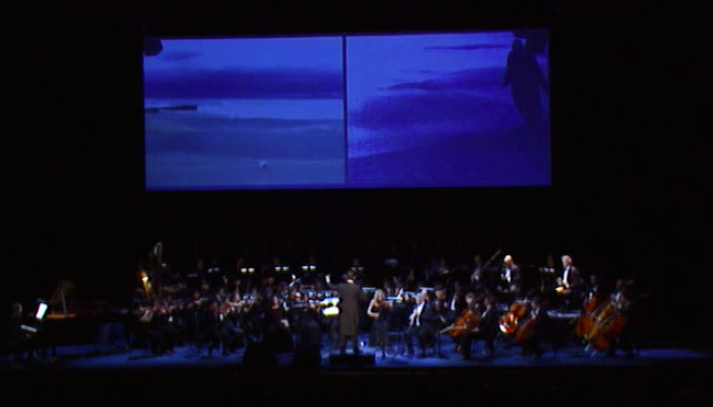
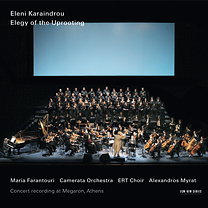
Elegy of the Uprooting condenses two decades of work by Eleni Karaindrou into what the Greek composer calls a “scenic cantata.” This is no mere retrospective, but a gravid musical statement in which the listener’s soul is carefully unfolded to reveal the sounds hidden within. Excerpting 13 scores for film and stage, this concert pulls out the red threads running through Karaindrou’s non-diegetic oeuvre with stunning video and audio clarity.

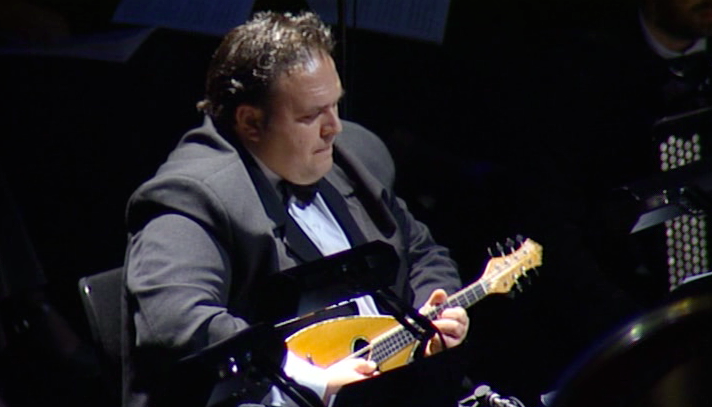
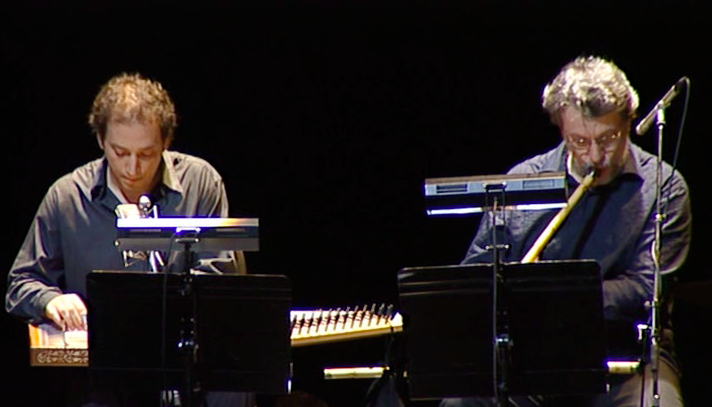
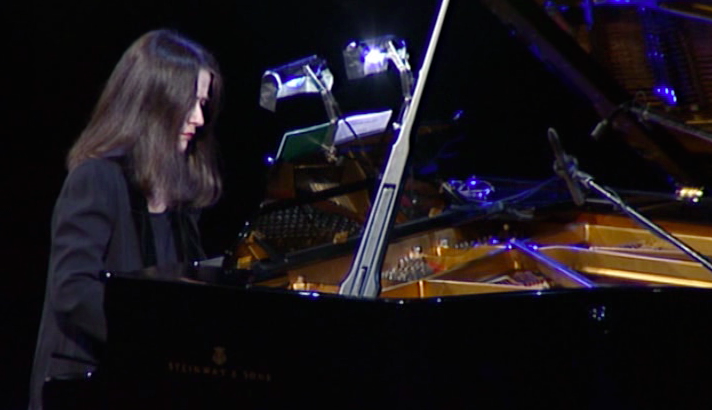
Of the 110 musicians seen in this live DVD—including an orchestra, chorus, and ensemble of traditional instruments—many of the soloists have been working with Karaindrou for many years, and their dedication shows. Of note are…

Vangelis Christopoulos on oboe:

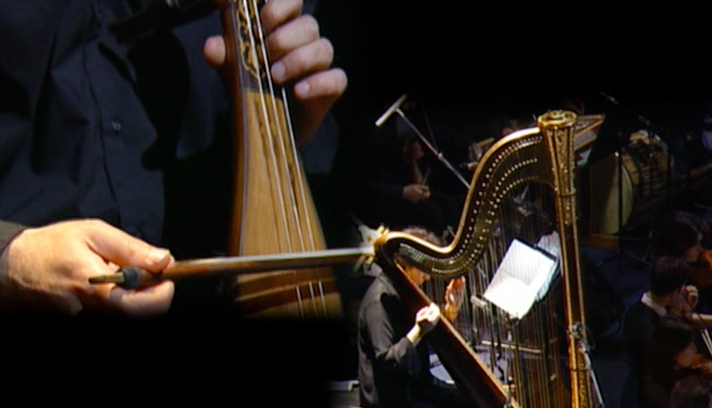
Socratis Sinopoulos on the Constantinople lyra/Maria Bildea on harp:

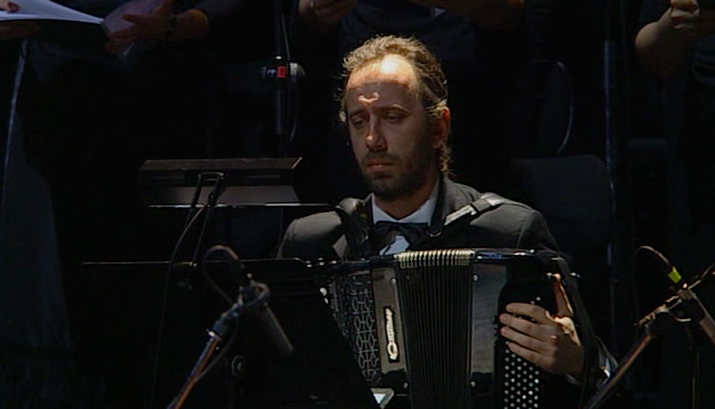
Konstantinos Raptis on the bayan:

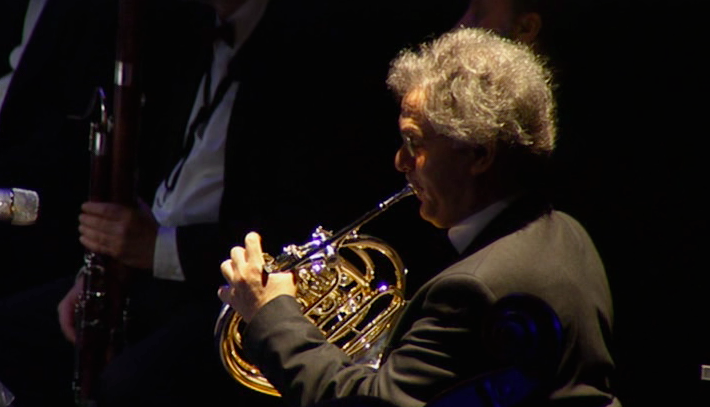
Vangelis Skouras on French horn:

Aris Dimitriadis on mandolin:

Panos Dimitrakopoulos on kanonaki/Christos Tsiamoulis on ney:

and the composer herself at the piano:

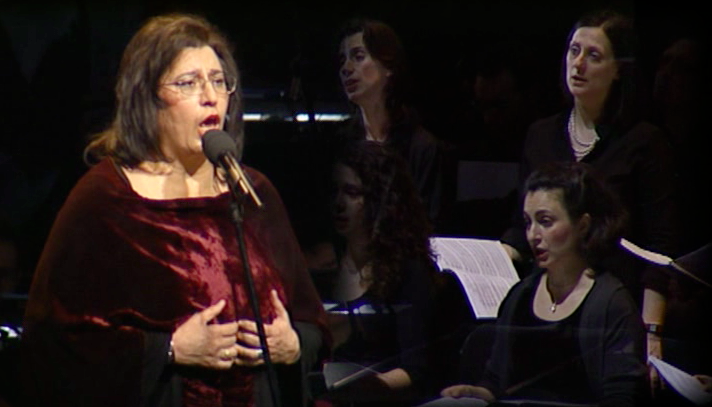
Much of the music will be familiar to ECM enthusiasts: Ulysses’ Gaze, The Suspended Step of the Stork, Eternity and a Day, The Weeping Meadow, and Euripedes Trojan Women feature heavily in this wide-ranging program, with the latter two in particular providing a larger thematic framework. Lesser known works such as the stunning Rosa’s Aria—from the film by Christoforos Christofis and reinterpreted here with total corporeal commitment by the legendary Maria Farantouri—should excite veteran and new listeners alike.

The staging was overseen by Manfred Eicher and is accordingly minimal. A large screen behind the musicians displays artfully arranged stills and clips from Angelopoulos’s films, as well as some computer generated imagery of swaying reeds, falling rain, and shooting flames.

It’s a joy and a privilege to see such a synergistic group of musicians banding together to share such doleful beauty, and to see the physical process of it all, the sheer assembly of talent and logistics required in putting together such a performance.

In all this rhetoric lately of carbon footprints and the detrimental impact of human activity on the physical environment, it’s easy to forget that our creativity often leaves the most “eco-friendly” impressions. Karaindrou has created for the world a statement without tangible shape, a visceral wave of melancholy into which we may project a semblance of ourselves. Like the water that figures so prominently in Angelopoulos’s films, her music ebbs and flows in spite of our foibles.

Elegy of the Uprooting is also available in this 2-CD set. I highly recommend both, for each is its own experience.

Keith Jarrett: Tokyo Solo (ECM 5501)

Keith Jarrett
Tokyo Solo

Keith Jarrett piano
Recorded October 30, 2002, Metropolitan Festival Hall, Tokyo
Directed by Kanama Kawachi

Over a career spanning nearly 70 recordings for ECM alone, Keith Jarrett has established himself as one of the world’s most inimitable and revered musicians. We marvel at his music-making, at his technical prowess and innovation, but rarely do we get to experience the physiological creativity so vital to what he does. For this concert, Jarrett’s 150th in Japan, the one and only has given us a primary source in video form, a clearer glimpse into the complexity of his craft. On the surface Jarrett is a lone pianist whose humble frame elicits some of the more towering improvisations one is ever likely to hear, and here we get to see what lies beyond that surface to the fiery core that sustains him. As he quietly takes the stage the house lights dim to circumscribe the piano, leaving Jarrett and his instrument suspended in darkness.

He blows on his hands and draws an abstract veil over our eyes and ears. What we hear is serial, boastful yet self-deprecating, and, while not entirely accessible, betrays total commitment to a challenging trajectory. Jarrett works his way through a dense cloud of notes, as if searching for the perfect one, which he finds and intones as his face contorts in mimicry of the depths plied with every repetition.

This instigates an ecstatic passage of finger pedaling, which eventually brings Jarrett to the piano’s outermost reaches. He plays a single high and low tone together before returning to the center, as if he were gently embracing every note available to him before singling out a privileged few.

We then enter the most emotional portion of the concert. Jarrett cannot help but sing along, as much in deference as we are to the sounds flowing through him. At this point we come to realize that the opening jumble was nothing more than a search for any fragment he might be able to expand into a larger narrative, and that this is the tale we are about to hear. As Jarrett begins the next section, someone claps. He stops and listens carefully before scrapping everything in favor of a new idea. What follows is an agitated catharsis that gradually beats itself into a more elegiac shape. So ends Part 1.

Part 2 is more like what we have come to expect from a Jarrett solo concert: protracted, pastoral bliss. With lips puckered and brow furrowed, Jarrett dives headfirst into a quiet maelstrom of beauty, precursor to a grinding tangent that stops as suddenly as it develops. In spite of the serious approach he manifests in his performance style, Jarrett is not without his lighter moments. He even flirts with the audience’s attentions at one point during the concert. He has just played a delicate high note to close an epic improvisation. Applause begins, but he signals silence, only to play that same note a final time. He smiles and says, “That’s it.”

From this laughter he emerges with a brilliant cascade to close. Not wanting to leave his audience without something familiar, he returns to the stage for three encores: Danny Boy, Old Man River (Jerome Kern), and Don’t Worry ‘Bout Me (Art Tatum/Count Basie)—all of them pulled off with unparalleled intuition.

Those wanting to get more out of the Keith Jarrett experience need look no further than this DVD. The camerawork and recording are simple and direct, capturing the full range of expressions and contortions at Jarret’s disposal, and the crisp sound ensures that we hear every surrender. Jarrett shows a profound respect for what he plays, be it a standard or something composed on the spot. The image of his spotlit piano is the perfect metaphor: the musical alchemist toiling over his crucibles while his admirers fall awestruck into shadow. That being said, it’s easy for us to over-romanticize Jarrett’s process, to wonder where he goes when he improvises with such fluidity. Thankfully in Tokyo Solo we no longer need to wonder, for in a performance such as this we share the same space.

Fraying the Thread: Dave Holland Quintet Live Report

Dave Holland Quintet

April 18, 2010
Buckley Recital Hall @ Amherst College

Dave Holland bass
Robin Eubanks trombone
Steve Nelson vibraphone, marimba
Chris Potter alto and soprano saxophones
Nate Smith drums

As a graduate student with limited time and financial resources (a redundant statement, if ever there was one), I find that going to live shows has become all too rare a luxury. Lack of a car further constrains my options, and so I am deeply appreciative of the musical opportunities that a college community brings to the hermetic academic. Where else could I have experienced the wonders of Zakir Hussain, stumble upon a free performance of Dvořák’s New World Symphony, and bask in the sounds of the Dave Holland Quintet for less than the price of a good dinner, all within a three-week period?

The venue for the latter was a packed Buckley Recital Hall at Amherst College. And while the space didn’t seem at first particularly suited for a quintet of such explosive caliber, a few knob-turnings from the sound technician worked out the kinks soon enough. After a brief introduction, Holland and his crew took the stage. The man himself offered a quip or two to an eager audience before jumping right in.

“The Balance”
The opening bass line was pure Holland: a mixture of delicate highs and thrumming lows that set the tone with unmistakable immediacy. Through this freshly strung loom, vibes, soprano sax, and trombone strung their own vivid threads. The group began by scaling up the improvisatory ladder with practiced precision, holding fast to a tight core of unity while venturing just close enough to the edge to gauge a drop to certain doom. A trio of drums, vibes, and bass provided solid ground for the horns, with ample room to roam. This led into an artfully performed passage of more staid harmonies before Eubanks broke free, jumping nimbly through invisible hoops as he dyed this mosaic with a guttural ferocity that was as viscous as it was effervescent. Just as the tension rose, Smith brought his drumming to a halt, stopping and starting playfully, paring down the music to a variant trio. With full support from bass and drums, Nelson loosed a barrage of half notes that shimmered like a hailstorm in sunlight. The horns returned on the heels of a violent drum kick, which soon relaxed into a head-nodding interplay of rim shots and hi-hat, bringing the ensemble down for a slow and easy landing.

Next up was a tune from the latest Octet CD, Pathways. An extended and soulful bass solo lulled the crowed into an intimate silence. Holland’s fingers made the lows sing, milking the amp for all it was worth, while his highs fluttered like wings. Just then, our rapt attention was broken by a cell phone, which Holland simply smiled away as Eubanks placed a hand on his chest and mouthed, “It’s not me.” Before long, Smith picked up the beat, ushering the others into more distinctly composed material as alto sax and trombone leaped across rim shots and cymbal rides. Potter’s first major solo of the evening began tentatively, as if he were putting out his feelers before releasing a modest joy. Bass and drums kept pace like a fast-moving train. Suddenly, the mood changed, and I felt like I was in a dingy nightclub rather than an immaculately kept concert hall. Smoke billowed in the darkness with every turn of phrase. Potter let out the occasional impassioned screech, each strategically placed amid clusters of glistening notes, then moved into a series of sustained tones over a spate of superb drumming. This paved the way for a ferocious solo from Smith, who elicited nothing short of gunshots from his snare. Yet Smith also proved his finesse with a delicate splash of cymbals, to which Holland added a few lobbing glissandi, before locking into a full-fledged groove. Holland eased his way in, ushering the theme’s return, which was then picked up by Potter. The group ended with a staccato burst in triplicate.

“Souls Harbor”
Holland broke out his bow for the opening lines of this Potter number before Nelson and Eubanks began hanging a series of triads from the composer’s smooth lead. Vibes asserted themselves with a bass-like steadiness. Holland swapped bow for fingertips and plucked his way out of a fluid intro. Potter and Eubanks laid out the main theme in perfect unison. After splitting into two-part harmonies, they rejoined as a single voice against Nelson’s ostinato. Eubanks’s emergent solo was one of the evening’s most idiosyncratic, sounding like a foghorn yearning to sing its woes across the waters. As the music gathered speed and energy, laced with incredibly dexterous runs, vibes crept along the cove with their slow return. Potter’s reappearance made for some subtle harmonization before Smith cracked open a livelier beat. At this point, Potter and Holland wandered off into an abstract, but strangely lyrical duet. To this question, Smith and Nelson had an expansive answer, fraying the thread of their overall sound into its determinate strands. Potter’s sax screamed, making its voice known above the din even as it parsed itself. And before we knew it, everyone was back into thematic material, closing in solid agreement.

“Walking the Walk”
This newer composition began in a solid triangle of bass, drums, and vibes. With the entrance of the horns, we were treated to a mélange of moods before settling into an arid sound, opened even wider by Nelson’s gorgeous four-mallet stylings. This was the vibraphonist’s time to shine. With the barest shades of the opening proclamation, he tread confidently in familiar territory and receded as Holland took the cue. The shuddering high notes, resplendent vibrato, and rumbling lows of Holland’s solo filled the space with the instrument’s deepest possibilities. All the while, Smith relegated his playing to the rims. Sax and trombone once again took center stage and ended in a paroxysm of beauty.

Holland’s quiet count kicked off “Secret Garden.” Hot off Critical Mass, this tune continued the dune-laden dynamics. It was at this point that Nelson finally turned to the massive marimba at stage left, lending a certain organic flair to the overall sound. With the theme dispensed, Holland and Smith rode easy to let the light of Eubanks break from behind the clouds. Eubanks stretched his breath to its limits, occasionally singing into the trombone for a chorused effect. Smith, meanwhile, tore a page from the Joey Baron handbook and drummed with his hands. Soon, it was just Smith and Holland for the latter’s brief solo turn, singing upward as the horns and vibes reinstated the path upon which they first led us in this taxing yet scenic journey. A flickering strand of bass and marimba brought us to our destination.

Last on the menu was “Step Tunes,” another new piece that showcased the quintet at its most blistering. After a brief blast from the horns, Nelson took over with some incendiary support from Holland and Smith. The brass returned, and presaged the most stellar solo of the evening from Potter, which brought thunderous applause from the crowd. Nelson was left to pick through the aftermath and find still more to salvage. His notes ran up and down with the abandon of a child at play, letting the occasional sustained note ring through the body. The return of Eubanks and Potter was almost anticlimactic after such inspired displays of joy. After a concise drum solo, the musicians converged and, with a glance from Holland, fell back into the center.

The audience wasn’t about to leave it at that, and cheered for more. Thankfully, dessert came in the form of “Easy Did It,” a short but sweet encore dedicated to the city of New Orleans. And indeed, it was like mashing five jazz clubs from The Big Easy into one delectably harmonious confection. The quintet blossomed with a soulful theme, punctuated by a couple of low blasts from Eubanks and painted with broad strokes from Potter, whose penultimate cries on soprano signaled the winding down of the evening’s song.

In its current incarnation, the Dave Holland Quintet is an unstoppable force. Seeing them live deepened my understanding of their relationship and their process. Holland’s bass lines are like supremely fashioned entities whose entire physical makeup is as taut as the strings that tell their life stories. He smiles, eyes slightly squinted, and leans into his bass with the lilt of a conductor’s baton. Eubanks plays with closed eyes, his entire body rocking into the balance of every piece. Smith is constantly looking up, as if to let his drum kit whisper and shout of its own accord. Nelson dances left and right, navigating the broad terrain of his instrument with the deftness of a boxer. Potter’s approach is rather different, as nonchalant as it is utterly embodied. It’s as if he refuses to lock himself into any motif for too long, more interested as he is in finding out what awaits just around the corner. He is always turning and weaving through the crowd of his musical ideas, pickpocketing whatever interesting tidbits he can along the way and exhibiting them with minimal mitigation. I also enjoyed seeing how the musicians performed as a group, sometimes leaving the stage or standing off to the side when they weren’t needed, coming back at just the right moment to an unspoken signal. Their synergy was complex without being complicated.

The quintet’s compositional astuteness was also clearly evident. These were far from the concise ditties that characterize so much of what constitutes jazz in the mainstream. Rather, they were (with the sole exception of the encore) 10- to 15-minute epics of form, freedom, and style. Theirs is beautiful, heart-wrenching music that stands firmly in tradition even as it thinks over the horizon. Their sound is rich, evolved, and never content to type itself. Although Holland has, with the founding of Dare2 Records, deviated from his 34-year stint with ECM, he nevertheless carries with him that same communal spirit instilled in him through his seminal work with the label. He is always about dialogue, even when playing alone, for jazz is nothing without response.