Live Report: Made in Chicago at Cornell

Made in Chicago

Made in Chicago
Live at Bailey Hall, Cornell University
October 4, 2015
8:00pm

In 2013, a year after being named a National Endowment for the Arts Jazz Master, drummer Jack DeJohnette was asked to perform at the Chicago Jazz Festival. Given a free choice of bandmates, he convened reedmen Henry Threadgill and Roscoe Mitchell, pianist Muhal Richard Abrams and bassist Larry Gray on far more than a whim. Their connection runs back to the early 1960s, when DeJohnette was making a name in his hometown of Chicago. Abrams and company would go on to found the Association for the Advancement of Creative Musicians, or AACM, from whose ranks would arise the legendary Art Ensemble of Chicago. By that time, DeJohnette’s career was already taking off in New York City. Still, he never forgot those formative spaces, where Chicago cats would play together for hours on end in the city’s legendary “loft” concerts, performed in musicians’ homes. As frequent host Mitchell recalls elsewhere, “Every time I get together with musicians from the AACM it’s like we are just picking up from wherever we left off.” And so, despite having never recorded before as a quintet, an organic unity abounded when the historicity of the 2013 gathering was captured as Made in Chicago, released this past January on the influential ECM Records label.

If the album can be said to be a feather in the cap of DeJohnette’s already vast output, then by now that same cap could surely unfurl wings and soar of its own accord. His discography reads like a Who’s Who of modern jazz, ranging from untouchables like Miles Davis and Ornette Coleman to the brightest stars, among them bassist Esperanza Spalding and trumpeter Ambrose Akinmusire, of the here and now. Although his integrated style is recognizable across a spectrum of genres and cross-cultural collaborations, his open-door policy with ECM has yielded some of the finest projects of his career. Whether in the Gateway Trio with bassist Dave Holland and guitarist John Abercrombie or the pet project known as Special Edition (which included pioneers Baikida Carroll, Chico Freeman, and Rufus Reid), to say little of the enduring Standards Trio with bassist Gary Peacock and pianist Keith Jarrett, DeJohnette has consistently brought an exhale of soul to every inhale of heart that imbues whatever musical organism he touches. All this and more was in clear evidence on Sunday night as Made in Chicago kicked off this year’s Cornell Concert Series on the Bailey Hall stage.

Before a single gesture of the band went live, I had the rare privilege of interviewing Mr. DeJohnette in an open Q&A session the previous afternoon. I asked him about his association with AACM musicians and how it shaped his musical identity. “Back then, we were cultivating an original approach to improvisation,” he told me in his thoughtful yet humble manner. “AACM’s motto was to establish the serious intentions of everyone that came out of its ranks. Jazz wasn’t simply improvisation, but a continuation of improvisation, creation through a process by which everyone and everything in the multiverse is hardwired to do. That concept fuels me and this combination of players that I got together. To play spontaneously is a challenge. You are exposed. The ability to compose on the spot, to create motifs and rhythms and communicate those not only to the other musicians but to the audience … It’s more like soundscapes, painting in sound.”

I asked DeJohnette whether he felt that hanging out with the AACM crowd allowed him to explore spontaneity in ways he hadn’t before. “Definitely,” he agreed. “Chicago prepared me for New York. It was my school. You practiced at home, but you played and developed your consistency to create and improvise fluidly on the instrument by performing. I don’t like the term ‘free jazz,’ because it’s not really free. The real freedom is in the choices we make. That’s why I always prefer to think of it as spontaneous composition.”

Indeed, we do well to remember that DeJohnette is a composer at heart, crafting — whether off the cuff or with more forethought — melodic and intervallic structures with the ease of a lifelong painter at the canvas. The analogy is not ill-chosen, for it is one that DeJohnette shares in reference to his own craft. “I’m not just a drummer,” he said of the capacity in which fans are more likely to understand him. “I’m a colorist who paints and participates in the music both harmonically and rhythmically.” He likewise cites the piano as a central component of his sonic upbringing. It was his primary instrument and one to which the drums were a later addition.  “I used to spend three to four hours a day on each instrument, because I wanted to bring the drums up to the level of my piano playing. The piano helped how I heard the ensemble, tuned the drums and how I approached the cymbals. If you listen to cymbals closely, they have a gong-like resonance, a higher frequency. Both piano and drums, of course, belong to the percussion family, so for me the two instruments have always overlapped one another.” This idea of overlapping is immortal in DeJohnette’s musical worldview, by which the growth of his art comes across with that much deeper inherency.

Where in the latter vein DeJohnette brought the wisdom of history, Abrams brought the wisdom of process when, following the Q&A, he led a master class for the Cornell University Jazz Band. Since co-founding the AACM, Abrams has had a formidable career of his own not only as a musician but also as a bona fide composer, his String Quartet No. 2, for one, having been premiered in 1985 by the Kronos Quartet at Carnegie Hall. It was from beneath the shadow of this hat that Abrams addressed the young musicians with poignant, if dense, nuggets of advice. “I’m interested in what you don’t know about yourselves,” he told them. “Allow your imagination to go inside.” Simple words on paper, to be sure, but difficult to embody in practice. In his sagacious, patient manner, Abrams worked through moments of confusion and revelation with equal attention, encouraging students to “give it presence” here or “create however you want to play it” there whenever hesitations manifested themselves. All of this was meant to bring across a central point: Evolving jazz artists feed not on the carrion of others, hunt not for things that have been found. Rather, they dig within and give us something we can carry on into the future.

Nowhere was this so aptly demonstrated as in the performance proper, in which the straight line paved by DeJohnette and Abrams yielded a downright ritualistic pentagon when Made in Chicago gave presence to 90 minutes of uninterrupted experience. No titles were given to the concert’s four long tunes, and perhaps any announcement thereof would have imposed on their continuity. The first piece, which felt more through-composed than improvised, opened where most jazz performances wouldn’t: with a cello solo. Gray’s bow was mellifluous yet robust, trailing a mournful shadow by its gait. Like so much of what followed, it catalyzed a play of frequencies, at once ancient and of the moment. One by one, the rest of the band followed suit. As Mitchell’s full-throated alto, DeJohnette’s selective contacts, Abrams’s starlit keys, and Threadgill’s incanting flute took shape, one could almost feel the molecules transforming in the room. It was, I would wager, a challenging introduction to those who were expecting to tap their feet to something recognizable. But as Abrams surely would have reminded us, it was all about sharing a search for the unknown.

How lucid this philosophy blossomed as the pianist himself introduced the second tune, rippling into Mitchell, whose alto proved a force to be reckoned with. His penchant for circular breathing and complex finger work led to some of the concert’s most arresting developments, contrasting beautifully with Threadgill’s halting pointillism. It was as if both were navigating a rift between dimensions, only one was trying to escape while the other was content to remain where he was. Gray and DeJohnette meanwhile played not so much off as through each other, shifting their densities to allow for Abrams’s extensions. Like a player piano gone haywire, his keys seemed to move of their own accord. From there the band whittled its way down to DeJohnette alone, crisply defining every hue with painterly intelligence, as he did also in the next tune, which found him exploring the possibilities of a full-contact drum synthesizer in a veritable rain forest of utterances, and in the final piece, recognizable as Mitchell’s “Chant” from the quintet’s recent album. Here Mitchell dominated on the shriller sopranino saxophone, keeping step with Abrams’s mounting speed. If anywhere, here was the potential of simplicity to the fullest, a difference through sameness that blew the candle flame of inspiration enough to keep it wildly dancing but unextinguished.

For its encore, the quintet proceeded whimsically, Mitchell (switching between three saxophones) and Threadgill (on alto) playing with expectations over the solid groove laid down by DeJohnette, who demonstrated himself, like the band as a whole, for all a peaceful commander. As the musicians turned on their last dime, strangely evoking a feeling of travel by way of suspension, I couldn’t help but be reminded of what DeJohnette had said the day before: “I just follow where jazz wants me to go, and where jazz wants to go depends on what humanity does with the challenges we face as a species. We have to adapt to our environment, and I think that music and art speak to that. I don’t know if you’re going to have any more John Coltranes and Miles Davises, but there will always be people addressing the times we live in through their music. The actual event of getting together and playing music together is vital. The people who come to listen are instruments, too.” Which is not to say that we as an audience were being played, but invited to join our notes of appreciation to theirs of generation.

Among the handful of albums in the DeJohnette catalog to which I find myself returning with especial frequency is his 1997 ECM effort Oneness. In addition to its moving progressions, this understated leader date boasts one of his most emblematic titles. Oneness is no mere throwaway concept, but a core tenet of this essentially ad hoc collective. It is an overarching expression for what DeJohnette and his peers can do, a testament to their quasi-spiritual quest for unity. As Abrams mentioned in his master class, musicians don’t need to be anywhere else than where they want to be, and neither did the fortunate listeners, as we sought purchase in the increasing density of their comet’s tail. They followed wherever the sounds wanted them to go and, despite the distant past implied in their advancing years, had nothing but the future in their hands.

(See this article as it originally appeared in The Cornell Daily Sun here.)

Live Report: Avi Rothbard Trio at Smalls Jazz Club

Avi Rothbard Trio
with Jay Leonhart (bass/vocals) and Tomoko Ohno Farnham (piano)
Smalls Jazz Club
22 June 2015
7:30pm

Israeli-born guitarist and composer Avi Rothbard has earned his stripes in the relentless music scene of New York, where he has lived since 1999 and where his talents have found their way into a range of projects. With such a full palette already on his own, only those musicians with the right sensibility will do for bandmates, and a trio performance with bassist Jay Leonhart and pianist Tomoko Ohno Farnham at Smalls in June of 2015 was just what the doctor ordered in this regard.

Over the course of two richly varied sets, Rothbard and friends managed to balance their idiosyncratic strong points within a smooth group unity. Each musician brought a distinct signature to the stage without ever clashing for dominance. Farnham’s compacted, cellular approach to soloing, for instance, tapped the flavors of old-timey jazz to everything she touched. Whether comping beneath Rothbard’s leading tone in Randy Weston’s “High Fly” or bringing nostalgia and joy to the music of Wes Montgomery and Kenny Baron, she maintained a free, conversational tone. She further showed her inventiveness in Herbie Hancock’s “Dolphy Dance,” for which, in tandem with Rothbard’s sensitive touch, she spun fresh colors from the older threads.

Rothbard, for his part, stretched each tune until it fit like a favorite shirt. As composer, he spearheaded some of the most impressive turns of the night. Three originals—“Eye Talk,” “Twin Song,” and “Minor Impact”—acted as vibrant springboards for the band’s communicative potential, each more appealing than the next. With moods ranging from lyrical to blinding, they had an overall ductile quality that adapted itself to the themes at hand. As technician, Rothbard bared his chops on the theme from I Love Lucy, an unexpected highlight made all the more brilliant for its arrangement and virtuosic energies.

Overall, the drum-less roster allowed the band members to revel in open improvisational spaces. Leonhart was particularly on point in this regard, his playing so percussive that the sticks and skins were hardly missed. A fixture in the New York jazz club scene, Leonhart sang not only through his instrument but also along with it, offering two originals of his own—a self-deprecating blues called “Joy” (another fine vehicle for Farnham) and a humorous ditty about sitting next to Leonard Bernstein on a plane—and a lighthearted take on “Cool,” from Bernstein’s West Side Story.

With so much to appreciate in terms of execution and variety, the Avi Rothbard Trio delivered exactly as advertised, plus a few surprises thrown in for good measure, for a thoroughly enjoyable summertime gig that was the very essence of cool.

Two live reviews for All About Jazz

My latest reviews for All About Jazz should be of interest to ECM fans. The first is of a concert at New York’s Birdland given by Sheila Jordan, who reunited with pianist Steve Kuhn for a week of stellar performances. The second is of a concert given at Cornell University by the Ravi Coltrane Quartet. Among the band was pianist David Virelles, who stole the show with a tune from his ECM leader debut, Mbókò.

Jordi Savall: A Melancholy Rose

Jordi Savall
(Photo credit: Molina Visuals)

On 24 January 2003, I witnessed a vibrant soul at play on Vienna’s Konzerthaus stage. Leading La Capella Reial de Catalunya and Le Concert des Nations in a program of madrigals and sinfonias by Claudio Monteverdi, Johann Hermann Schein and Samuel Scheidt, Jordi Savall’s performance was everything the music was: thrilling, captivating and, above all, inviting. On April 15, hunched over his bass viol (the fretted, cello-like instrument of which he is a legendary virtuoso) and accompanied by soloists from Le Concert des Nations, I saw a changed man—a man playing for himself, as if into a mirror.

It was more than a little surprising that, from a musician who boasts nearly 200 recordings, we should encounter such a pedantic program. Composers Jean de Sainte-Colombe and protégé Marin Marais were surely familiar to anyone who has at least glanced at Savall’s 40-year career, which broke international waters when he provided the soundtrack for the 1991 film Tous les Matins du Monde, a dramatization of Marais’s relationship with his reclusive teacher. By far, the musical offerings from those masters of the instrument were highlights of the evening’s performance. Sainte-Colombe’s brooding Tombeau les Regrets was a rare chance to hear Savall in duet. The sound of two bass viols alone was nothing short of transportive. Even the leading violin of Marais’s Sonnerie de Ste-Geneviève du Mont-de-Paris, an inventive piece meant to evoke the din of church bells, could do nothing to undermine their resonance.

The same could not be said for the rest of the program, which distilled unremarkable background music from some of the biggest names in the 17th-century French Baroque. Anonymous selections from the era of Louis XIII set the tone for the program’s theme, which sought to articulate the splendor of the French Bourbon court. And yet, what began as a royal affair settled into what felt like a glorified rehearsal. This was not only because of the awkward staging (the musicians were, for instance, left floundering without assistance when a music stand broke), but also because court music was for the most part incidental and not designed to be heard out of context. And so, whatever stateliness might have infused its origins, this music came across not as regal but as dolorous. This rendered the listening experience both intriguing and depressing. While on the one hand we could feel ourselves traveling back in time, on the other it reminded us of the transience of power and arbitrariness of kingly life. It was like hearing history crumble before our very ears, leaving only a handful of extant sonic monuments to an unrecoverable age. Even the jewelry of violin and flute seemed to harbor shadows of doubt. It was a strange thing: this music would not have existed without the power structures that engendered it, but its occasional beauties spoke of realms far beyond any artifice of courtly refinement.

From a curatorial perspective, missed opportunities abounded. For one, there was no chance to hear the unaccompanied solo viol, and two duo miniatures by Antoine Forqueray and his son Jean-Baptiste were etudinal at best, further diluted by a superfluous keyboard backbone. Despite father Forqueray being once called by Savall “a knight who is always on the verge of working his horse to death, but who knows his horse too well to go quite that far,” there was little proof of concept. For another, to be in the presence of renowned harpsichordist Pierre Hantaï, only to find him relegated to a continuo (i.e., supporting) role was curious, even if we did hear some of his brilliance come through in three selections from Jean-Philippe Rameau’s 1741 Pièces de Clavecin en Concerts. Yet with so much rich keyboard literature to choose from among the likes of Rameau and François Couperin, I couldn’t help but scratch my head over the latter’s Les Concerts Royaux, of which the three sections played were like the courtiers they were meant to entertain: passive and overdressed. (Far more active, though no less dressed, was the suite from Jean-Baptiste Lully’s 1670 Le Bourgeois Gentilhomme, after which the musicians were, for once, visibly satisfied.) Why not choose from something more suitable for a live setting, such as Couperin’s 1728 collection of suites for viol? Likewise, the inclusion of Jean-Marie Leclair’s Sonata in D Major, Op. 2, No. 8 was apocryphal at best, especially when one considers the lack of any credible evidence suggesting that Leclair even played at the court of Louis XIV. Why not instead bring another violinist and play the far more mature fascinations of his Opus 5?

In light of the fact that Savall has become increasingly known as an artist of difference, weaving together wide-ranging faiths, histories and spiritual threads through the loom of his musical vision, perhaps there was too much similarity. In the end, the playing, while effortless, was self-contained and the virtuosity incidental. And while one may never fully see into the heart of another, it was impossible to watch Savall and not mourn for him. Since facing immeasurable personal tragedy in 2011, we may only speculate about the depth of his loss and stand in awe at his creative resolve. Having recently lost someone close to me, I am admittedly primed to give such a reading, but I couldn’t help but feel the melancholy rose of his heart wilting just a little under the spotlight. It made me want to hear him play alone, if only to let that heart sing without obstacle, so that it might throw open a window into its own unrecoverable past. With this realization—or projection, if you will—in tow, I left the concert hall berating myself for the above criticisms and share them here only in the interest of full disclosure. It was a sobering reminder that there is far more to gain in this world than there is to lose. And at any rate, the world has gained so much from Savall already that one mere lackluster performance will leave no dent in his legacy.

Nrityagram Dance Ensemble Brings Magic to Cornell

Nrityagram

Nrityagram Dance Ensemble
Barnes Hall, Cornell University
February 4, 2015
8:00pm

Under most circumstances, calling a performance “magical” is like calling a sunset “picture perfect.” It reveals more about the limitations of the admirer than the uniqueness of what is being admired. That said, when Nrityagram presented Songs of Love and Longing to a packed yet intimate crowd at Barnes Hall on Wednesday night, the magic was undeniable.

Over an 85-minute traversal without intermission, the performance spotlighted the bodies, minds and spirits of dancers Surupa Sen and Bijayini Satpathy, both of whom are part of an intentional community (Nrityagram means “dance village”) in southwestern India, where they have dedicated their lives to expanding traditional Odissi dance forms through a gestural vocabulary that is very much their own. Along with a dedicated quartet of musicians playing harmonium, mardala (an oblong drum struck at both ends), violin and bamboo flute, they have lived and breathed their art before a variety of audiences around the globe. In this regard, just being in their presence was a wondrous experience, one that surely turned to whips of electricity for anyone fortunate enough to be held in a dancer’s gaze as she painted scenes with every calculated movement.

Interspersed with narration and threaded by singing, the program drew inspiration from the Gita Govinda, a Sanskrit poem written by the 12th-century mystic Jayadeva, and which describes the holy union between Krishna and Radha. Jayadeva defines their relationship not as one of divine lord and mistress, but rather as one of eternal reflection. The dancers’ ability to morph from one role to another (each switched between Krishna and Radha throughout) only served to emphasize their oneness. As Ms. Sen, who narrated verses offstage, said of Radha, “She revels in infinite spaces.” And indeed, one got the sense that Ms. Satpathy’s Radha permeated everything in the room. Whether plucking flowers from their stems or recounting Krishna’s slaying of the horse-demon Keshi, tracing a river’s flow or illustrating her lover’s redemptive touch, she showed exactitude in her comportment. Radha had all of creation in her grasp as fingers curled and splayed in sync with the live accompaniment. And that was when the first blush of magic came about, for as she shot out a hand into the air, a bat seemed to fly from her open palm. (In fact, the bat had been trapped in the hall and was startled by the mardala drum’s riveting entrance.)

As the story of Krishna and Radha ratcheted the tension, so too did the dancers when sharing the stage for the first time. At any given moment, I was aware of their bodily centers, from which extended invisible cords that tied them in moments of unison. These were among the most memorable aspects of the performance and made the playfulness of their courtship all the more thrilling. It also clarified the subtleties required to evoke the yin and yang of their gender play. Together, they were the hub of a divine wheel, each spoke of which told a variation of an interlocking story. This only served to underscore Krishna as a willing and able prisoner of Radha’s consuming love. The effect was such that, even when Krishna left his lover alone in pursuit of another, her power grew that much greater as she gathered resolve from the forest. When Krishna returned to her at last, he was a peacock spreading his tail feathers in a desperate bid for her attention.

Despite the obvious effort gone into its artistry, the sophistication and elasticity with which Nrityagram evoked these images was extraordinarily organic. Whether in its gallery of glances—at one moment burning with desire, the next cold with menace—or the ankle bells that became a part of its constant texture, the dance was a world unto itself, its spell so potent that every break for applause bordered on intrusive. We were no longer winter-weary travelers on Earth but participants in dialogue above it. As one moment became many, and those many more, Nrityagram proved that real magic takes root in the sacredness of human experience.

(See this article as it originally appeared in The Cornell Daily Sun.)

Prague Philharmonic Choir Tricks with Treats at Bailey

PPC

The Prague Philharmonic Choir
Bailey Hall, Cornell University
November 2, 2014
8:00 pm

Program changes can be tricky. The world-renowned Prague Philharmonic Choir singing Rachmaninoff’s Vespers, plus music by Dvořák and Janáček? Yes, please. Sadly, this was not the case when the choir came to Ithaca for Sunday night’s concert with something else in mind. Thankfully the new set list, as it were, offered plenty of delights to make up for unfulfilled expectations. The music of Czech composer Antonín Dvořák carried over by way of three works not often heard stateside. His Moravian Duets (1876), of which the sopranos and altos sang five selections to piano accompaniment, imbued Bailey Hall with a transportive, fairytale quality. Between the somber, overlapping lines of “The Maid Imprisoned” and the mélange of tones and tempi that was “The Ring,” these settings of folk poetry covered a wide and dramatic range. The Three Male Choruses on Folk Texts of 1877/78 followed, bringing contrast not only by the switch of roster, but also within the tripartite piece itself, marrying bright pianism with stark singing. With titles like “Sorrow” and “The Maiden in the Wood,” these songs engaged weighty and fleeting emotions alike, and did so with enough strength to withstand an underlying longing of epic proportion. Lastly before intermission was In Nature’s Realm. Written in 1882, it boasts some of Dvořák’s liveliest choral writing. For its five-song traversal the full choir assembled at last, underscoring the hymnal quality of “Music Descended on My Soul” and luxuriating in the echo effect of “The Rye Field”—the latter a memorable highlight, among others.

In addition to enjoying the opportunity to experience this music live, one could very much feel the cultures and places it represented. Each piece was an illustrative vignette, to be sure. Just as impressive, however, was Dvořák’s piano writing. More than mere support for the massive vocal forces, it held its own as an equal partner. Yet perhaps most enjoyable of all was principal conductor Lukáš Vasilek, whose superb direction—all of it without a master score, no less—continued on through the concert’s second half: the Liebeslieder Waltzes of Johannes Brahms. Composed 1868/69 and performed by the full choir and four-hand piano, it embodied, compared to the Dvořák, an integrated sound that was darker, more amalgamated. What the waltzes might have lacked in melodic oomph they made up for in rich choral textures, a quirky sense of humor (as in the invigoratingly stubborn “No, There’s Just No Getting Along”), and turns from alto and tenor soloists breaking the dense surroundings into smaller chunks.

The choir encored with an ethereal arrangement by Swedish composer Jan Sandström of the popular Elizabethan carol “Es ist ein Ros entsprungen,” which split the singers into two groups and showcased their ability to be as airy as they had been compact. With downright orchestral expanse and a sublime bass section to its credit, the choir showed us the true meaning of a cappella, and a lot more besides. A real treat.

Kim Kashkashian and friends astound on tour

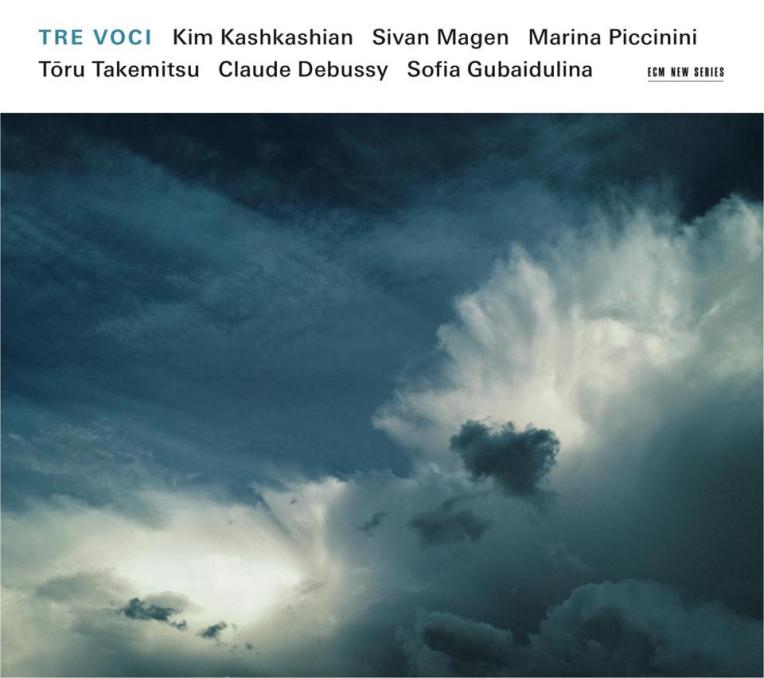
The peerless and ever-adventurous Kim Kashkashian has joined on tour this season Musicians from Marlboro. Among them are flutist Marina Piccinini and harpist Sivan Magen, the other two sides of Tre Voci, purveyors of a recent self-titled disc for ECM New Series. Click the cover below to read my exclusive Sequenza 21 report on their unforgettable performance in central New York.

Tre Voci

Beating the Highs and Lows: Sō Percussion at Bailey

So Percussion

Sō Percussion
Bailey Hall, Cornell University
October 24, 2014
8:00pm

Percussion ensembles and their repertoires can be hard sells in the contemporary music market. On the one hand, their emphasis on rhythm over, or in tandem with, melody makes them accessible to a broader audience than their classical allegiances might have us believe. On the other, that very slipperiness renders them moving targets in a genre-driven industry. The members of Sō Percussion, one of the leading quartets of its kind, bring such an eclectic mix of backgrounds, tastes, and talents to the table that any reliance on category would seem long dead. That said, Friday evening’s concert at Bailey Hall charted a disorienting EKG graph of peaks and valleys that left behind more questions than answers.

The program’s frame consisted of two perennial classics by composer Steve Reich. His 1973 Music for Pieces of Wood—a composition for five woodblock players that required a helping hand from Sō’s Operations Manager, Yumi Tamashiro—was captivating and clean. Although not overtly about melody, its pitch-tuned surfaces nevertheless overlapped in melodic ways, blending waves of rhythm into a seamless whole. Clapping Music, composed the year before, was the concert’s encore. Consisting of nothing but clapping hands, it brought the art of percussion to an even more primal level, using only the body and its discipline to enliven the space.

Moving in from either end, however, brought us to the program’s longest pieces, both of which relied on gimmicks that outweighed their musical results. Intriguingly, the score of Todd Lerew’s Flagging Entrainment of Ultradian Rhythms and the Consequences Thereof was mapped out like a choose-your-own-adventure novel, guiding performers to change paths based on their interactions (or lack thereof) with one another. Conceptually robust, despite the title’s dubious use of the word “ultradian,” and not without its beauties (the recurrence of bowed vibraphones and glockenspiels was nothing short of haunting), by the end it was unclear as to what the exercise was meant to achieve. In stark contrast to John Zorn’s influential game and file-card pieces of the 1970s and 80s, this one established a vague mood at best, in service of which beauty for its own sake felt ultimately arbitrary.

Sitting somewhere between the Bowed Piano Ensemble pieces of Stephen Scott and the guitar symphonies of Glenn Branca, but approaching the depths of neither, was Bryce Dessner’s Music for Wood and Strings. An electric guitarist known for his work with The National, Dessner enriches a selective rank of rock musicians, such as Radiohead’s Jonny Greenwood, that have had successful careers as composers. Yet whereas in other projects—check out his brilliant, heartfelt Aheym, in collaboration with the Kronos Quarte—he shines, too many rough patches overwhelmed the light of this particular experiment. The conceit of Music for Wood and Strings is a quartet of instruments, each a chromatically arrayed guitar neck laid flat and played like a dulcimer. Built with the assistance of drummer Aron Sanchez, who has also designed instruments for the Blue Man Group, their properties were exhaustively explored by Dessner and the musicians in kind. Despite the composer’s professed attempt to align “triadic chord inversions…in complex rhythm patterns to create a kaleidoscopic effect of harmony,” the end effect was neither rhythmically complex nor kaleidoscopic. After about the fifth missed opportunity for an ending, I was left asking: Had this piece been played on standard instruments—pianos, for example, or even plain old dulcimers, for that matter—would it have sustained attention for 30 minutes?

All of which left us with the program’s two star turns. As part of their ongoing commitment to education, the members of Sō Percussion held brief residency at Cornell last spring, during which time they collaborated with student composers to yield new works premiered during Friday night’s performance. Tonia Ko and Corey Keating, both D.M.A. students at Cornell, presented their pieces via the ensemble’s meticulous, animated approach. Ko’s Real Voices and Imagined Clatter was a multifaceted exploration of that juggernaut of the symphony orchestra: the timpani drum. Although her piece also made ample use of gimmicks and extended techniques, none seemed extraneous but rather a means by which to bring out the inner voices of the liberated drums. The strength of her piece was in the details: in the small gong that added a hint of gamelan, in the large gong struck only occasionally, in the delicate triangle and woodblocks clattering throughout. The atmosphere was immediate, artful, and, for lack of a better word, mountainous.

Keating’s Audio Geometry (Pythagorean Triple) for Percussion and Electronics might also be convicted of pretentious titling if it did not practice what it preaches. Scored for marimbas and live electronics, the latter courtesy of the composer on stage, it mapped a resonant and unearthly soundscape. Distortions derived from rehearsals of the piece itself were recycled, warped, and fed through echo chambers in a sampling spiral. What separated his and Ko’s pieces from the program’s subcutaneous selections was their willingness to be closed circuits. Each said what it wanted to say and nothing more. They were also the most musical, moving with organic care by way of a thinking-out-loud approach far more akin to jazz than to merely pedantic composing.

Despite the concert’s low points, and as emphasized by its highs, it was refreshing to encounter unfamiliar music and unfamiliar instruments sandwiched between two evergreens in the field. If anything, the evening’s diversity proved the bravery and exploratory spirit of four souls whose love for the beat reigns supreme.

(See this article as it originally appeared in The Cornell Daily Sun here.)