SPARKLER: I Colored It In For You

Sparkler

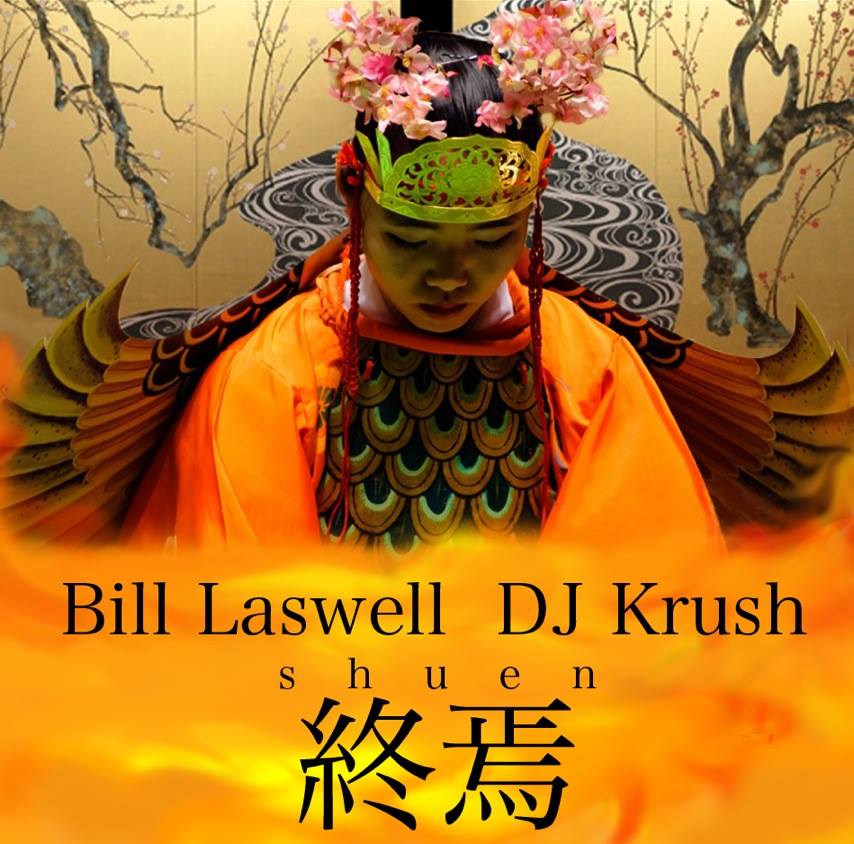
Bill Laswell’s “Incunabula” is a series of digital-only releases from the M.O.D. Technologies label. It has expanded the bassist-producer’s palette in directions ancient and futuristic, allowing freedom to strengthen his expressive reach. Part of that freedom includes promotion of artists from many walks of life, each highlighting one gradation of an ever-expanding spectrum. An apt metaphor, to be sure, in the context of I Colored It In For You. This debut single by SPARKLER kicks off the latest project from multi-instrumentalist Peter Apfelbaum, of New York Hieroglyphics fame. Having played with artists as varied as Don Cherry and the Grateful Dead, Apfelbaum presents here a 21st-century assembly of Natalie Cressman on vocals/trombone, Jill Ryan on vocals/alto sax, Will Bernard on guitar, Barney McAll on homemade instruments, Willard Dyson on drums, and co-producer Aaron Johnston (of Brazilian Girls) on drums and programming. Together they slide their way through two distinct tracks.

In the album’s EPK, Apfelbaum admits an affinity for extremes, as evident both within and between the song’s bifurcation. Part 1 shakes the night sky free of its galactic mess and uses it as a canvas for fresh, playful songwriting. The lyrics, while seemingly haphazard, reveal the randomness of a relatable mindset. Cressman and Ryan dress declarations of independence like “I’m gonna do it all” in frills of youthful confidence. It’s a whimsical contrast to the slickly crafted road beneath, and just off-center enough to make it endearing. “You make we wanna write ’til my memory is full” is another memorable line that blurs the separation between body and technology. The chorus moves through an honest groove, giving way to smooth horn work from the vocalists. Part 2 is more keyboard-driven and contradicts the previous incarnation with gentler, ephemeral transferences. A less bold and more reflective side of the band, it is an extreme in and of itself.

Rounding out the single is a Mix Translation (dub remix) by Laswell, who emphasizes the dreamy undercurrent, deepening the intro’s spatial qualities while rendering the voices into occasional messengers. A key bass line and drum beat kick things into gear, horns hopping in along the way, as the title phrase emerges in intermittent signals. Laswell crosses the song’s inner arc through gorgeous break-flow, surfacing with coral souvenirs.

It’s just the beginning of a journey, and I’m gonna hear it all.

(For ordering information, please visit M.O.D. Technologies here.)

Praxis: Sound Virus

Sound Virus

Sound Virus combines selections from the second (Sacrifist) and third (Metatron) studio albums of Praxis, featuring bassist Bill Laswell, guitarist Buckethead, and drummer Brain, along with inimitable contributions by John Zorn on alto saxophone and vocals by Yamatsuka Eye and Mick Harris. Both albums were released in 1994, during a particularly fruitful era for everyone involved, on the seminal yet ephemeral Subharmonic label. While such a description might lead one to treat the present compilation is merely that, it is in fact a reconstructed vehicle running on fresh cylinders. Not that fans won’t recognize enduring riffs from this eruptive supergroup; only that new fault lines will appear by the tectonic re-reckonings of producers and listeners alike. Tracks once separated by others find themselves melded in new biomechanical assemblages, while standalones emerge, nostalgia intact, in remastered clothing.

Three selections from Sacrifist indicate their mother context as arguably the edgier of the two albums, not least of all through the influences of Zorn, Harris, and Eye. Their juxtapositions not only of genres, such as they are, but also of atmospheres might seem audacious were it not for the inner logic of their grafting. Their placement is paramount. “Suspension” opens the skin, proceeds through several subcutaneous layers before nicking “Stronghold,” then lodges itself at last in the muscle of “Nine.” The latter track, originally billed as “Nine Secrets,” no longer has anything to hide, for it has stood the test of time. A masterpiece of the Praxis canon, it ends Sound Virus on a high note, flipping itself like a coin between industrial hell-scape (replete with Zorn’s spastic reed and Harris’s screaming) and tropical heaven (in which a squealing Eye swings whimsically from vine to vine). Here, as throughout, one encounters proof of the Praxis formula, solvable less through calculations of virtuosity than an unalterable dedication to every climate change. In the first Sacrifist throwback, for instance, initiatory transmissions of some other universe send out barest pulses via wormhole, indicating nothing of the onslaught about to ensue. The effect is not one of contrast or startlement, but rather of productive rupture that flags these audio signals as more than postmodern—they are posthuman.

Sacrifist

At its most aggressive, Praxis plies a melodic arc, finding truth in the pain of things through self-awareness. And because Metatron deals with the Laswell/Buckethead/Brain nexus alone, its commitment to a center line is even clearer. Noticeable is the foregrounding of Buckethead’s guitar, an instrument of such versatility that it’s like listening to history in the making. Those familiar with his prolific solo work will recognize seeds of later albums such as Colma (“Low Time Machine”) and are sure to appreciate the anthemism of “Inferno.” There’s even a guitar-only collage, “Triad,” of which chameleonic shifts through metal, backwoods blues, and psychedelic freak-out distill themselves from the harder liquor of “Warcraft.” Again, what seems to be a thrash-oriented aesthetic cages a heart sustained by absolute kinship. One can hear the trio working toward something so unpretentious, it can’t help but blast satellites away with its catharses.

Metatron

Laswell, for his part, pushes the cerebral groove quotient into the stratosphere, bringing in that exacting way he does a level of control to every head-nod drift. The elasticity of his playing in “Skull Crack/Cathedral” recalls the muddy jams of Primus, of which Brain was of course a key member in the latter half of the 1990s. The relationship between bassist and drummer is a tactile one throughout most of these tunes, and triangulates most memorably with Buckethead in “Turbine.” Cohesion abounds in all inward directions and renders this album’s title a most appropriate one. Like that strangely pleasant ache after a blood draw, you emerge knowing that, although something has been taken from you, a surge of survival has rushed in to take its place.

Hans Abrahamsen: Schnee

Schnee

All Heaven and Earth
Flowered white obliterate…
Snow…unceasing snow
–Kajiwara Hashin (1864-?)

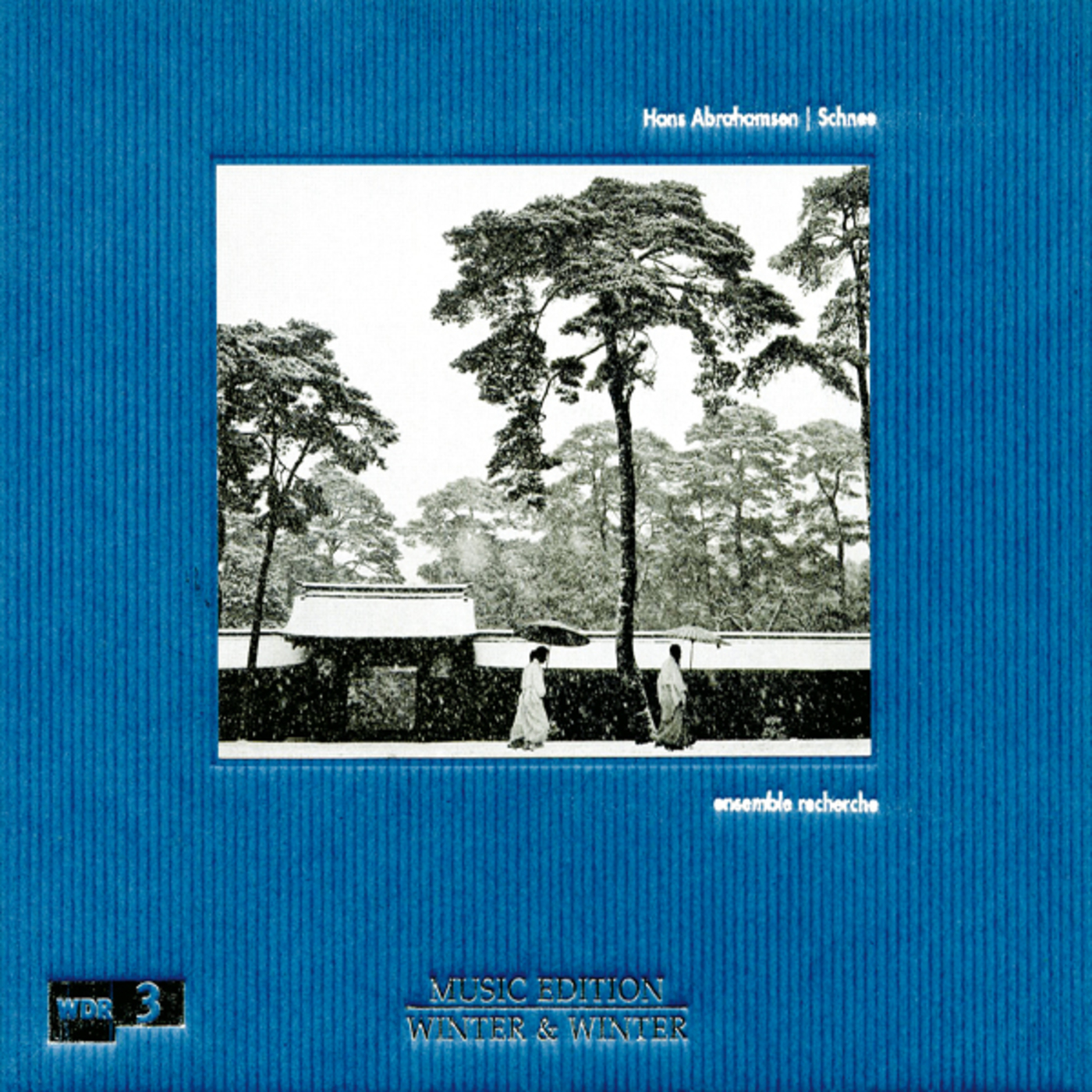
Written between 2006 and 2008 as five two-part canons and three intermezzi, Schnee grew out of Danish composer Hans Abrahamsen’s engagement with Bach. Commissioned by the ensemble recherche, who performs it for this Winter & Winter Music Edition (and what more appropriate label?), this vast, feathery piece withstands its composer’s own comparison to the structures of an Escher print. Such ambiguity of foreground and background, at once both and neither, makes it an all-encompassing experience. Like the recording itself, it reaches for us even as it occupies a world of its own making.

Despite the sparseness of Abrahamsen’s scoring, to say little of his nominal allegiance to the so-called “New Simplicity” movement, it would be deceptive to call him a minimalist. If anything, he is a maximalist, maximizing as he does the depth of effects possible through bare means. Unlike the music of, say, Alexander Knaifel, you won’t find yourself drifting through, but rather pervaded by, incarnate atmosphere.

Describing the music itself is as futile as describing the snow it is meant to evoke. First and foremost, it creates a tactile climate, not least of all through the placement of its instrumental forces. Two trios—one of strings, the other of woodwinds—occupy stages right and left, respectively, with a piano behind each and percussion tables at their center. It’s an arrangement that recalls the meticulousness of Karlheinz Stockhausen, only here it is meant to transform space, but become space. In this sense it is not some metaphorical re-creation of wintry landscape, but snow of a fashion all its own, replete with self-generated season.

Despite their placement, the pianos occupy a harmonic center, while the strings and cor anglais have been detuned to nearly imperceptible intervals of alterity. The caution with which bowed instruments are for the most part played yields indeterminate overtones with lives all their own, thus providing organic contrast to the regularity of their patterns on paper. The pianos move more waywardly, grabbing hold of congruities at the ends of phrases with hands of flame.

Abrahamsen’s snow isn’t always white. Sometimes it takes on the colors of sunset and other times a paler hue. Neither are his snowflakes always frail descenders, subject instead to a variety of physical actions. Whether being scraped off the bottom of a boot or alighting upon a metal roof, together they lay a path into a place where dreams reside. All of this dispersion and coagulation, a persistent binary of unblemished skin and ashen muscle, builds to premonitory levels of dynamism in an environment that you do not touch but which touches you—a cognizant sprawl in which every cell knows its place.

The writing for flute is particularly affecting, becoming more diffusive as its role intensifies. With each successive canon, layers of reflection build to peak levels of mystery, erupting with a blush of sun through the fragmented lungs of the fourth canon. The shortest intermezzo then leads to the shortest pair of canons. Fragile and sparse, each the mirror image of the other, they allow an eternity to step through on finite legs.

Quicksilver: Fantasticus

MFA43883_Digipak_slitpocket.eps

Those among my regular readers who admire the work of Stephen Stubbs, John Holloway, and Rolf Lislevand as documented on ECM’s New Series will want to cast their ears on this assortment of Baroque gems from the independent Acis label. Plying their gifts are violinists Robert Mealy and Julie Andrijeski, trombonist Greg Ingles, dulcianist Dominic Teresi, viola da gambist David Morris, keyboardist Avi Stein (on harpsichord and organ), and Charles Weaver on theorbo and guitar. Known collectively as Quicksilver, they bring a formidable admixture of panache and musicological erudition to everything they touch, engaging the discerning listener with the alacrity of their programming.

Although billed as “Extravagant and Virtuosic Music of the German Seventeenth Century,” the present program approaches these monolithic adjectives in ways more nuanced than one might expect. The album’s title refers to the “Stylus Fantasticus,” which in the experimental tradition of the Italians (think Farina, Fontana, Castello, etc.) brought a cellular, wayward brand of composing into vogue. In this instance, however, “extravagance” connotes not grandiosity but inward qualities at play. The music offered here is focused and stays true to where it wants to go. As for virtuosity, it is less a matter of technical flourish than of balancing and controlling emotion, of keeping even the most challenging motif always within frame.

Although pieces by better known composers are sure highlights—the g-minor Prelude and G-major Sonata by Dieterich Buxtehude (1637-1707) for their urgent, sparkling counterpoint and the Polnische Scakpfeiffen of Johann Schmeltzer (c.1623-1680) for its vibrant upsweep—the generous helping of sonatas by Matthias Weckmann (1616-1674) and Antonio Bertali (1605-1669) is by no means anything to balk at. The former’s acrobatically inflected Sonata no.9 à 4 delineates complementary qualities in each instrument, while each of the latter’s three chosen selections, and especially the Sonata à 3 in d minor, blends courtly and bucolic sentiments with nary a seam within earshot. Bertali’s Sonata no.10 is another lively delight, which, in being hollow-boned, is best suited for its edgier chromatism.

Other pieces showcase the musicians as much as their composers of interest. A sonata by Johann Kaspar Kerll (1627-1693) emphasizes the conversational relationship between the violins, another by Andreas Oswald (1634-1665) the dulcian’s melodic potential and keen interactions with trombone, and an anonymous Ciaconna the shadings of Quicksilver’s basso continuo. This leaves only the Canzona in C major, no.21 of Johannes Vierdanck (1605-1646), which gathers wood and strings in concert with Biber-like exuberance, shuffling atmospheres like a deck of cards dealt into a royal flush with every hand.

Alexander Berne & The Abandoned Orchestra: Flickers of Mime / Death of Memes

outside cover.indd

Alexander Berne is a world unto himself. Although this double album nominally features him and “The Abandoned Orchestra,” the latter is no more—and no less—than an expansion of self through the art of multi-tracking. Emoting through a variety of wind instruments, piano, percussion, and electronic treatments, he crafts brooding soundscapes for the discerning ambient listener. But don’t let the word “ambient” fool you. This is music that burrows with its own bronze sheen into the darkest corners of the soul and by that light inscribes reams of verses from makeshift biological desks.

Flickers of Mime is in eleven parts and is one of Berne’s most focused atmospheres yet. There is a magical consistency at work in the near-continual drone of Flickers I through IV, bleeding through psychological lattice with the persistence of solitude. Flicker V, however, transgresses a different skin altogether with its persistent, swirling luminescence. And yet, it doesn’t mark a turning point so much as a turning, period—a metamorphosis, if you will, of the self into an alternate signature. Overtly classical inflections speak not of earthly art but of an intergalactic pigment, whereby the unknown becomes the only frame of reference. By Flicker VIII we are caught in the machinery of linearly bound time. The electro-acoustic blend of crunchy break beats and organic breath forge enough heat in their center to turn dark matter into diamond. The flock of piano and reeds that is Flicker X gives glimpse into every occlusion, while the unconsummated matrix of the final Flicker gives rise to sinking.

Death of Memes is in nine parts. Its title comes from poet Michael Bonine’s sonnet sequence “August 12th, 1996.” There is indeed a feeling of raw poetry in the more industrial textures at play. From an introduction I can only describe as “comatose grunge,” it compresses anarchy into a single drop of ink and unfurls its dragon’s tail in a glass of water. This far more contemplative collection of impressions feeds on nutrients of the forgotten, the left-behind, the ruinous. Like the early tape loops of William Basinski, it embraces the aesthetic of decay as the only path toward completion. The sounds here are less locatable, more of a piece with outer spaces than with inner logics. In Meme VI the architecture begins to vibrate so intensely that it bends to the limits of its structural integrity. The droning textures are filled with promise, leaving the piano to resurface in Meme VIII like a floating dream, so that only in the final hour can angels touch their own ears.

This is asylum in sound. Welcome to your hermitage.

For more information on ordering, click here.

Alexander Berne & The Abandoned Orchestra: Composed and Performed by Alexander Berne

Composed and Performed by Alexander Berne

Although the word “enigma” refers to hidden meanings and messages, the music of composer-instrumentalist Alexander Berne discloses itself in starkness, not darkness. Nowhere so clearly as in this triptych of albums released in 2010 on the progressive Innova Recordings. Closest in spirit to the multi-tracked worlds of Stephan Micus, Berne’s universe expands well beyond the binary of flesh and spirit into geometries of neither.

The Soprano Saxophone Choir

The Soprano Saxophone Choir opens this 158-minute path by slowly melting away any obscuring hinges of expectation until the door falls away, leaving the listener between the infinity of two opposing mirrors. The ensuing soundscape unfolds a variety of topographical textures, each suited to its theme like light to color. The initiatory “Shores,” for example, paints miles of coastline with a minimal palette, evoking waters and coastlines with a fisherman’s intuition. It doesn’t so much tell as comport its story, as a dancer would favor gesture over pen. Yet it is not only bodies but environments themselves which move with mammalian self-awareness, moving stealthily through the sun and groundswell of “Gardens” and picking the “Hyacinth” that grows in its soil. What follows is a spectrum of nodes, moving from the isolationist jewel that is “Eschaton,” through the science fiction scope of “Reaches” and the ritual motifs of “Uhm,” and linking to the cellular origins of “Magic,” where modal poetry glows like desert canopy.

The Saduk

The Saduk takes its title from an instrument of Berne’s own invention. Something of a cross between a saxophone and a duduk but of a sphere all its own, it unfolds the very map charted on the first disc and adds names to its rivers, mountains, and geographical regions. The “Aubade” is a morning love song by name, a migration of geese and cranes reflected in sunlit waters that sets a viscerally focused tone, by which the tenderness of Berne’s performance sheds skin to reveal a syncopation free of clots in “Wanderer,” whereby the itinerant body reveals the lessons of its calluses and sunburns as if they were scripture. In contrast to this arid passage, “Clepsydra” (Greek for “water clock”) pours its liquid song from one vessel to another and back again in a droning piece that absorbs brief rhythmic elements to count the seconds. Filling the chasm framed by the eternal golden braid of “Sirens” (wherein one can hear the inner beauties of the saduk in all their glory) is Christo Nicholoudis, who provides vocals on two tracks: “Tridoula” and “Supernal.” His presence subtracts a feeling of architecture and substitutes cavernous breathing in its place. A stirring at the biological level.

The Abandoned Orchestra

The Abandoned Orchestra is Berne’s self-styled refraction, an expression of self that finds union in multiplicity. “Plumescent” is the first of seven steps into this more colorful anatomy. Pulses provide requisite traction, but feel almost accidental in their flips of grace. “Lustening” dips into Muslimgauze territory with its distorted break beat and fading reed lines, while “Kenosis” (another Greek word, this referring to the processes by which one empties the self to receive divine will) diffuses a mind interrupted by its own vocal desires. “Najash” refers to the snake in the Garden of Eden, enchanting with charmer’s croon but disappearing into the self-replicating spiral of “Arise” before being blasted into strands of infinity by the soprano saxophone in “Auriga.” Named for the constellation better known as the Charioteer, the latter does indeed pull its charge from one night to the next, unrelenting in its quest for fire.

Standing out like facial features along the way are three “Chronicles,” each a summary of what came before that treats every lilting line with the care of a mother bird warming her eggs. Averaging at 16.5 minutes each, they constitute a nomadic horizon at various stages of recession, and leave us wondering just how long it will take for our shadows to stretch until we step on our own heads.

For more information on ordering, click here.

Dreamers’ Circus review for RootsWorld

My latest review for RootsWorld online magazine looks at Second Movement, the sophomore album from Danish folk trio Dreamers’ Circus. This is sweeping, dreamlike music that should appeal to fans of Ale Möller. To read the review, click on the cover below. Also check out the live video below that to see the musicians in action.

Second Movement