My latest review for RootsWorld online magazine is by Palestinian singer Rim Banna, who explores an all-inclusive message in delicate political times. This one boasts a couple of ECM connections. It is arranged and produced by Bugg e Wesseltoft, who has appeared on albums by Terje Rypdal, Jan Garbarek, Arild Andersen, and Sidsel Endresen. It also features guitarist Eivind Aarset in a characteristically atmospheric role. Click the cover to read my review and hear samples of the album.
One of a handful of new reviews for RootsWorld online magazine, here I explore the once and future past with Andrea Esperti’s eponymous project debut, Le Voyage d’Hannibal. Click on the cover to discover!
My latest review for RootsWorld online magazine is of violist-composer Nils Bultmann’s Troubadour Blue, out on Innova Recordings. Bultmann can also be heard as part of the Transatlantic Art Ensemble albums on ECM. Click the cover to discover!
Two more reviews for RootsWorld online magazine, these of two very different albums: Iranian singer Marjan Vahdat’s long-awaited solo debut, Blue Fields, and Scottish fiddler Aidan O’Rourke’s autobiographical Hotline. Click a cover to discover!
There’s a reason why Pandora starter songs are called “seeds”: each has potential to grow into something magnificent. My first time using said online radio service, I’d created a Cocteau Twins station to maintain my sanity during some rote task or another, and periodically heard a mysterious song for which I was compelled to stop what I was doing and pay attention every time it came on. That song was “Misunderstanding” by Mediavolo, and my life as a listener was never the same. The music of Mediavolo has touched me like that of no other band. In an age where so many songs and their creators ephemerally surface before drowning in an unfathomable data stream, such life preservers are few and far between.
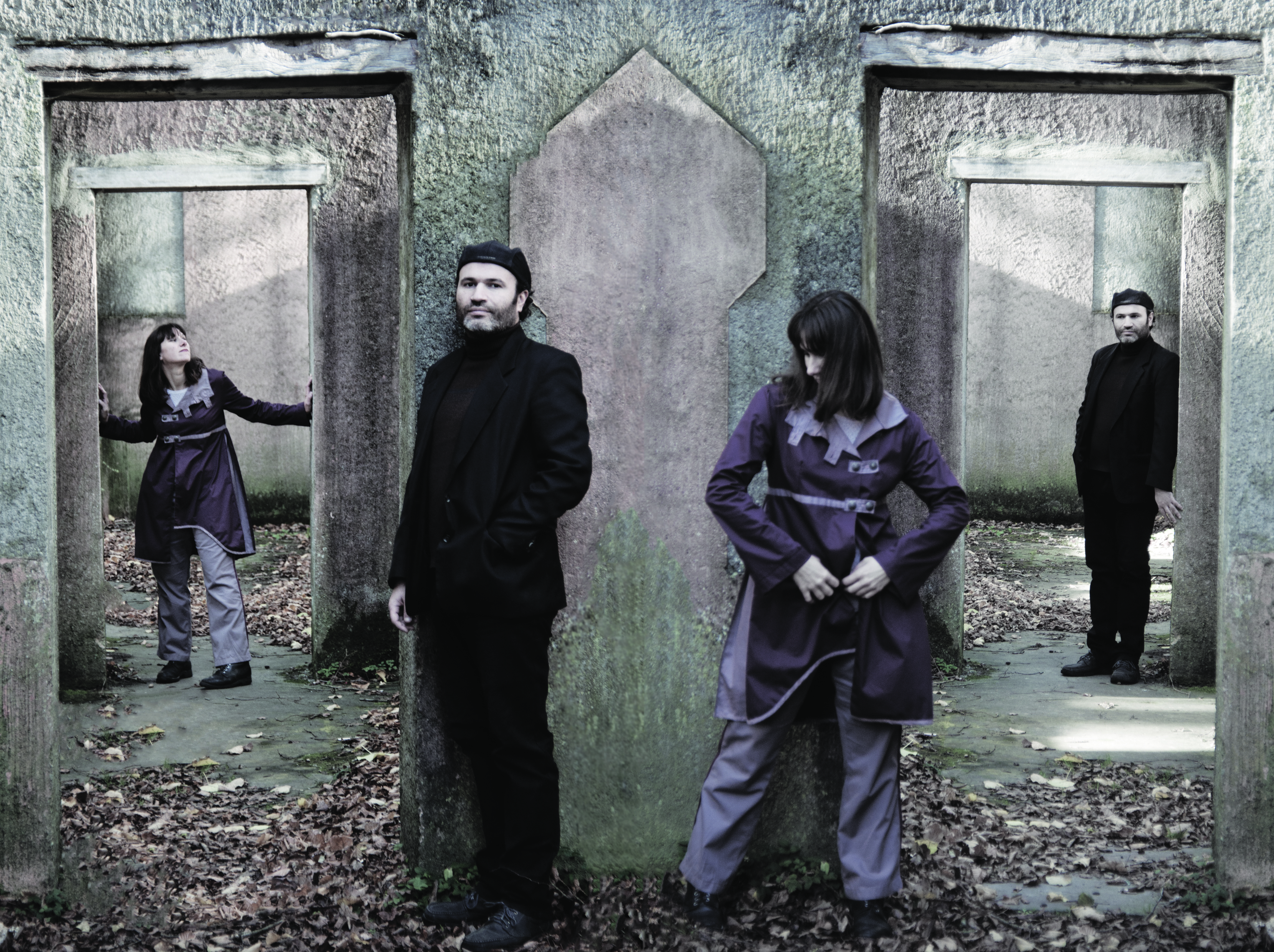
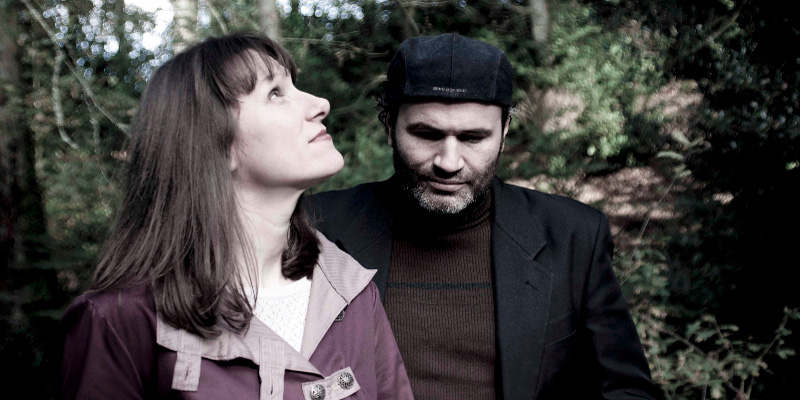
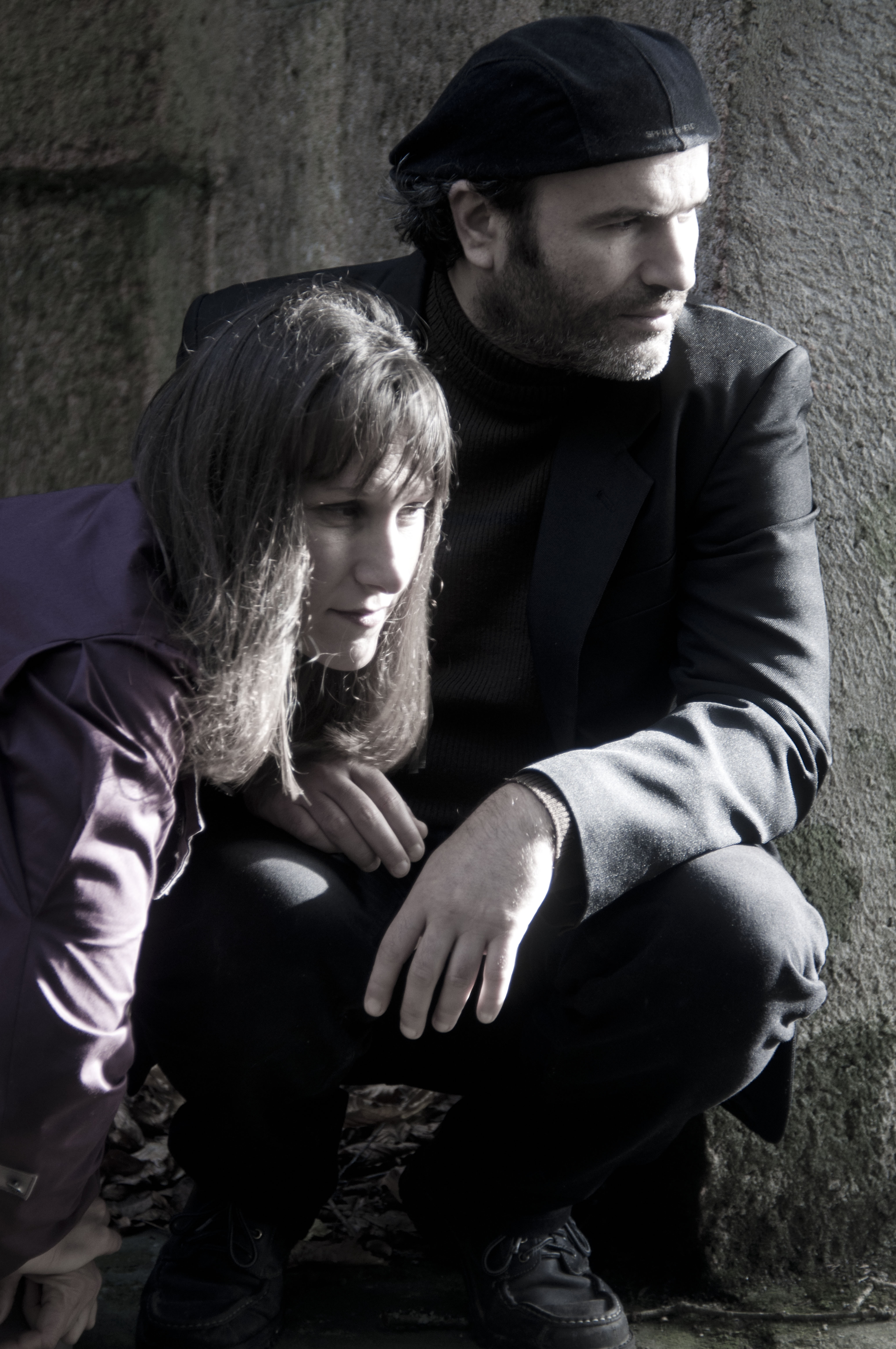
Mediavolo hails from the port town of Brest, in northwestern France. The band has shuffled its cards a few times over the years but, since 2000, Géraldine Le Cocq (who sings and writes all lyrics) and Jacques Henry (who handles all music, instruments, and production) have been its constant aces. Known affectionately as Gé and Jac, they took over officially as a duo in 2004, a binary star pulling other galactic talents into their sessions’ orbits but always shining brightest at the center of them all. Music had always been a vital force in their lives, prompting Jac to pick up a guitar at age six, and Gé the harp at seven. “We met thanks to common musical connections,” Gé recalls. “I joined the band Jac had with his brother and other friends, as it needed a new lead singer, which led to a name change: that’s how Mediavolo was born.” To that name, there is no meaning, save for whatever one brings to it. Naked and clothed alike, it embraces us as we are and slides around the brain until it becomes a single bead of dew on a blade of tomorrow.
Listening to any Mediavolo album is an exercise in pareidolia—that psychological phenomenon by which we see familiar shapes in clouds, stars, and the occasional potato chip. In this manner we may read core influences into the band’s multifaceted sound, including Cocteau Twins, Kate Bush, Blonde Redhead, David Bowie, and various new-wave synth acts of the 70s and 80s. For me, Cocteau Twins looms largest of these (for those keeping score, check out “Resolve,” “To the Eye,” “Fanciest Scheme,” “Up Ahead,” and “Wh”). Are these a conscious homage to the band, or does the affinity come about organically? Jac: “I discovered Cocteau Twins very late, when the band had just imploded. What struck me most, the first time I heard one of their songs, is that I felt at home. I think it’s a bit of both: I’ve an organic link to their music, no doubt, and somehow, I set out to carry on with their music in my own way.” Jac, it bears noting, grew up on a steady diet of Beach Boys and Beatles, neither of which bear out on his compositional world, but whom he credits nonetheless for making him the musician he is today. Whatever the persuasion, Mediavolo is a universe unto itself, where popular footholds are white dwarves at best. As in a kaleidoscope, such elements are fragmented beyond recognition, so that from them a new mosaic emerges.
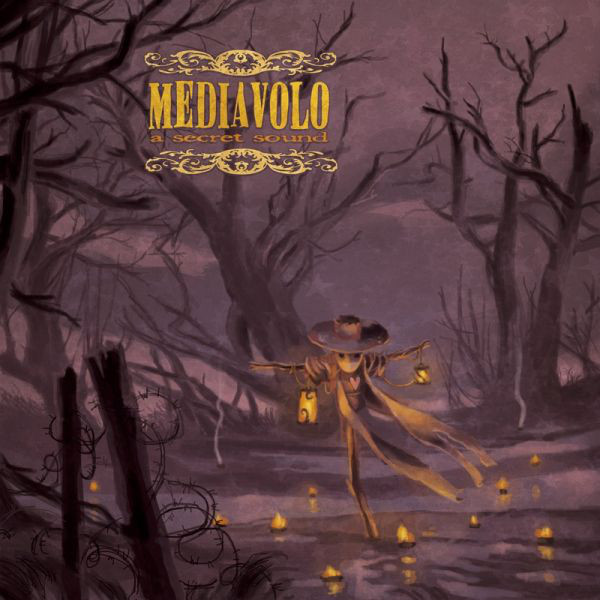
About my beloved “Misunderstanding” there was much to learn, and proper tutelage came in the form of A Secret Sound.
Released in 2006, it securely holds the throne of Mediavolo’s sonic kingdom, taking sustenance from the purple gold dripping down its castle of crossed destinies. Opening gambit “How Does It End?” is as splendid as they come, an anthem of shadows that crosses that clearing in the forest into which we all day must take leave. “Is it fear that sustained us?” Gé sings, balancing each word on the tip of her tongue before it drops into the abyss like the rabbit before Alice. Thus set, the stage of Mediavolo’s masterful songcraft opens its curtains. Resonating through its chemical admixture of sparkle and gloom is a phenomenal distillation, one that functions as something of a meta-statement for the band by way of its evergreen philosophical question.
“Humane & Live” finds an answer. With clear and present vocals (a harbinger of things to come on the latest record, Modern Cause), Gé floats the question “Am I afraid to die?” on post-storm streams, following it down sewage drains where, unwavering as the darkness there, she proclaims, “I’m not afraid to die.” The narrative voice finds further resolve in the track of the same name, which ends wordlessly—each utterance a torch without bearer whose wanderings are masked by the click of hammered leather on cobblestone.
The songs of Mediavolo often assume short story form, but on A Secret Sound the band takes especial care to evoke a poetic mise-en-scène. Gé elaborates: “It is the result of the systematic working method Jac and I had at the time: he wished the lyrics to be linked to the movies in his mind. These he would recount for me to develop an interpretation. It’s actually a storytelling-based process.” An example is the Dickensian nightmare that is “Death & the City.” This visceral nightscape follows Jack the Ripper through the less-than-pretty alleys east of Charing Cross. His is a resolve of a different order, flapping at his shoulders like a cape: a crude farewell to the corpses he leaves behind. His footfalls trail from nefarious transactions behind closed doors, through which bodies pass like so many ghostly matters into the annals of history. The streets of London bleed to the rhythm of Gé’s breathing (heard throughout the song in the right channel), and rebuild themselves in the enchanting synthesizer, which floats away in a nocturnal fog stretching out every final gasp to an unsuspecting dawn. “Hunted” revisits these autopsies and grants asylum, through sheer power of will, to blasts of light intent on clearing away the badness. This is the most hopeful song on the album, an affirmation on stilts.
“Hoary Man” is a true standout and another that feels tugged from some ancient past. As geometric arpeggios from bass drop anchor into ocean of mineral, a vision unfolds of another place where a golem-like figure embraces the narrator as a Venus flytrap closes around its meal. Fungible, smelling of rotting leaves and loam, yet caught in the eyelash flutter of a Frosted Elfin’s wing, the music here describes memory so powerful—of achieving one day fleeting confluence with the cosmos before gasping anew on the shores of reality—where swims the very figure who gave her life.
(“Hoary Man,” directed by Nicolas Hervoches)
Not all stories are pulled from dusty tomes. Touched off by echoing guitar, “Mass Anaesthesia” flanges into a traffic jam as timely as the technology used to record it. Gé floats above it, playing the part of the postmodern angel, dangling the ennui of our age on a string just out of reach. “Such a sight just fills my heart with awe,” she admits of these processions of anonymity. Cars become people and people become wishes, each desire fulfilled at the press of a button, the swing of a door, the click of a heel on hospital linoleum. Likewise the piano-driven “Dripping Mind,” which holds true to itself even as the barometric pressure drops for a spell, Gé’s voice oozing through the mist amid a flurry of banshees pushing its way beyond the pale of a covered moon.
My heart abounds With suns and stars
So avers Gé in “Secret Sound,” emblematic not only for yielding the album’s title but also for so carefully walking the line between sleeping and waking. Its aftereffects oscillate into “Misunderstanding,” bringing us back to where we started. Through its motions the band peels back layers of cloud to expose the invisible heart within. A second voice—the first of a handful—makes itself known, an alter ego singing of need and brokenness.
(“Misunderstanding,” directed by Nicolas Hervoches)
Lest we dwell too long in the shadows, “Hollow Of You” plows a decidedly romantic field. It is a rainbow drained of its color and cinched so tight that it goads the diaphragm into self-expression. Nominally ending things is “Chimera,” which is notable for at one time being the album’s opener and for whimsically including Jac’s voice in the studio just before he lays down the drum track. I ask Jac about this moment, which adds a human touch and reminds us that someone created all that we hear: “If you listen, closely with headphones, to ‘A Day in the Life’ off Sgt. Pepper, a person counting down to the famous violin crescendo can be heard. That’s an accident. It was never meant to be perceptible. At the time, no tool existed to isolate and erase a sound from tape. But it is the type of ‘secret’ a listener loves to discover. In studios today, there’s no such thing as ‘accidents’…merely the will to make a reference to mythical recordings…or let the listener in on the behind-the-scenes process. The latter was my intention.” This train-tracked journey flows through the enigma of silence into a hidden track called “Trapped.” Originally penned by Jac for a play, Gé contributed new lyrics, thereby enabling a grungier, less pulpy hue to the tip of the dragon’s tail.
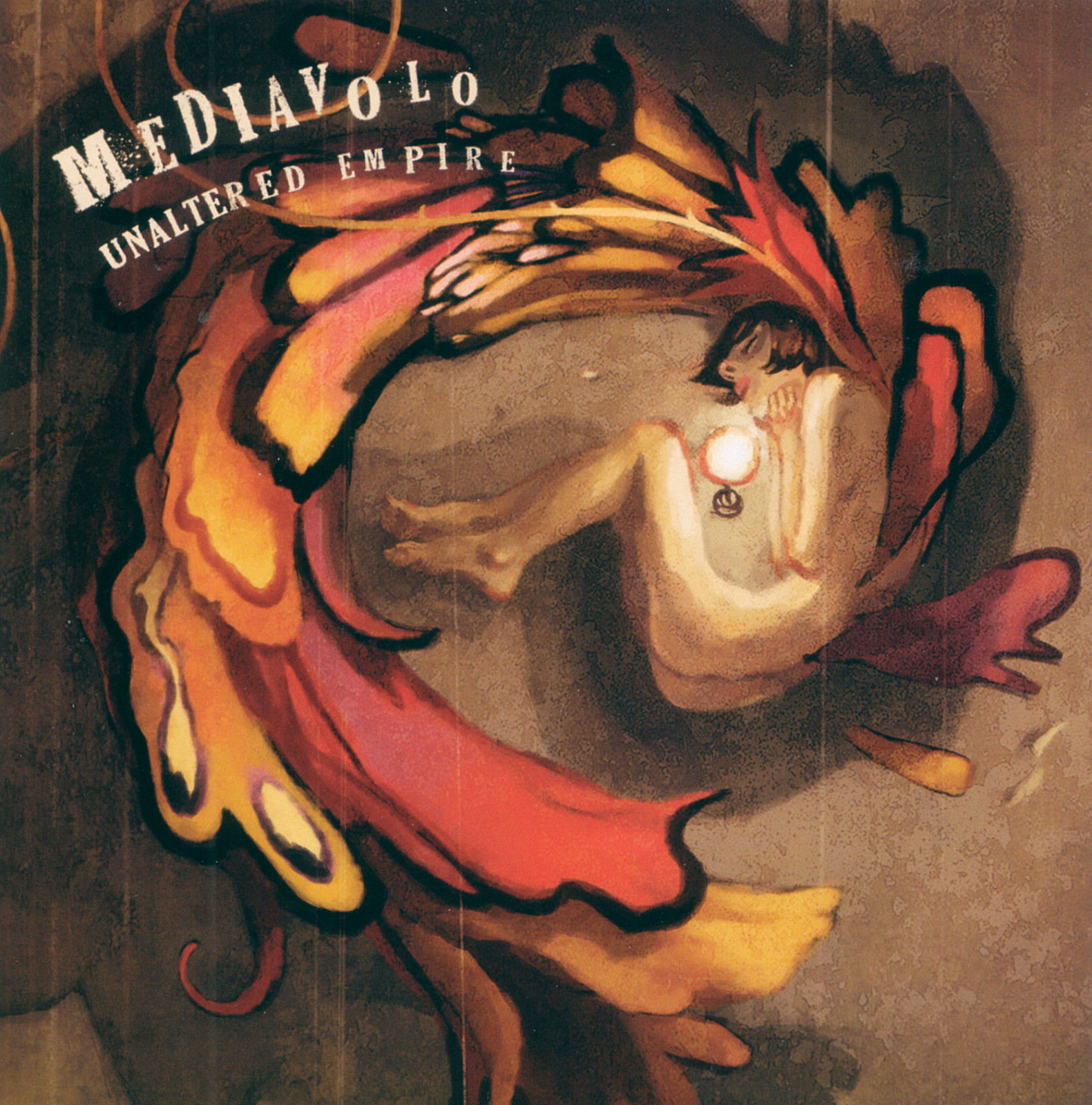
With Unaltered Empire (2008), Mediavolo carried its ethos over into even more visual territory. Its striking cover implies a private room, an almost David Lynchian spiral into a ceiling fixture where inner and outer spaces become one. This leads me to ask: Does the music start with imagery, or vice versa? Jac’s reply: “I remember very clearly traveling through unknown worlds, my head filled with images, while I listened or composed music as a boy. That’s why ‘concept albums’ have exerted a strong appeal for me: Sgt. Pepper, Tubular Bells, Never for Ever—albums developing their own worlds. I’ve always wanted to write albums as such. So it is true that before music or lyrics, come images.” Gé adds, “And Jac took the habit of sharing his images with me. But it is impossible to convey, with lyrics, as many meanings as with images. That’s why the cover art is so important.”
Unaltered Empire takes its inspiration from Kafka’s “The Metamorphosis,” telling instead the story of a young woman’s transformation into a butterfly. Accordingly, it plumbs the depths of our biological minds and pushes Mediavolo into its most cosmic directions yet. Many of the songs play off the storybook nature of Secret, but do so with a biographical lens focused on childhoods. Consider “Treasure Box,” which crosshatches the snow blind of birth with the charcoal of development. Crafting words as photographs, it rewrites a death in the family, throwing light across the blank page by way of the guitar’s golden sunrise. Consider also the denser palette of “Dry and Brave,” in which last night’s dreams are stretched to breaking and repaired as if by watchmaker’s tools. A purging, this is.
The title track, too, is touched by familial magic, adopting a maternal tone that whispers lullabies and wisdoms. It springs before us, a fantasy novel come to life, wielding tongues against the great Silence. Dissolution of allegiances, a cutting of blood ties in favor of the new veins: the songs will outlive us all. Only now do we discover that the titular empire is entirely on the inside. It is carried in the heart, in the hands, in our labyrinthine brains, filling the skull with a vintage that can never be brought to lips.
In some uncanny way, listening to these songs lends exactly the same feeling as a scene in the film Amelie in which the title character, upon finding a trinket box that once belonged to a boy now grown, returns it to him anonymously but watches unnoticed as he cradles the all-but-forgotten storehouse in his hands for the first time in decades. We are thus privileged to know the connectivity of “Black Roses,” to peek inside the time capsule of “Selling Birds,” and to taste the flightless habitus of “The Backroom of My Mind.” And further, the dulcet axis of “Fanciest Scheme,” which splits consciousness into dots and dashes, each signal received on a scratching record that trails a ligament of stardust.
As singer, Gé soars and mires in equal measure. Harboring little interest in adornment, she brings her beauties on this album to three blinding jewels. The first of these is “Cavalry Drum,” a song of conflict rolled until rice paper thin. Jac’s guitar captivates with its radiance, threading a bass line between predator and prey with a nervous excitement. Throughout the song’s interweaving of speech and conscience, Gé patterns mysteries with due clarity. “This song,” she tells me, “is about feeling strongly about simple things. Our world draws us away from nature, from contemplation. We surround ourselves with technology, and feel ‘happy,’ ‘excited,’ ‘contented.’ Can it ever make us feel ‘alive’ as the sun does when it touches our skin?”
(“Cavalry Drum”)
“Dr Quayle” occupies the center of this masterful song trio. Its exacting compositional science heightens the laboratorial feel of the lyrics. A guitar solo sweeps across the night like a patient’s cry, as do Gé’s powerful highs in the final stretch. With such noir-ish granules working their way down the Mediavolo hourglass, it might be tempting to file the band under Gothic or Darkwave. Such designations, however, ring reductively, deferring instead to something more inclusive. “Restraining myself to a channeled kind of music is very difficult,” Jac admits. “I have so many different musical urges that Mediavolo ends up with multiple identities. Labeling our music has always been a problem. That’s why I’d rather it came under ‘indie pop.’ It’s a large enough tag to encompass all of what we do.”
Either way, the good doctor’s tinkering yields the most sublime creation in the Mediavolo archive: “To the Eye.” As the pinnacle of the band’s craft, it heralds a great beyond when music will one day live of its own accord and resound for its sake alone. Which is why the guitar is forthright but also suffused with a child’s wonder, as expressed in Gé’s lyrics:
they say that a star that we get to see has long blown away and died but how can this feel true, that is, to the eye?
An insightful observation, to be sure, of the body’s generative power, but also of its penchant for immediacy. Gé stirs her hands in the overlapping tide of guitar, bass, and drums. From this she plucks her words, fixing each to a constellatory joint and breathing perfect animation with harmony. According to Jac, “To the Eye” takes its cue from The Sugarcubes and The Sundays (another heavenly band that should be of interest if anything herein strikes your fancy), but its winds blow decidedly off planet.
Before moving on to Modern Cause (2011), it bears us well to look at the foundations on which A Secret Sound stands: namely, the two French-language albums that preceded the band’s switch to English.
Soleil sans retour (2003) is a self-styled “collection of short stories on the difficulty of living in today’s world.” By way of introduction, the title song orchestrates our inclusion in a sound-world dappled with shadow and the promise of skin-to-skin contact. With its tasteful keyboard accents, this compact drama evokes old discoveries and new nostalgias. As with much of what follows, there is antiqueness at play, a chain of vignettes swimming in increasingly potent fire. “Cryogénie” is a strangely tender crawl inward and spins Gé’s reverbed voice atop a crunchier peak. Touches of mandolin speak of sconce-lit catacombs, while above ground lovers wander, ignorant, through catacombs of their own.
(“Cryogénie,” directed by Nicolas Hervoches)
“Dernière fantaisie” (Last Fantasy) feathers the album’s swan, working its contortions through the instrumental simmer of “Final” and on to the smooth echo chamber of “Wh.” Between their frame lies a treasure trove of faded photographs. From the slices of 70s rock that clasp then release us through the chronological reckoning of “Ma redemption” and “Ballon rouge” to the ever-after wayfaring of “Le Gouffre aux chimères,” we sense reams of trauma with every lyric sweep, but also the marginalia of difference between them (note, for instance, the watery play of harpsichord and vibraphone in “Antichambre”). What distinguishes Soleil is its malleability: just when you’ve pegged a song’s psychological shape, it contorts into something new yet clearly underwritten by the same genetic signature. Furthermore, with “La Fille de Ryan” (Ryan’s Daughter)—a nod to the David Lean film of the same name—it foreshadows Effets Personnels, which takes listeners on a soldier’s “philosophical and surrealist journey” through the First World War.
Effets waltzes its way across fallen soldiers and makes of their last wishes a symphony of flesh hurled toward the horizon in endless catapult. Looking at the sky as if from the bottom of a well, the albumoffers hope in small, unreachable circles—closest perhaps in “C’est écrit dans la glace” (It is Written in Ice). References to war abound. “Mogador,” for one, names a class of French naval destroyer, cutting surf toward the anthemic “Safari” with a heart of darkness in mind. Even the promise of “Le Phare” (The Lighthouse), in spite of its enchantments, is tainted by amnesia. The effect is such that evocative titles like “Un Papillon sur l’épaule” (A Butterfly on the Shoulder) and “L’echo dans la vallée” (The Echo in the Valley) feel all the more claustrophobic for the meticulousness of their arrangements. Memories of open sky and pasture are only that, drawn away as they are in the saddles of emotional horses who recede into afterlife with every clop of hooves, over lullabies and goddess trails before seeking the shelter of “Necropolis,” where materialize and dissolve the echoes of gatherings and family affairs, of victors’ nightmares and victims’ dreams, leaving only the title track to show for their passing. Here is the wonder of birth expressed in sound, pulling the fatal transition of life as a razor across stubble, its wake as bare as our first moments in this unwritten world.
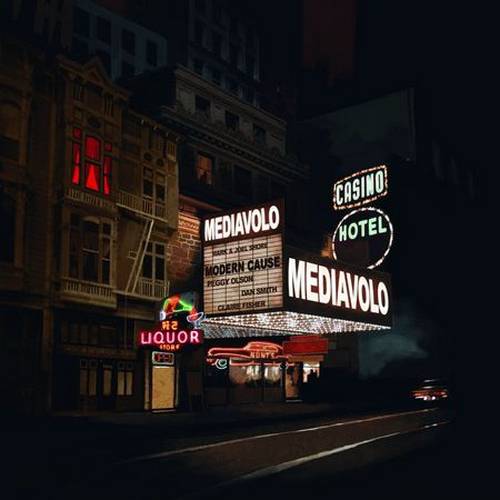
And so, we arrive at Modern Cause, a record that is, in Jac’s words, “a patchwork of moments in life, with no link existing between them.” Its prologue comes in the form of “Dan,” which reiterates some of the backward glances of Empire but with a new age of emotional becoming. I ask Gé if this is a personal song: “It is indeed personal,” she says, “but it does not root itself in reality; it is a projection. That siblings love each other is taken for granted. Family is not immune to implosion, however: small things, slight differences of perception add up, until the wrongs of life reveal them. I drew my inspiration from some of my own family’s words and moves, and tried to imagine what they could lead to in a distant, cold, and love-free environment.” In both this song and “Up Ahead,” she fully embodies the protagonist, as if she has dug up some corroded jewel and polished it as if it were her own creation. Is not singing, then, a form of acting, or is it something deeper? Gé: “I regard singing as acting, definitely. In that respect, I’ve always agreed to embody the male characters of Jac’s brother’s lyrics [on the older albums], and I’ve never attempted to feminize the stories that came to me involving one. It so happened that the emotions of some of them started resonating with my own. ‘Keepin’ out’ is one of those occurrences.”
Indeed, in the indie rock vibe of “Keepin’ Out” Gé converses as if with herself, pulling teeth from the gums of the ego with pliers coated, in her turn of phrase, with “non-secretive scorn.” These machinations charge through an increasingly dense vocal flock until they find neither resolution nor peace, but rather the reality of moving on.
(“Keepin’ Out,” directed by David Carquet)
An exception to this rule is “We Danced Today,” which closes the album’s intimate economy with Jac’s singing: “I was convinced the song fitted Gé’s voice. But when we started recording, we realized quickly something was wrong. The demo vocals I had recorded kept sounding better. We finally understood the musical pitch was that of a male voice. Gé convinced me to take the lead.” His voice lends a historical charge to the song’s lavish—if sparsely populated—ballroom scene. Faces disappear with every twirl and contact, until fadeout draws its curtain near.
From this song alone, one may note the distinct production values of Cause, the result of Jac’s desire to go for a Phil Spector “Wall of Sound” effect, affording less scrutiny of the mix in the interest of overall atmosphere. In this regard, “Latent” is the album’s centerpiece. The anthemic loop thereof trades anticipation for acceptance, ending in a protracted instrumental outro that lures us deeper with every reset. Such structures, Gé notes, informed the lyrics: “There is a clear division in the middle of the song. The first half is tense and anxiety-provoking; the second is luminous and full of hope. To me it evoked those moments when we are confronted with difficulties and the feeling of release when we step out of them. The second part did not need lyrics, the music alone conveys the feeling.” This is especially obvious in the nakedness of the acoustic version:
(“Latent” Acoustic Attack Session)
Although Cause is less specific at the mixing board, it fully discloses its ghosts. Its crucible aesthetic boils down past and future impulses into a here and now of raw vitality. As a result, a heavy nostalgia pervades that was very much a part of the recording process. Says Jac, “When you get older, you sometimes wish to go back to what you once knew. As a matter of fact, the studio in which we work looks very much like the room I had as a boy. Some of my old toys sit on the shelves…” One of the album’s many affordances, however, is that it leaves plenty of room on those shelves for listeners to place their own mementos, be they a set of keys alongside the teenage thrill of“You Wish Mark Steered,” moth-eaten pajamas curled around “It’s Begun,” or glass marbles bending light into “Peggy ’60,” each object follows us like the eyes of a banknote. Their regard anoints us i search for plainspoken undertakers.
The music of Mediavolo may draw its waters from many wells, but nothing tastes quite like it. It does not regard itself in the mirror, but instead acts as a mirror itself, one fit to contain any face that dares approach it with an open ear.
Ayako Shirasaki brings world-class jazz down to earth on Some Other Time. For this, her fifth album, the Japan-born and New York-based pianist is joined by bassist Noriko Ueda and drummer Quincy Davis. That Shirasaki cut her teeth on the bebop greats—Charlie Parker, Sonny Rollins, and Bud Powell, to name but a few—should come as no surprise. Neither should the fact that, in her defining twenties, the beauties of Bill Evans, Art Tatum, and Kenny Barron (her mentor at the Manhattan School of Music) would be just as influential in defining her current sound, a perfect admixture of both.
This being her first trio album in eight years, Shirasaki brings a wealth of maturation into the studio. “In that time my life has greatly changed by having two kids,” she tells me during a recent interview. “I’m not only a musician anymore but also a mother, wife, and teacher.” Shirasaki further acknowledges her children as having an effect on her playing: “I think that in dealing with small children everything has to be clear, natural, and easy for them to understand. These elements have changed my music a little bit. I have also become more openhearted since becoming a mother.”It’s an unenviable identity to inhabit in a male-dominated profession, but hearing her phenomenal rendition of “Oleo,” such labels cease to matter. This Sonny Rollins gem floats effortlessly from her fingertips with the punch of Chick Corea and the underlying elegance of Marc Copland.
Shirasaki is a cat with nine lives who imbues her playing with nods to various stages of jazz history. That said, she makes no pretensions about theme:“It’s funny, I never had any intension to make this album into a particular direction. I just followed my heart, and still the album developed a certain character.” And while some of that character comes from nods to the American Songbook, notably in the nostalgic hipness of “Long Ago and Far Away” (Jerome Kern) and her solo take on Duke Ellington’s “Sophisticated Lady” (a mission statement if there ever was one), Shirasaki brings more than a rainbow’s worth of colors to this gallery of moods by way of her interpretive prowess. Whether in the vivid, classic sound of “April in Paris” (Vernon Duke) or the bluesy urbanity of “My Man’s Gone” (George Gershwin), a certain optimism persists, although perhaps nowhere more so than in “Hope.” This Lars Jansson tune proves just how positive jazz can become in the pianist’s hands. Shirasaki: “Music has an aspect to heal people’s heart when they’re down or stressed for any reason. Jazz has such power in energetic and beautiful ways to impart positive messages.”If we hear anything in this revelry, it is the confidence in Shirasaki’s step; a confidence born of love.
These are, of course, songs without words, and as such get to the heart of every melody without distraction. Such conviction comes from Shirasaki’s rigorous classical training, which through the prism of the piano trio format lends special focus. “I love playing solo,” Shirasaki notes, “as I can control all the sound, harmony, bass, and rhythms from beginning to end, but it can be lonely. The trio brings out individual colors and tasks. Interaction between the three brings the music to another level. I think the piano trio is a very strong unit for being ‘minimal.’”
Such are the hallmarks, too, of her own tunes. “Sunrise” connotes the luminosity of her craft to exponential degree. Its invigorations emote with a welcoming spirit, fitting like well-worn shoes. The improvising here may not be fierce, and is even a bit saccharine, but nevertheless balances touch and go with assurance. Corea again lurks in the staggered harmonies and independent hands of “3 Steps Forward,” throughout which the superb rhythm section is plush and omnipresent, of which the phrasing speaks to tasteful attunement all around. “Peace of Mind” is another optimistic slice of forward-thinking jazz. Sparkling highs in the right hand contrast beautifully with thumping bass, the latter of which has a remarkable solo, delicate yet forthright.
As an avid enka (Japanese popular folk) and traditional Japanese music listener, I was delighted to encounter on this album such spirited takes on Saburō Kitajima’s “Yosaku” and the children’s song “Antagata dokosa.” When asked about her inclusion of these particular tunes, Shirasaki discusses her experiences performing in Japan as one motivation. “Another reason is that simply I like to play these songs. ‘Antagata dokosa’ came up since I used this song for my music class for kids and found that its odd metering carried over into jazz in a unique way.For ‘Yosaku,’ I just like the bluesy feeling of its chord progression (re-harmonized from the original version). It was quite a joy to find that ‘Yosaku’ could transform into jazz!” Both tracks show the trio at its swinging best and bring to life the freshness of Shirasaki’s thinking.
Like the title track by Leonard Bernstein, the album as a whole has a sense of breathing about it, as if it were being sung through the body rather than through an instrument. The affective commitment required to achieve this dynamic amounts to no small task, but Shirasaki and her trio make it sound natural as can be. In her own words: “I always want to play better than yesterday.” Let us hope, then, that there will be many other times to come.











 Between Sound and Space: ECM Records and Beyond