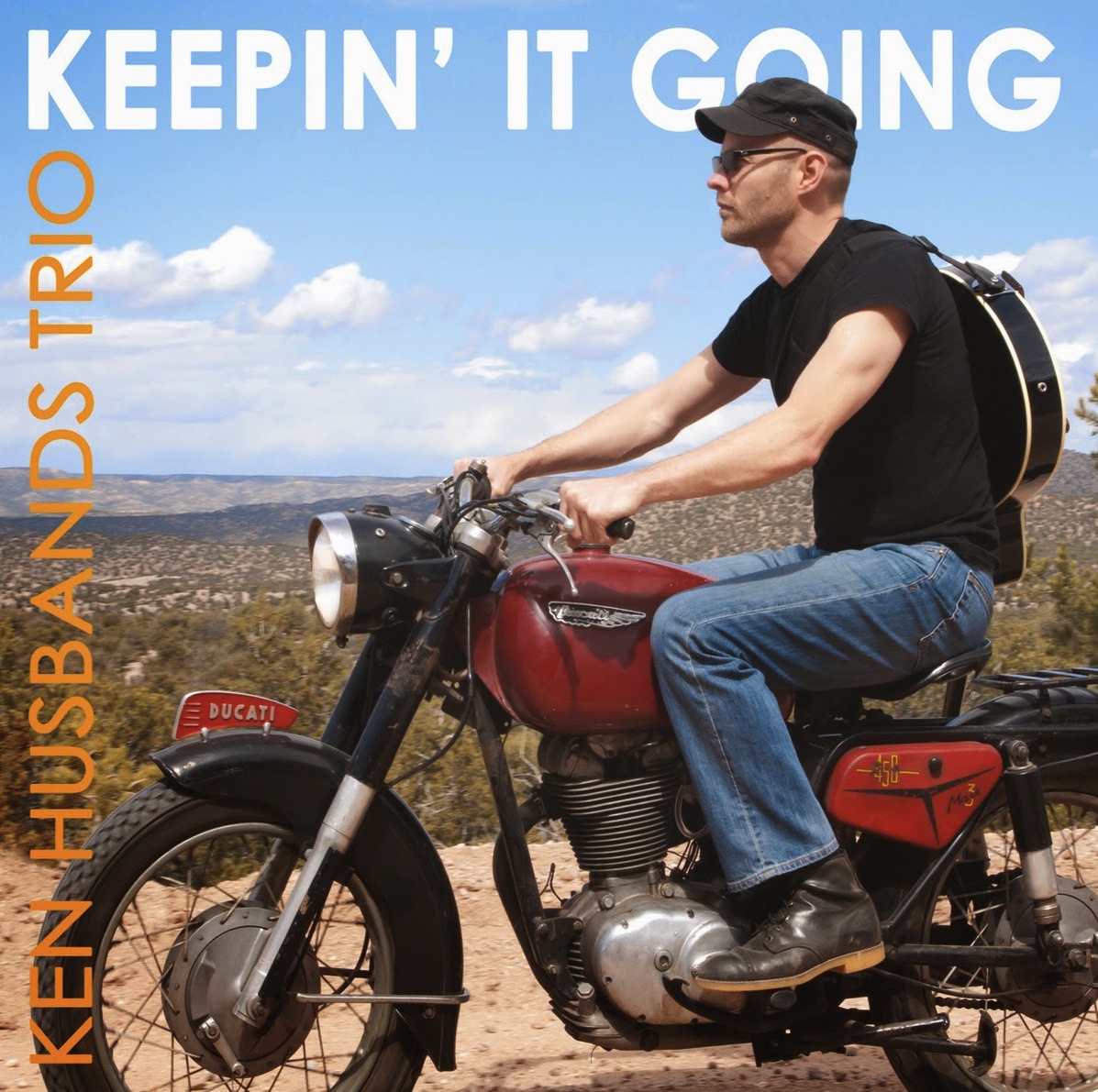
Ken Husbands Trio: Keepin’ It Going

Ken Husbands Trio

As a label mate of jazz guitarist Hristo Vitchev, Ken Husbands is in fine company. With bassist Aaron Germain and drummer Otto Huber, even finer. As the Ken Husbands Trio, they make sculptures of their music, smooth and chiseled to lifelike appearance. For its sophomore outing, the trio navigates a set of six originals, crisply recorded and played.

With a background in funk and a personal interest in fusion, Husbands harnesses many influences under one umbrella, but articulates them with an economy that is altogether refreshing. “East Coast Groupings” points to the guitarist’s Boston roots, dipping early into a pool of groove. There is here, as throughout the album, a feeling of the open road. Germain’s warped electric bass foils Huber’s pristine timekeeping with a hint of grunge. The drummer’s rhythmic slights of hand further dress the emerging groove of “Lucky Seven” in cathartic clothing. Here the trio works synergistically, Husbands working overtime to maintain a smooth exterior, stoking the flames by means of his stream-of-consciousness style. The title track proceeds along Huber’s skipping trail, while Germain switches to more direct amplification, augmented by a spacy echo effect. Husbands provides a circling backdrop for Germain’s initial forays before taking over the foreground with a non-invasive lyricism.

“Goodbye Eddie,” however, gives us the album’s biggest revelation in German’s less mitigated playing. The only non-Husbands original of the set (this one by way of the bassist’s pen), it evokes a slicker, more classic club vibe. Germain’s fast fingers give virtuosity a melodic sheen in this standout track. “Almost Eleven” returns us to the groove-oriented approach with which the album began and shows the trio at its tightest yet also its most liberated. Even amid all the hot action from the rhythm section here, Husbands manages to light a few fires of his own. Last is “But I Don’t,” another smooth and carefully interlocking ride. Husbands and Germain never cease to reinvent their own wheels along the way, Huber keeping toeing the line and throwing in a hard-edged solo for good measure.

At a mere 39 minutes, Keepin’ It Going might feel like a modest album were it not for the overt invitation of its playing. The band’s hallmark is a genuine desire to keep the listener engaged. This music is packed with ideas and expresses those ideas openly. This isn’t jazz that hits you over the head, but that takes you by the hand and shows you just how wide the world can be.

Możdżer/Danielsson/Fresco: The Time

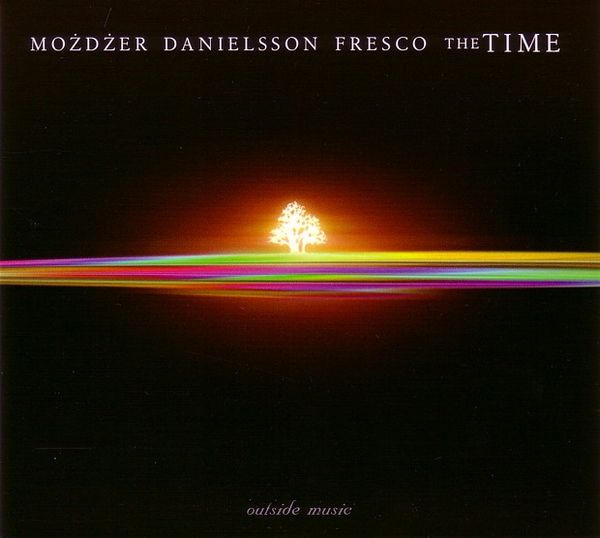
The Time

Polish pianist and composer Leszek Możdżer, best known for his solo re-imaginings of Chopin (released 1994 on Polonia Records), has since 2005 carved into the soil of jazz a significant river in trio with bassist Lars Danielsson and percussionist Zohar Fresco. The Time represents the group’s first studio outing, and the results are nothing short of enchanting. With a blend of lyricism and space that should appeal to fans of ECM’s many European traversals, Możdżer and Company put their all into every tune.

Among those tunes, Danielsson’s provide the skeleton. “Asta” opens the disc in David Darling-like reverie, Fresco’s wordless vocals floating in the spirit of Per Jørgensen, a swath of pollen fanning into open air. With a rare stillness of heart and transcendent core, the trio emotes without any discernible force of thought. Distillations of “Asta” appear twice more throughout the album, each a fantastic reflection, a film caught in repeat. “Suffering” laces muted pianism with cello pizzicati from the composer in a web of teardrops. The disc ends with an outtake of this same track, the laughter of which betrays a light and free spirit behind the shadows.

“Incognitor” is the first track by Możdżer. Along with “Easy Money,” it is among his best-known compositions, and pushes the trio paradigm into the wonders of letting go. Możdżer further displays great faculty for eclecticism, as in the tessellation of “Tsunami,” which twists gentle arcs and Byzantine touches in a helix of calm. The title track, co-written with Fresco, runs with scissors in one hand and, in the other, a page torn from the book of Nik Bärtsch’s Ronin. A likeminded jam aesthetic imbues the trio’s take on “Svantetic.” This one, by the great Krzysztof Komeda, reveals the influence of Tomasz Stanko, with whom Możdżer has worked in the past. It is notable proof of Fresco’s touch as he sets his planets around a sun-spotted center. Both tunes are puzzles of insight.

Also insightful is the band’s rendition of the Nirvana classic “Smells Like Teen Spirit.” What with the sonorous inner secrets from Danielsson and Możdżer’s deft tracings, the angst of the original melts into a shadow of its former self, even as Fresco’s hand percussion skirts the edges of seizure. Like the wave of clarity that follows a period of suffering, it turns tragedy into a triumph of the spirit.

Majamisty TriO: Mistyland

Mistyland

Pianist Maja Alvanovic, bassist Ervin Malina, and drummer Istvan Cik, known together as the Majamisty TriO, forge a path through the jazz landscape every bit as thoughtful as any of their European contemporaries. Alvanonic draws on her classical foundations—this debut was indeed reissued by Maple Grove Music Productions, a classical outfit out of the band’s native Serbia—for an intensely lyrical, at times somber, but ever-gorgeous sound.

All of the tunes on Mistyland owe origin to Alvanovic’s pen, except for the Brazilian-flavored “Happy Love Song” (by her father Blaza Alvanovic) and Errol Garner’s evergreen “Misty,” which at her fingertips becomes a piece of exponential crystal, with two beginnings for every ending. Crafting bright, optimistic melodies is Alvanovic’s strong suit, as is clear in “Landscape.” The album’s opener combines the gentle propulsions of her keyboarding with a wing-clipped rhythm section. Much of what follows is similarly evocative, throwing heads back in the revelry of clever rhythm changes and turns of phrase. Heartfelt ballads (“She Said…”) share breath with the minor-inflected curls of “The Tear” toward locomotive destinations (“Tuesday”), traversing airbrushed borders between waking and sleeping along the way. This emotional Rubik’s cube is at one moment sweeping and cinematic (“With You”), the next decidedly classical in scope, as in the Satie-esque “Waltz for Sofija.”

Majamisty
(Photo credit: Sinisa Ponjevic)

Alvanovic’s compositions, however, further allow the album’s only questionable inclusion: that of guest vocalist Aleksandra Drobac, who treats her voice like a fourth instrument, wordless and melodic, in tracks such as “Lullaby for Iva” and “Red Like.” As lovely as her voice is on its own, it adds little to the trio’s already-verdant sound, making it feel rather like an impressionist rendering every single leaf of a tree when only a few indicative strokes are needed. That said, after a few listens it becomes easier to feel Drobac’s colors blending into the rest, so that by then they begin to seem parts of the whole.

Improvisationally speaking, this is by no means a risky album, but in that respect provides vast comfort through its artful virtuosity. Alvanovic and her bandmates hold their own in an industry flooded with trios. Their vessel sails true with an attention to melodic detail known well by ECM listeners, for whom Mistyland might very well constitute a positive discovery.

(To preview the entire album, click on over to the band’s website here.)

Rim Banna review for RootsWorld

My latest review for RootsWorld online magazine is by Palestinian singer Rim Banna, who explores an all-inclusive message in delicate political times. This one boasts a couple of ECM connections. It is arranged and produced by Bugg e Wesseltoft, who has appeared on albums by Terje Rypdal, Jan Garbarek, Arild Andersen, and Sidsel Endresen. It also features guitarist Eivind Aarset in a characteristically atmospheric role. Click the cover to read my review and hear samples of the album.

Rim Banna