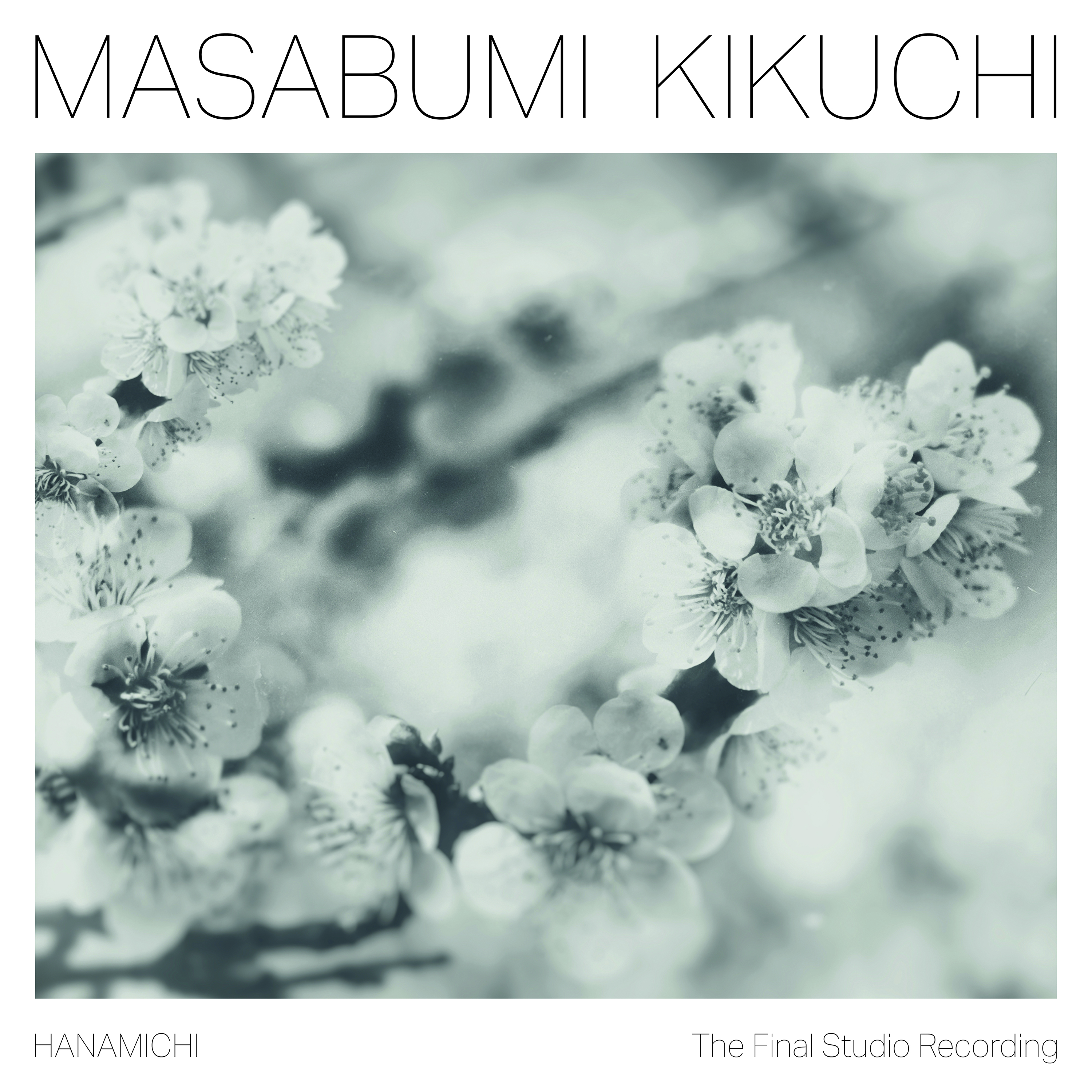
Masabumi Kikuchi: Hanamichi – The Final Recording Vol. II

Red Hook Records began its journey with pianist Masabumi Kikuchi’s final studio recording, and now, for the label’s eighth release, we are given more of a revelation than a sequel. If that first album was a door half open, this one is the room beyond it: dimly lit, shadows stretching toward us with quiet familiarity. Drawn from the same December 2013 sessions, these seven tracks seem to have steeped longer in the vessels of memory and time. They arrive seasoned by the sort of emotional oxidation that turns recollection into something rarer and more useful. If saving the best for last were a novel, then this album would not simply be the final chapter; it would be the codex hidden in the spine, the annotation that changes the tone of everything preceding it.

The standards here were formative ones in Kikuchi’s student days, and he approaches them as an elder returning to the foundational texts of his own becoming. They are less songs than mirrors that have aged with him, warped by years of touching, of looking, and of looking away.

“Manhã de Carnaval,” for instance, unfolds as a dream freshly slipped from its cocoon. Kikuchi walks tenderly across its terrain, each step testing the integrity of a world that seems to be forming beneath him even as he treads it. There is the sense of waking from a coma, unsure of what has changed most: the world outside, or the one within. As he coaxes the theme into coherence, it resembles memory grafting itself onto the present. Notes reach upward as fingertips toward a moon that has watched over him for decades, asking silent questions about the knots forming in the threads of existence below.

This pathos is his signature, and it reveals itself early, already pulsing under the surface of “Alone Together,” in which confidence is not announced but revealed slowly, the way a photograph emerges through chemical baths. Kikuchi does not so much play the tune as breathe through it. By the time we arrive at “I Loves You, Porgy,” the emotional stakes have deepened. The opening chords blush across time as if receiving a first kiss from a future that will never fully arrive. He settles into its changes with a kind of practiced vulnerability, proving that tenderness need not be fragile. His quietude carries drama the way a lantern carries flame, not ostentatiously but with an understanding of its purpose.

“My Ship” drifts into view as if slowed by the gravitational pull of recollection. Time is not a river but a weight, and living requires the steady muscle of acceptance. The ship does not simply approach; it gathers the currents of decades, reminding us that history is not always something the world gives us but grows in the chambers of the heart.

Faro-shuffled into these standards are three improvisations, astonishing in their immediacy and yet strangely timeless. As Ben Ratliff so beautifully puts it in his liner notes, they “can sound like instant ballads from another planet,” and together they form a kind of secret autobiography, spoken in a language only the subconscious fully understands. The first of them, “Improvisation II,” opens the door with a dark playfulness, as though Kikuchi were tugging at the piano’s hidden wiring, testing where resistance might give way to confession. What at first sounds abstract begins to gather logic the longer one listens. In “Improvisation III,” the music flips itself inside out. Small fragments swell into whole lifetimes, while emotional atoms compress into diamonds of feeling that shimmer before being tossed into the river of time. “Improvisation IV” climbs stairways within stairways, each gesture reaching for a rung made of breath and hesitation. A rhythm struggles to be born, faltering yet fiercely sane, as though meaning rises from the very fractures that threaten to undo it.

What is ultimately astonishing about this album is that it never feels tired or cynical, never weighted by the knowledge that these would be among his final recorded breaths. Instead, it is a witness: someone channeling truth in the moment, as though the body knows something that words and plans and even melodies cannot fully grasp. This is not farewell music. It is presence music, created by a human being who understands that honesty requires discipline.

To listen to this album is to feel the pulse of time through someone else’s fingertips, understanding at last that the deepest truths are not contained in beginnings or endings, but in the trembling line that connects them. In these tender and fractured meditations, Kikuchi offers not closure but permeability. The circle remains open, as all living circles do, inviting us to step through and find ourselves changed on the other side. Artistic life begins where the tape stops.

Amina Claudine Myers: Solace of the Mind

Even as the world churns in its ceaseless kaleidoscope of beginnings and erasures, Amina Claudine Myers sits at her solitary piano like a witness to the secret continuity beneath all ruptures. Her inner flame neither wavers nor consumes. It hovers, steady as a lantern held by an ancestor who has patiently waited for us to open the door. In this solo offering, recorded at 81 years young, she extends a topography of intimacy where every listener may stake a claim not of ownership but of belonging. It is a home carved from the psychic sediment of music made in real time. “African Blues” rises first, a kind of invocation to the heart’s memory of itself. Its anthemic pulse thins the veils between the seen and the felt until the blood remembers how to sing. “Song for Mother E” unfurls in response, sculpted yet unbounded, a river reasoning with its own flow. It reminds us that every emotion is both a tributary and a delta of something older than the body that hosts it. Here, her church roots shimmer not as dogma but as archeology. Layers of hymnody and gospel slough their husks to reveal a holiness that needs no altar. It is a spirituality so egalitarian it could only have been shaped by hands that labored long to mend the broken lens of the world with the glue of lived experience. Her “Hymn for John Lee Hooker” becomes a wandering morality, touching the past like a finger trailing over photographs saved from a burning house. The American spiritual “Steal Away” drips from her like baptismal water that refuses to dry, anointing with the trembling newness of a spirit freshly called. Her original pieces, nearly all of them windows cut into the architecture of her being, span a spectrum of interior climates. In “Ode to My Ancestors,” her Hammond B3 hums like a memory engine as she speaks of the lineage that built her path, hand upon weathered hand. Each uttered reflection is a stepping-stone laid. In “Voices,” the piano speaks in tongues older than language, delivering messages only the flesh understands. “Sensuous” enlarges the ears into satellite dishes that capture transmissions from the universe’s unanswered questions. It draws us into rooms of shadow and recollection where love’s contradictions bloom like crushed orchids—messy, fragrant, impossible to arrange without getting the fragrance on your fingertips. This ambiguity stretches further into “Twilight,” where starshine blurs into meteor-ghosts. Time loosens its grip, and even certainty forgets its name. “Cairo” offers points of reference that feel like déjà vu wearing new garments. “Beneath the Sun” tilts the face of the self upward, eyes closed, receiving the warmth of our nearest star as if gratitude were a gravitational force. Its chords unspool dissonance the way wisdom exudes suffering, letting each tension reveal its lesson. And though Myers’s personal history could indeed fill countless pages, tracing constellations of influence and expression, none of that is required to feel as though she is already kin. The moment we press play, we are confronted not with her story but with a shared stream of remembrance, carried by waters that have been flowing toward us long before we knew how to swim.

Bill Frisell/Kit Downes/Andrew Cyrille: Breaking the Shell

With Breaking the Shell, the sixth release from the groundbreaking Red Hook label, producer Sun Chung has offered not merely a trio but a quietly seismic realignment of possibility. Electric guitar (Bill Frisell), pipe organ (Kit Downes), and drums (Andrew Cyrille) form a constellation that feels, paradoxically, at once unprecedented and long familiar, like discovering a new moon only to realize its gravity has pulled our tides all along. Chung, having cultivated relationships with all three musicians through previous ECM projects, sensed a convergence before any of the participants could name it. As Philip Watson writes in his liner notes, the trio exists “in a deep state of not-knowing,” a phrase that might just as easily describe the listener’s condition of being suspended between recognition and estrangement.

Recorded at St. Luke in the Fields in New York’s Greenwich Village, the music bears the acoustics of a space built for a resonance of spiritual persuasion. Here, sound doesn’t merely travel outward but returns, circling back like a question that grows more meaningful the farther it wanders. The trio treads honestly without ever falling over, even as it allows trips and stumbles to become part of its gait. There is no fear of imbalance. Instead, there is trust in the materials of the moment. And while one could easily linger on the rare combo or the grandeur of hearing the pipe organ in a chamber-like setting, once the album begins, such considerations dissolve. The instruments become porous vessels for a collective intuition.

The opening track, “May 4th,” emerges in a slow-rolling fog, the organ releasing a detuned drone that tilts gently against the ear. Higher notes graze the air with the soft certainty of fingertips tracing an old, half-forgotten symbol. Frisell and Cyrille enter as if waking from the same dream, their gestures swelling and receding in a space where time loops back on itself. The music feels exploratory—not in the sense of searching for what is missing but in allowing what is already present to unfold without resistance.

From there, the trio slips into “Untitled 23,” a meditation that cycles through scenes like a zoetrope, each revolution shifting character just enough to remind us of the fragile illusions we call continuity. The trio invites the imagination to wander alongside them, not as spectators, but as co-conspirators in the act of making sense of the flickering.

The journey then turns extraterrestrial with “Kasei Valles,” named for the vast valley system etched across the Martian surface. The music reaches outward with similar breadth: Downes’s organ stretches into horizonless zones while Frisell’s guitar, distorted into an adventurous rasp, scratches the underbelly of atmosphere. One can almost sense distance itself, not only as measurement but as emotional terrain.

On “El,” cellist Lucy Railton joins the ensemble, her tone a shaded river cutting through the organ’s cathedral-like glow. The track breathes with the warmth of a melody as an offered hand rather than a distant signal. Cyrille’s brushes sketch spontaneous star paths, while Frisell’s detailing elicits messages whispered from within.

The mood deepens further with “Southern Body,” perhaps the album’s most quietly radiant piece. It is an earth swell of potential energy, the sound of something enormous choosing rest over detonation. Downes releases ocarina-like tones from the organ’s upper registers that seem to summon the wildness nestled in even the most domesticated corners of ourselves.

The first of two traditionals, “Sjung Herte Sjung,” arrives as a turning point. Translating from the Norwegian as “Sing Heart Sing,” it mirrors the ethos animating the entire project: a willingness to let the voice rise unforced. Frisell’s modal wanderings feel like steps taken along an ancient footpath, one that continues to reshape itself beneath each traveler.

Between these landmarks lie hints of discovery, including the swirling interplay of “Two Twins,” whose energies braid together like strands of DNA before dissolving in a delicately percussive fade. “July 2nd” is a drifting lantern, its tender, fluttering textures slipping briefly into an electronic-sounding mirage, as if a synthesizer were dreaming of being an organ, or vice versa.

Cyrille’s own “Proximity” appears near the album’s end, its tender-footed steps guided by the composer’s trademark sensitivity. The brushes move not to clear a path but to reveal it. Finally, another traditional, “Este a Székelyeknél” (“Evening in Transylvania”), closes the circle. Its Hungarian melody (one that passed under Bartók’s orchestrating hand) dissolves into the trio’s shared air, a cultural imprint carried forward not by preservation but by transformation.

By the end of Breaking the Shell, the title reveals its shape. What breaks is not the world but the hard surface of clinging to familiar forms. Frisell, Downes, and Cyrille do not present answers, nor do they ask us to seek them. Instead, they remind us that unknowing can be a place of shelter, and that music—when allowed to move through its players rather than be moved by them—can form a thematic circle in which every beginning contains its end, and every ending nods softly back to the beginning.

Here, in this luminous setting, the shell breaks not with force, but with attention. And what slips out feels like truth.

BlankFor.ms/Jason Moran/Marcus Gilmore: Refract

On Refract, electronic musician Tyler Gilmore (a.k.a. BlankFor.ms), pianist Jason Moran, and drummer Marcus Gilmore refuse the idea of a simple collaboration. Instead, they open their triad like a prism, splitting, bending, and rejoining light in ways that illuminate what music becomes when it learns to question its own edges. Their real-time explorations shatter the familiar, producing new angles of incidence and escape, each honed like a digital blade against the raw stone of acoustic touch. Tyler captures sounds as they appear, then manipulates and redeploys them as new organisms, refractions that remember their origins only in the way a rainbow remembers rain. It’s sound becoming itself by passing through itself. Using an inimitable array of degraded cassette tapes, analog synthesizers, and the tactile wisdom of his training at the New England Conservatory (where he studied with Jason), he brings physical materials to heel in service of apparitional textures. When producer Sun Chung first encountered these experiments, he discovered an irrepressible tension between fragility and force. The idea of being in a room with hard-hitting improvisers struck Tyler as both thrilling and terrifying. Jason and Marcus were invited, and suddenly the studio became a chamber of mirrored possibilities.

Before a single note was recorded, Sun and Tyler lingered in the long dawn of preparation, an apprenticeship to undetermined futures. Tyler laid out multiple pathways for the trio but held his expectations lightly, as gardeners do with unripe branches that might bear fruit or vanish into thin air. He offered fully formed pieces with melodic husks and harmonic marrow, skeletal sketches designed for wandering, and, above all, the spinning oracles of his tapes, each a prophecy split into new wavelengths.

The first sounds we hear come in “Onset I,” a beautiful wash of ambience, comforting and luminous, that meets the listener not with answers but with an invitation to dream without judgment. In this opening, where the glitch becomes the norm and coherence dissolves like a mirage, Jason’s pianism is pointillist and exploratory, fitful yet unguarded, as if tapping along the walls of an invisible room. Is the titular onset that of a seizure, a psychotic break, or a moment of long-awaited healing? The music refracts every interpretation, scattering our expectations into sympathetic fragments. Swirls of digital murmurations settle into sustained, lyrical pianism, hopeful despite the tremors, and without noticing, we find ourselves in “Onset II,” where subterranean beauty rises like musical lava. Tyler adds cryptic messages in plain earshot, flickering codes awaiting the translation of a dialogue that seems to recognize us even before we have learned how to listen.

The tender disorientation of this opening gives way to the warm, contoured intimacy of “Affectionate, Painful,” a track that feels like a kiss traded between piano and distorted inner hiccups. So much beauty and hope lie nestled in these woods, their branches bending with emotional weight. It pairs organically with “Inward, Curve,” a blossoming that moves into a fluent, jazzy ride of piano and drums, recalling the sheen of 1980s ECM while remaining unmistakably its own creature. These pieces feel more sculpted, guided by harmonic intention, though the electronic threading makes them seem strangely more organic—ironically so, given the circuitry at their core. Other pieces, however, arise from structures left intentionally open, vessels designed not to hold sound but to parse whatever light finds them.

Most of the album’s 16 tracks stem from the completely improvised tape loops—those fragile, flickering seeds in which the trio’s instincts seem most clearly aligned. From sputtering, almost vocal textures to interlaced patterns of tender repetition and meticulous drumming, each carves out a linguistic territory all its own. These passages examine surface texture across backward speech acts, elongated sustains, and distant echoes of time. They refract the notion of forward motion, making memory and immediacy exchange masks. At the album’s conclusion, “Tape Loop D” offers a particularly poignant elegy, polished just enough to shimmer. Its lyricism rises from the din of the city, swirling once more before sliding into an open manhole.

Amid these atmospheric passages comes the urban stride of “Eighth Pose,” the album’s most rhythmically grounded passage. Its pulse lays down a stretch of imaginary sidewalk, giving piano and drums room to catch their feet as they navigate back streets of unfamiliar harmony. Each swirl is another crack in the glass of the matrix. The music is phenomenal, not because it aims for spectacle but because it continually demonstrates how easily light can be fractured—and how beautiful the fracture becomes when treated with such care.

From here, the album breathes outward. “Stir” stretches a heartbeat into eternal song, a strip of empty road dissolving into the horizon. “Release” blossoms in suspended time, a long exhale after the chest has forgotten how to loosen. And “Little Known” closes this inner arc by turning a child’s secret thoughts inside out, shading them in charcoal and silver, a reminder that innocence contains shadows as complex as any adult confession.

And while echoes of Jon Hassell, Tim Hecker, Takagi Masakatsu, William Basinski, Aerovane, or Kettel may drift through the trees, these touchpoints evaporate almost as soon as they form. They are ephemeral reflections along a deeper pool, quickly lost in the forest of granulations that surrounds us. For Refract is not merely an album but an experience, one that holds us in its open palms and recalibrates the ears until they find their way.

PJEV/Kit Downes/Hayden Chisholm: Medna Roso

When using the word “inspire” today, we tend to think of it from an emotional perspective. If you look it up in a dictionary, however, you will find that it also means to inhale (think of it as a combination of “in” and “respire”). In that sense, the music documented on Medna Roso, the third and latest release on producer Sun Chung’s Red Hook Records, is inspired in the most physical way one could imagine. Recorded live at Cologne’s Agneskirche in the summer of 2021, and meshing the voices of Kit Downes (organ), Hayden Chisholm (alto saxophone, shruti box, analogue synthesizer, and throat singing), and Zagreb-based female vocal quintet PJEV, the program resituates songs from the Balkans, cultivating endangered traditions in the foreground of our attention in search of new growth.

Downes’s organ is firmament in which the album’s breaths flow from the pursed lips of invisible ancestors. The pipes, resonant and harmonic by virtue of their location, feel omnipresent—never close enough to touch yet never far enough to deny. What begins as a statement of heavenly creation reveals an earthly heart as PJEV churns the soil of “Listaj goro ne žali be’ara” (Bloom you mountain, don’t regret the blooming flowers). In combination with the subsequent “Ova brda i puste doline” (These hills and desolate valleys), it captures the carelessness of youth and the darker realities of adulthood. The titular landscapes and their features are the measures of a contemplation that pales in scope, always struggling to evoke the majesty of a universe so vast that, ultimately, death is required to comprehend it.

The ensuing journey takes us two steps inward for each outward. Through the solo strains of “Što si setna, nevesela” (Why are you sad and cheerless?) floating over a gong-like substrate, the haunting call and response of “Odkad seke nismo zapjevale” (Since when sisters, we haven’t sung), and the a capella “Službu služi viden dobar junak” (Been in service, a good hero), in which the singers hinge themselves in a massive temporal pivot, we can feel the immensity of things.

Connecting these songs are six instrumental interludes where the divisions of reed, metal, and breath melt in the crucible of singularity. The resulting alloy looks like silver, tastes like copper, sounds like gold. As with the throat singing that sometimes escapes Chisholm’s lips, it trembles in the presence of something formless. Settling beneath the weight of our transgressions, it takes shape in the listening while the terror and fury of nature, but also its quiet invitation, attune us for the time being—because time is only being.

Qasim Naqvi/Wadada Leo Smith/Andrew Cyrille: Two Centuries

Two Centuries is the second album from former ECM producer Sun Chung’s Red Hook label and may one day be regarded as its most defining release. As electronic musician Qasim Naqvi, trumpeter Wadada Leo Smith and drummer Andrew Cyrille put 11 of Naqvi’s tunes under their triangular microscope, the cells of our listening are magnified.

“For D.F.” opens with a political charge. Written for Darnella Frazier, who captured George Floyd’s murder, it uses distortions to evoke the white noise of our collective trauma. As subtle as this music is, with its near-comforting swells and honest lyricism, it offers not a moment of reflection but the reflection of a moment, a vivid gaze at a life lost on the brink of a society in turmoil. This is, perhaps, the deepest nuance of the titular centuries, the dividing line of which is drawn not numerically but on the shifting sands of justice.

What follows is a veritable tilling of melodies made possible as much through listening as playing. The foundation is often forged between Cyrille’s tools and Naqvi’s febrile choices of color. In fortifying each for harvest, they dip into disparate references. Hear, for example, the influence of Bryn Jones in “Sadden Upbeat,” while “Tympanic” recalls Sofia Gubaidulina’s String Quartet No. 4.

Contrasts in mood abound, ranging from sunlit (“Palaver”) to brooding (“Wraith”). “Bypass Decay” is of special note, chugging like a train against (and ultimately losing to) an encroaching night. Throughout, Smith speaks (e.g., “Spiritual is 150”) and sings (e.g., “Organum”) in equal measure, but always with a message to convey in the role of griot, reminding us of something spiritual, though severed from any particular tradition. As is evident in “Orion Ave,” where the free-floating hymn reigns supreme, faith walks these empty streets alone, trailing its shadow like a burden of care.

Masabumi Kikuchi: Hanamichi

Hanamichi is the final recording of Masabumi Kikuchi (1939-2015), a pianist whose fingers left indelible prints on many a keyboard. Produced by Sun Chung, a former ECM producer and now head of Red Hook Records (of which this is the debut release), the album drops like a stone into the ponds of our hearts. The resulting ripples take form as six tracks, yet it is in the unquantifiable rings of space between them that Kikuchi plants his notes as seeds for a crop that has outlived him. What distinguishes Kikuchi’s agricultural process is his refusal to prune away a single sunburnt leaf or dying plant. He takes care to describe those apparent imperfections as beauties in their own right because they are real, honest, and unmanufactured.

The not-quite-standard “Ramona” and the more-than-standard “Summertime” brim with such regard. The introductions to both breathe with a lived sense of geometry. Kikuchi tends to every stem like an ikebana master who works with his eyes closed. Just as the visual impact ceases to matter for one so accustomed to flowers, the sonic impact recedes for Kikuchi, who turns every contact of flesh and ivory into an emotional prelude beyond the confines of melody. His willingness and ability to capitulate to these moments come out of an understanding that intimacy has little to do with isolation but is just another name for connectivity. In the spirit of Paul Motian, the drummer with whom he played for more than two decades, the technical abilities required to evoke so much with so little are obscured. It is their shadows we encounter, if not also a hint of the light that casts them. He is the bird who flies for no other reason than to glorify the wind.

Unlike jazz players who unpack a thematic statement to expose hidden messages in even the most familiar tunes, Kikuchi reverse engineers them to unfamiliar origins. Two cases in point are his starkly different versions of “My Favorite Things.” Where the first molds nostalgia into a knotted internal dialogue of ringing chords, the second is the dream to its waking, performed in fearless slow motion. From these contemplations comes an “Improvisation,” which Kikuchi smooths into an altar for relatively percussive offerings.

“Little Abi,” a ballad he wrote for his daughter that was a cornerstone of his repertoire, concludes with a tear-inducing farewell. The pacing here is so cinematic that the listener cannot slide so much as a piece of paper between one movement and the next. How he accomplishes this while still allowing for so much breadth is unfathomable. A contradiction in words, to be sure, but an organic comfort in his sound.

To the details of said sound, Chung’s ears are lovingly matched, and Rick Kwan’s engineering seems to elucidate two inner songs for every outward one rendered. As in Kikuchi’s use of the sustain pedal, the recording team allows notes to inhale deeply before they exhale their songs into the ether. Thus, the studio functions as an extracorporeal lung—and perhaps by no metaphorical coincidence, given that the pianist had survived cancer of that very organ.

The term hanamichi (花道), literally “flower path,” is a Japanese idiom of kabuki theatrical origins that signifies an honorable end to one’s career. Listening to the session it titles, however, one could be forgiven for thinking of this as a beginning, given that final recordings are often new listeners’ entry point into the intangible wonders of great artists. Hence, the vintage Steinway on which he plays. While the family name is synonymous with world-class instruments, its literal meaning of “stone path” reveals another secret. The way of stone is an immovable trajectory from birth to death, raw and astonishing in its lack of repetition. All of which reminds us that every recording is a ghost of its creator, of whose soul we are but temporary hosts.